

物理化学学报 >> 2025, Vol. 41 >> Issue (3): 100021.doi: 10.3866/PKU.WHXB202311005
所属专题: 能源化学
林学宇1, 王瑞琦2,*( ), 董武杰3, 黄富强1,3,4,*()
收稿日期:2023-11-03
修回日期:2023-12-08
录用日期:2023-12-11
发布日期:2024-01-02
通讯作者:
Email: wangruiqi@ucas.ac.cn (王瑞琦)huangfq@pku.edu.cn (黄富强)
基金资助:
Xueyu Lin1, Ruiqi Wang2,*(), Wujie Dong3, Fuqiang Huang1,3,4,*()
Received:2023-11-03
Revised:2023-12-08
Accepted:2023-12-11
Published:2024-01-02
Contact:
Email: wangruiqi@ucas.ac.cn (Ruiqi Wang)huangfq@pku.edu.cn (Fuqiang Huang)
Supported by:摘要:
高能量密度、高功率密度的“双高”锂离子电池(LIBs)的实现依赖于创新突破高容量、高倍率及长循环寿命电极材料。插入型负极,以d0过渡金属氧化物为代表,含有强金属-氧键,表现出高循环稳定性和高倍率性能。然而,由于金属离子变价较少,其比容量相对较低。转化-合金型负极,以p区金属氧化物为代表,具备高理论比容量,但嵌锂过程中的相团聚和体积膨胀易导致容量快速衰减和倍率性能不佳。通过引入插入型或转化型功能基元构建双金属氧化物负极,可以优化电极中的电子/离子传导,从而改善循环性能和倍率性能,有望实现负极材料高容量、高倍率及长循环的统一。本文通过对各类金属氧化物中的化学键及电子结构特征进行分析,并提出一种新的图示表达方式,将负极锂离子插脱嵌的电化学反应储能过程表达为态密度(DOS)图示。文章阐述了双金属氧化物负极的多步储锂机制,并结合近期相关研究进展,为发展高容量、高倍率及高稳定的双金属化合物负极提供理论参考和实践依据。
林学宇, 王瑞琦, 董武杰, 黄富强. 高性能双金属氧化物负极的理性设计及储锂特性[J]. 物理化学学报, 2025, 41(3), 100021. doi: 10.3866/PKU.WHXB202311005
Xueyu Lin, Ruiqi Wang, Wujie Dong, Fuqiang Huang. Rational Design of Bimetallic Oxide Anodes for Superior Li+ Storage[J]. Acta Phys. -Chim. Sin. 2025, 41(3), 100021. doi: 10.3866/PKU.WHXB202311005
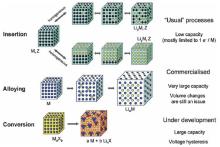
图1
"
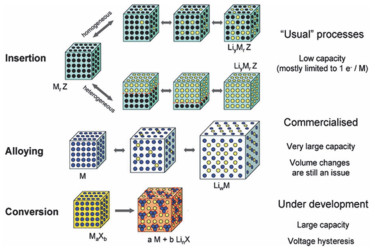
表1
"
| Litdium storage mechanism | Oxide | Theoretical specific capacity (mAh·g−1) | Potential (V vs. Li+/Li) | Advantages | Drawbacks |
| Intercalation type | TiO2 | 335 | 1.75 | High structure stability, small volume change during litdium insertion, long cycle life, and excellent rate performance | Low tdeoretical specific capacity, high potential, and high cost |
| Li2Ti3O12 | 175 | 1.55 | |||
| Nb2O5 | 202 | 1.63 | |||
| V2O5 | 294 | 3.30 | |||
| Conversion type | MnO | 756 | 1.25 | High tdeoretical specific capacity | High potential, large volume expansion during litdium insertion, low initial coulombic efficiency, high polarization voltage and low energy efficiency |
| Fe2O3 | 1007 | 1.70 | |||
| CoO | 715 | 1.85 | |||
| NiO | 718 | 2.20 | |||
| Alloying type | Si | 4200 | 0.35 | High tdeoretical specific capacity, low potential | Large volume expansion during litdium insertion, low initial coulombic efficiency |
| Ge | 1624 | 0.30 | |||
| Sn | 994 | 0.50 | |||
| Sb | 660 | 0.90 | |||
| In | 1012 | 0.70 |
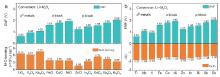
图2
"
图3
(a) Band structure schematic of intercalation-type TiO2 and (b) conversion-type NiO anodes during lithiation."
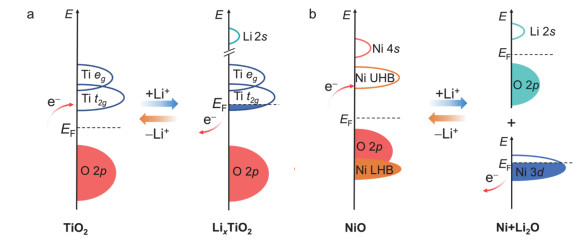
图4
"
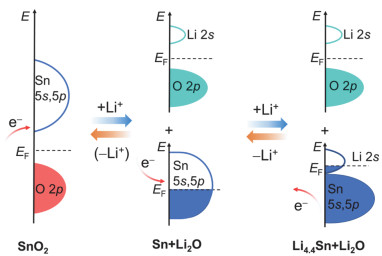
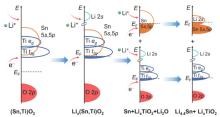
图5
"
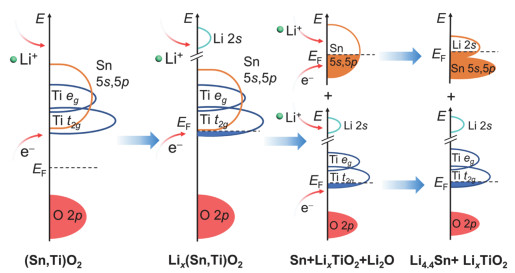
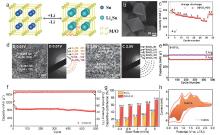
图6
"
图7
"
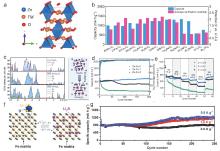
图8
(a) Crystal structure of spinel-type ZnTM2O4 64; (b) comparison of theoretical capacity and average Li+ extraction potential among several bimetallic oxides 57; (c) changes of density of states (DOS) from spinel-type Co3O4 to ZnCo2O4 by increasing Zn doping 64; (d) cycling performance of Zn1−xCoxO/ZnCo2O4 composite at 0.1 A g−1 64; (e) rate capability of Zn1−xCoxO/ZnCo2O4 composite 64; (f) schematic of lithium-storage mechanism for B2O3/Fe composite; (g) cycling performance of B2O3/Fe composite at 0.5, 1, and 2 A g−1 67."
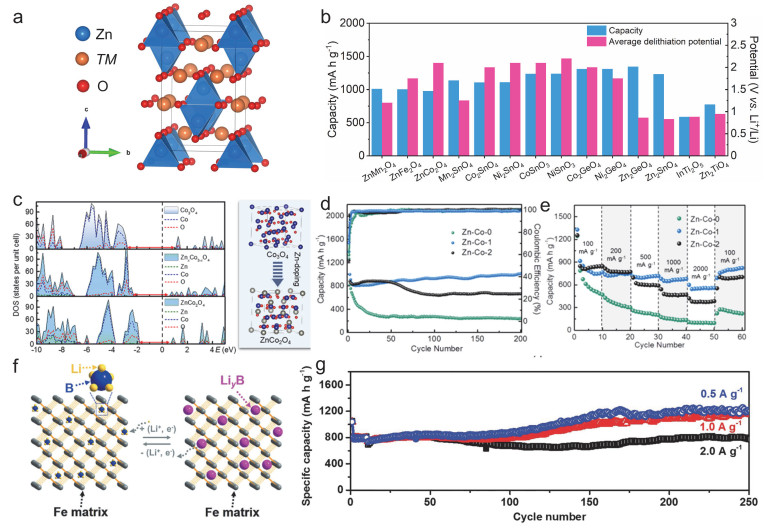
图9
"
图10
"
图11
"
| 1 |
doi: 10.1002/aenm.202101650 |
| 2 |
doi: 10.3866/PKU.WHXB202204057 |
|
丁晓博; 黄倩晖; 熊训辉; 等. 物理化学学报, 2022, 38, 2204057.
doi: 10.3866/PKU.WHXB202204057 |
|
| 3 |
doi: 10.1021/acsami.6b04239 |
| 4 |
doi: 10.1038/s41560-018-0107-2 |
| 5 |
doi: 10.1016/j.enchem.2020.100045 |
| 6 |
doi: 10.1021/cr3001884 |
| 7 |
doi: 10.1002/aenm.201402225 |
| 8 |
doi: 10.1021/acsami.5b03395 |
| 9 |
doi: 10.1021/nl504038s |
| 10 |
doi: 10.1039/c4cp00855c |
| 11 |
doi: 10.1039/B819629J |
| 12 |
doi: 10.1002/aenm.201601825 |
| 13 |
doi: 10.1149/2.040405jes |
| 14 |
doi: 10.1016/j.jpowsour.2017.03.007 |
| 15 |
doi: 10.1039/C3TA13352D |
| 16 |
doi: 10.1039/C9TA03551F |
| 17 |
doi: 10.1039/D1EE02664J |
| 18 |
doi: 10.1039/C0JM03132A |
| 19 |
doi: 10.1016/j.jpowsour.2017.06.023 |
| 20 |
doi: 10.1007/s41918-018-0001-4 |
| 21 |
doi: 10.1002/adma.201805754 |
| 22 |
doi: 10.1039/C3TA01285A |
| 23 |
doi: 10.1039/C8CC03875A |
| 24 |
doi: 10.1021/acs.chemmater.7b03847 |
| 25 |
doi: 10.1039/c7cs00863e |
| 26 |
doi: 10.1002/ange.201811784 |
| 27 |
doi: 10.1016/j.jallcom.2015.01.292 |
| 28 |
doi: 10.1039/C2JM31364B |
| 29 |
doi: 10.1002/adfm.201802756 |
| 30 |
doi: 10.1016/j.jpowsour.2010.02.020 |
| 31 |
doi: 10.1039/C5TA00516G |
| 32 |
doi: 10.1021/acssuschemeng.7b01595 |
| 33 |
doi: 10.1016/j.chempr.2018.01.003 |
| 34 |
doi: 10.1038/natrevmats.2016.13 |
| 35 |
doi: 10.1021/acsenergylett.1c01145 |
| 36 |
doi: 10.1039/b919877f |
| 37 |
doi: 10.1002/smll.201903194 |
| 38 |
doi: 10.1021/acs.accounts.7b00487 |
| 39 |
doi: 10.1149/1.1801451 |
| 40 |
|
| 41 |
doi: 10.1021/jacs.0c02203 |
| 42 |
doi: 10.1002/smll.201904740 |
| 43 |
doi: 10.1002/adfm.201404348 |
| 44 |
doi: 10.1016/j.esci.2023.100158 |
| 45 |
doi: 10.1016/j.mser.2022.100713 |
| 46 |
doi: 10.1002/aenm.201902485 |
| 47 |
doi: 10.1002/adma.201700136 |
| 48 |
doi: 10.1039/C6TA05645H |
| 49 |
doi: 10.1039/C9TA13602A |
| 50 |
doi: 10.1002/anie.202004149 |
| 51 |
doi: 10.1016/j.cej.2019.03.020 |
| 52 |
doi: 10.1002/smtd.202000218 |
| 53 |
doi: 10.1002/smtd.201900231 |
| 54 |
doi: 10.1002/advs.202202026 |
| 55 |
doi: 10.1007/s40843-021-1783-0 |
| 56 |
doi: 10.1016/j.electacta.2016.08.022 |
| 57 |
doi: 10.1039/C6EE02346K |
| 58 |
doi: 10.1002/aenm.201502175 |
| 59 |
doi: 10.1002/smll.201905868 |
| 60 |
doi: 10.1002/adfm.201805723 |
| 61 |
doi: 10.1039/C7TA05798A |
| 62 |
doi: 10.1021/acsami.9b08539 |
| 63 |
doi: 10.3866/PKU.WHXB201612222 |
|
甄绪; 郭雪静. 物理化学学报, 2017, 33, 845d.
doi: 10.3866/PKU.WHXB201612222 |
|
| 64 |
doi: 10.1021/acsnano.8b00168 |
| 65 |
doi: 10.1039/C3TA13228E |
| 66 |
doi: 10.1016/j.jpowsour.2017.05.104 |
| 67 |
doi: 10.1002/adma.201801409 |
| 68 |
doi: 10.1016/j.xcrp.2022.101109 |
| 69 |
doi: 10.1039/C1CP22298H |
| 70 |
doi: 10.1016/j.electacta.2019.04.167 |
| 71 |
doi: 10.1039/C2EE21580B |
| 72 |
doi: 10.1021/am301664e |
| 73 |
doi: 10.1039/C9NR03641E |
| 74 |
doi: 10.1016/j.electacta.2016.07.076 |
| 75 |
doi: 10.1039/C5TA04175A |
| 76 |
doi: 10.1021/acsmaterialslett.2c00810 |
| 77 |
doi: 10.1002/adma.201603286 |
| 78 |
doi: 10.1016/j.jpowsour.2014.08.084 |
| 79 |
doi: 10.1039/C9TA11330D |
| 80 |
doi: 10.1149/1.3532037 |
| 81 |
Kwon, C.; Kim, H.; Toupance, T.; Jousseaume, B.; Campet, G.; Fluorine-Doped Tin Oxide Electrods for Lithium Batteries. In Fluorinated Materials for Energy Conversion; Elsevier: The Netherlands, 2005; p. 103.
|
| 82 |
doi: 10.1016/j.jpowsour.2017.07.024 |
| 83 |
doi: 10.1021/acsaem.1c01883 |
| [1] | 祝鑫彤, 曹斌, 闫崇, 唐城, 陈爱兵, 张强. 锂离子电池石墨负极包覆研究进展[J]. 物理化学学报, 2025, 41(9): 100096 - . |
| [2] | 宋亮亮, 梁颢严, 李顺清, 邱报, 刘兆平. 超高比能电池高锰富锂层状氧化物正极材料面临的挑战与解决策略[J]. 物理化学学报, 2025, 41(8): 100085 - . |
| [3] | 黄奥羽, 许君, 黄玉, 储圭, 王卯, 王黎丽, 孙永奇, 蒋臻, 朱晓波. 通过简单的浆料添加剂调整电极-电解液界面以实现稳定的高电压锂离子电池[J]. 物理化学学报, 2025, 41(4): 100037 - . |
| [4] | 郭宇, 黄志伟, 胡雨青, 李俊哲, 徐杰. 钠离子电池中铁基异质结构负极材料的最新研究进展[J]. 物理化学学报, 2025, 41(3): 100022 - . |
| [5] | 黄辰悦, 郑鸿飞, 秦宁, 王灿沛, 王利光, 陆俊. 单晶高镍三元正极材料:挑战与策略[J]. 物理化学学报, 2024, 40(9): 2308051 - . |
| [6] | 张景硕, 翟越, 赵子云, 何家兴, 魏伟, 肖菁, 吴士超, 杨全红. 锂离子电池硅基负极用功能粘结剂的研究进展[J]. 物理化学学报, 2024, 40(6): 2306006 - . |
| [7] | 李莹, 赵钰燊, 陈凯, 刘旭, 伊廷锋, 陈立锋. 高性能锂离子电池用N掺杂C-Sn交联纳米纤维自支撑电极的理性设计[J]. 物理化学学报, 2024, 40(3): 2305007 - . |
| [8] | 胡雪晨, 夏求应, 岳钒, 何欣怡, 梅正浩, 王金石, 夏晖, 黄晓东. LiNbO3负极薄膜电化学性能及全固态薄膜锂离子电池应用[J]. 物理化学学报, 2024, 40(2): 2309046 - . |
| [9] | 张思宇, 谷昆泓, 鲁兵安, 韩俊伟, 周江. 退役锂离子电池正极的湿法冶金回收工艺:可持续技术的进展与应用[J]. 物理化学学报, 2024, 40(10): 2309028 - . |
| [10] | 李琪, 黎平安, 刘泽通, 张佳辉, 张浩, 余维来, 胡先罗. 同轴静电纺丝构筑微/纳米结构隔膜与电极材料用于锂离子电池:从原理到应用[J]. 物理化学学报, 2024, 40(10): 2311030 - . |
| [11] | 鲁航语, 侯瑞林, 褚世勇, 周豪慎, 郭少华. 高比能锂离子电池层状富锂正极材料改性策略研究进展[J]. 物理化学学报, 2023, 39(7): 2211057 -0 . |
| [12] | 汪茹, 刘志康, 严超, 伽龙, 黄云辉. 高安全锂离子电池复合集流体的界面强化[J]. 物理化学学报, 2023, 39(2): 2203043 -0 . |
| [13] | 朱思颖, 李辉阳, 胡忠利, 张桥保, 赵金保, 张力. 锂离子电池氧化亚硅负极结构优化和界面改性研究进展[J]. 物理化学学报, 2022, 38(6): 2103052 - . |
| [14] | 杨越, 朱加伟, 王鹏彦, 刘海咪, 曾炜豪, 陈磊, 陈志祥, 木士春. 镶嵌于NH2-MIL-125 (Ti)衍生氮掺多孔碳中的花状超细纳米TiO2作为高活性和稳定性的锂离子电池负极材料[J]. 物理化学学报, 2022, 38(6): 2106002 - . |
| [15] | 莫英, 肖逵逵, 吴剑芳, 刘辉, 胡爱平, 高鹏, 刘继磊. 锂离子电池隔膜的功能化改性及表征技术[J]. 物理化学学报, 2022, 38(6): 2107030 - . |
|
||
