物理化学学报 >> 2025, Vol. 41 >> Issue (1): 100009.doi: 10.3866/PKU.WHXB202404042
综述 上一篇
锂离子电池Ni-Co-Mn基正极材料前驱体的形核调控及机制
左稼暄1,†, 张坤2,†, 王敬1, 李喜飞1,3,4,*( )
)
- 1 西安理工大学材料科学与工程学院, 先进电化学能源研究院, 西安 710048
2 格林美股份有限公司, 广东 深圳 518101
3 广东原能科技有限公司, 广东 佛山 528223
4 青海民族大学, 青海省纳米材料与技术重点实验室, 西宁 810007
-
收稿日期:2024-04-29修回日期:2024-06-11录用日期:2024-06-13发布日期:2024-11-27 -
通讯作者:Email: xfli@xaut.edu.cn (李喜飞) -
作者简介:†These authors contributed equally to this work.
-
基金资助:陕西省重点研发计划国际科技合作计划(2024GH-ZDXM-02); 佛山市科技创新团队(1920001004098); 青海民族大学校级PI团队资助项目
Nucleation Regulation and Mechanism of Precursors for Nickel Cobalt Manganese-based Cathode Materials in Lithium-Ion Batteries
Jiaxuan Zuo1, Kun Zhang2, Jing Wang1, Xifei Li1,3,4,*()
- 1 Institute of Advanced Electrochemical Energy, School of Materials Science and Engineering, Xi'an University of Technology, Xi'an 710048, China
2 GEM Co., Ltd., Shenzhen 518101, Guangdong Province, China
3 Guangdong Yuanneng Technologies Co., Ltd., Foshan 528223, Guangdong Province, China
4 Qinghai Provincial Key Laboratory of Nanomaterials and Nanotechnology, Qinghai Minzu University, Xining 810007, China
-
Received:2024-04-29Revised:2024-06-11Accepted:2024-06-13Published:2024-11-27 -
Contact:Email: xfli@xaut.edu.cn (Xifei Li) -
Supported by:the Key Research and Development Program of Shaanxi(2024GH-ZDXM-02); Foshan Science and Technology Innovation Team Project(1920001004098); University-level Principle Investigator (PI) team of Qinghai Minzu University

摘要:
三元正极材料具有较高的放电比容量、倍率性能和工作电压,成为锂离子电池正极材料代表之一。三元正极材料由前驱体经过嵌锂烧结拓扑转变而来,因此,前驱体材料直接决定了三元正极材料的电池性能。针对前驱体可控均匀沉淀需求和对共沉淀过程参数变化极度敏感特性,本综述首先阐述络合调控实现Ni、Co、Mn元素均匀共沉淀,及沉淀物过饱和度诱导溶液体系不同形核状态基本原理,其次从晶面择优生长结合溶解-再结晶模型讨论了前驱体一次颗粒和二次颗粒生长模式,最后从实际生产角度,基本涵盖共沉淀过程所有可调参数,并深入讨论了各种参数由低到高变化对共沉淀反应形核及前驱体材料理化性能的影响。本综述阐释的相关理论及规律可进一步延伸至富锂锰基前驱体、单晶用前驱体以及径向排列织构前驱体等高端产品研发。
引用本文
左稼暄, 张坤, 王敬, 李喜飞. 锂离子电池Ni-Co-Mn基正极材料前驱体的形核调控及机制[J]. 物理化学学报, 2025, 41(1), 100009. doi: 10.3866/PKU.WHXB202404042
Jiaxuan Zuo, Kun Zhang, Jing Wang, Xifei Li. Nucleation Regulation and Mechanism of Precursors for Nickel Cobalt Manganese-based Cathode Materials in Lithium-Ion Batteries[J]. Acta Phys. -Chim. Sin. 2025, 41(1), 100009. doi: 10.3866/PKU.WHXB202404042
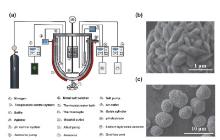
图1
"
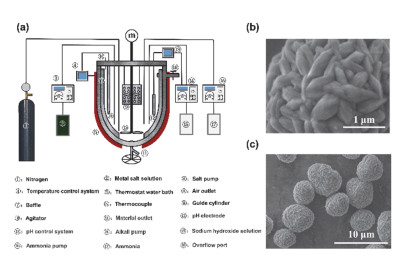
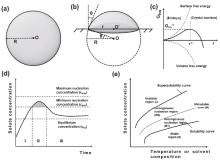
图2
"
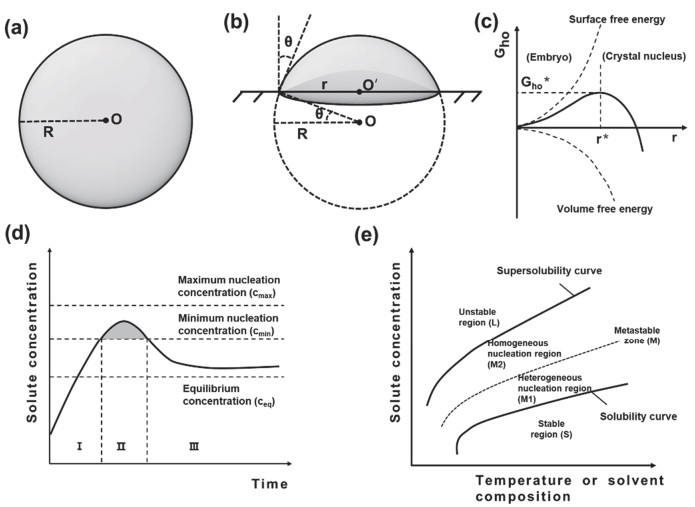
图3
"
图4
"
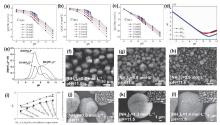
图5
"
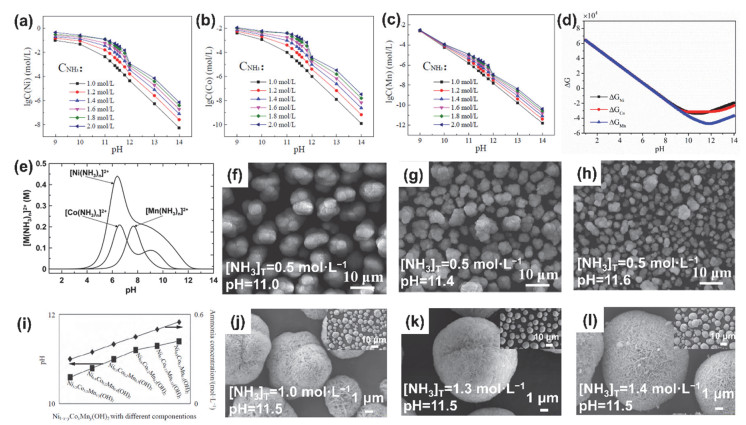
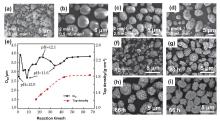
图6
"
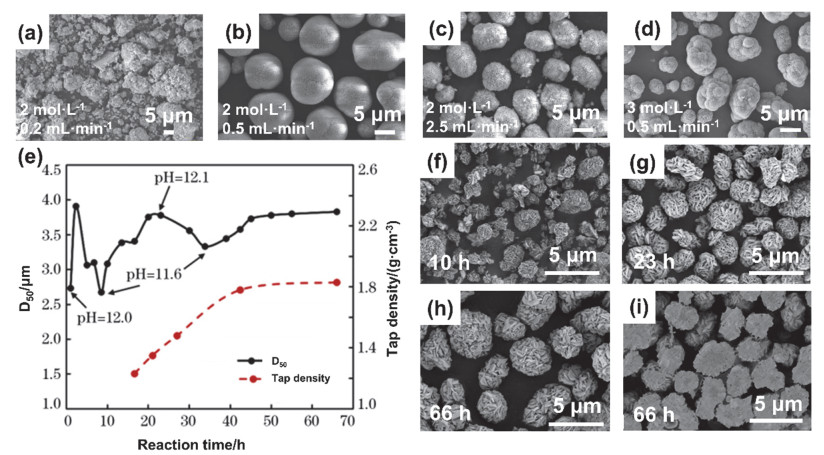
图7
"
图8
"
| 1 |
doi: 10.1002/aenm.202002027 |
| 2 |
doi: 10.1038/s41560-019-0513-0 |
| 3 |
|
|
张思东; 刘园; 祁慕尧; 曹安民. 物理化学学报, 2021, 37, 2011007.
doi: 10.3866/PKU.WHXB202011007 |
|
| 4 |
doi: 10.1039/d0ta01083a |
| 5 |
doi: 10.1021/acsenergylett.8b00805 |
| 6 |
doi: 10.1007/s41918-023-00206-5 |
| 7 |
doi: 10.1126/science.aba9168 |
| 8 |
doi: 10.1002/aenm.202101112 |
| 9 |
doi: 10.1039/b811802g |
| 10 |
doi: 10.1016/j.gee.2022.11.006 |
| 11 |
doi: 10.1007/s41918-022-00155-5 |
| 12 |
doi: 10.1021/acs.chemmater.7b05269 |
| 13 |
doi: 10.1016/j.nanoen.2024.109410 |
| 14 |
doi: 10.1002/adfm.202308152 |
| 15 |
|
|
吴锋; 李晴; 陈来; 王紫润; 陈刚; 包丽颖; 卢赟; 陈实; 苏岳锋. 物理化学学报, 2022, 38, 2007017.
doi: 10.3866/PKU.WHXB202007017 |
|
| 16 |
doi: 10.1007/s41918-022-00172-4 |
| 17 |
doi: 10.1021/acsaem.0c00803 |
| 18 |
doi: 10.1002/adma.202312292 |
| 19 |
doi: 10.1021/acsami.0c19493 |
| 20 |
doi: 10.1149/2.004302jes |
| 21 |
doi: 10.1016/j.jpowsour.2013.01.063 |
| 22 |
doi: 10.1016/j.jpowsour.2005.05.021 |
| 23 |
doi: 10.1002/adfm.202306654 |
| 24 |
doi: 10.1039/C6TA09921A |
| 25 |
doi: 10.1016/j.ensm.2020.01.027 |
| 26 |
doi: 10.1016/j.jpowsour.2013.09.064 |
| 27 |
doi: 10.1149/1945-7111/ad050b |
| 28 |
doi: 10.1016/j.electacta.2019.04.058 |
| 29 |
doi: 10.1002/smll.202107697 |
| 30 |
doi: 10.1016/S0378-7753(98)00182-7 |
| 31 |
doi: 10.1016/j.ces.2020.116337 |
| 32 |
doi: 10.1016/j.egyr.2022.06.110 |
| 33 |
doi: 10.1016/j.electacta.2004.07.038 |
| 34 |
|
|
胡赓祥; 蔡珣; 戎咏华. 材料科学基础, 第3版 上海: 上海交通大学出版社, 2016, 230- 236.
|
|
| 35 |
doi: 10.1016/j.nanoen.2023.109214 |
| 36 |
doi: 10.1021/ja01167a001 |
| 37 |
doi: 10.1016/S0022-0248(01)02284-9 |
| 38 |
doi: 10.1016/j.ceramint.2020.04.297 |
| 39 |
doi: 10.1016/j.electacta.2017.02.105 |
| 40 |
doi: 10.1016/j.jallcom.2014.08.152 |
| 41 |
doi: 10.1016/j.jpowsour.2014.01.064 |
| 42 |
Jiang, Y. P. Synthesis and Structure Optimization of LiNi0.8Co0.1Mn0.1O2 Nickel Rich Cathode Materials. M. S. Dissertation, Harbin Institute of Technology, Harbin, 2018.
|
|
姜云鹏. LiNi0.8Co0.1Mn0.1O2富镍三元正极材料的制备及结构优化[硕士学位论文]. 哈尔滨: 哈尔滨工业大学, 2018.
|
|
| 43 |
doi: 10.1021/cm803144d |
| 44 |
doi: 10.1021/acs.jpcb.8b12004 |
| 45 |
|
|
王鑫; 任莉; 王硕; 张燕辉; 左美华; 张军; 吕根品; 向伟. 复合材料学报, 2022, 39, 1995.
doi: 10.13801/j.cnki.fhclxb.20210922.001 |
|
| 46 |
doi: 10.1016/j.solidstatesciences.2023.107224 |
| 47 |
doi: 10.1016/j.jallcom.2018.10.057 |
| 48 |
doi: 10.1002/aenm.201803963 |
| 49 |
|
|
陈龙; 严雪枫; 李道聪; 杨茂萍; 夏昕. 金属功能材料, 2020, 27, 18.
doi: 10.13228/j.boyuan.issn1005-8192.202000006 |
|
| 50 |
Jia, X. B. Synthesis and Modification of LiNi0.5Co0.2Mn0.3O2 Cathode Material for Lithium Battery. M. S. Dissertation, Hainan University, Hainan, 2018.
|
|
贾孝波. LiNi0.5Co0.2Mn0.3O2三元正极材料的制备及其性能研究[硕士学位论文]. 海南: 海南大学, 2018.
|
|
| 51 |
Yan, C. Q. Study of Tap Density and Primary Particle of Ni-rich Ternary Material in Lithium Ion Battery. M. S. Dissertation, Harbin Institute of Technology, Harbin, 2015.
|
|
闫春秋. 锂离子电池富镍三元材料振实密度与一次颗粒研究[硕士学位论文]. 哈尔滨: 哈尔滨工业大学, 2015.
|
|
| 52 |
Xu, S. Study of Synthesis Amplification and Modification for Ni-rich Ternary Material in Lithium Ion Battery. M. S. Dissertation, Harbin Institute of Technology, Harbin, 2017.
|
|
徐晟. 锂离子电池富镍三元材料的合成放大化和改性研究[硕士学位论文]. 哈尔滨: 哈尔滨工业大学, 2017.
|
|
| 53 |
doi: 10.1016/j.electacta.2014.02.100 |
| 54 |
doi: 10.1016/j.ces.2008.03.035 |
| 55 |
|
|
王伟东; 仇卫华; 丁倩倩. 锂离子电池三元材料——工艺技术及生产应用, 第1版 北京: 化学工业出版社, 2015, 231- 232.
|
| [1] | 张玉亭. 醇对均匀胶体粒子形成的影响[J]. 物理化学学报, 1994, 10(01): 50 -53 . |
| [2] | 张玉亭;戴仲善. EDTA对均匀胶体粒子形成的影响[J]. 物理化学学报, 1993, 9(06): 728 -734 . |
| [3] | 张玉亭;于洺. 均匀球形α-Fe2O3胶体粒子的形成机理[J]. 物理化学学报, 1992, 8(06): 814 -818 . |
|
||