Acta Phys. -Chim. Sin. ›› 2026, Vol. 42 ›› Issue (7): 100212.doi: 10.1016/j.actphy.2025.100212
• ARTICLE • Previous Articles Next Articles
Transition metal-free poly(heptazine imide) photocatalyst for C–X bond construction from katritzky salts
Ying Wang, Mingcheng Yang, Zhu Yin, Yingqi Wang, Jiajia Cheng*( )
)
- State Key Laboratory of Chemistry for NBC Hazards Protection, State Key Laboratory of Photocatalysis on Energy and Environment, College of Chemistry, Fuzhou University, Fuzhou 350116, Fujian Province, China
-
Received:2025-09-15Revised:2025-10-26Accepted:2025-10-26Published:2026-05-22 -
Contact:Email: jjcheng@fzu.edu.cn (Jiajia Cheng)

Cite this article
Ying Wang, Mingcheng Yang, Zhu Yin, Yingqi Wang, Jiajia Cheng. Transition metal-free poly(heptazine imide) photocatalyst for C–X bond construction from katritzky salts[J]. Acta Phys. -Chim. Sin. 2026, 42(7), 100212. doi: 10.1016/j.actphy.2025.100212
share this article
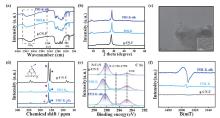
Fig 1
Structural characterization of carbon nitride-based photocatalysts. (a) FT-IR spectra, (b) PXRD patterns, (c) HR-TEM image, (d) Solid-state 13C NMR spectra, (e) XPS spectra, and (f) ESR spectra of the prepared samples under dark conditions."
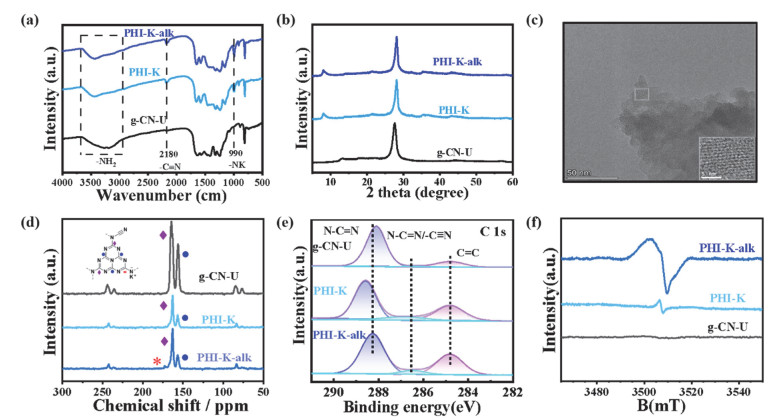
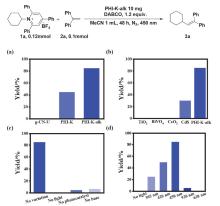
Fig 2
Photocatalytic performance of PHI photocatalysts in deaminative coupling reactions. (a) Comparative catalytic performance of g-CN-U, PHI-K, and PHI-K-alk in the model reaction between cyclohexyl Katritzky salt 1a and stilbene 2a. (b) Performance comparison of PHI-K-alk with other heterogeneous photocatalysts. (c) Control experiments. (d) Wavelength-dependent reactivity of the reaction."
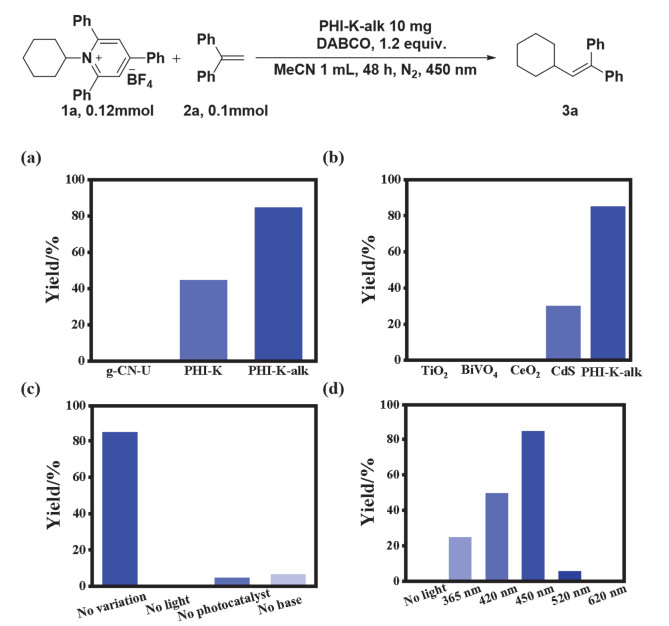
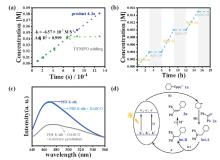
Fig 3
Mechanistic investigation of PHI-K-alk catalyst in the photocatalytic deaminative C–C coupling. (a) Reaction time profile and TEMPO radical trapping experiment over PHI-K-alk under the standard conditions, (b) Light on-off experiments, (c) Fluorescence quenching studies carried out by adding DABCO and Katritzky salt, (d) Possible reaction pathway for the reaction."
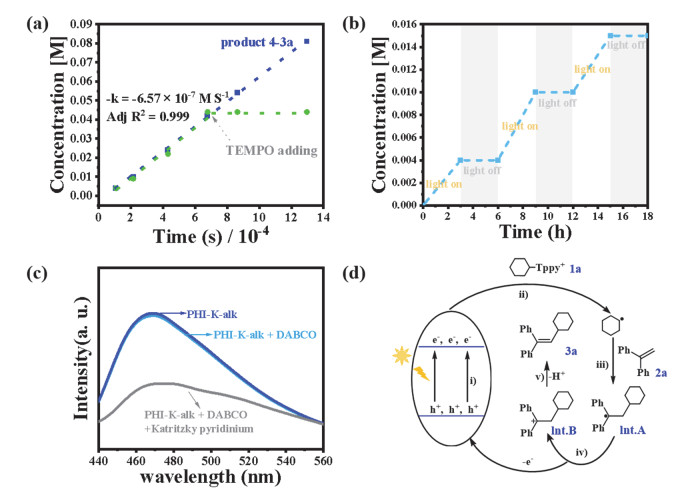
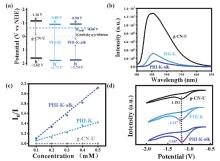
Fig 4
Photophysical properties of carbon nitride-based photocatalysts. (a) The schematic illustration of the semiconductor energy band structure, (b) Photoluminescence spectra, (c) Fluorescence quenching curves, and (d) Cyclic voltammetry measurements of g-CN-U, PHI-K, PHI-K-alk samples."
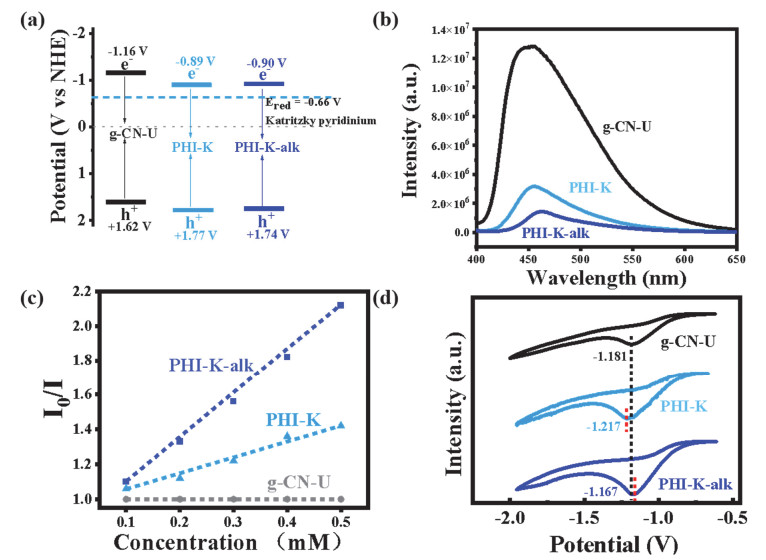
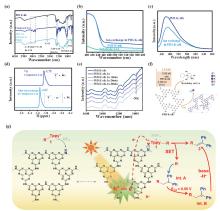
Fig 5
Catalyst-substrate interaction studies at the molecular level. (a) FT-IR spectra, (b) DRS spectra, (c) PL spectra, and (d) 11B NMR spectra of catalysts before and after ion exchange. (e) In situ IR spectroscopy of PHI-K-alk and substrate revealing significant shifts in N–K bonds upon 450 nm light illumination. (f) The energy change of the LUMO orbital of the catalyst before and after the addition of substrate 1a. (g) Schematic illustration of the proposed mechanism for the reaction."
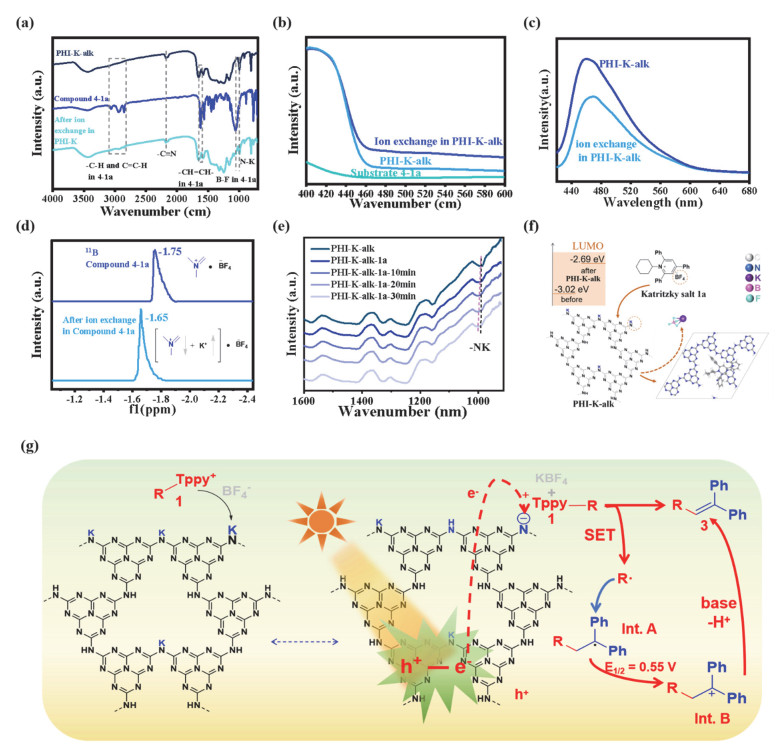
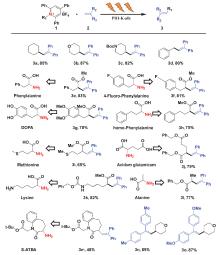
Fig 6
Substrate scope of Katritzky salt deaminative coupling with olefins. Reaction conditions: 1 (0.12 mmol), 2 (0.10 mmol), DABCO (0.12 mmol) and 10 mg PHI-K-alk in MeCN (1 mL) under N2 at room temperature for 48 h with a 3 W 450 nm LED. The yield refers to the isolated yield."
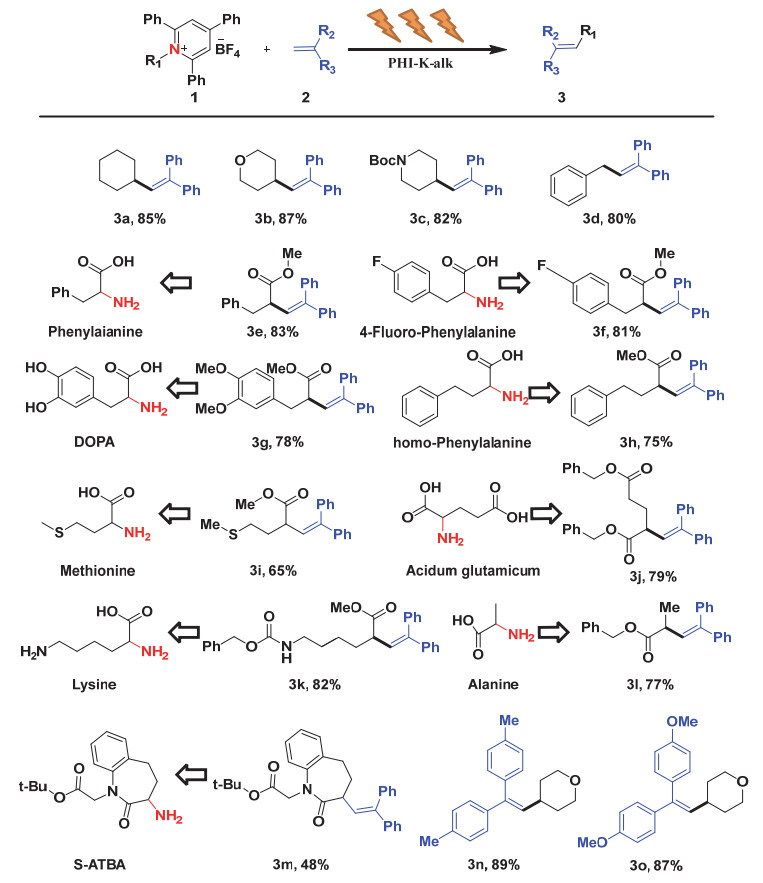
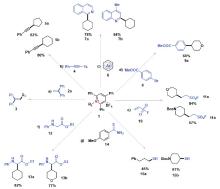
Fig 7
Synthetic applications of PHI-K-alk photocatalyst in deaminative coupling reactions. Reaction conditions: 1 (0.12 mmol), 2 (0.10 mmol), DABCO (0.12 mmol) and 10 mg PHI-K-alk in MeCN (1 mL) under N2 at room temperature for 48 h with a 3 W 450 nm LED. The yield refers to the isolated yield."
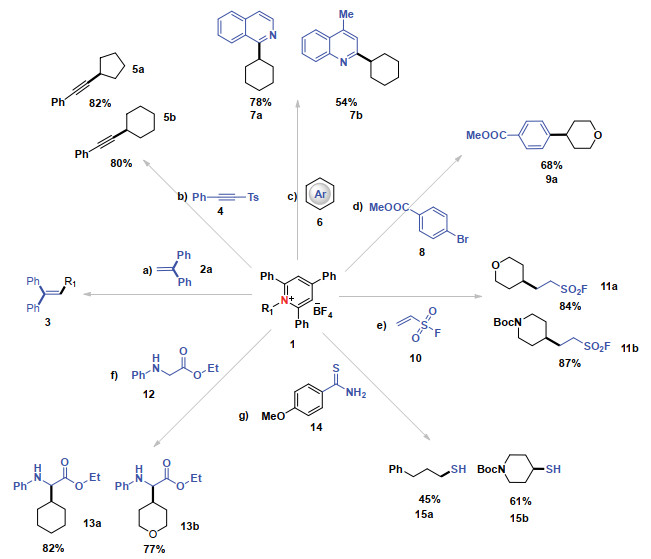
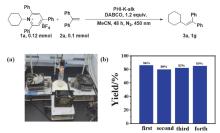
Fig 8
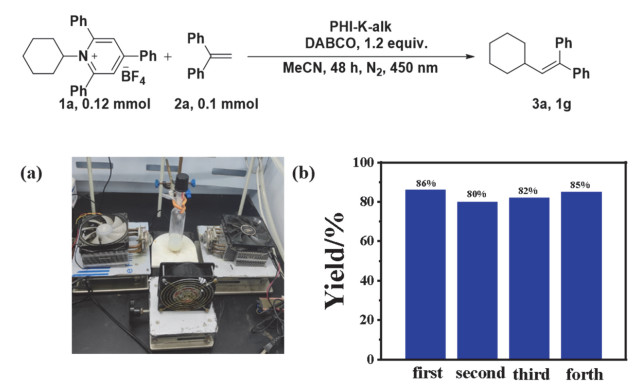
Scale-up capabilities and recyclability of PHI-K-alk photocatalyst. (a) gram-scale synthesis of product 3a. (b) Recycling experiments showing excellent stability of PHI-K-alk."
| 1 |
A. Mandal, M. Lim, L. Zhang, K. W. Huang, S. U. Dighe. ACS Catal. 2025, 15, 9976.
doi: 10.1021/acscatal.5c00343 |
| 2 |
Y. Jin, J. Wu, Z. Lin, Y. Lan, C. Wang. Org. Lett. 2020, 22, 5347.
doi: 10.1021/acs.orglett.0c01592 |
| 3 |
J. Min, Z. Zheng, S. Huang, R. He, Z. Xu, J. P. Bouillon, L. Xu. Green Synth. Catal. 2021, 2, 350.
doi: 10.1016/j.gresc.2021.09.003 |
| 4 |
W. Wei, H. Yu, A. Zangarelli, L. Ackermann. Chem. Sci. 2021, 12, 8073.
doi: 10.1039/D1SC00986A |
| 5 |
F. J. R. Klauck, M. J. James, F. Glorius. Angew. Chem. Int. Ed. 2017, 129, 12505.
doi: 10.1002/anie.201706896 |
| 6 |
Z. K. Yang, N. X. Xu, C. Wang, M. Uchiyama. Chem. Eur. J. 2019, 25, 5433.
doi: 10.1002/chem.201900886 |
| 7 |
R. Mészáros, A. Márton, M. Szabados, G. Varga, Z. Kónya, Á. Kukovecz, F. Fülöp, I. Pálinkó, S. B. Ötvös. Green Chem. 2021, 23, 4685.
doi: 10.1039/D1GC00924A |
| 8 |
P. Zhou, Y. Cai, Y. Tang. Org. Chem. Front. 2024, 11, 4624.
doi: 10.1039/D4QO00955J |
| 9 |
C. Huang, J. Wen, Y. Shen, F. He, L. Mi, Z. Gan, J. Ma, S. Liu, H. Ma, Y. Zhang. Chem. Sci. 2018, 9, 7912.
doi: 10.1039/C8SC03855D |
| 10 |
Y. Zhang, N. Hatami, N. S. Lange, E. Ronge, W. Schilling, C. Jooss, S. Das. Green Chem. 2020, 22, 4516.
doi: 10.1039/D0GC01187H |
| 11 |
H. Li, Y. Zhang, J. Tang, G. Huang, P. Cui, Q. Ke. Green Synth. Catal. 2023, 4, 293.
doi: 10.1016/j.gresc.2022.09.005 |
| 12 |
J. X. Wang, Y. T. Wang, H. Zhang, M. C. Fu. Org. Chem. Front. 2021, 8, 4466.
doi: 10.1039/D1QO00660F |
| 13 |
K. Wang, Y. Tian, B. Li, L. Wang, W. Gao, X. Jia, R. Wang, Y. Zhu, J. Chen. Green Synth. Catal. 2024, 5, 136.
doi: 10.1016/j.gresc.2022.06.006 |
| 14 |
M. Ociepa, J. Turkowska, D. Gryko. ACS Catal. 2018, 8, 11362.
doi: 10.1021/acscatal.8b03437 |
| 15 |
F. J. R. Klauck, H. Yoon, M. J. James, M. Lautens, F. Glorius. ACS Catal. 2019, 9, 236.
doi: 10.1021/acscatal.8b04191 |
| 16 |
M. Ren, X. Zhang, Y. Liu, G. Yang, L. Qin, J. Meng, Y. Guo, Y. Yang. ACS Catal. 2022, 12, 5077.
doi: 10.1021/acscatal.2c00427 |
| 17 |
S. Sha, Z. Yu, Y. Li, H. Xu, L. Dai, J. M. Cairney, W. Yang, Y. Li, S. Prucnal, S. Li, B. Liu, W. Li. Acta Mater. 2024, 281, 120389.
doi: 10.1016/j.actamat.2024.120389 |
| 18 |
N. N. Rosman, R. M. Yunus, N. R. A. M. Shah, R. M. Shah, K. Arifin, L. J. Minggu, N. A. Ludin. Int. J. Energy Res. 2022, 46, 11596.
doi: 10.1002/er.8001 |
| 19 |
G. A. A. Diab, I. F. Reis, C. Wang, D. Barreto, O. Savateev, I. F. Teixeira, P. Jiménez‐Calvo. Adv. Funct. Mater. 2025, 2501393.
doi: 10.1002/adfm.202501393 |
| 20 |
X. Chen, Y. Zhao, P. Liu, Z. Peng, F. Nemangwele, Z. Cheng, H. Lv, N. E. Maluta, Y. Huang, C. Han. Chem. Eng. J. 2025, 519, 164925.
doi: 10.1016/j.cej.2025.164925 |
| 21 |
Q. Liu, X. Han, A. Qian, J. Qian, X. Pu, L. Ye, J. Zhan, J. Zhang, Q. Yang, J. Liu. Small 2025, 21, 2407399.
doi: 10.1002/smll.202407399 |
| 22 |
C. Wang, Y. Lu, Z. Wang, H. Liao, W. Zhou, Y. He, S. M. Osman, M. An, Y. Asakura, Y. Yamauchi, L. Wang, Z. Yuan. Appl. Catal. B Environ. 2024, 350, 123902.
doi: 10.1016/j.apcatb.2024.123902 |
| 23 |
Y. Yang, W. Si, Y. Peng, J. Chen, Y. Wang, B. Zhou, J. Li. ACS Catal. 2023, 13, 14792.
doi: 10.1021/acscatal.3c03081 |
| 24 |
W. Li, Z. Wei, K. Zhu, W. Wei, J. Yang, J. Jing, D. L. Phillips, Y. Zhu. Appl. Catal. B Environ. 2022, 306, 121142.
doi: 10.1016/j.apcatb.2022.121142 |
| 25 |
S. Hou, X. Gao, X. Lv, Y. Zhao, X. Yin, Y. Liu, J. Fang, X. Yu, X. Ma, T. Ma, D. Su. Nano-Micro Lett. 2024, 16, 70.
doi: 10.1007/s40820-023-01297-x |
| 26 |
Q. Li, S. Zhao, B. Jiang, M. Jaroniec, L. Zhang. Mater. Today 2024, 80, 886.
doi: 10.1016/j.mattod.2024.09.019 |
| 27 |
S. Mo, X. Zhao, L. Huang, J. Zhou, S. Li, R. Peng, Z. Tu, L. Liao, Q. Xie, Y. Chen, Y. Zhang, D. Ye. Appl. Catal. B Environ. 2024, 342, 123435.
doi: 10.1016/j.apcatb.2023.123435 |
| 28 |
W. P. Shao, Y. Ling, H. Peng, J. Luo, Y. Cao, Y. Ran, J. Cai, J. Lv, B. Zhu, Y. Liu, et al.. J. Am. Chem. Soc. 2025, 147, 5703.
doi: 10.1021/jacs.4c13234 |
| 29 |
L. Li, E. A. Carter. J. Am. Chem. Soc. 2019, 141, 10451.
doi: 10.1021/jacs.9b04663 |
| 30 |
Y. Quan, R. Li, X. Li, R. Chen, Y. H. Ng, J. Huang, J. Hu, Y. Lai. Small 2024, 20, 2406576.
doi: 10.1002/smll.202406576 |
| 31 |
T. Jiang, Z. Wang, G. Wei, S. Wu, L. Huang, D. Li, X. Ruan, Y. Liu, C. Jiang, F. Ren. ACS Energy Lett. 2024, 9, 1915.
doi: 10.1021/acsenergylett.4c00623 |
| 32 |
X. Han, Y. Kang, S. Song, R. Lu, A. Yu. J. Mater. Chem. A 2023, 11, 18213.
doi: 10.1039/D3TA02887A |
| 33 |
M. Arif, A. Mahsud, A. Ali, S. Liao, J. Xia, H. Xiao, M. Azam, T. Muhmood, Z. Lu, Y. Chen. Chem. Eng. J. 2023, 475, 143458.
doi: 10.1016/j.cej.2023.146458 |
| 34 |
L. Fan, Z. An, Q. Xiao, X. Guo, Z. Jin. Appl. Catal. B Environ. 2025, 363, 124821.
doi: 10.1016/j.apcatb.2024.124821 |
| 35 |
D. J. Charboneau, H. Huang, E. L. Barth, C. C. Germe, N. Hazari, B. Q. Mercado, M. R. Uehling, S. L. Zultanski. J. Am. Chem. Soc. 2021, 143, 21024.
doi: 10.1021/jacs.1c10932 |
| 36 |
Z. Yang, Y. Zhang, H. Zhang, J. Zhao, H. Shi, M. Zhang, H. Yang, Z. Zheng, P. Yang. J. Catal. 2022, 409, 12.
doi: 10.1016/j.jcat.2022.03.016 |
| 37 |
W. Wang, Z. Shu, Z. Liao, J. Zhou, D. Meng, T. Li, Z. Zhao, L. Xu. Chem. Eng. J. 2021, 424, 130332.
doi: 10.1016/j.cej.2021.130332 |
| 38 |
C. C. Chen, J. J. Wu. ACS Appl. Energy Mater. 2022, 5, 9733.
doi: 10.1021/acsaem.2c01412 |
| 39 |
C. C. Chen, D. L. Tsai, H. T. Liu, J. J. Wu. ACS Sustain. Chem. Eng. 2023, 11, 6435.
doi: 10.1021/acssuschemeng.3c00363 |
| 40 |
D. V. Piankova, H. Zschiesche, A. P. Tyutyunnik, E. Svensson Grape, C. V. C. R. da Silva, W. G. Guimarães Junior, A. F. de Moura, I. F. Reis, G. A. A. Diab, J. B. G. Filho, et al.. Adv. Funct. Mater. 2025, e11389.
doi: 10.1002/adfm.202511389 |
| 41 |
H. Liu, B. Yang, G. Liao, B. Huang, J. Li, R. D. Rodriguez, X. Jia. Nat. Commun. 2025, 16, 5909.
doi: 10.1038/s41467-025-61185-3 |
| 42 |
Z. Zeng, H. Yu, X. Quan, S. Chen, S. Zhang. Appl. Catal. B Environ. 2018, 227, 153.
doi: 10.1016/j.apcatb.2018.01.023 |
| 43 |
Z. Zhao, J. Zhou, Z. Shu. Chem. Eng. J. 2022, 449, 137868.
doi: 10.1016/j.cej.2022.137868 |
| 44 |
O. Savateev, K. Nolkemper, T. D. Kühne, V. Shvalagin, Y. Markushyna, M. Antonietti. Nat. Commun. 2023, 14, 7684.
doi: 10.1038/s41467-023-43328-6 |
| 45 |
L. Yang, W. Zhou, M. Dou, X. Yue, Y. Hu, T. Lu, Y. He, Y. Du, A. Zhu, H. Yang, S. Lu, X. Chen. Adv. Funct. Mater. 2025, 35, 2500415.
doi: 10.1002/adfm.202500415 |
| 46 |
J. Ding, Z. Li, X. Chen, Y. Jiao, D. Yuan, W. Du, H. Wan, G. Guan. Green Chem. Eng. 2021, 2, 317.
doi: 10.1016/j.gce.2021.07.002 |
| 47 |
W. Wang, M. Jia, Z. Bi, X. Guo. Adv. Funct. Mater. 2025, 35, 2419182.
doi: 10.1002/adfm.202419182 |
| 48 |
X. Yu, S. F. Ng, L. K. Putri, L. L. Tan, A. R. Mohamed, W. J. Ong. Small 2021, 17, 2006851.
doi: 10.1002/smll.202006851 |
| 49 |
Q. Zhang, J. Liu, D. Wang, C. Jin, L. Fang, X. Li, Y. Jiang, X. Wang, C. Tian. Inorg. Chem. Front. 2025, 12, 5934.
doi: 10.1039/d5qi00668f |
| 50 |
J. A. Reddy, A. K. Lakshya, A. Chowdhury. J. Am. Ceram. Soc. 2024, 107, 5190.
doi: 10.1111/jace.19831 |
| 51 |
S. Park, S. Byun, H. Ryu, H. Hahm, J. Lee, S. Hong. ACS Catal. 2021, 11, 13860.
doi: 10.1021/acscatal.1c04281 |
| 52 |
C. Wang, B. Hu, X. Guo, L. Lei. Green Chem. 2024, 26, 6470.
doi: 10.1039/D4GC01025F |
| 53 |
M. Scherübl, C. G. Daniliuc, A. Studer. Angew. Chem. Int. Ed. 2021, 60, 711.
doi: 10.1002/anie.202012654 |
| 54 |
T. Dong, Y. Tang, G. C. Tsui. Org. Chem. Front. 2023, 10, 5092.
doi: 10.1039/D3QO01076G |
| 55 |
X. Li, S. Chen, Q. Liu, Y. Luo, X. Sun. Chem. Commun. 2021, 57, 8039.
doi: 10.1039/D1CC03011F |
| 56 |
Q. P. Huang, Y. Huang, A. J. Wang, L. Zhao, J. Jia, Y. Yu, J. Tong, J. Gu, C. Y. He. Org. Chem. Front. 2021, 8, 4438.
doi: 10.1039/D1QO00507C |
| 57 |
Z. Chen, G. Ding, Z. Wang, Y. Xiao, X. Liu, L. Chen, C. Li, H. Huang, G. Liao. Adv. Funct. Mater. 2025, 35, 2423213.
doi: 10.1002/adfm.202423213 |
| 58 |
L. Jiang, X. Yuan, Y. Pan, J. Liang, G. Zeng, Z. Wu, H. Wang. Appl. Catal. B Environ. 2017, 217, 388.
doi: 10.1016/j.apcatb.2017.06.003 |
| 59 |
F. Xi, L. Zhang, A. Cheng, H. Sun, Y. Qin, B. Yang, S. Zhang, J. Ma, X. Du, X. Meng. J. Colloid Interface Sci. 2025, 686, 1230.
doi: 10.1016/j.jcis.2025.01.183 |
| 60 |
T. Bhoyar, D. J. Kim, B. M. Abraham, S. Tonda, N. R. Manwar, D. Vidyasagar, S. S. Umare. Appl. Catal. B Environ. 2022, 310, 121347.
doi: 10.1016/j.apcatb.2022.121347 |
| 61 |
Y. Shi, P. Li, H. Chen, Z. Wang, Y. Song, Y. Tang, S. Lin, Z. Yu, L. Wu, J. C. Yu, X. Fu. Nat. Commun. 2024, 15, 4641.
doi: 10.1038/s41467-024-49005-6 |
| 62 |
C. Lu, X. Li, Q. Wu, J. Li, L. Wen, Y. Dai, B. Huang, B. Li, Z. Lou. ACS Nano 2021, 15, 3529.
doi: 10.1021/acsnano.1c00452 |
| 63 |
H. Ran, X. Liu, L. Ye, J. Fan, B. Zhu, Q. Xu, Y. Wei. J. Mater. Sci. Technol. 2025, 234, 24.
doi: 10.1016/j.jmst.2024.12.089 |
| 64 |
X. Shi, T. Song, Q. Li, X. Guo, Y. Yang. Org. Lett. 2022, 24, 8724.
doi: 10.1021/acs.orglett.2c03814 |
| 65 |
C. Wang, H. Xiao, Y. Lu, J. Lv, Z. Yuan, J. Cheng. ChemSusChem 2023, 16, e202300361.
doi: 10.1002/cssc.202300361 |
| 66 |
C. Wang, Q. Wan, J. Cheng, S. Lin, A. Savateev. J. Catal. 2021, 393, 116.
doi: 10.1016/j.jcat.2020.11.021 |
| 67 |
C. Wang, Y. Hou, J. Cheng, M.-J. Lin, X. Wang. Appl. Catal. B Environ. 2021, 294, 120259.
doi: 10.1016/j.apcatb.2021.120259 |
| 68 |
Z. Sun, Y. Tan, J. Wan, L. Huang. Chin. J. Chem. 2021, 39, 2044.
doi: 10.1002/cjoc.202000743 |
| 69 |
E. Zhao, L. Chen, Q. Zhu, Z. Chen, Y. Wei, W. Zhang, L. Dong, W. Fang, Z. Chen. Chin. J. Chem. 2023, 41, 3281.
doi: 10.1002/cjoc.202300329 |
| [1] | Yuan Xue, Yanjun Zhang, Jun Du, Zushun Xu, Guangfu Liao, Qing Li. Introducing dual-functional site on carbon nitride: steering carrier migration and O2 activation for boosted H2O2 photosynthesis [J]. Acta Phys. -Chim. Sin., 2026, 42(9): 100311-. |
| [2] | Xiaofei Zhang, Shanhao Xu, Zhiyuan Wang, Long He, Tiancheng Huang, Yongming Xu, Yucui Bian, Yike Li, Haijun Chen, Zhongjun Li. Surface doping of graphene into BiOCl for efficient photocatalytic amine coupling under visible light [J]. Acta Phys. -Chim. Sin., 2026, 42(5): 100202-. |
| [3] | Ziyi Xiao, Xinyi Ma, Linping Wang, Haobin Hu, Enzhou Liu. Efficient photocatalytic conversion H2S over NiS2/twinned-Mn0.5Cd0.5S Schottky/S-scheme homojunction in Na2S/Na2SO3 solution [J]. Acta Phys. -Chim. Sin., 2026, 42(4): 100171-. |
| [4] | Yanping Qiu, Jiatong Zhang, Linping Li, Yangqin Gao, Ning Li, Lei Ge. MOF-derived g-C3N4/ZnIn2S4 S-scheme heterojunction: interface-engineering enhanced photocatalytic NO conversion [J]. Acta Phys. -Chim. Sin., 2026, 42(4): 100175-. |
| [5] | Ze Luo, Yukun Zhu, Yadan Luo, Guangmin Ren, Yonghong Wang, Hua Tang. Photocatalytic selective oxidation of 5-hydroxymethylfurfural coupled with H2 evolution over In2O3/ZnIn2S4 S-scheme heterojunction [J]. Acta Phys. -Chim. Sin., 2026, 42(3): 100166-. |
| [6] | Yuhang Zhang, Yi Li, Yuehan Cao, Yingjie Shuai, Yu Zhou, Ying Zhou. Regulating the formation type by Ir of intermediates to suppress product overoxidation in photocatalytic methane conversion [J]. Acta Phys. -Chim. Sin., 2026, 42(2): 100173-. |
| [7] | Yu Liu, Pengfei Li, Yize Liu, Zaicheng Sun. Recent advances in carbon dots as a single photocatalyst [J]. Acta Phys. -Chim. Sin., 2026, 42(2): 100167-. |
| [8] | Chengxiao Zhao, Zhaolin Li, Dongfang Wu, Xiaofei Yang. SBA-15 templated covalent triazine frameworks for boosted photocatalytic hydrogen production [J]. Acta Phys. -Chim. Sin., 2026, 42(1): 100149-. |
| [9] | Shiyi Chen, Jialong Fu, Jianping Qiu, Guoju Chang, Shiyou Hao. Waste medical mask-derived carbon quantum dots enhance the photocatalytic degradation of polyethylene terephthalate (PET) over BiOBr/g-C3N4 S-scheme heterojunction [J]. Acta Phys. -Chim. Sin., 2026, 42(1): 100135-. |
| [10] | Fengying Zhang, Yanglin Mei, Yuman Jiang, Shenshen Zheng, Kaibo Zheng, Ying Zhou. Research progress of transient absorption spectroscopy in solar energy conversion and utilization [J]. Acta Phys. -Chim. Sin., 2025, 41(9): 100118-. |
| [11] | Menglan Wei, Xiaoxia Ou, Yimeng Wang, Mengyuan Zhang, Fei Teng, Kaixuan Wang. S-scheme heterojunction g-C3N4/Bi2WO6 highly efficient degradation of levofloxacin: performance, mechanism and degradation pathway [J]. Acta Phys. -Chim. Sin., 2025, 41(9): 100105-. |
| [12] | Jingping Li, Suding Yan, Jiaxi Wu, Qiang Cheng, Kai Wang. Improving hydrogen peroxide photosynthesis over inorganic/organic S-scheme photocatalyst with LiFePO4 [J]. Acta Phys. -Chim. Sin., 2025, 41(9): 100104-. |
| [13] | Jiajie Cai, Chang Cheng, Bowen Liu, Jianjun Zhang, Chuanjia Jiang, Bei Cheng. CdS/DBTSO-BDTO S-scheme photocatalyst for H2 production and its charge transfer dynamics [J]. Acta Phys. -Chim. Sin., 2025, 41(8): 100084-. |
| [14] | Lewang Yuan, Yaoyao Peng, Zong-Jie Guan, Yu Fang. Insights into the development of 2D covalent organic frameworks as photocatalysts in organic synthesis [J]. Acta Phys. -Chim. Sin., 2025, 41(8): 100086-. |
| [15] | Yu Wang, Haiyang Shi, Zihan Chen, Feng Chen, Ping Wang, Xuefei Wang. Hollow AgPt@Pt core-shell cocatalyst with electron-rich Ptδ− shell for boosting selectivity of photocatalytic H2O2 production for faceted BiVO4 [J]. Acta Phys. -Chim. Sin., 2025, 41(7): 100081-. |
|
||