Acta Phys. -Chim. Sin. ›› 2026, Vol. 42 ›› Issue (10): 100337.doi: 10.1016/j.actphy.2026.100337
• ARTICLE • Previous Articles Next Articles
Balancing photocatalytic efficiency and ecological safety: an S-scheme LaCoO3/PTP-DABDT heterojunction for "Kill-and-Clean" algal bloom control without secondary pollution
Yue Zhao1,2, Jie Zhang3, Mingcan Wu3,*( ), Li Zhao2, Anan Wang4, Kezhen Qi1,*()
- 1 College of Pharmacy, Dali University, Dali 671000, Yunnan Province, China
2 Ministry of Education Key Laboratory for the Green Preparation and Application of Functional Materials, Hubei Key Laboratory of Polymer Materials, Hubei Collaborative Innovation Center for Advanced Organic Chemical Materials, Hubei University, Wuhan 430062, Hubei Province, China
3 College of Agriculture and Biological Science, Dali University, Dali 671003, Yunnan Province, China
4 School of Economics and Management, Dali University, Dali 671003, Yunnan Province, China
-
Received:2026-04-08Revised:2026-06-01Accepted:2026-06-01Published:2026-09-03 -
Contact:Email: wmc@dali.edu.cn (Mingcan Wu)qkzh2003@aliyun.com (Kezhen Qi)

Cite this article
Yue Zhao, Jie Zhang, Mingcan Wu, Li Zhao, Anan Wang, Kezhen Qi. Balancing photocatalytic efficiency and ecological safety: an S-scheme LaCoO3/PTP-DABDT heterojunction for "Kill-and-Clean" algal bloom control without secondary pollution[J]. Acta Phys. -Chim. Sin. 2026, 42(10), 100337. doi: 10.1016/j.actphy.2026.100337
share this article
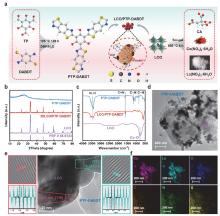
Fig 1
Synthesis and structural characterization of the LCO/PTP-DABDT heterojunction. (a) Schematic illustration depicting the synthesis route. The 2D PTP-DABDT supports are constructed from TP and DABDT monomers, followed by the integration of perovskite LCO nanoparticles derived from a sol-gel process. (b) XRD patterns confirming the coexistence of crystalline LCO and PTP-DABDT phases in the composite. (c) FT-IR spectra highlighting the characteristic C=N vibration of the PTP-DABDT linkage and Co–O bonds. (d) TEM image revealing the intimate contact between LCO nanoparticles and the PTP-DABDT. (e) HRTEM image of the heterojunction interface. The clear lattice fringes with interplanar spacings of 0.271 nm and 0.381 nm match the (110) and (012) planes of rhombohedral LCO, respectively. (f) STEM-EDS elemental mapping showing the homogeneous distribution of Co, La, O, C, N, and S elements throughout the composite structure."
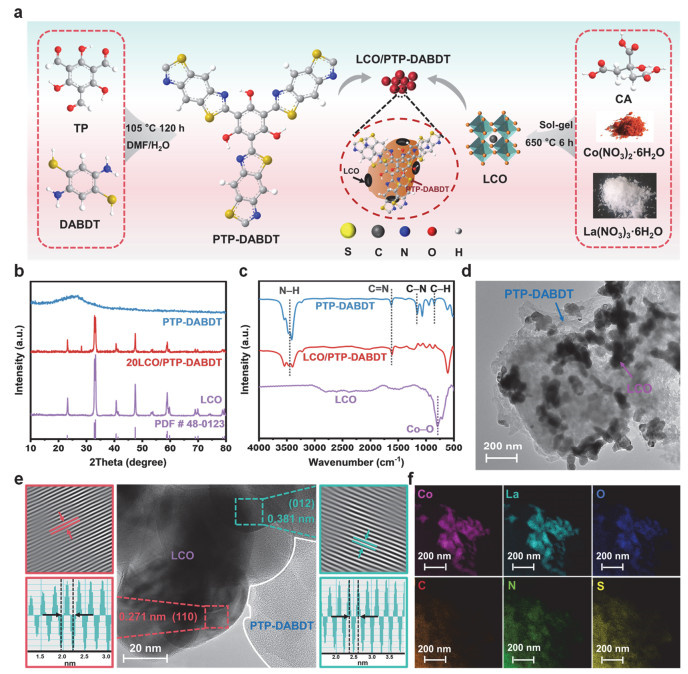
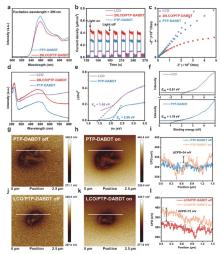
Fig 2
Optical properties, charge transfer dynamics, and band structure analysis. (a) Steady-state PL spectra (λex = 395 nm), where the significant fluorescence quenching in 20LCO/PTP-DABDT indicates inhibited radiative recombination of carriers. (b) Transient photocurrent responses and (c) EIS Nyquist plots, collectively confirming the most efficient charge separation and transfer in the heterojunction. (d) UV-Vis DRS spectra and (e) corresponding Tauc plots for band gap determination (Eg). (f) UPS VB spectra determining the VB edges relative to the Fermi level, located at binding energies of 0.81 eV for LCO and 1.76 eV for PTP-DABDT. Spatially resolved surface photovoltage characterization via KPFM: Surface potential maps of (g, h) pure PTP-DABDT and (j, k) the LCO/PTP-DABDT composite under dark and light irradiation. (i, l) The corresponding statistical analysis of contact potential difference (CPD). The larger CPD shift (ΔCPD) in LCO/PTP-DABDT (73 mV) compared to pure PTP-DABDT (34 mV) provides visual evidence of the enhanced driving force for photo-induced charge separation."
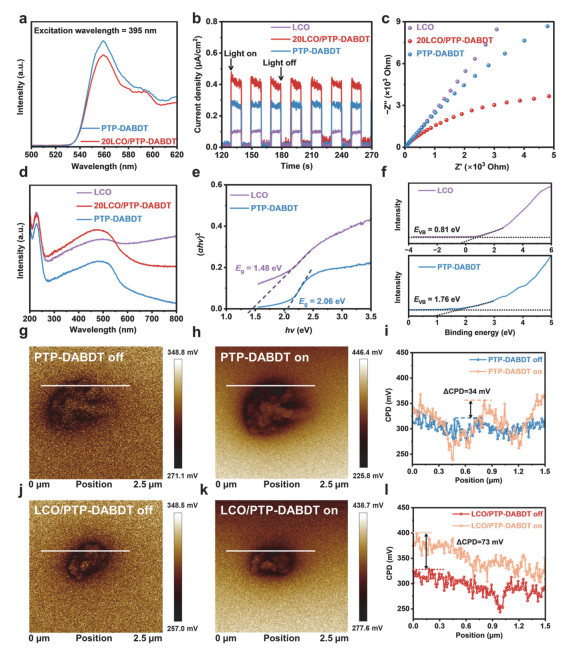
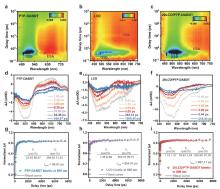
Fig 3
Ultrafast carrier dynamics and charge transfer mechanism analyzed by fs-TA spectroscopy. (a–c) Pseudo-color 2D contour maps of transient absorption intensity as a function of wavelength and delay time for PTP-DABDT, LCO, and 20LCO/PTP-DABDT (pumped at 400 nm). The blue regions indicate ground state bleaching (GSB), while red regions represent excited state absorption (ESA). (d–f) Transient absorption (ΔA) spectra at representative delay times, illustrating the spectral evolution of photogenerated carriers. (g–i) Normalized decay kinetics probed at the GSB maximum (500 nm) with corresponding multi-exponential fitting parameters. Notably, the 20LCO/PTP-DABDT heterojunction exhibits a significantly prolonged average carrier lifetime (ταve = 807.11 ps) compared to pure PTP-DABDT (55.57 ps) and LCO (684.03 ps), providing direct evidence for efficient charge separation and suppressed recombination."
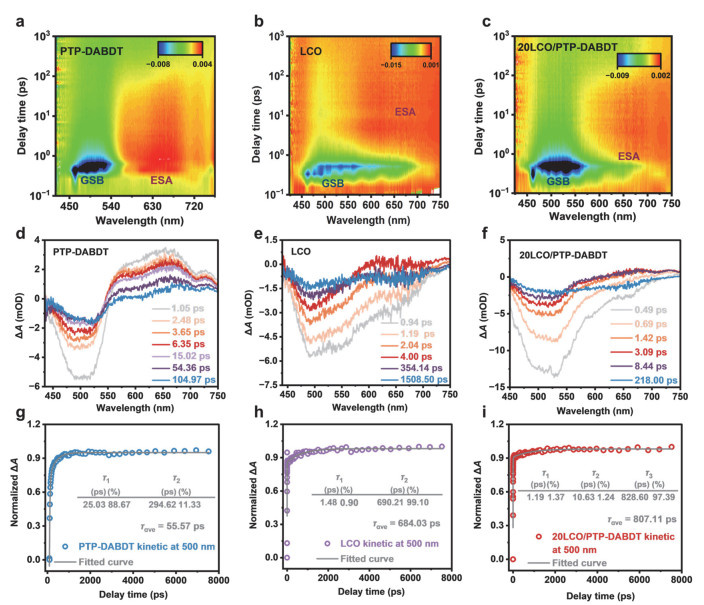
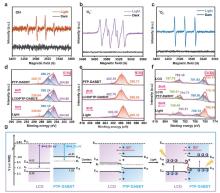
Fig 4
Identification of reactive oxygen species (ROS) and atomic-level verification of the S-scheme mechanism. (a–c) Electron paramagnetic resonance (EPR) spectra for the detection of ·OH, ·O2–, and 1O2 radicals using DMPO and TEMP as spin-trapping agents under dark and light irradiation. High-resolution in-situ irradiated XPS spectra of (d) C 1s, (e) N 1s, and (f) Co 2p. The comparisons between pure samples, the composite in the dark, and the composite under light irradiation reveal the electron density changes. Notably, the binding energy shift of N 1s to a lower value under light (402.76–402.28 eV) confirms the accumulation of photogenerated electrons on the PTP-DABDT surface. (g) Schematic illustration of the S-scheme charge transfer pathway. An IEF is established at the interface due to the work function difference (ΔΦ), driving the spatial separation of charge carriers where electrons and holes accumulate in the CB of PTP-DABDT and VB of LCO, respectively."
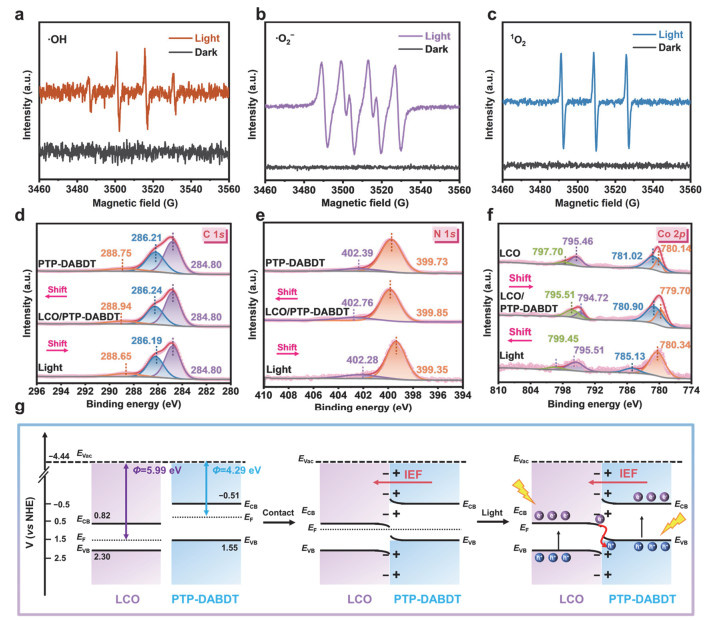
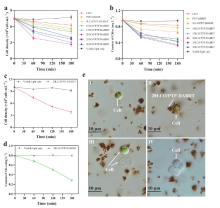
Fig 5
Photocatalytic inactivation performance and morphological evolution of M. aeruginosa. (a) Cell density and (b) Chl-a content reduction curves utilizing different photocatalysts under visible light, revealing that 20LCO/PTP-DABDT exhibits the optimal algicidal efficiency. Time-dependent inactivation kinetics of (c) cell density and (d) Chl-a content for the 20LCO/PTP-DABDT sample. (e) Microscopic observations tracking the cell death process: (Ⅰ) Intact cell with defined boundaries; (Ⅱ) Adhesion of 20LCO/PTP-DABDT aggregates onto the cell surface, initiating the attack; (Ⅲ) Loss of intracellular pigmentation and transparency indicating cytoplasm leakage; (Ⅳ) Final cell destruction characterized by membrane collapse and severe shrinkage. Data are presented as mean ± standard deviation (n = 3)."
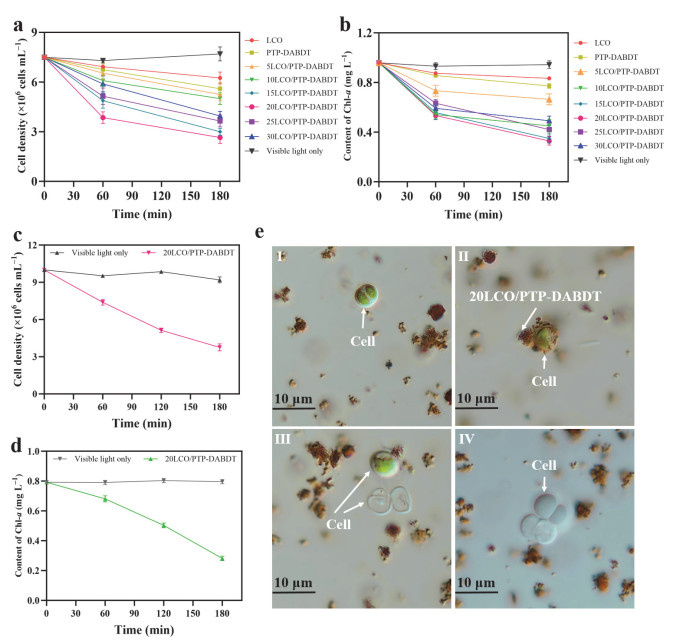
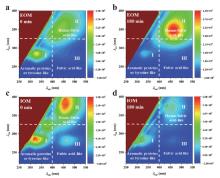
Fig 6
Monitoring membrane integrity and organic matter migration via 3D-EEM fluorescence spectroscopy. Contour maps characterizing the evolution of (a, b) extracellular organic matter (EOM) and (c, d) intracellular organic matter (IOM) before and after 180 min of photocatalytic treatment. Three distinct fluorescent regions are identified: Region Ⅰ (aromatic proteins/tryptophan-like), Region Ⅱ (humic-like substances), and Region Ⅲ (fulvic-like substances). The intensification of Region Ⅱ in the EOM (b) coincident with the significant quenching of fluorescence signals in the IOM (d) provides spectroscopic evidence for cell membrane rupture, resulting in the leakage of intracellular contents and subsequent degradation. (Note: Color intensity scales are normalized within each group to facilitate direct visual comparison)."
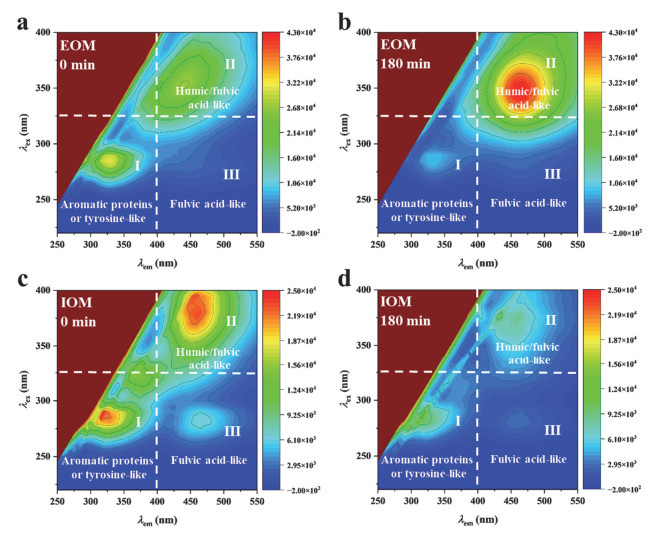
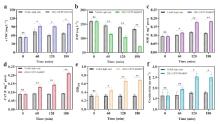
Fig 7
Physiological damage assessment and oxidative stress analysis of M. aeruginosa. (a, b) fate of intracellular components: Time-dependent variations in (a) extracellular total organic carbon (eTOC), (b) intracellular total soluble protein (iTSP). (c, d) Antioxidant enzyme activities: The variations in (c) superoxide dismutase (SOD) and (d) catalase (CAT) activities. (e, f) irreversible membrane permeabilization: (e) nucleic acid leakage (OD264), and (f) electrolyte conductivity. The significant upregulation of these enzymes (e.g. SOD, CAT) in the treatment group confirms the activation of the ROS-scavenging defense system in response to severe oxidative stress induced by the 20LCO/PTP-DABDT photocatalyst. The concurrent rise in extracellular components (eTOC, DNA/RNA) and conductivity, alongside the decline in intracellular proteins, provides quantitative evidence of cell membrane rupture and cytoplasmic leakage. (Data are presented as mean ± SD, n = 3. Asterisks indicate significant differences between the treatment and control groups at the same time point: * p < 0.05, ** p < 0.01)."
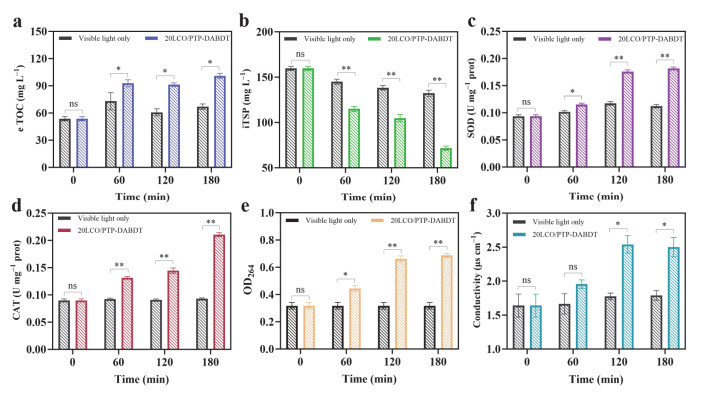
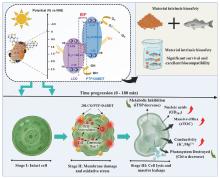
Fig 8
Proposed mechanism for the photocatalytic inactivation of M. aeruginosa and biosafety assessment. (Top Left) Schematic of the S-scheme charge transfer pathway in the 20LCO/PTP-DABDT heterojunction. Driven by the IEF, photogenerated electrons accumulate on the PTP-DABDT CB to generate superoxide radicals (·O2−), while holes accumulate on the LCO VB to produce hydroxyl radicals (·OH), realizing spatially separated redox centers. (Top Right) The material exhibits intrinsic biosafety, ensuring high survival rates for aquatic organisms (L. japonicus). (Bottom) The temporal evolution of algal cell death involves three stages: (Ⅰ) Initial state of intact cells; (Ⅱ) Membrane damage and oxidative stress, characterized by ROS accumulation and antioxidant enzyme activation; (Ⅲ) Cell lysis and leakage, leading to the irreversible efflux of intracellular organics (eTOC, nucleic acids) and ions (K+, Mg2+), metabolic collapse (iTSP decrease), and photosystem destruction."
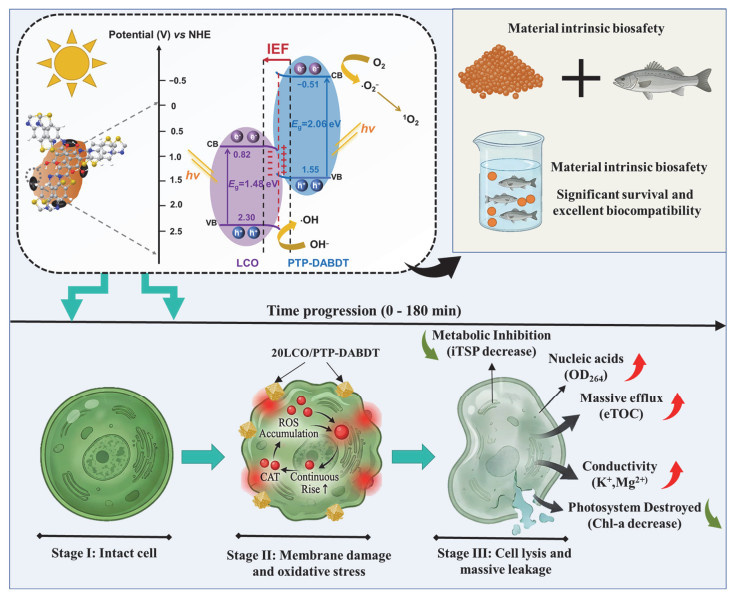
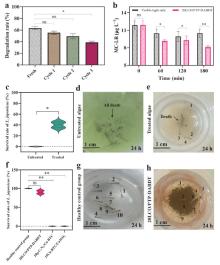
Fig 9
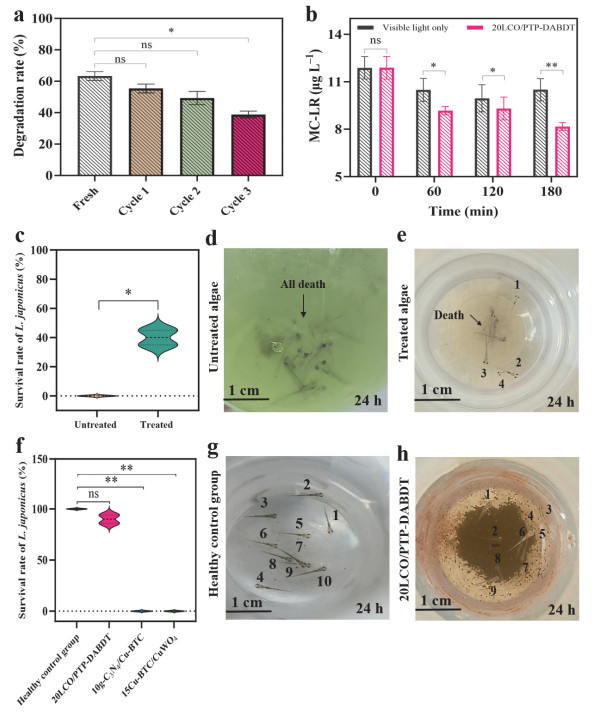
Evaluation of reusability, detoxification capability, and ecological biosafety. (a) Cyclic degradation experiments of 20LCO/PTP-DABDT for M. aeruginosa inactivation over three consecutive runs. (b) Time-dependent concentration profiles of microcystin-LR (MC-LR), demonstrating the simultaneous detoxification ability of the photocatalyst. (c–e) Assessment of water toxicity reduction: (c) Survival analysis of L. japonicus (sea bass) larvae exposed to the algal suspension before and after treatment. Representative photographs show (d) complete mortality in the untreated group versus (e) improved survival in the treated group (numbers indicate surviving individuals), confirming the mitigation of algal toxins. (f–h) Biosafety assessment of the material: (f) Survival rates of L. japonicus exposed to pure dispersions of 20LCO/PTP-DABDT compared to other Cu-based photocatalysts (g-C3N4/Cu-BTC and Cu-BTC/CuWO4). The high survival rate in the 20LCO/PTP-DABDT group, visualized in (h) compared to the normal control (g), highlights the negligible biotoxicity and environmental safety of the synthesized heterojunction. (Data are presented as mean ± SD, n = 3. Asterisks indicate significant differences: * p < 0.05, ** p < 0.01)."
| 1 |
A. Kumar, S. Mishra, S. Bakshi, P. Upadhyay, T.K. Thakur. Ecohydrology 2023, 16, e2483.
doi: 10.1002/eco.2483 |
| 2 |
K.L. Reinl, T.D. Harris, R.L. North, P. Almela, S.A. Berger, M. Bizic, S.H. Burnet, H. Grossart, B.W. Ibelings, E. Jakobsson, et al.. Limnol. Oceanogr. Lett. 2023, 8, 546.
doi: 10.1002/lol2.10316 |
| 3 |
L. Yue, M. Tao, L. Xu, C. Wang, Y. Xu, Y. Liu, X. Cao, J. White, Z. Wang. J. Hazard. Mater. 2024, 462, 132799.
doi: 10.1016/j.jhazmat.2023.132799 |
| 4 |
L. Yin, K. Shi, Y. Yin, Y. Zhang, L. Xu, J. An, C. Peng, C. Wang, H. He, S. Yang, et al.. J. Hazard. Mater. 2025, 487, 137205.
doi: 10.1016/j.jhazmat.2025.137205 |
| 5 |
J. Lv, H. Chu, C. Shao, L. Sun, G. Dawson, K. Dai. Chin. J. Catal. 2025, 78, 75.
doi: 10.1016/s1872-2067(25)64825-x |
| 6 |
P. Balaji, Y. Wang, Y.P. Su, D.P. Hamilton, H. Lin, L. Zheng, Y. Zhang. Environ. Chem. Lett. 2022, 20, 3133.
doi: 10.1007/s10311-022-01457-2 |
| 7 |
H. Chen, K.P. Tsai, Y. Liu, N. Tolić, S.D. Burton, R. Chu, T. Karanfil, A.T. Chow. Water Res. 2021, 189, 116640.
doi: 10.1016/j.watres.2020.116640 |
| 8 |
J. Liu, K. Qi, X. Xiang, A. Jamal Sisi, A. Khataee, L. Xu. Energy Environ. Mater. 2025, 8, e70071.
doi: 10.1002/eem2.70071 |
| 9 |
X. Wang, L. Ding, X. Li, Z. Wang, X. Xu, F. Deng, X. Luo. Chemosphere 2024, 363, 142996.
doi: 10.1016/j.chemosphere.2024.142996 |
| 10 |
Y. He, Y. Lin, Q. Guo, X. Hao, Z. Jin. J. Mater. Chem. A 2025, 13, 37491.
doi: 10.1039/d5ta07036h |
| 11 |
N. Lv, K. Qi, A. Zada, S. Lin. Colloids Surf. A: Physicochem. Eng. Asp. 2025, 725, 137543.
doi: 10.1016/j.colsurfa.2025.137543 |
| 12 |
J. Song, X. Wang, J. Ma, X. Wang, J. Wang, J. Zhao. Appl. Catal. B: Environ. 2018, 226, 83.
doi: 10.1016/j.apcatb.2017.12.034 |
| 13 |
M. Sayed, K. Qi, X. Wu, L. Zhang, H. García, J. Yu. Chem. Soc. Rev. 2025, 54, 4874.
doi: 10.1039/d4cs01091d |
| 14 |
J. Zhang, N. Lv, M. Wu, L. Liu, L. Fang, M. Ma, R. Pitcheri, S. Lin, K. Qi. Chem. Eng. J. 2025, 524, 169033.
doi: 10.1016/j.cej.2025.169033 |
| 15 |
H. Wang, L. Zhang, Z. Chen, J. Hu, S. Li, Z. Wang, J. Liu, X. Wang. Chem. Soc. Rev. 2014, 43, 6141.
doi: 10.1039/c4cs00126e |
| 16 |
H. Hu, X. Zhang, K. Zhang, Y. Ma, H. Wang, H. Li, H. Huang, X. Sun, T. Ma. Adv. Energy Mater. 2024, 14, 2303638.
doi: 10.1002/aenm.202303638 |
| 17 |
Z. Zhang, Y. Xia, C. Shao, L. Sun, G. Dawson, K. Dai. J. Mater. Sci. Technol. 2026, 252, 1.
doi: 10.1016/j.jmst.2025.06.050 |
| 18 |
L. Zhang, J. Zhang, J. Yu. Chem 2026, 12, 102719.
doi: 10.1016/j.chempr.2025.102719 |
| 19 |
Y. Zhao, C. Yang, S. Zhang, G. Sun, B. Zhu, L. Wang, J. Zhang. Chin. J. Catal. 2024, 63, 258.
doi: 10.1016/s1872-2067(24)60069-0 |
| 20 |
Y. Huang, J. Zhang, O. Ruzimuradov, S. Mamatkulov, K. Dai, J. Low. Compos. Funct. Mater. 2025, 1, 20250103.
doi: 10.63823/20250103 |
| 21 |
Y. Bian, Z. Wang, M. Du, K. Dai, J. Yu, L. Zhang. Adv. Funct. Mater. 2025, 36, e19493.
doi: 10.1002/adfm.202519493 |
| 22 |
P. Li, Y. Cui, Z. Wang, G. Dawson, C. Shao, K. Dai. Acta Phys. Chim. Sin. 2025, 41, 100065.
doi: 10.1016/j.actphy.2025.100065 |
| 23 |
D. Xiang, J. Yang, H. Xie, X. Hao, Z. Jin. Chem. Eng. J. 2025, 525, 169994.
doi: 10.1016/j.cej.2025.169994 |
| 24 |
K. Xu, J. Yu, W. Xia, J. Zhang, S. Han. Acta Phys. Chim. Sin. 2026, 42, 100211.
doi: 10.1016/j.actphy.2025.100211 |
| 25 |
J. Bi, C. Li, X. Huang, J. Ren, P. Zhang, T. Wang, Y. Zhao, H. Hao. Appl. Phys. Rev. 2025, 12, 031313.
doi: 10.1063/5.0253980 |
| 26 |
K. Xu, W. Zhu, M. Sayed, S. Han. Chin. J. Catal. 2026, 83, 24.
doi: 10.1016/s1872-2067(26)64988-1 |
| 27 |
F. Xu, Y. He, J. Zhang, G. Liang, C. Liu, J. Yu. Angew. Chem. Int. Ed. 2025, 137, e202414672.
doi: 10.1002/anie.202414672 |
| 28 |
S. Sun, Q. Tang, H. Xu, Y. Gao, W. Zhang, L. Zhou, Y. Li, J. Wang, C. Song. Chemosphere 2023, 312, 137239.
doi: 10.1016/j.chemosphere.2022.137239 |
| 29 |
B. Ge, P. Jiang, B. Chen, C. Huang. ACS Catal. 2025, 15, 477.
doi: 10.1021/acscatal.4c05479 |
| 30 |
Z. He, M. Chen, M. Xu, Y. Zhou, Y. Zhang, G. Hu. Appl. Catal. B: Environ. 2023, 335, 122883.
doi: 10.1016/j.apcatb.2023.122883 |
| 31 |
X. Wu, M. Sayed, G. Wang, W. Yu, B. Zhu. Adv. Mater. 2026, 38, e11322.
doi: 10.1002/adma.202511322 |
| 32 |
K. Geng, T. He, R. Liu, S. Dalapati, K. Tan, Z. Li, S. Tao, Y. Gong, Q. Jiang, D. Jiang. Chem. Rev. 2020, 120, 8814.
doi: 10.1021/acs.chemrev.9b00550 |
| 33 |
L. Zhang, J. Zhang, J. Yu, H. García. Nat. Rev. Chem. 2025, 9, 328.
doi: 10.1038/s41570-025-00698-3 |
| 34 |
M.J. Molaei. J. Am. Ceram. Soc. 2024, 107, 5695.
doi: 10.1111/jace.19920 |
| 35 |
X. Yuan, Y. Cheng, C. Zhang, G. Shan, R. Liu, F. Luo, Y. Deng, K. Yao, J. Xu, S. Shan, et al.. J. Colloid Interface Sci. 2025, 680, 748.
doi: 10.1016/j.jcis.2024.11.095 |
| 36 |
G. Visco, L. Campanella, V. Nobili. Microchem. J. 2005, 79, 185.
doi: 10.1016/j.microc.2004.10.018 |
| 37 |
X. Xu, B. Zhu, Z. Liu, F. Wang, J. Liang. J. Chromatogr. B 2019, 1125, 121709.
doi: 10.1016/j.jchromb.2019.06.036 |
| 38 |
S. Yang, S.J. Williams, M. Courtney, L. Burchill. Nat. Prod. Rep. 2025, 42, 681.
doi: 10.1039/d4np00038b |
| 39 |
W. Chu, X. Cao, L. Song, Y. Yang, W. Gao, L. Cheng, S. Ai, W. He, L. Cui. Sens. Actuators B: Chem. 2025, 431, 137459.
doi: 10.1016/j.snb.2025.137459 |
| 40 |
H. He, Z. Wang, J. Zhang, S. Mamatkulov, O. Ruzimuradov, K. Dai, J. Low, Y. Li. Energy Environ. Sci. 2025, 18, 6191.
doi: 10.1039/d5ee01295c |
| 41 |
Z. Li, Y. Xie, Z. Huang, Y. Su, C. Sun, J. Fu, H. Wei, F. Wu, G. Ou. ACS Appl. Nano Mater. 2022, 5, 14209.
doi: 10.1021/acsanm.2c02982 |
| 42 |
C. Li, Q. Wang, S. Lin, X. Xiang, K. Qi. Adv. Sci. 2025, 13, e18352.
doi: 10.1002/advs.202518352 |
| 43 |
X. Du, T. Gu, J. Xu, Y. Qu, H. Jia, S. Xu, M. Zhang, J. Chen. J. Environ. Chem. Eng. 2025, 13, 117970.
doi: 10.1016/j.jece.2025.117970 |
| 44 |
X. Zhu, Z. Dong, L. Liu, N. Hu, D. Wu, Y. Wei, Y. An. J. Colloid Interface Sci. 2025, 678, 313.
doi: 10.1016/j.jcis.2024.09.024 |
| 45 |
H. Cui, S. Jia, T. Du, J. Liu, X. Lin, X. Zhang, F. Yang. ACS Appl. Mater. Interfaces 2024, 16, 70477.
doi: 10.1021/acsami.4c13756 |
| 46 |
J. Lu, Y. Lu, P. Rosaiah, S. Lin, Z. Amir, K. Qi. Chem. Res. Chin. Univ. 2025, 41, 799.
doi: 10.1007/s40242-025-5089-6 |
| 47 |
Y. Ma, S. Wang, Y. Zhang, B. Cheng, L. Zhang. J. Materiomics 2025, 11, 100978.
doi: 10.1016/j.jmat.2024.100978 |
| 48 |
Z. Meng, J. Zhang, H. Long, H. García, L. Zhang, B. Zhu, J. Yu. Angew. Chem. Int. Ed. 2025, 137, e202505456.
doi: 10.1002/anie.202505456 |
| 49 |
M. Gu, J. Zhang, I.V. Kurganskii, A.S. Poryvaev, M.V. Fedin, B. Cheng, J. Yu, L. Zhang. Adv. Mater. 2024, 37, 2414803.
doi: 10.1002/adma.202414803 |
| 50 |
Y. An, W. Liu, Y. Zhang, J. Zhang, Z. Lu. Acta Phys. Chim. Sin. 2024, 40, 2407021.
doi: 10.3866/pku.Whxb202407021 |
| 51 |
K. Meng, J. Zhang, B. Zhu, C. Jiang, H. García, J. Yu. Adv. Mater. 2025, 37, 2505088.
doi: 10.1002/adma.202505088 |
| 52 |
Y. Wu, C. Cheng, K. Qi, B. Cheng, J. Zhang, J. Yu, L. Zhang. Acta Phys. Chim. Sin. 2024, 40, 2406027.
doi: 10.3866/pku.Whxb202406027 |
| 53 |
S. Yang, C. Bie, Y. Wu, W. Xia, K. Xu, J. Zhang, J. Yu. Small 2026, 22, e72654.
doi: 10.1002/smll.72654 |
| 54 |
M. Gu, Y. Yang, B. Cheng, L. Zhang, P. Xiao, T. Chen. Chin. J. Catal. 2024, 59, 185.
doi: 10.1016/s1872-2067(23)64610-8 |
| 55 |
J. Qiu, C. Cheng, H. García, G. Liang, B. Zhu, L. Zhang, J. Yu. Angew. Chem. Int. Ed. 2025, 64, e202515898.
doi: 10.1002/anie.202515898 |
| 56 |
D.D. Kruger, M. CabreroAntonino, S. Osella, F. Xu, J. Yu, A. Primo, H. Garcia. Angew. Chem. Int. Ed. 2026, 65, e8425918.
doi: 10.1002/anie.8425918 |
| 57 |
F. Xu, W. Mei, P. Hu, L. Zheng, J. Zhang, H. Cao, H. García, J. Yu. Angew. Chem. Int. Ed. 2025, 64, e202513364.
doi: 10.1002/anie.202513364 |
| 58 |
Y. Yea, B. Cha, L.K. Njaramba, S. Kim, J.U. Choi, Y. Yoon, C.M. Park. Chem. Eng. J. 2024, 495, 153106.
doi: 10.1016/j.cej.2024.153106 |
| 59 |
A. Meng, X. Wu, Z. Lu, M. Gu, W. Zhong, Y. Su, J. Yu. Angew. Chem. Int. Ed. 2026, 65, e25871.
doi: 10.1002/anie.202525871 |
| 60 |
F. Xu, F. Zhao, X. Deng, J. Zhang, J. Zhang, C. Ai, J. Yu, H. Garcia. Nat. Commun. 2025, 16, 6882.
doi: 10.1038/s41467-025-60961-5 |
| 61 |
J. Yang, X. Hao, J. Jing, Y. Hao, Z. Jin. Acta Phys. Chim. Sin. 2025, 41, 100131.
doi: 10.1016/j.actphy.2025.100131 |
| 62 |
L. Wang, J. Zhao. J. Mater. Sci. Technol. 2026, 241, 18.
doi: 10.1016/j.jmst.2025.04.009 |
| 63 |
J. Du, F. Jin, G. Jiang, Z. Jin. Chem. Mater. 2025, 37, 2664.
doi: 10.1021/acs.chemmater.5c00452 |
| 64 |
C.H. Park, H. Lee, J.S. Choi, T.G. Yun, Y. Lim, H.B. Bae, S.Y. Chung. Adv. Mater. 2024, 36, 2403392.
doi: 10.1002/adma.202403392 |
| 65 |
F. Xu, L. Zheng, J. Zhang, Y. He, H. Cao, X. Zheng, H. García, J. Yu. Nat. Catal. 2026, 9, 73.
doi: 10.1038/s41929-025-01471-x |
| 66 |
A. Chen, H. Ji, Z. Xu, Z. Wang, L. Zhang. J. Alloy. Compd. 2025, 1010, 177577.
doi: 10.1016/j.jallcom.2024.177577 |
| 67 |
G. Fan, Q. Lin, J. Lin, M. Xia, S. Chen, J. Luo, J. Zou, Z. Hong, K. Xu. Chemosphere 2024, 347, 140710.
doi: 10.1016/j.chemosphere.2023.140710 |
| 68 |
M. Wu, M. Du, G. Wu, F. Lu, J. Li, A. Lei, H. Zhu, Z. Hu, J. Wang. Biotechnol. Biofuel. 2021, 14, 132.
doi: 10.1186/s13068-021-01980-4 |
| 69 |
N. Philip, M. Poonam. Microorganisms 2023, 11, 259.
doi: 10.3390/microorganisms11020259 |
| 70 |
H. Wang, Y. Yang, Z. Zhou, X. Li, J. Gao, R. Yu, J. Li, N. Wang, H. Chang. Sep. Purif. Technol. 2022, 283, 120192.
doi: 10.1016/j.seppur.2021.120192 |
| 71 |
J. Wen, S. Sun, Q. Tang, C. Song, J. Wang, W. Zhang, L. Zhou, Y. Gao, X. Xiao. Chem. Eng. J. 2023, 475, 146526.
doi: 10.1016/j.cej.2023.146526 |
| 72 |
G. Fan, K. Hu, M. Xia, C. Cai, Z. He, J. Luo, K. Xu. J. Environ. Chem. Eng. 2024, 12, 111847.
doi: 10.1016/j.jece.2023.111847 |
| 73 |
A. Singh, W. Hou, T. Lin. Chemosphere 2021, 272, 129825.
doi: 10.1016/j.chemosphere.2021.129825 |
| 74 |
B. Wu, W. Su, P. Zhu, J. Xu, K. Yuan, L. Li, Y. Chen. Adv. Mater. 2025, 37, e07842.
doi: 10.1002/adma.202507842 |
| 75 |
S. Yang, X. Wang, P. Jin, A. Peng, K. Qi, J. He, A. Khataee. J. Alloy. Compd. 2024, 995, 174794.
doi: 10.1016/j.jallcom.2024.174794 |
| 76 |
P. Jin, N. Fu, R. Bai, Q. Liu, Y. Liu, M. Chen, J. He. Sep. Purif. Technol. 2026, 385, 136453.
doi: 10.1016/j.seppur.2025.136453 |
| 77 |
Z. Wang, Y. Xu, C. Wang, L. Yue, T. Liu, Q. Lan, X. Cao, B. Xing. Sep. Purif. Technol. 2023, 313, 123515.
doi: 10.1016/j.seppur.2023.123515 |
| 78 |
G. Fan, J. Zhou, X. Zheng, J. Luo, L. Hong, F. Qu. Chemosphere 2020, 239, 124721.
doi: 10.1016/j.chemosphere.2019.124721 |
| [1] | Lishan Chen, Xuemei Li, Xiangju Xu, Youqing Dong, Quanlong Xu. MA3Bi2Br9/g-C3N4 0D/2D S-scheme heterojunction for selective photooxidation of toluene [J]. Acta Phys. -Chim. Sin., 2026, 42(9): 100258-. |
| [2] | Hongfei Yin, Mengling Hong, Jinyang Zhang, Wentao Wang, Wei Chen, Guozhi Wu. Oxygen vacancy-mediated 2D/2D Bi2MoO6/Bi2O2S S-scheme heterojunctions for efficient CO2 photoreduction [J]. Acta Phys. -Chim. Sin., 2026, 42(9): 100332-. |
| [3] | Kaiqiang Xu, Jia Yu, Wei Xia, Jianjun Zhang, Sheng Han. Rapid charge transfer endowed by van der Waals S-scheme heterojunction for boosting photocatalytic activity [J]. Acta Phys. -Chim. Sin., 2026, 42(7): 100211-. |
| [4] | Chengcheng Yuan, Wei Xia, Jun Wang, Xiaofeng Zhu, Yong Zhang, Bicheng Zhu, Jiaguo Yu. A dual-functional single-atom modified SnS2/CdS S-scheme photocatalyst for synergistic hydrogen production and lactic acid oxidation: A DFT study [J]. Acta Phys. -Chim. Sin., 2026, 42(6): 100244-. |
| [5] | Jie Guo, Lijun Xue, Fahui Song, Chengpeng Li, Zhuo Chen, Lili Wen. Dual built-in electric field-driven S-scheme heterojunction of D-A COFs/ZnIn2S4 for accelerated charge separation toward high-efficiency H2O2 photosynthesis in pure water [J]. Acta Phys. -Chim. Sin., 2026, 42(4): 100177-. |
| [6] | Zhen Li, Sujuan Zhang, Zhongliao Wang, Jinfeng Zhang, Gaoli Chen, Shifu Chen. Rational design of S-scheme CdS/MnO2 heterojunctions for high-value photothermal synergistic catalytic oxidation of toluene [J]. Acta Phys. -Chim. Sin., 2026, 42(4): 100179-. |
| [7] | Wenjun Zhu, Chenbin Ai, Kaiqiang Xu, Yatai Zhou, Xidong Zhang, Yong Zhang. WO3@TP inorganic@organic S-scheme photocatalyst for boosting H2O2 production [J]. Acta Phys. -Chim. Sin., 2026, 42(3): 100184-. |
| [8] | Ze Luo, Yukun Zhu, Yadan Luo, Guangmin Ren, Yonghong Wang, Hua Tang. Photocatalytic selective oxidation of 5-hydroxymethylfurfural coupled with H2 evolution over In2O3/ZnIn2S4 S-scheme heterojunction [J]. Acta Phys. -Chim. Sin., 2026, 42(3): 100166-. |
| [9] | Ling Zhou, Long Li, Liwen Huang, Yan Wu. Enhanced H2O2 production performance via indirect two-electron reduction of HOF/BiVO4 (010) S-scheme photocatalyst [J]. Acta Phys. -Chim. Sin., 2026, 42(3): 100172-. |
| [10] | Fan Fan, Hao Xiu, Yuting Wang, Yongpeng Cui, Yajun Wang. Construction of NH2-MIL-125/Na-doped g-C3N4 composite S-scheme heterojunction and its performance in photocatalytic hydrogen peroxide production [J]. Acta Phys. -Chim. Sin., 2026, 42(2): 100143-. |
| [11] | Chengyan Ge, Jiawei Hu, Xingyu Liu, Yuxi Song, Chao Liu, Zhigang Zou. Self-integrated black NiO clusters with ZnIn2S4 microspheres for photothermal-assisted hydrogen evolution by S-scheme electron transfer mechanism [J]. Acta Phys. -Chim. Sin., 2026, 42(1): 100154-. |
| [12] | Shiyi Chen, Jialong Fu, Jianping Qiu, Guoju Chang, Shiyou Hao. Waste medical mask-derived carbon quantum dots enhance the photocatalytic degradation of polyethylene terephthalate (PET) over BiOBr/g-C3N4 S-scheme heterojunction [J]. Acta Phys. -Chim. Sin., 2026, 42(1): 100135-. |
| [13] | Menglan Wei, Xiaoxia Ou, Yimeng Wang, Mengyuan Zhang, Fei Teng, Kaixuan Wang. S-scheme heterojunction g-C3N4/Bi2WO6 highly efficient degradation of levofloxacin: performance, mechanism and degradation pathway [J]. Acta Phys. -Chim. Sin., 2025, 41(9): 100105-. |
| [14] | Wenlong Wang, Wentao Hao, Lang He, Jia Qiao, Ning Li, Chaoqiu Chen, Yong Qin. Bandgap and adsorption engineering of carbon dots/TiO2 S-scheme heterojunctions for enhanced photocatalytic CO2 methanation [J]. Acta Phys. -Chim. Sin., 2025, 41(9): 100116-. |
| [15] | Jiajie Cai, Chang Cheng, Bowen Liu, Jianjun Zhang, Chuanjia Jiang, Bei Cheng. CdS/DBTSO-BDTO S-scheme photocatalyst for H2 production and its charge transfer dynamics [J]. Acta Phys. -Chim. Sin., 2025, 41(8): 100084-. |
|
||