Acta Phys. -Chim. Sin. ›› 2023, Vol. 39 ›› Issue (11): 2302021.doi: 10.3866/PKU.WHXB202302021
Special Issue: Carbon Dioxide Valorization
• ARTICLE • Previous Articles Next Articles
Ir Single Atoms and Clusters Supported on α-MoC as Catalysts for Efficient Hydrogenation of CO2 to CO
Junwen Lu1,2, Shunan Zhang3,*( ), Haozhi Zhou3, Chaojie Huang1,2, Lin Xia1, Xiaofang Liu1, Hu Luo1, Hui Wang1,3,*()
- 1 CAS Key Laboratory of Low-Carbon Conversion Science and Engineering, Shanghai Advanced Research Institute, Chinese Academy of Sciences, Shanghai 201210, China
2 University of Chinese Academy of Sciences, Beijing 100049, China
3 Institute of Carbon Neutrality, ShanghaiTech University, Shanghai 201203, China
-
Received:2023-02-14Accepted:2023-03-21Published:2023-03-24 -
Contact:Shunan Zhang, Hui Wang E-mail:zhangshn2@shanghaitech.edu.cn;wanghh@sari.ac.cn -
Supported by:the National Key Research and Development Program of China(2022YFA1504800);the National Key Research and Development Program of China(2022YFA1504702);the National Key Research and Development Program of China(2022YFB4101900);the National Natural Science Foundation of China(22108289);the National Natural Science Foundation of China(22279158);the National Natural Science Foundation of China(21905291);CNOOC Institute of Chemicals & Advanced Materials(YJSCZX07956YJ);Shanghai Institute of Cleantech Innovation(E244831E01)

Cite this article
Junwen Lu, Shunan Zhang, Haozhi Zhou, Chaojie Huang, Lin Xia, Xiaofang Liu, Hu Luo, Hui Wang. Ir Single Atoms and Clusters Supported on α-MoC as Catalysts for Efficient Hydrogenation of CO2 to CO[J]. Acta Phys. -Chim. Sin. 2023, 39(11), 2302021. doi: 10.3866/PKU.WHXB202302021
share this article
"
"
"
| Catalyst | Ir loading (wt) a | Surface area b/(m2∙g−1) | Pore volume c/(cm3∙g−1) | Pore size d/nm |
| α-MoC | N/A | 127 | 0.13 | 3.05 |
| 0.2%Ir/MoC | 0.28% | 107 | 0.11 | 1.75 |
| 0.5%Ir/MoC | 0.42% | 99 | 0.08 | 2.13 |
| 2%Ir/MoC | 2.23% | 85 | 0.06 | 2.92 |
| 5%Ir/MoC | 6.60% | 50 | 0.09 | 3.81 |
"
"
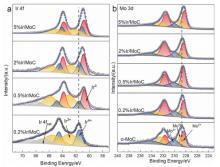
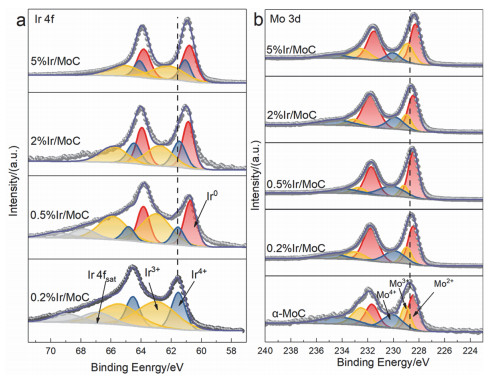
| Catalyst | Mo 3d5/2 binding energy/eV | Ir 4f7/2 binding energy/eV | |||||
| Mo2+ | Mo3+ | Mo4+ | Ir0 | Ir4+ | Ir3+ | ||
| α-MoC | 228.43 | 229.05 | 230.08 | – | – | – | |
| (39.48%) | (30.57%) | (29.95%) | – | – | – | ||
| 0.2%Ir/MoC | 228.45 | 228.96 | 229.92 | – | 61.53 | 62.97 | |
| (56.57%) | (19.88%) | (23.55%) | – | (33.18%) | (66.82%) | ||
| 0.5%Ir/MoC | 228.45 | 229.18 | 230.16 | 60.74 | 61.56 | 62.99 | |
| (59.62%) | (13.36%) | (27.02%) | (34.13%) | (12.98%) | (52.90%) | ||
| 2%Ir/MoC | 228.46 | 228.98 | 229.87 | 60.87 | 61.46 | 62.76 | |
| (58.65%) | (16.71%) | (24.64%) | (37.54%) | (24.28%) | (38.18%) | ||
| 5%Ir/MoC | 228.30 | 228.98 | 230.08 | 60.80 | 61.07 | 62.21 | |
| (58.19%) | (26.91%) | (14.90%) | (42.23%) | (19.74%) | (38.02%) | ||
"
"
"
"
"
| 1 |
SuX.;YangX.;ZhaoB.;HuangY.J. Energy Chem.2017,26(5),854.
doi: 10.1016/j.jechem.2017.07.006 |
| 2 |
ChuW.;WangL.-N.;ChernavskiiP. A.;KhodakovA. Y.Angew. Chem. Int. Ed.2008,47(27),5052.
doi: 10.1002/anie.200800657 |
| 3 |
ZhangD.;LuoJ.;WangJ.;XiaoX.;LiuY.;QiW.;SuD. S.;ChuW.Chin. J. Catal.2018,39(1),157.
doi: 10.1016/S1872-2067(17)62967-X |
| 4 |
VarvoutisG.;LykakiM.;PapistaE.;CarabineiroS. A. C.;PsarrasA. C.;MarnellosG. E.;KonsolakisM.J. CO2 Util.2021,44,101408.
doi: 10.1016/j.jcou.2020.101408 |
| 5 |
LoilandJ. A.;WulfersM. J.;MarinkovicN. S.;LoboR. F.Catal. Sci. Technol.2016,6(14),5267.
doi: 10.1039/C5CY02111A |
| 6 |
LuB.;KawamotoK.J. Environ. Chem. Eng.2013,1(3),300.
doi: 10.1016/j.jece.2013.05.008 |
| 7 |
VovchokD.;ZhangC.;HwangS.;JiaoL.;ZhangF.;LiuZ.;SenanayakeS. D.;RodriguezJ. A.ACS Catal.2020,10(17),10216.
doi: 10.1021/acscatal.0c01584 |
| 8 |
JungH.S.;ZafarF.;WangX.;NguyenT. X.;HongC. H.;HurY. G.;ChoungJ. W.;ParkM.-J.;BaeJ. W.ACS Catal.2021,11(22),14210.
doi: 10.1021/acscatal.1c04451 |
| 9 |
LiuH.-X.;LiS.-Q.;WangW.-W.;YuW.-Z.;ZhangW.-J.;MaC.;JiaC. J.Nat. Commun.2022,13(1),867.
doi: 10.1038/s41467-022-28476-5 |
| 10 |
MorseJ. R.;JuneauM.;BaldwinJ. W.;PorosoffM. D.;WillauerH. D.J. CO2 Util.2020,35,38.
doi: 10.1016/j.jcou.2019.08.024 |
| 11 |
RodriguezJ. A.;EvansJ.;FeriaL.;VidalA. B.;LiuP.;NakamuraK.;IllasF.J. Catal.2013,307,162.
doi: 10.1016/j.jcat.2013.07.023 |
| 12 |
PorosoffM. D.;YanB.;ChenJ. G.Energ Environ. Sci.2016,9(1),62.
doi: 10.1039/C5EE02657A |
| 13 |
LiJ.;LiuL.;LiuY.;LiM.;ZhuY.;LiuH.;KouY.;ZhangJ.;HanY.;MaD.Energ Environ. Sci.2014,7(1),393.
doi: 10.1039/C3EE41945B |
| 14 |
MaY.;GuoZ.;JiangQ.;WuK.-H.;GongH.;LiuY.J. Energy Chem.2020,50,37.
doi: 10.1016/j.jechem.2020.03.012 |
| 15 |
ZhangX.;ZhuX.;LinL.;YaoS.;ZhangM.;LiuX.;WangX.;LiY.-W.;ShiC.;MaD.ACS Catal.2016,7(1),912.
doi: 10.1021/acscatal.6b02991 |
| 16 |
LiS.;CaoR.;XuM.;DengY.;LinL.;YaoS.;LiangX.;PengM.;GaoZ.;GeY.Nat. Sci. Rev.2021,9(1),2095.
doi: 10.1093/nsr/nwab026 |
| 17 |
LinL.;ZhouW.;GaoR.;YaoS.;ZhangX.;XuW.;ZhengS.;JiangZ.;YuQ.;LiY.-W.Nature2017,544(7648),80.
doi: 10.1038/nature21672 |
| 18 |
GeY.;QinX.;LiA.;DengY.;LinL.;ZhangM.;YuQ.;LiS.;PengM.;XuY.J. Am. Chem. Soc.2021,143(2),628.
doi: 10.1021/jacs.0c11285 |
| 19 |
FanX.;LiuC.;WuM.;GaoB.;ZhengL.;ZhangY.;ZhangH.;GaoQ.;CaoX.;TangY.Appl. Catal. B2022,318,121867.
doi: 10.1016/j.apcatb.2022.121867 |
| 20 |
ReddyK. P.;DamaS.;MhamaneN. B.;GhosalyaM. K.;RajaT.;SatyanarayanaC. V.;GopinathC. S.Dalton Trans.2019,48(32),12199.
doi: 10.1039/C9DT01774G |
| 21 |
GaoJ.;WuY.;JiaC.;ZhongZ.;GaoF.;YangY.;LiuB.Catal. Commun.2016,84,147.
doi: 10.1016/j.catcom.2016.06.026 |
| 22 | MaD.Acta Phys. -Chim. Sin.2019,35(8),794. |
|
马丁;物理化学学报,2019,35(8),794.
doi: 10.3866/PKU.WHXB201810033 |
|
| 23 |
DengY.;GeY.;XuM.;YuQ.;XiaoD.;YaoS.;MaD.Acc. Chem. Res.2019,52(12),3372.
doi: 10.1021/acs.accounts.9b00182 |
| 24 |
YaoS.;ZhangX.;ZhouW.;GaoR.;XuW.;YeY.;LinL.;WenX.;LiuP.;ChenB.Science2017,357(6349),389.
doi: 10.1126/science.aah4321 |
| 25 |
LinL.;YaoS.;GaoR.;LiangX.;YuQ.;DengY.;LiuJ.;PengM.;JiangZ.;LiS.Nat. Nanotechnol.2019,14(4),354.
doi: 10.1038/s41565-019-0366-5 |
| 26 | WuK.Acta Phys. -Chim. Sin.2017,33(6),1073. |
|
吴凯;物理化学学报,2017,33(6),1073.
doi: 10.3866/PKU.WHXB201704122 |
|
| 27 |
JinC.;WangB.;ZhouY.;YangF.;GuoP.;LiuZ.;ShenW.Chem. Commun.2022,58(52),7313.
doi: 10.1039/D2CC02478K |
| 28 |
GuoY.;WangM.;ZhuQ.;XiaoD.;MaD.Nat. Catal.2022,5(9),766.
doi: 10.1038/s41929-022-00839-7 |
| 29 |
ChenX.;SuX.;SuH.-Y.;LiuX.;MiaoS.;ZhaoY.;SunK.;HuangY.;ZhangT.ACS Catal.2017,7(7),4613.
doi: 10.1021/acscatal.7b00903 |
| 30 |
PerumalS.;LimT.;SeenivasanS.;SeoJ.Appl. Surf. Sci.2022,604,154553.
doi: 10.1016/j.apsusc.2022.154553 |
| 31 |
ZhangY.;ZhangZ.;YangX.;WangR.;DuanH.;ShenZ.;LiL.;SuY.;YangR.;ZhangY.Green Chem.2020,22(20),6855.
doi: 10.1039/D0GC02302G |
| 32 |
LiS.;XuY.;ChenY.;LiW.;LinL.;LiM.;DengY.;WangX.;GeB.;YangC.Angew. Chem. Int. Ed.2017,56(36),10761.
doi: 10.1002/anie.201705002 |
| 33 |
LinL.;YuQ.;PengM.;LiA.;YaoS.;TianS.;LiuX.;LiA.;JiangZ.;GaoR.J. Am. Chem. Soc.2021,143(1),309.
doi: 10.1021/jacs.0c10776 |
| 34 |
ZuoJ.;NaW.;ZhangP.;YangX.;WenJ.;ZhengM.;WangH.Mol. Catal.2022,526,112357.
doi: 10.1016/j.mcat.2022.112357 |
| 35 |
PahijaE.;PanaritisC.;GusarovS.;ShadbahrJ.;BensebaaF.;PatienceG.;BoffitoD. C.ACS Catal.2022,12(12),6887.
doi: 10.1021/acscatal.2c01099 |
| 36 |
ZhangQ.;Pastor-PérezL.;JinW.;GuS.;ReinaT. R.Appl. Catal. B.2019,244,889.
doi: 10.1016/j.apcatb.2018.12.023 |
| 37 |
WangL.-X.;GuanE.;WangZ.;WangL.;GongZ.;CuiY.;YangZ.;WangC.;ZhangJ.;MengX.ACS Catal.2020,10(16),9261.
doi: 10.1021/acscatal.0c00907 |
| 38 |
XuJ.;GongX.;HuR.;LiuZ.-W.;LiuZ.-T.Mol. Catal.2021,516,111954.
doi: 10.1016/j.mcat.2021.111954 |
| 39 |
MaY.;RenY.;ZhouY.;LiuW.;BaazizW.;ErsenO.;CuongP.;GreinerM.;ChuW.;WangA.Angew. Chem. Int. Ed.2020,59(48),21613.
doi: 10.1002/anie.202007707 |
| 40 |
GuF.;ZhengL.;WeiH.;MiW.;ZhangC.;SuQ.;ZhuW.;LinW.Appl. Surf. Sci.2022,606,155008.
doi: 10.1016/j.apsusc.2022.155008 |
| 41 |
TangY.;YangZ.;GuoC.;HanH.;JiangY.;WangZ.;LiuJ.;WuL.;WangF.J. Mater. Chem. A2022,10(22),12157.
doi: 10.1039/D2TA00933A |
| 42 |
YangQ.;SunK.;XuY.;DingZ.;HouR.Appl. Catal. A-Gen.2022,630,118455.
doi: 10.1016/j.apcata.2021.118455 |
| 43 |
ChenJ. G.Chem. Rev.1996,96(4),1477.
doi: 10.1021/cr950232u |
| 44 |
XiaZ.;ZhangH.;ShenK.;QuY.;JiangZ.Phys. B Condens. Matter.2018,542,12.
doi: 10.1016/j.physb.2018.04.039 |
| 45 |
RavelB.;NewvilleM.J. Synchrot. Radiat.2005,12(4),537.
doi: 10.1107/S0909049505012719 |
| 46 |
WangS.-G.;LiaoX.-Y.;CaoD.-B.;HuoC.-F.;LiY.-W.;WangJ.;JiaoH.J. Phys. Chem.2007,111(45),16934.
doi: 10.1021/jp074570y |
| 47 |
LiuH.-X.;LiJ.-Y.;QinX.;MaC.;WangW.-W.;XuK.;YanH.;XiaoD.;JiaC.-J.;FuQ.Nat. Commun.2022,13(1),5800.
doi: 10.1038/s41467-022-33308-7 |
| 48 |
Alvarez-GalvanC.;LustembergP. G.;OropezaF. E.;Bachiller-BaezaB.;Dapena OspinaM.;HerranzM.;CebolladaJ.;ColladoL.;Campos-MartinJ. M.;de la Peña-O'SheaV. A.ACS Appl. Mater. Interfaces2022,14(45),50739.
doi: 10.1021/acsami.2c11248 |
| 49 |
ZhangY.;LiangL.;ChenZ.;WenJ.;ZhongW.;ZouS.;FuM.;ChenL.;YeD.Appl. Surf. Sci.2020,516,146035.
doi: 10.1016/j.apsusc.2020.146035 |
| 50 |
ZhangX.;LiuY.;ZhangM.;YuT.;ChenB.;XuY.;CrockerM.;ZhuX.;ZhuY.;WangR.Chem2020,6(12),3312.
doi: 10.1016/j.chempr.2020.09.016 |
| 51 |
XuD.;DingM.;HongX.;LiuG.ACS Catal.2020,10(24),14516.
doi: 10.1021/acscatal.0c03575 |
| 52 |
ZhengH.;LiaoW.;DingJ.;XuF.;JiaA.;HuangW.;ZhangZ.ACS Catal.2022,12(24),15451.
doi: 10.1021/acscatal.2c04437 |
| 53 |
BobadillaL. F.;SantosJ. L.;IvanovaS.;OdriozolaJ. A.;UrakawaA.ACS Catal.2018,8(8),7455.
doi: 10.1021/acscatal.8b02121 |
| [1] | Hailian Tang, Siyuan Chen, Qiaoyun Liu, Guoyi Bai, Botao Qiao, Liu Fei. Stabilized Rh/hydroxyapatite Catalyst for Furfuryl Alcohol Hydrogenation: Application of Oxidative Strong Metal-Support Interactions in Reducing Conditions [J]. Acta Phys. -Chim. Sin., 2025, 41(4): 100036-. |
| [2] | Yongqing Xu, Yuyao Yang, Mengna Wu, Xiaoxiao Yang, Xuan Bie, Shiyu Zhang, Qinghai Li, Yanguo Zhang, Chenwei Zhang, Robert E. Przekop, Bogna Sztorch, Dariusz Brzakalski, Hui Zhou. Review on Using Molybdenum Carbides for the Thermal Catalysis of CO2 Hydrogenation to Produce High-Value-Added Chemicals and Fuels [J]. Acta Phys. -Chim. Sin., 2024, 40(4): 2304003-. |
| [3] | Yinjie Xu, Suiqin Li, Lihao Liu, Jiahui He, Kai Li, Mengxin Wang, Shuying Zhao, Chun Li, Zhengbin Zhang, Xing Zhong, Jianguo Wang. Enhanced Electrocatalytic Oxidation of Sterols using the Synergistic Effect of NiFe-MOF and Aminoxyl Radicals [J]. Acta Phys. -Chim. Sin., 2024, 40(3): 2305012-. |
| [4] | Jia Wang, Qing Qin, Zhe Wang, Xuhao Zhao, Yunfei Chen, Liqiang Hou, Shangguo Liu, Xien Liu. P-Doped Carbon-Supported ZnxPyOz for Efficient Ammonia Electrosynthesis under Ambient Conditions [J]. Acta Phys. -Chim. Sin., 2024, 40(3): 2304044-. |
| [5] | Shijie Li, Ke Rong, Xiaoqin Wang, Chuqi Shen, Fang Yang, Qinghong Zhang. Design of Carbon Quantum Dots/CdS/Ta3N5 S-scheme Heterojunction Nanofibers for Efficient Photocatalytic Antibiotic Removal [J]. Acta Phys. -Chim. Sin., 2024, 40(12): 2403005-. |
| [6] | Kexin Dong, Chuqi Shen, Ruyu Yan, Yanping Liu, Chunqiang Zhuang, Shijie Li. Integration of Plasmonic Effect and S-Scheme Heterojunction into Ag/Ag3PO4/C3N5 Photocatalyst for Boosted Photocatalytic Levofloxacin Degradation [J]. Acta Phys. -Chim. Sin., 2024, 40(10): 2310013-. |
| [7] | Yaowu Luo, Dingsheng Wang. Enhancing Heterogeneous Catalysis by Electronic Property Regulation of Single Atom Catalysts [J]. Acta Phys. -Chim. Sin., 2023, 39(9): 2212020-0. |
| [8] | Fengyu Gao, Hengheng Liu, Xiaolong Yao, Zaharaddeen Sani, Xiaolong Tang, Ning Luo, Honghong Yi, Shunzheng Zhao, Qingjun Yu, Yuansong Zhou. Spherical MnxCo3−xO4−ƞ Spinel with Mn-Enriched Surface as High-Efficiency Catalysts for Low-Temperature Selective Catalytic Reduction of NOx by NH3 [J]. Acta Phys. -Chim. Sin., 2023, 39(9): 2212003-0. |
| [9] | Zhongliao Wang, Jing Wang, Jinfeng Zhang, Kai Dai. Overall Utilization of Photoexcited Charges for Simultaneous Photocatalytic Redox Reactions [J]. Acta Phys. -Chim. Sin., 2023, 39(6): 2209037-. |
| [10] | Haoliang Lv, Xuejie Wang, Yu Yang, Tao Liu, Liuyang Zhang. RGO-Coated MOF-Derived In2Se3 as a High-Performance Anode for Sodium-Ion Batteries [J]. Acta Phys. -Chim. Sin., 2023, 39(3): 2210014-0. |
| [11] | Meifang Cao, Bo Chen, Tao Ruan, Xinping Ouyang, Xueqing Qiu. Preparation of a Pt/NbPWO Bifunctional Catalyst for the Hydrogenolysis of Alkali Lignin to Aromatic Monomers [J]. Acta Phys. -Chim. Sin., 2022, 38(10): 2204037-. |
| [12] | Congming Li, Kuo Chen, Xiaoyue Wang, Nan Xue, Hengquan Yang. Understanding the Role of Cu/ZnO Interaction in CO2 Hydrogenation to Methanol [J]. Acta Phys. -Chim. Sin., 2021, 37(5): 2009101-. |
| [13] | Hanlin Lyu, Bing Hu, Guoliang Liu, Xinlin Hong, Lin Zhuang. Inverse Decoration of ZnO on Small-Sized Cu/Sio2 with Controllable Cu-ZnO Interaction for CO2 Hydrogenation to Produce Methanol [J]. Acta Physico-Chimica Sinica, 2020, 36(11): 1911008-. |
| [14] | Qianqian WANG, Dajun LIU, Xingquan HE. Metal-Organic Framework-Derived Fe-N-C Nanohybrids as Highly-Efficient Oxygen Reduction Catalysts [J]. Acta Physico-Chimica Sinica, 2019, 35(7): 740-748. |
| [15] | Zhou LIN,Linfan SHEN,Ximing QU,Junming ZHANG,Yanxia JIANG,Shigang SUN. Molybdenum Carbide Prepared by a Salt Sealing Approach as an Electrocatalyst for Enhanced Hydrogen Evolution Reaction [J]. Acta Phys. -Chim. Sin., 2019, 35(5): 523-530. |
|
||