Acta Phys. -Chim. Sin. ›› 2024, Vol. 40 ›› Issue (3): 2305021.doi: 10.3866/PKU.WHXB202305021
Special Issue: Electrocatalysis in Energy Conversion
• ARTICLE • Previous Articles Next Articles
Enhancing Cobalt―Oxygen Bond to Stabilize Defective Co2MnO4 in Acidic Oxygen Evolution
Jingyi Xie, Qianxi Lü, Weizhen Qiao, Chenyu Bu, Yusheng Zhang, Xuejun Zhai, Renqing Lü, Yongming Chai*( ), Bin Dong*()
- State Key Laboratory of Heavy Oil Processing, College of Chemistry and Chemical Engineering, China University of Petroleum (East China), Qingdao 266580, Shandong Province, China
-
Received:2023-05-09Revised:2023-07-08Accepted:2023-07-10Published:2023-07-17 -
Contact:Email: ymchai@upc.edu.cn (Yongming Chai)dongbin@upc.edu.cn; Tel.: +86-532-86981156 (Bin Dong) -
Supported by:the National Natural Science Foundation of China(52174283); Innovation Fund Project for Graduate Student of China University of Petroleum (East China)(22CX04023A); the Fundamental Research Funds for the Central Universities

Cite this article
Jingyi Xie, Qianxi Lü, Weizhen Qiao, Chenyu Bu, Yusheng Zhang, Xuejun Zhai, Renqing Lü, Yongming Chai, Bin Dong. Enhancing Cobalt―Oxygen Bond to Stabilize Defective Co2MnO4 in Acidic Oxygen Evolution[J]. Acta Phys. -Chim. Sin. 2024, 40(3), 2305021. doi: 10.3866/PKU.WHXB202305021
share this article
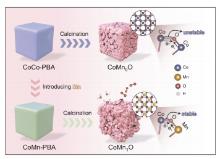
Fig 1
Schematic diagram of the synthesis procedure for CoMn0O and CoMn1O."
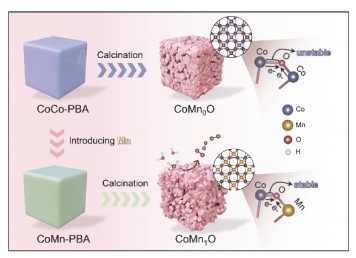
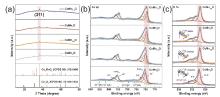
Fig 2
(a) XRD, (b) Co 2p, and (c) O 1s XPS spectra of CoMn1.5O, CoMn1O, CoMn0.5O and CoMn0O."
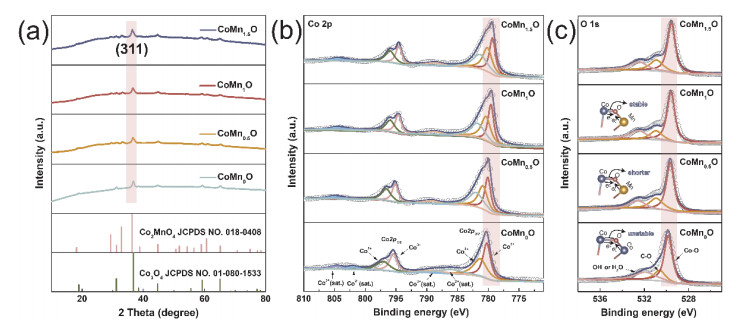
Fig 3
SEM images of (a) CoCo PBA, (b) CoMn PBA, (c) CoMn0O, (d) CoMn0.5O, (e) CoMn1O, and (f) CoMn1.5O."
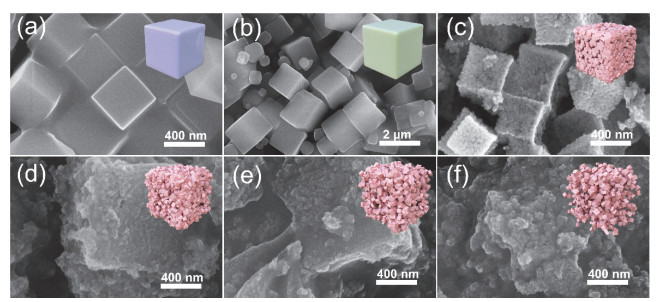
Fig 4
(a) TEM image, (b, c) HRTEM images, and (d–f) EDS elemental maps of Co, Mn, and O from the TEM image of CoMn1O. (g) EDS elemental atomic ratios of CoMn1.5O, CoMn1O, CoMn0.5O, and CoMn0O."
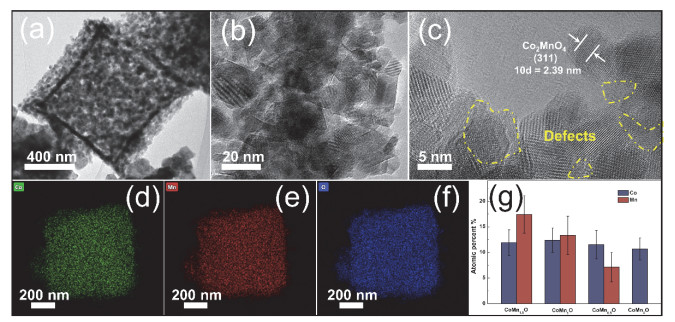
Fig 5
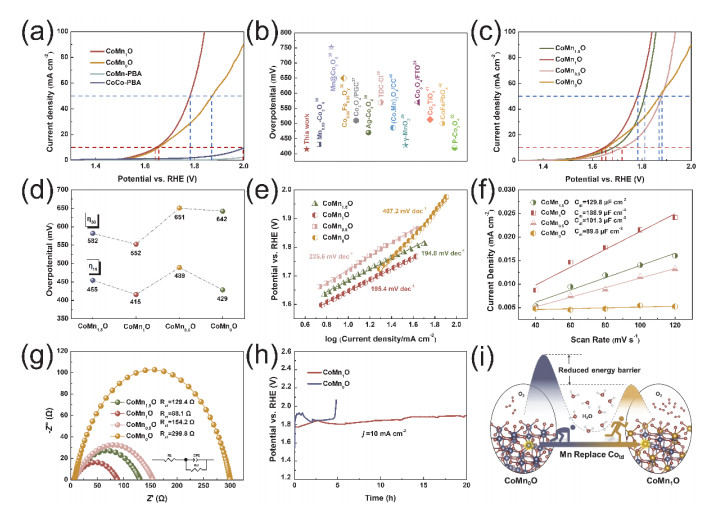
The electrochemical tests of CoMn1O and the comparison samples were performed using a standard three-electrode system in 0.5 mol∙L−1 H2SO4: (a) LSV curves of CoMn1O, CoMn0O, and their precursors; (b) comparison of overpotential of CoMn1O with those of other reported catalysts; (c) LSV curves of CoMn1O and comparison samples with different Mn ratios; (d) relative overpotentials; (e) Tafel plots; (f) Cdl; (g) Nyquist plots; and (h) stability of CoMn1O and CoMn0O at 10 mA∙cm–2 investigated using chronoamperometry (CA). (i) Schematic diagram of catalytic mechanism."
| 1 |
doi: 10.1002/adma.202107956 |
| 2 |
doi: 10.1016/j.jechem.2023.02.032 |
| 3 |
doi: 10.1016/j.apcatb.2023.122633 |
| 4 |
doi: 10.1016/j.jallcom.2022.167789 |
| 5 |
doi: 10.1039/D2QI00003B |
| 6 |
doi: 10.1016/j.nanoen.2020.104761 |
| 7 |
doi: 10.1002/adfm.202212160 |
| 8 |
doi: 10.1002/adma.201903909 |
| 9 |
doi: 10.1038/s41560-019-0407-1 |
| 10 |
doi: 10.1038/nchem.2874 |
| 11 |
doi: 10.1016/j.apcatb.2021.120834 |
| 12 |
doi: 10.1016/j.apsusc.2022.154727 |
| 13 |
doi: 10.1002/adfm.202003935 |
| 14 |
doi: 10.1002/aenm.201904114 |
| 15 |
doi: 10.1002/smtd.202101236 |
| 16 |
doi: 10.1002/anie.201406455 |
| 17 |
doi: 10.1039/C5SC00518C |
| 18 |
doi: 10.1021/acsenergylett.9b01129 |
| 19 |
doi: 10.1016/j.ensm.2016.11.001 |
| 20 |
doi: 10.1039/D0TA04331A |
| 21 |
doi: 10.1021/acsami.1c07267 |
| 22 |
doi: 10.1016/j.jcis.2023.03.036 |
| 23 |
doi: 10.1002/anie.200805534 |
| 24 |
doi: 10.1021/acs.chemmater.6b02879 |
| 25 |
doi: 10.1002/aenm.201500991 |
| 26 |
doi: 10.1002/anie.201813361 |
| 27 |
doi: 10.1126/science.aaf5050 |
| 28 |
doi: 10.1021/acsenergylett.1c00283 |
| 29 |
doi: 10.1021/acsami.9b13697 |
| 30 |
doi: 10.1016/j.fuel.2022.126361 |
| 31 |
|
| 32 |
doi: 10.1016/j.jechem.2020.02.031 |
| 33 |
doi: 10.1002/adma.202110103 |
| 34 |
doi: 10.1016/j.ensm.2019.02.014 |
| 35 |
doi: 10.1039/D2RA04570B |
| 36 |
doi: 10.1039/C9CC01369E |
| 37 |
doi: 10.1016/j.jechem.2020.01.026 |
| 38 |
doi: 10.1039/C8TA00070K |
| 39 |
doi: 10.1021/acsami.6b00437 |
| 40 |
doi: 10.1016/j.apcatb.2021.120442 |
| 41 |
doi: 10.1021/acs.inorgchem.9b00868 |
| 42 |
doi: 10.1038/s41929-019-0277-8 |
| 43 |
doi: 10.1002/aenm.202300765 |
| 44 |
doi: 10.1016/j.apcatb.2023.122660 |
| [1] | Fangxuan Liu, Ziyan Liu, Guowei Zhou, Tingting Gao, Wenyu Liu, Bin Sun. Hollow structured photocatalysts [J]. Acta Phys. -Chim. Sin., 2025, 41(7): 100071-. |
| [2] | Xinyu Miao, Hao Yang, Jie He, Jing Wang, Zhiliang Jin. Adjusting the electronic structure of Keggin-type polyoxometalates to construct S-scheme heterojunction for photocatalytic hydrogen evolution [J]. Acta Phys. -Chim. Sin., 2025, 41(6): 100051-. |
| [3] | Yi YANG,Lai-Ming LUO,Di CHEN,Hong-Ming LIU,Rong-Hua ZHANG,Zhong-Xu DAI,Xin-Wen ZHOU. Synthesis and Electrocatalytic Properties of PtPd Nanocatalysts Supported on Graphene for Methanol Oxidation [J]. Acta Phys. -Chim. Sin., 2017, 33(8): 1628-1634. |
| [4] | Yi YANG,Lai-Ming LUO,Juan-Juan DU,Rong-Hua ZHANG,Zhong-Xu DAI,Xin-Wen ZHOU. Hollow Pt-Based Nanocatalysts Synthesized through Galvanic Replacement Reaction for Application in Proton Exchange Membrane Fuel Cells [J]. Acta Phys. -Chim. Sin., 2016, 32(4): 834-847. |
| [5] | Xiao-Mei. HAN,Yan-Bo. WU,Heng-Yan. ZHAO,Jun. BI,Bin-Bin. WEI. Preparation and Supercapacitor Properties of Carbon-Coated SnO2 Hollow Fibers [J]. Acta Phys. -Chim. Sin., 2015, 31(11): 2220-2228. |
| [6] | MA Xue-Hui; ZHAO Yan-Bao; WU Zhi-Shen. Preparation of Surface-Modified Hollow LaF3 Nanoparticles and Their Tribological Performances [J]. Acta Phys. -Chim. Sin., 2008, 24(11): 2037-2041. |
|
||