Acta Phys. -Chim. Sin. ›› 2025, Vol. 41 ›› Issue (2): 100018.doi: 10.3866/PKU.WHXB202310046
Special Issue: Next-Generation Optoelectronic Functional Materials
• REVIEW • Previous Articles
Recent Advances of Functional Nanomaterials for Screen-Printed Photoelectrochemical Biosensors
Yang Meiqing1, Lu Wang2, Haozi Lu2, Yaocheng Yang3,*( ), Song Liu2,*()
- 1 Zoology Key Laboratory of Hunan Higher Education, College of Life and Environmental Science, Hunan University of Arts and Science, Changde 415000, Hunan Province, China
2 Institute of Chemical Biology and Nanomedicine (ICBN), State Key Laboratory of Chemo/Biosensing and Chemometrics, College of Chemistry and Chemical Engineering, Hunan University, Changsha 410082, China
3 Department of Orthopaedics, The Second Xiangya Hospital, Central South University, Changsha 410011, China
-
Received:2023-10-31Revised:2023-11-29Accepted:2023-11-30Published:2024-01-09 -
Contact:Email: yangyaocheng@csu.edu.cn (Yaocheng Yang)liusong@hnu.edu.cn (Song Liu) -
Supported by:the Doctoral Research Start-up Fund of Hunan University of Arts and Science(21BSQD43); the Natural Science Foundation of Hunan Province, China(2023JJ40463); the National Natural Science Foundation of China(22175060)

Cite this article
Yang Meiqing, Lu Wang, Haozi Lu, Yaocheng Yang, Song Liu. Recent Advances of Functional Nanomaterials for Screen-Printed Photoelectrochemical Biosensors[J]. Acta Phys. -Chim. Sin. 2025, 41(2), 100018. doi: 10.3866/PKU.WHXB202310046
share this article
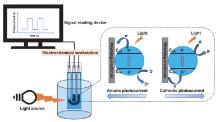
Fig 1
Schematic diagram of the general working principle of PEC sensing."
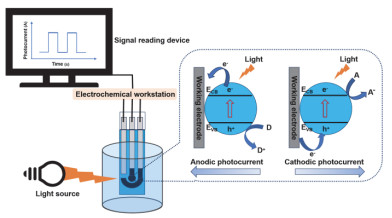
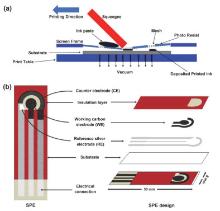
Fig 2
(a) Diagram of SPE fabrication process. (b) Diagram of the SPE with specific design. (a, b) Adapted with permission from Ref. 21, Copyright 2021 Elsevier."
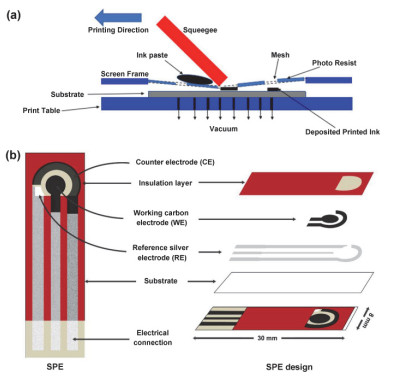
Table 1
Summary of metal oxide-based screen-printed PEC biosensors."
| Electrode | Photoactive material | Recognition element | Target | Limit of detection | Linear range | Ref. |
| CdS/ZnO/PDDA-CNTs/PWE | CdS QD/ZnO spheres | antibody | CEA | 4 pg∙mL−1 | 0.01 to 50 ng·mL−1 | |
| CdS/ZnO/Au@Pt-PWE | CdS QD/ZnO nanorods | antibody | CEA; AFP | CEA: 0.3 pg·mL−1; AFP: 0.5 pg·mL−1 | 1.0 pg·mL−1 to 100 ng·mL−1 | |
| ZnO/Au PWE | CdS nanorods/ ZnO spheres | antibody | PSA | 2.3 pg·mL−1 | 0.005 to 150 ng·mL−1 | |
| CdS/ZnO/rGO-PWE | CdS QDs/ZnO nanorods | antibody | CA 125 | 2.0 × 10⁻⁴ U·mL−1 | 5.0 × 10⁻⁴ U·mL−1 to 500 U·mL−1 | |
| CdS/ZnO/rGO/cellulose | CdS QDs/leaf-shape ZnO | capture DNA | adenosine; potassium ion | adenosine: 0.15 nM *; potassium ion: 0.06 nM | adenosine: 0.5 nM to 50 μM; potassium ion: 0.1 nM to 50 μM | |
| CdS/ZnO/PAE | CdS QDs/ZnO nanotubes | aptamer | PSA | 0.34 pg·mL−1 | 0.001 to 80 ng·mL−1 | |
| CdS/rGO/ZnO/Au-PWE | CdS QDs/rGO/ ZnO nanorods | hairpin DNA | miRNA-21; miRNA-122b; miRNA-7f | miRNA-21: 0.32 fM; miRNA-122b: 0.37 fM; miRNA-7f: 3.8 fM | miRNA-21: 0.5 fM to 100 pM; miRNA-122b: 0.5 fM to 100 pM; miRNA-7f: 10 fM to 100 pM | |
| CdSe/ZnO/Au/SPCE | CdSe QDs/ZnO networks | aptamer | ATP | 6.3 nM | 10 nM to 3 μM | |
| CdTe/ZnO/Au-PWE | CdTe QDs/ZnO spheres | aptamer | MCF-7 cell | 21 cells·mL−1 | 63–1.0 × 10⁷ cell·mL−1 | |
| ZnO/CuInS2/PAE | ZnO nanoflakes/ CuInS2/Ag2Se QDs | hairpin DNA | miRNA-141 | 16.7 fM | 50 fM to 100 pM | |
| Au/ZnO/graphene/ITO | ZnO naospheres/graphene | aptamer | SK-BR-3 breast cancer cell | 58 cells·mL−1 | 1 × 10²−1 × 10⁶ cells·mL−1 | |
| N-Cdots/ZnO/ Au@3D-rGO/cellulose | N-Cdots/astroid ZnO | aptamer | thrombin | 16.7 fM | 50 fM to 1000 pM | |
| GQDs/ZnO/Au | ZnO nanorods/GQDs/Ag2Se QDs | aptamer | MCF-7 cell | 198 cells·mL−1 | 5.0 × 10² to 5.0 × 10⁶ cells·mL−1 | |
| Ag2Se/GQDs/ZnO/Au-PWE | Ag2Se/GQDs/ZnO nanosheets | DNA | miRNA-141 | 52 aM | 0.15 fM to 2 nM | |
| ZnNc-COOH/ZnO/Au-PWE | ZnNc-COOH/ZnO nanorods | antibody | CEA | 1.6 pg·mL−1 | 0.005–100 ng·mL−1 | |
| AuNPs/CS/TiO2-graphene/CS/SPCE | TiO2 nanobelts-graphene | antibody | CEA | 0.28 pg·mL−1 | 0.5–8000 pg·mL−1 | |
| Amb/Nix-gC3N4/TiO2/SPCE | Amb/Nix-gC3N4/TiO2 nanoparticles | antibody | PSA | 0.06 fg·mL−1 | 10−16–10−8 g·mL−1 | |
| N-Cdots/TiO2-Pt/PWE | N-Cdots/TiO2 nanoparticle | aptamer | CEA | 1.0 pg·mL−1 | 0.002–200 ng·mL−1 | |
| N-Cdots/TiO2/Pt/PWE | N-Cdots/TiO2 nanotubes | primer strand | CEA | 0.48 pg·mL−1 | 0.001–200 ng·mL−1 | |
| CdS/TiO2/Au-PWE | CdS/TiO2 | antibody | CEA | 0.065 pg·mL−1 | 0.1 pg·mL−1–5 μg·mL−1 | |
| cellulose paper/PSATs/CdS | PSATs/CdS | ssDNA | cTnI | 0.47 fg·mL−1 | 1.2 fg·mL−1–20 ng·mL−1 | |
| TiO2@Au/ITO | TiO2@Au/CdS Z-scheme structure | ssDNA | nine HPV genotyping | 0.1 copies·μL−1 | 0.6–600 copies·μL−1 | |
| TiO2/MIL-125-NH2/Au-PWE | TiO2/MIL-125-NH2 | DNA | miRNA-182-5p | 0.09 fM | 10–16 to 10–10 M | |
| CuO/rGO/cellulose | CuO nanoflowers | aptamer | ATP | 2.1 nM | 5.0 to 3.0 × 10³ nM | |
| Bi2S3-BiVO4/Cu2O/PAE | BiVO4-Bi2S3/Cu2O | hairpin DNA | miRNA-141 | 0.17 fM | 0.5 fM to 5 nM | |
| BiVO4/Cu2O/rGO-PWE | BiVO4/Cu2O | DNA | miRNA-141 | 83 aM | 0.25 fM to 1 nM | |
| Au-PWE/FeOOH/Cu2O/CuS | FeOOH/Cu2O/CuS | DNA | miRNA-141 | 0.11 fM | 0.3 fM to 10 nM | |
| WO3/SPE | flower-like WO3 | antibody | okadaic acid | 0.007 ng·mL−1 | 0.01–60 ng·mL−1 | |
| WO3/Fe2O3/Au-PWE | WO3/Fe2O3 | aptamer | mucin 1; miRNA-21 | mucin 1: 3.4 fg·mL−1; miRNA-21: 36 fM | mucin 1: 10 fg·mL−1–100 ng·mL−1; miRNA-21: 0.1 pM–10 nM | |
| In2S3-P/WO3/Au-PWE | In2S3-P/WO3 | aptamer | OTA | 0.052 pg·mL−1 | 10−13 to 10−7 g·mL−1 | |
| SnO2 QD/rGO/Au-PWE | SnO2 QD/rGO | ssDNA | ATP | 0.025 pM | 0.1 pM to 100 nM | |
| Sn-self doped SnO2−x/Au-PWE | Sn-self doped SnO2−x nanotubes | antibody | AFP | 3.84 pg·mL−1 | 10 pg·mL−1 to 200 ng·mL−1 | |
| CeO2-PTNs | CeO2-PTNs heterostructure | hairpin DNA | thrombin | 6.7 fM | 0.02 pM to 100 pM | |
| CQDs-MnO2/SPCE | CQDs-MnO2 heterojunctions | antibody | AFP | 9.3 pg·mL−1 | 0.01 to 100 ng·mL−1 | |
| In2O3-In2S3/SPE | In2O3-In2S3 | Cas12a-CrRNA | HPV-16 | 1.2 pM | 5.0 to 5000 pM |
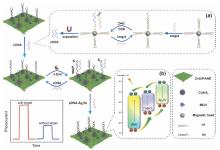
Fig 3
Schematic diagram of the paper-based PEC biosensor for miRNA-141 detection. (a) DSN-propelled target recycling procedure. (b) Electron transfer mechanism of the ZnO/CuInS2/Ag2Se photoactive structure. (a, b) Adapted with permission from Ref. 45, Copyright 2022 Elsevier."
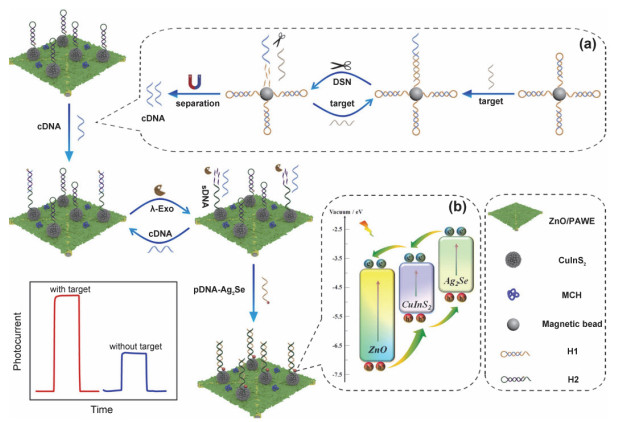
Fig 4
(a) Fabrication procedure of the competitive PEC immunosensor for CEA detection. (b) Diagram of the photocurrent generation mechanism of the PEC immunosensor, SPCWE and SPCCE represent screen-printed carbon working electrode and screen-printed carbon counter electrode, respectively. (a, b) Adapted with permission from Ref. 55, Copyright 2015 Elsevier."
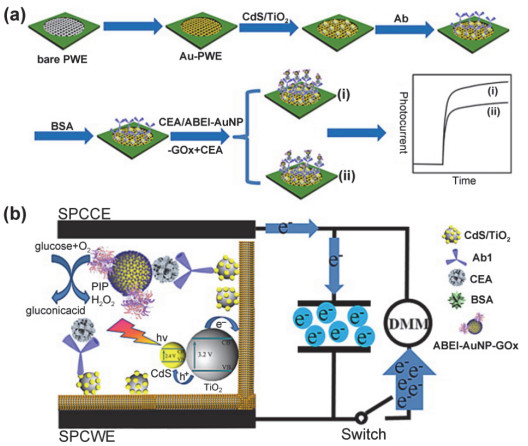
Fig 5
Schematic diagram of the O2-H2O2-O2 circulation system. (a) Running of the O2-H2O2-O2 circulation. (b) DSN-induced target recycling reaction. (c) Target-induced interruption of the O2-H2O2-O2 circulation. (a–c) Adapted with permission from Ref. 61, Copyright 2021 American Chemical Society."
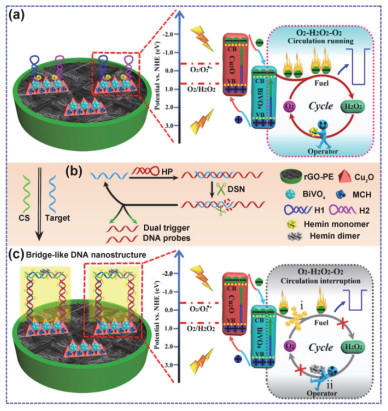
Table 2
Summary of metal chalcogenide-based screen-printed PEC biosensors."
| Electrode | Photoactive material | Recognition element | Target | Limit of detection | Linear range | Ref. |
| CdS/PDDA-CNTs/PWE | CdS NPs | antibody | CEA | 2.1 pg·mL−1 | 0.01 to 50 ng·mL−1 | |
| CdS/PDDA-CNTs/PWE | CdS NPs | aptamer | ATP | 0.2 pM | 1.0 pM to 1.0 nM | |
| CdS/PDDA-GR/ Au-PWE | CdS NPs | ssDNA | DNA | 15 fM | 50.0 fM to 100 nM | |
| CdS/SPCE | CdS QDs | antibody | HSA | 1.97 ng·mL−1 | 0 to 100 ng·mL−1 | |
| CdS-Fe3O4/SPE | CdS QDs-Fe3O4 | antibody | AFB1 | 5.0 pg·mL−1 | 0.01 to 80 ng·mL−1 | |
| Au/SPCE | Au/PANI@CdS | antibody | Cyfra 21-1 | 0.035 pg·mL−1 | 0.1 pg·mL−1 – 100 ng·mL−1 | |
| CdS@CdMoO4/ SPE | hollow CdS/CdMoO4 heterostructures | antibody | CEA | 11.3 pg·mL−1 | 0.02 to 50.0 ng·mL−1 | |
| EGNPs/CdTe-GO/SPE | CdTe QDs-GO | aptamer | 17β-estradiol | 0.01 pM | 0.04 to 10 pM | |
| Au/SPE | SnSe QD | antibody | CA19-9 | 0.0011 U·mL−1 | 0.005–100 U·mL−1 | |
| MSPPE | rGO-MoS2 sheets | antibody | Escherichia coli O157:H7 | 2.0 CFU·mL−1 | 5.0 – 5.0 × 10⁶ CFU·mL−1 | |
| ZnIn2S4/SPE | ZnIn2S4 | antibody | AFP | 0.01 ng·mL−1 | 0.05 to 1 ng·mL−1 and 5 to 100 ng·mL−1 | |
| Co9S8@ZnIn2S4/ SPE | Co9S8@ZnIn2S4 heterostructures | antibody | HER2 | 3.5 pg·mL−1 | 0.01 to 10 ng·mL−1 | |
| CuInS2/CoIn2S4/ Au-WE | CuInS2/CoIn2S4 | hairpin DNA | miRNA-141 | 0.29 pM | 0.5 pM to 2 nM |
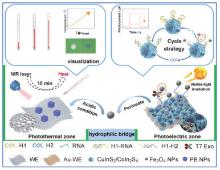
Fig 6
Schematic diagram of a lab-on-paper thermoresponsive-photoelectric biosensor for on-site detection of miRNA-141. Adapted with permission from Ref. 85, Copyright 2022 American Chemical Society."
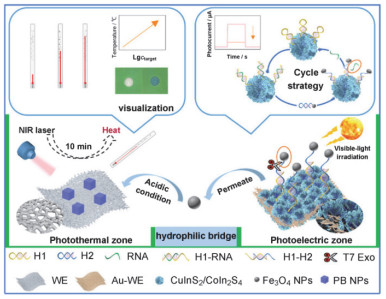
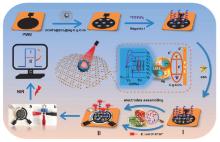
Fig 7
Fabrication process of a NIR-responsive PEC biosensor for the detection of E. coli O157:H7. Adapted with permission from Ref. 92, Copyright 2022 Elsevier."
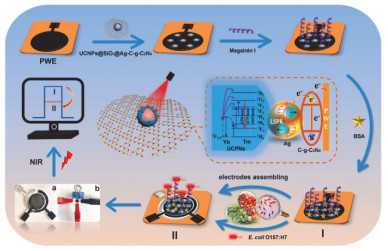
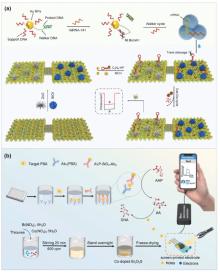
Fig 8
(a) Schematic diagram of the dual-engine PEC biosensor based on a 3D DNA nanomachine-mediated CRISPR/Cas12a shearing tool. (b) Fabrication procedure of a portable smartphone-based PEC immunosensor for PSA detection. (a) Adapted with permission from Ref. 97, Copyright 2022 American Chemical Society. (b) Adapted with permission from Ref. 99, Copyright 2023 Elsevier."
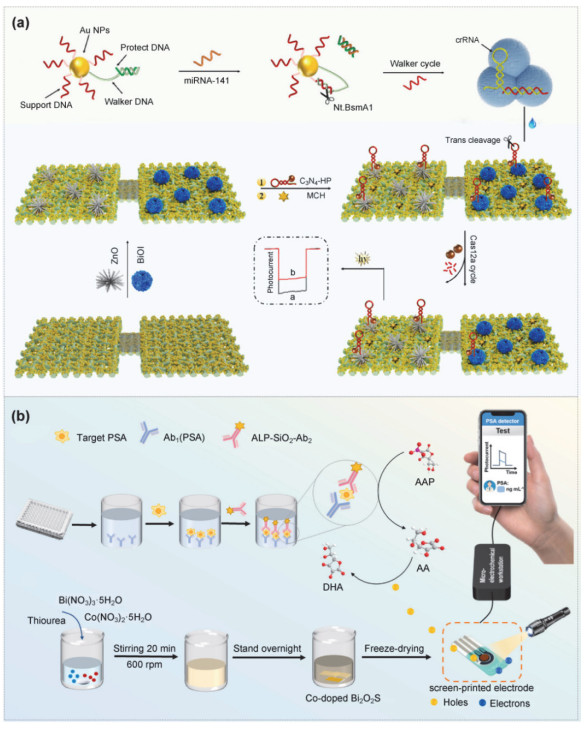
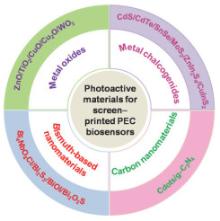
Fig 9
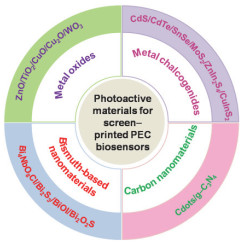
Photoactive materials for PEC biosensors."
| 1 |
doi: 10.1007/s42823-022-00419-6 |
| 2 |
doi: 10.1021/acs.analchem.9b04199 |
| 3 |
doi: 10.1016/j.trac.2020.116020 |
| 4 |
doi: 10.1039/c9tb02844g |
| 5 |
doi: 10.3390/chemosensors10010014 |
| 6 |
doi: 10.1016/j.trac.2023.117149 |
| 7 |
doi: 10.1016/j.bios.2023.115400 |
| 8 |
doi: 10.1007/s11426-009-0271-0 |
| 9 |
doi: 10.3866/PKU.WHXB201611141 |
|
阮弋帆; 张楠; 朱圆城; 赵伟伟; 徐静娟; 陈洪渊. 物理化学学报, 2017, 33, 476.
doi: 10.3866/PKU.WHXB201611141 |
|
| 10 |
doi: 10.1016/j.bios.2017.04.030 |
| 11 |
doi: 10.1016/j.ccr.2022.214675 |
| 12 |
doi: 10.1016/j.bioelechem.2020.107590 |
| 13 |
doi: 10.1016/j.trac.2020.115814 |
| 14 |
doi: 10.1016/j.bios.2022.114811 |
| 15 |
doi: 10.1039/c9tb01644a |
| 16 |
doi: 10.1016/j.apcatb.2019.02.044 |
| 17 |
doi: 10.1016/j.trac.2016.01.032 |
| 18 |
doi: 10.3390/bios6040050 |
| 19 |
doi: 10.1016/j.bios.2016.07.005 |
| 20 |
doi: 10.1016/j.trac.2019.03.021 |
| 21 |
doi: 10.1016/j.trac.2021.116254 |
| 22 |
doi: 10.3390/bios10040032 |
| 23 |
doi: 10.3390/bios10090118 |
| 24 |
doi: 10.1016/j.msec.2015.12.031 |
| 25 |
doi: 10.3390/biomedicines9050540 |
| 26 |
doi: 10.1016/j.jphotochemrev.2015.06.002 |
| 27 |
doi: 10.1039/d0tb01191f |
| 28 |
doi: 10.1016/j.bios.2020.112476 |
| 29 |
doi: 10.1007/s10853-020-05499-1 |
| 30 |
doi: 10.1016/j.mtchem.2022.101129 |
| 31 |
doi: 10.1016/j.aca.2012.05.018 |
| 32 |
doi: 10.1016/j.talanta.2010.08.033 |
| 33 |
doi: 10.1016/j.talanta.2015.06.011 |
| 34 |
doi: 10.1016/j.eti.2022.102922 |
| 35 |
doi: 10.3390/bios13040453 |
| 36 |
doi: 10.1039/c3cc45856c |
| 37 |
doi: 10.1039/c4tb01570c |
| 38 |
doi: 10.1039/c4tb01119h |
| 39 |
doi: 10.1016/j.snb.2016.04.166 |
| 40 |
doi: 10.1021/acs.analchem.8b01844 |
| 41 |
doi: 10.1016/j.bios.2019.111786 |
| 42 |
doi: 10.1016/j.bios.2018.08.028 |
| 43 |
doi: 10.1016/j.talanta.2020.121517 |
| 44 |
doi: 10.1021/acsami.6b11966 |
| 45 |
doi: 10.1016/j.snb.2022.132374 |
| 46 |
doi: 10.1016/j.bios.2013.07.066 |
| 47 |
doi: 10.1021/acsami.7b12338 |
| 48 |
doi: 10.1021/acs.analchem.8b00153 |
| 49 |
doi: 10.1021/acs.analchem.9b03638 |
| 50 |
doi: 10.1039/c4tb00623b |
| 51 |
doi: 10.1016/j.electacta.2013.09.009 |
| 52 |
doi: 10.1021/acsami.2c03106 |
| 53 |
doi: 10.1021/acsami.8b03632 |
| 54 |
doi: 10.1021/acs.analchem.8b02849 |
| 55 |
doi: 10.1016/j.snb.2014.11.088 |
| 56 |
doi: 10.1016/j.bios.2019.01.038 |
| 57 |
doi: 10.1016/j.bios.2023.115059 |
| 58 |
doi: 10.1021/acs.analchem.2c05686 |
| 59 |
doi: 10.1016/j.bios.2019.02.027 |
| 60 |
doi: 10.1021/acsami.9b22558 |
| 61 |
doi: 10.1021/acsami.1c03891 |
| 62 |
doi: 10.1016/j.cej.2021.132846 |
| 63 |
doi: 10.1016/j.bios.2021.113278 |
| 64 |
doi: 10.1021/acsami.0c19853 |
| 65 |
doi: 10.1021/acs.analchem.1c04259 |
| 66 |
doi: 10.1039/c4tb00233d |
| 67 |
doi: 10.1016/j.bios.2021.113250 |
| 68 |
doi: 10.1016/j.bios.2019.03.022 |
| 69 |
doi: 10.1039/d2nj01954j |
| 70 |
doi: 10.1021/acs.analchem.2c01373 |
| 71 |
doi: 10.1016/j.bioelechem.2021.108000 |
| 72 |
doi: 10.1016/j.microc.2021.106644 |
| 73 |
doi: 10.1039/c3cc00149k |
| 74 |
doi: 10.1021/ac4001496 |
| 75 |
doi: 10.1039/c3lc50430a |
| 76 |
doi: 10.1039/d0an01950j |
| 77 |
doi: 10.1039/c4ra15918g |
| 78 |
doi: 10.1016/j.biosx.2022.100207 |
| 79 |
doi: 10.1016/j.talanta.2022.124176 |
| 80 |
doi: 10.1016/j.jelechem.2022.116284 |
| 81 |
doi: 10.1007/s00604-023-05718-x |
| 82 |
doi: 10.1021/acsami.2c13292 |
| 83 |
doi: 10.1016/j.bios.2020.112158 |
| 84 |
doi: 10.34133/2022/9831521 |
| 85 |
doi: 10.1021/acssensors.2c01162 |
| 86 |
doi: 10.1039/c5cc04092b |
| 87 |
doi: 10.1016/j.bios.2017.07.065 |
| 88 |
doi: 10.1039/c9nr01675a |
| 89 |
doi: 10.1039/c3cc48421a |
| 90 |
doi: 10.1016/j.electacta.2022.141094 |
| 91 |
doi: 10.1016/j.electacta.2023.142271 |
| 92 |
doi: 10.1016/j.bios.2022.114022 |
| 93 |
doi: 10.1021/acs.analchem.8b04662 |
| 94 |
doi: 10.1021/acs.analchem.3c01006 |
| 95 |
doi: 10.1016/j.ccr.2021.214156 |
| 96 |
doi: 10.1016/j.foodchem.2023.136999 |
| 97 |
doi: 10.1021/acs.analchem.2c01717 |
| 98 |
doi: 10.1016/j.bios.2022.115028 |
| 99 |
doi: 10.1016/j.bios.2023.115260 |
| 100 |
doi: 10.1016/j.snb.2023.134054 |
| [1] | XU Xian-Jin, SU Ji-Guo, LIU Bin, LI Chun-Hua, TAN Jian-Jun, ZHANG Xiao-Yi, CHEN Wei-Zu, WANG Cun-Xin. Reverse Virtual Screening on Persistent Organic Pollutants 4,4’-DDE and CB-153 [J]. Acta Phys. -Chim. Sin., 2013, 29(10): 2276-2285. |
| [2] | HE Chuan-Xin, YUAN An-Peng, ZHANG Qian-Lin, REN Xiang-Zhong, LI Cui-Hua, LIU Jian-Hong. Adsorption of Core-Shell Poly(Methyl Methacrylate)-Bovine Serum Albumin Nanoparticles on Gold Surface and Its Sensor Application [J]. Acta Phys. -Chim. Sin., 2012, 28(11): 2721-2728. |
| [3] | LI Jin-Hua, LI JING, FANG Xuan, WANG Xiao-Hua, WEI Zhi-Peng. Fabrication and Characteristic of ZnO Glucose Oxidase Enzyme Electrode Based on Flexible Substrate [J]. Acta Phys. -Chim. Sin., 2012, 28(06): 1393-1397. |
| [4] | HE Sai-Nan, HU Cai-Yuan, XIAO Ge, ZHENG Hua-Jun. Hydrothermal Synthesis and Amperometric Determination of Hydrogen Peroxide of Highly-Dispersed MnO2 Nanofibers [J]. Acta Phys. -Chim. Sin., 2012, 28(03): 630-634. |
| [5] | ZENG Han, LIAO Ling-Wen, LI Ming-Fang, TAO Qian, KANG Jing, CHEN Yan-Xia. Poly Aryl Amide and Multiwalled Carbon Nanotube Composite Supported Laccase Electrode and Its Electrochemical Behavior [J]. Acta Phys. -Chim. Sin., 2010, 26(12): 3217-3224. |
| [6] | GE Fang, CAO Rui-Guo, ZHU Bin, LI Jing-Jian, XU Dong-Sheng. DNA Electrochemical Biosensor for Trace Hg2+ Detection [J]. Acta Phys. -Chim. Sin., 2010, 26(07): 1779-1783. |
| [7] | CAO Rui-Guo, ZHU Bin, LIU Wei, LI Jing-Jian, XU Dong-Sheng. Electrochemical DNA Biosensor with a Polyamide Probe [J]. Acta Phys. -Chim. Sin., 2010, 26(04): 1119-1123. |
| [8] | MA Guo-Xian, ZHONG Qing-Dong, LU Xiong-Gang, LU Tian-Hong. Immobilization and Direct Electrochemistry of Horseradish Peroxidase on Large Cage-Like Mesoporous Silica FDU-12 [J]. Acta Phys. -Chim. Sin., 2009, 25(10): 2061-2067. |
| [9] | GUO Su;LIAO Wei;WEI Fang;QIAN Min-Xie;ZHAO Xin-Sheng . Protein Biosensors Based on Scanning Potential Hairpin Denaturation and Fluorescence Resonance Energy Transfer [J]. Acta Phys. -Chim. Sin., 2006, 22(08): 917-920. |
| [10] | Chen Zhi-Chun;Xu Shan-Hao;Lin Han-Feng;Yang Shao-Ming;Lin Xian-Fu. Glucose Oxidase Modified Electrode Fabricated by Layer-by-layer Molecular Deposition [J]. Acta Phys. -Chim. Sin., 2004, 20(10): 1267-1270. |
| [11] | Dai Zhi-Hui;Ju Huang-Xian. Direct Electron Transfer of Protein Immobilized on Mesoporous Molecular Sieves Matrix [J]. Acta Phys. -Chim. Sin., 2004, 20(10): 1262-1266. |
| [12] | Hong Long;Liao Wei;Wei Fang;Zhao Xin-Sheng;Zhu Sheng-Geng. Phage Antibody Chip for Discriminating Proteomes from Different Cells [J]. Acta Phys. -Chim. Sin., 2004, 20(10): 1182-1185. |
| [13] | Zhang Guo-Lin;Pan Xian-Hua;Kan Jin-Qing;Zhang Jing-Hui;Li Yong-Fang. Studies on Conducting Composite MaterialGlucose Oxidase Biosensor [J]. Acta Phys. -Chim. Sin., 2003, 19(06): 533-537. |
| [14] | Xue Huai-Guo,Zhong Lei,Shao Liang,Kan Jin-Qing,Mu Shao-Lin. Stusy on Inhibition of Xanthine Oxidase by Allopurinol [J]. Acta Phys. -Chim. Sin., 1996, 12(04): 310-314. |
|
||