Acta Phys. -Chim. Sin. ›› 2024, Vol. 40 ›› Issue (11): 2403032.doi: 10.3866/PKU.WHXB202403032
• ARTICLE • Previous Articles Next Articles
NH2-UIO-66 Based Hydrophobic Porous Liquid with High Mass Transfer and Affinity Surface for Enhancing CO2 Photoreduction
Yangrui Xu1, Yewei Ren1, Xinlin Liu2,*( ), Hongping Li3, Ziyang Lu1,4,*()
- 1 Institute of Environmental Health and Ecological Security, School of Emergency Management, School of the Environment and Safety Engineering, Jiangsu University, Zhenjiang 212013, Jiangsu Province, China
2 School of Energy and Power Engineering, Jiangsu University, Zhenjiang 212013, Jiangsu Province, China
3 Institute for Energy Research, Jiangsu University, Jiangsu, Zhenjiang 212013, Jiangsu Province, China
4 Jiangsu Collaborative Innovation Center of Technology and Material of Water Treatment, Suzhou University of Science and Technology, Suzhou 215009, Jiangsu Province, China
-
Received:2024-03-28Revised:2024-05-02Accepted:2024-05-06Published:2024-10-14 -
Contact:Email: liuxl@ujs.edu.cn (Xinlin Liu)luziyang126@126.com (Ziyang Lu) -
Supported by:the National Natural Science Foundation of China(22278190); Zhenjiang Carbon Emissions Peak/Carbon Neutrality Science and Technology Innovation Special Fund Project(CQ2022009); Open Project of State Key Laboratory of Structural Chemistry(20230022); Qing Lan Project of Jiangsu Province(2023); Jiangsu Collaborative Innovation Center of Technology and Material of Water Treatment, Project of Research on Educational Reform and Talent Development of School of Emergency Management of Jiangsu University(JG-03-11); the Special Scientific Research Project of School of Emergency Management of Jiangsu University(KY-C-12)

Cite this article
Yangrui Xu, Yewei Ren, Xinlin Liu, Hongping Li, Ziyang Lu. NH2-UIO-66 Based Hydrophobic Porous Liquid with High Mass Transfer and Affinity Surface for Enhancing CO2 Photoreduction[J]. Acta Phys. -Chim. Sin. 2024, 40(11), 2403032. doi: 10.3866/PKU.WHXB202403032
share this article
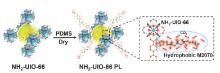
Fig 1
Illustration of synthesis approach for NH2-UIO-66 PL (The yellow sphere represents the cage shaped holes in the structure). Color online."
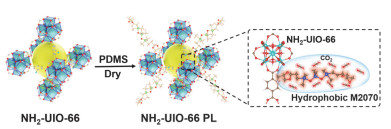
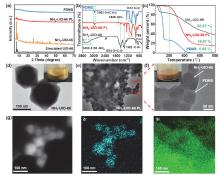
Fig 2
XRD (a) and FT-IR spectra (b) of different samples. (c) TGA curve of three different samples. TEM image of NH2-UIO-66 (d) and TEM image (e), HRTEM image (f) and HRTEM EDS mapping (g) of NH2-UIO-66 PL."
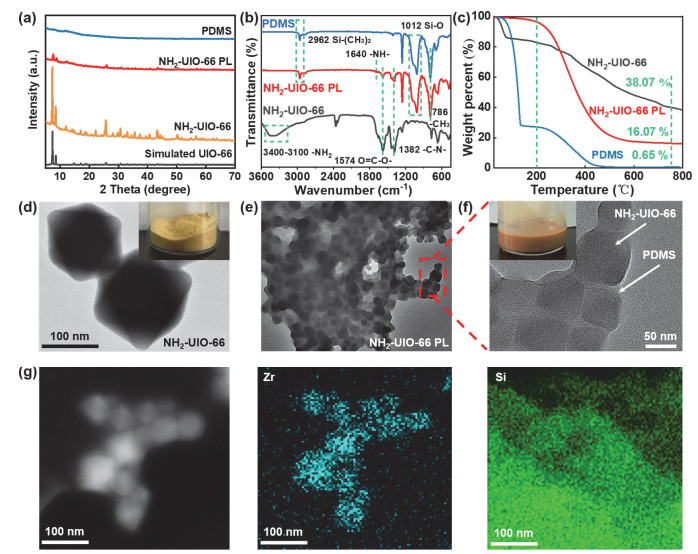
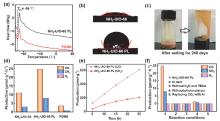
Fig 3
(a) DSC curves of NH2-UIO-66 PL and PDMS; (b) Hydrophilicity tests of NH2-UIO-66 and NH2-UIO-66 PL; (c) The fluidity of NH2-UIO-66 PL after setting for 240 days at 25 ℃. (d) Photocatalytic CO2 reduction yield of different samples; (e) Continuous stability experiment of photocatalytic CO2 reduction of NH2-UIO-66 PL; (f) Control experiment of NH2-UIO-66 PL."
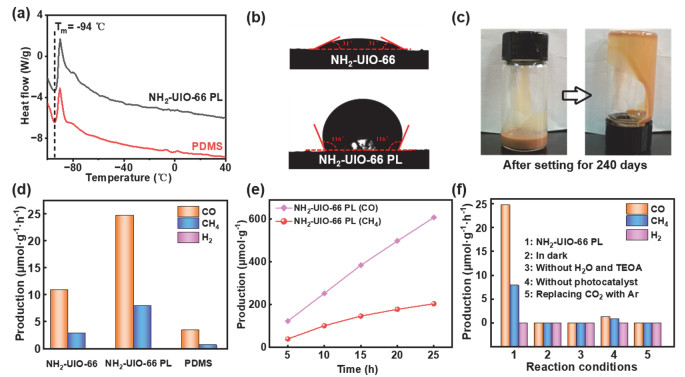
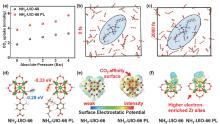
Fig 4
(a) CO2 adsorption experiment. (b, c) Molecular dynamic simulation of PDMS in CO2 reaction atmosphere. (d) Adsorption sites and adsorption energy calculation of NH2-UIO-66 and NH2-UIO-66 PL. (e) ESP calculation of NH2-UIO-66 and NH2-UIO-66 PL. (f) Differential charge simulation of NH2-UIO-66*CO2 and NH2-UIO-66 PL*CO2."
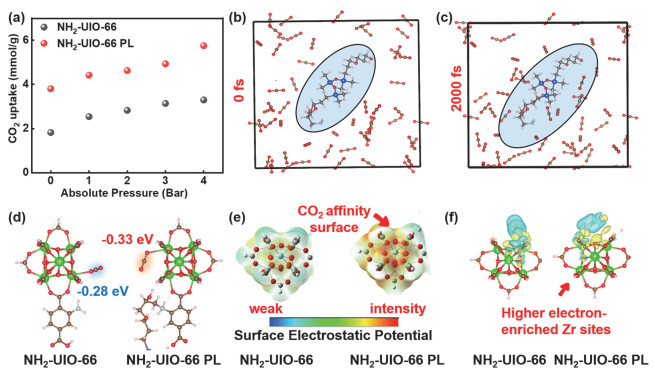
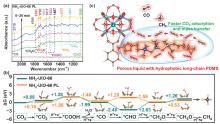
Fig 5
(a) In situ infrared spectrum of NH2-UIO-66 PL after adsorbing H2O and CO2 in the dark and illumination for 20 min. (b) The Gibbs free energy barrier calculation of NH2-UIO-66 and NH2-UIO-66 PL. (c) Mechanism diagram of photocatalytic CO2 by NH2-UIO-66 PL."
| 1 |
doi: 10.1016/j.cej.2018.12.034 |
| 2 |
doi: 10.1016/j.cej.2018.10.200 |
| 3 |
doi: 10.1002/adma.202208625 |
| 4 |
doi: 10.3866/PKU.WHXB202212027 |
| 5 |
doi: 10.1007/s10853-017-1200-9 |
| 6 |
doi: 10.1016/j.catcom.2018.04.003 |
| 7 |
doi: 10.14102/j.cnki.0254-5861.2022-0062 |
| 8 |
doi: 10.1039/C3RA00124E |
| 9 |
doi: 10.1039/C5RA08795C |
| 10 |
doi: 10.1016/j.surfin.2023.103483 |
| 11 |
doi: 10.1016/j.surfin.2022.102308 |
| 12 |
doi: 10.1016/j.apcatb.2021.120787 |
| 13 |
doi: 10.1016/S1872-2067(21)63930-X |
| 14 |
doi: 10.1002/anie.202214142 |
| 15 |
doi: 10.1002/smll.202305410 |
| 16 |
doi: 10.1016/j.jcis.2023.12.173 |
| 17 |
doi: 10.1016/j.apcatb.2019.118433 |
| 18 |
doi: 10.1039/C9TA01863H |
| 19 |
doi: 10.1016/j.cjsc.2023.100194 |
| 20 |
doi: 10.1016/j.surfin.2022.101910 |
| 21 |
doi: 10.1021/acscatal.4c00026 |
| 22 |
doi: 10.1002/aenm.201903879 |
| 23 |
doi: 10.1016/j.apcatb.2020.119173 |
| 24 |
doi: 10.1021/acscatal.2c01012 |
| 25 |
doi: 10.1016/j.apcatb.2020.119630 |
| 26 |
doi: 10.1016/j.cjsc.2023.100045 |
| 27 |
doi: 10.1016/S1872-2067(23)64556-5 |
| 28 |
doi: 10.1016/j.cej.2017.12.115 |
| 29 |
doi: 10.1016/j.cej.2014.03.077 |
| 30 |
doi: 10.1007/s40843-021-1845-3 |
| 31 |
doi: 10.1016/j.apsusc.2012.03.154 |
| 32 |
doi: 10.1039/C3RA44855J |
| 33 |
doi: 10.1016/S1872-2067(23)64552-8 |
| 34 |
doi: 10.3390/ma16020489 |
| 35 |
doi: 10.3390/agronomy11091822 |
| 36 |
doi: 10.1002/ange.202400857 |
| 37 |
doi: 10.1016/j.molstruc.2019.126892 |
| 38 |
doi: 10.1016/j.apsusc.2019.03.311 |
| 39 |
doi: 10.1016/j.cplett.2018.05.056 |
| 40 |
doi: 10.1016/S1872-2067(23)64554-1 |
| 41 |
doi: 10.1016/j.cej.2024.150163 |
| 42 |
doi: 10.3866/PKU.WHXB202209012 |
| 43 |
doi: 10.3866/PKU.WHXB202301023 |
| 44 |
doi: 10.1016/j.surfin.2023.103303 |
| 45 |
doi: 10.1021/acsanm.9b00113 |
| 46 |
doi: 10.1021/acscatal.2c01329 |
| 47 |
doi: 10.3866/pku.Whxb202209016 |
| 48 |
doi: 10.1002/adfm.202313695 |
| 49 |
doi: 10.1016/S1872-2067(22)64108-1 |
| 50 |
doi: 10.1016/j.apcatb.2023.122892 |
| 51 |
doi: 10.1016/j.cej.2023.142324 |
| 52 |
doi: 10.3866/PKU.WHXB202210038 |
| 53 |
doi: 10.3866/PKU.WHXB202211051 |
| 54 |
doi: 10.3866/PKU.WHXB202210003 |
| 55 |
doi: 10.3866/PKU.WHXB202212026 |
| [1] | Haotong Ma, Mingyu Heng, Yang Xu, Wei Bi, Yingchun Miao, Shuning Xiao. Synergistic carbon doping and Cu loading on boron nitride via microwave synthesis for enhanced atmospheric CO2 photoreduction [J]. Acta Phys. -Chim. Sin., 2025, 41(11): 100132-. |
| [2] | Yiting Huo, Xin Zhou, Feifan Zhao, Chenbin Ai, Zhen Wu, Zhidong Chang, Bicheng Zhu. Boosting photocatalytic CO2 methanation through TiO2/CdS S-scheme heterojunction and fs-TAS mechanism study [J]. Acta Phys. -Chim. Sin., 2025, 41(11): 100148-. |
| [3] | Gaopeng Liu, Lina Li, Bin Wang, Ningjie Shan, Jintao Dong, Mengxia Ji, Wenshuai Zhu, Paul K. Chu, Jiexiang Xia, Huaming Li. Construction of Bi Nanoparticles Loaded BiOCl Nanosheets Ohmic Junction for Photocatalytic CO2 Reduction [J]. Acta Phys. -Chim. Sin., 2024, 40(7): 2306041-. |
| [4] | Hui-Ying Chen, Hao-Lin Zhu, Pei-Qin Liao, Xiao-Ming Chen. Integration of Ru(Ⅱ)-Bipyridyl and Zinc(Ⅱ)-Porphyrin Moieties in a Metal-Organic Framework for Efficient Overall CO2 Photoreduction [J]. Acta Phys. -Chim. Sin., 2024, 40(4): 2306046-. |
| [5] | Yuejiao An, Wenxuan Liu, Yanfeng Zhang, Jianjun Zhang, Zhansheng Lu. Revealing Photoinduced Charge Transfer Mechanism of SnO2/BiOBr S-Scheme Heterostructure for CO2 Photoreduction [J]. Acta Phys. -Chim. Sin., 2024, 40(12): 2407021-. |
| [6] | Jianyu Qin, Yuejiao An, Yanfeng Zhang. In Situ Assembled ZnWO4/g-C3N4 S-Scheme Heterojunction with Nitrogen Defect for CO2 Photoreduction [J]. Acta Phys. -Chim. Sin., 2024, 40(12): 2408002-. |
| [7] | Yuehan Cao, Rui Guo, Minzhi Ma, Zeai Huang, Ying Zhou. Effects of Electron Density Variation of Active Sites in CO2 Activation and Photoreduction: A Review [J]. Acta Phys. -Chim. Sin., 2024, 40(1): 2303029-. |
| [8] | Yi Zhou, Weilong Ouyang, Yuejun Wang, Haiqiang Wang, Zhongbiao Wu. Core-Shell Structured NH2-UiO-66@TiO2 Photocatalyst for the Degradation of Toluene under Visible Light Irradiation [J]. Acta Phys. -Chim. Sin., 2021, 37(8): 2009045-. |
| [9] | Yanqiu Wang, Zixin Zhong, Tangkang Liu, Guoliang Liu, Xinlin Hong. Cu@UiO-66 Derived Cu+-ZrO2 Interfacial Sites for Efficient CO2 Hydrogenation to Methanol [J]. Acta Phys. -Chim. Sin., 2021, 37(5): 2007089-. |
| [10] | LIU Tian-Qing, SUN Wei, SUN Xiang-Yu, AI Hong-Ru. Mechanism and Condition Analysis of Condensed Drop Jumping on Super-Hydrophobic Surfaces [J]. Acta Phys. -Chim. Sin., 2012, 28(05): 1206-1212. |
| [11] | MU Dan, ZHOU Yi-Han. Molecular Dynamics Simulation of the Adsorption and Diffusion of a Single Hydrophobic Polymer Chain on a Hydrophobic Surface [J]. Acta Phys. -Chim. Sin., 2011, 27(02): 374-378. |
| [12] | LIU Tian-Qing, SUN Wei, SUN Xiang-Yu, AI Hong-Ru. Effect of Hierarchical Architecture of Super-Hydrophobic Surface on the Condensed Drop's Final State [J]. Acta Phys. -Chim. Sin., 2010, 26(11): 2989-2996. |
|
||