Acta Phys. -Chim. Sin. ›› 2024, Vol. 40 ›› Issue (12): 2408002.doi: 10.3866/PKU.WHXB202408002
Special Issue: Solar fuel preparation
• ARTICLE • Previous Articles Next Articles
In Situ Assembled ZnWO4/g-C3N4 S-Scheme Heterojunction with Nitrogen Defect for CO2 Photoreduction
Jianyu Qin, Yuejiao An, Yanfeng Zhang*( )
)
- National Demonstration Center for Experimental Chemistry Education, Hebei Key Laboratory of Inorganic Nano-materials, College of Chemistry and Materials Science, Hebei Normal University, Shijiazhuang 050024, China
-
Received:2024-08-01Revised:2024-09-02Accepted:2024-09-02Published:2024-11-09 -
Contact:Email: zhangyanfeng@hebtu.edu.cn (Yanfeng Zhang) -
Supported by:ebei Provincial Natural Science Foundation(B2020205013); ebei Provincial Natural Science Foundation(B2022205008); Science and Technology Project of Hebei Normal University of China(L2021K01); Innovation Capability Improvement Plan Project of Hebei Province(22567604H)

Cite this article
Jianyu Qin, Yuejiao An, Yanfeng Zhang. In Situ Assembled ZnWO4/g-C3N4 S-Scheme Heterojunction with Nitrogen Defect for CO2 Photoreduction[J]. Acta Phys. -Chim. Sin. 2024, 40(12), 2408002. doi: 10.3866/PKU.WHXB202408002
share this article
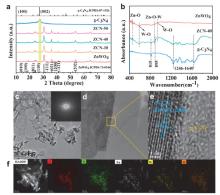
Fig 1
(a) XRD patterns of samples. (b) FTIR spectra of samples. (c, d)TEM and SAED images (inset) of ZCN-40. (e) HRTEM and (f) EDS-mapping images of ZCN-40."
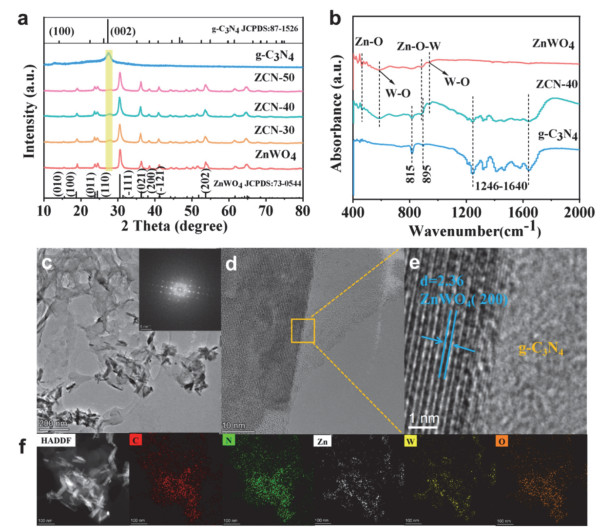
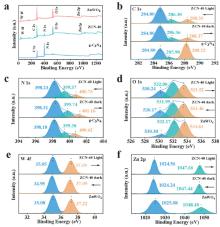
Fig 2
XPS spectra of (a) survey. High-resolution XPS spectra of (b) C 1s, (c) N 1s, (d) O 1s, (e) W 4f and (f) Zn 2p of g-C3N4, ZnWO4 and ZCN-40 in the dark and under light irradiation, respectively."
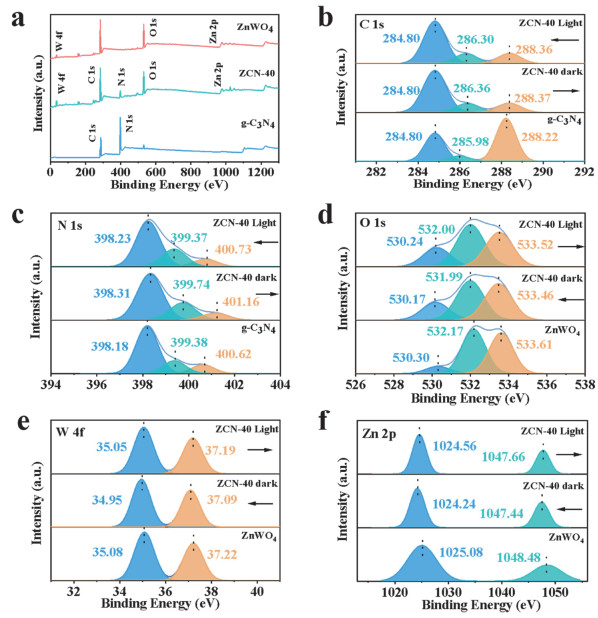
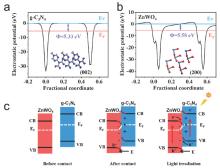
Fig 3
Calculated work function of (a) g-C3N4 (002) and (b) ZnWO4 (200) planes. (c) Schematic illustration of the mechanism of charge transfer and separation over ZnWO4/g-C3N4 heterojunctions."
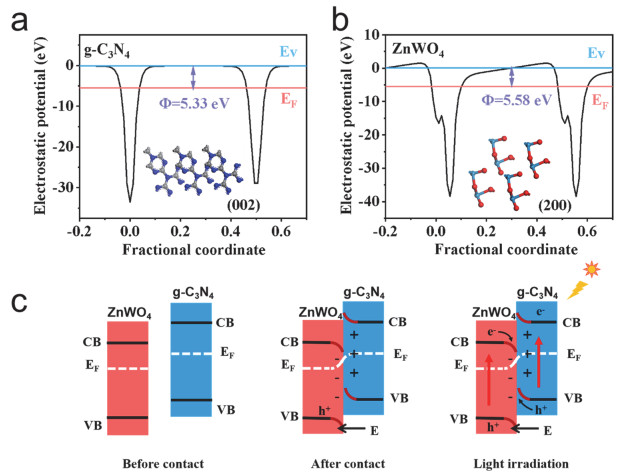
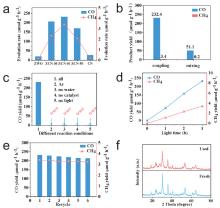
Fig 4
(a) Yields of CO and CH4 on pristine g-C3N4, ZnWO4 and ZnWO4/g-C3N4 with various amounts. (b) CO and CH4 yields under different preparation methods (mechanical mixture and in situ synthesized). (c) Yields of CO and CH4 under different reaction conditions with ZCN-40. (d) Yields of CO and CH4 with ZCN-40 at different irradiation time. (e) Recycling photocatalytic performance of ZCN-40. (f) XRD patterns of the used and fresh ZCN-40."
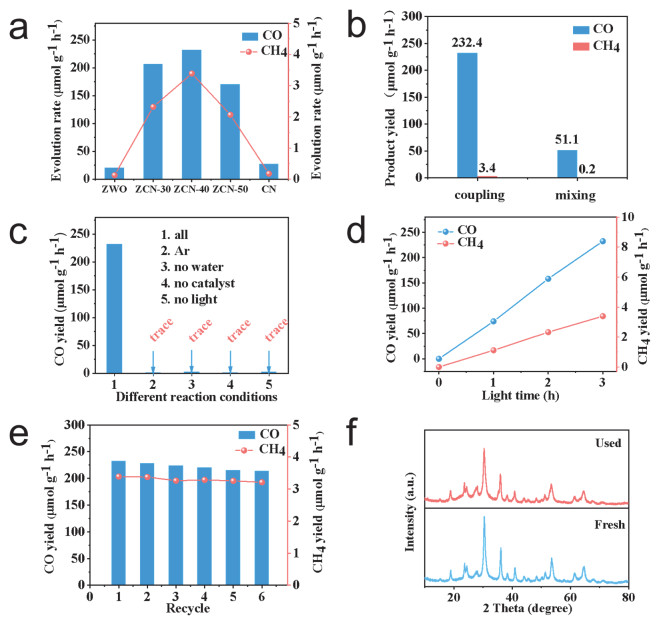
Fig 5
(a–c) In situ ESR spectra of pure ZnWO4, g-C3N4 and ZCN-40 in different environments. (d) Pore size distribution."
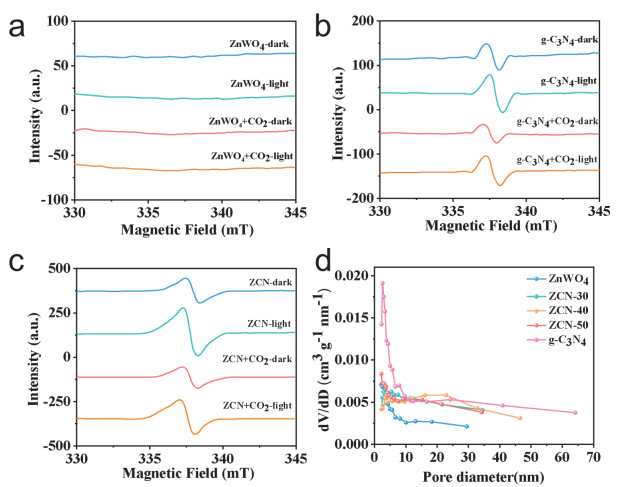
Fig 6
Band structure of (a) ZnWO4 and (b) g-C3N4. DOS plots of (c) ZnWO4 and (d) g-C3N4."
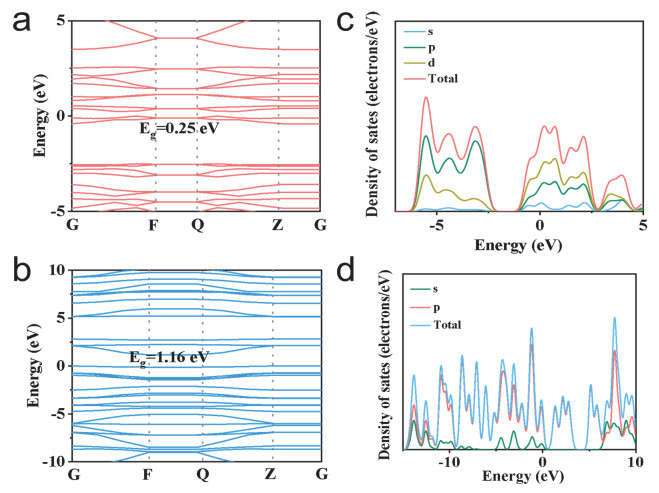
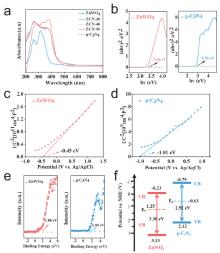
Fig 7
(a) UV-vis DRS of pure ZnWO4, g-C3N4 and ZnWO4/g-C3N4 with different ratios. (b) Band gap energies. (c, d) Mott-Schottky curves. (e) VB-XPS and (f) band structure of pure ZnWO4 and g-C3N4."
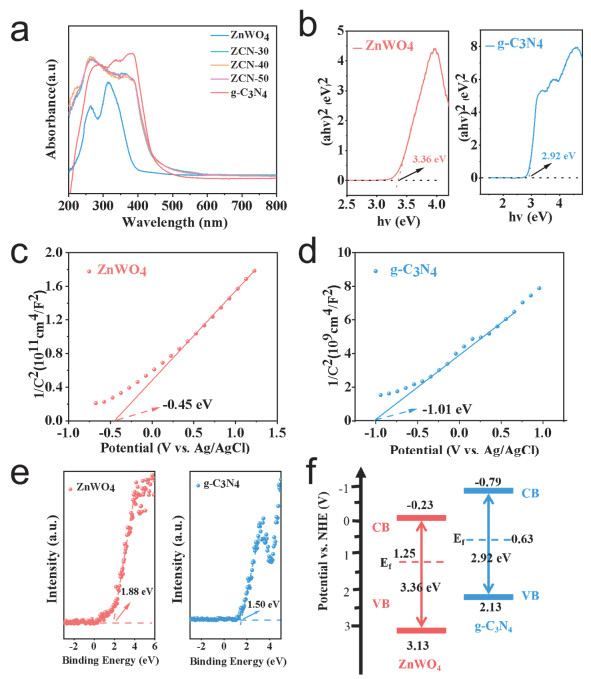
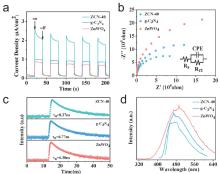
Fig 8
(a) Transient photocurrent densities and (b) Electrochemical impedance spectroscopy of as-prepared samples. (c) Time-resolved PL decay (TRPL) curve of g-C3N4, ZnWO4 and ZCN-40. (d) photoluminescence emission spectra of pure g-C3N4, ZnWO4 and ZCN-40."
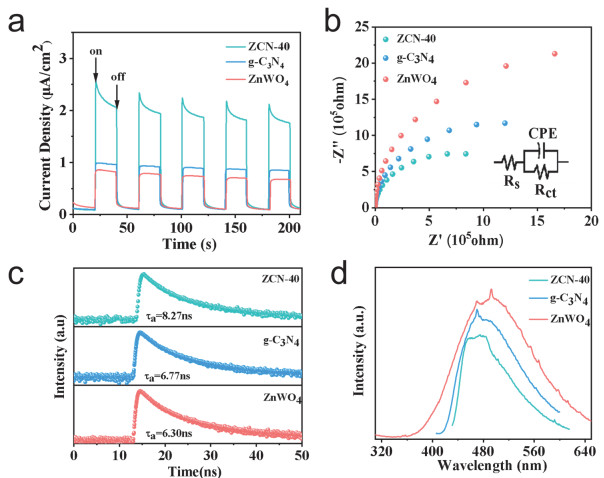
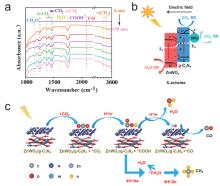
Fig 9
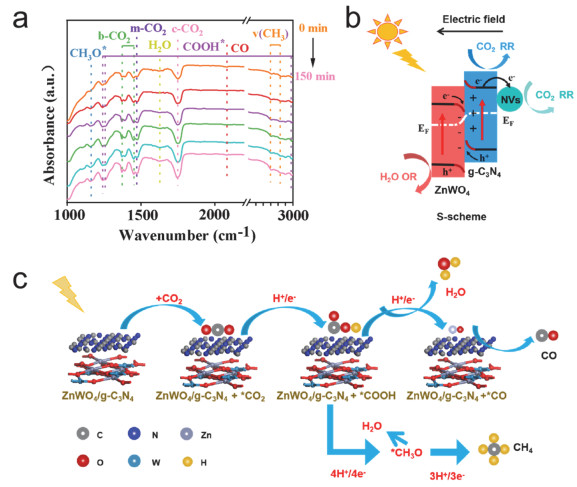
(a) In situ FTIR spectra of ZCN-40 in the process of photocatalytic CO2 reduction at different time. (b) Photocatalytic CO2 reduction mechanism of ZCN-40 under visible light irradiation. (c) reaction route of CO2 photoreduction with water on the ZCN-40 heterojunction."
| 1 |
doi: 10.1038/nature11475 |
| 2 |
doi: 10.1002/adma.201904635 |
| 3 |
doi: 10.1038/s41570-021-00289-y |
| 4 |
doi: 10.1007/s40843-023-2698-5 |
| 5 |
doi: 10.1002/anie.202101818 |
| 6 |
doi: 10.1002/adma.201704649 |
| 7 |
doi: 10.1007/s11467-021-1079-4 |
| 8 |
doi: 10.1038/s41467-021-25007-6 |
| 9 |
doi: 10.1016/j.apcatb.2024.124167 |
| 10 |
doi: 10.1016/S1872-2067(23)64480-8 |
| 11 |
doi: 10.1002/adma.202400288 |
| 12 |
doi: 10.1039/d2cp05281d |
| 13 |
doi: 10.1007/s12274-023-5910-9 |
| 14 |
doi: 10.1016/j.apsusc.2019.04.116 |
| 15 |
doi: 10.1016/j.jcou.2018.05.025 |
| 16 |
doi: 10.1016/j.cej.2023.147942 |
| 17 |
doi: 10.1021/am503696b |
| 18 |
doi: 10.1021/cs3005852 |
| 19 |
doi: 10.1002/admi.202201400 |
| 20 |
doi: 10.1039/d1tc04932a |
| 21 |
doi: 10.1016/j.matt.2022.09.009 |
| 22 |
doi: 10.3866/PKU.WHXB202211009 |
| 23 |
doi: 10.1002/adma.202107668 |
| 24 |
doi: 10.1016/S1872-2067(23)64477-8 |
| 25 |
doi: 10.1016/j.chempr.2020.06.010 |
| 26 |
doi: 10.3866/PKU.WHXB202312024 |
| 27 |
doi: 10.1002/adma.202310600 |
| 28 |
doi: 10.1021/acscatal.3c03095 |
| 29 |
doi: 10.1016/S1872-2067(23)64478-X |
| 30 |
doi: 10.1021/acs.chemrev.6b00075 |
| 31 |
doi: 10.1002/aenm.201701503 |
| 32 |
doi: 10.1039/d2cs00806h |
| 33 |
doi: 10.1007/s11467-019-0950-z |
| 34 |
doi: 10.1007/s40843-023-2770-8 |
| 35 |
doi: 10.1007/s40843-023-2755-2 |
| 36 |
doi: 10.1016/S1872-2067(23)64513-9 |
| 37 |
doi: 10.1016/j.jcat.2024.115405 |
| 38 |
doi: 10.1021/acsaem.0c00750 |
| 39 |
doi: 10.3866/PKU.WHXB202212026 |
| 40 |
doi: 10.1016/j.gee.2023.02.012 |
| 41 |
doi: 10.1021/jacs.3c05234 |
| 42 |
doi: 10.1016/j.apcatb.2023.122890 |
| 43 |
doi: 10.1016/j.jechem.2023.01.028 |
| 44 |
doi: 10.1016/j.diamond.2020.107981 |
| 45 |
doi: 10.1016/j.jcis.2019.12.088 |
| 46 |
doi: 10.1007/s40843-023-2703-0 |
| 47 |
doi: 10.1002/adfm.202308411 |
| 48 |
doi: 10.1016/j.apcatb.2022.122231 |
| 49 |
doi: 10.1016/j.jcis.2023.12.173 |
| 50 |
doi: 10.1016/S1872-2067(23)64420-1 |
| 51 |
doi: 10.1002/smll.202302058 |
| 52 |
doi: 10.1021/acscatal.4c00026 |
| 53 |
doi: 10.1002/adma.202406460 |
| 54 |
doi: 10.1038/s41467-024-49004-7 |
| 55 |
doi: 10.3866/PKU.WHXB202307022 |
| 56 |
doi: 10.1038/s41467-020-18350-7 |
| 57 |
doi: 10.1038/s41467-022-30434-0 |
| 58 |
doi: 10.1021/acscatal.2c02390 |
| 59 |
doi: 10.1016/j.jcis.2024.06.176 |
| 60 |
doi: 10.1016/j.apcatb.2021.120802 |
| 61 |
doi: 10.1016/j.cej.2022.135652 |
| 62 |
doi: 10.1016/j.carbon.2024.119418 |
| 63 |
doi: 10.1007/s40843-023-2725-y |
| 64 |
doi: 10.3866/PKU.WHXB202309031 |
| 65 |
doi: 10.1002/aenm.202301118 |
| 66 |
doi: 10.1039/d1nr03221f |
| 67 |
doi: 10.1016/j.cej.2023.142536 |
| 68 |
doi: 10.1039/c9nr09117c |
| 69 |
doi: 10.1002/anie.202203519 |
| 70 |
doi: 10.1002/adma.202300643 |
| 71 |
doi: 10.1016/j.cej.2022.139493 |
| 72 |
doi: 10.1021/acscatal.1c05553 |
|
||