Acta Phys. -Chim. Sin. ›› 2024, Vol. 40 ›› Issue (12): 2408005.doi: 10.3866/PKU.WHXB202408005
• REVIEW • Previous Articles Next Articles
Photocatalytic CO2 Reduction by Modified g-C3N4
Xuejiao Wang1, Suiying Dong1, Kezhen Qi1,*( ), Vadim Popkov2,*(), Xianglin Xiang3,*()
- 1 College of Pharmacy, Dali University, Dali 671000, Yunnan Province, China
2 Hydrogen Energy Laboratory, Ioffe Institute, Saint Petersburg 194021, Russia
3 Faculty of Materials Science and Engineering, Kunming University of Science and Technology, Kunming 650093, China
-
Received:2024-08-04Revised:2024-09-12Accepted:2024-09-12Published:2024-11-09 -
Contact:Email: qkzh2003@aliyun.com (Kezhen Qi)vadim.i.popkov@gmail.com (Vadim Popkov )xiangxianglin@kust.edu.cn (Xianglin Xiang) -
Supported by:the National Natural Science Foundation of China(22268003); the National Natural Science Foundation of China(52272287); Xingdian Talent Support Program of Yunnan Province(XDYC-QNRC-2022-0525); Projects from Yunnan Province(202305AF150116); Projects from Yunnan Province(202301AT070027)

Cite this article
Xuejiao Wang, Suiying Dong, Kezhen Qi, Vadim Popkov, Xianglin Xiang. Photocatalytic CO2 Reduction by Modified g-C3N4[J]. Acta Phys. -Chim. Sin. 2024, 40(12), 2408005. doi: 10.3866/PKU.WHXB202408005
share this article
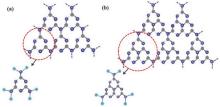
Fig 1
Structure of (a) triazine and (b) tri-s-triazine fragments in g-C3N4 9, 10. Copyright 2015 John Wiley & Sons - Journals."
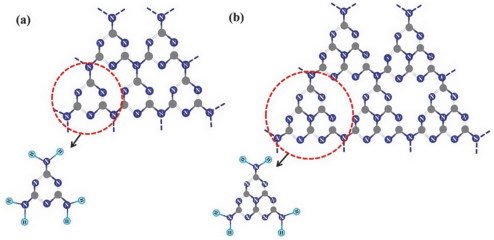
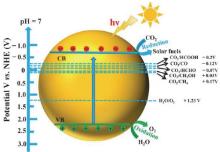
Fig 2
Reduction potentials of photocatalytic CO2 reduction to different products (V vs. NHE, pH = 7)."
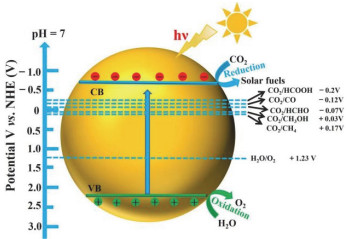
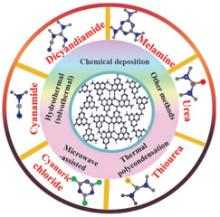
Fig 3
Various N-precursors utilized in the preparation of g-C3N4 via different synthetic routes."
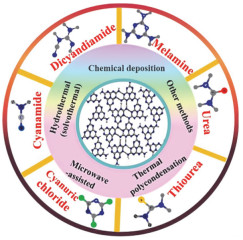
Table 1
Methods of preparing g-C3N4 using various precursors."
| Precursor | Methods | Reaction condition | BET surface area (m2·g−1) | Eg/(eV) | Morphology | Ref. a |
| Melamine | Thermal polymerization | 8 ℃∙min−1, 550 ℃ (4 h) | 3.4 | 2.80 | Bulky | |
| Ammonium thiocyanate | Thermal polymerization | 6 K∙min−1, 600 ℃ (2 h) | 16 | 2.71 | Lamellar | |
| Cyanamide | Thermal polymerization | 2.3 ℃∙min−1,550 ℃ (4 h) | 9.8 | 2.79 | Mesoporous | |
| Guanidine Hydrochloride | Thermal polymerization | 2 ℃ min−1,550 ℃ (2 h) | 41.5 | 2.77 | Nanosheets | |
| Dicyandiamid, melamine, urea, thiourea | Thermal polymerization | 5 ℃ min−1, 450 ℃ (3 h) | 18.3; 5.4; 98.3; 6.8 | b N/A | Bulky | |
| Melamine, urea | Thermal polymerization | 5 ℃ min−1, 550 ℃ (4 h) | N/A | 2.65 | Bulky | |
| Guanidine, hydrochloride, dicyandiamide | Solvothermal | 180 ℃ (48 h) | 19.0 | 2.45 | Belt-like | |
| Melamine | Ultrasound-assisted | 80 ℃ (1 h) | 43.5 | 1.96 | Ribbon | |
| Dicyandiamide | Sol-gel method | CTAB c, TEOS d, 5 ℃ min−1, 550 ℃ (2 h) | 12.09 | 2.11 | Multilayered sheets | |
| Melamine, cyanuric chloride | Solvothermal | 4 ℃ min−1, 150 ℃ (3 h) | N/A | N/A | Nanosheets | |
| Urea | Solid-state thermal condensation | 200 ℃ (2 h) | N/A | 2.90 | Nanodots |
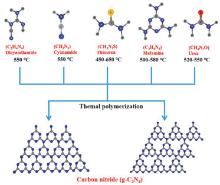
Fig 4
Schematic diagram illustrating synthesis of g-C₃N₄ through thermal polymerization using various nitrogen-rich precursors such as melamine 22, cyanamide 23, dicyandiamide 24, urea 25, and thiourea 26."
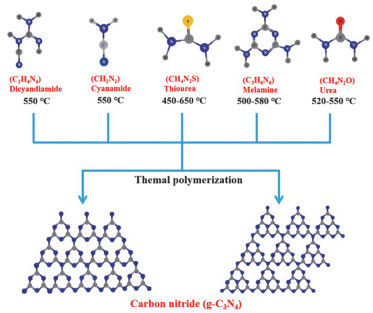
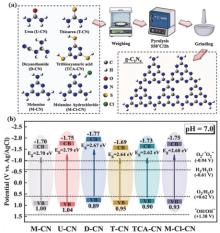
Fig 5
(a) Molecular structure of various precursors under identical g-C3N4 synthesis conditions (pyrolysis at 7 ℃∙min−1 and 500 ℃ for 2 h); (b) Predicted band structures of g-C3N4 obtained from diverse precursors 35. Copyright 2023 Elsevier."
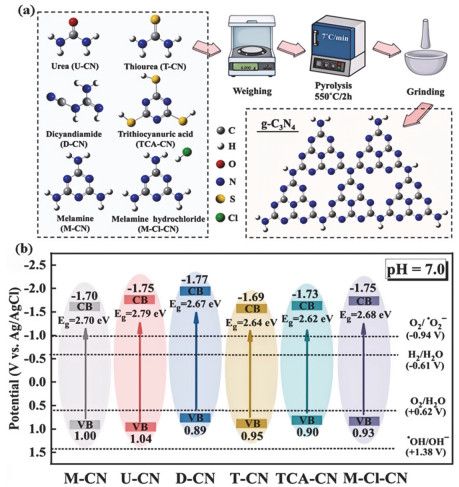
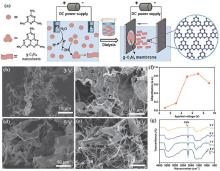
Fig 6
(a) Schematic of the electrochemical preparation of g-C3N4, SEM images of g-C3N4 nanosheets synthesized under different voltages: (b) 3 V; (c) 5 V; (d) 7 V; (e) 9 V. (f) UV absorbance dependence on solution at different voltages. (g) FTIR spectra of g-C₃N₄ synthesized at arious voltages 37. Copyright 2020 Elsevier."
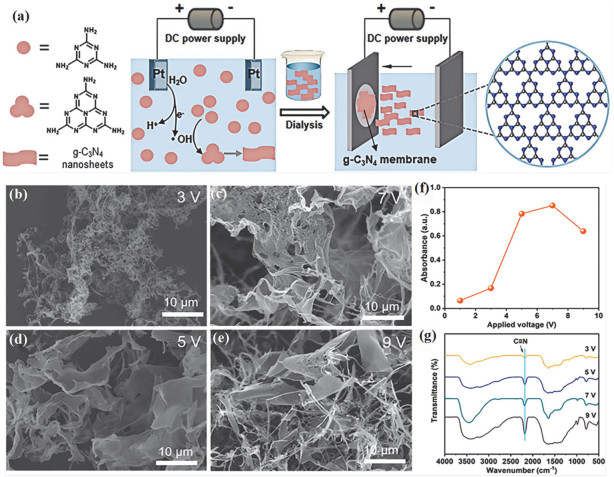
Fig 7
Schematic demonstrating the preparation of HCNMS, H-HCNMS, and OH-HCNMS 38. Copyright 2020 Elsevier."
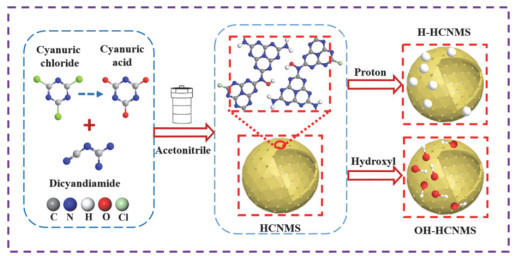
Table 2
Modification strategy of g-C3N4 and its photocatalytic CO2 reduction performance."
| Catalyst | Modification method | Catalyst mass (mg) | Light source | Activity/ (µmol·g−1·h−1) | Selectivity | Ref. |
| UV60-CN | O doping | 5 | Xe lamp (300 W) | CH4: 37.3 | CH4: 77% | |
| P-g-C3N4 | P doping | 50 | Xe lamp (300 W) | CO: 2.4 CH4: 1.8 | CH4: 3.3% | |
| PCCN | P, C co-doping | 25 | Xe lamp (300 W) | CH4: 41.85 | N/A | |
| PFCN | P, F co-doping | 100 | LED (34W) | CH3OH: 119.56 | N/A | |
| MCN | Cu, Co, Ti, Fe doping | 3 | Xe lamp (300 W) | 3CuCN: 246 10CoCN: 326 30TiCN: 45425 25FeCN: 490 | CO: 87% | |
| PtCu‐crCN | dual‐single‐atoms | 25 | Xe lamp (300 W) | CH4: 2.8 | CH4: 9.4% | |
| TCN-1 | N-vacancy | 50 | Xe lamp (300 W) | CO: 7.1 | CO: 100% | |
| g-CN-650 g-CN-750 | N-vacancy N-vacancy | 10 | Xe lamp (300 W) | CO: 5.3 CH4: 34.4 CH4: 52.8 | CH4: 6.6% CH4: 6.4% | |
| NVs-PCN | N-vacancy | 20 | LED (50 W) | CO: 55.95 | CO: 85% | |
| GCN510 | C-vacancy | 20 | Xe lamp (300 W) | CO: 4.18 | N/A | |
| CCN | Functionalized crystallization | 5 | Visible light (λ > 400 nm) | CO: 25.7 | CO: 93.8% | |
| Ni5-CN | Ni monoatomic | 20 | Xe lamp (300 W) | CO: 8.6 | CO: 81.1% | |
| PN-g-C3N4 | Porous nanobelts | 10 | Xe lamp (300 W) | CO: 29.8 | CO: 100% | |
| Cu-CNTs/pCN | CNTs modification | 50 | Hg lamp (200 W) | CO: 560 | N/A | |
| 30AgBr/pCN | Type Ⅱ heterojunction | 100 | Xe lamp (500 W) | CH4: 10.92 | N/A | |
| 30AgCl/pCN | Type Ⅰ heterojunction | 100 | Xe lamp (500 W) | CH4: 8.51 | N/A | |
| BCN-NaK | Type Ⅱ heterojunction | 10 | Xe lamp (300 W) | CO: 22.8 | CO: 62.3% | |
| ZnTP/CN | S–scheme heterojunction | 20 | Xe lamp (300 W) | CO: 19.4 | CO: 95.8% | |
| CN/CFT | COF | 5 | Xe lamp (300 W) | CO: 151.1 | CO: 99.9% | |
| Co-MOL/CN (400) | Co-MOF | 2 | Xe lamp (300 W) | CO: 539 | CO: 79.8 | |
| Co-MOF/g-C3N4 | Co-MOF | 20 | Xe lamp (300 W) | CO: 6.75 CH4: 5.47 | CH4: 4.8% | |
| VCQDs/C3N4 | CQDs (with carbon vacancy) modification | 50 | Xe lamp (300 W) | CO: 56 | N/A |
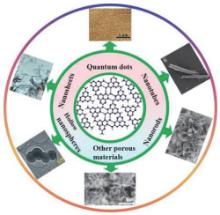
Fig 8
Different morphologies of g-C3N4 75–80. Copyright 2014, 2021 Royal Society of Chemistry, Copyright 2022, 2023 Elsevier."
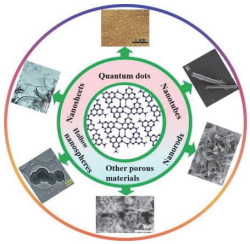
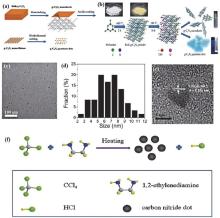
Fig 9
(a) Schematic diagram of controlled synthesis of CNQDs 86; Copyright 2014 Royal Society of Chemistry. (b) schematic diagram of g-C3N4 nanosheets and QDs with controllable size synthesized by ethanol in the presence of KOH 87; (c) TEM images of CNQDs, (d) diameter distribution of CNQDs; Copyright 2017 Royal Society of Chemistry (e) HRTEM of a single CNQDs 86; (f) schematic illustrating the formation process of CNQDs 88. Copyright 2011 Royal Society of Chemistry."
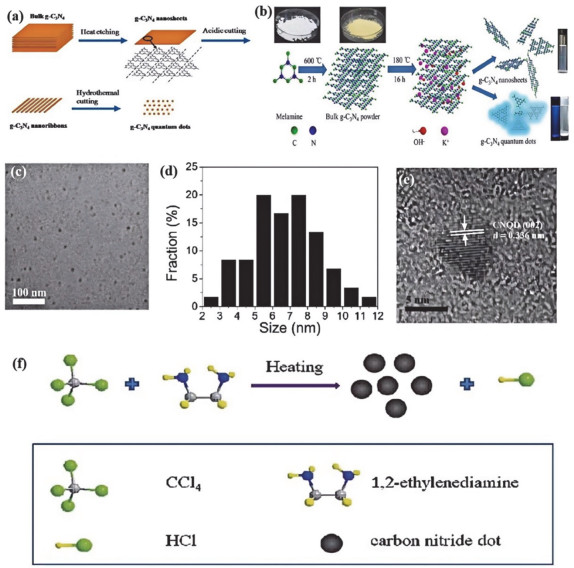
Fig 10
Typical (a) SEM and (b) TEM images of g-C3N4 with 1D structure 96; Copyright 2012 John Wiley & Sons - Journals. (c) formation process of porous g-C3N4 nanotubes, (d) SEM and (e) TEM images of g-C3N4 nanotubes 97. Copyright 2019 Springer Nature."
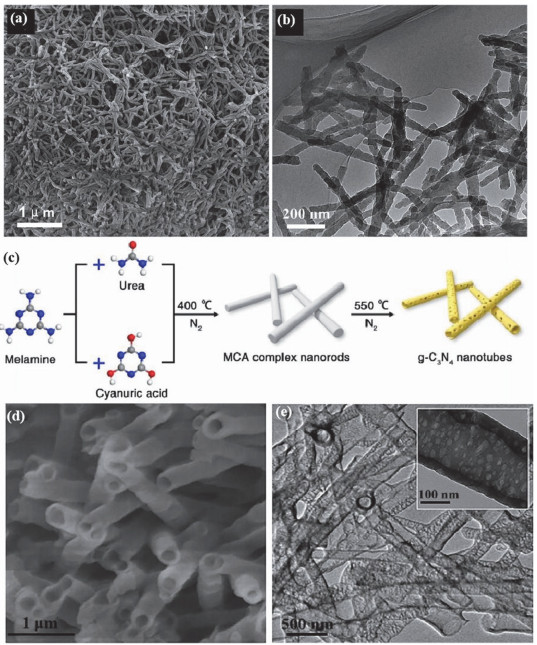
Fig 11
Schematic illustrations of exfoliation strategies for preparing g-C3N4 nanosheets by (a) H2SO4 (98 wt%); (b) typical AFM images and (c) TEM images of the as-prepared monolayer-C3N4 nanosheets 106; Copyright 2013 Royal Society of Chemistry. (d) mechanical grinding 107. Copyright 2017 American Chemical Society."
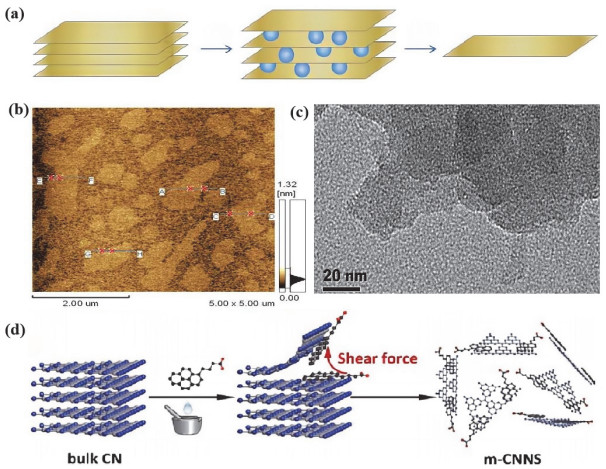
Fig 12
(a) Synthesis of HCNS and metal-based HCNS composites; (b) TEM image of HCNS-3 (scale bar equals 1 μm) 108; Copyright 2012 Springer Nature. (c) Formation process of 3D porous g-C3N4 ultra-thin nanosheets 109; Copyright 2021 Elsevier. (d) Schematic of the synthetic strategy for 3DOM g-C3N4 110 (polyvinylpyrrolidone abbreviated as PVP). Copyright 2016 Elsevier."
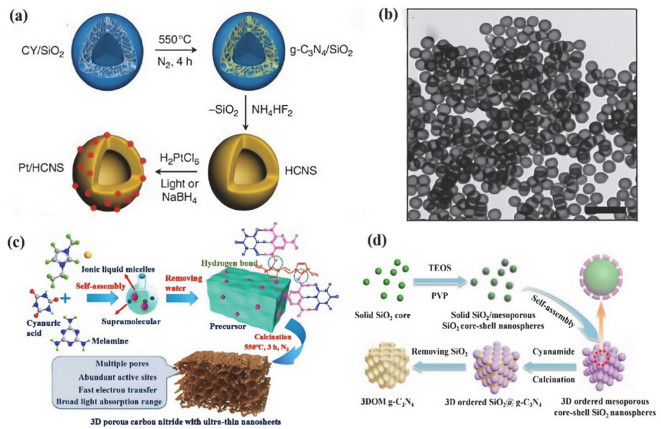
Fig 13
(a) Synthesis and (b) TEM image of PCN-S (inset HRTEM and AFM images); (c) Top and side views of optimized g-C3N4 and P-doped g-C3N4; (d) Band structures of doped samples 117. Copyright 2015 Royal Society of Chemistry."
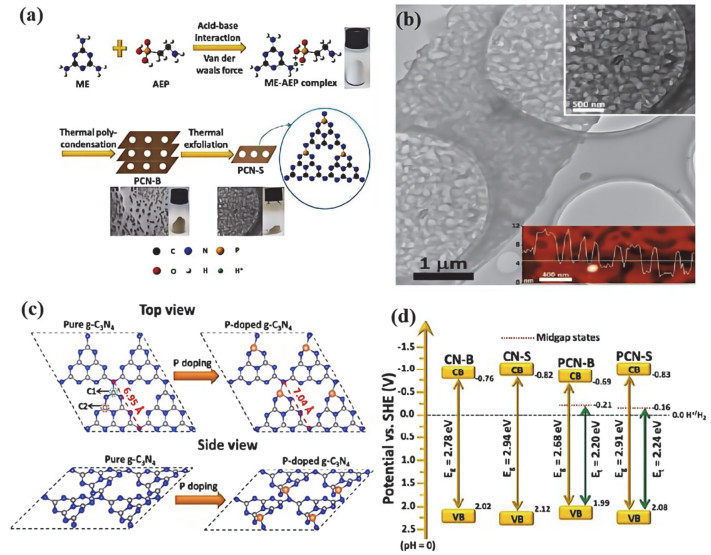
Fig 14
(a) Optimized structure and potential doping sites of monolayer g-C3N4; (b) Proposed CO2 reduction mechanism over Co-doped g-C3N4 (CoCN) 120; Copyright 2023 Elsevier. (c) Synthesis method for copper-modified g-C3N4 nanorod bundles (CCNBs); (d) Proposed CO2 reduction mechanism over CCNBs 121. Copyright 2022 Elsevier."
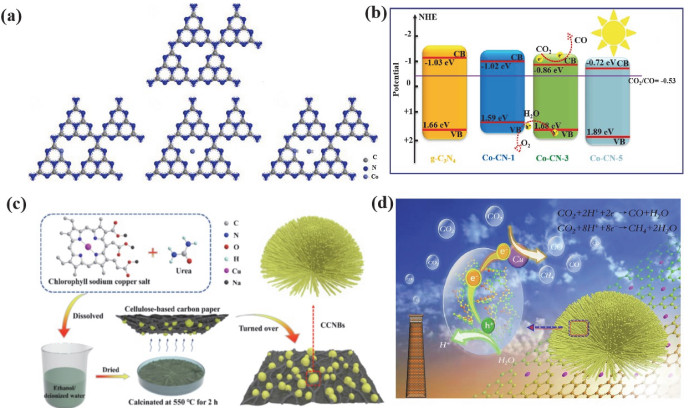
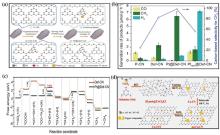
Fig 15
(a) Schematic representation of the synthesis of Pt@Def-CN; (b) CO2 reduction conversion and carbon-based selectivity of photocatalysts including P-CN, Def-CN, Pt@Def-CN, and PtNPS@Def-CN; (c) Free energy diagram for CO2 → CH4 on Pt@Def-CN and Def-CN catalysts 130; Copyright 2022 John Wiley & Sons - Journals. (d) Fabrication process of Cu-CCN samples 131. Copyright 2020 American Chemical Society."
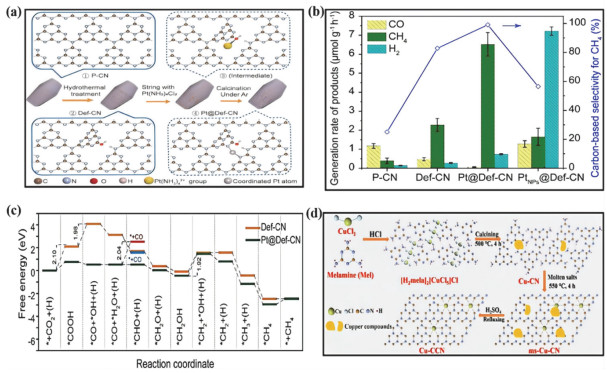
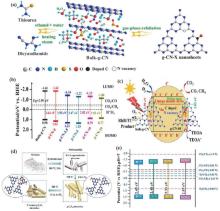
Fig 16
(a) Schematic for the preparation of graphitic carbon nitride nanosheets (g-CN-X); (b) Band gap of various g-CN-X samples; (c) Proposed mechanism for reaction in g-CN-10 143; (d) Schematic for the synthesis of nitrogen-vacancy g-C3N4 microtubes; (e) Band structure alignments of different samples 60. Copyright 2022, 2023 Elsevier."
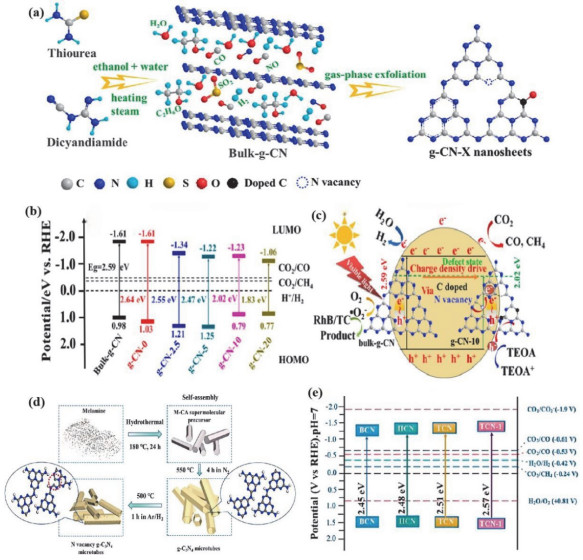
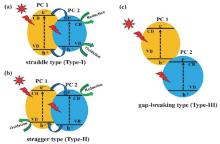
Fig 17
Schematic diagram of three types of heterojunctions: (a) Type-Ⅰ, (b) Type-Ⅱ and (c) Type-Ⅲ heterojunction."
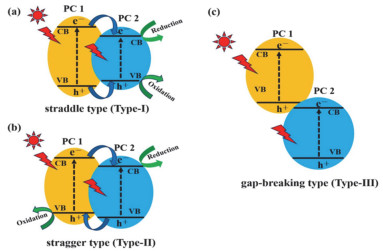
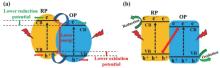
Fig 18
(a) Transfer pathways of carriers in Type-Ⅱ system and associated issues; (b) Transfer pathways of photogenerated carriers in an S-scheme heterojunction."
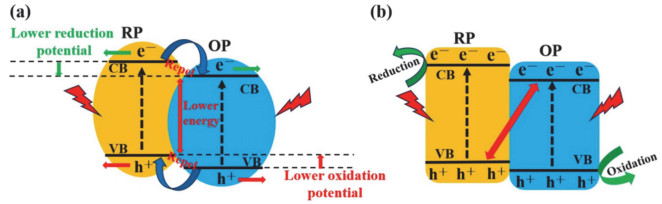
Fig 19
Charge transfer schematic in S-scheme heterojunctions."
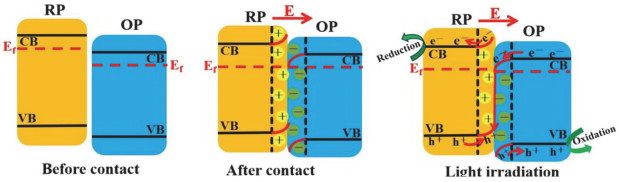
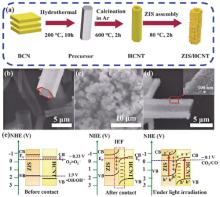
Fig 20
(a) Synthesis of ZIS/HCNT heterostructures; SEM images of (b) HCNT, (c) ZIS, and (d) ZIS/HCNT-2; (e) Proposed charge transfer mechanism for the ZIS/HCNT S-scheme heterojunction 159. Copyright 2022 Elsevier."
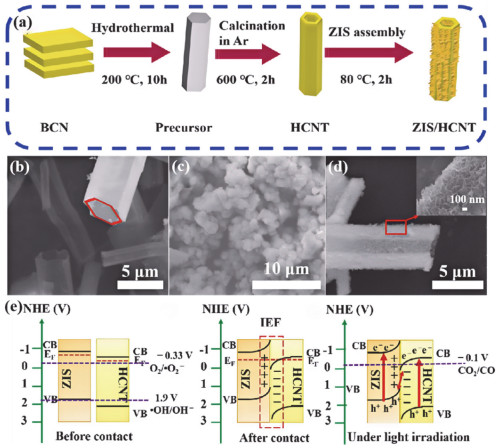
Table 3
Photocatalytic CO2 reduction over g-C3N4 composites based on S-scheme heterojunctions."
| Catalysts | BET surface area/(m2∙g−1) | Activity/(µmol∙g−1∙h−1) | Light source | Catalysts Mass (mg) | Ref. |
| BiOBr/TCN | 27.90 | CO: 10.89 | 300 W Xe lamp; λ ≥ 400 nm | 10 | |
| BWO/CN-3 | 70.50 | CO: 5.44 CH4: 0.91 | 300 W Xe lamp; λ ≥ 400 nm | 10 | |
| CIS/PCN | 54.54 | CO: 105.89 | 300 W Xe lamp | 10 | |
| PDI/CN | N/A | CO: 139.60 | 300 W Xe lamp; full-spectrum | 25 | |
| g-C3N4/CDs/WO3 | N/A | CO: 31.04 | 300 W Xe lamp, λ ≥ 420 nm | 20 | |
| 30%-Sv-MS@GCN | 99.65 | CO: 68.3 | 10 W V-light lamp (790 mW∙cm−2) | 10 | |
| NT@CN5 | 17.62 | CO: 33.35 | 300 W Xe lamp | 50 | |
| α-Fe2O3/In–CN | N/A | CO: 24.3 | 300 W Xe lamp | 10 | |
| g-C3N4/Cu2O@Cu-4 | 66.00 | CO: 10.8 CH4: 3.1 | 500 W Xe lamp, λ ≥ 400 nm | 100 | |
| CN/AP/AW-2 | 33.843 | CH4: 18.49 | 300 W Xe lamp | 50 | |
| 2% CTO/CN | 18.25 | CO: 236.2 | 300 W Xe lamp | 30 | |
| 40 OCNNb | 169.54 | CO: 253.34 CH4: 68.11 | 300 W Xe lamp, λ ≥ 420 nm | 100 | |
| BI/CN-50% | 51.10 | CO: 3.1125 | 300 W Xe lamp, λ ≥ 420 nm | 10 | |
| CN-ZnBVO-3 | 25.64 | CH3OH: 609.10 | 300 W Xe lamp | 20 | |
| g-C3N4/Bi/BiVO4 | 50.00 | CO: 0.63 | 300 W Xe lamp, λ ≥ 420 nm | 100 | |
| CuWO4@g-C3N4 | 50.00 | CO: 4.15 CH4: 0.12 | 300 W Xe lamp, λ ≥ 420 nm | 50 | |
| ZnIn2S4/g-C3N4 | 48.91 | CO: 25.96 CH4: 3.70 | 300 W Xe lamp; λ ≥ 420 nm | 50 | |
| g-C3N4/Cu2O-Pd | N/A | CO: 14.68 | 500 W Xe lamp; λ ≥ 400 nm | 20 |
Fig 21
(a) Schematic illustration for the preparation of the CN/Fe-MOF composite, (b) Schematic of the formation of the S-scheme heterojunction between CN and Fe-MOF 181. Copyright 2022 Elsevier."
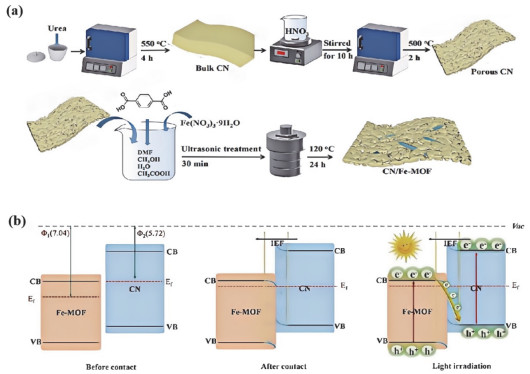
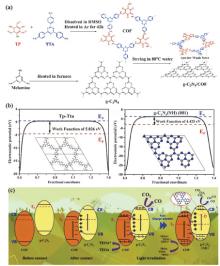
Fig 22
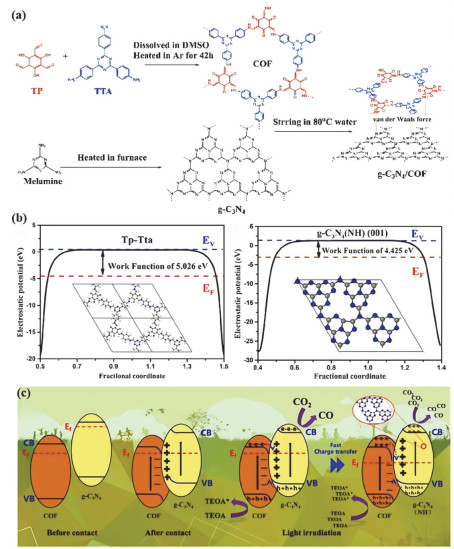
(a) Schematic for the preparation of the g-C3N4/Tp-Tta COF S-scheme heterojunction, (b) Calculated work functions for Tp-Tta COF and defective g-C3N4, (c) Illustration of the carrier transfer in gCN/Tp-Tta COF S-scheme heterojunction 184. Copyright 2022 Elsevier."
| 1 |
doi: 10.1038/275115a0 |
| 2 |
doi: 10.1038/277637a0 |
| 3 |
doi: 10.1016/j.matchemphys.2020.123322 |
| 4 |
doi: 10.1021/ja903923s |
| 5 |
doi: 10.1039/C1JM14312C |
| 6 |
doi: 10.1016/j.ijhydene.2012.04.138 |
| 7 |
doi: 10.1016/j.chemosphere.2022.135717 |
| 8 |
doi: 10.1002/solr.201900440 |
| 9 |
doi: 10.1002/cnma.201500060 |
| 10 |
doi: 10.1039/C5SC02992A |
| 11 |
doi: 10.1021/acs.chemrev.6b00075 |
| 12 |
doi: 10.1016/j.mattod.2019.06.009 |
| 13 |
doi: 10.1021/ja0103849 |
| 14 |
doi: 10.1016/j.carbon.2005.01.005 |
| 15 |
doi: 10.1016/j.diamond.2022.108873 |
| 16 |
doi: 10.1021/la900923z |
| 17 |
doi: 10.1021/jp809119m |
| 18 |
doi: 10.1016/j.cattod.2013.11.038 |
| 19 |
doi: 10.1021/acsaelm.3c00404 |
| 20 |
doi: 10.1016/j.jmst.2021.05.019 |
| 21 |
doi: 10.1021/jp4009338 |
| 22 |
doi: 10.1016/j.cej.2019.122535 |
| 23 |
doi: 10.1021/ja809307s |
| 24 |
doi: 10.1016/j.jcis.2020.10.144 |
| 25 |
doi: 10.1016/j.apcatb.2017.10.028 |
| 26 |
doi: 10.1039/C8TA03068E |
| 27 |
doi: 10.1016/j.apcatb.2019.02.033 |
| 28 |
doi: 10.1016/j.apsusc.2015.03.086 |
| 29 |
doi: 10.1016/j.ijhydene.2021.08.178 |
| 30 |
doi: 10.1016/j.jphotochem.2016.08.005 |
| 31 |
doi: 10.1039/C2NR30948C |
| 32 |
doi: 10.1016/j.apcatb.2020.119452 |
| 33 |
doi: 10.1016/S1872-2067(19)63459-5 |
| 34 |
doi: 10.1016/j.jssc.2021.122545 |
| 35 |
doi: 10.1016/j.seppur.2023.124904 |
| 36 |
doi: 10.1016/j.apsusc.2009.10.061 |
| 37 |
doi: 10.1016/j.cej.2024.151638 |
| 38 |
doi: 10.1016/j.cej.2019.122593 |
| 39 |
doi: 10.1007/s00339-018-1834-8 |
| 40 |
doi: 10.1016/j.matlet.2015.08.106 |
| 41 |
doi: 10.1039/C4GC01517G |
| 42 |
doi: 10.1002/anie.201608453 |
| 43 |
doi: 10.1039/C1EE02165F |
| 44 |
doi: 10.1016/j.apcatb.2016.06.074 |
| 45 |
doi: 10.1021/acscatal.1c05013 |
| 46 |
doi: 10.3390/catal12060672 |
| 47 |
doi: 10.1039/D0DT03229H |
| 48 |
doi: 10.1016/j.fuel.2023.129757 |
| 49 |
doi: 10.1002/cssc.202000375 |
| 50 |
doi: 10.1002/adfm.201900093 |
| 51 |
doi: 10.1002/cey2.270 |
| 52 |
doi: 10.1002/cssc.202002041 |
| 53 |
doi: 10.1016/j.jcat.2024.115597 |
| 54 |
doi: 10.1016/j.cej.2022.141067 |
| 55 |
doi: 10.1016/j.jmst.2022.06.022 |
| 56 |
doi: 10.1021/acsami.7b17503 |
| 57 |
doi: 10.1016/j.cej.2024.149155 |
| 58 |
doi: 10.1016/j.jcou.2022.102162 |
| 59 |
doi: 10.1016/S1872-2067(21)63879-2 |
| 60 |
doi: 10.1016/j.mtener.2022.101211 |
| 61 |
doi: 10.1021/acsami.2c03913 |
| 62 |
doi: 10.1016/j.jcat.2022.03.016 |
| 63 |
doi: 10.1039/C8TA09302D |
| 64 |
doi: 10.1002/adfm.202312634 |
| 65 |
doi: 10.1002/aenm.201902738 |
| 66 |
doi: 10.3390/molecules27186054 |
| 67 |
doi: 10.1016/j.apsusc.2019.04.220 |
| 68 |
doi: 10.1016/j.apcatb.2015.06.053 |
| 69 |
doi: 10.1016/j.apcatb.2023.122733 |
| 70 |
doi: 10.1021/acsami.3c10503 |
| 71 |
doi: 10.1016/S1872-2067(21)63936-0 |
| 72 |
doi: 10.1039/D2TA09579C |
| 73 |
doi: 10.1016/S1872-2067(19)63497-2 |
| 74 |
doi: 10.1016/j.carbon.2022.12.021 |
| 75 |
doi: 10.1039/C4TA02781G |
| 76 |
doi: 10.1016/j.apcatb.2021.120978 |
| 77 |
doi: 10.1039/C5NR08278A |
| 78 |
doi: 10.1016/j.jallcom.2023.172229 |
| 79 |
doi: 10.1016/j.chemosphere.2024.142522 |
| 80 |
doi: 10.1016/j.apcatb.2021.120904 |
| 81 |
|
|
王亦清; 沈少华. 物理化学学报, 2020, 36, 1905080.
doi: 10.3866/pku.Whxb201905080 |
|
| 82 |
doi: 10.1016/j.jmst.2023.06.042 |
| 83 |
doi: 10.1016/j.pmatsci.2024.101242 |
| 84 |
doi: 10.1039/D2CS00806H |
| 85 |
doi: 10.1016/j.jcis.2023.01.107 |
| 86 |
doi: 10.1039/C4CC02543A |
| 87 |
doi: 10.1039/c7nj00058h |
| 88 |
doi: 10.1039/c1jm12149a |
| 89 |
doi: 10.1038/s41467-022-28701-1 |
| 90 |
doi: 10.3390/nano13020305 |
| 91 |
doi: 10.1016/j.apsusc.2023.158044 |
| 92 |
doi: 10.1039/C6TA09747B |
| 93 |
doi: 10.1016/j.ijhydene.2019.05.105 |
| 94 |
doi: 10.1016/j.jhazmat.2018.09.095 |
| 95 |
doi: 10.1039/D0TA08892G |
| 96 |
doi: 10.1002/anie.201206534 |
| 97 |
doi: 10.1007/s12274-019-2357-0 |
| 98 |
doi: 10.1016/j.jcis.2023.08.042 |
| 99 |
doi: 10.1016/j.carbon.2022.09.029 |
| 100 |
|
|
殷方鑫; 秦品权; 许景三; 曹少文. 物理化学学报, 2023, 39, 2212062.
doi: 10.3866/PKU.WHXB202212062 |
|
| 101 |
|
|
昝忠奇; 李喜宝; 高晓明; 黄军同; 罗一丹; 韩露. 物理化学学报, 2023, 39, 2209016.
doi: 10.3866/PKU.WHXB202209016 |
|
| 102 |
doi: 10.3389/fchem.2019.00941 |
| 103 |
doi: 10.1021/acsnano.1c01105 |
| 104 |
doi: 10.1002/adfm.201200922 |
| 105 |
doi: 10.1021/ja308249k |
| 106 |
doi: 10.1039/c3ta13188b |
| 107 |
doi: 10.1021/jacs.7b06708 |
| 108 |
doi: 10.1038/ncomms2152 |
| 109 |
doi: 10.1016/j.ijhydene.2021.05.018 |
| 110 |
doi: 10.1016/j.apcatb.2016.05.069 |
| 111 |
doi: 10.1039/D0CY01890B |
| 112 |
doi: 10.1039/D1EE02073K |
| 113 |
doi: 10.1039/D0TA07794A |
| 114 |
doi: 10.1016/j.apcatb.2015.03.045 |
| 115 |
doi: 10.1016/j.chemosphere.2021.131765 |
| 116 |
doi: 10.1002/smll.201603938 |
| 117 |
doi: 10.1039/C5EE02650D |
| 118 |
|
|
沈荣晨; 郝磊; 陈晴; 郑巧清; 张鹏; 李鑫. 物理化学学报, 2022, 38, 2110014.
doi: 10.3866/PKU.WHXB202110014 |
|
| 119 |
doi: 10.1016/j.apcatb.2019.118212 |
| 120 |
doi: 10.1016/j.jallcom.2023.170044 |
| 121 |
doi: 10.1016/j.jcis.2022.04.099 |
| 122 |
doi: 10.1021/jacs.6b02692 |
| 123 |
doi: 10.1016/j.ijhydene.2023.07.175 |
| 124 |
doi: 10.1016/j.carbon.2016.12.061 |
| 125 |
doi: 10.1002/anie.202011495 |
| 126 |
doi: 10.3389/fchem.2022.1069816 |
| 127 |
doi: 10.1021/jacs.9b03811 |
| 128 |
doi: 10.1016/j.cogsc.2018.11.002 |
| 129 |
doi: 10.1016/S1872-2067(22)64199-8 |
| 130 |
doi: 10.1002/anie.202203063 |
| 131 |
doi: 10.1021/acsnano.0c04544 |
| 132 |
doi: 10.1002/adma.201605148 |
| 133 |
doi: 10.1016/j.jmst.2020.02.024 |
| 134 |
doi: 10.1002/anie.201809897 |
| 135 |
doi: 10.1021/acscatal.6b00879 |
| 136 |
doi: 10.1021/acsanm.8b02089 |
| 137 |
doi: 10.1016/j.jhazmat.2019.120815 |
| 138 |
doi: 10.1016/j.renene.2021.06.066 |
| 139 |
doi: 10.1016/j.jcis.2021.03.163 |
| 140 |
doi: 10.1016/j.apcatb.2023.123604 |
| 141 |
doi: 10.1016/j.scitotenv.2022.155920 |
| 142 |
doi: 10.1016/j.seppur.2024.128001 |
| 143 |
doi: 10.1016/j.cej.2022.138425 |
| 144 |
doi: 10.1016/j.cej.2022.139755 |
| 145 |
|
|
罗铖; 龙庆; 程蓓; 朱必成; 王临曦. 物理化学学报, 2023, 39, 2212026.
doi: 10.3866/PKU.WHXB202212026 |
|
| 146 |
doi: 10.1002/adma.202107668 |
| 147 |
doi: 10.1021/acsami.5b00063 |
| 148 |
doi: 10.1002/adma.201601694 |
| 149 |
|
|
吴新鹤; 陈郭强; 王娟; 李金懋; 王国宏. 物理化学学报, 2023, 39, 2212016.
doi: 10.3866/PKU.WHXB202212016 |
|
| 150 |
doi: 10.1016/j.chempr.2020.06.010 |
| 151 |
doi: 10.1016/j.jcis.2020.10.028 |
| 152 |
doi: 10.1038/s41467-024-49004-7 |
| 153 |
doi: 10.1039/D3TA02951D |
| 154 |
|
|
李云锋; 张敏; 周亮; 杨思佳; 武占省; 马玉花. 物理化学学报, 2020, 37, 2009030.
doi: 10.3866/PKU.WHXB202009030 |
|
| 155 |
doi: 10.1002/adfm.202214470 |
| 156 |
doi: 10.1016/j.jhazmat.2021.127416 |
| 157 |
doi: 10.1016/j.seppur.2024.127299 |
| 158 |
doi: 10.1016/j.jcis.2024.06.204 |
| 159 |
doi: 10.1016/j.cej.2022.135153 |
| 160 |
doi: 10.1039/D3TA05388A |
| 161 |
doi: 10.1021/acsanm.3c03349 |
| 162 |
doi: 10.1016/j.seppur.2024.126808 |
| 163 |
doi: 10.1021/acs.jpcc.1c07726 |
| 164 |
doi: 10.1016/j.cej.2023.146774 |
| 165 |
doi: 10.1016/j.cej.2024.152729 |
| 166 |
doi: 10.1039/D2CY01839J |
| 167 |
doi: 10.1039/D1CY02215F |
| 168 |
doi: 10.1016/j.carbon.2022.03.038 |
| 169 |
doi: 10.1016/j.seppur.2024.128473 |
| 170 |
doi: 10.1039/D2SE01158A |
| 171 |
doi: 10.1016/j.apcatb.2022.121585 |
| 172 |
doi: 10.1016/j.jece.2022.108201 |
| 173 |
doi: 10.1021/acs.iecr.2c03536 |
| 174 |
doi: 10.1016/S1872-2067(19)63481-9 |
| 175 |
doi: 10.1016/j.mssp.2022.107177 |
| 176 |
doi: 10.1016/j.jece.2024.112971 |
| 177 |
doi: 10.1021/acsami.3c02383 |
| 178 |
doi: 10.1016/j.ccr.2020.213262 |
| 179 |
doi: 10.1039/C4CP02173H |
| 180 |
doi: 10.1002/anie.202216717 |
| 181 |
doi: 10.1016/S1872-2067(22)64115-9 |
| 182 |
doi: 10.3390/catal13101331 |
| 183 |
doi: 10.1002/advs.201801410 |
| 184 |
doi: 10.1016/j.apcatb.2021.120814 |
| [1] | Fan Fan, Hao Xiu, Yuting Wang, Yongpeng Cui, Yajun Wang. Construction of NH2-MIL-125/Na-doped g-C3N4 composite S-scheme heterojunction and its performance in photocatalytic hydrogen peroxide production [J]. Acta Phys. -Chim. Sin., 2026, 42(2): 100143-. |
| [2] | Yu Liu, Pengfei Li, Yize Liu, Zaicheng Sun. Recent advances in carbon dots as a single photocatalyst [J]. Acta Phys. -Chim. Sin., 2026, 42(2): 100167-. |
| [3] | Yuhang Zhang, Yi Li, Yuehan Cao, Yingjie Shuai, Yu Zhou, Ying Zhou. Regulating the formation type by Ir of intermediates to suppress product overoxidation in photocatalytic methane conversion [J]. Acta Phys. -Chim. Sin., 2026, 42(2): 100173-. |
| [4] | Chengxiao Zhao, Zhaolin Li, Dongfang Wu, Xiaofei Yang. SBA-15 templated covalent triazine frameworks for boosted photocatalytic hydrogen production [J]. Acta Phys. -Chim. Sin., 2026, 42(1): 100149-. |
| [5] | Chengyan Ge, Jiawei Hu, Xingyu Liu, Yuxi Song, Chao Liu, Zhigang Zou. Self-integrated black NiO clusters with ZnIn2S4 microspheres for photothermal-assisted hydrogen evolution by S-scheme electron transfer mechanism [J]. Acta Phys. -Chim. Sin., 2026, 42(1): 100154-. |
| [6] | Shiyi Chen, Jialong Fu, Jianping Qiu, Guoju Chang, Shiyou Hao. Waste medical mask-derived carbon quantum dots enhance the photocatalytic degradation of polyethylene terephthalate (PET) over BiOBr/g-C3N4 S-scheme heterojunction [J]. Acta Phys. -Chim. Sin., 2026, 42(1): 100135-. |
| [7] | Fengying Zhang, Yanglin Mei, Yuman Jiang, Shenshen Zheng, Kaibo Zheng, Ying Zhou. Research progress of transient absorption spectroscopy in solar energy conversion and utilization [J]. Acta Phys. -Chim. Sin., 2025, 41(9): 100118-. |
| [8] | Wenlong Wang, Wentao Hao, Lang He, Jia Qiao, Ning Li, Chaoqiu Chen, Yong Qin. Bandgap and adsorption engineering of carbon dots/TiO2 S-scheme heterojunctions for enhanced photocatalytic CO2 methanation [J]. Acta Phys. -Chim. Sin., 2025, 41(9): 100116-. |
| [9] | Ying Liang, Yuheng Deng, Shilv Yu, Jiahao Cheng, Jiawei Song, Jun Yao, Yichen Yang, Wanlei Zhang, Wenjing Zhou, Xin Zhang, Wenjian Shen, Guijie Liang, Bin Li, Yong Peng, Run Hu, Wangnan Li. Machine learning-guided antireflection coatings architectures and interface modification for synergistically optimizing efficient and stable perovskite solar cells [J]. Acta Phys. -Chim. Sin., 2025, 41(9): 100098-. |
| [10] | Jianan Hong, Chenyu Xu, Yan Liu, Changqi Li, Menglin Wang, Yanwei Zhang. Decoding the interfacial competition between hydrogen evolution and CO2 reduction via edge-active-site modulation in photothermal catalysis [J]. Acta Phys. -Chim. Sin., 2025, 41(9): 100099-. |
| [11] | Menglan Wei, Xiaoxia Ou, Yimeng Wang, Mengyuan Zhang, Fei Teng, Kaixuan Wang. S-scheme heterojunction g-C3N4/Bi2WO6 highly efficient degradation of levofloxacin: performance, mechanism and degradation pathway [J]. Acta Phys. -Chim. Sin., 2025, 41(9): 100105-. |
| [12] | Jingping Li, Suding Yan, Jiaxi Wu, Qiang Cheng, Kai Wang. Improving hydrogen peroxide photosynthesis over inorganic/organic S-scheme photocatalyst with LiFePO4 [J]. Acta Phys. -Chim. Sin., 2025, 41(9): 100104-. |
| [13] | Liangliang Song, Haoyan Liang, Shunqing Li, Bao Qiu, Zhaoping Liu. Challenges and strategies on high-manganese Li-rich layered oxide cathodes for ultrahigh-energy-density batteries [J]. Acta Phys. -Chim. Sin., 2025, 41(8): 100085-. |
| [14] | Jiajie Cai, Chang Cheng, Bowen Liu, Jianjun Zhang, Chuanjia Jiang, Bei Cheng. CdS/DBTSO-BDTO S-scheme photocatalyst for H2 production and its charge transfer dynamics [J]. Acta Phys. -Chim. Sin., 2025, 41(8): 100084-. |
| [15] | Lewang Yuan, Yaoyao Peng, Zong-Jie Guan, Yu Fang. Insights into the development of 2D covalent organic frameworks as photocatalysts in organic synthesis [J]. Acta Phys. -Chim. Sin., 2025, 41(8): 100086-. |
|
||