Acta Phys. -Chim. Sin. ›› 2025, Vol. 41 ›› Issue (5): 100050.doi: 10.1016/j.actphy.2025.100050
Special Issue: S-scheme heterojunction in photocatalysis
• ARTICLE • Previous Articles
Rationally Designed ZnFe1.2Co0.8O4/BiVO4 S-Scheme Heterojunction with Spin-Polarization for the Elimination of Antibiotic
Jinwang Wu1, Qijing Xie1, Chengliang Zhang2, Haifeng Shi1,3,*( )
)
- 1 School of Science, Jiangnan University, Wuxi 214122, Jiangsu Province, China
2 Hangzhou Dianzi University, Hangzhou 310018, China
3 National Laboratory of Solid State Microstructures, Nanjing University, Nanjing 210093, China
-
Received:2024-11-05Revised:2024-12-16Accepted:2024-12-24Published:2025-04-18 -
Contact:Email: hfshi@jiangnan.edu.cn; Tel.: +86-15052262655 (Haifeng Shi) -
Supported by:the National Natural Science Foundation of China(52271175); National Laboratory of Solid State Microstructures, Nanjing University(M34047); Prof. Haifeng Shi was indebted to the financial support from the Qing Lan Project of Jiangsu Province

Cite this article
Jinwang Wu, Qijing Xie, Chengliang Zhang, Haifeng Shi. Rationally Designed ZnFe1.2Co0.8O4/BiVO4 S-Scheme Heterojunction with Spin-Polarization for the Elimination of Antibiotic[J]. Acta Phys. -Chim. Sin. 2025, 41(5), 100050. doi: 10.1016/j.actphy.2025.100050
share this article
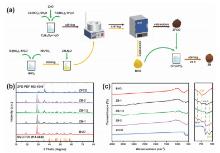
Fig 1
(a) Procedure for the preparation of ZB samples. (b) XRD patterns. (c) FTIR spectra of ZFCO, ZB-x and BVO photocatalysts."
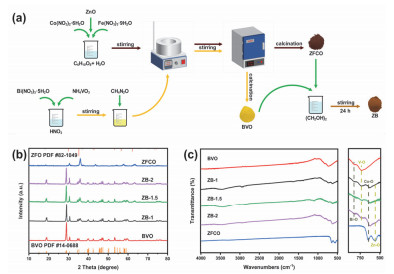
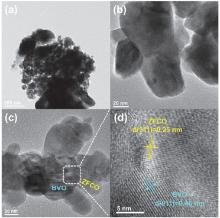
Fig 2
(a) TEM image of ZFCO. (b) TEM image of BVO. (c) TEM image of ZFCO/BVO composites. (d) HRTEM of ZFCO/BVO composites."
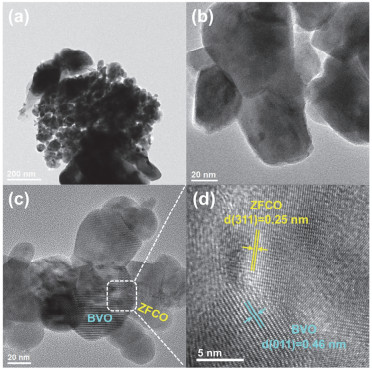
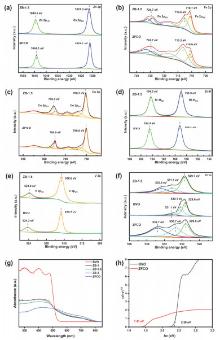
Fig 3
XPS spectra of ZB-1.5 composites of (a) Zn 2p, (b) Fe 2p, (c) Co 2p, (d) Bi 4f, (e) V 2p and (f) O 1s. (g) UV-vis DRS spectra of ZFCO, ZB-x, and BVO composites and (h) Tauc’s plot of BVO and ZFCO."
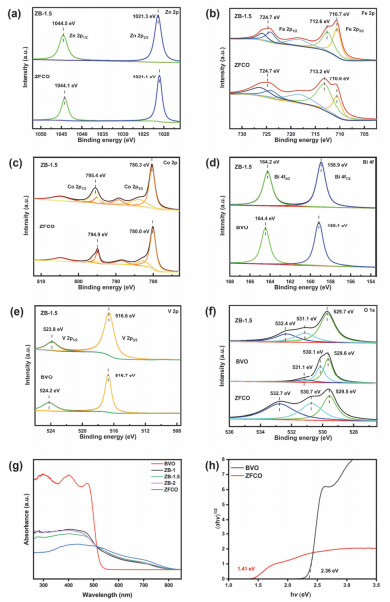
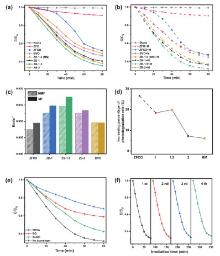
Fig 4
Photocatalytic degradation performance of TC solution (a) without a magnetic field and (b) with a magnetic field. (c) The fitted kinetic constant of photodegradation of TC solution without and with a magnet. (d) Increasing percentage of photodegradation rate under magnetic field. (e) Comparison of the effect of different radical scavengers. (f) The recyclability experiments of ZB-1.5 with magnetic field for photocatalytic degradation of TC."
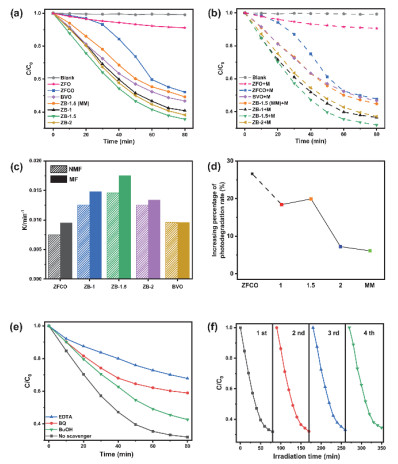
Table 1
The TOC removal rates in the ZB-1.5."
| Materials | Total carbon (mg∙L−1) | Inorganic carbon (mg∙L−1) | TOC removal rates (%) |
| ZB-1.5 | 13.011 | 5.173 | 39.757 |
| ZB-1.5 (1st cycle) | 12.935 | 5.141 | 39.748 |
| ZB-1.5 (2nd cycle) | 12.860 | 5.111 | 39.746 |
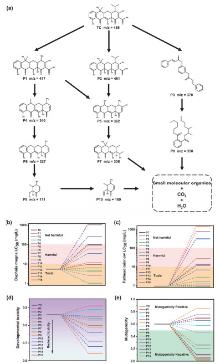
Fig 5
(a) Proposed degradation pathways of TC by the ZB-1.5 photocatalysts. Toxicity analysis of (b, c) acute toxicity, (d) developmental toxicity and (e) mutagenicity over TC photodegradation."
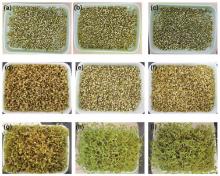
Fig 6
The mung bean germination experiment with TC, the solution after TC degradation, and tap water (a–c) for 1 day; (d–f) for 4 days; (g–i) for 7 days."
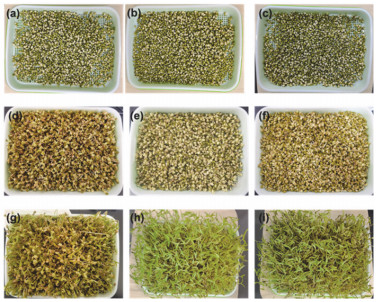
Fig 7
(a) Transient photocurrent responses of ZFCO, BVO, ZB-1.5 and ZB-1.5+M. (b) Magnetic hysteresis loops of BVO, ZFCO, and ZB-1.5 samples at room temperature."
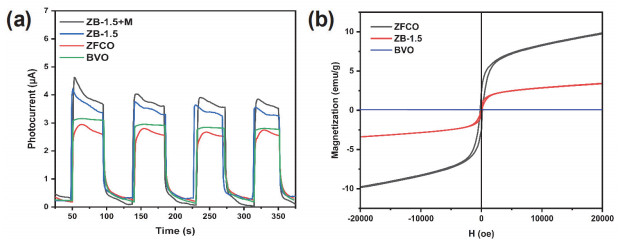
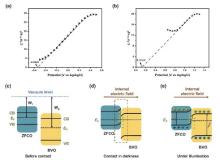
Fig 8
Mott–Schottky plot of (a) ZFCO and (b) BVO. The carriers transfer mechanism of S-scheme between ZFCO and BVO (c) before contact, (d) after contact and (e) under illumination."
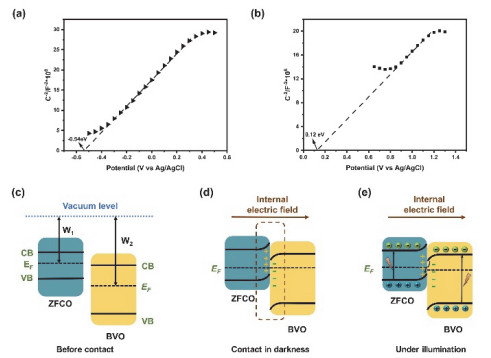
Fig 9
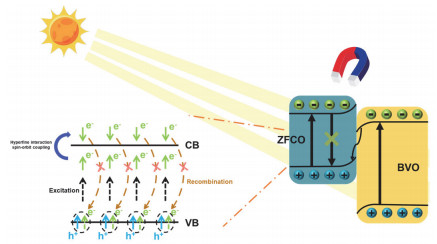
The proposed mechanism of TC degradation in ZFCO/BVO system under visible light irradiation and magnetic field."
| 1 |
doi: 10.1002/adfm.202316725 |
| 2 |
|
|
陈茹瑶; 夏加增; 陈义钢; 史海峰. 物理化学学报, 2023, 39, 2209012.
doi: 10.3866/PKU.WHXB202209012 |
|
| 3 |
doi: 10.1088/1361-6463/ad2094 |
| 4 |
doi: 10.1002/adfm.202313653 |
| 5 |
doi: 10.1021/acscatal.4c03916 |
| 6 |
|
|
游常俊; 王春春; 蔡铭洁; 刘艳萍; 竺柏康; 李世杰. 物理化学学报, 2024, 40, 2407014.
doi: 10.3866/PKU.WHXB202407014 |
|
| 7 |
doi: 10.1016/j.jmst.2023.07.005 |
| 8 |
doi: 10.1021/acs.accounts.4c00280 |
| 9 |
doi: 10.1021/cs500848f |
| 10 |
|
|
董珂欣; 申楚琦; 阎如玉; 刘艳萍; 庄春强; 李世杰. 物理化学学报, 2024, 40, 2310013.
doi: 10.3866/PKU.WHXB202310013 |
|
| 11 |
doi: 10.1016/j.jmst.2024.02.073 |
| 12 |
doi: 10.1016/j.nanoen.2024.109341 |
| 13 |
doi: 10.1021/acs.nanolett.3c05098 |
| 14 |
doi: 10.1016/j.cej.2024.156091 |
| 15 |
doi: 10.1039/d3ta06439e |
| 16 |
doi: 10.1016/j.nanoen.2022.107616 |
| 17 |
doi: 10.1039/D1EE02222A |
| 18 |
doi: 10.1021/acs.jpclett.5b02419 |
| 19 |
doi: 10.1002/adma.202207041 |
| 20 |
doi: 10.1038/ncomms11510 |
| 21 |
doi: 10.1021/acsenergylett.1c00682 |
| 22 |
doi: 10.1038/s41467-020-14333-w |
| 23 |
doi: 10.1002/adma.202310600 |
| 24 |
doi: 10.1038/s41467-024-49004-7 |
| 25 |
doi: 10.1002/adma.202406460 |
| 26 |
doi: 10.1016/j.apcatb.2024.124459 |
| 27 |
doi: 10.1002/smll.202312104 |
| 28 |
doi: 10.1002/adma.202400288 |
| 29 |
doi: 10.1002/smll.202305410 |
| 30 |
|
|
王文亮; 张灏纯; 陈义钢; 史海峰. 物理化学学报, 2022, 38, 2201008.
doi: 10.3866/PKU.WHXB202201008 |
|
| 31 |
doi: 10.1016/j.apcatb.2024.124366 |
| 32 |
doi: 10.1016/j.apcatb.2024.124690 |
| 33 |
|
|
肖林锋; 任婉璐; 沈诗诗; 陈梦姗; 廖润华; 周英棠; 李喜宝. 物理化学学报, 2024, 40, 2308036.
doi: 10.3866/PKU.WHXB202308036 |
|
| 34 |
doi: 10.1016/j.apcatb.2020.118844 |
| 35 |
|
|
黄凯辉; 陈德俊; 张欣; 沈荣晨; 张鹏; 许第发; 李鑫. 物理化学学报, 2024, 40, 2407020.
doi: 10.3866/PKU.WHXB202407020 |
|
| 36 |
doi: 10.1002/aenm.202303638 |
| 37 |
doi: 10.1002/solr.201900423 |
| 38 |
doi: 10.1016/S1872-2067(23)64479-1 |
| 39 |
doi: 10.1016/S1872-2067(21)63846-9 |
| 40 |
|
|
王春春; 游常俊; 戎珂; 申楚琦; 杨方; 李世杰. 物理化学学报, 2024, 40, 2307045.
doi: 10.3866/PKU.WHXB202307045 |
|
| 41 |
doi: 10.1016/j.jmst.2023.05.066 |
| 42 |
doi: 10.1016/j.envres.2021.111136 |
| 43 |
doi: 10.1016/j.apcatb.2017.12.051 |
| 44 |
doi: 10.1016/j.apcatb.2021.120379 |
| 45 |
doi: 10.1016/j.jmst.2020.11.037 |
| 46 |
doi: 10.1016/j.cej.2020.125919 |
| 47 |
doi: 10.1016/j.cej.2018.10.072 |
| 48 |
doi: 10.1039/D1DT02865K |
| 49 |
doi: 10.1016/j.apcatb.2024.123834 |
| 50 |
doi: 10.1016/j.cej.2019.01.189 |
| 51 |
doi: 10.1016/j.jmst.2023.03.053 |
| 52 |
doi: 10.1016/j.jmst.2023.12.054 |
| 53 |
doi: 10.1016/j.jmst.2024.02.012 |
| 54 |
doi: 10.1016/S1872-2067(23)64438-9 |
| 55 |
doi: 10.1002/anie.202218688 |
| 56 |
doi: 10.19728/j.issn1672-6634.2021070009 |
| 57 |
doi: 10.1039/D2TA07289K |
| 58 |
doi: 10.1016/j.jcis.2024.09.112 |
| 59 |
doi: 10.1016/S1872-2067(19)63481-9 |
| 60 |
doi: 10.1016/j.jcat.2018.03.012 |
| 61 |
doi: 10.1002/cctc.201700302 |
| 62 |
doi: 10.1021/acs.jpcc.9b01635 |
|
||