Acta Phys. -Chim. Sin. ›› 2026, Vol. 42 ›› Issue (10): 100265.doi: 10.1016/j.actphy.2026.100265
• ARTICLE • Previous Articles Next Articles
Transparent and hydrophilic "phoenix garment" for corneal stromal regeneration
Yimeng Li1,†, Yuanyuan Yang2,†, Zhengke Wang1,2,*( )
)
- 1 MOE Key Laboratory of Macromolecular Synthesis and Functionalization, Department of Polymer Science and Engineering, Zhejiang University, Hangzhou 310058, Zhejiang Province, China
2 The Second Affiliated Hospital, School of Medicine, Zhejiang University, Hangzhou 310009, Zhejiang Province, China
-
Received:2025-12-07Revised:2026-02-14Accepted:2026-02-25Published:2026-09-03 -
Contact:Email: wangzk@zju.edu.cn (Zhengke Wang)

Cite this article
Yimeng Li, Yuanyuan Yang, Zhengke Wang. Transparent and hydrophilic "phoenix garment" for corneal stromal regeneration[J]. Acta Phys. -Chim. Sin. 2026, 42(10), 100265. doi: 10.1016/j.actphy.2026.100265
share this article
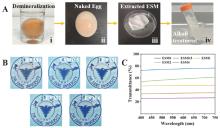
Fig 1
Extraction and clarification of ESM. (A) Processing of ESM: ⅰ, demineralization in EDTA/imidazole solution for 24 h, the calcareous shell completely dissolved; ⅱ, ESM carefully peeled off and thoroughly rinsed; ⅲ, a clean, semi-transparent ESM0 membrane; iv, ESM0 immersed in 1 mol L−1 NaOH for varying durations (0.5–4 h) to yield a series of clarified samples. (B) Macroscopic images of ESM after alkaline treatment. (C) Visible-light transmittance spectra of ESM."
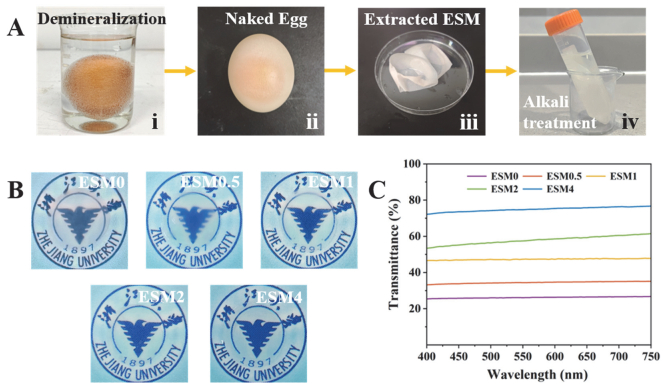
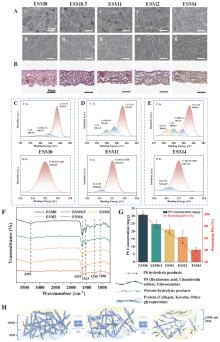
Fig 2
Impact of alkaline treatment on the microstructure, chemical composition, and transparency mechanism of ESM. (A) Representative SEM images: ⅰ, outer membrane; ⅱ, inner membrane. (B) EVG staining images. (C–E) High-resolution XPS C 1s and O 1s spectra of ESM0, ESM1, and ESM4, respectively. (F) FTIR spectra of ESM. (G) PS content of ESM. (H) Schematic illustration of the transparency mechanism."
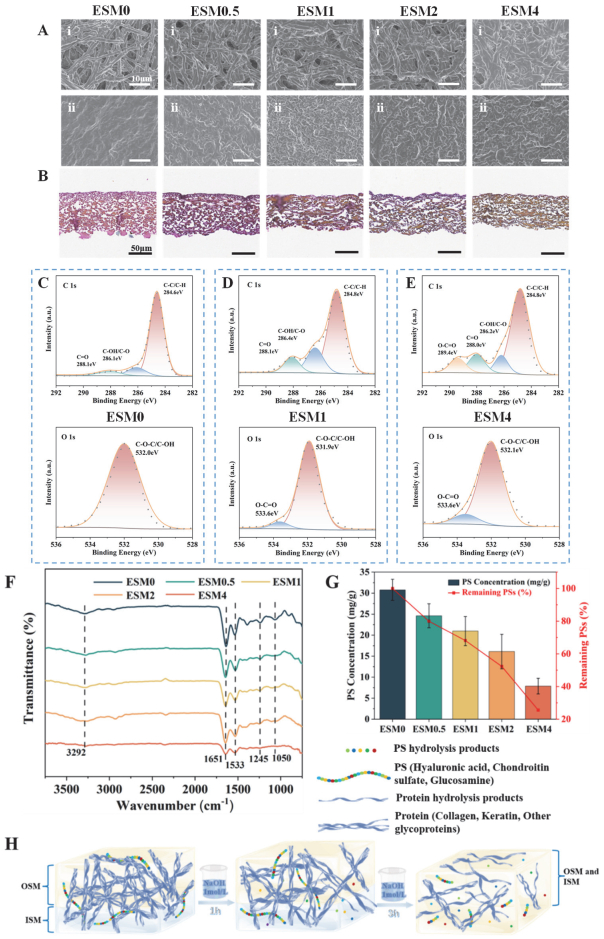
Fig 3
Regulation of the physicochemical properties of ESM by alkaline treatment. (A) Thickness, measured by confocal microscopy. (B) Saturated water content. (C) Collagenase degradation test. (D, E) Static water contact angle: representative images and quantitative analysis. (F) Mean flow pore diameter. (G, H) Tensile stress-strain curves and ultimate tensile strength. (*p < 0.05, **p < 0.01, ***p < 0.001)."
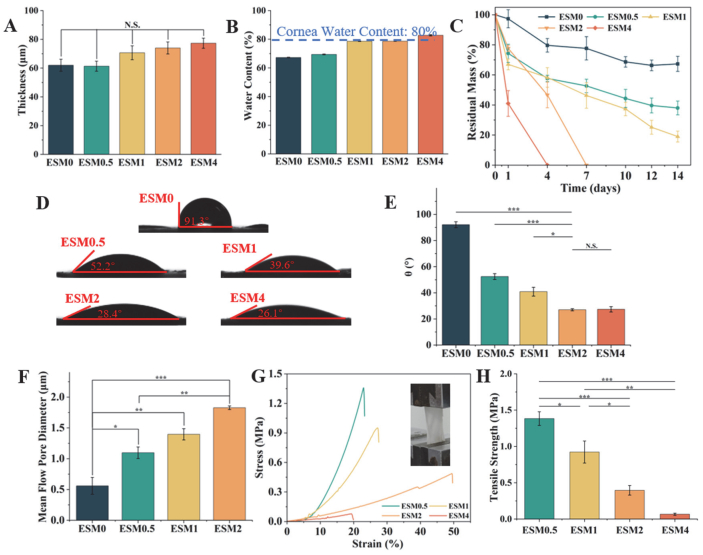
Fig 4
In vivo repair efficacy of ESM in a rabbit anterior-lamellar corneal defect model. (A) Schematic diagram of the experimental design: a partial-thickness corneal defect with a diameter of 5 mm and a depth of 200 μm was created in the left eye of New Zealand white rabbits. A 7 mm ESM1 patch was implanted and sutured in place, while the non-implanted group served as a negative control. (B) Slit-lamp microscopic appearance of ESM-mediated corneal repair. (C) Representative anterior segment optical coherence tomography (AS-OCT) images of rabbit corneas at 1, 2, 4, and 8 weeks post-surgery. (D) Corneal topography of rabbit corneas at 8 weeks post-surgery. (E) Quantitative analysis of corneal epithelial healing over time."
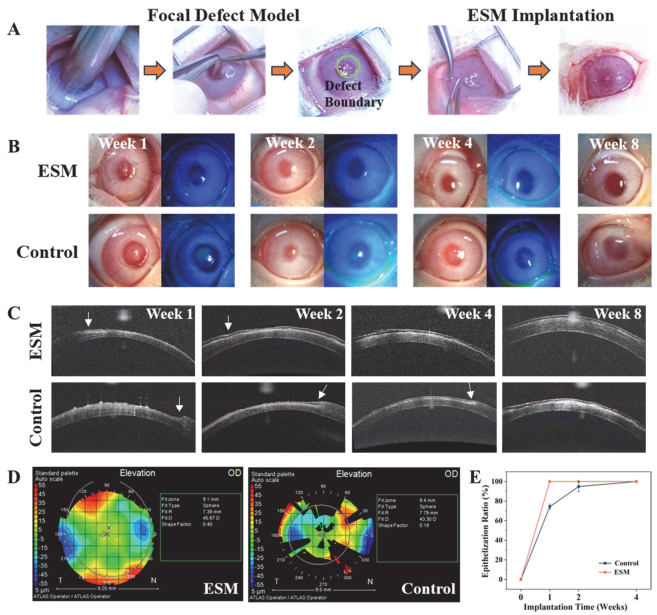
Fig 5
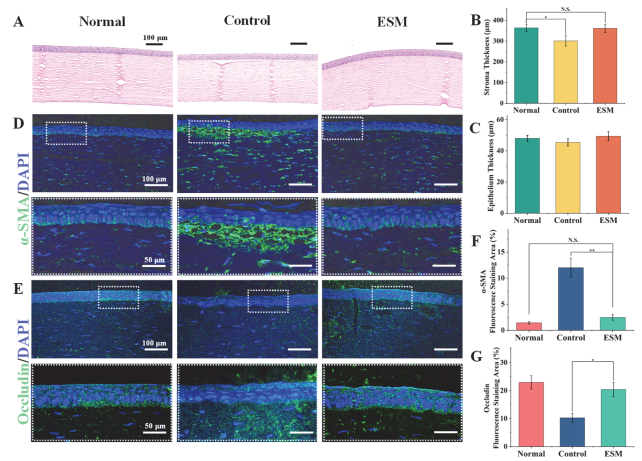
Histological evaluation of ESM in rabbit corneal defect repair. (A) Representative images of hematoxylin and eosin (H&E) staining at 8 weeks post-surgery. (B, C) Quantitative analyses of central corneal stromal and epithelial thicknesses, respectively. (D) Immunofluorescence staining images of DAPI (blue) and α-SMA (green). (E) Immunofluorescence staining images of DAPI (blue) and tight-junction protein Occludin (green). (F, G) Quantitative analyses of α-SMA and Occludin expression areas from fluorescence staining images, respectively. (*p < 0.05, **p < 0.01)."
| 1 |
S. Khosravimelal, M. Mobaraki, S. Eftekhari, M. Ahearne, A. M. Seifalian, M. Gholipourmalekabadi. Small 2021, 17(30), 2006335.
doi: 10.1002/smll.202006335 |
| 2 |
H. Aghamohammadzadeh, R. H. Newton, K. M. Meek. Structure 2004, 12(2), 249.
doi: 10.1016/j.str.2004.01.002 |
| 3 |
S. R. Flaxman, R. R. A. Bourne, S. Resnikoff, P. Ackland, T. Braithwaite, M. V. Cicinelli, A. Das, J. B. Jonas, J. Keeffe, J. H. Kempen, et al.. Lancet Glob. Health 2017, 5(12), e1221.
doi: 10.1016/S2214-109X(17)30393-5 |
| 4 |
M. Soleimani, Z. Ebrahimi, K. S. Ebrahimi, N. Farhadian, M. Shahlaei, K. Cheraqpour, H. Ghasemi, S. Moradi, A. Y. Chang, S. Sharifi, et al.. J. Int. Med. Res. 2023, 51(7), 03000605231190473.
doi: 10.1177/03000605231190473 |
| 5 |
Y. Li, Z. Wang. Adv. Sci. 2025, 12(6), 2408021.
doi: 10.1002/advs.202408021 |
| 6 |
G. Yazdanpanah, R. Shah, R. Raghurama, S. Somala, K. N. Anwar, X. Shen, S. An, M. Omidi, M. I. Rosenblatt, T. Shokuhfar, et al.. Ocul. Surf. 2021, 21, 27.
doi: 10.1016/j.jtos.2021.04.004 |
| 7 |
N. W. Kang, Y. A. Seo, K. J. Jackson, K. Jang, E. Song, U. Han, F. Chen, S. C. Heilshorn, D. Myung. Bioact. Mater. 2024, 40, 417.
doi: 10.1016/j.bioactmat.2024.05.045 |
| 8 |
X. Shen, S. Li, X. Zhao, J. Han, J. Chen, Z. Rao, K. Zhang, D. Quan, J. Yuan, Y. Bai. Bioact. Mater. 2023, 20, 434.
doi: 10.1016/j.bioactmat.2022.06.006 |
| 9 |
C. D. McTiernan, F. C. Simpson, M. Haagdorens, C. Samarawickrama, D. Hunter, O. Buznyk, P. Fagerholm, M. K. Ljunggren, P. Lewis, I. Pintelon, et al.. Sci. Adv. 2020, 6(25), eaba2187.
doi: 10.1126/sciadv.aba2187 |
| 10 |
A. J. MacAdam, M. Munoz, J. E. Hage, K. Hu, A. Ross, A. Chandra, J. D. Edwards, Z. Shahid, S. Mourcos, M. E. Comtois-Bona, et al.. Adv. Funct. Mater. 2023, 33(45), 2302721.
doi: 10.1002/adfm.202302721 |
| 11 |
Q. Tang, B. Lu, J. He, X. Chen, Q. Fu, H. Han, C. Luo, H. Yin, Z. Qin, D. Lyu, et al.. Biomaterials 2022, 280, 121320.
doi: 10.1016/j.biomaterials.2021.121320 |
| 12 |
X. Zhao, X. Zuo, J. Zhong, B. Wang, S. Li, Y. Xiao, J. Yuan. Front. Bioeng. Biotechnol. 2020, 8, 599800.
doi: 10.3389/fbioe.2020.599800 |
| 13 |
Z. Esmaeili, Z. Nokhbedehghan, S. Alizadeh, J. Majidi, H. Chahsetareh, S. H. Daryabari, M. Nazm-Bojnourdi, M. Kadkhodaie, M. Ghaffari, A. Hashemi, et al.. Mater. Design 2024, 237, 112614.
doi: 10.1016/j.matdes.2023.112614 |
| 14 |
G. Yazdanpanah, X. Shen, T. Nguyen, K. N. Anwar, O. Jeon, Y. Jiang, M. Pachenari, Y. Pan, T. Shokuhfar, M. I. Rosenblatt, et al.. Adv. Funct. Mater 2022, 32, 2113383.
doi: 10.1002/adfm.202113383 |
| 15 |
P. S. Kousiouris, M. Kantzanou, M. Dantsiou, A. Drosopoulou, K. Rallis, D. Papakonstantinou, M. M. Moschos. Cureus 2024, 16(3), 55435.
doi: 10.7759/cureus.55435 |
| 16 |
N. Colatrella. J. Dry Eye Dis. 2019, 2(1), e1.
doi: 10.22374/jded.v2i1.14 |
| 17 |
C. C. De Farias, N. Allemann, J. Á. P. Gomes. Cornea 2016, 35(4), 438.
doi: 10.1097/ICO.0000000000000754 |
| 18 |
Y. Manolova, Z. Stoycheva, Y. Yordanov, C. Grupcheva. Scripta Sci. Med. 2017, 49(1), 12.
doi: 10.14748/ssm.v49i1.2060 |
| 19 |
M. Liu, G. Luo, Y. Wang, R. Xu, Y. Wang, W. He, J. Tan, M. Xing, J. Wu. Sci. Rep. 2017, 7(1), 436.
doi: 10.1038/s41598-017-00594-x |
| 20 |
X. Duan, H. Sheardown. Biomaterials 2006, 27(26), 4608.
doi: 10.1016/j.biomaterials.2006.04.022 |
| 21 |
S. Park, K. S. Choi, D. Lee, D. Kim, K. T. Lim, K. H. Lee, H. Seonwoo, J. Kim. Biosyst. Eng. 2016, 151, 446.
doi: 10.1016/j.biosystemseng.2016.10.014 |
| 22 |
M. M. Pillai, R. Saha, P. Tayalia. J. Mater. Sci. 2023, 58(16), 6865.
doi: 10.1007/s10853-023-08434-2 |
| 23 |
Y. Shi, K. Zhou, D. Li, V. Guyonnet, M. T. Hincke, Y. Mine. Foods 2021, 10(9), 2178.
doi: 10.3390/foods10092178 |
| 24 |
R. A. Mensah, S. B. Jo, H. Kim, S. M. Park, K. D. Patel, K. J. Cho, M. T. Cook, S. B. Kirton, V. Hutter, L. E. Sidney, et al.. J. Biomater. Appl. 2021, 36(5), 912.
doi: 10.1177/08853282211024040 |
| 25 |
J. Strnková, Š. Nedomová, V. Kumbár, J. Trnka. Acta Univ. Agric. Silvic. Mendel. Brun. 2016, 64(1), 159.
doi: 10.11118/actaun201664010159 |
| 26 |
Y. Zhang, H. M. Pham, S. D. Tran. Biomolecules 2024, 14(4), 439.
doi: 10.3390/biom14040439 |
| 27 |
H. J. Choi, Y. M. Kim, J. Y. Suh, J. Y. Han. Mater. Sci. Eng. C 2021, 128, 112350.
doi: 10.1016/j.msec.2021.112350 |
| 28 |
E. Briggs, R. A. Mensah, K. D. Patel, N. E. Mandakhbayar, N. S. Sharifulden, Z. K. Erdogan, L. V. B. Silva, K. Salim, H. W. Kim, L. T. B. Nguyen, et al.. Pharmaceutics 2022, 14(10), 2162.
doi: 10.3390/pharmaceutics14102162 |
| 29 |
X. Chen, L. Zhu, W. Wen, L. Lu, B. Luo, C. Zhou. Colloids Surf. B Biointerfaces 2019, 179, 299.
doi: 10.1016/j.colsurfb.2019.04.009 |
| 30 |
M. M. Pillai, J. Gopinathan, R. Senthil Kumar, G. Sathish Kumar, S. Shanthakumari, K. S. Sahanand, A. Bhattacharyya, R. Selvakumar. J. Biomed. Mater. Res 2018, 106(6), 1722.
doi: 10.1002/jbm.a.36372 |
| 31 |
S. Yan, B. Napiwocki, Y. Xu, J. Zhang, X. Zhang, X. Wang, W. C. Crone, Q. Li, L. S. Turng. Mater. Sci. Eng. C 2020, 107, 110311.
doi: 10.1016/j.msec.2019.110311 |
| 32 |
R. A. Mensah, M. T. Cook, S. B. Kirton, V. Hutter, D. Y. S. Chau. Eur. J. Pharm. Biopharm. 2023, 190, 258.
doi: 10.1016/j.ejpb.2023.07.007 |
| 33 |
L. Wang, L. Bao, Z. Wang, B. Sun, Y. Yu, Y. Ma, J. Hu, X. Ding, Y. Bao, J. Dai, J., et al.. Bioact. Mater. 2026, 59, 266.
doi: 10.1016/j.bioactmat.2025.12.047 |
| 34 |
L. Zhao, Z. Shi, X. Zhang, J. Wang, S. Yang, F. Wang, T. Li, Q. Zhou, T. Wang, W. Shi. Adv. Sci. 2025, 12(19), 2411540.
doi: 10.1002/advs.202411540 |
| 35 |
A. Resch, M. C. Huber, A. Resch, A. Schreiber, T. Lapp, J. Dittrich, F. Eisen, A. J. Michalec, V. Planz, A. Kolberg, et al.. Adv. Funct. Mater. 2026, 36(4), e17275.
doi: 10.1002/adfm.202517275 |
| 36 |
S. P. Kambhampati, R. Sharma, H. Lin, S. Appiani, J. L. Cleland, S. C. Yiu, R. M. Kannan. Adv. Sci. 2025, 12(23), 2417731.
doi: 10.1002/advs.202417731 |
| 37 |
S. Makkar, R. Liyanage, L. Kannan, B. Packialakshmi, J. O. Lay, N. C. Rath. J. Agric. Food Chem. 2015, 63(44), 9888.
doi: 10.1021/acs.jafc.5b04266 |
| 38 |
V. V. Acharya, P. Chaudhuri. Int. J. Pharm. Sci. Rev. Res. 2021, 69(2), 19.
doi: 10.47583/ijpsrr.2021.v69i02.002 |
| 39 |
T. Yu, X. Zhong, D. Li, J. Zhu, V. V. Tuchin, D. Zhu. Adv. Drug Deliv. Rev. 2024, 215, 115470.
doi: 10.1016/j.addr.2024.115470 |
| 40 |
Z. Zhang, Y. Yu, D. Zhao, X. Ding, B. Sun, Y. Ma, L. Wang, X. Wang, Z. Cai, W. Cui, et al.. Adv. Funct. Mater. 2025, 35(32), 2423392.
doi: 10.1002/adfm.202423392 |
| 41 |
Y. Y. Wang, J. P. Huang, S. L. Fu, Y. Jiang, T. Chen, X. Y. Liu, E. W. Jin, Y. Dong, Z. K. Wang, P. H. Ding. Int. J. Biol. Macromol. 2023, 253, 127193.
doi: 10.1016/j.ijbiomac.2023.127193 |
| 42 |
K. Tainaka, T. C. Murakami, E. A. Susaki, C. Shimizu, R. Saito, K. Takahashi, A. Hayashi-Takagi, H. Sekiya, Y. Arima, S. Nojima, et al.. Cell Reports 2018, 24(8), 2196.
doi: 10.1016/j.celrep.2018.07.056 |
| 43 |
K. M. Meek, C. Knupp. Prog. Retin. Eye Res. 2015, 49, 1.
doi: 10.1016/j.preteyeres.2015.07.001 |
| 44 |
F. G. Torres, O. P. Troncoso, F. Piaggio, A. Hijar. Acta Biomater. 2010, 6(9), 3687.
doi: 10.1016/j.actbio.2010.03.014 |
| 45 |
R. Muthuraj, M. Hajee, A. R. Horrocks, B. K. Kandola. Int. J. Biol. Macromol. 2019, 132, 439.
doi: 10.1016/j.ijbiomac.2019.03.142 |
| 46 |
J. Hernández, C. Panadero-Medianero, M. S. Arrázola, M. Ahumada. Polymers 2024, 16(8), 1118.
doi: 10.3390/polym16081118 |
| 47 |
Y. Li, Y. Shi, D. Huang, Y. Wu, W. Dong. J. Hazard. Mater. 2021, 413, 125420.
doi: 10.1016/j.jhazmat.2021.125420 |
| 48 |
T. Yu, J. Zhu, D. Li, D. Zhu. iScience 2021, 24(3), 102178.
doi: 10.1016/j.isci.2021.102178 |
| 49 |
H. Zhou, S. Zhang, M. Lei, Y. Cai, H. Wang, J. Sun, J. Cui, C. Liu, X. Qu. Bioact. Mater. 2023, 29, 1.
doi: 10.1016/j.bioactmat.2023.05.008 |
| 50 |
A. Recchioni, E. Mocciardini, E. Ponzini, S. Tavazzi. Exp. Eye Res. 2022, 219, 109083.
doi: 10.1016/j.exer.2022.109083 |
| 51 |
M. Fénelon, S. Catros, C. Meyer, J. C. Fricain, L. Obert, F. Auber, A. Louvrier, F. Gindraux. Membranes 2021, 11(6), 387.
doi: 10.3390/membranes11060387 |
| 52 |
S. Bradford, S. Luo, D. Brown, T. Juhasz, J. Jester. Ocul. Surf. 2023, 30, 150.
doi: 10.1016/j.jtos.2023.09.003 |
| 53 |
Y. Yang, Y. Li, Z. Wang, Research Square (2025), https://doi.org/10.21203/rs.3.rs-8298309/v1.
|
| 54 |
S. Dupont, L. Morsut, M. Aragona, E. Enzo, S. Giulitti, M. Cordenonsi, F. Zanconato, J. Le Digabel, M. Forcato, S. Bicciato, et al.. Nature 7350, 474(2011), 179.
doi: 10.1038/nature10137 |
| 55 |
E. Ohto-Fujita, M. Shimizu, S. Sano, M. Kurimoto, K. Yamazawa, T. Atomi, T. Sakurai, Y. Murakami, T. Takami, T. Murakami, et al.. Cell Tissue Res. 2019, 376(1), 123.
doi: 10.1007/s00441-018-2954-3 |
| 56 |
X. Kong, J. Fu, K. Shao, L. Wang, X. Lan, J. Shi. Acta Biomater. 2019, 100, 255.
doi: 10.1016/j.actbio.2019.10.011 |
| [1] | Na Zhao, Jing Peng, Jianping Wang, Maolin Zhai. Novel Carboxy-Functionalized PVP-CdS Nanopopcorns with Homojunctions for Enhanced Photocatalytic Hydrogen Evolution [J]. Acta Phys. -Chim. Sin., 2022, 38(4): 2004046-. |
| [2] | SONG Guang-Ling;SONG Shi-Zhe. Corrosion Behaviour of Pure Magnesium in a Simulated Body Fluid [J]. Acta Phys. -Chim. Sin., 2006, 22(10): 1222-1226. |
|
||