Acta Phys. -Chim. Sin. ›› 2026, Vol. 42 ›› Issue (10): 100280.doi: 10.1016/j.actphy.2026.100280
Special Issue: Solar Energy Conversion and Storage
• ARTICLE • Previous Articles Next Articles
Solvatochromic Ti-oxo clusters as cathode interlayer for efficient organic solar cells
Chaowei Zhao1,2,3,4, Ting Li1,2, Dongdong Xia2, Qian Xie2, Jie Fang2, Yuefeng Zhang2,*( ), Yu Xie1,*(), Alex K.-Y. Jen3,4,5,*()
- 1 College of Environment and Chemical Engineering, Nanchang Hangkong University, Nanchang 330063, Jiangxi Province, China
2 Key Laboratory of Jiangxi Province for Environment and Energy Catalysis, Institute of Energy Research, Jiangxi Academy of Sciences, Nanchang 330096, Jiangxi Province, China
3 Hong Kong Institute for Clean Energy, City University of Hong Kong, Kowloon, Hong Kong, China
4 Department of Materials Science and Engineering, City University of Hong Kong, Kowloon, Hong Kong, China
5 Department of Chemistry, City University of Hong Kong, Kowloon, Hong Kong, China
-
Received:2025-09-22Revised:2026-03-04Accepted:2026-03-05Published:2026-09-03 -
Contact:Email: zhangyuefeng1987@126.com (Yuefeng Zhang)xieyu_121@163.com (Yu Xie)alexjen@cityu.edu.hk (Alex K.-Y. Jen)

Cite this article
Chaowei Zhao, Ting Li, Dongdong Xia, Qian Xie, Jie Fang, Yuefeng Zhang, Yu Xie, Alex K.-Y. Jen. Solvatochromic Ti-oxo clusters as cathode interlayer for efficient organic solar cells[J]. Acta Phys. -Chim. Sin. 2026, 42(10), 100280. doi: 10.1016/j.actphy.2026.100280
share this article
Fig 1
(a) The Ti6O4 core structure in these clusters. Single crystal structures of each cluster of Ti6-1 (b), Ti6-2 (c), and Ti6-3 (d). Inset is the corresponding SEM images, where the bar scale is 20 µm. Color legend: grey, C; blue, N; red, O; purple, P; lime, Ti. H atoms are omitted for clarity. PXRD of Ti6-1 (e), Ti6-2 (f), and Ti6-3 (g)."
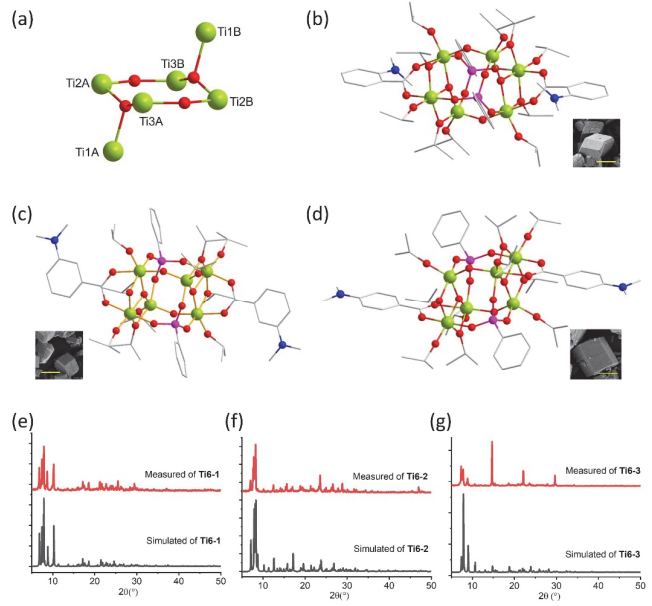
Fig 2
The UV-Vis absorption spectra of (a) Ti6-3 in DCM/TFE, (b) Ti6-3 in DCM/IPA, (c) Ti6-1 in DCM/TFE and DCM/IPA, (d)Ti6-2 in DCM/TFE and DCM/IPA, respectively. The inset is the cooresponding photos of the solution. Comparison of the absorption spectra (e) and EPR spectra (f) of Ti6-1-F, Ti6-2-F and Ti6-3-F."
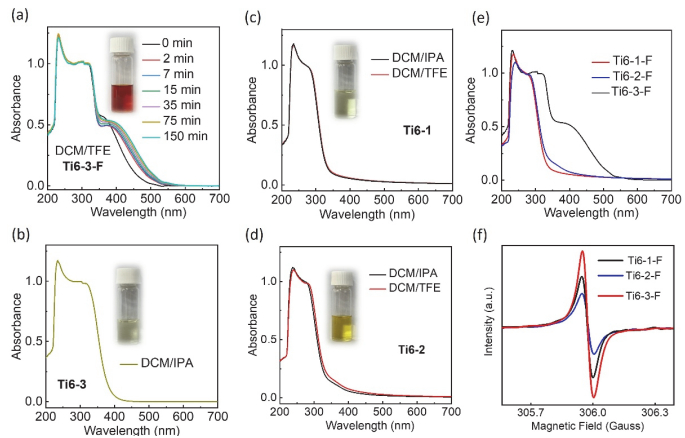
Fig 3
(a) 1H NMR of three as-synthesized TOCs in CDCl3. (b) 1H NMR of three TOCs in CDCl3 in the presence of excess TFE."
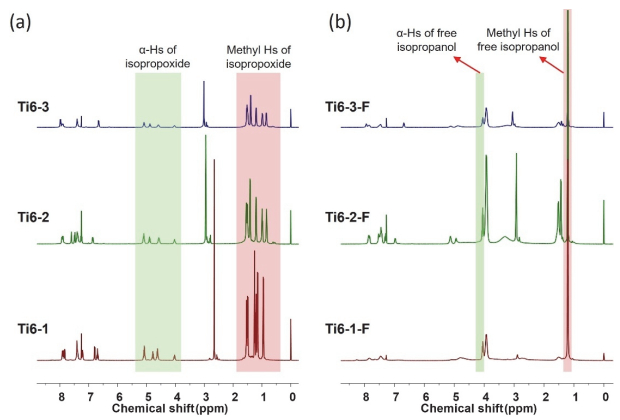
Fig 4
The frontier energy levels of Ti6-3 and Ti6-3-F by DFT calculation."
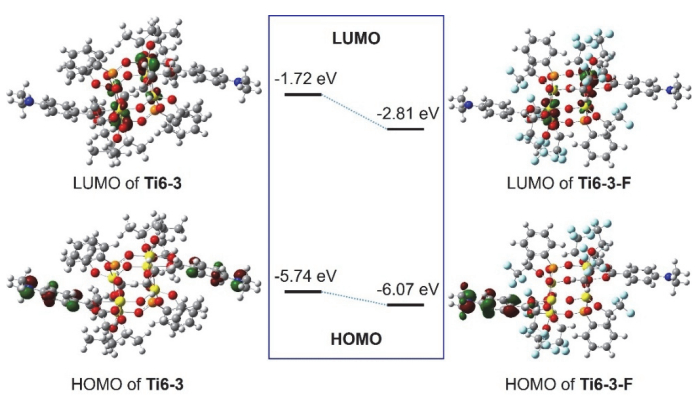
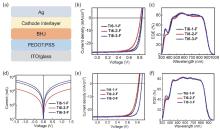
Fig 5
Device performance of OSCs using the modifed TOCs as CILs. (a) The device architecture. (b) The J–V curves of PM6:BO-4Cl based OSCs and (c) the corresponding EQEs. (d) I–V measurements of the modifed TOCs as thin films. (e) The J–V curves of PM6:L8-BO based OSCs and (f) the corresponding EQEs."
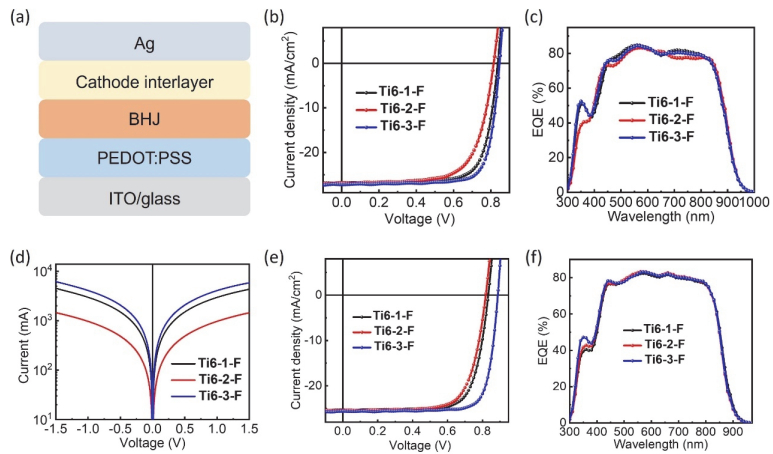
Table 1
Characteristics of optimized solar cells based on PM6:BO-4Cl and PM6:L8-BO with different CILs a."
| BHJ | CILs | Jsc/(mA cm−2) | Voc/(V) | FF | PCE a (%) | σ/(S cm−1) |
| PM6:BO-4Cl | Ti6-1-F | 26.99 (26.99 ± 0.04) | 0.837 (0.832 ± 0.003) | 0.744 (0.741 ± 0.006) | 16.82 (16.64 ± 0.12) | 1.8 × 10⁻⁵ |
| Ti6-2-F | 26.40 (26.28 ± 0.09) | 0.816 (0.811 ± 0.002) | 0.691 (0.694 ± 0.003) | 14.88 (14.78 ± 0.07) | 5.8 × 10⁻⁶ | |
| Ti6-3-F | 27.18 (27.11 ± 0.08) | 0.847 (0.843 ± 0.002) | 0.777 (0.778 ± 0.002) | 17.89 (17.77 ± 0.05) | 2.4 × 10⁻⁵ | |
| PM6:L8-BO | Ti6-1-F | 25.32 (25.24 ± 0.13) | 0.833 (0.830 ± 0.004) | 0.743 (0.735 ± 0.007) | 15.67 (15.40 ± 0.17) | 1.8 × 10⁻⁵ |
| Ti6-2-F | 25.37 (25.40 ± 0.08) | 0.819 (0.816 ± 0.006) | 0.719 (0.715 ± 0.003) | 14.93 (14.82 ± 0.12) | 5.8 × 10⁻⁶ | |
| Ti6-3-F | 25.56 (25.47 ± 0.12) | 0.888 (0.885 ± 0.002) | 0.797 (0.793 ± 0.005) | 18.09 (17.88 ± 0.10) | 2.4 × 10⁻⁵ |
| 1 |
D. Chen, R. A. Caruso. Adv. Funct. Mater. 2012, 23(11), 1356.
doi: 10.1002/adfm.201201880 |
| 2 |
J. Bai, B. Zhou. Chem. Rev. 2014, 114(19), 10131.
doi: 10.1021/cr400625j |
| 3 |
Y. Bai, I. Mora-Sero, F. De Angelis, J. Bisquert, P. Wang. Chem. Rev. 2014, 114(19), 10095.
doi: 10.1021/cr400606n |
| 4 |
M. Kapilashrami, Y. Zhang, Y. S. Liu, A. Hagfeldt, J. Guo. Chem. Rev. 2014, 114(19), 9662.
doi: 10.1021/cr5000893 |
| 5 |
Y. Ma, X. Wang, Y. Jia, X. Chen, H. Han, C. Li. Chem. Rev. 2014, 114(19), 9987.
doi: 10.1021/cr500008u |
| 6 |
T. Rajh, N. M. Dimitrijevic, M. Bissonnette, T. Koritarov, V. Konda. Chem. Rev. 2014, 114(19), 10177.
doi: 10.1021/cr500029g |
| 7 |
F. De Angelis, C. Di Valentin, S. Fantacci, A. Vittadini, A. Selloni. Chem. Rev. 2014, 114(19), 9708.
doi: 10.1021/cr500055q |
| 8 |
P. Coppens, Y. Chen, E. Trzop. Chem. Rev. 2014, 114(19), 9645.
doi: 10.1021/cr400724e |
| 9 |
U. Schubert. Coord. Chem. Rev. 2017, 350, 61.
doi: 10.1016/j.ccr.2017.05.002 |
| 10 |
Y. Yan, C. Li, Y. Wu, J. Gao, Q. Zhang. J. Mater. Chem. A 2020, 8(31), 15245.
doi: 10.1039/d0ta03749d |
| 11 |
G. B. Xiao, X. Mu, S. Zhou, L. Zhu, Y. Peng, Q. Liang, X. Zou, J. Zhang, L. Zhang, J. Cao. Angew. Chem. Int. Ed. 2023, 62(17), e202218478.
doi: 10.1002/anie.202218478 |
| 12 |
X. Huang, D. Xia, Q. Xie, D. Wang, Q. Li, C. Zhao, J. Yin, F. Cao, Z. Su, Z. Zeng, et al.. Nat. Commun. 2025, 16(1), 1626.
doi: 10.1038/s41467-025-56060-0 |
| 13 |
F. Li, C. Zhao, Y. Li, Z. Zhang, X. Huang, Y. Zhang, J. Fang, T. Bian, Z. Zeng, J. Yin, et al.. Sci. Adv. 2024, 10(50), eadq1150.
doi: 10.1126/sciadv.adq1150 |
| 14 |
S. Zhao, W. Peng, L. Zhou, S. Dai, W. Ren, E. Xu, Y. Xiao, M. Zhang, M. Huang, Y. Shen, et al.. Nat. Commun. 2025, 16(1), 769.
doi: 10.1038/s41467-025-56069-5 |
| 15 |
J. Zhang, L. Liu, Z. Zhao, C. T. Hung, B. Wang, L. Duan, K. Lv, X. M. Cao, Y. Tang, D. Zhao. J. Am. Chem. Soc. 2024, 146(26), 17866.
doi: 10.1021/jacs.4c03538 |
| 16 |
H. Assi, G. Mouchaham, N. Steunou, T. Devic, C. Serre. Chem. Soc. Rev. 2017, 46(11), 3431.
doi: 10.1039/c7cs00001d |
| 17 |
W. H. Fang, L. Zhang, J. Zhang. Chem. Soc. Rev. 2018, 47(2), 404.
doi: 10.1039/c7cs00511c |
| 18 |
W. H. Fang, L. Zhang, J. Zhang. J. Am. Chem. Soc. 2016, 138(24)
doi: 10.1021/jacs.6b03489 |
| 19 |
M.-Y. Gao, F. Wang, Z.-G. Gu, D.-X. Zhang, L. Zhang, J. Zhang. J. Am. Chem. Soc. 2016, 138(8)
doi: 10.1021/jacs.6b00613 |
| 20 |
C. Zhao, Y. Z. Han, S. Dai, X. Chen, J. Yan, W. Zhang, H. Su, S. Lin, Z. Tang, B. K. Teo, et al.. Angew. Chem. Int. Ed. 2017, 56, 16252.
doi: 10.1002/anie.201709096 |
| 21 |
H. Zheng, M. H. Du, S. C. Lin, Z. C. Tang, X. J. Kong, L. S. Long, L. S. Zheng. Angew. Chem. Int. Ed. 2018, 57(34), 10976.
doi: 10.1002/anie.201806757 |
| 22 |
Y. L. Xie, W. H. Fang, J. Zhang. Aggregate 2024, 5(3), e506.
doi: 10.1002/agt2.506 |
| 23 |
Y. Zou, W. Lv, A. N. Wang, X. Y. Li, J. H. Li, G. M. Wang. Inorg. Chem. 2023, 62(6), 2617.
doi: 10.1021/acs.inorgchem.2c03397 |
| 24 |
C. Li, K. Wang, X. Y. Li, X. F. Jiang, Q. Wei, J. H. Li, G. M. Wang. Inorg. Chem. 2021, 60(4), 2105.
doi: 10.1021/acs.inorgchem.0c03665 |
| 25 |
S. Chen, W. H. Fang, L. Zhang, J. Zhang. Angew. Chem. Int. Ed. 2018, 57(35), 11252.
doi: 10.1002/anie.201804569 |
| 26 |
Y. Lin, Y.-F. Zhu, Z.-H. Chen, F.-H. Liu, L. Zhao, Z.-M. Su. Inorg. Chem. Commun. 2014, 40, 22.
doi: 10.1016/j.inoche.2013.11.023 |
| 27 |
X. Fan, J. Wang, K. Wu, L. Zhang, J. Zhang. Angew. Chem. Int. Ed. 2019, 58(5), 1320.
doi: 10.1002/anie.201809961 |
| 28 |
G. Zhang, C. Liu, D.-L. Long, L. Cronin, C.-H. Tung, Y. Wang. J. Mater. Chem. A 2016, 138(35)
doi: 10.1021/jacs.6b06290 |
| 29 |
C. Li, H. Xu, J. Gao, W. Du, L. Shangguan, X. Zhang, R. B. Lin, H. Wu, W. Zhou, X. Liu, et al.. J. Mater. Chem. A 2019, 7(19), 11928.
doi: 10.1039/C9TA01942A |
| 30 |
T. Kramer, F. Tuna, S. D. Pike. Chem. Sci. 2019, 10(28), 6886.
doi: 10.1039/c9sc01241a |
| 31 |
Q.-Y. Zhu, J. Dai. Coord. Chem. Rev. 2021, 430, 213664.
doi: 10.1016/j.ccr.2020.213664 |
| 32 |
J. L. Hou, P. Huo, Z. Z. Tang, L. N. Cui, Q. Y. Zhu, J. Dai. Inorg. Chem. 2018, 57(12), 7420.
doi: 10.1021/acs.inorgchem.8b01050 |
| 33 |
L.-R. Liao, D.-C. Zheng, P.-X. Ou, Q.-X. Zhao, W.-M. Xuan, Q. Zheng. Rare Met. 2024, 43(4), 1736.
doi: 10.1007/s12598-023-02545-0 |
| 34 |
J.-X. Yin, P. Huo, S. Wang, J. Wu, Q.-Y. Zhu, J. Dai. J. Mater. Chem. C 2015, 3(2), 409.
doi: 10.1039/c4tc02009j |
| 35 |
Y. Z. Yu, Y. R. Zhang, C. H. Geng, L. Sun, Y. Guo, Y. R. Feng, Y. X. Wang, X. M. Zhang. Inorg. Chem. 2019, 58(24), 16785.
doi: 10.1021/acs.inorgchem.9b02951 |
| 36 |
N. Li, S.-Q. Zhao, X.-R. Ding, X.-Y. Hu, Q.-K. Zhang, G.-D. Zou, Y. Fan. Inorg. Chem. Commun. 2021, 130, 108681.
doi: 10.1016/j.inoche.2021.108681 |
| 37 |
M. Y. Gao, Z. Wang, Q. H. Li, D. Li, Y. Sun, Y. H. Andaloussi, C. Ma, C. Deng, J. Zhang, L. Zhang. J. Am. Chem. Soc. 2022, 144(18), 8153.
doi: 10.1021/jacs.2c00765 |
| 38 |
Y. Cui, G.-D. Zou, H.-M. Li, Y. Huang, Y. Fan. Polyhedron 2019, 157, 177.
doi: 10.1016/j.poly.2018.10.011 |
| 39 |
N. Li, P. D. Matthews, H. K. Luo, D. S. Wright. Chem. Commun. 2016, 52(75), 11180.
doi: 10.1039/c6cc03788g |
| 40 |
C. Wang, C. Liu, L. J. Li, Z. M. Sun. Inorg. Chem. 2019, 58(9), 6312.
doi: 10.1021/acs.inorgchem.9b00508 |
| 41 |
X. Li, Y. Zhu, Y. Gai, Y. Shi, T. Wei, Y. Wang, A. Zhou, H. Zhang, H. Wang, K. Xiong. Inorg. Chem. Commun. 2021, 123, 108324.
doi: 10.1016/j.inoche.2020.108324 |
| 42 |
F. Meng, W.-D. Liu, G.-J. Li, J. Deng, X.-J. Kong. Inorg. Chem. Commun. 2022, 141, 109565.
doi: 10.1016/j.inoche.2022.109565 |
| 43 |
N. Li, P. Yang, M.-Y. Pan, X.-Y. Lv, G.-D. Zou, Y. Fan. J. Mol. Struct. 2022, 1263, 133169.
doi: 10.1016/j.molstruc.2022.133169 |
| 44 |
Y.-J. Liu, W.-H. Fang, L. Zhang, J. Zhang. Coord. Chem. Rev. 2020, 404, 213099.
doi: 10.1016/j.ccr.2019.213099 |
| 45 |
J. X. Liu, M. Y. Gao, W. H. Fang, L. Zhang, J. Zhang. Angew. Chem. Int. Ed. 2016, 55(17), 5160.
doi: 10.1002/anie.201510455 |
| 46 |
X. Chen, Y. Han, J. Fang, Z. Zhang, Y. Zhang, C. Zhao, D. Xia, X. Dong, C. Xiao, Y. Wu, et al.. ACS Appl. Mater. Interfaces 2021, 13(33), 39671.
doi: 10.1021/acsami.1c11332 |
| 47 |
C. Zhao, Z. Zhang, F. Han, D. Xia, C. Xiao, J. Fang, Y. Zhang, B. Wu, S. You, Y. Wu, et al.. Angew. Chem. Int. Ed. 2021, 60(15), 8526.
doi: 10.1002/anie.202100755 |
| 48 |
Z. Zhang, F. Han, J. Fang, C. Zhao, S. Li, Y. Wu, Y. Zhang, S. You, B. Wu, W. Li. CCS Chem. 2022, 4(3), 880.
doi: 10.31635/ccschem.021.202100825 |
| 49 |
Z. Zhang, C. Zhao, Y. Zhang, Y. Han, Z. Zhang, J. Fang, D. Xia, S. You, Q. Chen, W. Li. Chem. Eng. J. 2023, 454, 140002.
doi: 10.1016/j.cej.2022.140002 |
| 50 |
Y. Wang, Z. Chen, R. Yang, N. Kwon, S. Park, H. S. Kim, H. Lee, Y. Liu. Adv. Electron. Mater. 2022, 8(7), 2101316.
doi: 10.1002/aelm.202101316 |
| 51 |
F. Qi, H. Zhang, S. Liu, Y. Wei, H. Lu, G. Ran, P. Zhang, H. Li, W. Zhang, Y. Liu, et al.. Adv. Funct. Mater. 2025, 35, 2424978.
doi: 10.1002/adfm.202424978 |
| 52 |
W. Liu, J. Wen, H. Yu, X. Zhan, Y. Wang, L. Zhang, Y. Fan, Z. You, Y. Liu. Angew. Chem. Int. Ed. 2025, 64(1), e202413135.
doi: 10.1002/anie.202413135 |
| 53 |
Y. Wang, J. Wen, Z. Shang, Y. Zhong, H. Zhang, W. Liu, W. Han, H. Yang, J. Liu, J. Zhang, et al.. Angew. Chem. Int. Ed. 2025, 64(31), e202506252.
doi: 10.1002/anie.202506252 |
| 54 |
X. Wang, J. Tian, Z. You, L. Lei, A. Ge, Y. Liu. Chin. J. Chem. 2024, 42(23), 2979.
doi: 10.1002/cjoc.202400692 |
| 55 |
X. Wang, X. Chang, A. Gao, Y. Guo, H. Yang, J. Wen, Z. You, D. Jeon, T. Emrick, T. P. Russell, et al.. Wearable Electronics 2025, 2, 250.
doi: 10.1016/j.wees.2025.07.002 |
| 56 |
X. Xin, Z. Zhao, Y. Chen, J. Tan, Y. Shi, H. Ren, D. Yang, Z. Jiang. ACS Appl. Mater. Interfaces 2023, 15(1), 1053.
doi: 10.1021/acsami.2c17829 |
| 57 |
H. T. Lv, H. M. Li, G. D. Zou, Y. Cui, Y. Huang, Y. Fan. Dalton Trans. 2018, 47(24), 8158.
doi: 10.1039/c8dt01844h |
| 58 |
T. Frot, S. Cochet, G. Laurent, C. Sassoye, M. Popall, C. Sanchez, L. Rozes. Eur. J. Inorg. Chem. 2010, 2010(36), 5650.
doi: 10.1002/ejic.201000807 |
| 59 |
J. Kreutzer, M. Czakler, M. Puchberger, E. Pittenauer, U. Schubert. Eur. J. Inorg. Chem. 2015, 2015(17), 2889.
doi: 10.1002/ejic.201500193 |
| 60 |
R. Li, S. Liang, Y. Xu, C. Zhang, Z. Tang, B. Liu, W. Li. Acta Phys.-Chim. Sin. 2024, 40(8), 2307037.
doi: 10.3866/pku.Whxb202307037 |
| 61 |
Y. Wang, X. Jiang, H. Song, N. Wei, Y. Wang, X. Xu, C. Li, H. Lu, Y. Liu, Z. Bo. Acta Phys.-Chim. Sin. 2025, 41(3), 100027.
doi: 10.3866/pku.Whxb202406007 |
| 62 |
M. Li, J. Fang, Y. Cheng, Z. Gao, H. Fang, Z. Lu, C. Zhao, J. Zhang, C. Xiao, W. Li. Adv. Funct. Mater. 2025, 35, 2421224.
doi: 10.1002/adfm.202421224 |
| 63 |
S. Shen, W. Liu, H. Lu, W. Zhang, F. Zhao, B. Hu, Z. Suo, K. Zhao, J. Deng, Y. Mi, et al.. Adv. Funct. Mater. 2025, 35, 2507288.
doi: 10.1002/adfm.202507288 |
| 64 |
L. Yang, S. Shen, X. Chen, H. Wei, D. Xia, C. Zhao, N. Zhang, Y. Hu, W. Li, H. Xin, et al.. Adv. Funct. Mater. 2023, 33(36), 2303603.
doi: 10.1002/adfm.202303603 |
| 65 |
W. Zhang, K. Zhao, N. Zhang, Q. Dong, S. Shen, H. Lu, B. Hu, F. Zhao, S. Yuan, G. Lu, et al.. Adv. Funct. Mater. 2025, 35, 2423242.
doi: 10.1002/adfm.202423242 |
| 66 |
B. Fan, H. Gao, L. Yu, R. Li, L. Wang, W. Zhong, Y. Wang, W. Jiang, H. Fu, T. Chen, et al.. Angew. Chem. Int. Ed. 2024, 64, e202418439.
doi: 10.1002/anie.202418439 |
| 67 |
S. Shen, Y. Mi, Y. Ouyang, Y. Lin, J. Deng, W. Zhang, J. Zhang, Z. Ma, C. Zhang, J. Song, et al.. Angew. Chem. Int. Ed. 2023, 62(52), e202316495.
doi: 10.1002/anie.202316495 |
| 68 |
S. Shen, H. Lu, R. Zhu, W. Zhang, F. Zhao, C. Zhu, W. Liu, K. Zhao, J. Deng, W. Ma, et al.. CCS Chem. 2025, 8, 1082.
doi: 10.31635/ccschem.025.202505659 |
| 69 |
W. Gao, R. Ma, T. A. Dela Pena, C. Yan, H. Li, M. Li, J. Wu, P. Cheng, C. Zhong, Z. Wei, et al.. Nat. Commun. 2024, 15(1), 1946.
doi: 10.1038/s41467-024-46144-8 |
| 70 |
X. Chen, Z. Zhang, J. Fang, Y. Zhang, C. Zhao, Y. Wu, W. Li. Org. Electron. 2022, 101, 106422.
doi: 10.1016/j.orgel.2021.106422 |
| [1] | Xing Yan, Yetai Cheng, Yixun Shu, Luyao Yang, Weidong Wang, Xinlu Bai, Ya-Nan Chen, Hao Lu, Zhishan Bo, Yahui Liu. Highly efficient and stable organic solar cells based on dimeric non-fused ring acceptors as the third component [J]. Acta Phys. -Chim. Sin., 2026, 42(7): 100228-. |
| [2] | Zhenhuan Wang, Weifei Wei, Ruijie Ma, Dou Luo, Zhanxiang Chen, Jun Zhang, Liyang Yu, Gang Li, Zhenghui Luo. Core cyanation of benzo[a]phenazine acceptor enables 19.04% binary organic solar cells with green solvent compatibility [J]. Acta Phys. -Chim. Sin., 2026, 42(2): 100182-. |
| [3] | Wenhao Zhang, Haisheng Fang, Lijuan Liu, Huaihao Tang, Chengyi Xiao, Weiwei Li. Spacer isomerization engineering in double-cable conjugated polymers for optimized molecular packing and enhanced photovoltaic performance [J]. Acta Phys. -Chim. Sin., 2026, 42(10): 100229-. |
| [4] | Yikai Wang, Xiaolin Jiang, Haoming Song, Nan Wei, Yifan Wang, Xinjun Xu, Cuihong Li, Hao Lu, Yahui Liu, Zhishan Bo. Thickness-Insensitive, Cyano-Modified Perylene Diimide Derivative as a Cathode Interlayer Material for High-Efficiency Organic Solar Cells [J]. Acta Phys. -Chim. Sin., 2025, 41(3): 100027-. |
| [5] | Qiuju Liang, Yinxia Chang, Chaowei Liang, Haolei Zhu, Zibin Guo, Jiangang Liu. Application of Crystallization Kinetics Strategy in Morphology Control of Solar Cells based on Nonfullerene Blends [J]. Acta Phys. -Chim. Sin., 2023, 39(7): 2212006-0. |
| [6] | Fangbin LIU,Jun LIU,Lixiang WANG. An Organoboron Compound with a Thienyl Substituent as an Electron Acceptor for Organic Solar Cells [J]. Acta Phys. -Chim. Sin., 2019, 35(3): 251-256. |
| [7] | Yang YANG,Xiu JIANG,Xiaowei ZHAN,Xingguo CHEN. Designing an Organic Acceptor with Unsymmetrical Structure Based on Rhodanine and Thiazolidine-2, 4-dione Units to Study the Structure–Property Relationship [J]. Acta Phys. -Chim. Sin., 2019, 35(3): 257-267. |
| [8] | Guoxiao JIA,Shaoqing ZHANG,Liyan YANG,Chang HE,Huili FAN,Jianhui HOU. Development of Benzodithiophene-Based A-D-A Small Molecules with Different Acceptor End Groups for Efficient Organic Solar Cells [J]. Acta Phys. -Chim. Sin., 2019, 35(1): 76-83. |
| [9] | Shaohai LI,Bo WENG,Kangqiang LU,Yijun XU. Improving the Efficiency of Carbon Quantum Dots as a Visible Light Photosensitizer by Polyamine Interfacial Modification [J]. Acta Phys. -Chim. Sin., 2018, 34(6): 708-718. |
| [10] | Shichao ZHOU,Guitao FENG,Dongdong XIA,Cheng LI,Yonggang WU,Weiwei LI. Star-Shaped Electron Acceptor based on Naphthalenediimide-Porphyrin for Non-Fullerene Organic Solar Cells [J]. Acta Phys. -Chim. Sin., 2018, 34(4): 344-347. |
| [11] | Linji GONG,Jiani XIE,Shuang ZHU,Zhanjun GU,Yuliang ZHAO. Application of Multifunctional Nanomaterials in Tumor Radiosensitization [J]. Acta Phys. -Chim. Sin., 2018, 34(2): 140-167. |
| [12] | Ji-Chong LIU,Feng TANG,Feng-Ye YE,Qi CHEN,Li-Wei CHEN. Visualization of Energy Band Alignment in Thin-Film Optoelectronic Devices with Scanning Kelvin Probe Microscopy [J]. Acta Phys. -Chim. Sin., 2017, 33(10): 1934-1943. |
| [13] | Xu-Qiang HAO,Hao YANG,Zhi-Liang JIN,Jing XU,Shi-Xiong MIN,Gong-Xuan Lü. Quantum Confinement Effect of Graphene-Like C3N4 Nanosheets for Efficient Photocatalytic Hydrogen Production fromWater Splitting [J]. Acta Phys. -Chim. Sin., 2016, 32(10): 2581-2592. |
| [14] | LIU Xing, LI Yue-Xiang, PENG Shao-Qin, LAI Hua. Progress in Visible-Light Photocatalytic Hydrogen Production by Dye Sensitization [J]. Acta Phys. -Chim. Sin., 2015, 31(4): 612-626. |
| [15] | LI Jing-Zhe, KONG Fan-Tai, WU Guo-Hua, HUANG Yang, CHEN Wang-Chao, DAI Song-Yuan. TiO2/Dye/Electrolyte Interface Modification for Dye-Sensitized Solar Cells [J]. Acta Phys. -Chim. Sin., 2013, 29(09): 1851-1864. |
|
||