Acta Phys. -Chim. Sin. ›› 2025, Vol. 41 ›› Issue (3): 100027.doi: 10.3866/PKU.WHXB202406007
• ARTICLE • Previous Articles Next Articles
Thickness-Insensitive, Cyano-Modified Perylene Diimide Derivative as a Cathode Interlayer Material for High-Efficiency Organic Solar Cells
Yikai Wang1, Xiaolin Jiang2, Haoming Song1, Nan Wei1, Yifan Wang2, Xinjun Xu1, Cuihong Li1,*( ), Hao Lu2,*(), Yahui Liu2,*, Zhishan Bo1,*()
- 1 Beijing Key Laboratory of Energy Conversion and Storage Materials, College of Chemistry, Beijing Normal University, Beijing 100875, China
2 College of Textiles & Clothing, State Key Laboratory of Bio-fibers and Eco-textiles, Qingdao University, Qingdao 266071, Shandong Province, China
-
Received:2024-06-06Revised:2024-07-10Accepted:2024-07-11Published:2024-12-14 -
Contact:Email: licuihong@bnu.edu.cn (Cuihong Li)luhao@qdu.edu.cn (Hao Lu)liuyh@qdu.edu.cn (Yahui Liu)zsbo@bnu.edu.cn (Zhishan Bo) -
Supported by:the National Natural Science Foundation of China(22375024); the National Natural Science Foundation of China(21975031); the National Natural Science Foundation of China(51933001); the National Natural Science Foundation of China(21734009)

Cite this article
Yikai Wang, Xiaolin Jiang, Haoming Song, Nan Wei, Yifan Wang, Xinjun Xu, Cuihong Li, Hao Lu, Yahui Liu, Zhishan Bo. Thickness-Insensitive, Cyano-Modified Perylene Diimide Derivative as a Cathode Interlayer Material for High-Efficiency Organic Solar Cells[J]. Acta Phys. -Chim. Sin. 2025, 41(3), 100027. doi: 10.3866/PKU.WHXB202406007
share this article
"
"
"
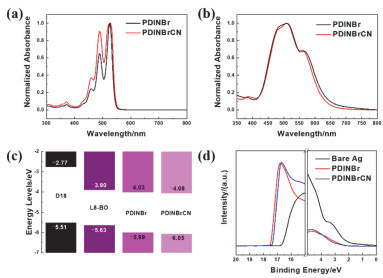
"
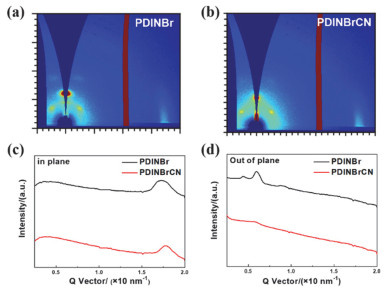
| ETLs | | | HOMO a/eV | LUMO b/eV | WF/eV | ||
| PDINBr | 525 | 510 | 632 | 1.96 | −5.99 | −4.03 | 3.78 |
| PDINBrCN | 529 | 509 | 628 | 1.97 | −6.05 | −4.08 | 3.90 |
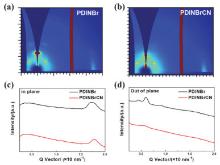
"
"
"
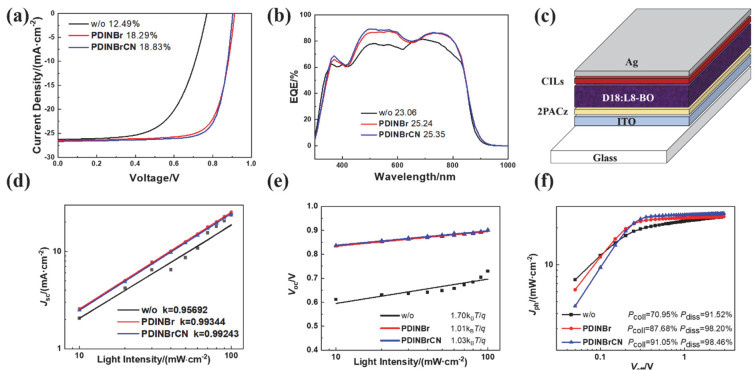
| Active Layers | ETLs | Thickness/nm | Voc/V | Jsc /(mA∙cm−2) | FF/% | PCE/% |
| D18:L8-BO | w/o | 0 | 0.769 | 26.28 | 61.39 | 12.49 |
| PDINBr | 10 | 0.913 | 26.48 (25.360 a) | 75.18 | 18.29 | |
| 50 | 0.899 | 25.42 (24.567 a) | 74.25 | 17.17 | ||
| PDINBrCN | 10 | 0.903 | 26.67 (25.351 a) | 77.68 | 18.83 | |
| 50 | 0.904 | 26.12 (25.442 a) | 75.27 | 17.90 |
"
"
| 1 |
doi: 10.1038/s41563-022-01244-y |
| 2 |
doi: 10.1093/nsr/nwad085 |
| 3 |
doi: 10.1002/anie.202314420 |
| 4 |
doi: 10.31635/ccschem.024.202404023 |
| 5 |
李若男; 梁世洁; 许韵华; 张翠芬; 唐正; 刘柏侨; 李韦伟. 物理化学学报, 2024, 40(8), 2307037.
doi: 10.3866/PKU.WHXB202307037 |
|
|
|
| 6 |
doi: 10.1002/adma.201502110 |
| 7 |
doi: 10.1002/adma.201600281 |
| 8 |
doi: 10.1002/adma.201707170 |
| 9 |
doi: 10.1016/j.joule.2019.01.004 |
| 10 |
doi: 10.1016/j.scib.2020.01.001 |
| 11 |
doi: 10.1038/s41560-021-00820-x |
| 12 |
doi: 10.1002/adma.201404317 |
| 13 |
doi: 10.1007/s11426-024-2054-8 |
| 14 |
doi: 10.11777/j.issn1000-3304.2022.22055 |
| 15 |
张默淳; 冯硕; 邬赟羚; 李彦光. 物理化学学报, 2023, 39(2), 2205050.
doi: 10.3866/PKU.WHXB202205050 |
|
|
|
| 16 |
doi: 10.1002/adma.202400342 |
| 17 |
doi: 10.11777/j.issn1000-3304.2023.23020 |
| 18 |
梁秋菊; 常银霞; 梁朝伟; 祝浩雷; 郭子宾; 刘剑刚. 物理化学学报, 2023, 39(7), 2212006.
doi: 10.3866/PKU.WHXB202212006 |
|
|
|
| 19 |
赵永智; 陈晨阳; 刘文燚; 胡伟飞; 刘金平. 物理化学学报, 2023, 39(8), 2211017.
doi: 10.3866/PKU.WHXB202211017 |
|
|
|
| 20 |
郭雅雯; 李大伟; 高杨; 李翠红. 物理化学学报, 2024, 40(6), 2306050.
doi: 10.3866/PKU.WHXB202306050 |
|
|
|
| 21 |
doi: 10.1002/anie.201503933 |
| 22 |
doi: 10.1021/jacs.0c07439 |
| 23 |
doi: 10.1021/acsenergylett.3c00584 |
| 24 |
doi: 10.1126/science.1218829 |
| 25 |
doi: 10.1002/aenm.201501393 |
| 26 |
doi: 10.1038/nphoton.2012.190 |
| 27 |
doi: 10.1021/acsami.5b10211 |
| 28 |
doi: 10.1021/acsami.5b08769 |
| 29 |
doi: 10.1007/s11426-024-1948-6 |
| 30 |
doi: 10.1039/C4EE00022F |
| 31 |
doi: 10.1038/s41467-020-16509-w |
| 32 |
doi: 10.1002/adma.202203690 |
| 33 |
doi: 10.1021/acsenergylett.1c01482 |
| 34 |
doi: 10.1021/acsami.2c22069 |
| 35 |
doi: 10.1002/adfm.202303386 |
| 36 |
doi: 10.1039/d3ta07443a |
| 37 |
doi: 10.1021/cm048642z |
| 38 |
doi: 10.1038/s41598-021-95551-0 |
| 39 |
doi: 10.1126/science.1255826 |
| 40 |
doi: 10.1021/acsami.1c12790 |
| 41 |
doi: 10.1021/acsami.6b02712 |
| 42 |
doi: 10.1039/D3TA04833K |
| 43 |
doi: 10.5101/nml.v6i1.pp.24–29 |
| [1] | Zhenhuan Wang, Weifei Wei, Ruijie Ma, Dou Luo, Zhanxiang Chen, Jun Zhang, Liyang Yu, Gang Li, Zhenghui Luo. Core cyanation of benzo[a]phenazine acceptor enables 19.04% binary organic solar cells with green solvent compatibility [J]. Acta Phys. -Chim. Sin., 2026, 42(2): 100182-. |
| [2] | Ruonan Li, Shijie Liang, Yunhua Xu, Cuifen Zhang, Zheng Tang, Baiqiao Liu, Weiwei Li. Chlorine-Substituted Double-Cable Conjugated Polymers with Near-Infrared Absorption for Low Energy Loss Single-Component Organic Solar Cells [J]. Acta Phys. -Chim. Sin., 2024, 40(8): 2307037-. |
| [3] | Yawen Guo, Dawei Li, Yang Gao, Cuihong Li. Recent Progress on Stability of Organic Solar Cells Based on Non-Fullerene Acceptors [J]. Acta Phys. -Chim. Sin., 2024, 40(6): 2306050-. |
| [4] | Qiuju Liang, Yinxia Chang, Chaowei Liang, Haolei Zhu, Zibin Guo, Jiangang Liu. Application of Crystallization Kinetics Strategy in Morphology Control of Solar Cells based on Nonfullerene Blends [J]. Acta Phys. -Chim. Sin., 2023, 39(7): 2212006-0. |
| [5] | Xiaoyun Xu, Hongbo Wu, Shijie Liang, Zheng Tang, Mengyang Li, Jing Wang, Xiang Wang, Jin Wen, Erjun Zhou, Weiwei Li, Zaifei Ma. Quantum Efficiency and Voltage Losses in P3HT: Non-fullerene Solar Cells [J]. Acta Phys. -Chim. Sin., 2022, 38(11): 2201039-. |
| [6] | Baiqiao Liu, Yunhua Xu, Dongdong Xia, Chengyi Xiao, Zhaofan Yang, Weiwei Li. Semitransparent Organic Solar Cells based on Non-Fullerene Electron Acceptors [J]. Acta Phys. -Chim. Sin., 2021, 37(3): 2009056-. |
| [7] | Zhen Wei, Minjie Li, Wencong Lu. Theoretical Study of High-Efficiency Organic Dyes with Different Electron-Withdrawing Groups Based on R6 toward Dye-Sensitized Solar Cells [J]. Acta Phys. -Chim. Sin., 2021, 37(10): 1905084-. |
| [8] | Meiqi ZHANG, Yunlong MA, Qingdong ZHENG. Bandgap Modulation of Dithienonaphthalene-Based Small-Molecule Acceptors for Nonfullerene Organic Solar Cells [J]. Acta Physico-Chimica Sinica, 2019, 35(5): 503-508. |
| [9] | Yihua DENG, Aidong PENG, Xiaoxi WU, Huajie CHEN, Hui HUANG. Recent Progress in Perylene Diimide-Based Small Molecule Acceptors for Organic Solar Cells [J]. Acta Physico-Chimica Sinica, 2019, 35(5): 461-471. |
| [10] | Zhongqiang ZHANG, Shuhua ZHANG, Zhixi LIU, Zhiguo ZHANG, Yongfang LI, Changzhi LI, Hongzheng CHEN. A Simple Electron Acceptor with Unfused Backbone for Polymer Solar Cells [J]. Acta Phys. -Chim. Sin., 2019, 35(4): 394-400. |
| [11] | Peiyao XUE,Junxiang ZHANG,Jingming XIN,Jeromy RECH,Tengfei LI,Kaixin MENG,Jiayu WANG,Wei MA,Wei YOU,Seth R. MARDER,Ray P. S. HAN,Xiaowei ZHAN. Effects of Terminal Groups in Third Components on Performance of Organic Solar Cells [J]. Acta Phys. -Chim. Sin., 2019, 35(3): 275-283. |
| [12] | Fangbin LIU,Jun LIU,Lixiang WANG. An Organoboron Compound with a Thienyl Substituent as an Electron Acceptor for Organic Solar Cells [J]. Acta Phys. -Chim. Sin., 2019, 35(3): 251-256. |
| [13] | Yang YANG,Xiu JIANG,Xiaowei ZHAN,Xingguo CHEN. Designing an Organic Acceptor with Unsymmetrical Structure Based on Rhodanine and Thiazolidine-2, 4-dione Units to Study the Structure–Property Relationship [J]. Acta Phys. -Chim. Sin., 2019, 35(3): 257-267. |
| [14] | Qingqing XU,Chunmei CHANG,Wanbin LI,Bing GUO,Xia GUO,Maojie ZHANG. Non-Fullerene Polymer Solar Cells Based on a New Polythiophene Derivative as Donor [J]. Acta Phys. -Chim. Sin., 2019, 35(3): 268-274. |
| [15] | Yi WU, Jingyi KONG, Yunpeng QIN, Huifeng YAO, Shaoqing ZHANG, Jianhui HOU. Realizing Green Solvent Processable Non-fullerene Organic Solar Cells by Modulating the Side Groups of Conjugated Polymers [J]. Acta Physico-Chimica Sinica, 2019, 35(12): 1391-1398. |
|
||