Acta Phys. -Chim. Sin. ›› 2026, Vol. 42 ›› Issue (7): 100283.doi: 10.1016/j.actphy.2026.100283
• ARTICLE • Previous Articles Next Articles
Introducing nanocrystalline/amorphous heterostructures on laminated FeSiBCr to synchronously enhance absorption, expand absorption bandwidth and reduce matching thickness
Shihao Tan1, Caiyun Cui2, Shuwei Ma1, Liangsen Zhu1, Xianguo Liu1,*( )
)
- 1 Institute of Advanced Magnetic Materials, College of Materials and Environmental Engineering, Hangzhou Dianzi University, Hangzhou 310012, Zhejiang Province, China
2 School of New Energy, Wanjiang University of Technology, Ma'anshan 243031, Anhui Province, China
-
Received:2026-02-11Revised:2026-03-08Accepted:2026-03-09Published:2026-05-22 -
Contact:Email: liuxg@hdu.edu.cn (Xianguo Liu)

Cite this article
Shihao Tan, Caiyun Cui, Shuwei Ma, Liangsen Zhu, Xianguo Liu. Introducing nanocrystalline/amorphous heterostructures on laminated FeSiBCr to synchronously enhance absorption, expand absorption bandwidth and reduce matching thickness[J]. Acta Phys. -Chim. Sin. 2026, 42(7), 100283. doi: 10.1016/j.actphy.2026.100283
share this article
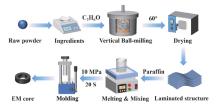
Fig 1
Schematic diagram of the process for fabricating laminated FeSiBCr and EM test core."
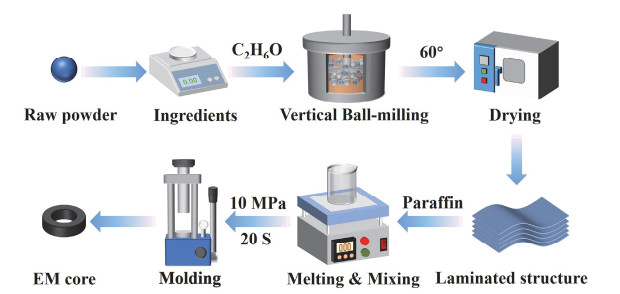
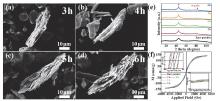
Fig 2
SEM images of powders with different milling time. (a) 3 h, (b) 4 h, (c) 5 h and (d) 6 h. (e) XRD patterns and (f) magnetic hysteretic loops of raw powder and milled powders."
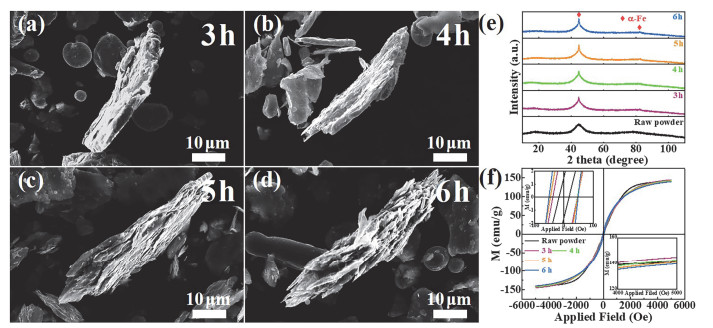
Fig 3
(a) TEM image of powder with 5 h milling time. HRTEM images of (b) the surface and (c) the matrix. (d) HAADF image of 5 h milled powder with the corresponding element distribution maps."
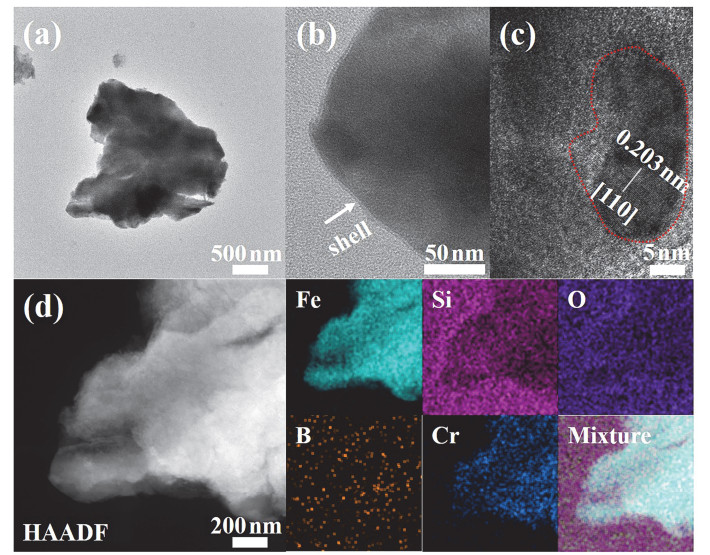
Fig 4
(a) survey curve, (b) the fitted O 1s spectrum, (c) the high-resolution Fe 2p spectrum and (d) the detailed Si 2p of FeSiBCr flakes with 5 h milling time on an etching depth of 2 nm."
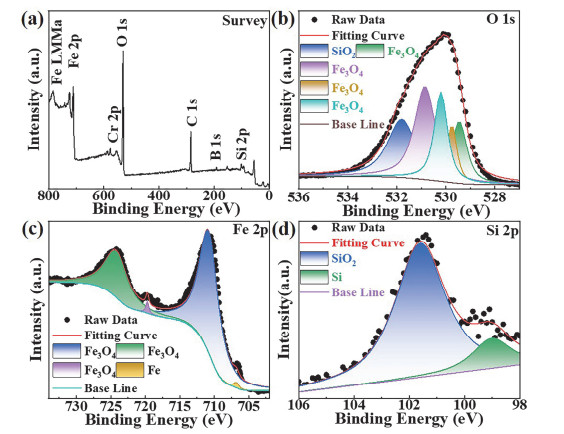
Fig 5
(a)–(d) 3D diagrams and (e)–(h) the corresponding 2D contour maps of RL values dependent thickness and frequency for powders with different milling time. The summarized (i) RLm and tR and (j) EABm and tE with milling time of 3–6 h. (k) comparison of RLm and EABm of the reported flaky soft magnetic materials [30–40]."
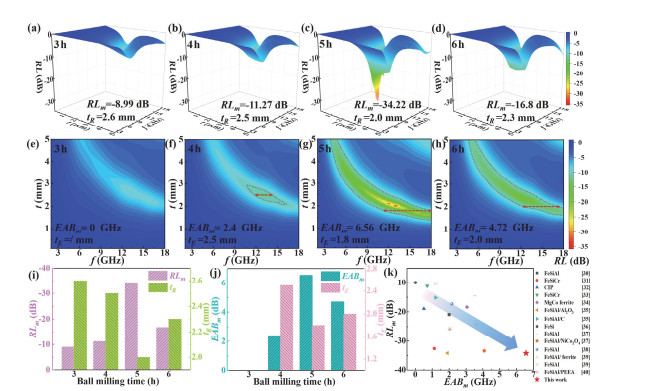
Fig 6
Frequency dependence of (a) ε′ and (b) ε′′ for as-milled FeSiBCr powders. ε′ versus ε′′ curves of FeSiBCr powders with different milling time: (c) 3 h, (d) 4 h, (e) 5 h and (f) 6 h."
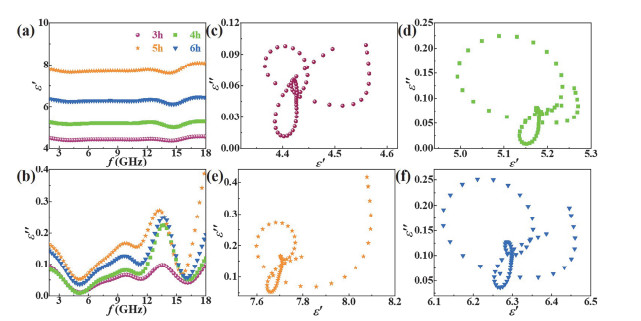
Fig 7
Frequency dependence of (a) μ′ and (b) μ′′ for as-milled FeSiBCr powders. μ′ versus μ′′ curves of FeSiBCr powders with different milling time: (c) 3 h, (d) 4 h, (e) 5 h and (f) 6 h."
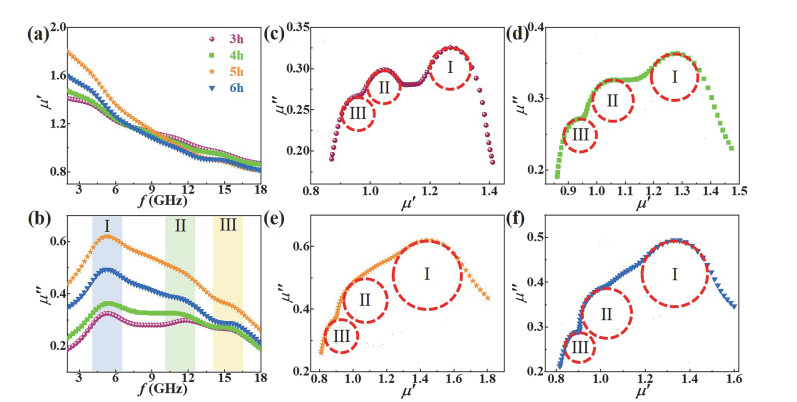
Fig 8
(a) S11, (b) S21, (c) absorption ratio, (d) α, (e) tanδE and (f) tanδM of FeSiBCr powders with different milling time."
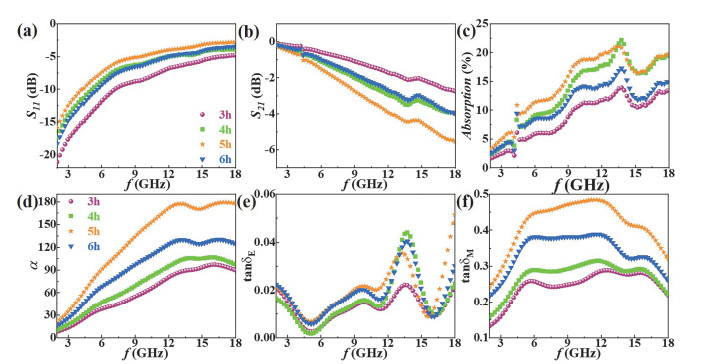
Fig 9
The optimal RL curve and Zim curve with tR and simulated t under λ/4 model of powders with milling time of (a) 3 h, (b) 4 h, (c) 5 h and (d) 6 h."
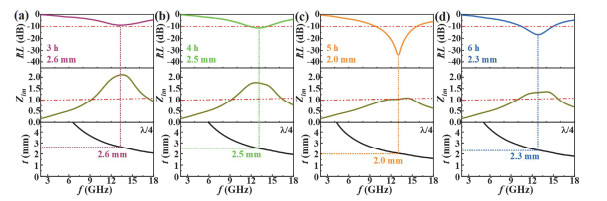
Fig 10
EM wave loss mechanism of laminated FeSiBCr."
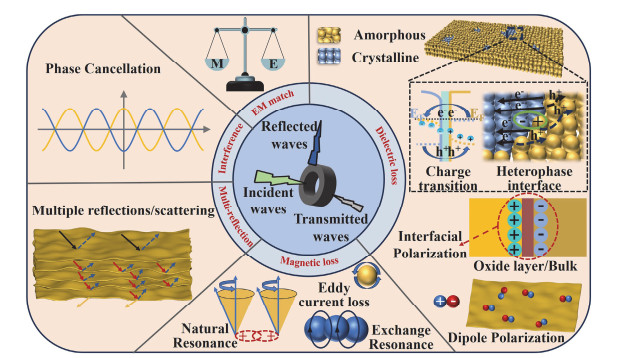
Fig 11
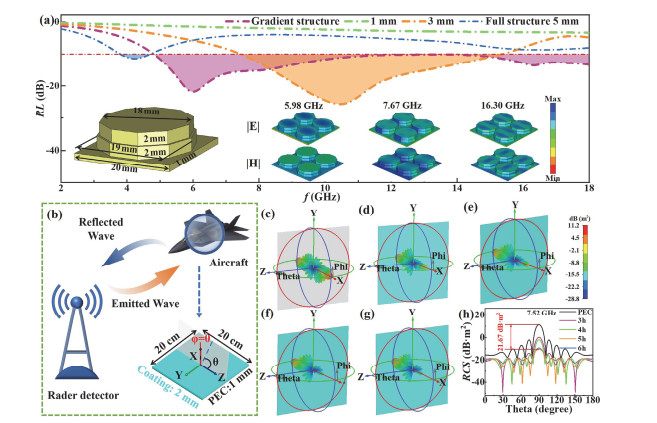
(a) Simulated RL curve based on designed periodic gradient structure (inset). The inset shows electric and magnetic loss densities of periodic gradient structure at 5.98 GHz, 7.67 GHz and 16.30 GHz. (b) Working principle of radar detectors and the RCS simulation model. 3D radar wave scattering signals of (c) PEC, (d) PEC/3 h-milled powder, (e) PEC/4 h-milled powder, (f) PEC/5 h-milled powder, (g) PEC/6 h-milled powder. (h) RCS simulation curves of PEC and PEC with different milled powder coating."
| 1 |
S. Zhang, R.F. Niu, X.M. Guo, Z.R. Jia, D. Lan, G.L. Wu. Carbon 2026, 252, 121371.
doi: 10.1016/j.carbon.2026.121371 |
| 2 |
R.L. Liu, X.M. Jiang, C. Ni, B.L. Wang, C.X. Hou, X.Y. Yang, Y.P. Zhang, W. Du, X.B. Xie. Adv. Funct. Mater. 2025, e23317.
doi: 10.1002/adfm.202523317 |
| 3 |
X.G. Liu, Y.H. Wan, S.M. Tao, P. Cao, Y.L. Liu, F. Zhou. Carbon 2025, 244, 120688.
doi: 10.1016/j.carbon.2025.120688 |
| 4 |
X.B. Xie, R.L. Liu, C. Chen, D. Lan, Z.L. Chen, W. Du, G.L. Wu. Int. J. Min. Met. Mater. 2025, 32, 566.
doi: 10.1007/s12613-024-3024-3 |
| 5 |
M.J. Shi, Z.R. Jia, D. Lan, Z.G. Gao, S.Y. Zhang, G.L. Wu. Adv. Funct. Mater. 2026, 36, e28665.
doi: 10.1002/adfm.202628665 |
| 6 |
Y.H. Wan, T. Jing, S.W. Ma, F.Y. Shen, X.G. Liu. Appl. Surf. Sci. 2025, 687, 162303.
doi: 10.1016/j.apsusc.2025.162303 |
| 7 |
W.H. Jiang, S. Xu, C.P. Lv, D. Lan, S.Y. Zhang, Z.G. Gao, Z.R. Jia, G.L. Wu. Carbon 2025, 245, 120784.
doi: 10.1016/j.carbon.2025.120784 |
| 8 |
Y.J. Yang, B.X. Zhu, X.L. She, K.H. Wang, A. Liu. IEEE Trans. Transp. Electrif. 2025, 11, 9864.
doi: 10.1109/TTE.2025.3558906 |
| 9 |
Y. Zhang, X.J. Lyu, Z.H. Yang, M. Li, L.J. Yang, J.C. Liu, R.B. Wu. J. Phys. Chem. Solids 2018, 126, 143.
doi: 10.1016/j.jpcs.2018.11.015 |
| 10 |
N.L. Shi, H.J. Xu, C. Chen, Y. Wu, B. Yang, T. Zhang. J. Alloy. Compd. 2019, 797, 39.
doi: 10.1016/j.jallcom.2019.05.061 |
| 11 |
C.X. Zhang, Y.H. Li, Y.P. Duan, W. Zhang. J. Magn. Magn. Mater. 2020, 497, 165988.
doi: 10.1016/j.jmmm.2019.165988 |
| 12 |
Y.H. Li, C.L. Shi, W. Zhang. Compos. Part A: Appl. Sci. Manuf. 2023, 164, 107295.
doi: 10.1016/j.compositesa.2022.107295 |
| 13 |
K.M. Lim, M.C. Kim, K.A. Lee, C.G. Park. IEEE Trans. Magn. 2003, 39, 1836.
doi: 10.1109/TMAG.2003.810619 |
| 14 |
M.G. Han, D.F. Liang, L.J. Deng. Appl. Phys. Lett. 2011, 99, 082503.
doi: 10.1063/1.3628661 |
| 15 |
X. Luo, Y.H. Wu, M.G. Han, L.J. Deng. J. Magn. Magn. Mater. 2018, 451, 5.
doi: 10.1016/j.jmmm.2017.10.113 |
| 16 |
J.X. Zhou, X.M. Huang, D. Lan, Z.T. Jia, G.L. Wu. Carbon 2026, 248, 121143.
doi: 10.1016/j.carbon.2025.121143 |
| 17 |
P.H. Zhou, J.L. Xie, Y.Q. Liu, L.J. Deng. J. Magn. Magn. Mater. 2008, 320, 3390.
doi: 10.1016/j.jmmm.2008.07.020 |
| 18 |
W.F. Yang, L. Qiao, T. Wang, F.S. Li. J. Alloy. Compd. 2011, 509, 7066.
doi: 10.1016/j.jallcom.2011.03.168 |
| 19 |
S.W. Ma, T. Jing, X.G. Liu. Phys. Scr. 2025, 100, 065543.
doi: 10.1088/1402-4896/add7a0 |
| 20 |
T. Jing, S.W. Ma, Y.H. Wan, X.G. Li, M.L. Yu. J. Alloy. Compd. 2025, 1034, 181442.
doi: 10.1016/j.jallcom.2025.181442 |
| 21 |
T. Jing, S.W. Ma, H.Y. Yao, X.G. Liu. J. Alloy. Compd. 2025, 1047, 184496.
doi: 10.1016/j.jallcom.2025.184496 |
| 22 |
Y.H. Wan, F.Y. Shen, Y.P. Sun, X.G. Liu. J. Alloy. Compd. 2024, 1001, 175162.
doi: 10.1016/j.jallcom.2024.175162 |
| 23 |
L.T. Zhang, Y.J. Duan, Y.J. Wang, E. Pineda, Y. Yang, J.M. Pelletier, T. Wada, H. Kato, D. Crespo, J.C. Qiao. Acta Mech. Sinica 2026, 42, 425311.
doi: 10.1007/sl0409-025-25311-x |
| 24 |
M.G. Han, Y. Ou, D.F. Liang, L.J. Deng. Chin. Phys. B 2009, 18, 1261.
doi: 10.1088/1674-1056/18/3/070 |
| 25 |
C. Suryanarayana. Prog. Mater. Sci. 2001, 46, 1.
doi: 10.1016/S0079-6425(99)00010-9 |
| 26 |
B. Zhang, Y.P. Duan, Y.L. Cui, G.J. Ma, T.M. Wang, X.L. Dong. Mater. Des. 2018, 149, 173.
doi: 10.1016/j.matdes.2018.04.018 |
| 27 |
W.W. Dong, L. Wang, S.U. Rehman, C.C. Chen, W.M. Zhang, Y.F. Hu, H.P. Zou, T.X. Liang, J.P. Zou. J. Alloy. Compd. 2025, 1010, 177344.
doi: 10.1016/j.jallcom.2024.177344 |
| 28 |
W.L. Li, J.M. Zhang, D.L. He, G.W. Wang, T. Wang. J. Phys. D: Appl. Phys. 2021, 54, 305002.
doi: 10.1088/1361-6463/abfce6 |
| 29 |
H. Cheng, X.H. Li, L.Y. Zhang, F.Y. Shen, X.G. Liu, Y.P. Sun. Ceram. Int. 2023, 49, 26568.
doi: 10.1016/j.ceramint.2023.05.191 |
| 30 |
J. Sun, H.L. Xu, Y. Shen, H. Bi, W.F. Liang, R.B. Yang. J. Alloy. Compd. 2013, 548, 18.
doi: 10.1016/j.jallcom.2012.08.114 |
| 31 |
S. Tu, W.W. Dong, C.C. Chen, D.Z. Lu, S.U. Rehman, L. Wang. J. Alloy. Compd. 2025, 1047, 185033.
doi: 10.1016/j.jallcom.2025.185033 |
| 32 |
Z.Z. Wu, B. Huang, R.Y. Yang, J. Hou, Y. Xu, B.Q. Wang, T.X. Song, Q. Cai, T.D. Zhou, L. Zhong, et al.. J. Phys. Chem. Solids 2024, 193, 112209.
doi: 10.1016/j.jpcs.2024.112209 |
| 33 |
X.Y. Huang, G.Z. Xie, N.Y. Xie, J. Chen. J. Mater. Sci.: Mater. Electron. 2023, 34, 109.
doi: 10.1007/s10854-022-09611-w |
| 34 |
Y. Zheng, Z.J. Ma, X.Y. Weng, L. Cheng, Z.M. Li. J. Alloy. Compd. 2025, 1037, 182603.
doi: 10.1016/j.jallcom.2025.182603 |
| 35 |
L. Zhou, J.L. Huang, X.G. Wang, G.X. Su, J.Y. Qiu, Y.L. Dong. J. Alloy. Compd. 2019, 774, 813.
doi: 10.1016/j.jallcom.2018.09.387 |
| 36 |
C. Liu, Y. Yuan, J.T. Jiang, Y.X. Gong, L. Zhen. J. Magn. Magn. Mater. 2015, 395, 152.
doi: 10.1016/j.jmmm.2015.06.085 |
| 37 |
G.M. Fu, J. He, S.Q. Yan, L.H. He, D.Y. Shan. J. Phys. D: Appl. Phys. 2024, 57, 335001.
doi: 10.1088/1361-6463/ad4b30 |
| 38 |
J. He, L.W. Deng, S. Liu, S.Q. Yan, H. Luo, Y.H. Li, L.H. He, S.X. Huang. J. Magn. Magn. Mater. 2017, 444, 49.
doi: 10.1016/j.jmmm.2017.07.097 |
| 39 |
H.Y. Yan, L. Zhong, J.L. Tang, J. Xue, L. Gu, T.D. Zhou. J. Mater. Sci.: Mater. Electron. 2021, 32, 18371.
doi: 10.1007/s10854-021-06380-w |
| 40 |
J. Gao, Z.J. Guan, Y.X. Gong, L. Zhen, J.T. Jiang. ACS Appl. Mater. Interfaces 2025, 17, 2327.
doi: 10.1021/acsami.4c18958 |
| 41 |
Y.J. Wang, X.C. Wang, M.M. Kang, Z.H. Zhang, Y.C. Yang, W. Zeng, Z. Liu. Compos. Part A: Appl. Sci. Manuf. 2025, 192, 108807.
doi: 10.1016/j.compositesa.2025.108807 |
| 42 |
J. López-Sánchez, Á. Peña, A. Serrano, A. del Campo, Ó.R. de la Fuente, N. Carmona, D. Matatagui, M.D. Horrillo, J. Rubio-Zuazo, E. Navarro, et al.. ACS Appl. Mater. Interfaces 2023, 15, 3507.
doi: 10.1021/acsami.2c19886 |
| 43 |
Y.X. Zhao, Y.T. Ta, R. Bi, B. Tang, Z.J. Lu, Y.H. Yan, J.S. Xie, Z.B. Guo. Adv. Eng. Inform. 2026, 71, 104313.
doi: 10.1016/j.aei.2026.104313 |
| 44 |
Y.R. Sun, J. Liu, J.M. Chen, G.H. Li, M.X. Liang, M. Zhang. Desalination 2025, 614, 119183.
doi: 10.1016/j.desal.2025.119183 |
| 45 |
M. Han, M.N. Rozanov, P.A. Zezyulina, Y.H. Wu. J. Magn. Magn. Mater. 2015, 383, 114.
doi: 10.1016/j.jmmm.2014.10.010 |
| 46 |
S.J. Woo, H.J. Cho, E.K. Cho, M. Kim, K.Y. Sohn, W.W. Park. Met. Mater. Int. 2008, 14, 511.
doi: 10.3365/met.mat.2008.08.511 |
| 47 |
R.Q. Wang, Y. He, C.H. Tang, X.H. Wu, Q.X. Zhuang, X.Y. Liu, X. Liu, P.Y. Zuo. Carbon 2024, 229, 119494.
doi: 10.1016/j.carbon.2024.119494 |
| 48 |
Y.L. Song, Y. Li, J. Lu, L. Hua, Y.F. Gu, Y.K. Yang. Sci. Chian Tech. Sci. 2025, 68, 1520201.
doi: 10.1007/s11431-024-2901-8 |
| 49 |
L.J. Rao, L. Wang, C.D. Yang, R.X. Zhang, J.C. Zhang, C.Y. Liang, R.C. Che. Adv. Funct. Mater. 2023, 33, 2213258.
doi: 10.1002/adfm.202213258 |
| 50 |
S.Q. Zheng, T. Jiang, X.Y. Wei, Q.Y. Cai, C. Chen, G. Fang, C.Y. Liu. J. Phys. Chem. C 2023, 127, 1704.
doi: 10.1021/acs.jpcc.2c08060 |
| 51 |
X.Y. Ren, Z. Jia, Z.G. Gao, S.Y. Zhang, Y. Zhang, D. Lan, G.L. Wu. Adv. Funct. Mater. 2026, 36, e24264.
doi: 10.1002/adfm.202524264 |
| 52 |
T.Y. Zhang, J.F. Qiu, S.H. Wang, Y. Juan, J.Y. Li, W. Wang. Adv. Funct. Mater. 2026, 36, e21010.
doi: 10.1002/adfm.202521010 |
| 53 |
S.L. Guo, Y.L. Song, Y.H. Wu, J.H. Hu, J. Lu, C.J. Wang, Z.C. Jia. J. Alloy. Compd. 2026, 1052, 186139.
doi: 10.1016/j.jallcom.2026.186139 |
| [1] | Liangsen Zhu, Caiyun Cui, Tao Jing, Shihao Tan, Xianguo Liu, Menglin Yu. Strong and broadband microwave absorption under thin thickness induced by multiple dielectric relaxation and multiple magnetic resonances through the dual nanocrystalline phases in amorphous FeSiBCr flakes [J]. Acta Phys. -Chim. Sin., 2026, 42(9): 100331-. |
| [2] | Chen Pu, Daijie Deng, Henan Li, Li Xu. Fe0.64Ni0.36@Fe3NiN Core-Shell Nanostructure Encapsulated in N-Doped Carbon Nanotubes for Rechargeable Zinc-Air Batteries with Ultralong Cycle Stability [J]. Acta Phys. -Chim. Sin., 2024, 40(2): 2304021-. |
| [3] | Qi Li, Pingan Li, Zetong Liu, Jiahui Zhang, Hao Zhang, Weilai Yu, Xianluo Hu. Fabricating Micro/Nanostructured Separators and Electrode Materials by Coaxial Electrospinning for Lithium-Ion Batteries: From Fundamentals to Applications [J]. Acta Phys. -Chim. Sin., 2024, 40(10): 2311030-. |
| [4] | Yi Zhou, Weilong Ouyang, Yuejun Wang, Haiqiang Wang, Zhongbiao Wu. Core-Shell Structured NH2-UiO-66@TiO2 Photocatalyst for the Degradation of Toluene under Visible Light Irradiation [J]. Acta Phys. -Chim. Sin., 2021, 37(8): 2009045-. |
| [5] | Jian Zhang, Liang Wang, Zhiyi Wu, Chengtao Wang, Zerui Su, Feng-Shou Xiao. Rational Design of a Core-Shell Rh@Zeolite Catalyst for Selective Diene Hydrogenation [J]. Acta Phys. -Chim. Sin., 2020, 36(9): 1912001-. |
| [6] | Chao Zhang, Sihan Li, Chenliang Wu, Xiaoqing Li, Xinhuan Yan. Preparation and Characterization of Pt@Au/Al2O3 Core-Shell Nanoparticles for Toluene Oxidation Reaction [J]. Acta Physico-Chimica Sinica, 2020, 36(8): 1907057-. |
| [7] | Danye Liu,Dong Chen,Hui Liu,Jun Yang. Inside-Out Migration of Noble Metals in Ag2S Nanoparticles [J]. Acta Physico-Chimica Sinica, 2020, 36(7): 1906069-. |
| [8] | Mengru HAN,Yanan ZHOU,Xuan ZHOU,Wei CHU. Tunable Reactivity of MNi12 (M = Fe, Co, Cu, Zn) Nanoparticles Supported on Graphitic Carbon Nitride in Methanation [J]. Acta Physico-Chimica Sinica, 2019, 35(8): 850-857. |
| [9] | Lulu LI,Lu YAO,Li DUAN. Application of Lithium-Selenium Batteries Using Covalent Organic Framework Composite Cathodes [J]. Acta Phys. -Chim. Sin., 2019, 35(7): 734-739. |
| [10] | Guo-Min LI,Bao-Shun ZHU,Li-Ping LIANG,Yu-Ming TIAN,Bao-Liang LÜ,Lian-Cheng WANG. Core-Shell Co3Fe7@C Composite as Efficient Microwave Absorbent [J]. Acta Phys. -Chim. Sin., 2017, 33(8): 1715-1720. |
| [11] | Yang Lü,Yu-Jiang SONG,Hui-Yuan LIU,Huan-Qiao LI. Pd-Containing Core/Pt-Based Shell Structured Electrocatalysts [J]. Acta Phys. -Chim. Sin., 2017, 33(2): 283-294. |
| [12] | Qiao-Wan CHANG,Fei XIAO,Yuan XU,Min-Hua SHAO. Core-Shell Electrocatalysts for Oxygen Reduction Reaction [J]. Acta Phys. -Chim. Sin., 2017, 33(1): 9-17. |
| [13] | Ling ZHANG,Hai-Yan WANG,Zhong-Xiang JIANG,Yu-Jia WANG. Synthesis and Catalytic Activity of Core-Shell MFI/CHA Zeolites [J]. Acta Phys. -Chim. Sin., 2016, 32(3): 745-752. |
| [14] | Hong ZHU,Ming-Chuan LUO,Ye-Zheng CAI,Zhao-Nan SUN. Core-Shell Structured Electrocatalysts for the Cathodic Oxygen Reduction Reaction in Proton Exchange Membrane Fuel Cells [J]. Acta Phys. -Chim. Sin., 2016, 32(10): 2462-2474. |
| [15] | Liu-Xuan LUO,Shui-Yun SHEN,Feng-Juan ZHU,Jun-Liang ZHANG. Formic Acid Oxidation by Pd Monolayers on Pt3Ni Nanocubes [J]. Acta Phys. -Chim. Sin., 2016, 32(1): 337-342. |
|
||