Acta Phys. -Chim. Sin. ›› 2025, Vol. 41 ›› Issue (8): 100084.doi: 10.1016/j.actphy.2025.100084
Special Issue: S-scheme heterojunction in photocatalysis
• ARTICLE • Previous Articles Next Articles
CdS/DBTSO-BDTO S-scheme photocatalyst for H2 production and its charge transfer dynamics
Jiajie Cai1, Chang Cheng2, Bowen Liu1, Jianjun Zhang2,*( ), Chuanjia Jiang3,*(), Bei Cheng1,*()
- 1 State Key Laboratory of Advanced Technology for Materials Synthesis and Processing, Wuhan University of Technology, Wuhan 430070, Hubei Province, China
2 Laboratory of Solar Fuel, Faculty of Materials Science and Chemistry, China University of Geosciences, Wuhan 430078, Hubei Province, China
3 College of Environmental Science and Engineering, Nankai University, Tianjin 300350, China
-
Received:2025-02-20Revised:2025-03-10Accepted:2025-03-24Published:2025-06-07 -
Contact:Email: zhangjianjun@cug.edu.cn (Jianjun Zhang)jiangcj@nankai.edu.cn (Chuanjia Jiang)chengbei2013@whut.edu.cn (Bei Cheng) -
Supported by:the National Key Research and Development Program of China(2022YFB3803600); the National Natural Science Foundation of China(22238009); the National Natural Science Foundation of China(22361142704); the National Natural Science Foundation of China(22261142666); the National Natural Science Foundation of China(22278324); the National Natural Science Foundation of China(52073223); the Natural Science Foundation of Hubei Province of China(2022CFA001); the Fundamental Research Funds for the Central Universities(63241632)

Cite this article
Jiajie Cai, Chang Cheng, Bowen Liu, Jianjun Zhang, Chuanjia Jiang, Bei Cheng. CdS/DBTSO-BDTO S-scheme photocatalyst for H2 production and its charge transfer dynamics[J]. Acta Phys. -Chim. Sin. 2025, 41(8), 100084. doi: 10.1016/j.actphy.2025.100084
share this article
Fig 1
Synthesis pathways for (a) DBTSO-BDTO and (b) CdS/DBTSO-BDTO (SD) composite materials."
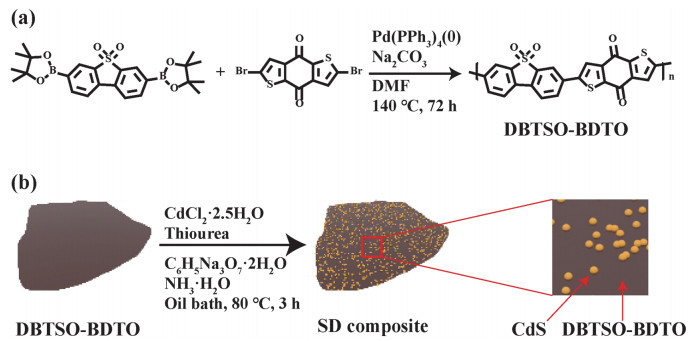
Fig 2
(a, b) TEM images of SD10 at different magnifications. (c) HRTEM image of the part in the dashed square of part (b). (d) High-angle annular dark-field image and energy dispersive X-ray elemental maps of Cd, S, O, and C elements in the SD10 composite."
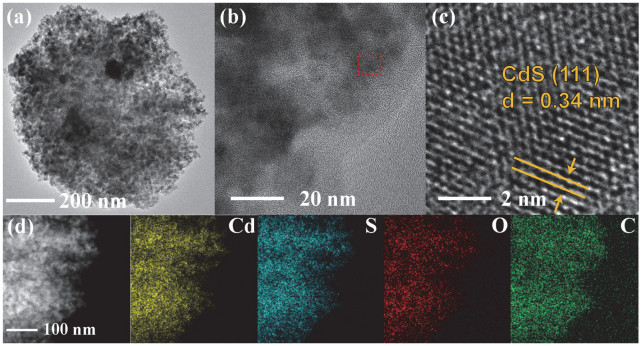
Fig 3
(a) UV-Vis spectra of DB, CdS, and SDx (x = 5, 10, 20). (b) Kubelka-Munk transformed and (c) Mott-Schottky plots for DB and CdS measured at a frequency of 1500 Hz. (d) Illustration of band structures of DB and CdS."
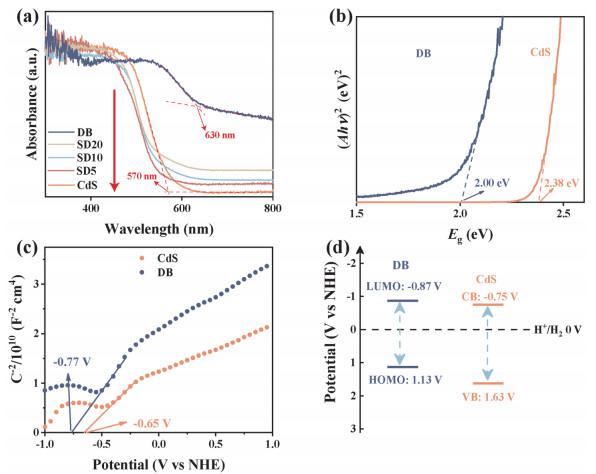
Fig 4
(a) H2 production rates by CdS, DB, and SDx. (b) H2 production of SD10 over four cycles."
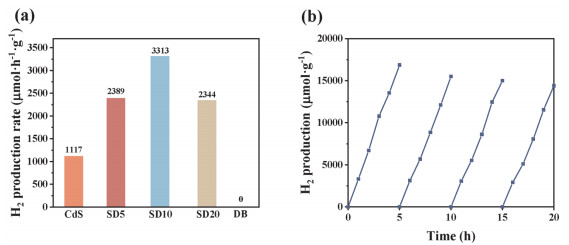
Fig 5
(a) XPS survey spectra of the DB, CdS, and SD10 materials, and XPS spectra of (b) Cd 3d and (c) O 1s of the corresponding samples with or without light irradiation (at 365 nm). (d) Schematics of S-scheme carrier transfer mechanism for the SD heterojunction."
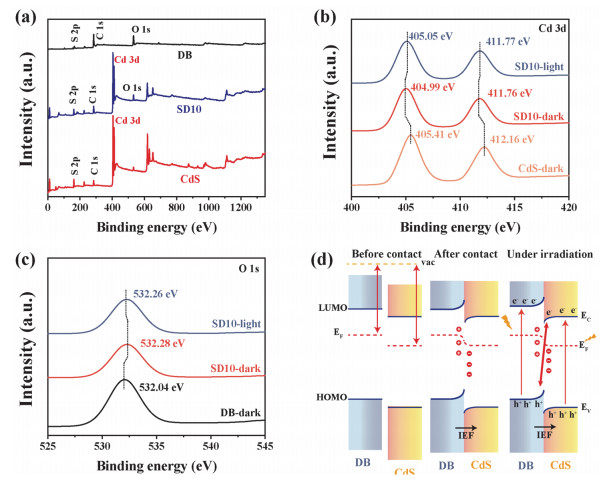
Fig 6
Pseudocolor fs-TA plots of (a) CdS, (b) DB, and (c) SD10, and the fs-TA spectra of (d) CdS, (e) DB, and (f) SD10."
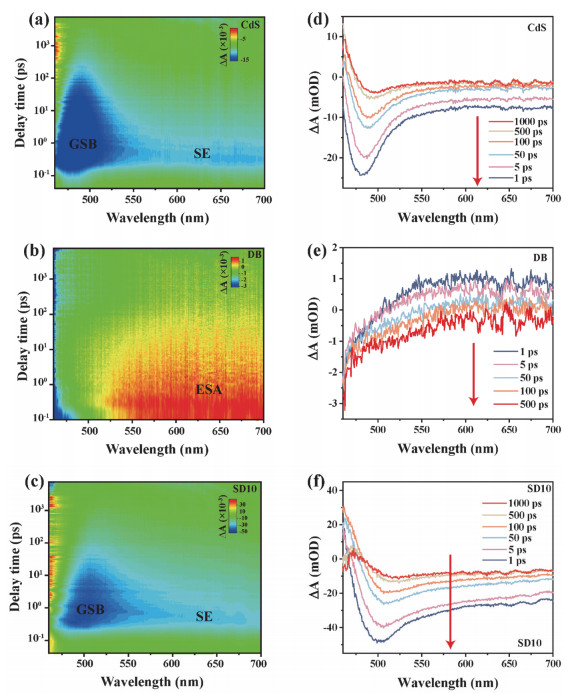
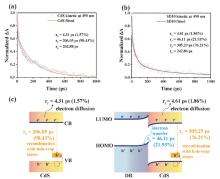
Fig 7
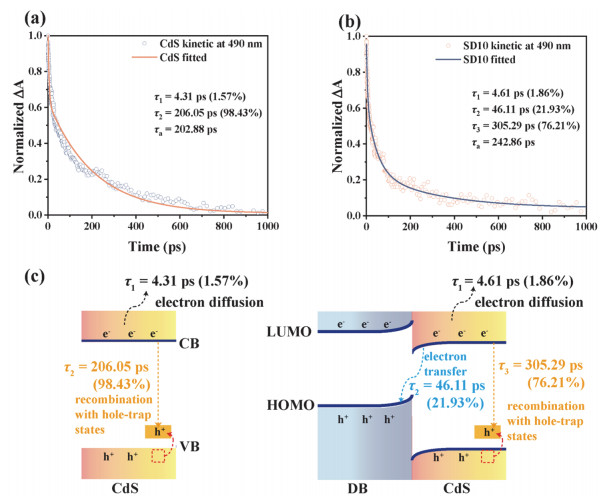
The GSB recovery kinetics of (a) CdS and (b) SD10 as probed at 490 nm. (c) Dynamics and lifetime of charge carrier relaxation steps in CdS and SD10."
| 1 |
doi: 10.1002/adma.202007100 |
| 2 |
doi: 10.1007/s40843-023-2760-1 |
| 3 |
doi: 10.1016/s1872-2067(23)64491-2 |
| 4 |
doi: 10.1038/s41586-021-03907-3 |
| 5 |
doi: 10.1038/s41586-022-05399-1 |
| 6 |
doi: 10.1016/j.apcatb.2024.124459 |
| 7 |
doi: 10.1016/s1872-2067(23)64448-1 |
| 8 |
doi: 10.1016/j.apcatb.2018.09.062 |
| 9 |
doi: 10.3866/PKU.WHXB202307016 |
| 10 |
doi: 10.1016/s1872-2067(23)64483-3 |
| 11 |
doi: 10.1021/ja2025454 |
| 12 |
doi: 10.1021/cm7029344 |
| 13 |
doi: 10.1021/ja8007825 |
| 14 |
doi: 10.1016/j.jmst.2023.06.052 |
| 15 |
doi: 10.1007/s40843-020-1456-x |
| 16 |
doi: 10.1016/j.ijhydene.2023.09.033 |
| 17 |
doi: 10.1016/j.apcatb.2022.121158 |
| 18 |
doi: 10.1039/c5cy00470e |
| 19 |
doi: 10.1016/j.cej.2023.146818 |
| 20 |
doi: 10.1016/s1872-2067(23)64507-3 |
| 21 |
doi: 10.1002/adpr.202200065 |
| 22 |
doi: 10.1016/j.apcatb.2023.123196 |
| 23 |
doi: 10.1002/adma.202100317 |
| 24 |
doi: 10.1038/s41467-024-49004-7 |
| 25 |
doi: 10.1002/adma.202406460 |
| 26 |
doi: 10.1016/s1872-2067(23)64610-8 |
| 27 |
doi: 10.1016/j.apcatb.2018.11.011 |
| 28 |
doi: 10.1016/j.ccr.2024.215674 |
| 29 |
doi: 10.1016/j.jmst.2023.08.023 |
| 30 |
doi: 10.1016/s1872-2067(21)63925-6 |
| 31 |
doi: 10.3866/PKU.WHXB202212016 |
| 32 |
doi: 10.3866/PKU.WHXB202211009 |
| 33 |
doi: 10.1002/anie.202218688 |
| 34 |
doi: 10.1016/j.jmst.2023.12.054 |
| 35 |
doi: 10.3866/PKU.WHXB202406027 |
| 36 |
doi: 10.1016/j.apsusc.2019.143537 |
| 37 |
doi: 10.1016/j.matchemphys.2022.125824 |
| 38 |
doi: 10.1002/cjoc.202200355 |
| 39 |
doi: 10.1039/c8ra02061b |
| 40 |
doi: 10.14102/j.cnki.0254-5861.2022-0124 |
| 41 |
doi: 10.1016/s1872-2067(23)64466-3 |
| 42 |
doi: 10.1515/pac-2014-1117 |
| 43 |
doi: 10.1016/j.matlet.2024.136179 |
| 44 |
doi: 10.1039/d0nr03196h |
| 45 |
doi: 10.1002/adma.202310600 |
| 46 |
doi: 10.1002/smll.202207758 |
| 47 |
doi: 10.1002/anie.202313172 |
| 48 |
doi: 10.3866/PKU.WHXB202307022 |
| 49 |
doi: 10.1016/j.jmst.2023.03.054 |
| 50 |
doi: 10.1002/smll.202308952 |
| 51 |
doi: 10.1002/adfm.202201357 |
| 52 |
doi: 10.1002/anie.202212045 |
| 53 |
doi: 10.1002/smll.202301017 |
| 54 |
doi: 10.1016/j.jmst.2024.02.012 |
| 55 |
doi: 10.1021/ja303306u |
| 56 |
doi: 10.1002/advs.201903568 |
| 57 |
doi: 10.1016/j.jmst.2023.02.044 |
| 58 |
doi: 10.1016/s1872-2067(22)64108-1 |
| 59 |
doi: 10.1021/acscatal.2c05001 |
| 60 |
doi: 10.1002/adma.202400288 |
| 61 |
doi: 10.1016/j.jmst.2023.03.038 |
| 62 |
doi: 10.1016/j.jmst.2023.03.003 |
| 63 |
doi: 10.3866/PKU.WHXB202212009 |
|
||