Acta Phys. -Chim. Sin. ›› 2025, Vol. 41 ›› Issue (11): 100145.doi: 10.1016/j.actphy.2025.100145
• ARTICLE • Previous Articles Next Articles
W18O49/Al-doped SrTiO3 S-scheme heterojunction aided by the LSPR effect for full-spectrum solar light-driven photocatalytic hydrogen evolution
Jinhui Jiang1, Jiaqi Sun1, Yongyi Chen1,2, Lei Zhang1,2, Pengyu Dong1,*( )
)
- 1 Key Laboratory for Advanced Technology in Environmental Protection of Jiangsu Province, Yancheng Institute of Technology, Yancheng 224051, Jiangsu Province, China
2 Key Laboratory for Ecological-Environment Materials of Jiangsu Province, School of Materials Science and Engineering, Yancheng Institute of Technology, Yancheng 224051, Jiangsu Province, China
-
Received:2025-06-20Revised:2025-07-30Accepted:2025-07-31Published:2025-09-29 -
Contact:Email: dongpy11@gmail.com (Pengyu Dong) -
Supported by:the National Natural Science Foundation of China(21403184); the Natural Science Foundation of the Jiangsu Higher Education Institutions of China(22KJA430008)

Cite this article
Jinhui Jiang, Jiaqi Sun, Yongyi Chen, Lei Zhang, Pengyu Dong. W18O49/Al-doped SrTiO3 S-scheme heterojunction aided by the LSPR effect for full-spectrum solar light-driven photocatalytic hydrogen evolution[J]. Acta Phys. -Chim. Sin. 2025, 41(11), 100145. doi: 10.1016/j.actphy.2025.100145
share this article
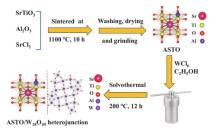
Fig 1
The proposed preparation procedure of ASTO/W18O49 heterojunction by an in situ solvothermal method."
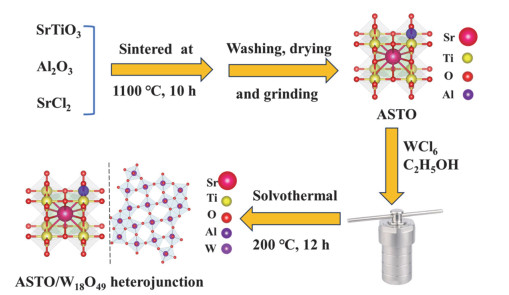
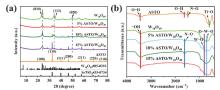
Fig 1
(a) XRD patterns and (b) FT-IR spectra of as-prepared products."
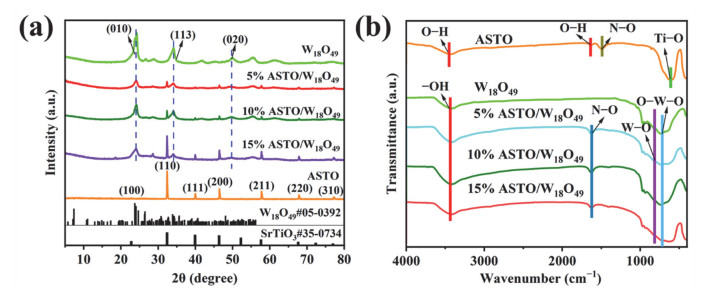
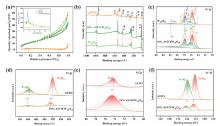
Fig 2
(a) N2 adsorption isotherms (inset: variations in pore size) for ASTO, W18O49, and 10% ASTO/W18O49. XPS spectra for as-prepared samples: (b) survey, (c) high-resolution W 4f, (d) Ti 2p, (e) Al 2p, and (f) Sr 3d."
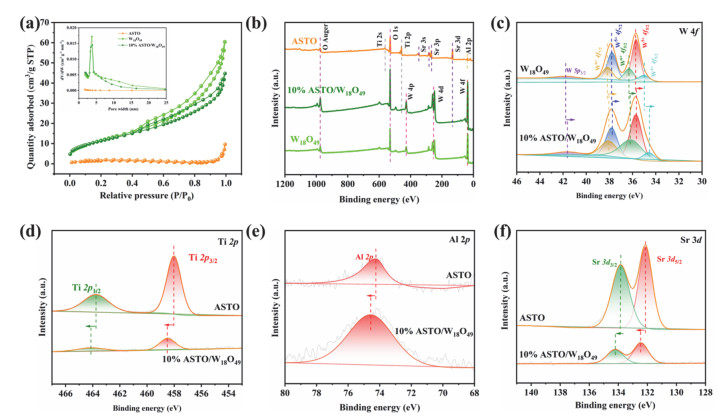
Fig 3
TEM and HRTEM images: (a) ASTO, (b) W18O49, (c, d) 10% ASTO/W18O49, and (e) STEM and EDS mapping images of 10% ASTO/W18O49."
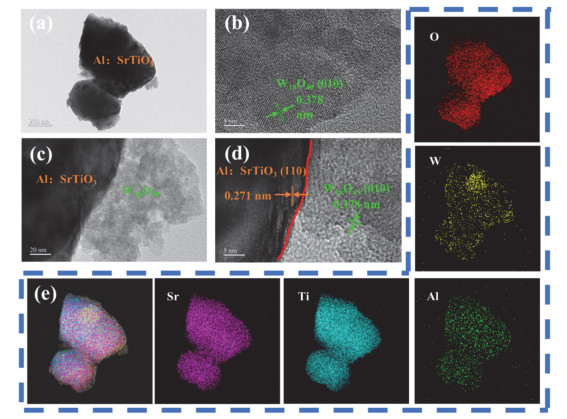
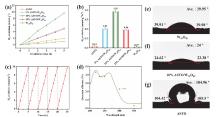
Fig 4
(a) Photocatalytic hydrogen production performance of the as-prepared samples. (b) Comparison of photocatalytic hydrogen evolution rates for these photocatalysts. (c) Photocatalytic cycling stability test of 10% ASTO/W18O49. (d) AQE of 10% ASTO/W18O49 at various wavelengths. Water contact angles of (e) W18O49, (f) 10% ASTO/W18O49, and (g) ASTO."
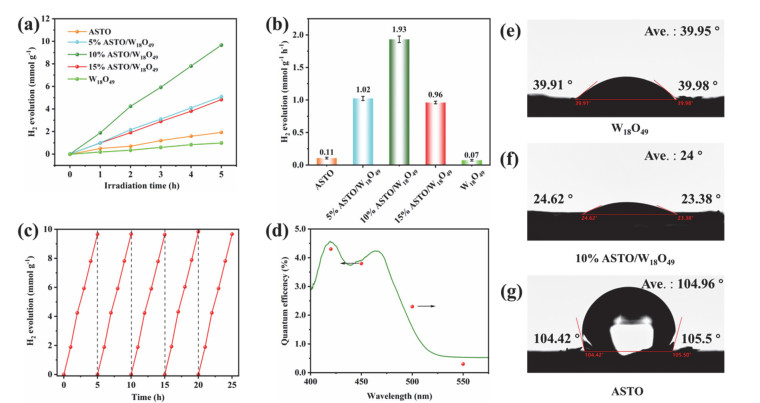
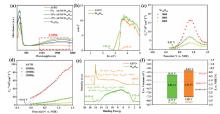
Fig 5
(a) UV-vis DRS of the as-prepared photocatalysts. (b) Corresponding Tauc plots. Mott-Schottky plots of (c) W18O49 and (d) ASTO measured with Ag/AgCl as the reference electrode in the dark at 1000, 2000, and 3000 Hz. (e) UPS spectra for ASTO and W18O49. (f) Energy band levels of ASTO and W18O49."
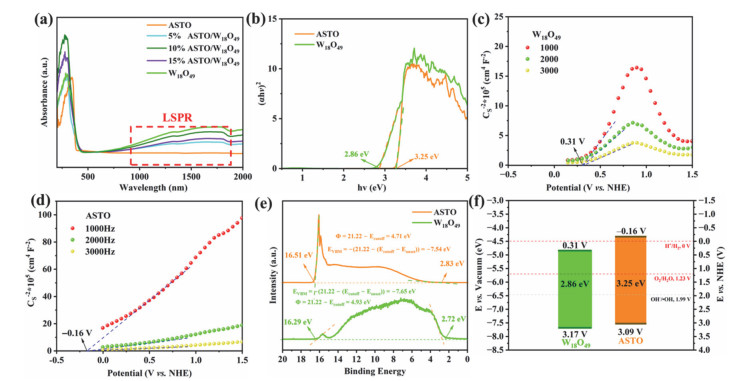
Fig 6
(a) EIS Nyquist plots, (b) transient photocurrent response, (c) steady-state PL spectra excited by a wavelength of 395 nm, and (d) transient PL decay profiles for as-prepared ASTO, W18O49, and 10% ASTO/W18O49 heterojunction."
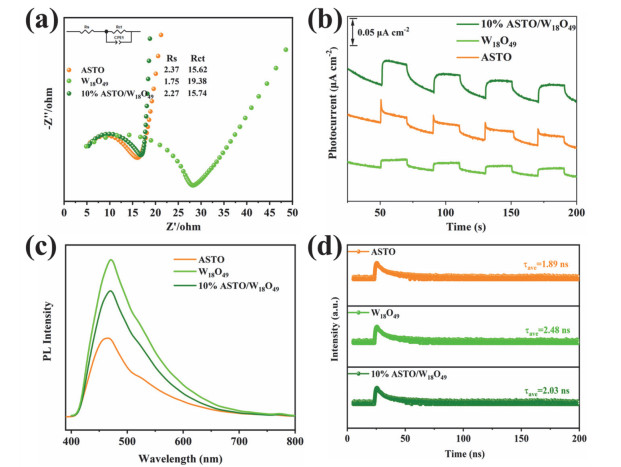
Fig 7
(a) DMPO–•O2− and (b) DMPO–•OH spin-trapping EPR spectra of 10% ASTO/W18O49, W18O49, and ASTO. (c) Proposed type-Ⅱ heterojunction mechanism for charge transfer of 10% ASTO/W18O49. (d) A proposed S-scheme heterojunction mechanism for charge transfer of 10% ASTO/W18O49."
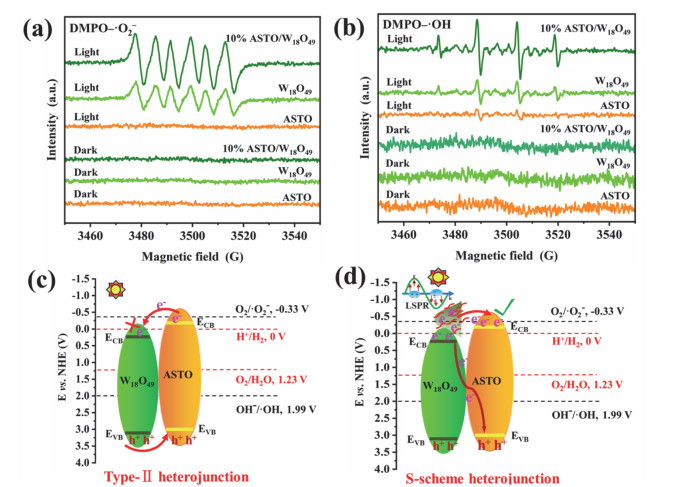
Fig 8
In situ illuminated XPS spectra of the 10% ASTO/W18O49 sample: (a) high-resolution W 4f, (b) Ti 2p, (c) Al 2p, and (d) Sr 3d."
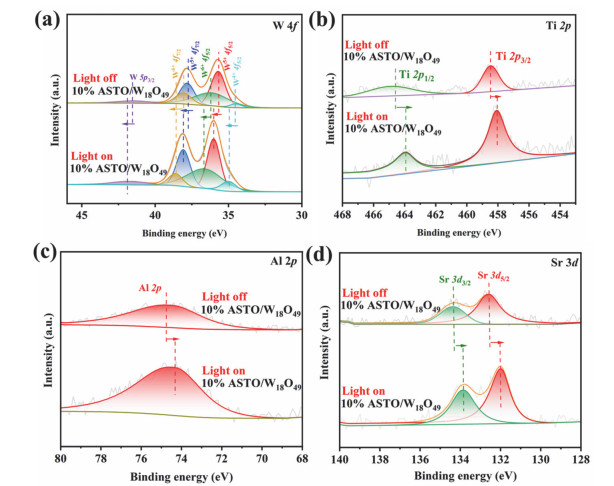
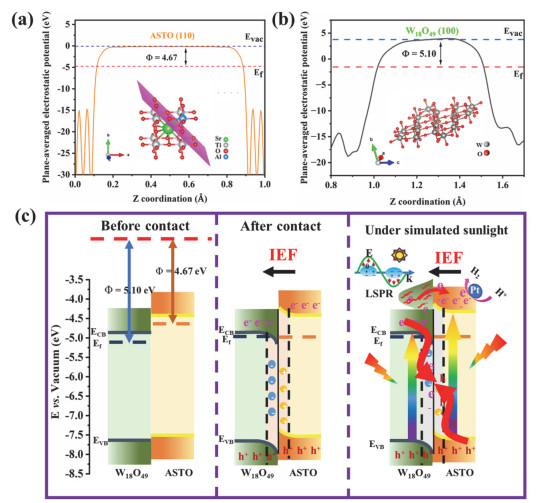
Fig 9
(a, b) Electrostatic potentials of ASTO (110) and W18O49 (100) surfaces, respectively. (c) Schematic illustration of the potential mechanism of charge transfer over the S-scheme ASTO/W18O49 heterojunction before and after contact in the dark and when exposed to the simulated solar light."
| 1 |
doi: 10.1021/acs.chemrev.9b00201 |
| 2 |
doi: 10.1038/nmat4589 |
| 3 |
doi: 10.1039/C6EE00526H |
| 4 |
doi: 10.1021/jacs.3c12062 |
| 5 |
doi: 10.1002/smll.202407963 |
| 6 |
doi: 10.1021/acscatal.1c02874 |
| 7 |
doi: 10.1016/j.joule.2017.12.009 |
| 8 |
doi: 10.1038/s41586-020-2278-9 |
| 9 |
doi: 10.1002/anie.202313537 |
| 10 |
doi: 10.1016/S1872-2067(23)64414-6 |
| 11 |
doi: 10.1002/anie.202204271 |
| 12 |
doi: 10.1021/jacs.8b02076 |
| 13 |
doi: 10.1080/01614940.2022.2038472 |
| 14 |
doi: 10.1002/adma.201606688 |
| 15 |
doi: 10.1002/adma.201404792 |
| 16 |
doi: 10.1016/j.apcatb.2019.04.035 |
| 17 |
doi: 10.1002/adma.202406460 |
| 18 |
doi: 10.1021/acs.chemrev.1c00473 |
| 19 |
doi: 10.1016/S1872-2067(23)64420-1 |
| 20 |
doi: 10.1016/S1872-2067(20)63753-6 |
| 21 |
doi: 10.1002/adma.202310600 |
| 22 |
doi: 10.1038/s41570-025-00698-3 |
| 23 |
doi: 10.1016/j.cej.2023.143184 |
| 24 |
doi: 10.1016/S1872-2067(24)60149-X |
| 25 |
doi: 10.1016/j.ijhydene.2024.08.266 |
| 26 |
doi: 10.1016/S1872-2067(21)64024-X |
| 27 |
doi: 10.1002/cnma.202000536 |
| 28 |
doi: 10.1016/j.jcis.2021.11.141 |
| 29 |
doi: 10.1016/S1872-2067(20)63783-4 |
| 30 |
doi: 10.1021/acsanm.0c02210 |
| 31 |
doi: 10.1016/j.ijhydene.2017.10.154 |
| 32 |
doi: 10.1016/j.apsusc.2023.158794 |
| 33 |
doi: 10.1186/s11671-018-2558-6 |
| 34 |
doi: 10.1021/jacsau.2c00146 |
| 35 |
doi: 10.1002/adfm.202203638 |
| 36 |
doi: 10.1002/adma.202003082 |
| 37 |
doi: 10.1016/j.apcatb.2024.124297 |
| 38 |
doi: 10.1126/science.aaa5760 |
| 39 |
doi: 10.1021/acscatal.1c03441 |
| 40 |
doi: 10.1126/science.aao5561 |
| 41 |
doi: 10.1002/adma.201800486 |
| 42 |
doi: 10.1002/adma.202400288 |
| 43 |
doi: 10.1016/j.cej.2024.158649 |
| 44 |
doi: 10.1002/adfm.202500733 |
| 45 |
doi: 10.1016/j.apcatb.2024.124366 |
| 46 |
doi: 10.1016/S1872-2067(21)63883-4 |
| 47 |
doi: 10.1007/s12274-024-6501-0 |
| 48 |
doi: 10.1002/adma.202414803 |
| 49 |
doi: 10.1016/j.actphy.2025.100084 |
|
||