Acta Phys. -Chim. Sin. ›› 2026, Vol. 42 ›› Issue (5): 100209.doi: 10.1016/j.actphy.2025.100209
• ARTICLE • Previous Articles Next Articles
MolUNet++: adaptive-grained explicit substructure and interaction aware molecular representation learning
Fanding Xu1, Zhiwei Yang2,*( ), Sirui Wu3, Wu Su1, Lizhuo Wang1, Deyu Meng4,5,*(), Jiangang Long1,*()
- 1 School of Life Science and Technology, Xi'an Jiaotong University, Xi'an 710049, Shaanxi Province, China
2 School of Physics, Xi'an Jiaotong University, Xi'an 710049, Shaanxi Province, China
3 China Mobile Communications Group Shaanxi Co., Ltd, Xi'an 710077, Shaanxi Province, China
4 Research Institute for Mathematics and Mathematical Technology, Xi'an Jiaotong University, Xi'an 710049, Shaanxi Province, China
5 School of Mathematics and Statistics, Henan University, Zhengzhou 475004, Henan Province, China
-
Received:2025-08-22Revised:2025-10-21Accepted:2025-10-22Published:2026-01-23 -
Contact:Email: jglong@xjtu.edu.cn (Jiangang Long)dymeng@mail.xjtu.edu.cn (Deyu Meng)yzws-123@xjtu.edu.cn (Zhiwei Yang)

Cite this article
Fanding Xu, Zhiwei Yang, Sirui Wu, Wu Su, Lizhuo Wang, Deyu Meng, Jiangang Long. MolUNet++: adaptive-grained explicit substructure and interaction aware molecular representation learning[J]. Acta Phys. -Chim. Sin. 2026, 42(5), 100209. doi: 10.1016/j.actphy.2025.100209
share this article
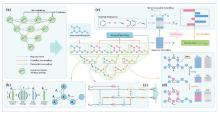
Fig 1
Overview of the MolUNet++ architecture. (a) The architecture of MolUNet++ incorporates pooling and unpooling operations as down-sampling and up-sampling processes, respectively. Each layer following the unpooling operation retains feature representations from the previous layers of the same scale through skip connections. Ultimately, molecular embeddings at various granularities are combined for prediction tasks. (b) The edge feature update process within the edge message passing (E-MP) module. (c) The pipeline of the MESPool process: node features and edge features are integrated to represent undirected bonds, which are then scored by a query feature. The edges are classified as inner-substructure and backbone bonds, with nodes clustered accordingly and shrunk into super-nodes. (d) An illustration of the pooling and unpooling operations applied to the dopamine toy structure. The unpooling operation reconstructs the original graph structure, copies and aligns the super-node feature to its member nodes, and resets the features of the inner-substructural edges to zero vectors. (e) The substructure explainer: MolUNet++ encodes atom features and merges them into a molecular representation through global pooling, subsequently predicting the property $ y $. By masking the atom features of substructures identified by MESPool, a new prediction, $ y_{\text{sub}} $, is obtained for the molecule with those substructures removed. The contribution of each substructure to the property is determined by $ y\text{-}y_{\text{sub}} $, and this contribution is visualized to provide insights."
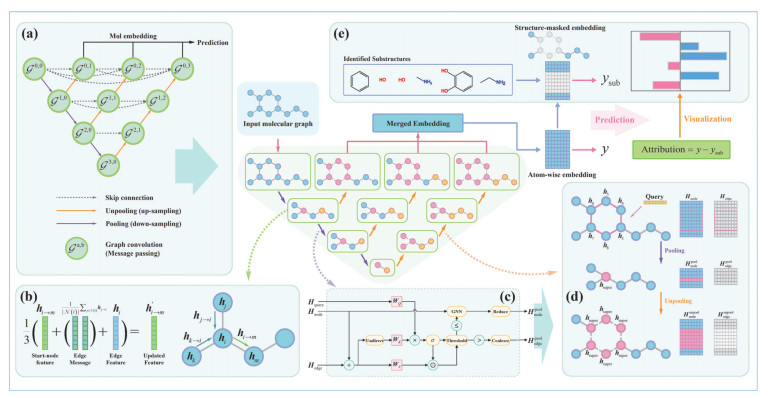
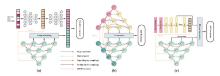
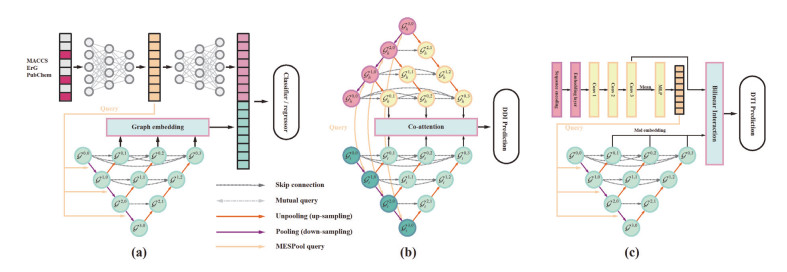
Fig 2
Utilization of structural identification query (Equation3) across different tasks. (a) Molecular property prediction: Three molecular structural fingerprints are concatenated and encoded using a multi-layer perceptron (MLP). The resulting feature serves as the query feature $ H_{\text{query}} $ in MESPool, and is subsequently decoded by another MLP for property prediction in conjunction with the graph embedding. (b) A pair of molecules is encoded using the same MolUNet++ network, with each molecule mutually utilizing the other's graph features as $ H_{\text{query}} $. The output embeddings are integrated through a co-attention layer to predict DDI interactions. (c) DTI prediction: The protein sequence is encoded using 1D CNNs, and the average of the representation rows is transformed through an MLP to serve as the $ H_{\text{query}} $ for structural identification in the drug encoder. The drug and protein representations are then fed into a bilinear attention network to learn their pairwise local interactions."
"
| Models | BBBP | BACE | ClinTox | Tox21 | SIDER | Lipophilicity | FreeSolv | ESOL |
| Compounds | 2039 | 1513 | 1478 | 7831 | 1427 | 4200 | 642 | 1128 |
| Task Type | Classification | Regression | ||||||
| Metric | AUC-ROC (Higher is better) | RMSE (Lower is better) | ||||||
| Basic GNN | 0.6987 ± 0.0210 | 0.6662 ± 0.0600 | 0.5895 ± 0.0433 | 0.7454 ± 0.0052 | 0.5735 ± 0.0097 | 0.8076 ± 0.0253 | 2.9105 ± 0.5219 | 1.3907 ± 0.0244 |
| GraphUNet | 0.6667 ± 0.0159 | 0.7676 ± 0.0052 | 0.8492 ± 0.0208 | 0.7387 ± 0.0030 | 0.6197 ± 0.0077 | 0.8031 ± 0.0182 | 2.2641 ± 0.1608 | 1.0125 ± 0.0380 |
| AttrMask | 0.6458 ± 0.0278 | 0.7934 ± 0.0070 | 0.7305 ± 0.0462 | 0.7700 ± 0.0030 | 0.6091 ± 0.0032 | 0.7715 ± 0.0053 | 2.9172 ± 0.1165 | 1.2825 ± 0.0230 |
| ContextPred | 0.6621 ± 0.0133 | 0.8068 ± 0.0075 | 0.6605 ± 0.0275 | 0.7572 ± 0.0029 | 0.6085 ± 0.0086 | 0.7932 ± 0.0060 | 3.0323 ± 0.1202 | 1.3256 ± 0.0176 |
| GraphMAE | 0.7165 ± 0.0088 | 0.8221 ± 0.0107 | 0.8245 ± 0.0132 | 0.7533 ± 0.0024 | 0.6038 ± 0.0069 | 0.7703 ± 0.0083 | 2.8209 ± 0.0803 | 1.2972 ± 0.0139 |
| Mole-BERT | 0.6831 ± 0.0210 | 0.8157 ± 0.0144 | 0.7384 ± 0.0372 | 0.7791 ± 0.0055 | 0.6332 ± 0.0021 | 0.7324 ± 0.0084 | 2.9246 ± 0.1661 | 1.1154 ± 0.0308 |
| GraphCL | 0.6882 ± 0.0240 | 0.7383 ± 0.0289 | 0.6561 ± 0.0697 | 0.7450 ± 0.0059 | 0.5912 ± 0.0048 | 0.8020 ± 0.0084 | 3.1731 ± 0.2245 | 1.2801 ± 0.0281 |
| MGSSL | 0.6736 ± 0.0128 | 0.8254 ± 0.0071 | 0.7249 ± 0.0266 | 0.7545 ± 0.0019 | 0.5809 ± 0.0133 | 0.7750 ± 0.0068 | 2.9681 ± 0.1432 | 1.3405 ± 0.0377 |
| MolUNet++ | 0.6664 ± 0.0190 | 0.8186 ± 0.0149 | 0.8594 ± 0.0171 | 0.7496 ± 0.0133 | 0.6257 ± 0.0169 | 0.7467 ± 0.0218 | 2.6853 ± 0.1063 | 0.9822 ± 0.0281 |
| MolUNet++ Pretrain | 0.6957 ± 0.0101 ↑ | 0.8276 ± 0.0102 ↑ | 0.8713 ± 0.0112 ↑ | 0.8003 ± 0.0039 ↑ | 0.6271 ± 0.0117 ↑ | 0.6725 ± 0.0094 ↑ | 2.2138 ± 0.0801 ↑ | 0.9664 ± 0.0228 ↑ |
| MolUNet++ FP | 0.7237 ± 0.0097 ↑ | 0.8107 ± 0.0151 | 0.7982 ± 0.0189 | 0.7191 ± 0.0059 | 0.6400 ± 0.0089 ↑ | 0.7467 ± 0.0081 ↑ | 2.2058 ± 0.0721 ↑ | 1.0190 ± 0.0375 |
| MolUNet++ Pretrain FP | 0.7058 ± 0.0129 ↑ | 0.8183 ± 0.0181 ↑ | 0.8596 ± 0.0098 ↑ ↑ | 0.8087 ± 0.0043 ↑ ↑ | 0.6551 ± 0.0103 ↑ ↑ | 0.6376 ± 0.0107 ↑ ↑ | 2.0756 ± 0.1112 ↑ ↑ | 0.9611 ± 0.0323 ↑ ↑ |
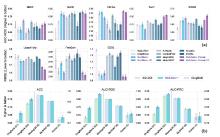
Fig 3
Benchmark performance. (a) Property prediction: the figures compare non-pretrained models (the first 4 bars) with pretrained models (the last 8 bars). The first 5 charts utilize AUC-ROC as the metric, where higher bars indicate better performance. The last 3 charts employ RMSE, where lower bars indicate better performance. (b) Interaction prediction: in each figure, the left two bar groups show DDI performance, while the right three show DTI performance. Each figure represents a different metric, where higher bars indicate better performance."
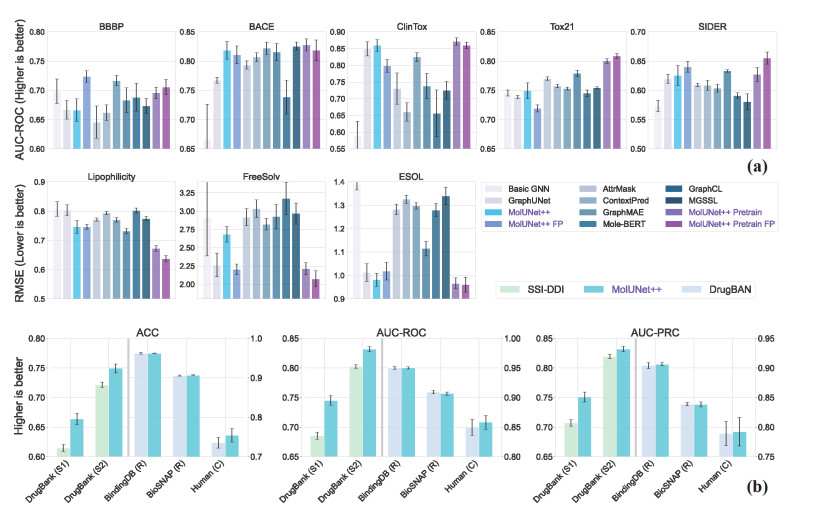
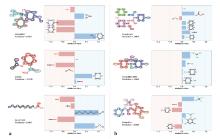
Fig 4
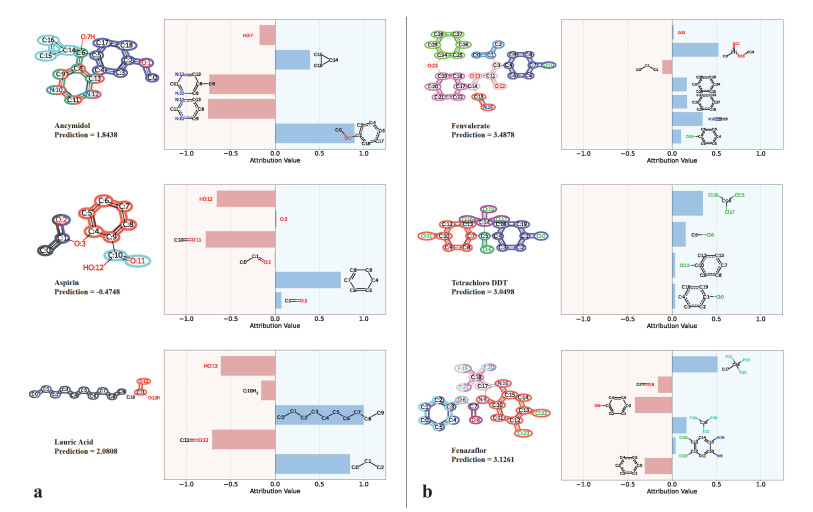
Visualization of pooling results and substructure attribution values in 2 property prediction tasks. Atoms of the same color represent an identified fragment, while independent atoms are also regarded as a single atomic substructure. (a) $ \text{log}D $ prediction: positive values indicate an increase in hydrophobicity (lipophilicity), whereas negative values indicate the contrary; (b) $ {\text{LD}}_{\text{50}} $ toxicity prediction: positive values suggest increased lethality."
"
| Interaction | Dataset | Models | ACC | AUC-ROC | AUC-PRC |
| DDI | DrugBank (S1) | SSI-DDI | 0.6147 ± 0.0059 | 0.6856 ± 0.0059 | 0.7072 ± 0.0055 |
| MolUNet++ | 0.6638 ± 0.0096 | 0.7452 ± 0.0081 | 0.7511 ± 0.0083 | ||
| DrugBank (S2) | SSI-DDI | 0.7216 ± 0.0045 | 0.8023 ± 0.0031 | 0.8195 ± 0.0041 | |
| MolUNet++ | 0.7492 ± 0.0076 | 0.8319 ± 0.0040 | 0.8320 ± 0.0045 | ||
| DTI | BindingDB (R) | DrugBAN | 0.9622 ± 0.0021 | 0.9502 ± 0.0024 | 0.9040 ± 0.0052 |
| MolUNet++ | 0.9624 ± 0.0005 | 0.9499 ± 0.0017 | 0.9063 ± 0.0025 | ||
| BioSNAP (R) | DrugBAN | 0.9057 ± 0.0015 | 0.9093 ± 0.0027 | 0.8390 ± 0.0030 | |
| MolUNet++ | 0.9067 ± 0.0014 | 0.9067 ± 0.0027 | 0.8383 ± 0.0040 | ||
| Human (C) | DrugBAN | 0.7357 ± 0.0134 | 0.8496 ± 0.0135 | 0.7892 ± 0.0205 | |
| MolUNet++ | 0.7543 ± 0.0173 | 0.8581 ± 0.0119 | 0.7923 ± 0.0243 |
Fig 5
Visualization of the case study in DDI prediction. (a) Attention scores visualization in the original SSI-DDI; (b) pooling results and identified substructure contribution visualization in MolUNet++."
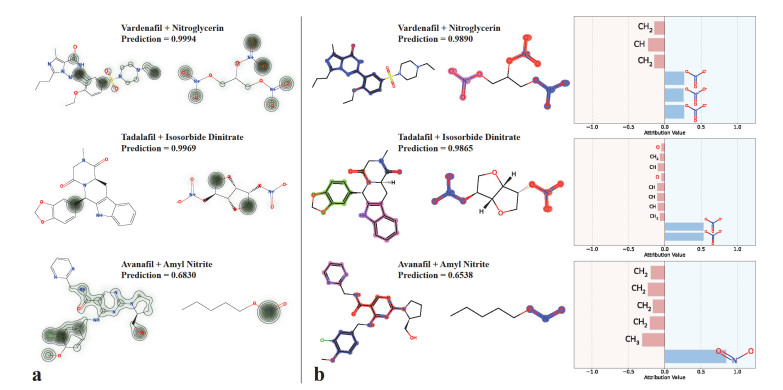
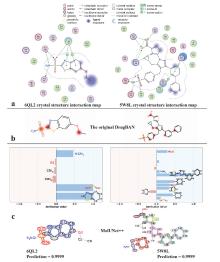
Fig 6
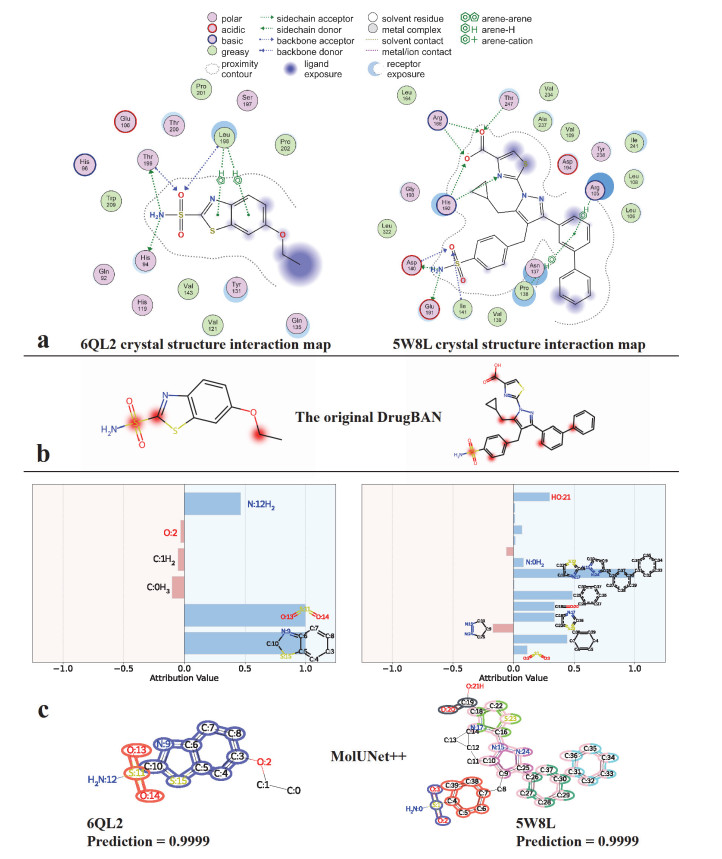
Visualization of the case study in DTI prediction. (a) The ligand-protein interaction from the corresponding crystal structures (visualized through the Molecular Operating Environment (MOE) software); (b) visualization of the most important atoms in the bilinear attention layer of DrugBAN, that contribute to the binding; (c) pooling results and identified substructure contribution visualization in MolUNet++."
| 1 |
Z. Guo, K. Guo, B. Nan, Y. Tian, R.G. Iyer, Y. Ma, O. Wiest, X. Zhang, W. Wang, C. Zhang, et al., arXiv: 2207.04869, https://doi.org/10.48550/arXiv.2207.04869.
|
| 2 |
T.-H. Nguyen-Vo, P. Teesdale-Spittle, J.E. Harvey, B.P. Nguyen. Memetic Comput. 2024, 16, 519.
doi: 10.1007/s12293-024-00414-6 |
| 3 |
L. David, A. Thakkar, R. Mercado, O. Engkvist. J. Cheminform. 2020, 12, 56.
doi: 10.1186/s13321-020-00460-5 |
| 4 |
Y. Harnik, A. Milo. Chem. Sci. 2024, 15, 5052.
doi: 10.1039/d4sc90043j |
| 5 |
N. Wen, G. Liu, J. Zhang, R. Zhang, Y. Fu, X. Han. J. Cheminform. 2022, 14, 71.
doi: 10.1186/s13321-022-00650-3 |
| 6 |
D. Baptista, J. Correia, B. Pereira, M. Rocha. J. Integr. Bioinform. 2022, 19, 20220006.
doi: 10.1515/jib-2022-0006 |
| 7 |
R. Zhang, Y. Lin, Y. Wu, L. Deng, H. Zhang, M. Liao, Y. Peng. Brief. Bioinform. 2024, 25, bbae298.
doi: 10.1093/bib/bbae298 |
| 8 |
K.V. Chuang, L.M. Gunsalus, M.J. Keiser. J. Med. Chem. 2020, 63, 8705.
doi: 10.1021/acs.jmedchem.0c00385 |
| 9 |
D. Jiang, Z. Wu, C.-Y. Hsieh, G. Chen, B. Liao, Z. Wang, C. Shen, D. Cao, J. Wu, T. Hou. J. Cheminform. 2021, 13, 12.
doi: 10.1186/s13321-020-00479-8 |
| 10 |
Y. Wang, Z. Li, A. Barati Farimani, Graph Neural Networks for Molecules, in Machine Learning in Molecular Sciences, C. Qu, H. Liu, Eds., Springer: Cham, Switzerland, 2023, pp. 21–66, https://doi.org/10.1007/978-3-031-37196-7_2.
|
| 11 |
O. Wieder, S. Kohlbacher, M. Kuenemann, A. Garon, P. Ducrot, T. Seidel, T. Langer. Drug Discov. Today Technol. 2020, 37, 1.
doi: 10.1016/j.ddtec.2020.11.009 |
| 12 |
Z. Li, K. Meidani, P. Yadav, A. Barati Farimani. J. Chem. Phys. 2022, 156, 144103.
doi: 10.1063/5.0083060 |
| 13 |
Z. Zhang, L. Chen, F. Zhong, D. Wang, J. Jiang, S. Zhang, H. Jiang, M. Zheng, X. Li. Curr. Opin. Struct. Biol. 2022, 73, 102327.
doi: 10.1016/j.sbi.2021.102327 |
| 14 |
Z. Wu, J. Wang, H. Du, D. Jiang, Y. Kang, D. Li, P. Pan, Y. Deng, D. Cao, C.-Y. Hsieh, et al.. Nat. Commun. 2023, 14, 2585.
doi: 10.1038/s41467-023-38192-3 |
| 15 |
A.Z. Dudek, T. Arodz, J. Gálvez. Comb. Chem. High Throughput Screen. 2006, 9, 213.
doi: 10.2174/138620706776055539 |
| 16 |
Y. Liu, B. Guo, X. Zou, Y. Li, S. Shi. Energy Storage Mater. 2020, 31, 434.
doi: 10.1016/j.ensm.2020.06.033 |
| 17 |
Y. Liu, X. Zou, Z. Yang, S. Shi. J. Chin. Ceram. Soc. 2022, 50, 863.
doi: 10.14062/j.issn.0454-5648.20220093 |
| 18 |
Y. Wang, W. Hou, N. Sheng, Z. Zhao, J. Liu, L. Huang, J. Wang. Artif. Intell. Rev. 2024, 57, 294.
doi: 10.1007/s10462-024-10918-9 |
| 19 |
D. Mesquita, A. Souza, S. Kaski. Adv. Neural Inf. Process. Syst. 2020, 33, 2220.
doi: 10.48550/arXiv.2010.11418 |
| 20 |
D. Grattarola, D. Zambon, F.M. Bianchi, C. Alippi. IEEE Trans. Neural Netw. Learn. Syst. 2022, 35, 2708.
doi: 10.1109/TNNLS.2022.3190922 |
| 21 |
C. Liu, Y. Zhan, J. Wu, C. Li, B. Du, W. Hu, T. Liu, D. Tao, Graph Pooling for Graph Neural Networks: Progress, Challenges, and Opportunities, in Proceedings of the Thirty-Second International Joint Conference on Artificial Intelligence (IJCAI 2023), 2023, pp. 6712–6722, https://doi.org/10.24963/ijcai.2023/752.
|
| 22 |
F. Xu, Z. Yang, L. Wang, D. Meng, J. Long. Brief. Bioinform. 2024, 25, bbad423.
doi: 10.1093/bib/bbad423 |
| 23 |
Z. Zhou, M.M. Rahman Siddiquee, N. Tajbakhsh, J. Liang, UNet++: A Nested U-Net Architecture for Medical Image Segmentation, in Deep Learning in Medical Image Analysis and Multimodal Learning for Clinical Decision Support, Springer: Cham, Switzerland, 2018, pp. 3–11, https://link.springer.com/chapter/10.1007/978-3-030-00889-5_1.
|
| 24 |
D.J. Pearce, An Improved Algorithm for Finding the Strongly Connected Components of a Directed Graph, (2005), https://api.semanticscholar.org/CorpusID:7781255.
|
| 25 |
O. Ronneberger, P. Fischer, T. Brox, U-Net: Convolutional Networks for Biomedical Image Segmentation, in Medical Image Computing and Computer-Assisted Intervention - MICCAI 2015, Springer: Cham, Switzerland, 2015, pp. 234–241, https://doi.org/10.1007/978-3-319-24574-4_28.
|
| 26 |
H. Gao, S. Ji. IEEE Trans. Pattern Anal. Mach. Intell. 2022, 44, 4948.
doi: 10.1109/TPAMI.2021.3081010 |
| 27 |
C. Cangea, P. Veličković, N. Jovanović, T. Kipf, P. Liò, arXiv: 1811.01287, https://doi.org/10.48550/arXiv.1811.01287.
|
| 28 |
G. Corso, L. Cavalleri, D. Beaini, P. Liò, P. Veličković. Adv. Neural Inf. Process. Syst. 2020, 33, 13260.
doi: 10.48550/arXiv.2004.05718 |
| 29 |
W. Hu, B. Liu, J. Gomes, M. Zitnik, P. Liang, V. Pande, J. Leskovec, arXiv: 1905.12265, https://doi.org/10.48550/arXiv.1905.12265.
|
| 30 |
Y. You, T. Chen, Y. Sui, T. Chen, Z. Wang, Y. Shen. Adv. Neural Inf. Process. Syst. 2020, 33, 5812.
|
| 31 |
R. Sun, H. Dai, A.W. Yu. Adv. Neural Inf. Process. Syst. 2022, 35, 12096.
doi: 10.5555/3600270.3601149 |
| 32 |
S. Zhang, Z. Yan, Y. Huang, L. Liu, D. He, W. Wang, X. Fang, X. Zhang, F. Wang, H. Wu, et al.. Bioinformatics 2022, 38, 3444.
doi: 10.1093/bioinformatics/btac342 |
| 33 |
W. Lin, C.C.A. Fung. ACS Omega 2024, 9, 20832.
doi: 10.1021/acsomega.3c09512 |
| 34 |
E. Inae, G. Liu, M. Jiang, arXiv: 2309.04589, https://doi.org/10.48550/arXiv.2309.04589.
|
| 35 |
B. Fabian, T. Edlich, H. Gaspar, M. Segler, J. Meyers, M. Fiscato, M. Ahmed, arXiv: 2011.13230, https://doi.org/10.48550/arXiv.2011.13230.
|
| 36 |
Y. Liu, Z. Yang, X. Zou, S. Ma, D. Liu, M. Avdeev, S. Shi. Natl. Sci. Rev. 2023, 10, nwad125.
doi: 10.1093/nsr/nwad125 |
| 37 |
Y. Liu, S. Ma, Z. Yang, X. Zou, S. Shi. J. Chin. Ceram. Soc. 2023, 51, 427.
doi: 10.14062/j.issn.0454-5648.20220991 |
| 38 |
Y. Liu, Z. Yang, X. Zou, Y. Lin, S. Ma, W. Zuo, Z. Zou, H. Wang, M. Avdeev, S. Shi. Mater. Sci. Eng.: R: Rep. 2025, 166, 101050.
doi: 10.1016/j.mser.2025.101050 |
| 39 |
Z. Hou, X. Liu, Y. Cen, Y. Dong, H. Yang, C. Wang, J. Tang, GraphMAE: Self-Supervised Masked Graph Autoencoders, in Proceedings of the 28th ACM SIGKDD Conference on Knowledge Discovery and Data Mining, Association for Computing Machinery: New York, NY, USA, 2022, pp. 594–604, https://doi.org/10.1145/3534678.3539321.
|
| 40 |
J. Xia, C. Zhao, B. Hu, Z. Gao, C. Tan, Y. Liu, S. Li, S. Z. Li, Mole-BERT: Rethinking Pre-training Graph Neural Networks for Molecules, in the Eleventh International Conference on Learning Representations (ICLR2023), 2023 poster, https://openreview.net/forum?id=jevY-DtiZTR.
|
| 41 |
Z. Zhang, Q. Liu, H. Wang, C. Lu, C.-K. Lee, Motif-based Graph Self-Supervised Learning for Molecular Property Prediction, in Proceedings of the 35th International Conference on Neural Information Processing Systems (NIPS2021), Curran Associates Inc. : Red Hook, NY, USA, 2021 pp. 15870–15882, https://dl.acm.org/doi/10.5555/3540261.3541475.
|
| 42 |
G.W. Bemis, M.A. Murcko. J. Med. Chem. 1996, 39, 2887.
doi: 10.1021/jm9602928 |
| 43 |
Y. Liu, S. Ma, Z. Yang, D. Wu, Y. Zhao, M. Avdeev, S. Shi. J. Materiomics 2025, 11, 101066.
doi: 10.1016/j.jmat.2025.101066 |
| 44 |
H. Zhu, T.M. Martin, L. Ye, A. Sedykh, D.M. Young, A. Tropsha. Chem. Res. Toxicol. 2009, 22, 1913.
doi: 10.1021/tx900189p |
| 45 |
M.L. Landry, J.J. Crawford. ACS Med. Chem. Lett. 2019, 11, 72.
doi: 10.1021/acsmedchemlett.9b00489 |
| 46 |
A.K. Nyamabo, H. Yu, J.-Y. Shi. Brief. Bioinform. 2021, 22, bbab133.
doi: 10.1093/bib/bbab133 |
| 47 |
P. Bai, F. Miljković, B. John, H. Lu. Nat. Mach. Intell 2023, 5, 126.
doi: 10.1038/s42256-022-00605-1 |
| 48 |
M. Nickel, V. Tresp, H.-P. Kriegel, A Three-Way Model for Collective Learning on Multi-Relational Data, in Proceedings of the 28th International Conference on Machine Learning PMLR97 (ICML2021), Omnipress: Madison, WI, USA, 2011 pp. 809–816, https://dl.acm.org/doi/10.5555/3104482.3104584.
|
| 49 |
J. Lee, I. Lee, J. Kang, Self-Attention Graph Pooling, in Proceedings of the 36th International Conference on Machine Learning (ICML2019), PMLR, 2019, pp. 3734-3743, https://proceedings.mlr.press/v97/lee19c/lee19c.pdf.
|
| 50 |
T. Liu, Y. Lin, X. Wen, R.N. Jorissen, M.K. Gilson. Nucleic Acids Res. 2007, 35, D198.
doi: 10.1093/nar/gkl999 |
| 51 |
M. Zitnik, R. Sosic, S. Maheshwari, J. Leskovec, BioSNAP Datasets: Stanford Biomedical Network Dataset Collection, (2018), https://snap.stanford.edu/biodata/.
|
| 52 |
H. Liu, J. Sun, J. Guan, J. Zheng, S. Zhou. Bioinformatics 2015, 31, i221.
doi: 10.1093/bioinformatics/btv256 |
| No related articles found! |
|
||