Acta Phys. -Chim. Sin. ›› 2026, Vol. 42 ›› Issue (5): 100213.doi: 10.1016/j.actphy.2025.100213
• ARTICLE • Previous Articles Next Articles
T2MAT (text-to-material): a universal agent for generating material structures with goal properties from a single sentence
Zhilong Song1,2, Shuaihua Lu1, Qionghua Zhou1,2,*( ), Jinlan Wang1,2,*()
- 1 Key Laboratory of Quantum Materials and Devices of Ministry of Education, School of Physics, Southeast University, Nanjing 211189, Jiangsu Province, China
2 Suzhou Laboratory, Suzhou 215004, Jiangsu Province, China
-
Received:2025-08-25Revised:2025-10-27Accepted:2025-10-27Published:2026-01-23 -
Contact:Email: qh.zhou@seu.edu.cn (Qionghua Zhou)jlwang@seu.edu.cn (Jinlan Wang)

Cite this article
Zhilong Song, Shuaihua Lu, Qionghua Zhou, Jinlan Wang. T2MAT (text-to-material): a universal agent for generating material structures with goal properties from a single sentence[J]. Acta Phys. -Chim. Sin. 2026, 42(5), 100213. doi: 10.1016/j.actphy.2025.100213
share this article
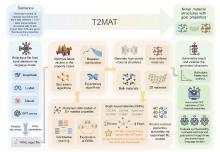
Fig 1
Overview of T2MAT's three primary modules: ⅰ) Capturing material design requirements from user-input (blue background); ⅱ) Generating a variety of novel material structures based on user-specified properties (orange background); ⅲ) Implementing a fully automated DFT validation process (green background)."
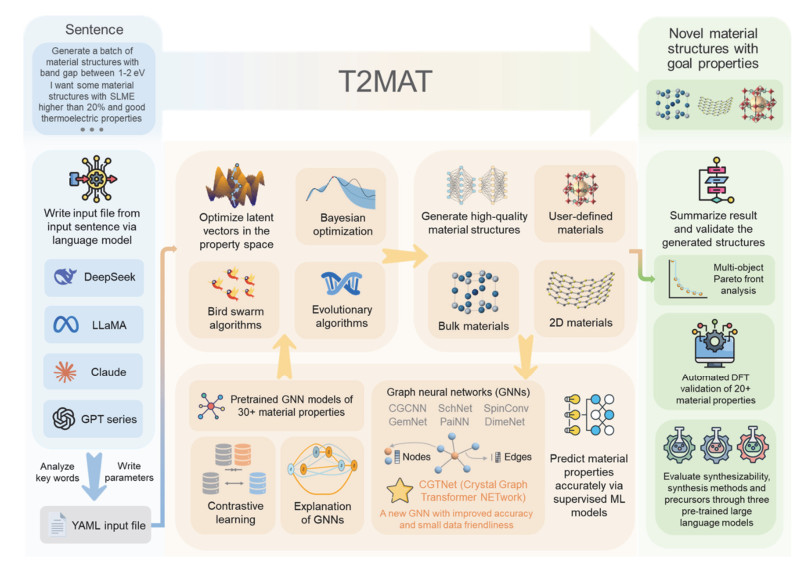
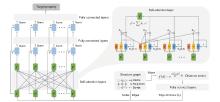
Fig 2
Architecture of CGTNet. The self-attention layers are designed to capture dynamically and efficiently capture long-range interaction. Graph features are constructed from atom features, interatomic distances, and angles. Edge features, processed through a fully connected layer, are integrated into the self-attention mechanism for enhanced information exchange."
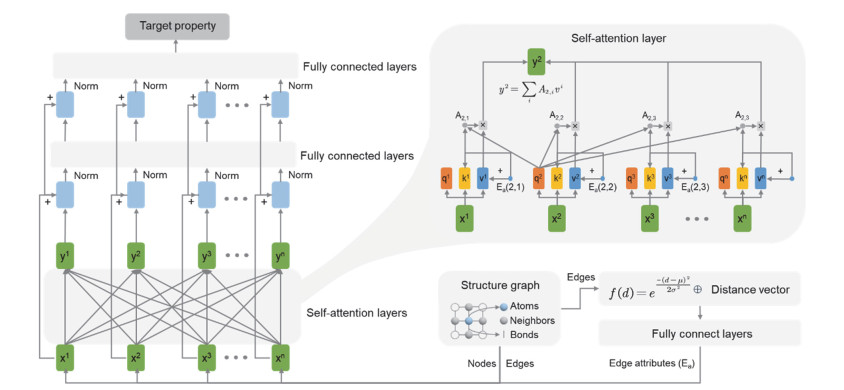
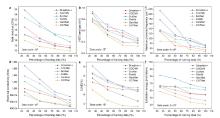
Fig 3
Performance of CGTNet. MAE of DimeNet++, CGCNN, SchNet, PaiNN, GemNet, and CGTNet on testing data using 25%, 50%, 75% and 100 % training data for the prediction of (a) bulk modulus, (b) HSE band gap, (c) maximum phonon spectrum frequency, (d) electrical conductivity, (e) SLME, and (f) exfoliation energy."
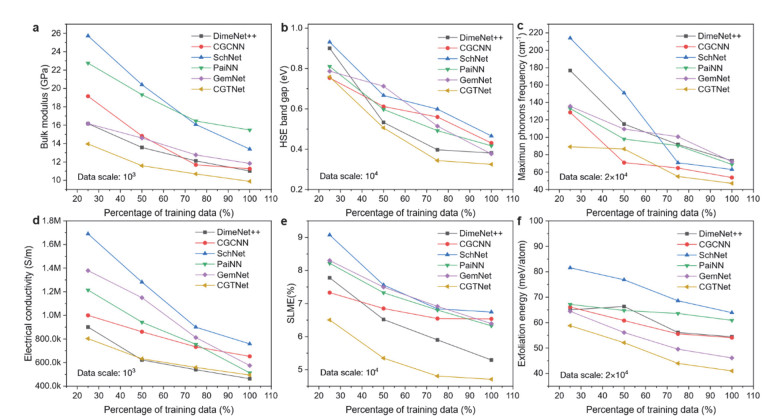
Fig 4
Necessity, architecture and performance of contrastive learning. (a–c) Linear relationship between the InfoNCE loss function and the predictive performance on testing data. (d) Architecture of contrastive learning for minimizing distances between positive structures and maximize those between negative ones. (e) Performance comparison of CGTNet with and without contrastive learning."
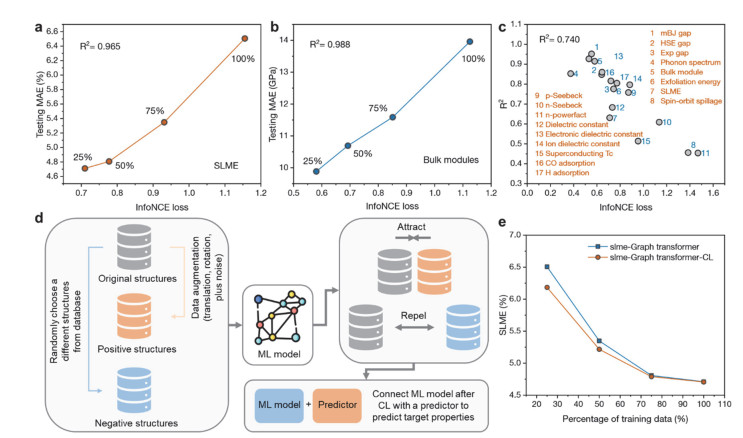
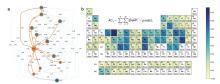
Fig 5
Example of the GNN explainer for interpreting GNNs in T2MAT. (a)Visualization of the node and edge importance in predicting the SLME of MAPbI3. (b) Contribution of individual elements in improving the SLME, which is summarized based on 9770 GNN-based SLME predictions. The bluer an element's color, the greater its positive contribution to the SLME."
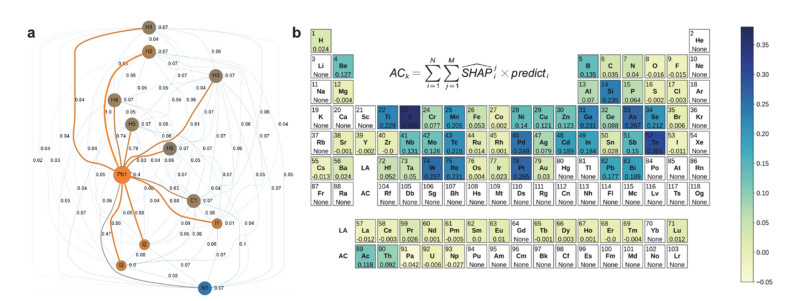
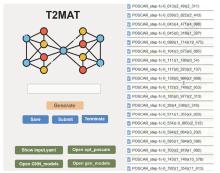
Fig 6
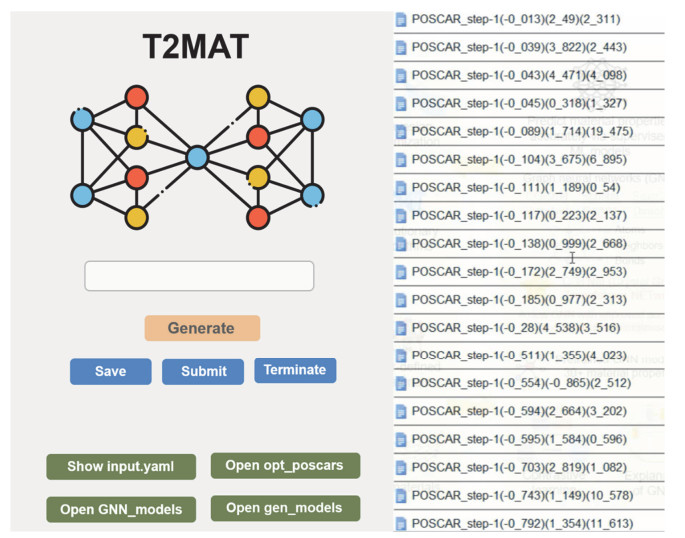
GUI of T2MAT. The interface includes the submission of material design requirements, modifications of the input file, display of available generative models, property-prediction models and generated structures."
| 1 |
Y. Cao, S. Li, Y. Liu, Z. Yan, Y. Dai, P.S. Yu, L. Sun, arXiv: 2303.04226, http://arxiv.org/abs/2303.04226.
|
| 2 |
Editorial. Nat. Mach. Intell. 2022, 4, 733.
doi: 10.1038/s42256-022-00539-8 |
| 3 |
K.T. Butler, D.W. Davies, H. Cartwright, O. Isayev, A. Walsh. Nature 2018, 559, 547.
doi: 10.1038/s41586-018-0337-2 |
| 4 |
M. Zhong, K. Tran, Y. Min, C. Wang, Z. Wang, C.T. Dinh, P. De Luna, Z. Yu, A.S. Rasouli, P. Brodersen, et al.. Nature 2020, 581, 178.
doi: 10.1038/s41586-020-2242-8 |
| 5 |
B. Weng, Z. Song, R. Zhu, Q. Yan, Q. Sun, C.G. Grice, Y. Yan, W.-J. Yin. Nat. Commun. 2020, 11, 3513.
doi: 10.1038/s41467-020-17263-9 |
| 6 |
Z. Song, X. Wang, F. Liu, Q. Zhou, W.-J. Yin, H. Wu, W. Deng, J. Wang. Mater. Horizons 2023, 10, 1651.
doi: 10.1039/D3MH00157A |
| 7 |
S. Lu, Q. Zhou, Y. Ouyang, Y. Guo, Q. Li, J. Wang. Nat. Commun. 2018, 9, 3405.
doi: 10.1038/s41467-018-05761-w |
| 8 |
S. Lu, Q. Zhou, Y. Guo, J. Wang. Chem 2022, 8, 769.
doi: 10.1016/j.chempr.2021.11.009 |
| 9 |
B. Sanchez-Lengeling, A. Aspuru-Guzik. Science 2018, 361, 360.
doi: 10.1126/science.aat2663 |
| 10 |
J. Noh, G.H. Gu, S. Kim, Y. Jung. Chem. Sci. 2020, 11, 4871.
doi: 10.1039/d0sc00594k |
| 11 |
S. Lu, Q. Zhou, X. Chen, Z. Song, J. Wang. Natl. Sci. Rev. 2022, 9, 9.
doi: 10.1093/nsr/nwac111 |
| 12 |
Y. Zhao, M. Al‐Fahdi, M. Hu, E.M.D. Siriwardane, Y. Song, A. Nasiri, J. Hu. Adv. Sci. 2021, 8, 14.
doi: 10.1002/advs.202100566 |
| 13 |
Z. Yao, B. Sánchez-Lengeling, N.S. Bobbitt, B.J. Bucior, S.G.H. Kumar, S.P. Collins, T. Burns, T.K. Woo, O.K. Farha, R.Q. Snurr, et al.. Nat. Mach. Intell. 2021, 3, 76.
doi: 10.1038/s42256-020-00271-1 |
| 14 |
B. Kim, S. Lee, J. Kim. Sci. Adv. 2020, 6, eaax9324.
doi: 10.1126/sciadv.aax9324 |
| 15 |
T. Salimans, I. Goodfellow, W. Zaremba, V. Cheung, A. Radford, X. Chen. Adv. Neural Inf. Process. Syst. 2016, 2234.
doi: 10.5555/3157096.3157346 |
| 16 |
K.M. Jablonka, P. Schwaller, A. Ortega-Guerrero, B. Smit. Nat. Mach. Intell. 2024, 6, 161.
doi: 10.1038/s42256-023-00788-1 |
| 17 |
L.M. Antunes, K.T. Butler, R. Grau-Crespo. Nat. Coummn. 2024, 10570.
doi: 10.1038/s41467-024-54639-7 |
| 18 |
T. Xie, J.C. Grossman. Phys. Rev. Lett. 2018, 120, 145301.
doi: 10.1103/PhysRevLett.120.145301 |
| 19 |
J. Gasteiger, J. Groß, S. Günnemann, arXiv: 2003.03123, https://arxiv.org/abs/2003.03123.
|
| 20 |
K.T. Schütt, H.E. Sauceda, P.-J. Kindermans, A. Tkatchenko, K.-R. Müller. J. Chem. Phys. 2018, 148, 241722.
doi: 10.1063/1.5019779 |
| 21 |
M. Shuaibi, A. Kolluru, A. Das, A. Grover, A. Sriram, Z. Ulissi, C.L. Zitnick, arXiv: 2106.09575, http://arxiv.org/abs/2106.09575.
|
| 22 |
J. Gasteiger, F. Becker, S. Günnemann, GemNet: Universal Directional Graph Neural Networks for Molecules, in Advances in Neural Information Processing Systems 34 (NeurIPS 2021), Curran Associates, Inc., 2021, pp. 6790–6802, https://proceedings.neurips.cc/paper/2021/hash/35cf8659cfcb13224cbd47863a34fc58-Abstract.html.
|
| 23 |
K.T. Schütt, O.T. Unke, M. Gastegger, Equivariant Message Passing for the Prediction of Tensorial Properties and Molecular Spectra, in Proceedings of the 38th International Conference on Machine Learning (ICML 2021), PMLR, 2021, pp. 9377–9388, https://proceedings.mlr.press/v139/schutt21a.html.
|
| 24 |
Y.-L. Liao, B. Wood, A. Das, T. Smidt, EquiformerV2: Improved Equivariant Transformer for Scaling to Higher-Degree Representations, in International Conference on Learning Representations (ICLR), 2024, https://proceedings.iclr.cc/paper_files/paper/2024/file/ab12e8f3443c1a789f595b18d8c597b4-Paper-Conference.pdf.
|
| 25 |
M. Fey, J.E. Lenssen, Fast Graph Representation Learning with PyTorch Geometric, in ICLR Workshop on Representation Learning on Graphs and Manifolds, 2019, https://rlgm.github.io/papers/2.pdf.
|
| 26 |
Z. Song, S. Lu, M. Ju, Q. Zhou, J. Wang. Nat. Commun. 2025, 16, 6530.
doi: 10.1038/s41467-025-61778-y |
| 27 |
D. Guo, D. Yang, H. Zhang, J. Song, R. Zhang, R. Xu, Q. Zhu, S. Ma, P. Wang, X. Bi, et al.. Nature 2025, 645, 633.
doi: 10.1038/s41586-025-09422-z |
| 28 |
H. Touvron, L. Martin, K. Stone, P. Albert, A. Almahairi, Y. Babaei, N. Bashlykov, S. Batra, P. Bhargava, S. Bhosale, et al., arXiv: 2307.09288, http://arxiv.org/abs/2307.09288
|
| 29 |
Z. Du, Y. Qian, X. Liu, M. Ding, J. Qiu, Z. Yang, J. Tang. Proc. Annu. Meet. Assoc. Comput. Linguist. 2022, 1, 320.
doi: 10.18653/v1/2022.acl-long.26 |
| 30 |
T.B. Brown, B. Mann, N. Ryder, M. Subbiah, J. Kaplan, P. Dhariwal, A. Neelakantan, P. Shyam, G. Sastry, A. Askell, et al., Language Models are Few-Shot Learners, in Advances in Neural Information Processing Systems 33 (NeurIPS 2020), Curran Associates, Inc., 2020, pp. 1877–1901, https://papers.nips.cc/paper/2020/hash/1457c0d6bfcb4967418bfb8ac142f64a-Abstract.html
|
| 31 |
S.P. Ong, W.D. Richards, A. Jain, G. Hautier, M. Kocher, S. Cholia, D. Gunter, V.L. Chevrier, K.A. Persson, G. Ceder. Comput. Mater. Sci. 2013, 68, 314.
doi: 10.1016/j.commatsci.2012.10.028 |
| 32 |
S. Haastrup, M. Strange, M. Pandey, T. Deilmann, P.S. Schmidt, N.F. Hinsche, M.N. Gjerding, D. Torelli, P.M. Larsen, A.C. Riis-Jensen, et al.. 2D Mater. 2018, 5, 042002.
doi: 10.1088/2053-1583/aacfc1 |
| 33 |
M.N. Gjerding, A. Taghizadeh, A. Rasmussen, S. Ali, F. Bertoldo, T. Deilmann, N.R. Knøsgaard, M. Kruse, A.H. Larsen, S. Manti, et al.. 2D Mater. 2021, 8, 044002.
doi: 10.1088/2053-1583/ac1059 |
| 34 |
A.S. Rosen, S.M. Iyer, D. Ray, Z. Yao, A. Aspuru-Guzik, L. Gagliardi, J.M. Notestein, R.Q. Snurr. Matter 2021, 4, 1578.
doi: 10.1016/j.matt.2021.02.015 |
| 35 |
A.S. Rosen, V. Fung, P. Huck, C.T. O'Donnell, M.K. Horton, D.G. Truhlar, K.A. Persson, J.M. Notestein, R.Q. Snurr. npj Comput. Mater. 2022, 8, 112.
doi: 10.1038/s41524-022-00796-6 |
| 36 |
T. Xie, X. Fu, O.-E. Ganea, R. Barzilay, T. Jaakkola, arXiv: 2110.06197, https://arxiv.org/abs/2110.06197.
|
| 37 |
R. Jiao, W. Huang, Y. Liu, D. Zhao, Y. Liu, arXiv: 2402.03992, https://arxiv.org/abs/2402.03992.
|
| 38 |
B.K. Miller, R.T.Q. Chen, A. Sriram, B.M. Wood. FlowMM: Generating Materials with Riemannian Flow Matching, in Proceedings of the 41st International Conference on Machine Learning, PMLR, 2024, pp. 35664–35686, https://proceedings.mlr.press/v235/miller24a.html.
|
| 39 |
C. Zeni, R. Pinsler, D. Zügner, A. Fowler, M. Horton, X. Fu, Z. Wang, A. Shysheya, J. Crabbé, S. Ueda, et al.. Nature 2025, 639, 624.
doi: 10.1038/s41586-025-08628-5 |
| 40 |
Z. Song, C. Ling, Q. Li, Q. Zhou, J. Wang, arXiv: 2507.19307, http://arxiv.org/abs/2507.19307.
|
| 41 |
A. Vaswani, N. Shazeer, N. Parmar, J. Uszkoreit, L. Jones, A.N. Gomez, L. Kaiser, I. Polosukhin. Attention is All you Need, in Advances in Neural Information Processing Systems 30 (NIPS 2017), Curran Associates, Inc., 2017, https://papers.neurips.cc/paper/7181-attention-is-all-you-need.pdf.
|
| 42 |
J. Devlin, M.-W. Chang, K. Lee, K. Toutanova, BERT: Pre-training of Deep Bidirectional Transformers for Language Understanding, in Proceedings of the 2019 Conference of the North American Chapter of the Association for Computational Linguistics: Human Language Technologies, Association for Computational Linguistics: Minneapolis, Minnesota, 2019, pp. 4171–4186, https://aclanthology.org/N19-1423/.
|
| 43 |
H. Huo, M. Rupp. Mach. Learn. Sci. Technol. 2022, 3, 045017.
doi: 10.1088/2632-2153/aca005 |
| 44 |
L. Yu, A. Zunger. Phys. Rev. Lett. 2012, 108, 068701.
doi: 10.1103/PhysRevLett.108.068701 |
| 45 |
S. Kong, F. Ricci, D. Guevarra, J. B. Neaton, C. P. Gomes, J. M. Gregoire. Nat. Commun. 2022, 13, 949.
doi: 10.1038/s41467-022-28543-x |
| 46 |
C. Loh, T. Christensen, R. Dangovski, S. Kim, M. Soljačić. Nat. Commun. 2022, 13, 4223.
doi: 10.1038/s41467-022-31915-y |
| 47 |
S. Kirklin, J.E. Saal, B. Meredig, A. Thompson, J.W. Doak, M. Aykol, S. Rühl, C. Wolverton. npj Comput. Mater. 2015, 1, 15010.
doi: 10.1038/npjcompumats.2015.10 |
| 48 |
K. Choudhary, K.F. Garrity, A.C.E. Reid, B. DeCost, A.J. Biacchi, A.R. Hight Walker, Z. Trautt, J. Hattrick-Simpers, A.G. Kusne, A. Centrone, et al.. npj Comput. Mater. 2020, 6, 173.
doi: 10.1038/s41524-020-00440-1 |
| 49 |
Z. Yang, D. Bourgeois, J. You, M. Zitnik, J. Leskovec, GNNExplainer: Generating Explanations for Graph Neural Networks, in Advances in Neural Information Processing Systems 32 (NuerIPS 2019), Curran Associates, Inc., 2019, https://proceedings.neurips.cc/paper_files/paper/2019/file/d80b7040b773199015de6d3b4293c8ff-Paper.pdf.
|
| 50 |
W.-J. Yin, T. Shi, Y. Yan. Adv. Mater. 2014, 26, 4653.
doi: 10.1002/adma.201306281 |
| 51 |
W.-J. J. Yin, T. Shi, Y. Yan. Appl. Phys. Lett. 2014, 104, 063903.
doi: 10.1063/1.4864778 |
| 52 |
S.M. Lundberg, S.I. Lee, A Unified Approach to Interpreting Model Predictions, in Advances in Neural Information Processing Systems 30 (NIPS 2017), Curran Associates, Inc., 2017, https://proceedings.neurips.cc/paper/7062-a-unified-approach-to-interpreting-model-predictions.pdf.
|
| 53 |
K. Momma, F. Izumi. J. Appl. Crystallogr. 2011, 44, 1272.
doi: 10.1107/S0021889811038970 |
| 54 |
G. Kresse, J. Furthmüller. Phys. Rev. B 1996, 54, 11169.
doi: 10.1103/PhysRevB.54.11169 |
| 55 |
P. Giannozzi, S. Baroni, N. Bonini, M. Calandra, R. Car, C. Cavazzoni, D. Ceresoli, G. L. Chiarotti, M. Cococcioni, I. Dabo, et al.. J. Phys. Condens. Matter 2009, 21, 395502.
doi: 10.1088/0953-8984/21/39/395502 |
| [1] | Han-Zhi Luo, Qi-Ming Liang, Zi-Xing Guo, Xin-Tian Xie, Jin-Peng Tang, Tong Guan, Ye-Fei Li, Si-Cong Ma, Ying-Chen Xu, Zhen-Xiong Wang, Cheng Shang, Zhi-Pan Liu. LASPAI: AI-powered platform for the future atomic simulation [J]. Acta Phys. -Chim. Sin., 2026, 42(6): 100235-. |
| [2] | Jia-Hao Wang, Bo Cai, Bowen Sun, Zhi-Ling Hou, Shu-Hao Yang, Qinglin Yang, Pei-Yan Zhao, Wen-Ping Li, Yu Zhang, Guang-Sheng Wang. Molecular dipole engineering for tailored dielectric properties in MXene/ZnO heterostructures [J]. Acta Phys. -Chim. Sin., 2026, 42(6): 100271-. |
| [3] | Weikang Wang, Yadong Wu, Jianjun Zhang, Kai Meng, Jinhe Li, Lele Wang, Qinqin Liu. Green H2O2 synthesis via melamine-foam supported S-scheme Cd0.5Zn0.5In2S4/S-doped carbon nitride heterojunction: synergistic interfacial charge transfer and local photothermal effect [J]. Acta Phys. -Chim. Sin., 2025, 41(8): 100093-. |
| [4] | Hengrui Zhang, Xijun Xu, Xun-Lu Li, Xiangwen Gao. Applications of Generative Artificial Intelligence in Battery Research: Current Status and Prospects [J]. Acta Phys. -Chim. Sin., 2025, 41(10): 100115-. |
| [5] | Hanmei Lü, Xin Chen, Qifu Sun, Ning Zhao, Xiangxin Guo. Uniform Garnet Nanoparticle Dispersion in Composite Polymer Electrolytes [J]. Acta Phys. -Chim. Sin., 2024, 40(3): 2305016-. |
| [6] | Yang Xia, Kangyan Zhang, Heng Yang, Lijuan Shi, Qun Yi. Improving Photocatalytic H2O2 Production over iCOF/Bi2O3 S-Scheme Heterojunction in Pure Water via Dual Channel Pathways [J]. Acta Phys. -Chim. Sin., 2024, 40(11): 2407012-. |
| [7] | Xuewei Liu, Ying Niu, Ruixiong Cao, Xiaohong Chen, Hongyan Shang, Huaihe Song. Is there a Demand of Conducting Agent of Acetylene Black for Graphene-Wrapped Natural Spherical Graphite as Anode Material for Lithium-Ion Batteries? [J]. Acta Phys. -Chim. Sin., 2022, 38(2): 2012062-. |
| [8] | Xiaolong Liu, Qiang Wang, Chao Wang, Jun Xu, Feng Deng. Hydrogen-Bond Induced Crystallization of Silicalite-1 Zeolite as Revealed by Solid-State NMR Spectroscopy [J]. Acta Physico-Chimica Sinica, 2020, 36(4): 1905035-. |
| [9] | Xue-Jiao SONG,Zhuang LIU. Applications of Nanotechnology for Physical Stimulus-Responsive Cancer Therapies [J]. Acta Phys. -Chim. Sin., 2018, 34(2): 123-139. |
| [10] | Liang ZHOU,Xue-Hua ZHANG,Lin LIN,Pan LI,Kun-Juan SHAO,Chun-Zhong LI,Tao HE. Visible-Light Photocatalytic Reduction of CO2 by CoTe Prepared via a Template-Free Hydrothermal Method [J]. Acta Phys. -Chim. Sin., 2017, 33(9): 1884-1890. |
| [11] | Hai-Kuan YANG. A Solution-Based Self-Assembly Approach to Preparing Functional Supramolecular Hybrid Materials [J]. Acta Phys. -Chim. Sin., 2017, 33(3): 582-589. |
| [12] | Ya-Yu HUANG,Qiu-Yan FANG,Jian-Zhang ZHOU,Dong-Ping ZHAN,Kang SHI,Zhong-Qun TIAN. Deposition and Inhibition of Cu on TiO2 Nanotube Photoelectrode in Photoinduced Confined Etching System [J]. Acta Phys. -Chim. Sin., 2017, 33(10): 2042-2051. |
| [13] | Xing-Zhong GUO,Li DING,Huan YU,Jia-Qi SHAN,Hui YANG. Construction and Preparation Mechanism of Hierarchically Porous SiO2 Monoliths [J]. Acta Phys. -Chim. Sin., 2016, 32(7): 1727-1733. |
| [14] | ZHANG Yu-Jiao, TANG Qian, CAO Hong-Yu, ZHENG Xue-Fang. Acid-Induced Unfolding Process of Myoglobin and Its Mutant under Macromolecular Crowding Conditions [J]. Acta Phys. -Chim. Sin., 2013, 29(08): 1785-1792. |
| [15] | ZHAO Hui-Min, LIN Dan, YANG Gang, CHUN Yuan, XU Qin-Hua. Adsorption Capacity of Carbon Dioxide on Amine Modified Mesoporous Materials with Larger Pore Sizes [J]. Acta Phys. -Chim. Sin., 2012, 28(04): 985-992. |
|
||