


1 Introduction
Noble metal nanocatalysts have drawn broad attention thanks to their promising applications 1–9. In order to maximize their catalytic activities, various structural features, including size 10, facet 11, dimension 12, architecture 13, morphology 14 and composition 15, have been extensively investigated. Recently, phase engineering of nanomaterials (PEN) 16–18, as an emerging hot research topic, has demonstrated the significant role of phases on the properties of noble metal nanocatalysts in various kinds of applications 19–39. For instance, 4H hexagonal Au (4H-Au; 4H: hexagonal close-packed (hcp) with a stacking sequence of "ABCB") nanoribbon shows quite different optical response from face-centered cubic (fcc) Au according to the observed and simulated electron energy loss spectroscopy spectra 26. Similarly, the catalytic performance of unconventional fcc-Ru nanoparticles for the CO oxidation is better than that of the hcp counterparts when their size is above 3 nm 35.
Normally, in order to obtain unconventional-crystal-phase noble metal nanocatalysts, harsh experimental conditions, for example, high pressure 40 and high temperature 41, are used. In comparison, wet-chemical synthesis is much more facile because it can be carried out under mild conditions. Particularly, by using unconventional-phase noble metal nanocrystals as the templates, wet-chemical epitaxial growth is very effective for the growth of materials with the same unconventional crystal phase 21, 26–30. For example, when 4H-Au nanoribbons are used as the templates, a series of noble metals (e.g., Ir, Pt, Ru, Pd, Ag, Rh) with 4H phase can be prepared 26, 27. Furthermore, according to the earlier studies 42, 43, noble metal-based alloys present superior catalytic activities compared to monometallic noble metals. Therefore, it is highly desired to use the epitaxial growth method to prepare unconventional-crystal-phase noble metal-based alloy nanocatalysts. However, compared with monometallic nanostructures, it is challenging to epitaxially grow bimetallic alloy nanostructures while maintaining the unconventional crystal phase because of the different reduction potentials of two kinds of metals.
Here, by utilizing 4H-Au nanoribbons as templates, a range of Pd-based alloy nanostructures with 4H phase, including PdFe, PdIr, and PdRu, are obtained via epitaxial growth. Furthermore, the electrocatalytic methanol oxidation reaction (MOR) properties of the as-obtained 4H-Au@PdFe core-shell nanoribbons are investigated under alkaline conditions. Impressively, 4H-Au@PdFe nanoribbons exhibit a mass activity of 3.69 A∙mgPd−1, which is 10.5 and 2.4 times that of the Pd black and Pt/C, respectively, placing it among the best MOR electrocatalysts to date.
2 Results and discussion
4H-Au nanoribbons are firstly prepared by using our recently reported strategy with slight modifications 26. The 4H crystal phase and ribbon-like shape of the as-obtained Au nanoribbons are confirmed by transmission electron microscopy (TEM, Fig. S1a–c, Supporting Information) and X-ray diffraction (XRD, Fig. S1d). The as-prepared 4H-Au nanoribbons are then utilized as templates for the growth of PdFe alloy to generate 4H-Au@PdFe core-shell nanostructures.
Fig. 1a and b present the TEM images of the 4H-Au@PdFe nanoribbons. The selected area electron diffraction (SAED) result (Fig. 1c) of a representative 4H-Au@PdFe nanoribbon (Fig. 1b) shows a characteristic diffraction pattern of 4H phase along the [110]4H orientation. The aberration-corrected high-angle annular dark field scanning TEM (HAADF-STEM) image of a representative 4H-Au@PdFe nanoribbon (Fig. 1d) shows continuous crystal lattice from the Au core to the PdFe shell, demonstrating the epitaxial deposition of PdFe shell. The inter-plane distances of 0.23 and 0.24 nm can be ascribed to the (004)4H planes of PdFe and Au, respectively (Fig. 1d). In addition, the high-resolution HAADF-STEM images acquired from both the core (Fig. 1e) and shell (Fig. 1f) areas of the nanoribbon in Fig. 1d, marked with yellow and green dashed squares, respectively, exhibit the characteristic close-packing mode of 4H phase, namely "ABCB" along the [001]4H orientation, which is manifested by the corresponding fast Fourier transform (FFT) patterns (Fig. 1g and h). The HAADF-STEM image and the corresponding energy-dispersive X-ray spectroscopy (EDS) elemental mappings (Fig. 1i) of a typical 4H-Au@PdFe nanoribbon show homogeneous covering of Pd and Fe atoms on the Au core, which could be also evidenced by the STEM-EDS line scan profile (Fig. S2). Based on the EDS spectrum (Fig. S3), the atomic ratio of Pd/Fe in 4H-Au@PdFe nanoribbons is ~2, matching well with the ratio (~2.1, as shown in Table S1, Supporting Information) obtained by inductive coupled plasma-optical emission spectroscopy (ICP-OES).
Fig 1
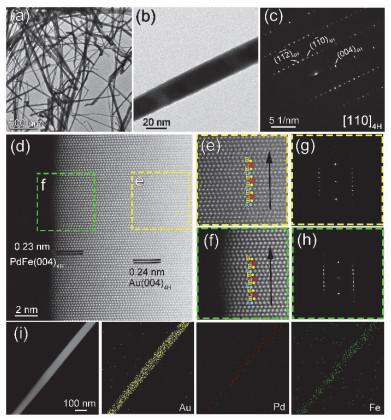
Fig 1
(a) Low-magnification TEM image of 4H-Au@PdFe nanoribbons. (b) High-magnification TEM image, (c) the corresponding SAED pattern, and (d) aberration-corrected high-resolution HAADF-STEM image of a representative 4H-Au@PdFe nanoribbon. (e, f) High-resolution HAADF-STEM images of the regions marked with green and yellow dashed squares in (d), respectively, and (g, h) the corresponding FFT patterns of (e) and (f), respectively. (i) HAADF-STEM image, and the corresponding STEM-EDS elemental mappings of a representative 4H-Au@PdFe nanoribbon.
Furthermore, by using the similar strategy mentioned above, PdIr and PdRu alloy nanostructures with the unconventional 4H phase can also be prepared (Fig. 2). TEM images (Fig. 2a, b) display the ribbon-like morphology of 4H-Au@PdIr core-shell nanoribbons. The SAED pattern (Fig. 2c) of a 4H-Au@PdIr nanoribbon (Fig. 2b) can be referred to the typical diffraction pattern of 4H phase along the [110]4H orientation. HRTEM image collected at the edge area of a representative 4H-Au@PdIr nanoribbon (Fig. 2d) shows that the 4H crystal lattice retains continuous from the Au core to the PdIr shell, suggesting the epitaxial deposition of PdIr shell. Moreover, the inter-plane distances of 0.23 and 0.24 nm can be ascribed to the (004)4H planes of PdIr and Au, respectively (Fig. 2d). Moreover, the as-grown PdIr alloy at the edge area features the characteristic close-packing mode of 4H phase, that is, "ABCB" along the [001]4H orientation (Fig. 2d1), evidenced by the corresponding FFT pattern (Fig. 2d2) as well. The DF-STEM and the corresponding EDS elemental mapping images (Fig. 2e) display the homogeneous deposition of the Pd and Ir atoms on 4H-Au core. Similarly, Fig. 2f presents a typical TEM image of 4H-Au@PdRu nanoribbons. The SAED pattern (Fig. 2h) of the 4H-Au@PdRu nanoribbon shown in Fig. 2g, which should be ascribed to the diffraction pattern of 4H phase along the [110]4H orientation, confirms the 4H crystal structure of the core-shell nanoribbon. According to the HRTEM image (Fig. 2i), the 4H crystal lattice keeps continuous from the Au core to the PdRu shell, demonstrating that the PdRu shell is epitaxially grown on 4H-Au surface. Moreover, the inter-plane distances of 0.23 and 0.24 nm are ascribed to the (004)4H planes of PdRu and Au, respectively (Fig. 2i). Furthermore, the PdRu shell characterizes a typical stacking sequence of "ABCB" along the [001]4H orientation (Fig. 2i1), suggesting its 4H structure, as also evidenced by the corresponding FFT pattern (Fig. 2i2). The Au nanoribbon is uniformly covered by PdRu shell, as confirmed by the DF-STEM image as well as the corresponding EDS elemental mappings (Fig. 2j).
Fig 2

Fig 2
(a, f) Low-magnification TEM images of 4H-Au@PdIr (a) and 4H-Au@PdRu (f) core-shell nanoribbons. (b, g) High-magnification TEM images, (c, h) the corresponding SAED patterns, and (d, i) HRTEM images of a representative 4H-Au@PdIr (b, c, d) and a typical 4H-Au@PdRu (g, h, i) core-shell nanoribbon. (d1, i1) Enlarged HRTEM images from the selected dashed square regions in (d, i). (d2, i2) The corresponding selected-region FFT patterns of (d1, i1). (e, j) DF-STEM images, and the corresponding STEM-EDS elemental mappings of a representative 4H-Au@PdIr (e) and a typical 4H-Au@PdRu (j) nanoribbon.
Previous literature has revealed that Pd-based alloy nanostructures are excellent MOR electrocatalysts because of their relatively high catalytic activity and better resistance to CO poisoning in alkaline media 44–47. Here, we evaluate the electrocatalytic MOR activity of 4H-Au@PdFe nanoribbons at room temperature under alkaline conditions by using commercial Pd black and Pt/C (20 wt%) as benchmark catalysts. To evaluate their electrochemically active surface areas (ECSAs), the cyclic voltammetry (CV) curves are firstly measured in N2-saturated 1.0 mol∙L−1 KOH. As shown in Fig. 3a, the cathodic peaks from 0.9 to 0.5 V (vs. reversible hydrogen electrode (RHE)) in the CV curves of 4H-Au@PdFe nanoribbons and Pd black arise from the reduction of PdO to Pd 48. Based on the previously published method 48, the ECSA of electrocatalyst can be evaluated from the integrated charge (Q (mC)) with respect to the cathodic peak according to the equation of ECSA = Q/(0.405 × mPd), in which mPd is the mass of loaded Pd (g). Therefore, the ECSA of 4H-Au@PdFe nanoribbon is calculated to be 15.6 m2∙g−1 and that of Pd black is calculated to be 27.3 m2∙g−1. In addition, the ECSA of Pt/C is measured through the underpotential hydrogen adsorption/desorption method 49 based on the corresponding CV curve (inset of Fig. 3a). The obtained ECSA value of Pt/C is 23.9 m2∙g−1. Fig. 3b exhibits the CV curves of various electrocatalysts measured in N2-saturated aqueous solution comprising 1.0 mol∙L−1 KOH and 1.0 mol∙L−1 methanol using a scan rate of 50 mV∙s−1, and the current is normalized by the mass of Pd or Pt loaded. Manifestly, 4H-Au@PdFe nanoribbons possess superior performance to those of the Pd black and Pt/C electrocatalysts. For comparison, the mass activities (Jm) of these catalysts taken from their peak current densities in the forward scans are shown in Fig. 3c. Specifically, 4H-Au@PdFe nanoribbons exhibit the highest Jm of 3.69 A∙mgPd−1, which is 10.5 times that of Pd black (0.35 A∙mgPd−1) and 2.4 times that of Pt/C (1.56 A∙mgPt−1), comparable to the best among the published catalysts towards MOR (Table S2). In addition, the specific activity (Js) is evaluated by normalizing the corresponding currents to their ECSAs (Fig. 3c). The specific activity of 4H-Au@PdFe nanoribbons is 23.6 mA∙cm−2, which is about 18.2 and 3.6 times that of Pd black and Pt/C, respectively. The durability of these three catalysts, as another important indicator of electrocatalytic MOR performance, is also studied via the chronoamperometry test at 0.85 V (vs. RHE) for 6000 s. 4H-Au@PdFe nanoribbons exhibit more retarded current decay over time by contrast with the Pd black and Pt/C catalysts, revealing their better stability towards MOR (Fig. 3d). Moreover, the crystal phase and the morphology of 4H-Au@PdFe nanoribbons after the chromoamperometric measurement are analyzed by scanning electronic microscopy (SEM) and TEM characterizations, both of which are well maintained (Fig. S4). Overall, the as-synthesized 4H-Au@PdFe nanoribbons could be exploited as a particularly competitive and durable electrocatalyst towards the electrochemical MOR.
Fig 3
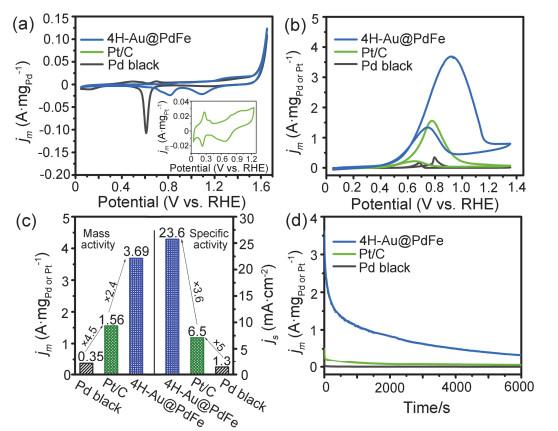
Fig 3
(a) CV curves of 4H-Au@PdFe nanoribbons and Pd black. Inset: the CV curve of Pt/C. (b) Pd mass-normalized CV curves, and (c) histograms of mass and specific activities of 4H-Au@PdFe nanoribbons, Pd black and Pt/C electrocatalysts in aqueous solution comprising 1.0 mol∙L−1 KOH and 1.0 mol∙L−1 methanol with N2 saturated using a scan rate of 50 mV∙s−1. Mass activities were normalized to the amounts of Pd (or Pt) loaded and specific activities were normalized to the ECSAs. (d) Chronoamperometric results towards MOR at 0.85 V (vs. RHE) over 4H-Au@PdFe nanoribbons, Pt/C and Pd black in N2-saturated aqueous solution comprising 1.0 mol∙L−1 KOH and 1.0 mol∙L−1 methanol.
3 Conclusions
To summarize, we have developed a general epitaxial growth strategy to prepare Pd-based alloy nanostructures with unconventional 4H phase by utilizing 4H-Au nanoribbons as the templates. Notably, 4H-Au@PdFe nanoribbons exhibit an outstanding mass activity of 3.69 A∙mgPd−1 for electrocatalytic MOR, which is 10.5 and 2.4 times that of Pd black and Pt/C electrocatalysts, respectively, placing it among the best of previously published MOR catalysts. Our results reveal that the wet-chemical epitaxial preparation of new metal nanocatalysts possessing unconventional crystal phases offers a general and robust strategy towards the crystal-phase-manipulated growth of a wide range of multimetallic alloys, which is highly favorable to explore their phase-determined properties in various kinds of applications.
参考文献
DOI:10.1021/acs.chemrev.0c00454 [本文引用: 1]
DOI:10.1021/acs.chemrev.0c00940 [本文引用: 3]
DOI:10.1021/acs.chemrev.7b00727
DOI:10.1126/science.aaw1108 [本文引用: 1]
DOI:10.1021/ja406091p [本文引用: 1]
DOI:10.1002/smll.201502669 [本文引用: 1]
DOI:10.1126/science.1249061 [本文引用: 1]
DOI:10.1002/adma.201501133 [本文引用: 1]
DOI:10.1021/nn403027j [本文引用: 1]
DOI:10.1021/ja3010754 [本文引用: 1]
DOI:10.1038/s41570-020-0173-4 [本文引用: 1]
DOI:10.1016/j.chempr.2020.04.004 [本文引用: 1]
DOI:10.1021/accountsmr.2c00238
DOI:10.1038/ncomms8684 [本文引用: 4]
DOI:10.1039/C6SC02953A [本文引用: 1]
DOI:10.1021/jacs.1c11313 [本文引用: 1]
DOI:10.1021/acs.chemrev.0c01047
DOI:10.1021/acs.accounts.0c00487
DOI:10.1021/ja311261s [本文引用: 1]
DOI:10.1038/s41467-020-17068-w
DOI:10.1021/acsnano.9b07775 [本文引用: 1]
DOI:10.1126/science.287.5460.1989 [本文引用: 1]
DOI:10.1039/C8CS00113H [本文引用: 1]
DOI:10.1002/anie.201603022 [本文引用: 1]
DOI:10.3866/PKU.WHXB202009077 [本文引用: 1]
DOI:10.1038/ncomms14136 [本文引用: 2]


