物理化学学报 >> 2025, Vol. 41 >> Issue (5): 100050.doi: 10.1016/j.actphy.2025.100050
所属专题: 光催化中的S型异质结
论文 上一篇
自旋极化增强ZnFe1.2Co0.8O4/BiVO4 S型异质结光催化性能降解四环素
吴金往1,†, 谢琦靖1,†, 张成亮2, 史海峰1,3,*( )
)
- 1 江南大学理学院, 江苏 无锡 214122
2 杭州电子科技大学, 杭州 310018
3 南京大学固体微结构国家实验室, 南京 210093
-
收稿日期:2024-11-05修回日期:2024-12-16录用日期:2024-12-24发布日期:2025-04-18 -
通讯作者:Email: hfshi@jiangnan.edu.cn; Tel.: +86-15052262655 (史海峰) -
作者简介:†Contributed equally to this work.
-
基金资助:国家自然科学基金(52271175); 南京大学固体微结构国家重点实验室开放课题(M34047); 江苏省青蓝工程项目
Rationally Designed ZnFe1.2Co0.8O4/BiVO4 S-Scheme Heterojunction with Spin-Polarization for the Elimination of Antibiotic
Jinwang Wu1, Qijing Xie1, Chengliang Zhang2, Haifeng Shi1,3,*()
- 1 School of Science, Jiangnan University, Wuxi 214122, Jiangsu Province, China
2 Hangzhou Dianzi University, Hangzhou 310018, China
3 National Laboratory of Solid State Microstructures, Nanjing University, Nanjing 210093, China
-
Received:2024-11-05Revised:2024-12-16Accepted:2024-12-24Published:2025-04-18 -
Contact:Email: hfshi@jiangnan.edu.cn; Tel.: +86-15052262655 (Haifeng Shi) -
Supported by:the National Natural Science Foundation of China(52271175); National Laboratory of Solid State Microstructures, Nanjing University(M34047); Prof. Haifeng Shi was indebted to the financial support from the Qing Lan Project of Jiangsu Province

摘要:
最近,电子自旋极化作为抑制光生电荷快速复合的一种策略受到了广泛的关注。然而,自旋极化调控主要关注于单个光催化材料,光生电荷分离的效率依然有待进一步提高。于此,本文构建了ZnFe1.2Co0.8O4(ZFCO)/BiVO4(BVO)异质结,通过S型异质结和自旋极化作用协同促进光生电荷分离,在外部磁场下进一步促进了光催化去除有机物污染物的性能。实验结果表明,在光照下,ZB-1.5 (ZFCO : BVO = 3 : 2)表现出最佳性能,四环素(TC)降解的反应速率常数(k)为0.0146 min−1。在光照和磁场条件下,ZB-1.5的TC降解反应速率常数(k)为0.0175 min−1,其光催化性能得到了进一步提升。研究表明这是由于电子自旋极化和S型电荷分离机制协同促进了光生电荷分离。DFT计算表明,ZFCO在费米能级附近出现了明显的自旋极化现象。光致发光光谱(PL)表明,S型异质结提高了电荷分离效率。此外,评估了可能的降解路径和毒性,表明成功实现了脱毒。这项工作为利用S型异质结开发具有高效光生电荷分离的光催化剂提供了一种研究思路。
引用本文
吴金往, 谢琦靖, 张成亮, 史海峰. 自旋极化增强ZnFe1.2Co0.8O4/BiVO4 S型异质结光催化性能降解四环素[J]. 物理化学学报, 2025, 41(5), 100050. doi: 10.1016/j.actphy.2025.100050
Jinwang Wu, Qijing Xie, Chengliang Zhang, Haifeng Shi. Rationally Designed ZnFe1.2Co0.8O4/BiVO4 S-Scheme Heterojunction with Spin-Polarization for the Elimination of Antibiotic[J]. Acta Phys. -Chim. Sin. 2025, 41(5), 100050. doi: 10.1016/j.actphy.2025.100050
图1
"
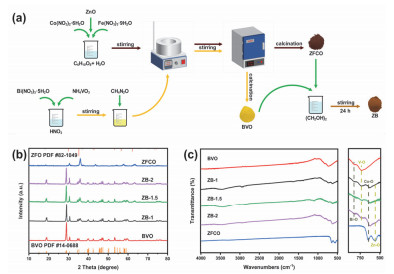
图2
"
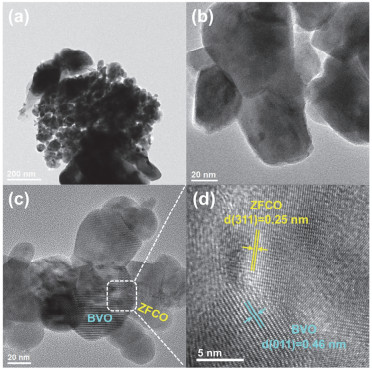
图3
"
图4
"
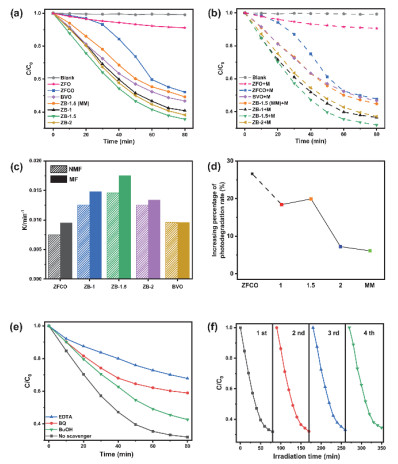
表1
"
| Materials | Total carbon (mg∙L−1) | Inorganic carbon (mg∙L−1) | TOC removal rates (%) |
| ZB-1.5 | 13.011 | 5.173 | 39.757 |
| ZB-1.5 (1st cycle) | 12.935 | 5.141 | 39.748 |
| ZB-1.5 (2nd cycle) | 12.860 | 5.111 | 39.746 |
图5
"
图6
"
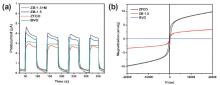
图7
"
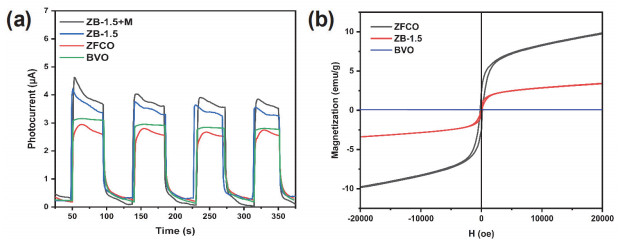
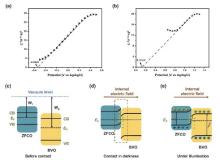
图8
"
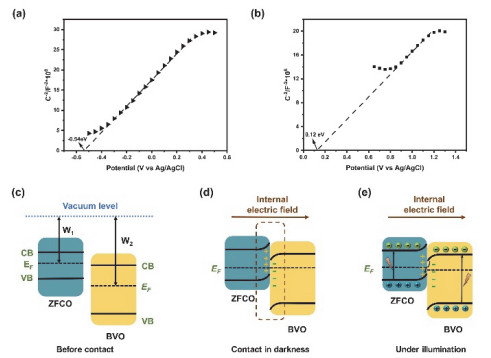
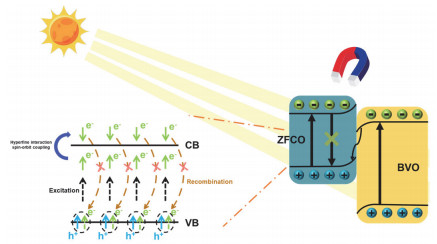
图9
"
| 1 |
doi: 10.1002/adfm.202316725 |
| 2 |
|
|
陈茹瑶; 夏加增; 陈义钢; 史海峰. 物理化学学报, 2023, 39, 2209012.
doi: 10.3866/PKU.WHXB202209012 |
|
| 3 |
doi: 10.1088/1361-6463/ad2094 |
| 4 |
doi: 10.1002/adfm.202313653 |
| 5 |
doi: 10.1021/acscatal.4c03916 |
| 6 |
|
|
游常俊; 王春春; 蔡铭洁; 刘艳萍; 竺柏康; 李世杰. 物理化学学报, 2024, 40, 2407014.
doi: 10.3866/PKU.WHXB202407014 |
|
| 7 |
doi: 10.1016/j.jmst.2023.07.005 |
| 8 |
doi: 10.1021/acs.accounts.4c00280 |
| 9 |
doi: 10.1021/cs500848f |
| 10 |
|
|
董珂欣; 申楚琦; 阎如玉; 刘艳萍; 庄春强; 李世杰. 物理化学学报, 2024, 40, 2310013.
doi: 10.3866/PKU.WHXB202310013 |
|
| 11 |
doi: 10.1016/j.jmst.2024.02.073 |
| 12 |
doi: 10.1016/j.nanoen.2024.109341 |
| 13 |
doi: 10.1021/acs.nanolett.3c05098 |
| 14 |
doi: 10.1016/j.cej.2024.156091 |
| 15 |
doi: 10.1039/d3ta06439e |
| 16 |
doi: 10.1016/j.nanoen.2022.107616 |
| 17 |
doi: 10.1039/D1EE02222A |
| 18 |
doi: 10.1021/acs.jpclett.5b02419 |
| 19 |
doi: 10.1002/adma.202207041 |
| 20 |
doi: 10.1038/ncomms11510 |
| 21 |
doi: 10.1021/acsenergylett.1c00682 |
| 22 |
doi: 10.1038/s41467-020-14333-w |
| 23 |
doi: 10.1002/adma.202310600 |
| 24 |
doi: 10.1038/s41467-024-49004-7 |
| 25 |
doi: 10.1002/adma.202406460 |
| 26 |
doi: 10.1016/j.apcatb.2024.124459 |
| 27 |
doi: 10.1002/smll.202312104 |
| 28 |
doi: 10.1002/adma.202400288 |
| 29 |
doi: 10.1002/smll.202305410 |
| 30 |
|
|
王文亮; 张灏纯; 陈义钢; 史海峰. 物理化学学报, 2022, 38, 2201008.
doi: 10.3866/PKU.WHXB202201008 |
|
| 31 |
doi: 10.1016/j.apcatb.2024.124366 |
| 32 |
doi: 10.1016/j.apcatb.2024.124690 |
| 33 |
|
|
肖林锋; 任婉璐; 沈诗诗; 陈梦姗; 廖润华; 周英棠; 李喜宝. 物理化学学报, 2024, 40, 2308036.
doi: 10.3866/PKU.WHXB202308036 |
|
| 34 |
doi: 10.1016/j.apcatb.2020.118844 |
| 35 |
|
|
黄凯辉; 陈德俊; 张欣; 沈荣晨; 张鹏; 许第发; 李鑫. 物理化学学报, 2024, 40, 2407020.
doi: 10.3866/PKU.WHXB202407020 |
|
| 36 |
doi: 10.1002/aenm.202303638 |
| 37 |
doi: 10.1002/solr.201900423 |
| 38 |
doi: 10.1016/S1872-2067(23)64479-1 |
| 39 |
doi: 10.1016/S1872-2067(21)63846-9 |
| 40 |
|
|
王春春; 游常俊; 戎珂; 申楚琦; 杨方; 李世杰. 物理化学学报, 2024, 40, 2307045.
doi: 10.3866/PKU.WHXB202307045 |
|
| 41 |
doi: 10.1016/j.jmst.2023.05.066 |
| 42 |
doi: 10.1016/j.envres.2021.111136 |
| 43 |
doi: 10.1016/j.apcatb.2017.12.051 |
| 44 |
doi: 10.1016/j.apcatb.2021.120379 |
| 45 |
doi: 10.1016/j.jmst.2020.11.037 |
| 46 |
doi: 10.1016/j.cej.2020.125919 |
| 47 |
doi: 10.1016/j.cej.2018.10.072 |
| 48 |
doi: 10.1039/D1DT02865K |
| 49 |
doi: 10.1016/j.apcatb.2024.123834 |
| 50 |
doi: 10.1016/j.cej.2019.01.189 |
| 51 |
doi: 10.1016/j.jmst.2023.03.053 |
| 52 |
doi: 10.1016/j.jmst.2023.12.054 |
| 53 |
doi: 10.1016/j.jmst.2024.02.012 |
| 54 |
doi: 10.1016/S1872-2067(23)64438-9 |
| 55 |
doi: 10.1002/anie.202218688 |
| 56 |
doi: 10.19728/j.issn1672-6634.2021070009 |
| 57 |
doi: 10.1039/D2TA07289K |
| 58 |
doi: 10.1016/j.jcis.2024.09.112 |
| 59 |
doi: 10.1016/S1872-2067(19)63481-9 |
| 60 |
doi: 10.1016/j.jcat.2018.03.012 |
| 61 |
doi: 10.1002/cctc.201700302 |
| 62 |
doi: 10.1021/acs.jpcc.9b01635 |
| [1] | 樊凡, 修浩, 王宇婷, 崔永朋, 王雅君. NH2-MIL-125/Na掺杂g-C3N4复合S型异质结的构建及其光催化产过氧化氢性能[J]. 物理化学学报, 2026, 42(2): 100143 - . |
| [2] | 葛成艳, 胡佳伟, 刘星雨, 宋玉玺, 刘超, 邹志刚. 自集成黑色NiO团簇与ZnIn2S4微球实现S型电子转移机制下光热辅助制氢[J]. 物理化学学报, 2026, 42(1): 100154 - . |
| [3] | 陈轼逸, 付家龙, 裘建平, 常国菊, 郝仕油. 废弃医用口罩衍生的碳量子点增强BiOBr/g-C3N4 S型异质结光催化降解聚对苯二甲酸乙二醇酯(PET)[J]. 物理化学学报, 2026, 42(1): 100135 - . |
| [4] | 韦梦兰, 欧晓霞, 王艺濛, 张梦圆, 滕飞, 王凯旋. S型异质结g-C3N4/Bi2WO6高效降解左氧氟沙星:性能、机理及降解路径[J]. 物理化学学报, 2025, 41(9): 100105 - . |
| [5] | 王文龙, 郝文韬, 何浪, 乔佳, 李宁, 陈朝秋, 覃勇. 碳量子点/TiO2 S型异质结的能带和吸附工程促进光催化CO2甲烷化[J]. 物理化学学报, 2025, 41(9): 100116 - . |
| [6] | 蔡家杰, 程畅, 刘博文, 张建军, 姜传佳, 程蓓. CdS/DBTSO-BDTO S型异质结光催化制氢及其电荷转移动力学[J]. 物理化学学报, 2025, 41(8): 100084 - . |
| [7] | 孟凡鹏, 赵飞, 林靖恺, 赵金生, 张华阳, 王少彬. 优化氮化碳纳米片/球形共轭聚合物S型异质结界面电场以促进析氢反应[J]. 物理化学学报, 2025, 41(8): 100095 - . |
| [8] | 王伟康, 吴亚栋, 张建军, 孟凯, 李金河, 王乐乐, 刘芹芹. 三聚氰胺泡沫支撑的S型硫铟锌镉/硫掺杂氮化碳异质结的绿色H2O2合成:协同界面电荷转移调控与局域光热效应[J]. 物理化学学报, 2025, 41(8): 100093 - . |
| [9] | 苗鑫宇, 杨浩, 何杰, 王晶, 靳治良. 调整Keggin型多金属氧酸盐电子结构构建S型异质结用于光催化析氢[J]. 物理化学学报, 2025, 41(6): 100051 - . |
| [10] | 杨祎, 周欣, 谷苗莉, 程蓓, 吴珍, 张建军. S型ZnO/CdIn2S4光催化剂制备H2O2偶联苄胺氧化的超快电子转移飞秒吸收光谱研究[J]. 物理化学学报, 2025, 41(6): 100064 - . |
| [11] | 李朋, 崔元映, 王中辽, DawsonGraham, 邵春风, 代凯. CeO2/Bi19Br3S27 S型异质结的高效界面电荷转移用于增强光催化CO2还原[J]. 物理化学学报, 2025, 41(6): 100065 - . |
| [12] | 魏勉, 程畅, 何博文, 程蓓, 戚克振, 别传彪. 无机-有机CdS/YBTPy S型光催化剂高效产氢及其机理[J]. 物理化学学报, 2025, 41(12): 100158 - . |
| [13] | 赵鑫婉, 曹越, 雷敏军, 靳治良, TsubakiNoritatsu. 构建S型异质结:通过将共价有机框架与过渡金属硫化物结合实现高效无贵金属光催化制氢[J]. 物理化学学报, 2025, 41(12): 100152 - . |
| [14] | 雷嘉莉, 王娟, 张文慧, 王国宏, 梁子辉, 李金懋. TiO2/CdIn2S4 S型异质结光催化剂促进光催化产氢耦合香兰醇氧化[J]. 物理化学学报, 2025, 41(12): 100174 - . |
| [15] | 马德运, 梁凤兰, 薛清泉, 刘艳萍, 庄春强, 李世杰. 界面工程与氧空位协同策略促进Cd0.5Zn0.5S/BiOBr S型异质结高效光催化去除抗生素[J]. 物理化学学报, 2025, 41(12): 100190 - . |
|
||