物理化学学报 >> 2023, Vol. 39 >> Issue (12): 2212039.doi: 10.3866/PKU.WHXB202212039
可见光激发的BiOI/ZnO纳米复合抗菌剂制备及其抗菌活性与机制
孔菁1,2, 张金贵3, 张素芬2, 奚菊群1,*( ), 沈明2,3,*()
- 1 扬州大学医学院,江苏 扬州 225009
2 扬州大学化学化工学院,江苏 扬州 225002
3 江苏汇诚医疗科技有限公司,江苏 扬州 225108
-
收稿日期:2022-12-23录用日期:2023-02-08发布日期:2023-07-31 -
通讯作者:奚菊群,沈明E-mail:xijq@yzu.edu.cn;shenming@yzu.edu.cn -
作者简介:第一联系人:†These authors contributed equally to this work.
-
基金资助:国家自然科学基金(21673201);扬州市广陵区科技计划产业前瞻性与共性关键技术重点项目(GL202206);江苏高校品牌专业建设工程项目;江苏高校优势学科建设工程项目
Performance Improvement and Antibacterial Mechanism of BiOI/ZnO Nanocomposites as Antibacterial Agent under Visible Light
Jing Kong1,2, Jingui Zhang3, Sufen Zhang2, Juqun Xi1,*(), Ming Shen2,3,*()
- 1 Medical College, Yangzhou University, Yangzhou 225009, Jiangsu Province, China
2 College of Chemistry and Chemical Engineering, Yangzhou University, Yangzhou 225002, Jiangsu Province, China
3 Jiangsu Huicheng Medical Technology Co., Ltd., Yangzhou 225108, Jiangsu Province, China
-
Received:2022-12-23Accepted:2023-02-08Published:2023-07-31 -
Contact:Juqun Xi, Ming Shen E-mail:xijq@yzu.edu.cn;shenming@yzu.edu.cn -
Supported by:the National Natural Science Foundation of China(21673201);the Yangzhou Guangling District Science and Technology Plan Industry Foresight and Key Common Technology Key Project(GL202206);the Top-notch Academic Programs Project of Jiangsu Higher Education Institutions, China (TAPP);the Priority Academic Program Development of Jiangsu Higher Education Institutions, China

摘要:
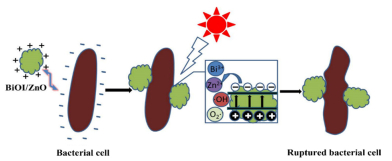
细菌感染可引发各种严重疾病,在细菌耐药性日益严重的今天开发无机抗菌药物具有重要意义。为提升氧化锌在可见光下的抗菌活性,本文设计出一系列碘氧铋与氧化锌(BiOI/ZnO)的纳米复合材料,通过常压下机械搅拌法成功合成了形状和尺寸较为均一的系列复合纳米结构。紫外-可见漫反射光谱测试结果表明此类材料具有较高的可见光吸收率和更窄的带隙。对这类新复合材料进行的抗菌活性试验表明,在可见光激发下其BiOI/ZnO-10%和BiOI/ZnO-20%样品对金黄色葡萄球菌和大肠杆菌的抗菌活性有明显增强,且光照强度可影响该类材料的抗菌活性。抗菌机制研究结果显示此类材料具有与纳米ZnO抗菌材料相似的机理:通过带正电荷的表面和强活性氧基团(•OH)的产生导致细菌细胞壁破裂和死亡,而纳米碘氧铋的复合所形成的异质结不仅使得强活性氧基团易于产生,而且使BiOI/ZnO纳米复合材料的可见光吸收增强。本研究既提出了纳米ZnO材料利用可见光激发增强抗菌活性的策略,又为纳米ZnO基复合材料的临床应用提供了实验支撑。
引用本文
孔菁, 张金贵, 张素芬, 奚菊群, 沈明. 可见光激发的BiOI/ZnO纳米复合抗菌剂制备及其抗菌活性与机制[J]. 物理化学学报, 2023, 39(12), 2212039. doi: 10.3866/PKU.WHXB202212039
Jing Kong, Jingui Zhang, Sufen Zhang, Juqun Xi, Ming Shen. Performance Improvement and Antibacterial Mechanism of BiOI/ZnO Nanocomposites as Antibacterial Agent under Visible Light[J]. Acta Phys. -Chim. Sin. 2023, 39(12), 2212039. doi: 10.3866/PKU.WHXB202212039
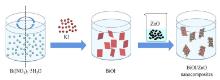
Fig 1
The general preparation scheme of BiOI/ZnO nanocomposites."
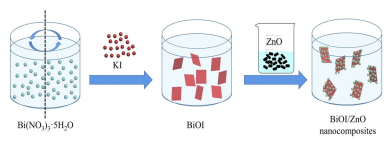
Fig 2
SEM micrographs of different samples. (a) ZnO nanoparticles, (b) BiOI flakes, (c) the BiOI/ZnO-10% sample. (d–e) The HRTEM micrographs of the BiOI/ZnO-10% sample. (f) The SAED micrograph of the BiOI/ZnO-10% sample."
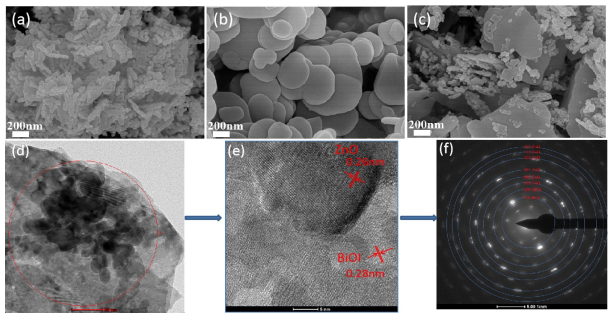
Fig 3
EDS and XRD results of the following samples. (a) The EDS images of the BiOI/ZnO-10% sample; (b) XRD patterns of ZnO nanoparticles, BiOI flakes, BiOI/ZnO-2.5%, BiOI/ZnO-5%, BiOI/ZnO-10%, and BiOI/ZnO-20% samples."
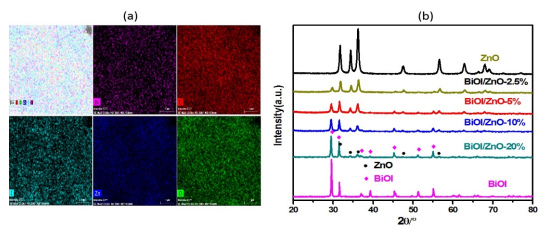
Fig 4
XPS spectra of the BiOI/ZnO-10% sample. (a) The full survey spectrum, (b–e) high-resolution spectra of Bi 4f, Zn 2p, I 3d, O 1s, respectively."
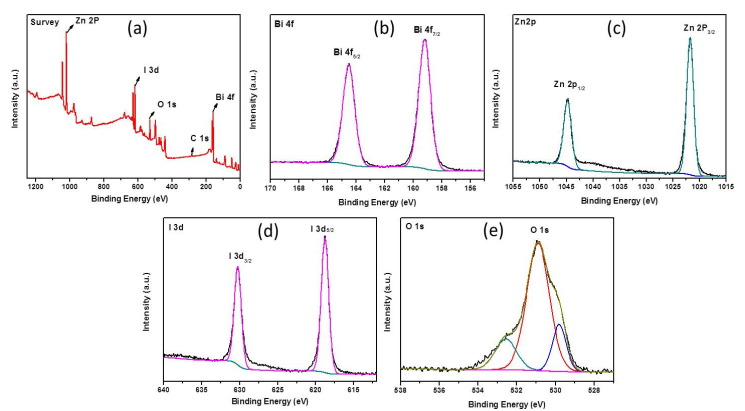
Fig 5
Optical property evaluation results. (a) The UV-Vis DRS spectra of the following samples: ZnO, BiOI/ZnO-2.5%, BiOI/ZnO-5%, BiOI/ZnO-10%, BiOI/ZnO-20%, and BiOI; (b) the bandgap of ZnO, BiOI/ZnO-2.5%, BiOI/ZnO-5%, BiOI/ZnO-10%, BiOI/ZnO-20%, and BiOI."
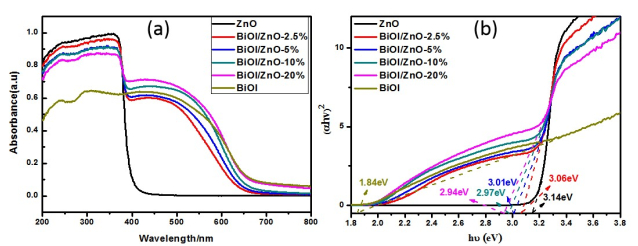
Fig 6
The antibacterial activity of the following samples against S. aureus. (a) ZnO, BiOI/ZnO-2.5%, BiOI/ZnO-5%, BiOI/ZnO-10%, BiOI/ZnO-20%, and BiOI against S. aureus; (b) the pictures of the CFU counting plates after treated with different samples against S. aureus."
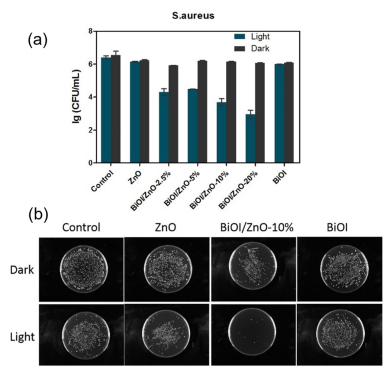
Fig 7
The antibacterial activity of the following samples against E. coli. (a) The antibacterial activity of ZnO, BiOI/ZnO-2.5%, BiOI/ZnO-5%, BiOI/ZnO-10%, BiOI/ZnO-20%, and BiOI against E. coli; (b) the pictures of the CFU counting plates after treated with different samples against E. coli."
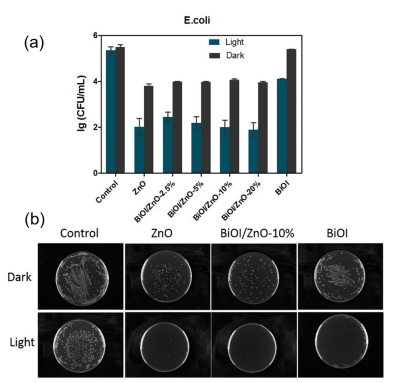
Fig 8
The antibacterial results of BiOI/ZnO-10% nanocomposites against S. aureus under two different Xenon lamps at two different working currents: 10 A (140 W) and 15 A (210 W)."
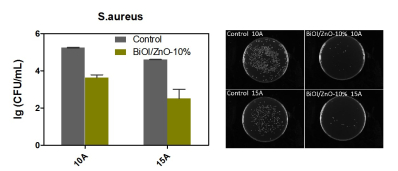
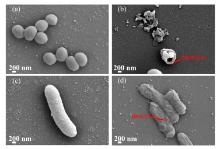
Fig 9
The SEM pictures of the following samples. (a) The S. aureus bacteria cells without treatments; (b) the S. aureus bacteria cells treated with BiOI/ZnO-10% after 30 min; (c) the E. coli bacteria cell without treatments; (d) E. coli bacteria cells treated with BiOI/ZnO-10% after 30 min."
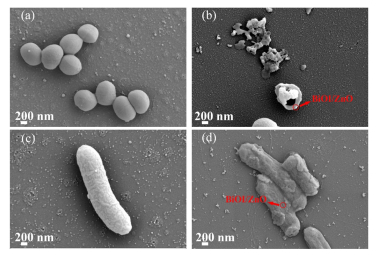
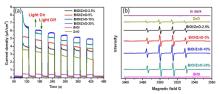
Fig 10
Photocatalytic activity of the BiOI/ZnO nanocomposites and the control samples. (a) Transient photoelectric response curves of the ZnO, BiOI/ZnO-2.5%, BiOI/ZnO-5%, BiOI/ZnO-10%, BiOI/ZnO-20%, and the BiOI samples; (b) the DMPO-•OH signals captured from the aqueous solutions of following samples: the ZnO, BiOI/ZnO-2.5%, BiOI/ZnO-5%, BiOI/ZnO-10%, BiOI/ZnO-20%, and the BiOI."
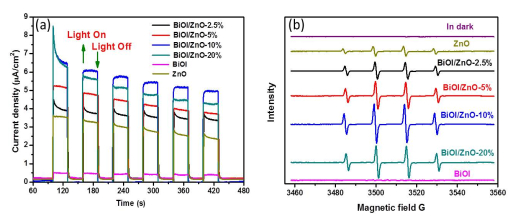
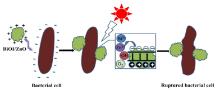
Fig 11
The proposed general mechanisms of action of the BiOI/ZnO nanocomposites under visible light."
| 1 |
Costerton J. W. ; Stewart P. S. ; Greenberg E. P. Science 1999, 284 (5418), 1318.
doi: 10.1126/science.284.5418.1318 |
| 2 |
Lebeaux D. ; Ghigo J.-M. ; Beloin C. Microbiol. Mol. Biol. Rev. 2014, 78 (3), 510.
doi: 10.1128/mmbr.00013-14 |
| 3 |
Cappelletty D. Pediatr. Infect. Dis. J. 1998, 17 (8), S55.
doi: 10.1097/00006454-199808001-00002 |
| 4 |
Saidin S. ; Jumat M. A. ; Mohd Amin N. A. A. ; Saleh Al-Hammadi A. S. Mater. Sci. Eng. C 2021, 118, 111382.
doi: 10.1016/j.msec.2020.111382 |
| 5 |
Bbosa G. S. ; Mwebaza N. ; Odda J. ; Kyegombe D. B. ; Ntale M. Health N. Hav. 2014, 6 (5), 410.
doi: 10.4236/health.2014.65059 |
| 6 |
Frieri M. ; Kumar K. ; Boutin A. J. Infect. Public Health 2017, 10 (4), 369.
doi: 10.1016/j.jiph.2016.08.007 |
| 7 |
Mohapatra D. P. ; Debata N. K. ; Singh S. K. J. Glob. Antimicrob. Resist. 2018, 15, 246.
doi: 10.1016/j.jgar.2018.08.010 |
| 8 |
Danner M. C. ; Robertson A. ; Behrends V. ; Reiss J. Sci. Total Environ. 2019, 664, 793.
doi: 10.1016/J.SCITOTENV.2019.01.406 |
| 9 |
Horcajada J. P. ; Montero M. ; Oliver A. ; Sorlí L. ; Luque S. ; Gómez-Zorrilla S. ; Benito N. ; Grau S. Clin. Microbiol. Rev. 2019, 32 (4), e00031.
doi: 10.1128/CMR.00031-19 |
| 10 |
Schifano E. ; Cavallini D. ; de Bellis G. ; Bracciale M. P. ; Felici A. C. ; Santarelli M. L. ; Sarto M. S. ; Uccelletti D. Nanomaterials 2020, 10 (2), 335.
doi: 10.3390/nano10020335 |
| 11 |
Qu Y. ; Duan X. Chem. Soc. Rev. 2013, 42 (7), 2568.
doi: 10.1039/C2CS35355E |
| 12 |
Xu H. ; Zhang J. ; Lv X. ; Niu T. ; Zeng Y. ; Duan J. ; Hou B. Biofouling 2019, 35 (7), 719.
doi: 10.1080/08927014.2019.1653453 |
| 13 |
Liu B. ; Mu L. ; Han X. ; Zhang J. ; Shi H. J. Photochem. Photobiol. A-Chem. 2019, 380, 111866.
doi: 10.1016/J.JPHOTOCHEM.2019.111866 |
| 14 |
Zhang F. ; Wang X. ; Liu H. ; Liu C. ; Wan Y. ; Long Y. ; Cai Z. Appl. Sci. 2019, 9 (12), 2489.
doi: 10.3390/app9122489 |
| 15 | Zhang Y. ; Lin S. ; Zhang Y. ; Song X. M. Acta Phys. -Chim. Sin. 2013, 29 (11), 2399. |
|
张宇; 林申; 张钰; 宋溪明; 物理化学学报, 2013, 29 (11), 2399.
doi: 10.3866/PKU.WHXB201309061 |
|
| 16 |
Dryden M. Int. J. Antimicrob. Agents 2018, 51 (3), 299.
doi: 10.1016/j.ijantimicag.2017.08.029 |
| 17 |
Zhang J. ; Wang J. ; Xu H. ; Lv X. ; Zeng Y. X. ; Duan J. ; Hou B. RSC Adv. 2019, 9, 37109.
doi: 10.1039/c9ra06810d |
| 18 |
Kołodziejczak-Radzimska A. ; Jesionowski T. Materials 2014, 7 (4), 2833.
doi: 10.3390/ma7042833 |
| 19 |
Liu H. L. ; Yang T. C. K. Process Biochem. 2003, 39 (4), 475.
doi: 10.1016/S0032-9592(03)00084-0 |
| 20 |
Zhang L. ; Jiang Y. ; Ding Y. ; Povey M. ; York D. J. Nanopart. Res. 2007, 9 (3), 479.
doi: 10.1007/s11051-006-9150-1 |
| 21 |
Basnet P. ; Anderson E. ; Zhao Y. ACS Appl. Nano Mater. 2019, 2 (4), 2446.
doi: 10.1021/acsanm.9b00325 |
| 22 |
Liu J. ; Liu Y. ; Liu N. ; Han Y. ; Zhang X. ; Huang H. ; Lifshitz Y. ; Lee S.-T. ; Zhong J. ; Kang Z. Science 2015, 347 (6225), 970.
doi: 10.1126/science.aaa3145 |
| 23 |
Kong J. ; Zhang S. ; Shen M. ; Zhang J. ; Yoganathan S. Colloids Surf. A-Physicochem. Eng. Asp. 2022, 643, 128742.
doi: 10.1016/J.COLSURFA.2022.128742 |
| 24 |
Yao Y. ; Fan J. ; Shen M. ; Li W. ; Du B. ; Li X. ; Dai J. J. Colloid Interface Sci. 2019, 546, 70.
doi: 10.1016/j.jcis.2019.03.021 |
| 25 |
Yao Y. ; Yuan J. ; Shen M. ; Du B. Inorg. Chem. Front. 2021, 8 (22), 4903.
doi: 10.1039/d1qi00968k |
| 26 |
Suresh S. ; Karthikeyan S. J. Iran. Chem. Soc. 2016, 13 (11), 2049.
doi: 10.1007/s13738-016-0922-y |
| 27 |
Yu Y.-X. ; Ouyang W.-X. ; Zhang W.-D. J. Solid State Electrochem. 2014, 18 (6), 1743.
doi: 10.1007/s10008-014-2402-6 |
| 28 |
Dai G. ; Yu J. ; Liu G. J. Phys. Chem. C 2011, 115 (15), 7339.
doi: 10.1021/jp200788n |
| 29 | Yao Y. ; Yuan J. ; Shen M. ; Du B. ; Xing R. Chin. J. Inorg. Chem. 2022, 38 (2), 261. |
|
姚玉峰; 袁嘉怡; 沈明; 杜彬; 邢蓉; 无机化学学报, 2022, 38 (2), 261.
doi: 10.11862/CJIC.2022.022 |
|
| 30 |
Yao Y. ; Zhang Y. ; Shen M. ; Li W. ; Xia W. Colloids Surf. A-Physicochem. Eng. Asp. 2020, 591, 124556.
doi: 10.1016/j.colsurfa.2020.124556 |
| 31 |
Domenico P. ; Salo R. J. ; Novick S. G. ; Schoch P. E. ; van Horn K. ; Cunha B. A. Antimicrob. Agents Chemother. 1997, 41 (8), 1697.
doi: 10.1128/AAC.41.8.1697 |
| 32 |
Thomas F. ; Bialek B. ; Hensel R. J. Clin. Toxicol. 2013, s3, 004.
doi: 10.4172/2161-0495.S3-004 |
| 33 |
Meng X. ; Zhang Z. J. Mol. Catal. A-Chem. 2016, 423, 533.
doi: 10.1016/j.molcata.2016.07.030 |
| 34 |
Zhou H. ; Zhong S. ; Shen M. ; Hou J. ; Chen W. J. Alloys Compd. 2018, 769, 301.
doi: 10.1016/j.jallcom.2018.08.007 |
| 35 |
Wei X. ; Akbar M. U. ; Raza A. ; Li G. Nanoscale Adv. 2021, 3 (12), 3353.
doi: 10.1039/D1NA00223F |
| 36 |
Zhou H. ; Kalware K. ; Shen M. ; Zhong S. ; Yao Y. CrystEngComm 2020, 22 (8), 1368.
doi: 10.1039/c9ce01960j |
| 37 |
Huang W. L. J. Comput. Chem. 2009, 30 (12), 1882.
doi: 10.1002/JCC.21191 |
| 38 |
Zhang M. ; Qin J. ; Yu P. ; Zhang B. ; Ma M. ; Zhang X. ; Liu R. Beilstein J. Nanotechnol. 2018, 9 (1), 789.
doi: 10.3762/BJNANO.9.72 |
| 39 |
Khodja A. A. ; Sehili T. ; Pilichowski J. F. ; Boule P. J. Photochem. Photobiol. A-Chem. 2001, 141 (2–3), 231.
doi: 10.1016/S1010-6030(01)00423-3 |
| 40 |
Jamil T. S. ; Mansor E. S. ; Azab El-Liethy M. J. Environ. Chem. Eng. 2015, 3 (4), 2463.
doi: 10.1016/j.jece.2015.09.017 |
| 41 |
Pang S. ; He Y. ; Zhong R. ; Guo Z. ; He P. ; Zhou C. ; Xue B. ; Wen X. ; Li H. Ceram. Int. 2019, 45 (10), 12663.
doi: 10.1016/j.ceramint.2019.03.076 |
| 42 |
Seredych M. ; Łoś S. ; Giannakoudakis D. A. ; Rodríguez-Castellón E. ; Bandosz T. J. ChemSusChem 2016, 9 (8), 795.
doi: 10.1002/cssc.201501658 |
| 43 |
Mulwa W. M. Appl. Phys. A 2020, 126 (7), 546.
doi: 10.1007/s00339-020-03735-8 |
| 44 |
Intaphong P. ; Phuruangrat A. ; Thongtem T. ; Thongtem S. J. Aust. Ceram. Soc. 2019, 55, 1021.
doi: 10.1007/s41779-019-00314-w |
| 45 |
Zhou T. ; Zhang H. ; Zhang X. ; Yang W. ; Cao Y. ; Yang P. J. Phys. Chem. C 2020, 124 (37), 20294.
doi: 10.1021/ACS.JPCC.0C06833 |
| 46 |
Al-Keisy A. ; Ren L. ; Xu X. ; Hao W. ; Dou S. X. ; Du Y. J. Phys. Chem. C 2019, 123 (1), 517.
doi: 10.1021/ACS.JPCC.8B09816 |
| 47 |
Huang N. ; Shu J. ; Wang Z. ; Chen M. ; Ren C. ; Zhang W. J. Alloys Compd. 2015, 648, 919.
doi: 10.1016/J.JALLCOM.2015.07.039 |
| 48 |
Wang Y. ; Deng K. ; Zhang L. J. Phys. Chem. C 2011, 115 (29), 14300.
doi: 10.1021/jp2042069 |
| 49 |
Tauc J. Mater. Res. Bull. 1968, 3 (1), 37.
doi: 10.1016/0025-5408(68)90023-8 |
| 50 |
Jiang J. ; Zhang X. ; Sun P. ; Zhang L. J. Phys. Chem. C 2011, 115 (42), 20555.
doi: 10.1021/JP205925Z |
| 51 |
Sirelkhatim A. ; Mahmud S. ; Seeni A. ; Kaus N. H. M. ; Ann L. C. ; Bakhori S. K. M. ; Hasan H. ; Mohamad D. Nanomicro. Lett. 2015, 7 (3), 219.
doi: 10.1007/s40820-015-0040-x |
| 52 |
Jiang Y. ; Zhang L. ; Wen D. ; Ding Y. Mater. Sci. Eng. C 2016, 69, 1361.
doi: 10.1016/j.msec.2016.08.044 |
| 53 |
Bayer M. E. ; Sloyer J. L. J. Gen. Microbiol. 1990, 136, 867.
doi: 10.1099/00221287-136-5-867 |
| 54 |
Abebe B. ; Zereffa E. A. ; Tadesse A. ; Murthy H. C. A. Nanoscale Res. Lett. 2020, 15, 190.
doi: 10.1186/s11671-020-03418-6 |
| 55 |
Zhang Y.-M. ; Rock C. O. Nat. Rev. Microbiol. 2008, 6 (3), 222.
doi: 10.1038/nrmicro1839 |
| 56 |
Koe W. S. ; Lee J. W. ; Chong W. C. ; Pang Y. L. ; Sim L. C. Environ. Sci. Pollut. Res. 2020, 27, 2522.
doi: 10.1007/s11356-019-07193-5 |
| 57 |
He W. ; Kim H. K. ; Wamer W. G. ; Melka D. ; Callahan J. H. ; Yin J. J. J. Am. Chem. Soc. 2014, 136 (2), 750.
doi: 10.1021/ja410800y |
| 58 |
Liu J. ; Zou S. ; Lou B. ; Chen C. ; Xiao L. ; Fan J. Inorg. Chem. 2019, 58 (13), 8525.
doi: 10.1021/acs.inorgchem.9b00834 |
| [1] | 陈轼逸, 付家龙, 裘建平, 常国菊, 郝仕油. 废弃医用口罩衍生的碳量子点增强BiOBr/g-C3N4 S型异质结光催化降解聚对苯二甲酸乙二醇酯(PET)[J]. 物理化学学报, 2026, 42(1): 100135 - . |
| [2] | 黄火帅, 韦之栋, 严嘉玮, 池家晟, 苏千翔, 陈铭夏, 江治, 孙洋洲, 上官文峰. 揭示ZnxCd1−xS固溶体光催化析氢中的直接-间接带隙跃迁机制[J]. 物理化学学报, 2026, 42(1): 100141 - . |
| [3] | 赵呈孝, 李昭霖, 吴东方, 杨小飞. SBA-15模板化共价三嗪框架增强光催化产氢[J]. 物理化学学报, 2026, 42(1): 100149 - . |
| [4] | 陈芸, 邓代洁, 徐丽, 朱兴旺, 李赫楠, 孙成明. 共价键调控电荷转移以实现自供能电化学传感平台对重金属离子的灵敏分析[J]. 物理化学学报, 2026, 42(1): 100144 - . |
| [5] | 韦梦兰, 欧晓霞, 王艺濛, 张梦圆, 滕飞, 王凯旋. S型异质结g-C3N4/Bi2WO6高效降解左氧氟沙星:性能、机理及降解路径[J]. 物理化学学报, 2025, 41(9): 100105 - . |
| [6] | 李静萍, 严素定, 吴佳曦, 程强, 王楷. LiFePO4改善无机/有机S型光催化剂的过氧化氢光合作用[J]. 物理化学学报, 2025, 41(9): 100104 - . |
| [7] | 吴琦, 王长华, 李莹莹, 张昕彤. 增强g-C3N4@BN范德华异质结界面上的三重态电子转移增强光催化合成H2O2[J]. 物理化学学报, 2025, 41(9): 100107 - . |
| [8] | 张凤英, 梅杨林, 蒋毓蔓, 郑申申, 郑凯波, 周莹. 瞬态吸收光谱在太阳能转化利用中的研究进展[J]. 物理化学学报, 2025, 41(9): 100118 - . |
| [9] | 王文龙, 郝文韬, 何浪, 乔佳, 李宁, 陈朝秋, 覃勇. 碳量子点/TiO2 S型异质结的能带和吸附工程促进光催化CO2甲烷化[J]. 物理化学学报, 2025, 41(9): 100116 - . |
| [10] | 袁乐汪, 彭垚垚, 管宗杰, 方煜. 二维共价有机框架作为光催化剂在有机合成中的研究进展[J]. 物理化学学报, 2025, 41(8): 100086 - . |
| [11] | 蔡家杰, 程畅, 刘博文, 张建军, 姜传佳, 程蓓. CdS/DBTSO-BDTO S型异质结光催化制氢及其电荷转移动力学[J]. 物理化学学报, 2025, 41(8): 100084 - . |
| [12] | 王玉, 石海洋, 陈子涵, 陈峰, 王苹, 王雪飞. 具有富电子Ptδ−壳层的空心AgPt@Pt核壳催化剂:提升光催化H2O2生成选择性与活性[J]. 物理化学学报, 2025, 41(7): 100081 - . |
| [13] | 刘方璇, 刘子妍, 周国伟, 高婷婷, 刘文宇, 孙彬. 中空结构光催化剂[J]. 物理化学学报, 2025, 41(7): 100071 - . |
| [14] | 罗雅丹, 郑浩, 李鑫, 李锋民, 唐华, 佘希林. 调节O, S共掺杂C3N4中的活性氧生成以促进光催化降解微塑料[J]. 物理化学学报, 2025, 41(6): 100052 - . |
| [15] | 宋相海, 刘晓颖, 任智祥, 刘想, 汪梅, 吴元锋, 周伟强, 朱志, 霍鹏伟. 氮掺杂显著提升BiOBr光催化还原CO2性能研究[J]. 物理化学学报, 2025, 41(6): 100055 - . |
|
||