物理化学学报 >> 2025, Vol. 41 >> Issue (1): 100006.doi: 10.3866/PKU.WHXB202309042
所属专题: 新型光电功能材料
多重共振TADF分子的设计策略
张泽华, 于海涛*( ), 祁彦宇*()
- 河北师范大学化学与材料科学学院, 河北省有机功能分子重点实验室, 石家庄 050024
-
收稿日期:2023-09-27修回日期:2023-11-07录用日期:2023-11-09发布日期:2023-12-25 -
通讯作者:Email: haitaoyu@hebtu.edu.cn (于海涛)hbsdqyy@hebtu.edu.cn (祁彦宇) -
基金资助:国家自然科学基金(21971054); 国家自然科学基金(22002092); 河北省省级科技计划(B2022205014); 河北省省级科技计划(22567622H); 河北省教育厅科学研究项目(BJK2023014); 河北省博士后科研择优资助项目(B2023005008); 石家庄市科学技术研究与发展计划项目(241791047A); 河北师范大学科技类基金(L2022B12); 河北师范大学科技类基金(L2023T01)
Design Strategy for Thermally Activated Delayed Fluorescence Materials with Multiple Resonance Effect
Zehua Zhang, Haitao Yu*(), Yanyu Qi*()
- Hebei Key Laboratory of Organic Functional Molecules, College of Chemistry and Materials Science, Hebei Normal University, Shijiazhuang 050024, China
-
Received:2023-09-27Revised:2023-11-07Accepted:2023-11-09Published:2023-12-25 -
Contact:Email: haitaoyu@hebtu.edu.cn (Haitao Yu)hbsdqyy@hebtu.edu.cn (Yanyu Qi) -
Supported by:the National Natural Science Foundation of China(21971054); the National Natural Science Foundation of China(22002092); S&T Program of Hebei(B2022205014); S&T Program of Hebei(22567622H); Science Research Project of Hebei Education Department(BJK2023014); Postdoctoral Research Projects Merit-based Funding Programs of Hebei Province(B2023005008); Shijiazhuang Science and Technology Research and Development Program(241791047A); the Science Foundation of Hebei Normal University(L2022B12); the Science Foundation of Hebei Normal University(L2023T01)

摘要:
自首例多重共振热激活延迟荧光(Multiple resonance thermal activation delayed fluorescence,MR-TADF)分子报道至今,其表现出的窄带发射、高发光量子效率等特性在有机电子学,尤其是有机发光二极管(Organic light-emitting diode,OLED)等领域引发了持续的研究热度,迅速成为重点研究对象,并涌现出了众多性能出色的分子和高性能器件。以MR-TADF分子为发光层的器件不断刷新人们对OLED的认知,其中一些采用了超荧光技术所制备的器件性能代表了当今某些光色领域OLED性能的最高值。随着人们对超高分辨率显示器需求的与日俱增,国际电信联盟(ITU)宣布了下一代色域标准,即BT.2020。此标准建立了最宽的显示色域标准,要求单色的原色波长为467、532和630 nm,这个色域非常宽。同时,在如此之宽的色域上实现高分辨率的显示,对器件基元色纯度的要求达到了可谓史无前例的严格。因此,它为显示技术树立了一个具有极大挑战难度的色纯度目标。鉴于以往传统荧光材料难以担当此攻关重任,故而BT.2020的出现给予了MR-TADF分子新的发展机遇,并在很大程度上使得该领域愈发火热起来。近年来,随着大量的研究与实践,MR-TADF分子家族得到了飞速的发展,然而大家讨论和归纳的重点基本都集中在领域整体的发展方面,专门针对分子设计策略所展开的讨论和总结依旧较少,不足以为刚涉足该领域的科研人员提供足够的参考。因此,本文从X-π-X原则,快反向系间窜越过程,窄带发射与高振子强度等方面,阐述了近三年来所报道的MR-TADF分子的设计思路,并对未来可能的设计方向进行了展望,例如将一些不同于传统MR-TADF分子的结构引入这一领域。最后,对今后MR-TADF领域的发展和产业化提出建议。
引用本文
张泽华, 于海涛, 祁彦宇. 多重共振TADF分子的设计策略[J]. 物理化学学报, 2025, 41(1), 100006. doi: 10.3866/PKU.WHXB202309042
Zehua Zhang, Haitao Yu, Yanyu Qi. Design Strategy for Thermally Activated Delayed Fluorescence Materials with Multiple Resonance Effect[J]. Acta Phys. -Chim. Sin. 2025, 41(1), 100006. doi: 10.3866/PKU.WHXB202309042
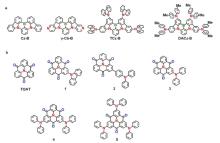
图1
"
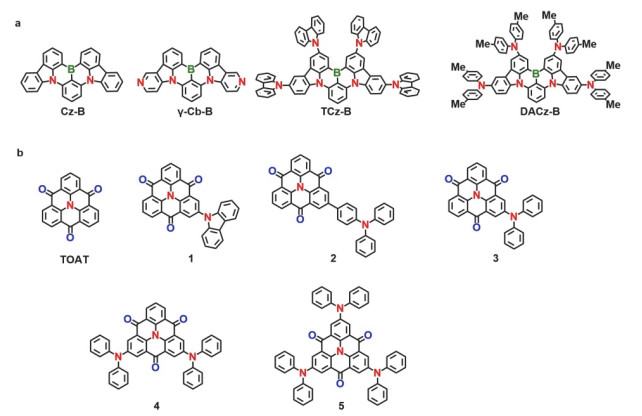
图2
"
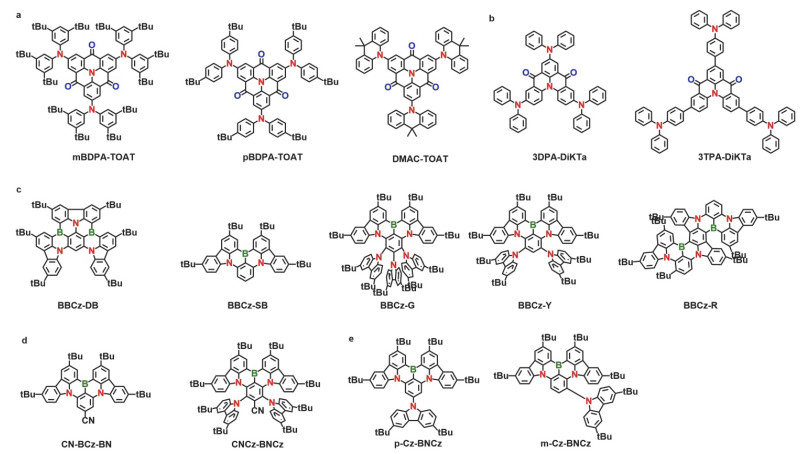
图3
"
图4
"
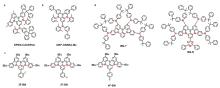
图5
"
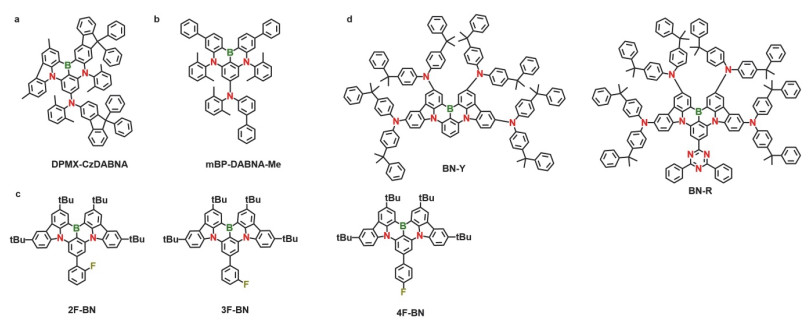
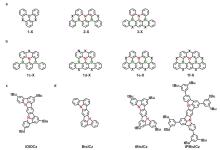
图6
"
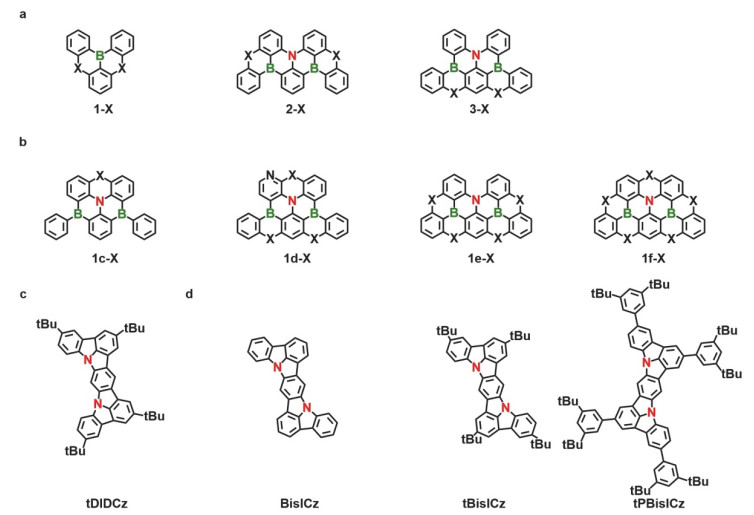
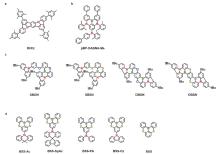
图7
"
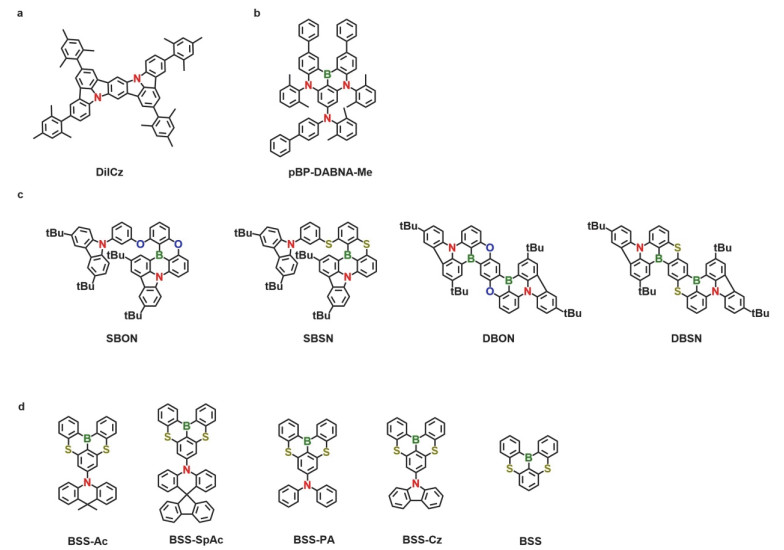
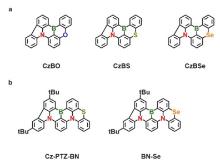
图8
"
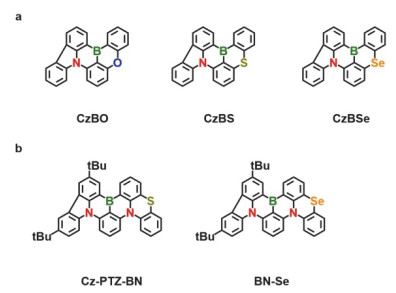
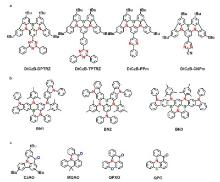
图9
"
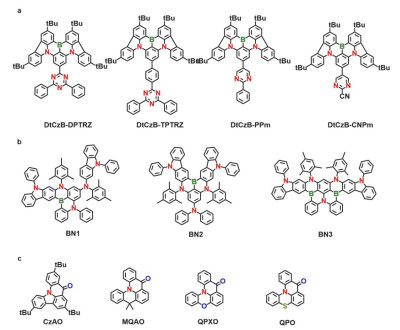
图10
"
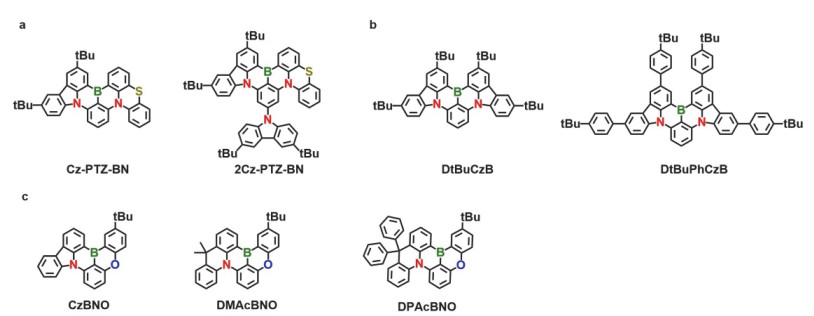
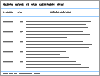
表1
"
| Molecules | λabs (nm) | λem (nm) | ΔEST (eV) | PLQY (%) | FWHM (nm) | f | Ref. |
| Cz–B | 458 | 477 | 0.14 | 98 | 25 | – | |
| γ-Cb–B | 443 | 460 | 0.14 | 83 | 23 | – | |
| TCz–B | 491 | 512 | 0.13 | 89 | 27 | – | |
| DACz–B | 540 | 572 | 0.13 | 87 | 34 | – | |
| 1 | – | – | 0.21 | – | – | 0.013 | |
| 2 | – | – | 0.15 | – | – | 0.026 | |
| 3 | – | – | 0.29 | – | – | 0.016 | |
| 4 | – | – | 0.34 | – | – | 0.016 | |
| 5 | – | – | 0.34 | – | – | 0.050 | |
| TOAT | 408 | – | 0.34 | – | – | 0.015 | |
| mBDPA-TOAT | 571 | 599 | 0.23 | 73 | 37 | – | |
| pBDPA-TOAT | 563 | 603 | 0.23 | 57 | 48 | – | |
| DMAC-TOAT | 505 | 656 | 0.08 | 15 | 105 | – | |
| 3DPA-DiKTa | 554 | 597 | 0.20 | 59 | 47 | – | |
| 3TPA-DiKTa | 494 | 537 | 0.13 | 44 | 54 | – | |
| BBCz-DB | 453 | 466 | 0.09 | 93 | 16 | – | |
| BBCz-SB | 468 | 489 | 0.13 | 98 | 23 | – | |
| BBCz-G | 487 | 517 | 0.16 | 90 | 34 | – | |
| BBCz-Y | 505 | 549 | 0.17 | 85 | 42 | – | |
| BBCz-R | 597 | 615 | 0.07 | 89 | 21 | – | |
| CN-BCz-BN | – | 496 | – | – | 21 | – | |
| CNCz-BNCz | – | 581 | 0.18 | 90 | 42 | – | |
| m-Cz-BNCz | 489 | 519 | 0.08 | 97 | 38 | – | |
| p-Cz-BNCz | – | 477 | – | – | 22 | 0.3977 | |
| 2CN-BN | – | – | – | – | – | 0.3482 | |
| 4CN-BN | – | – | – | – | – | 0.3273 | |
| R-BN | 629 | 662 | 0.18 | 100 | 38 | 0.2822 | |
| R-TBN | 651 | 692 | 0.16 | 100 | 38 | – | |
| Cz-Ph-DiKTa | – | – | 0.22 | – | 47 | 0.254 | |
| DMAC-DiKTa | – | – | 0.21 | – | 89 | 0.23 | |
| TMCz-DiKTa | – | – | 0.23 | – | 78 | 0.228 | |
| 3Cz-DiKTa | – | – | 0.11 | – | 53 | 0.212 | |
| 3DMCz-DiKTa | – | – | 0.01 | – | 110 | 0.21 | |
| 3DMAC-DiKTa | – | – | 0.01 | – | 116 | 0.02 | |
| Cz-DiKTa | – | – | 0.2 | 90 | 54 | 0.215 | |
| NBNP | 473 | 500 | 0.09 | 93 | 29 | 0.2302 | |
| NBO | 466 | 487 | 0.12 | 92 | 27 | 0.2736 | |
| BOQAO | – | 474 | 0.22 | – | 28 | – | |
| BNO1 | 582 | 605 | 0.25 | 96 | 32 | 0.3133 | |
| BNO2 | 588 | 609 | 0.27 | 95 | 32 | 0.3423 | |
| BNO3 | 595 | 616 | 0.26 | 96 | 33 | 0.3121 | |
| DPMX-CzDABNA | 461 | 471 | 0.11 | – | 22 | 0.3 | |
| mBP-DABNA-Me | 445 | 464 | 0.12 | – | – | – | |
| 2F-BN | – | 494 | 0.16 | 95.4 | 24 | 0.4113 | |
| 3F-BN | – | 499 | 0.08 | 90.2 | 24 | 0.3951 | |
| 4F-BN | – | 496 | 0.11 | 98.7 | 25 | 0.3937 | |
| BN-Y | 534 | 567 | 0.12 | 95 | 34 | 0.382 | |
| BN-R | 581 | 624 | 0.11 | 94 | 46 | 0.233 | |
| 1-X | – | – | – | – | – | – | |
| 2-X | – | – | – | – | – | – | |
| 3-X | – | – | – | – | – | – | |
| 1c-X | – | – | – | – | – | – | |
| 1d-X | – | – | – | – | – | – | |
| 1e-X | – | – | – | – | – | – | |
| 1f–X | – | – | – | – | – | – | |
| tDIDCz | 241 | 393 | 0.44 | 60 | 20 | – | |
| BisICz | – | 432 | 0.31 | 81 | 27 | – | |
| tBisICz | – | 442 | 0.29 | 95 | 21 | – | |
| tPBisICz | – | 448 | 0.27 | 91 | 21 | – | |
| DilCz | 307 | 441 | 0.26 | 70 | 17 | – | |
| pBP–DABNA-Me | – | 462 | 0.176 | 98 | 22 | – | |
| SBON | 442 | 463 | 0.16 | 74 | 24 | – | |
| SBSN | 460 | 489 | 0.10 | 76 | 27 | – | |
| DBON | 491 | 505 | 0.13 | 98 | 20 | – | |
| DBSN | 520 | 553 | 0.13 | 98 | 28 | – | |
| BSS | 431 | 457 | 0.15 | 90 | 27 | – | |
| BSS-Ac | 434 | 456 | 0.04 | 90 | 105 | – | |
| BSS-SpAc | 433 | 456 | 0.07 | 89 | 101 | – | |
| BSS-PA | 432 | 454 | 0.13 | 66 | 35 | – | |
| BSS-Cz | 432 | 455 | 0.14 | 86 | 28 | – | |
| CzBO | – | 445 | 0.15 | 98 | 26 | – | |
| CzBS | – | 471 | 0.11 | 99 | 28 | – | |
| CzBSe | – | 477 | 0.12 | 98 | 33 | – | |
| Cz-PTZ-BN | 475 | 510 | 0.11 | 37 | 91 | 0.4079 | |
| 2Cz-PTZ-BN | 468 | 505 | 0.09 | 38 | 96 | 0.4698 | |
| BN-Se | 467 | 502 | 0.08 | 99 | 42 | 0.2619 | |
| DtCzB-DPTRZ | 507 | 521 | 0.18 | 94 | 24 | 0.2283 | |
| DtCzB-TPTRZ | 477 | 501 | 0.11 | 97 | 27 | 0.2170 | |
| DtCzB-PPm | 474 | 499 | 0.11 | 96 | 25 | 0.3407 | |
| DtCzB-CNPm | 481 | 515 | 0.15 | 93 | 36 | 0.1900 | |
| BN1 | 439 | 454 | 0.12 | – | 18 | – | |
| BN2 | 450 | 464 | 0.09 | – | 15 | – | |
| BN3 | 444 | 456 | 0.03 | – | 17 | – | |
| CzAO | 415 | 431 | 0.40 | 42 | 36 | – | |
| MQAO | 405 | 447 | 0.31 | 72 | 61 | – | |
| QPXO | 413 | 485 | 0.29 | 75 | 76 | – | |
| QPO | 410 | 501 | 0.27 | 33 | 86 | – | |
| DtBuPhCzB | 481 | 496 | 0.09 | 97 | 21 | 0.5693 | |
| DtBuCzB | 467 | 481 | 0.13 | 91 | 22 | 0.4098 | |
| CzBNO | 427 | 443 | 0.21 | 96 | 23 | 0.2611 | |
| DMAcBNO | 434 | 462 | 0.23 | 99 | 34 | 0.2407 | |
| DPAcBNO | 436 | 462 | 0.19 | 98 | 33 | 0.2577 |
| 1 |
doi: 10.1063/1.98799 |
| 2 |
|
|
王玲霞; 梅群波; 颜芳; 田波; 翁洁娜; 张彬; 黄维. 物理化学学报, 2012, 28, 1556.
doi: 10.3866/PKU.WHXB201205043 |
|
| 3 |
|
|
蓝露华; 陶洪; 李美灵; 高栋雨; 邹建华; 徐苗; 王磊; 彭俊彪. 物理化学学报, 2017, 33, 1548.
doi: 10.3866/PKU.WHXB201704283 |
|
| 4 |
doi: 10.1002/adma.201305733 |
| 5 |
doi: 10.1002/adfm.200600167 |
| 6 |
doi: 10.1021/jacs.7b04952 |
| 7 |
doi: 10.1002/anie.201711846 |
| 8 |
doi: 10.1039/c7cc04875k |
| 9 |
doi: 10.1002/adma.201300575 |
| 10 |
doi: 10.1002/anie.201506687 |
| 11 |
doi: 10.1021/jacs.5b10950 |
| 12 |
doi: 10.1002/adma.201902368 |
| 13 |
doi: 10.1021/acsami.9b04664 |
| 14 |
doi: 10.1002/adom.201901627 |
| 15 |
doi: 10.1021/acsami.0c03711 |
| 16 |
doi: 10.1002/anie.202103187 |
| 17 |
doi: 10.1039/d0mh01521k |
| 18 |
doi: 10.1002/anie.202013051 |
| 19 |
|
|
黄斌; 代钰; 班鑫鑫; 蒋伟; 张兆杭; 孙开涌; 林保平; 孙岳明. 物理化学学报, 2015, 31, 1621.
doi: 10.3866/PKU.WHXB201506121 |
|
| 20 |
doi: 10.1063/1.3626856 |
| 21 |
doi: 10.1002/adma.201505491 |
| 22 |
doi: 10.1002/anie.202312666 |
| 23 |
doi: 10.1002/ange.202017328 |
| 24 |
doi: 10.1126/sciadv.adh8296 |
| 25 |
doi: 10.1002/adfm.202102017 |
| 26 |
doi: 10.1002/anie.202109335 |
| 27 |
doi: 10.1002/adom.202002174 |
| 28 |
doi: 10.1002/anie.202310047 |
| 29 |
doi: 10.1021/acsami.0c20619 |
| 30 |
doi: 10.1002/anie.201913393 |
| 31 |
doi: 10.1002/adom.202101789 |
| 32 |
doi: 10.1002/anie.202213697 |
| 33 |
doi: 10.1021/jacs.0c10081 |
| 34 |
doi: 10.1039/d1sc02042k |
| 35 |
doi: 10.1002/anie.202007210 |
| 36 |
doi: 10.1002/adma.202100652 |
| 37 |
doi: 10.1002/anie.202107848 |
| 38 |
doi: 10.1021/acsami.2c02756 |
| 39 |
doi: 10.1002/adom.202102513 |
| 40 |
doi: 10.1039/d1tc05711a |
| 41 |
doi: 10.1002/adma.202201442 |
| 42 |
doi: 10.1021/acsami.1c18704 |
| 43 |
doi: 10.1002/adom.202202267 |
| 44 |
doi: 10.1002/smll.202107574 |
| 45 |
doi: 10.1002/ange.201911266 |
| 46 |
doi: 10.1002/aelm.202001090 |
| 47 |
doi: 10.1002/anie.202216473 |
| 48 |
doi: 10.1021/acsmaterialslett.1c00809 |
| 49 |
doi: 10.1021/acs.orglett.9b03342 |
| 50 |
doi: 10.1021/acs.chemmater.2c01952 |
| 51 |
doi: 10.1002/smll.201907569 |
| 52 |
doi: 10.1002/advs.202101137 |
| 53 |
doi: 10.1039/d1mh01383a |
| 54 |
doi: 10.1002/adma.202207416 |
| 55 |
doi: 10.1002/adom.202200504 |
| 56 |
doi: 10.1007/s11426-020-9944-1 |
| 57 |
doi: 10.1016/j.cej.2022.138545 |
| 58 |
doi: 10.1002/anie.202205684 |
| 59 |
doi: 10.1002/anie.202116927 |
| 60 |
doi: 10.1021/jacs.2c09543 |
| 61 |
doi: 10.31635/ccschem.021.202101033 |
| 62 |
doi: 10.1002/anie.202201588 |
| 63 |
doi: 10.1039/D1TC06165H |
| 64 |
doi: 10.1016/j.cej.2021.131169 |
| 65 |
doi: 10.1002/adom.201902142 |
| 66 |
doi: 10.1002/adom.202102092 |
| [1] | 姜羊林, 陈明卿, 梁民, 尧奕歌, 张燕, 王鹏, 张建平. 4′-N,N-二乙氨基-3-羟基苯并黄酮激发态分子内质子转移机制的溶剂极性效应——实验和理论研究[J]. 物理化学学报, 2025, 41(2): 100012 - . |
| [2] | 常建桥, 许慧敏, 谢文菁, 张洋, 祁玲, 范楼珍, 李勇. 用于高灵敏快速核酸检测的荧光碳点[J]. 物理化学学报, 2023, 39(12): 2301034 - . |
| [3] | 王晨璐, 宿素玲, 任宁, 张建军. 卤代芳香族羧酸与含氮配体合成镧系配合物的结构、热化学和荧光性质[J]. 物理化学学报, 2023, 39(1): 2206035 -0 . |
| [4] | 樊晔, 曹崇梅, 方云, 夏咏梅. 自交联共轭亚油酸囊泡基荧光纳米点的构筑及其荧光特性[J]. 物理化学学报, 2022, 38(3): 2002032 - . |
| [5] | 常明凯, 胡娜, 李遥, 鲜东帆, 周万强, 王静一, 时燕琳, 刘春立. Eu(Ⅲ)在蒙脱石上的吸附及碳酸根和磷酸根对其吸附的影响[J]. 物理化学学报, 2022, 38(3): 2003031 - . |
| [6] | 杨健, 雷辰, 刘祥, 张建, 孙玉蝶, 张铖, 叶明富, 张奎. 碳量子点阳离子表面活性剂的多功能性[J]. 物理化学学报, 2022, 38(12): 2111030 - . |
| [7] | 周孟雪, 任宁, 张建军. 2, 4, 6-三甲基苯甲酸与5, 5'-二甲基-2, 2'-联吡啶构筑的系列镧系超分子配合物的晶体结构、热分解机理和性能[J]. 物理化学学报, 2021, 37(10): 2004071 - . |
| [8] | 黄靖, 王丹阳, 李淑花, 范红, 范楼珍. 红色荧光碳量子点用于肿瘤微酸环境诊断[J]. 物理化学学报, 2021, 37(10): 1905067 - . |
| [9] | 覃方红, 万婷, 邱江源, 王一惠, 肖碧源, 黄在银. 基于光微热量-荧光光谱联用技术研究光催化热力学和动力学的温度效应[J]. 物理化学学报, 2020, 36(6): 1905087 - . |
| [10] | 刘太宏, 苗荣, 彭浩南, 刘静, 丁立平, 房喻. 薄膜基荧光气体传感器中的涂层化学[J]. 物理化学学报, 2020, 36(10): 1908025 - . |
| [11] | 薛楷, 闫敏楠, 潘飞, 田梦颖, 潘旭东, 张宏梅. C60与MoO3混合材料做空穴注入层的单层有机电致发光器件[J]. 物理化学学报, 2019, 35(8): 896 -902 . |
| [12] | 胡超,穆野,李明宇,邱介山. 纳米碳点的制备与应用研究进展[J]. 物理化学学报, 2019, 35(6): 572 -590 . |
| [13] | 卜佩璇,何晨晖,赵新生. OmpT在Tween-20胶束中折叠的单分子研究[J]. 物理化学学报, 2019, 35(5): 546 -554 . |
| [14] | 曹丹丹, 吕荣, 于安池. 高光学质量氮化碳薄膜的制备和表征[J]. 物理化学学报, 2019, 35(4): 442 -450 . |
| [15] | 夏慧芸,耿通,赵旭,李芳芳,王凤燕,高莉宁. 基于ZnS纳米粒子的有机凝胶荧光薄膜的制备及其传感性能[J]. 物理化学学报, 2019, 35(3): 337 -344 . |
|
||