物理化学学报 >> 2025, Vol. 41 >> Issue (5): 100041.doi: 10.1016/j.actphy.2024.100041
电催化反应中的界面双电层:理论、表征与应用
曹雪婷, 察爽爽, 龚鸣*( )
)
- 复旦大学化学系, 上海市分子催化与功能材料重点实验室, 能源材料化学协同创新中心(iChem), 上海 200438
-
收稿日期:2024-10-25修回日期:2024-11-18录用日期:2024-11-19发布日期:2025-04-18 -
通讯作者:Email: gongm@fudan.edu.cn (龚鸣) -
基金资助:国家自然科学基金(22172036); 中央高校基本科研业务费专项经费(20720220011)
Interfacial Electrical Double Layer in Electrocatalytic Reactions: Fundamentals, Characterizations and Applications
Xueting Cao, Shuangshuang Cha, Ming Gong*()
- Department of Chemistry, Shanghai Key Laboratory of Molecular Catalysis and Innovative Materials, Collaborative Innovation Center of Chemistry for Energy Materials (iChEM), Fudan University, Shanghai 200438, China
-
Received:2024-10-25Revised:2024-11-18Accepted:2024-11-19Published:2025-04-18 -
Contact:Email: gongm@fudan.edu.cn (Ming Gong) -
Supported by:the National Natural Science Foundation of China(22172036); the Fundamental Research Funds for the Central Universities(20720220011)

摘要:
界面双电层是电催化反应的核心区域。催化剂表面原子、反应物、中间体、产物、溶剂分子和离子等组分,共同构成了复杂的动态反应网络。这种特殊的组成和结构赋予界面双电层以特殊的性质,深刻地影响了电催化反应的路径与结果。本文将以电催化反应中的双电层为主要研究对象,围绕双电层理论模型及其历史沿革、双电层的实验表征方法和双电层对电催化反应的影响这三个方面,以若干电催化反应前沿研究为例,阐述双电层与电催化反应之间的关联,并介绍一些特定情形下电催化双电层研究的研究方法和研究逻辑。
引用本文
曹雪婷, 察爽爽, 龚鸣. 电催化反应中的界面双电层:理论、表征与应用[J]. 物理化学学报, 2025, 41(5), 100041. doi: 10.1016/j.actphy.2024.100041
Xueting Cao, Shuangshuang Cha, Ming Gong. Interfacial Electrical Double Layer in Electrocatalytic Reactions: Fundamentals, Characterizations and Applications[J]. Acta Phys. -Chim. Sin. 2025, 41(5), 100041. doi: 10.1016/j.actphy.2024.100041
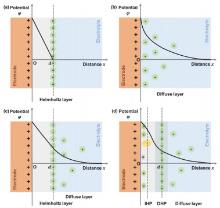
图1
"
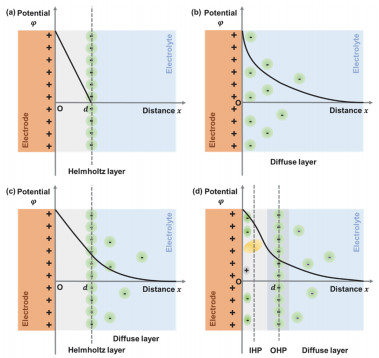
表1
"
| Symbols | Connotations |
| A | the interactions between adsorbates in the Frumkin adsorption isotherm |
| b | difference between the Gibbs free energy change for the formation of the down-state water at the electrode surface and the up-state water |
| β | symmetry factor |
| ca | concentration of adsorbates in the bulk phase of the solution |
| c0 | concentration of species i in the bulk phase of the solution |
| concentration of the reduced species Re in the bulk phase of the solution in the interfacial single-electron transfer reaction | |
| concentration of the oxidized species Ox in the interfacial single-electron transfer reaction | |
| concentration of the oxidized species Ox in the bulk phase of the solution in the interfacial single-electron transfer reaction | |
| csurface | concentration of species on electrode surface |
| C | double layer (differential) capacitance |
| Ccharge | capacitance formed when ions are adsorbed on the electrode surface |
| Cdipole | capacitance formed when water dipoles are adsorbed by the electrode |
| Ceqcm | correction constant for EQCM resonator |
| CM | the contribution of electrode side to the interfacial capacitance |
| CH | the contribution of Helmholtz layer to the interfacial capacitance |
| CG | the contribution of diffusion layer to the interfacial capacitance |
| χ(2) | second-order optical susceptibility |
| χ(3) | third-order optical susceptibility |
| The effective second-order optical susceptibility | |
| d | Differential notation (as distinguished from italicized d for the plate separation distance) |
| d | the plate separation distance in the parallel plate capacitor model |
| E | electric field intensity |
| e0 | the charge carried by one single electron |
| ε | the dielectric constant in a certain medium |
| ε0 | vacuum dielectric constant |
| F | Faraday constant |
| f | f= F/RT |
| Δf | the change in vibrational frequency measured by EQCM |
| ΔGn | Gibbs free energy change for primitive reaction steps associated with n proton-electron pairs |
| the change of surface dipole potential | |
| gM | the electrode potential on the metal electrode surface within the double layer |
| gS | the electrode potential on the solution side within the double layer |
| The surface potential contributed by oriented water molecules | |
| I2ω | the emitted light intensity of SHG |
| i | imaginary unit, species designation (such as species i) |
| i | current density |
| i0 | exchange current density |
| icath | cathodic current density |
| iS | the current of the substrate in SECM |
| iT | the (Faradaic) current passing through the tip in SECM |
| k0 | standard reaction rate constant |
| kb | backward reaction rate constant |
| kf | forward reaction rate constant |
| κ-1 | the characteristic thickness of the EDL in the GC model |
| KA→B | the integral capacitance from A to B |
| γ | interfacial tension |
| kB | Boltzmann constant |
| Δm | the change of the electrode mass |
| Mads | the molar mass of adsorbed species |
| dipole moment | |
| the electrochemical potential of the electrons on the reference electrode | |
| the electrochemical potential of the electrons on the (other) metal electrode | |
| Δμ | Stark tunability |
| n | Variable indicating ‘number’, e.g., number of radical reactions, number of water molecules in hydrated ions, etc. |
| Ne, trans | electron transfer coefficient per unit mole of reaction |
| Nt | the background signal in a radiotracer measurement |
| Nt’ | the signal under the voltage without specific adsorption in a radiotracer measurement |
| Nt’’ | the signal under the voltage with specific adsorption in a radiotracer measurement |
| Nwater | number of water molecules on the electrode surface |
| ϕ | the phase of emitted light of SHG |
| φ | inner potential, the electrode potential under certain conditions |
| Δφ | the potential difference within the electrical double layer, i.e., the electrode | solution interface potential difference |
| φt | the potential of the working electrode at time t |
| φdc | the potential of the working electrode under direct current |
| φx | the potential at a distance x from the electrode surface, with the bulk solution potential defined as 0 |
| ψ | outer potential |
| Δψ | the outer potential difference of the electrical double layer |
| ω | frequency |
| qCA | the charge density of specific adsorbed ions |
| qd | the total diffuse charge density in solution |
| qM | the charge density of the (metal) electrode |
| ΔQ | the change of quantity of electric charge during electrocatalytic reactions |
| R | ideal gas constant |
| R | the roughness of the electrode |
| t | time |
| T | absolute temperature |
| θa | coverage (referring to the fraction of the surface that is covered) |
| θ | the phase difference between χ(3) and χ(2) |
| U | Maximum value of dipole-dipole interaction energy |
| V | the voltage drop per unit area of M | S EDL interface |
| Vapp | applied potential |
| vscan | the potential scan rate in cyclic voltammetry |
| x | the vertical distance of the target site from the electrode surface |
| X | the constant related to lateral interactions, 0 < X < 1 |
| y | an artificially defined physical quantity to represent the electrical and lateral interactions in interactions within EDL |
| Z | an artificially defined physical quantity to represent the distribution of water in the up and down states on the electrode surface |
| z | the number of charges per ion |
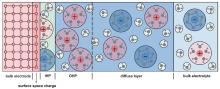
图2
"
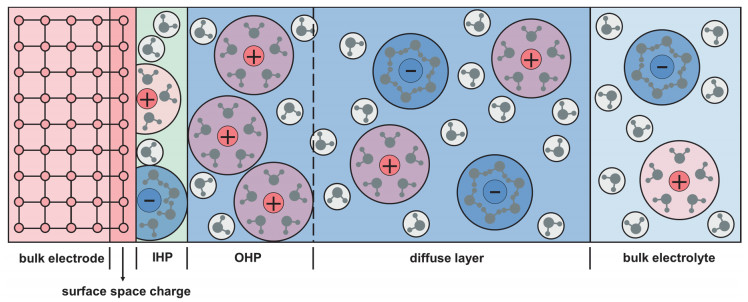
表2
"
| Characterization Techniques | Abbreviation | Basic Principles | Vertical Resolution | Horizontal Resolution | Time Resolution | Information | On the Electrode Side | IHP/Adsorption Layer | OHP & Diffusion Layer | Category |
| Electrocapillary | – | Measurement of interfacial tension as a function of applied voltage | Macroscopic nature | Macroscopic nature | Measurement of the differential capacitance and the potential of zero charge of an EDL | Electrochemical Method | ||||
| Cyclic Voltammetry | CV | Potential scanning cyclically to obtain the current-potential relationship | Macroscopic nature | Macroscopic nature | Electrochemical behaviors of the system | Electrochemical Method | ||||
| Alternating Current Voltammetry | ACV | Relationship between the variation of AC amplitude and phase with DC polarization potential at a given electrical signal frequency | Macroscopic nature | Macroscopic nature | Distinguishing between Faraday and charging currents and separating to obtain information on different electrochemical processes | Electrochemical Method | ||||
| Electrochemical Impedance Spectroscopy | EIS | Variation of AC impedance of an electrochemical system as a function of the frequency of an applied electrical signal under a certain condition of DC polarization | Macroscopic nature | Macroscopic nature | Frequency dependent, up to milliseconds | Solution resistance from reference electrode to working electrode, double layer capacitance, charge transfer resistance, detection of diffusion processes from the body to the electrode surface and in the electrolyte | Electrochemical Method | |||
| Electrochemical Quartz Crystal Microbalance | EQCM | The oscillation frequency of quartz crystal lenses is affected by changes in electrode mass, thus correlating electrochemical information with changes in electrode mass | Relationships between mass, current and charge as a function of potential in the surface layer of solid electrodes, tracking mass transfer and charge transfer processes | Derivative Electrochemical Method | ||||||
| Radiotracer Measurements | - | Detection of β particles from isotope decay in the electrolyte by means of a scintillation counter, where the signal from the decay of the radioactive substrate is not recorded if it is adsorbed on the electrode | Surface radiation intensity or surface concentration, corresponding to the number of molecules adsorbed on the electrode surface Limitations lie in finding target molecules with radioactive isotopes | √ | Spectroscopy | |||||
| in situ/operando Infrared Reflection Absorption Spectroscopy | IRRAS | The infrared light passes through a thin layer of electrolyte to illuminate the interface, while elective absorption occurs and multiple reflections and attenuation result in an outgoing light that contains information about the interface | 100 nm | 5 μm | In the order of milliseconds and microseconds | Chemical nature and adsorption structure of adsorbed species Orientation of molecules on surfaces and the effect of double layer electric fields on intramolecular bonding Functional groups, molecular symmetry, and catalyst-molecule interactions | (very weak) | √ | IR Spectroscopy | |
| Attenuated Total Reflectance Infrared Spectroscopy | ATR-IR | Infrared light irradiates the sample to be measured, penetrates into the interface to a certain depth and undergoes selective absorption, and is reflected and attenuated several times to obtain the outgoing light which contains the interface information | 100 nm | 5 μm | √ | √ (no resolution) | √ | IR Spectroscopy | ||
| Surface Enhanced Infrared Absorption Spectroscopy | SEIRAS | When a molecule is adsorbed on the surface of a noble metal, transition metal or semiconductor substrate, its infrared absorption signal is dramatically amplified by several orders of magnitude | 10 nm | 5 μm | √ | √ | √ | IR Spectroscopy | ||
| in situ/operando Raman Spectroscopy | Raman | Scattered light undergoes an energy exchange within the illuminated object, and the difference in photon energy between the scattered light and the incident light reflects information about the vibrational energy levels of the molecules | 500 nm | 2-3 μm | Generally in the order of milliseconds with CCD; in the order of 10 nanoseconds with pump light | Structure and orientation of molecules on the surface, the effect of the electric field of the double electric layer on intramolecular bonding; qualitative and quantitative information about the electrode composition in the near-surface region, i.e., bonding on the catalyst surface; changes in the surface with potential, state of charge, and/or time | √ | √ (no resolution) | √ | Raman Spectroscopy |
| Surface enhanced Raman Spectroscopy | SERS | When a molecule is adsorbed on the surface of a noble metal, transition metal or semiconductor substrate, the Raman scattering signal is dramatically amplified by several orders of magnitude | 1 nm | √ | √ | √ | Raman Spectroscopy | |||
| Sum Frequency Generation Vibrational Spectroscopy | SFG-VS | Simultaneous irradiation of an electrochemical interface with non-central symmetry (satisfying symmetry breaking) by an infrared beam and a visible beam produces a sum-frequency signal | Measurement of surface potential, molecular structure, symmetry and orientation of interfacial reactants/solvents/intermediates, and surface number density | √ | √ | No solution phase information | Nonlinear Optical Characterization | |||
| Second Harmonic Generation | SHG | Two incident photons of the same frequency pass through the electrode-electrolyte interface to produce a doubled-frequency photon, and the resulting intensity of the incident light reflects the electric field information at the interface | Measurement of surface potential, determination of zero-charge potential, molecular structure and orientation of interfacial reactants/solvents/intermediates | √ | √ | No solution phase information | Nonlinear Optical Characterization | |||
| in situ X-ray Diffraction | XRD | Using an in situ electrochemical cell, X-rays diffract with the working electrode phase and contain information on the bulk phase of the crystalline electrode under reaction conditions | > 1 mm | 1–3 μm | Fast enough to capture the typical dynamic processes of active substances in operando experiments | Qualitative and quantitative information on the (average) composition of bulk phase electrodes Changes in the crystal structure of bulk phase electrodes with potential, state of charge and/or time | √ (bulk) | × | × | X-Ray Diffraction Spectroscopy |
| in situ X-ray absorption near edge structure | XANES | Incident X-rays excite the inner electrons to unoccupied energy levels and the X-rays are strongly absorbed, reflecting information about the oxidation state and electronic structure of the element under test | Penetrate the bulk phase | Average oxidation states and electronic configurations of specific elements in electrode materials for amorphous electrodes | √ (bulk) | Characterization of hydrogen bond strength of water molecules in IHP | × | X-Ray Absorption Spectroscopy | ||
| in situ Extended X-ray Absorption Fine Structure | EXAFS | Incident X-ray excitation to the continuum state of the inner electrons interferes with neighboring atoms, reflecting information such as bond distances and coordination numbers | Penetrate the bulk phase | 5 Å range of short-range covalent structures | Interface constituent element analysis, interatomic distances, coordination information, available for amorphous electrodes | √ (bulk) | × (analyzed indirectly in conjunction with other techniques) | × | X-Ray Absorption Spectroscopy | |
| Ambient Pressure X-ray Photoelectron Spectroscopy | APXPS | Improvements to the vacuum system, X-ray source and feeding technique have enabled the XPS to be tested at near atmospheric pressure, measuring the photoelectron beam formed by the incident X-rays striking the inner electrons | 1–12 nm | 30 μm | Qualitative and semi-quantitative elemental analysis, depth imaging, oxidation states; molecular structure identification at interfaces | √ | √ | √ | Photoelectron Spectroscopy | |
| Ambient Pressure Resonance Auger Electron Spectroscopy | APRAES | The incident X-ray-excited inner electron leaps back into the inner vacancy and the energy released excites the valence electron, the Rochelle electron | 1–6 nm | 0.02–50 μm | Surface elemental composition, adsorbate coverage, interfacial electronic structure | √ | √ | √ | Photoelectron Spectroscopy | |
| Electrochemical Scanning Tunneling Microscopy | EC-STM | The tunnelling current is sensitive to the probe-sample distance and the electronic properties of the sample, reflecting interfacial information | 0.1–1 nm | 1–10 nm | In the order of milliseconds | Adsorption of species structure, electrode surface morphology, electronic structure and active sites, information on both liquid and solid phase sides can be obtained | √ | √ | Scanning Probe Microscopy | |
| Scanning Electrochemical Microscopy | SECM | Faraday currents generated by electrochemical reactions at the interface, which are strongly correlated with the probe-sample distance, reflect interfacial information | 10 nm | 20–50 nm | Quantification of local concentrations of interfacial species, adsorbed species coverage, local pH, surface reactivity | √ | Scanning Probe Microscopy |
图3
"
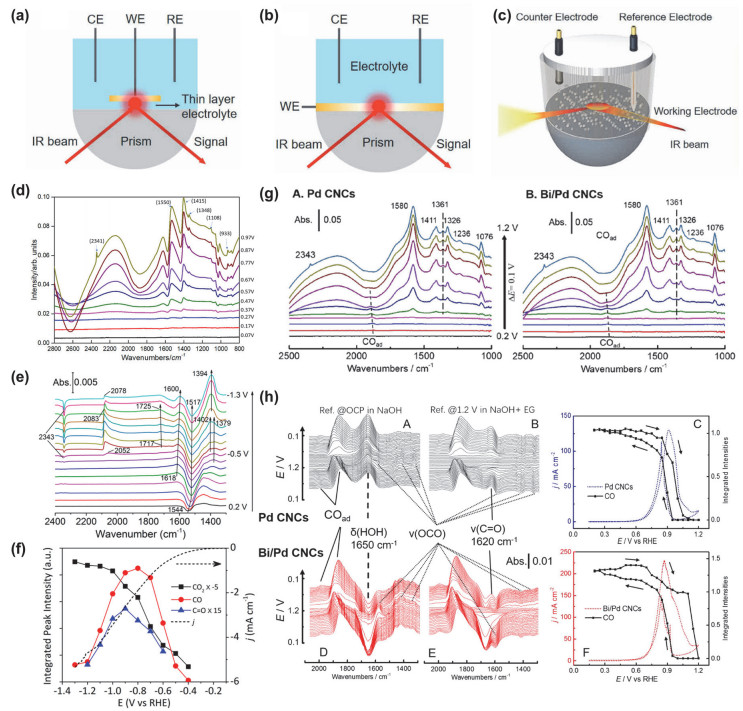
图4
"
图5
"
图6
"
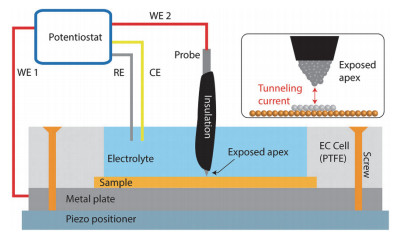
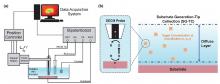
图7
"
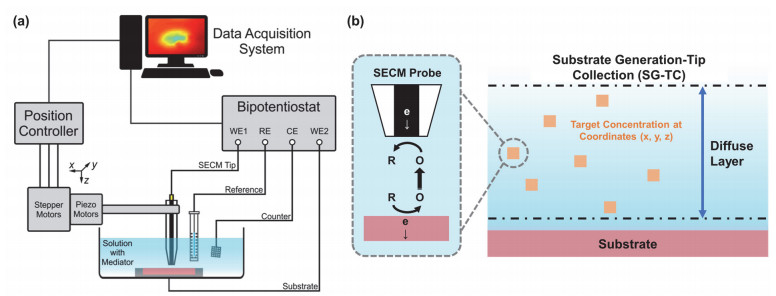
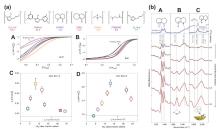
图8
"
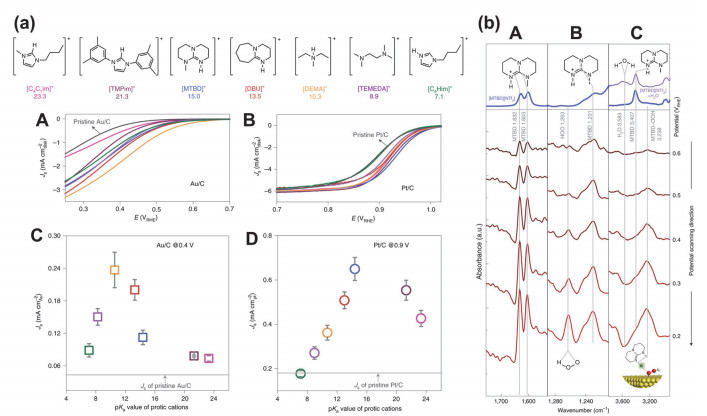
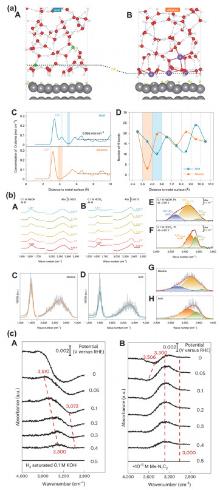
图9
"
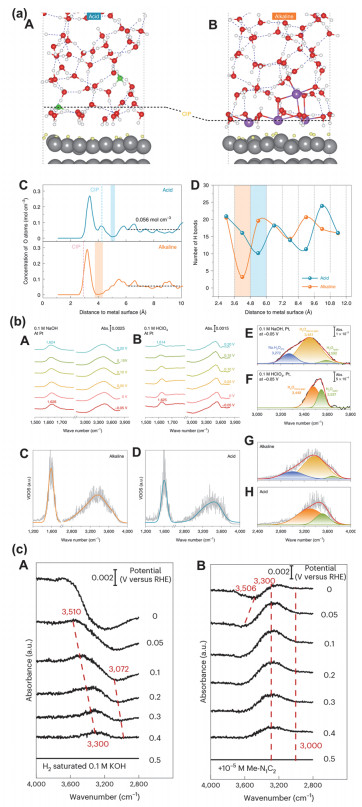
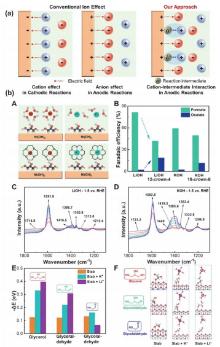
图10
"
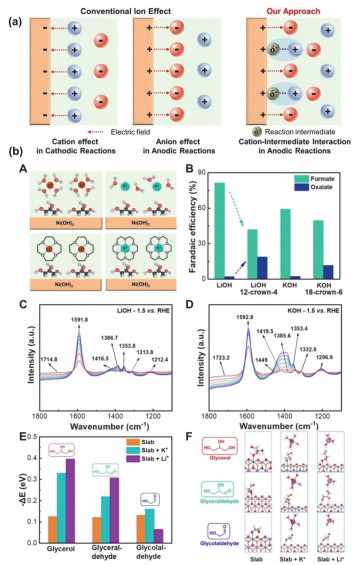
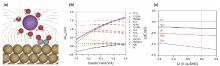
图11
"
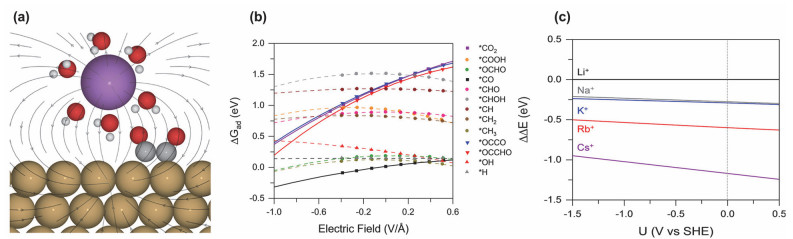
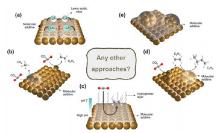
图12
"
| 1 |
doi: 10.1016/j.nanoen.2016.09.025 |
| 2 |
doi: 10.1038/s41578-021-00303-1 |
| 3 |
Bockris, J. O'. M.; Reddy, A. K. N.; Gamboa-Aldeco, M. Modern Electrochemistry 2A: Fundamentals of Electrodics, 2nd ed.; Kluwer Academic Publishers: New York, NY, USA, 2000; pp. 771–775.
|
| 4 |
|
|
许义飞; 杨瀚文; 常晓侠; 徐冰君. 物理化学学报, 2023, 39, 2210025.
doi: 10.3866/PKU.WHXB202210025 |
|
| 5 |
doi: 10.1039/D2TC01631A |
| 6 |
doi: 10.1007/s10008-024-05850-5 |
| 7 |
doi: 10.1051/jphystap:019100090045700 |
| 8 |
doi: 10.1080/14786440408634187 |
| 9 |
doi: 10.1002/bbpc.192400182 |
| 10 |
doi: 10.1021/cr60130a002 |
| 11 |
doi: 10.1038/s41467-024-46318-4 |
| 12 |
doi: 10.1038/s41929-020-00570-1 |
| 13 |
doi: 10.3389/fchem.2023.1231886 |
| 14 |
doi: 10.1007/s10008-011-1337-4 |
| 15 |
doi: 10.1016/0039-6028(69)90266-0 |
| 16 |
Bockris, J. O'. M.; Reddy, A. K. N.; Gamboa-Aldeco, M. Modern Electrochemistry 2A: Fundamentals of Electrodics, 2nd ed.; Kluwer Academic Publishers: New York, NY, USA, 2000; pp. 933–959, 1190–1201.
|
| 17 |
doi: 10.1039/C4CS00087K |
| 18 |
doi: 10.1002/anie.202403466 |
| 19 |
doi: 10.1080/14786444208520813 |
| 20 |
doi: 10.1021/ja01421a013 |
| 21 |
doi: 10.1039/tf9514700756 |
| 22 |
doi: 10.1098/rspa.1963.0114 |
| 23 |
Bockris, J. O'. M.; Reddy, A. K. N.; Gamboa-Aldeco, M. Modern Electrochemistry 2A: Fundamentals of Electrodics, 2nd ed.; Kluwer Academic Publishers: New York, NY, USA, 2000; pp. 895–919.
|
| 24 |
doi: 10.1038/s41929-022-00846-8 |
| 25 |
doi: 10.1038/s41570-021-00293-2 |
| 26 |
doi: 10.1002/aenm.202402974 |
| 27 |
|
|
张露露; 李琛坤; 黄俊. 电化学(中英文), 2022, 28(2), 2108471.
doi: 10.13208/j.electrochem.210847 |
|
| 28 |
doi: 10.1515/mlbmb-2017-0010 |
| 29 |
doi: 10.1080/00268977500103051 |
| 30 |
doi: 10.1039/F29807601388 |
| 31 |
doi: 10.1039/C8CP05113E |
| 32 |
doi: 10.1002/andp.19003060312 |
| 33 |
doi: 10.1063/1.447092 |
| 34 |
Bockris, J. O'. M.; Reddy, A. K. N.; Gamboa-Aldeco, M. Modern Electrochemistry 2A: Fundamentals of Electrodics, 2nd ed.; Kluwer Academic Publishers: New York, NY, USA, 2000; pp. 919–968.
|
| 35 |
doi: 10.1016/0013-4686(96)00060-6 |
| 36 |
doi: 10.1093/nsr/nwad166 |
| 37 |
doi: 10.1126/science.1132195 |
| 38 |
doi: 10.1007/s10008-020-04597-z |
| 39 |
|
|
方亚辉; 刘智攀. 催化学报, 2019, 40(s1), 90.
|
|
| 40 |
|
|
方亚辉; 刘智攀. 电化学(中英文), 2020, 26(1), 32.
doi: 10.13208/j.electrochem.181243 |
|
| 41 |
doi: 10.1021/jp047349j |
| 42 |
doi: 10.1021/acs.jpcc.3c03796 |
| 43 |
doi: 10.1021/acs.jpcc.1c10870 |
| 44 |
doi: 10.1021/jacs.2c08743 |
| 45 |
doi: 10.1021/acs.jpclett.5b01043 |
| 46 |
doi: 10.1039/D1CS00789K |
| 47 |
doi: 10.1039/D4TA02285H |
| 48 |
doi: 10.1021/jacsau.3c00410 |
| 49 |
doi: 10.1039/D1TA07791K |
| 50 |
doi: 10.1063/1.4946894 |
| 51 |
doi: 10.1002/wcms.1415 |
| 52 |
doi: 10.1016/j.matt.2020.11.010 |
| 53 |
doi: 10.1002/aenm.202200708 |
| 54 |
Bard, A. J.; Faulkner, L. R. Electrochemical Methods: Fundamentals and Applications, 2nd ed.; Wiley: New York, NY, USA, 2001; pp. 156–417.
|
| 55 |
Zhang, J. Q. Electrochemical Measurement Technology, 1st ed.; Chemical Industry Press: Beijing, 2010; pp. 73–300.
|
|
张鉴清等. 电化学测试技术, 第一版; 北京: 化学工业出版社, 2010; 73–300.
|
|
| 56 |
doi: 10.1007/s40828-015-0016-y |
| 57 |
Bockris, J. O'. M.; Reddy, A. K. N.; Gamboa-Aldeco, M. Modern Electrochemistry 2A: Fundamentals of Electrodics, 2nd ed.; Kluwer Academic Publishers: New York, NY, USA, 2000; pp. 859–869.
|
| 58 |
doi: 10.1021/j100722a045 |
| 59 |
doi: 10.1016/0039-6028(71)90246-9 |
| 60 |
doi: 10.1016/0022-0728(96)01006-6 |
| 61 |
doi: 10.1021/ac053370k |
| 62 |
doi: 10.1021/acs.jpcc.8b00272 |
| 63 |
doi: 10.1002/anie.201911929 |
| 64 |
doi: 10.1021/la702454k |
| 65 |
doi: 10.1021/acs.jpcc.7b00287 |
| 66 |
doi: 10.1016/j.jelechem.2006.02.012 |
| 67 |
Bard, A. J.; Faulkner, L. R. Electrochemical Methods: Fundamentals and Applications, 2nd ed.; Wiley: New York, NY, USA, 2001; pp. 537–544.
|
| 68 |
doi: 10.1016/j.susc.2014.04.014 |
| 69 |
doi: 10.20964/2021.03.50 |
| 70 |
doi: 10.1039/C3AN00791J |
| 71 |
doi: 10.1021/acscatal.0c04789 |
| 72 |
doi: 10.1039/D1CS00629K |
| 73 |
doi: 10.1007/s10008-009-0926-y |
| 74 |
doi: 10.1016/0022-0728(92)80463-E |
| 75 |
doi: 10.1016/S1872-2067(22)64157-3 |
| 76 |
doi: 10.1016/j.apcatb.2018.04.052 |
| 77 |
doi: 10.1021/jacs.7b10462 |
| 78 |
doi: 10.1038/s41560-023-01302-y |
| 79 |
doi: 10.1002/anie.202113362 |
| 80 |
doi: 10.1021/jacs.9b07000 |
| 81 |
doi: 10.1021/acscatal.6b03108 |
| 82 |
doi: 10.1016/j.chempr.2022.06.012 |
| 83 |
doi: 10.1038/nature08907 |
| 84 |
doi: 10.1002/anie.202014551 |
| 85 |
doi: 10.1021/jacs.0c11307 |
| 86 |
doi: 10.1021/jacs.0c04867 |
| 87 |
doi: 10.1016/j.ccr.2021.213824 |
| 88 |
doi: 10.1038/s41586-021-04068-z |
| 89 |
doi: 10.1039/D1SC01876K |
| 90 |
doi: 10.1039/D1CY01090E |
| 91 |
doi: 10.1116/6.0002007 |
| 92 |
doi: 10.1002/anie.201908722 |
| 93 |
doi: 10.1021/acs.accounts.9b00001 |
| 94 |
doi: 10.1021/jacs.2c05563 |
| 95 |
doi: 10.1038/s41563-023-01474-8 |
| 96 |
doi: 10.1016/j.coelec.2020.08.005 |
| 97 |
doi: 10.1515/pac-2019-1006 |
| 98 |
doi: 10.1038/ncomms12695 |
| 99 |
doi: 10.1016/j.matt.2021.09.024 |
| 100 |
doi: 10.1021/acs.chemrev.2c00766 |
| 101 |
doi: 10.1002/smtd.201800387 |
| 102 |
doi: 10.1021/ja071330n |
| 103 |
doi: 10.1038/s41467-023-39206-w |
| 104 |
doi: 10.1021/acs.chemrev.6b00067 |
| 105 |
doi: 10.1021/jacs.2c12775 |
| 106 |
doi: 10.1021/acs.analchem.9b04952 |
| 107 |
doi: 10.1038/s41560-020-00730-4 |
| 108 |
doi: 10.1038/s41467-023-36718-3 |
| 109 |
doi: 10.1038/s41467-023-35912-7 |
| 110 |
doi: 10.1038/s41929-021-00668-0 |
| 111 |
doi: 10.1002/adma.202200270 |
| 112 |
doi: 10.1038/s41929-019-0383-7 |
| 113 |
doi: 10.1021/la200694a |
| 114 |
doi: 10.1038/s41929-021-00655-5 |
| 115 |
doi: 10.1021/jacs.1c10171 |
| 116 |
doi: 10.1039/C9EE01341E |
| 117 |
doi: 10.1021/jacs.7b06765 |
| 118 |
doi: 10.1126/sciadv.abd2569 |
| 119 |
doi: 10.1021/jacs.3c00565 |
| 120 |
doi: 10.1038/s41563-020-0610-2 |
| [1] | 吕宪伟, 丁信元, 龚家兴, 闫旭焕, 黄大勇, 耿建新, 袁忠勇. 轨道杂化在光催化与电催化中的研究进展[J]. 物理化学学报, 2026, 42(2): 100151 - . |
| [2] | 邱江源, 于涛, 陈均鑫, 李文轩, 张晓萱, 李金生, 郭瑞, 黄在银, 刘宣文. FeOOH调节Bi12O17Cl2@FeOOH异质结中Bi12O17Cl2的表面势阱深度以增强压电电荷转移和压电自芬顿催化[J]. 物理化学学报, 2026, 42(1): 100157 - . |
| [3] | 段睿智, 王小梅, 周潘旺, 刘扬, 李灿. 羟基物种在过渡金属表面碱性析氢反应中的作用[J]. 物理化学学报, 2025, 41(9): 100111 - . |
| [4] | DristySumiya Akter, HabibMd Ahasan, LinShusen, JoniMehedi Hasan, MandavkarRutuja, ChungYoung-Uk, NajibullahMd, LeeJihoon. 利用Zn掺杂制备高效稳定工业级电解水的NiBP微球催化剂研究[J]. 物理化学学报, 2025, 41(7): 100079 - . |
| [5] | 李坚, 张毓, 闫融融, 孙开媛, 刘晓晴, 梁子尚, 焦忆楠, 卜晖, 陈欣, 赵晋津, 施剑林. 高效靶向示踪钙钛矿纳米系统光电增效抗肿瘤[J]. 物理化学学报, 2025, 41(5): 100042 - . |
| [6] | 陈润华, 吴琼, 罗婧宸, 祖小龙, 朱姗, 孙永福. 缺陷态二维超薄材料用于光/电催化CO2还原的基础与展望[J]. 物理化学学报, 2025, 41(3): 100019 - . |
| [7] | 董雪, 孙晓甫, 贾帅强, 韩世涛, 周达伟, 姚婷, 王敏, 方明慧, 吴海虹, 韩布兴. 碳修饰的铜催化剂实现安培级电流电化学还原CO2制C2+产物[J]. 物理化学学报, 2025, 41(3): 100024 - . |
| [8] | 王琪, 刘宇庆, 王洁菲, 马媛媛, 都京, 韩占刚. 电催化氯代芳香烃脱氯催化剂的合成策略、应用与挑战[J]. 物理化学学报, 2025, 41(10): 100120 - . |
| [9] | 李清, 张光勋, 徐玉霞, 孙洋洋, 庞欢. 磷化调控构筑分层结构的Ni2P催化剂用于高效电氧化尿素[J]. 物理化学学报, 2024, 40(9): 2308045 - . |
| [10] | 李美然, 宋英杰, 万鑫, 李洋, 罗毅奇, 贺业亨, 夏博文, 周华, 邵明飞. 镍钒水滑石电极用于可放大电催化5-羟甲基糠醛氧化耦合产氢[J]. 物理化学学报, 2024, 40(9): 2306007 - . |
| [11] | 孔燕, 危伟, 徐乐凯, 陈晨. 电催化氮集成二氧化碳还原反应合成有机氮化合物[J]. 物理化学学报, 2024, 40(8): 2307049 - . |
| [12] | 许文涛, 莫栩妍, 周洋, 翁祖贤, 莫坤玲, 吴炎桦, 蒋欣霖, 李丹, 蓝汤淇, 文欢, 郑伏琴, 樊友军, 陈卫. 双金属浸出诱导催化剂重构用于高活性和高稳定性电化学水氧化[J]. 物理化学学报, 2024, 40(8): 2308003 - . |
| [13] | 赵路甜, 郭杨格, 罗柳轩, 闫晓晖, 沈水云, 章俊良. 金属纳米晶体电催化剂的电化学合成:原理、应用与挑战[J]. 物理化学学报, 2024, 40(7): 2306029 - . |
| [14] | 王烨, 葛瑞翔, 刘翔, 李敬, 段昊泓. 一种阴离子浸出策略合成金属羟基氧化物用于电催化甘油氧化[J]. 物理化学学报, 2024, 40(7): 2307019 - . |
| [15] | 张新义, 任楷, 刘妍宁, 谷振一, 黄志雄, 郑硕航, 王晓彤, 郭晋芝, ZatovskyIgor V., 曹峻鸣, 吴兴隆. 熵增工程在电催化反应中的研究进展[J]. 物理化学学报, 2024, 40(7): 2307057 - . |
|
||