物理化学学报 >> 2025, Vol. 41 >> Issue (3): 100019.doi: 10.3866/PKU.WHXB202308052
所属专题: 能源化学
缺陷态二维超薄材料用于光/电催化CO2还原的基础与展望
陈润华1,†, 吴琼1,†, 罗婧宸1, 祖小龙2,*( ), 朱姗3, 孙永福1,*()
- 1 中国科学技术大学合肥微尺度物质科学国家研究中心, 合肥 230026
2 福建省能源材料科学与技术创新实验室(IKKEM), 福建 厦门 360015
3 国网安徽省电力有限公司电力科学研究院, 合肥 230601
-
收稿日期:2023-08-31修回日期:2023-10-04录用日期:2023-10-17发布日期:2023-12-20 -
通讯作者:Email: xiaolongzu@xmu.edu.cn (祖小龙)yfsun@ustc.edu.cn (孙永福) -
作者简介:†These authors contributed equally to this work.
-
基金资助:国家重点研发计划(2019YFA0210004); 国家重点研发计划(2022YFA1502904); 国家重点研发计划(2021YFA1501502); 国家自然科学基金(22125503); 国家自然科学基金(21975242); 国家自然科学基金(U2032212); 中国科学院青年创新促进会优秀会员(CX2340007003); 安徽省自然科学基金(2208085QB31)
Defective Ultrathin Two-Dimensional Materials for Photo-/Electrocatalytic CO2 Reduction: Fundamentals and Perspectives
Runhua Chen1, Qiong Wu1, Jingchen Luo1, Xiaolong Zu2,*(), Shan Zhu3, Yongfu Sun1,*()
- 1 Hefei National Research Center for Physical Sciences at Microscale, University of Science and Technology of China, Hefei 230026, China
2 Innovation Laboratory for Sciences and Technologies of Energy Materials of Fujian Province (IKKEM), Xiamen 361005, Fujian Province, China
3 State Grid Anhui Electric Power Research Institute, Hefei 230601, China
-
Received:2023-08-31Revised:2023-10-04Accepted:2023-10-17Published:2023-12-20 -
Contact:Email: xiaolongzu@xmu.edu.cn (Xiaolong Zu)yfsun@ustc.edu.cn (Yongfu Sun) -
Supported by:the National Key Research and Development Program of China(2019YFA0210004); the National Key Research and Development Program of China(2022YFA1502904); the National Key Research and Development Program of China(2021YFA1501502); the National Natural Science Foundation of China(22125503); the National Natural Science Foundation of China(21975242); the National Natural Science Foundation of China(U2032212); the Youth Innovation Promotion Association of CAS(CX2340007003); the Anhui Provincial Natural Science Foundation(2208085QB31)

摘要:
太阳能、风能等可再生能源驱动的光/电催化还原二氧化碳(CO2)制碳基燃料是一种非常吸引人的资源再生和能源存储策略,这对中国实现碳达峰和碳中和战略具有重要意义。然而,CO2分子极高的热力学稳定性和极强的化学惰性导致CO2还原反应的转化效率和选择性仍然不理想,这严重限制了CO2转化技术的实际应用。得益于超薄的厚度、高比表面积和相对均一的暴露晶面等特性,二维超薄材料具有高活性、高密度以及高均一的催化位点,能够优化关键的热力学和动力学因素,进而有效改善CO2光/电还原性能。需要指出的是,缺陷态二维超薄材料中的富电子催化位点能够更高效地吸附和活化CO2分子,从而有效降低反应势垒,加速CO2还原并提高产物选择性。此外,二维超薄材料的缺陷结构也有助于催化过程中的质子传递和电子转移等行为,从而进一步提高催化剂的反应活性。本文综述了缺陷态二维超薄材料在CO2光/电催化还原方面的最新研究进展,详细介绍了几类常见的缺陷态二维超薄材料的可控制备方法和精细结构表征。结合典型实例,系统总结了表面缺陷结构对二维超薄材料的局域原子结构和电子结构的调制作用,以及对CO2还原性能的影响。最后,展望了缺陷态二维超薄材料在CO2还原领域所面临的挑战与机遇,为今后的研究提供了借鉴和启示。
引用本文
陈润华, 吴琼, 罗婧宸, 祖小龙, 朱姗, 孙永福. 缺陷态二维超薄材料用于光/电催化CO2还原的基础与展望[J]. 物理化学学报, 2025, 41(3), 100019. doi: 10.3866/PKU.WHXB202308052
Runhua Chen, Qiong Wu, Jingchen Luo, Xiaolong Zu, Shan Zhu, Yongfu Sun. Defective Ultrathin Two-Dimensional Materials for Photo-/Electrocatalytic CO2 Reduction: Fundamentals and Perspectives[J]. Acta Phys. -Chim. Sin. 2025, 41(3), 100019. doi: 10.3866/PKU.WHXB202308052
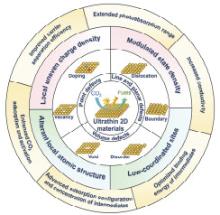
图1
"
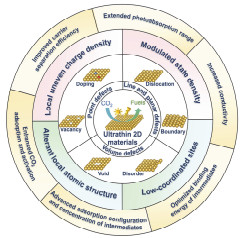
图2
"
图3
"
图4
"
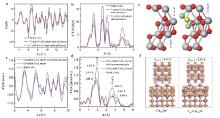
图5
"
图6
"
图7
"
图8
"
图9
"
图10
"
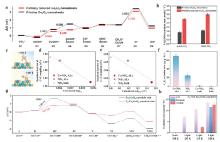
图11
"
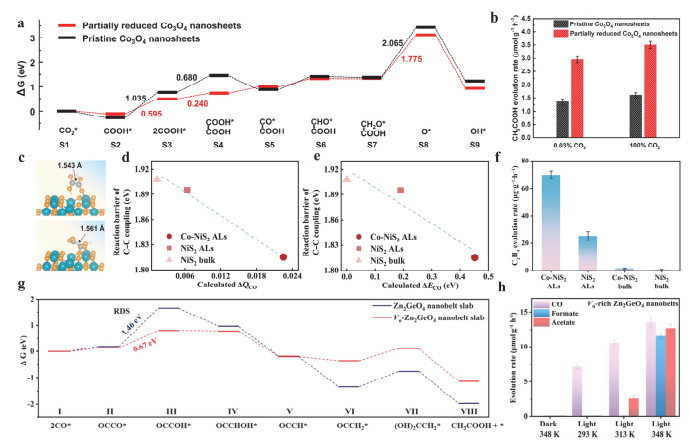
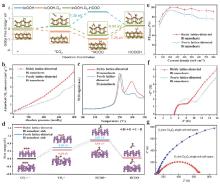
图12
"
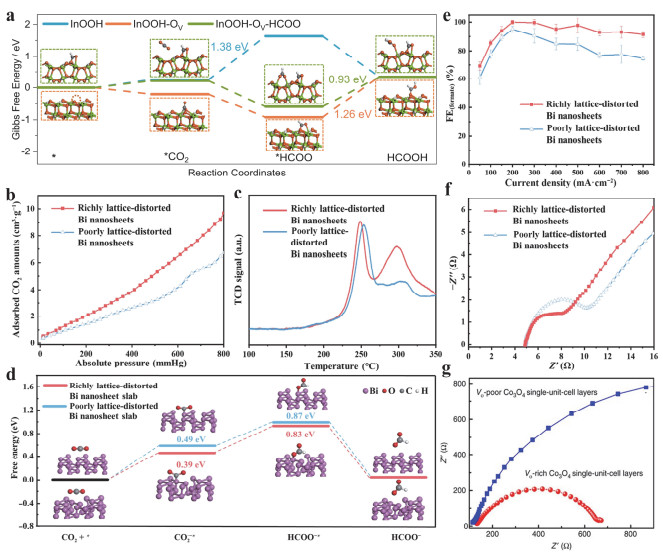
图13
(a) Gibbs free energy diagrams for the CO2 electrochemical reduction to formate on the oxygen-deficient Co3O4 single-unit-cell layers (top) and the perfect Co3O4 single-unit-cell layers (bottom). (b) Tafel plots and (c) Faradaic efficiencies of formate with different applied potentials over the VO-rich and VO-poor Co3O4 single-unit-cell layers. (d) Gibbs free reaction energy as a function of *ECOOH on (211) surface of transition metals and (110) surface of tinoxides at 298 K without potential correction (up) H* adsorption energy on O-Sn-O (SnO2), N-Sn-O (N-SnO2), O-Sn-VO (VO-SnO2), and N-Sn-VO (VO-N-SnO2) (down). (e) Voltammograms of OHads peaks obtained in a 0.1 mol∙L−1 KOH batch cell (up) and adsorption energy of key intermediates on (100) and (111) facets (down) of Cu nanosheets with pits and Cu nanosheets. (f) Scheme of n-propanol formation on CuS with double S vacancies. (g) Gibbs free energy diagrams for CuS with double S vacancies (blue curve) and CuS with single S vacancies (red curve) at 0 V vs. RHE.(h) Schematic diagram for improved EtOH generation over VSe-Cu2−xSe."
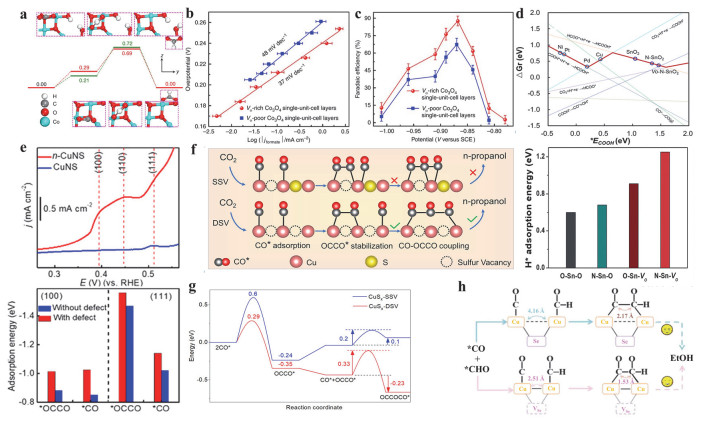
表1
"
| 2D materials | Vacancy types | syntdetic metdod | Characterization metdods | Product | Formation rate/ (μmol·g-1·h-1) or FEP% | Ref. |
| ZnIn2S4 atomic layers | Zn vacancies | hydrotdermal | HAADF-STEM, EPR, PAS | CO | 33.2 | |
| BiOBr atomic layers | Oxygen vacancies | UV irradiation | XPS, EPR, XANES | CO | 87.4 | |
| CuIn2S4 single-unit-cell layers | S vacancies | fast-calciination treatment | XPS, EPR | CH4 | 8.7 | |
| BiVO4 layers | V vacancies | hydrotdermal | PAS | CH3OH | 398.3 | |
| TiO2 ultratdin layers | Oxygen vacancies | annealing treatment | XPS, PAS | CO | 23.1 | |
| Bi2O2CO3 nanosheets | Oxygen vacancies | UV irradiation | XPS, EPR | CO | 275 | |
| ZnCo2O4 atomic layers | Ni-doping | adding reactants | XPS, ICP-AES | CO | 31.4 | |
| WO3 nanosheets | Ti-doping | adding reactants | XPS, XANES | CH3OH | 16.8 | |
| Co3O4 nanosheets | Oxygen vacancies | fast-calciination treatment | XPS, EPR, XANES | CH3COOH | 2.95 | |
| Zn2GeO4 nanobelts | Oxygen vacancies | vacuum aluminotdermic reduction | XPS, EPR | CH3COOH | 12.7 | |
| WO3 layers | Oxygen vacancies | annealing treatment | XPS, EPR | CO | 2.7 | |
| Bi2WO6 atomic layers | Oxygen vacancies | annealing treatment | HRTEM, XPS, Raman, EPR | CH3OH | 157 | |
| NiS2 atomic layers | Co doping | adding reactants | XPS, ICP-AES | C2H4 | 2.5 | |
| Bi nanosheets | lattice-distorted | hydrotdermal | HAADF-STEM, Raman | HCOOH | 100% | |
| Co3O4 atomic layer | Oxygen vacancies | fast-calciination treatment | XAFS, XPS | HCOOH | 85% | |
| Cu2-δSe nanosheets | Se vacancies | hydrotdermal | XPS, EPR, XANES | EtOH | 68.1% | |
| SnO2 nanosheet | oxygen vacancies and N-doping | hydrotdermal | XPS, EPR | HCOOH | 83% | |
| Cu nanosheets | pits | electroreduction | HAADF-STEM | C2H4 | 83.2% |
| 1 |
doi: 10.1021/cr4002758 |
| 2 |
doi: 10.1038/nature16455 |
| 3 |
doi: 10.1039/D2IM00055E |
| 4 |
doi: 10.1016/j.jmst.2021.12.018 |
| 5 |
doi: 10.1007/s11426-022-1595-9 |
| 6 |
|
|
常诚; 陈伟; 陈也; 陈永华; 陈雨; 丁峰; 樊春海; 范红金; 范战西; 龚成; 等. 物理化学学报, 2021, 37, 2108017.
doi: 10.3866/PKU.WHXB202108017 |
|
| 7 |
doi: 10.1016/j.nanoen.2018.08.058 |
| 8 |
doi: 10.1039/C4CS00236A |
| 9 |
doi: 10.1002/adma.202005798 |
| 11 |
doi: 10.1039/C8QI00122G |
|
doi: 10.1007/s12274-022-5112-x |
|
| 12 |
doi: 10.1016/j.carbon.2014.08.059 |
| 13 |
doi: 10.1016/j.carbon.2018.01.008 |
| 14 |
doi: 10.1007/s11426-021-1184-6 |
| 15 |
doi: 10.1021/jacs.0c02973 |
| 16 |
doi: 10.1016/j.jcat.2013.06.008 |
| 17 |
doi: 10.1021/acs.chemrev.8b00705 |
| 18 |
doi: 10.1039/C6EE00383D |
| 19 |
doi: 10.1002/anie.201103600 |
| 20 |
doi: 10.3866/PKU.WHXB202212053 |
|
陈瑶; 陈存; 曹雪松; 王震宇; 张楠; 刘天西. 物理化学学报, 2023, 39, 2212053.
|
|
| 21 |
doi: 10.1016/j.chempr.2017.09.009 |
| 22 |
doi: 10.1002/aenm.202003159 |
| 23 |
doi: 10.1002/adma.201503730 |
| 24 |
doi: 10.1021/ja402956f |
| 25 |
doi: 10.1016/j.nanoen.2019.04.029 |
| 26 |
doi: 10.1021/jacs.7b02290 |
| 27 |
doi: 10.1021/acs.nanolett.8b03655 |
| 28 |
doi: 10.1039/C6CP08409E |
| 29 |
doi: 10.1038/nmat4465 |
| 30 |
doi: 10.1002/anie.201600687 |
| 31 |
doi: 10.1002/anie.201803514 |
| 32 |
doi: 10.1126/science.1200448 |
| 33 |
doi: 10.1007/s12274-015-0917-5 |
| 34 |
doi: 10.1002/chem.201202833 |
| 35 |
doi: 10.1002/adma.201404057 |
| 36 |
doi: 10.1038/s41560-019-0431-1 |
| 37 |
doi: 10.1021/ja501866r |
| 38 |
doi: 10.1039/C4SC00565A |
| 39 |
doi: 10.1038/ncomms3899 |
| 40 |
doi: 10.1021/acs.nanolett.3c00524 |
| 41 |
doi: 10.1021/acsnano.2c11046 |
| 42 |
doi: 10.1016/j.jmst.2017.11.050 |
| 43 |
doi: 10.1021/jacs.6b11263 |
| 44 |
doi: 10.1021/ja3102049 |
| 45 |
doi: 10.1007/s12274-022-4335-1 |
| 46 |
doi: 10.1021/acscatal.2c00157 |
| 47 |
doi: 10.1002/aenm.201600436 |
| 48 |
doi: 10.1016/j.matt.2020.02.006 |
| 49 |
doi: 10.1021/acs.nanolett.2c04335 |
| 50 |
doi: 10.1038/ncomms14503 |
| 51 |
doi: 10.1007/s11426-021-9967-9 |
| 52 |
doi: 10.1002/adfm.202214946 |
| 53 |
doi: 10.1039/D2IM00056C |
| 54 |
doi: 10.1039/D3CC02843G |
| 55 |
doi: 10.1002/anie.202101894 |
| 56 |
doi: 10.1007/s12274-017-1943-2 |
| 57 |
doi: 10.1039/D2NR02364D |
| 58 |
doi: 10.1021/acs.nanolett.1c00383 |
| 59 |
doi: 10.1021/jacs.1c08033 |
| 60 |
doi: 10.1039/D0CS00332H |
| 61 |
doi: 10.1073/pnas.1203122109 |
| 62 |
doi: 10.1016/j.joule.2018.02.019 |
| 63 |
doi: 10.1039/C0EE00309C |
| 64 |
doi: 10.1021/ja207826q |
| 65 |
doi: 10.1002/smll.201303548 |
| 66 |
doi: 10.1016/j.nanoen.2016.12.054 |
| 67 |
doi: 10.1021/acs.jpcc.6b07459 |
| 68 |
doi: 10.1007/s12274-021-3789-x |
| 69 |
doi: 10.1038/s41467-023-37679-3 |
| 70 |
doi: 10.1038/ncomms2066 |
| 71 |
doi: 10.1002/adma.202005113 |
| 72 |
doi: 10.1021/jacs.0c06420 |
| 73 |
doi: 10.1038/s41467-021-21901-1 |
| 74 |
doi: 10.1007/s42823-022-00380-4 |
| 75 |
doi: 10.1039/D2GC03160D |
| 76 |
doi: 10.1007/s42823-022-00401-2 |
| 77 |
doi: 10.1016/j.jmst.2021.10.029 |
| 78 |
doi: 10.1002/adma.202110699 |
| 79 |
doi: 10.1002/adfm.202301984 |
| 80 |
doi: 10.1002/adma.201701774 |
| 81 |
doi: 10.1039/D0TA01154A |
| [1] | 洪佳楠, 许辰宇, 刘烟, 黎昌棋, 王梦琳, 张彦威. 通过边缘活性位点调控解析光热催化中析氢与二氧化碳还原的界面竞争[J]. 物理化学学报, 2025, 41(9): 100099 - . |
| [2] | 李朋, 崔元映, 王中辽, DawsonGraham, 邵春风, 代凯. CeO2/Bi19Br3S27 S型异质结的高效界面电荷转移用于增强光催化CO2还原[J]. 物理化学学报, 2025, 41(6): 100065 - . |
| [3] | KumarRohit, SudhaikAnita, Pawaz KhanAftab Asalam, NeguyenVan Huy, SinghArchana, SinghPardeep, ThakurSourbh, RaizadaPankaj. 设计串联S型光催化体系:机理见解、表征技术与应用[J]. 物理化学学报, 2025, 41(11): 100150 - . |
| [4] | 项东, 李坤振, 苗康华, 龙冉, 熊宇杰, 康雄武. 胺功能化的铜催化剂:氢键介导的电化学CO2还原为C2产物以及优越的可充电Zn-CO2电池性能[J]. 物理化学学报, 2024, 40(8): 2308027 - . |
| [5] | 吕旭东, 邵涛, 刘均炎, 叶萌, 刘升卫. CO2还原和HCHO氧化耦合电催化反应系统高效益生产高附加值产物[J]. 物理化学学报, 2024, 40(5): 2305028 - . |
| [6] | 邵碧珠, 董慧君, 龚云南, 梅剑华, 蔡锋石, 刘金彪, 钟地长, 鲁统部. 金属有机框架衍生镍纳米颗粒在宽电位窗口内高效电催化二氧化碳还原[J]. 物理化学学报, 2024, 40(4): 2305026 - . |
| [7] | 曹玥晗, 郭瑞, 马敏智, 黄泽皑, 周莹. 活性位点电子密度变化对光催化CO2活化和选择转化的影响[J]. 物理化学学报, 2024, 40(1): 2303029 - . |
| [8] | 陈瑶, 陈存, 曹雪松, 王震宇, 张楠, 刘天西. CO2和N2电还原中缺陷及界面工程的最新进展[J]. 物理化学学报, 2023, 39(8): 2212053 -0 . |
| [9] | 李景学, 于跃, 徐斯然, 闫文付, 木士春, 张佳楠. 电子自旋效应在电催化剂中的作用[J]. 物理化学学报, 2023, 39(12): 2302049 - . |
| [10] | 彭芦苇, 张杨, 何瑞楠, 徐能能, 乔锦丽. 电催化二氧化碳还原催化剂、电解液、反应器和隔膜研究进展[J]. 物理化学学报, 2023, 39(12): 2302037 - . |
| [11] | 董金涛, 季赛楠, 张屹, 季梦夏, 王彬, 李英杰, 陈志刚, 夏杰祥, 李华明. 构筑Z型MnO2/BiOBr异质结用于光催化环丙沙星去除和CO2还原[J]. 物理化学学报, 2023, 39(11): 2212011 - . |
| [12] | 朱弼辰, 洪小洋, 唐丽永, 刘芹芹, 唐华. 二维/一维BiOBr0.5Cl0.5/WO3 S型异质结助力光催化CO2还原[J]. 物理化学学报, 2022, 38(7): 2111008 - . |
| [13] | 宋雨珂, 谢文富, 邵明飞. 一体化电极电催化二氧化碳还原研究进展[J]. 物理化学学报, 2022, 38(6): 2101028 - . |
| [14] | 杜亚东, 孟祥桐, 汪珍, 赵鑫, 邱介山. 石墨烯基二氧化碳电化学还原催化剂的研究进展[J]. 物理化学学报, 2022, 38(2): 2101009 - . |
| [15] | 黄小雄, 马英杰, 智林杰. 超薄氮掺杂碳纳米片负载单原子镍用于高效电催化还原二氧化碳[J]. 物理化学学报, 2022, 38(2): 2011050 - . |
|
||