物理化学学报 >> 2025, Vol. 41 >> Issue (9): 100099.doi: 10.1016/j.actphy.2025.100099
通过边缘活性位点调控解析光热催化中析氢与二氧化碳还原的界面竞争
洪佳楠, 许辰宇*( ), 刘烟, 黎昌棋, 王梦琳, 张彦威*()
- 浙江大学清洁能源利用国家重点实验室, 浙江 杭州 310027
-
收稿日期:2025-03-22修回日期:2025-04-19录用日期:2025-04-28发布日期:2025-07-04 -
通讯作者:Email: mrxcy@zju.edu.cn (许辰宇)zhangyw@zju.edu.cn (张彦威) -
基金资助:浙江省自然科学基金(LDT23E06014E06); 国家自然科学基金(52341602); 浙江省自然科学基金(LQ24E060001); 国家重点研发计划(2023YFC3710800); 中央高校基本科研业务费专项资金(2022ZFJH04)
Decoding the interfacial competition between hydrogen evolution and CO2 reduction via edge-active-site modulation in photothermal catalysis
Jianan Hong, Chenyu Xu*(), Yan Liu, Changqi Li, Menglin Wang, Yanwei Zhang*()
- State Key Laboratory of Clean Energy Utilization, Zhejiang University, Hangzhou 310027, Zhejiang Province, China
-
Received:2025-03-22Revised:2025-04-19Accepted:2025-04-28Published:2025-07-04 -
Contact:Email: mrxcy@zju.edu.cn (Chenyu Xu)zhangyw@zju.edu.cn (Yanwei Zhang) -
Supported by:the Zhejiang Provincial Natural Science Foundation of China(LDT23E06014E06); the National Natural Science Foundation of China(52341602); the Zhejiang Provincial Natural Science Foundation of China(LQ24E060001); the National Key Research and Development Project(2023YFC3710800); the Fundamental Research Funds for the Central Universities(2022ZFJH04)

摘要:
太阳能驱动的光热催化CO2与H2O转化是生产可持续燃料和化学品的重要途径。然而,析氢反应(HER)与CO2还原反应(CO2RR)之间的竞争导致产物选择性不理想。贵金属纳米颗粒作为常用助催化剂,可在半导体上形成活性位点,其中金属-半导体界面边缘的特殊活性位点在竞争机制中起关键作用。本研究制备了具有丰富界面边缘位点的Al掺杂SrTiO3负载贵金属催化剂,用于连续光热催化CO2和H2O转化。不同贵金属纳米颗粒上CO2对析氢性能的影响表现出显著差异。通过原位漫反射红外傅里叶变换光谱(DRIFTS)和密度泛函理论(DFT)计算研究了关键中间基团的相互作用,发现双齿碳酸盐(b-CO32−)倾向于占据金属-半导体界面边缘位点,竞争性消耗*H吸附位点并改变析氢能垒。通过建立简化几何模型量化颗粒尺寸、活性位点比例与CO2引起的产氢变化之间的关系,验证了b-CO32−的位点阻塞效应在Rh负载催化剂上占主导地位。通过调控Rh纳米颗粒尺寸可优化边缘位点比例,从而实现*H覆盖度与CO2活化之间的平衡,促进CO2RR生成甲烷。本研究通过边缘活性位点调控初步揭示了HER与CO2RR的界面竞争机制,为催化剂的合理设计提供新见解,并为提升CO2转化效率提供潜在策略。
引用本文
洪佳楠, 许辰宇, 刘烟, 黎昌棋, 王梦琳, 张彦威. 通过边缘活性位点调控解析光热催化中析氢与二氧化碳还原的界面竞争[J]. 物理化学学报, 2025, 41(9), 100099. doi: 10.1016/j.actphy.2025.100099
Jianan Hong, Chenyu Xu, Yan Liu, Changqi Li, Menglin Wang, Yanwei Zhang. Decoding the interfacial competition between hydrogen evolution and CO2 reduction via edge-active-site modulation in photothermal catalysis[J]. Acta Phys. -Chim. Sin. 2025, 41(9), 100099. doi: 10.1016/j.actphy.2025.100099
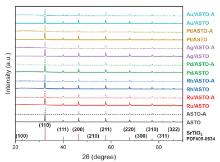
图1
The solid lines represent the fresh samples, and dashed lines represent the samples after reaction."
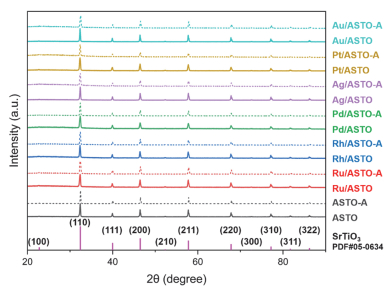
图2
"
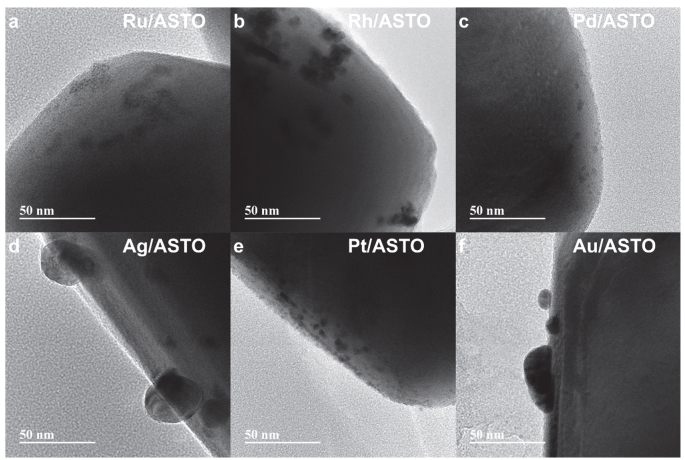
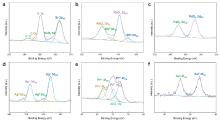
图3
"
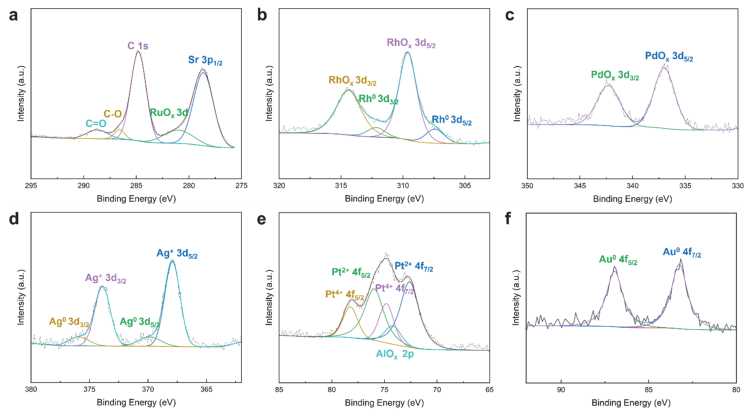
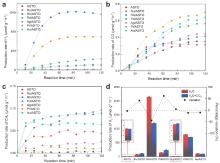
图4
"
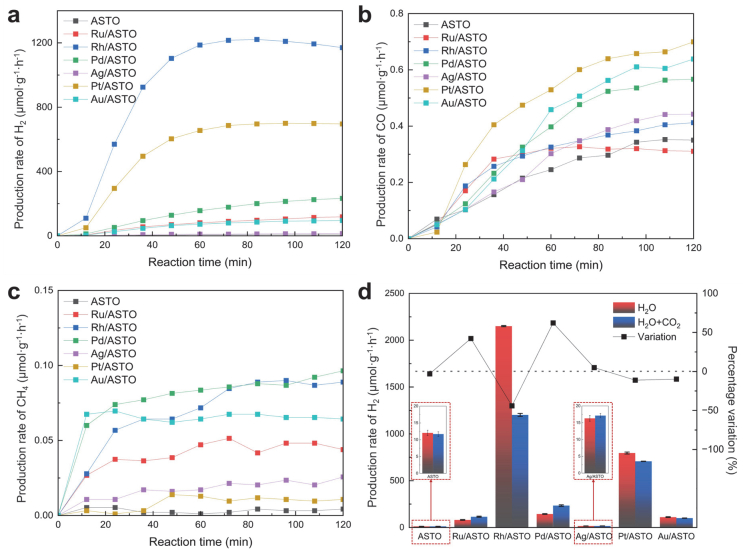
图5
"
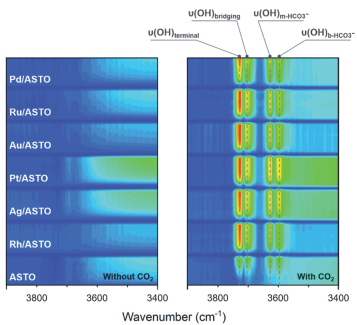
图6
"
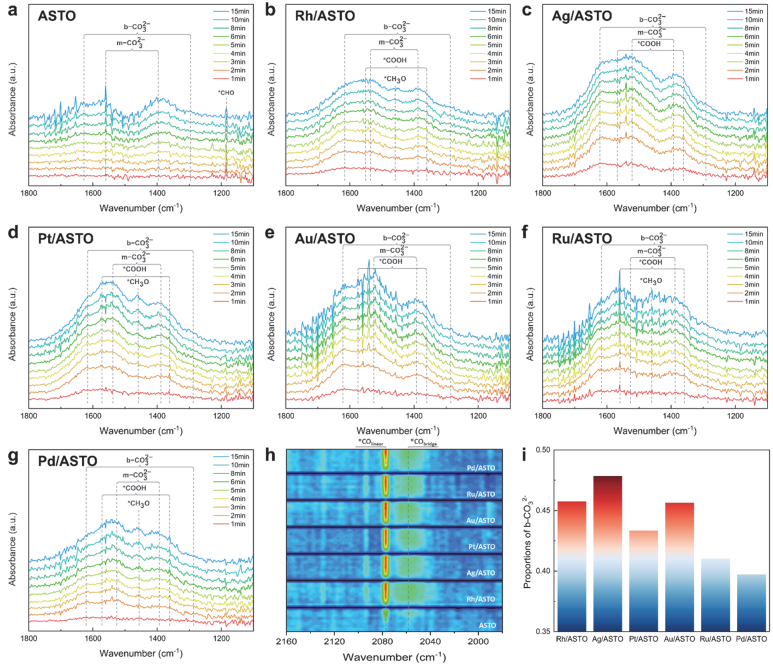
图7
"
图8
"
图9
"
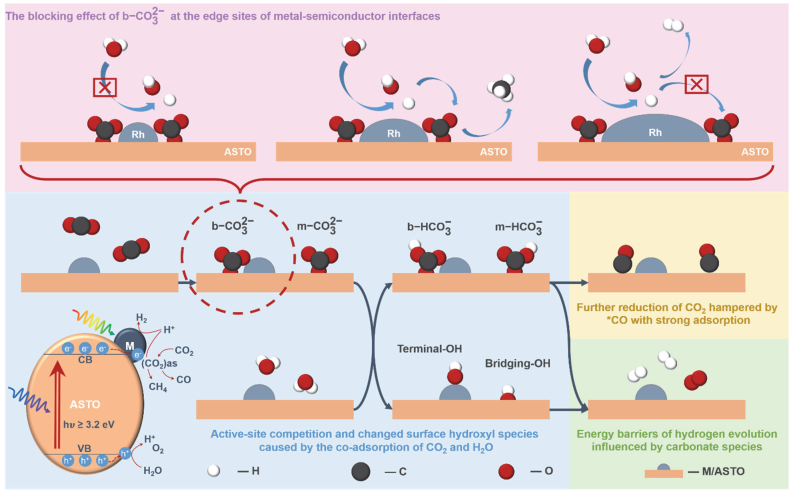
| 1 |
doi: 10.1039/D1EE02714J |
| 2 |
doi: 10.3866/PKU.WHXB202406029 |
| 3 |
doi: 10.1002/solr.201900546 |
| 4 |
doi: 10.1002/advs.202103926 |
| 5 |
doi: 10.3866/PKU.WHXB202304004 |
| 6 |
doi: 10.1002/solr.202200493 |
| 7 |
doi: 10.1016/j.nanoen.2022.107650 |
| 8 |
doi: 10.1038/s41586-020-2278-9 |
| 9 |
doi: 10.1016/j.joule.2017.12.009 |
| 10 |
doi: 10.1002/advs.202410201 |
| 11 |
doi: 10.1002/slct.202001693 |
| 12 |
doi: 10.1021/acsaem.9b01927 |
| 13 |
doi: 10.1016/j.seppur.2023.124528 |
| 14 |
doi: 10.3866/PKU.WHXB202308052 |
| 15 |
doi: 10.3866/PKU.WHXB202303029 |
| 16 |
doi: 10.1016/j.apcatb.2021.120635 |
| 17 |
doi: 10.1016/j.jcou.2021.101801 |
| 18 |
doi: 10.1038/s41467-021-21526-4 |
| 19 |
doi: 10.1021/acs.langmuir.1c02894 |
| 20 |
doi: 10.1016/j.cej.2023.147636 |
| 21 |
doi: 10.1038/s41524-024-01325-3 |
| 22 |
doi: 10.1016/j.mattod.2019.06.009 |
| 23 |
doi: 10.1038/s41467-022-33439-x |
| 24 |
doi: 10.1007/s42768-023-00185-9 |
| 25 |
doi: 10.1016/j.apcatb.2018.02.046 |
| 26 |
doi: 10.1016/j.apcatb.2017.08.011 |
| 27 |
doi: 10.1021/cs5012298 |
| 28 |
doi: 10.1021/acs.chemrev.9b00201 |
| 29 |
doi: 10.1002/adma.201704649 |
| 30 |
doi: 10.1016/j.apcatb.2025.125391 |
| 31 |
doi: 10.1016/j.apsusc.2024.162086 |
| 32 |
doi: 10.1007/s12274-017-1552-0 |
| 33 |
doi: 10.1093/nsr/nwae361 |
| 34 |
doi: 10.1002/anie.201301473 |
| 35 |
doi: 10.1039/B800260F |
| 36 |
doi: 10.1002/advs.201500085 |
| 37 |
doi: 10.1126/science.1141483 |
| 38 |
doi: 10.1002/anie.202304754 |
| 39 |
doi: 10.1038/s41929-024-01156-x |
| 40 |
doi: 10.1021/ja409445p |
| 41 |
doi: 10.1021/acs.chemrev.7b00776 |
| 42 |
doi: 10.1021/acscatal.2c01519 |
| 43 |
doi: 10.1016/S1872-2067(21)64048-2 |
| 44 |
doi: 10.1103/PhysRevLett.91.146401 |
| 45 |
doi: 10.1063/1.3382344 |
| 46 |
doi: 10.1103/PhysRevB.58.3641 |
| 47 |
doi: 10.1063/1.2770708 |
| 48 |
doi: 10.1038/s41929-020-00508-7 |
| 49 |
doi: 10.1021/jacs.7b10394 |
| 50 |
doi: 10.1021/acs.jpclett.8b02892 |
| 51 |
doi: 10.1002/anie.202219340 |
| 52 |
doi: 10.1016/j.ijhydene.2024.10.135 |
| 53 |
doi: 10.1038/s41377-020-00345-0 |
| 54 |
doi: 10.1002/sstr.202400283 |
| 55 |
doi: 10.1021/la0009240 |
| 56 |
doi: 10.1021/jp405625x |
| 57 |
doi: 10.1016/S0920-5861(98)00504-5 |
| 58 |
doi: 10.1246/bcsj.46.1616 |
| 59 |
doi: 10.1007/s10562-021-03539-2 |
| 60 |
doi: 10.1021/jacs.7b10287 |
| 61 |
doi: 10.1002/anie.201908058 |
| 62 |
doi: 10.1038/s41467-020-14817-9 |
| 63 |
doi: 10.1021/jacs.6b05791 |
| 64 |
doi: 10.1021/acscatal.7b01745 |
| 65 |
doi: 10.1002/aoc.5076 |
| 66 |
doi: 10.1021/acsaem.8b00817 |
| 67 |
doi: 10.1039/D2SC05160E |
| 68 |
doi: 10.1002/anie.202200190 |
| [1] | 黄火帅, 韦之栋, 严嘉玮, 池家晟, 苏千翔, 陈铭夏, 江治, 孙洋洲, 上官文峰. 揭示ZnxCd1−xS固溶体光催化析氢中的直接-间接带隙跃迁机制[J]. 物理化学学报, 2026, 42(1): 100141 - . |
| [2] | 赵呈孝, 李昭霖, 吴东方, 杨小飞. SBA-15模板化共价三嗪框架增强光催化产氢[J]. 物理化学学报, 2026, 42(1): 100149 - . |
| [3] | 李朋, 崔元映, 王中辽, DawsonGraham, 邵春风, 代凯. CeO2/Bi19Br3S27 S型异质结的高效界面电荷转移用于增强光催化CO2还原[J]. 物理化学学报, 2025, 41(6): 100065 - . |
| [4] | 刘雪, 王力鹏, 李璐伶, 王凯, 刘文举, 胡彪, 曹道帆, 江锋浩, 李俊国, 刘科. Cu基和Pt基甲醇水蒸气重整制氢催化剂研究进展[J]. 物理化学学报, 2025, 41(5): 100049 - . |
| [5] | 吕卓岩, 丁杨铭, 康磊磊, 李林, 刘晓艳, 王爱琴, 张涛. 光增强CuOx/TiO2催化丙烯氧气直接环氧化反应[J]. 物理化学学报, 2025, 41(4): 100038 - . |
| [6] | 李钦, 张慧慧, 顾华军, 崔园园, 高瑞华, 戴维林. Ti3C2 MXene纳米片上原位生长的Cd0.5Zn0.5S纳米棒实现高效可见光催化析氢[J]. 物理化学学报, 2025, 41(4): 100031 - . |
| [7] | 陈润华, 吴琼, 罗婧宸, 祖小龙, 朱姗, 孙永福. 缺陷态二维超薄材料用于光/电催化CO2还原的基础与展望[J]. 物理化学学报, 2025, 41(3): 100019 - . |
| [8] | 赵鑫婉, 曹越, 雷敏军, 靳治良, TsubakiNoritatsu. 构建S型异质结:通过将共价有机框架与过渡金属硫化物结合实现高效无贵金属光催化制氢[J]. 物理化学学报, 2025, 41(12): 100152 - . |
| [9] | 柳如艳, 倪振瑞, RuzimuradovOlim, TurayevKhayit, 刘涛, 余罗, 邝攀勇. Ni诱导的Pt 5d-H 1s反键轨道调控以增强析氢和尿素氧化[J]. 物理化学学报, 2025, 41(12): 100159 - . |
| [10] | KumarRohit, SudhaikAnita, Pawaz KhanAftab Asalam, NeguyenVan Huy, SinghArchana, SinghPardeep, ThakurSourbh, RaizadaPankaj. 设计串联S型光催化体系:机理见解、表征技术与应用[J]. 物理化学学报, 2025, 41(11): 100150 - . |
| [11] | 郭李娜, 李睿哲, 孙闯, 罗小利, 石义秋, 原弘, 欧阳述昕, 张铁锐. 层状双金属氢氧化物的层间阴离子对衍生的Ni-Al2O3催化剂光热催化CO2甲烷化反应的影响[J]. 物理化学学报, 2025, 41(1): 100002 - . |
| [12] | 秦春玲, 陈爽, GomaaHassanien, ShenashenMohamed A., El-SaftySherif A., 刘倩, 安翠华, 刘熙俊, 邓齐波, 胡宁. 外加物理场调控二维材料的HER和OER性能[J]. 物理化学学报, 2024, 40(9): 2307059 - . |
| [13] | 李亚晋, 刘会敏, 马兰, 刘佳雄, 贺德华. Au/Co3O4-ZnO催化剂上CO2-丙三醇羰基化合成丙三醇碳酸酯[J]. 物理化学学报, 2024, 40(9): 2308005 - . |
| [14] | 孙巍, 王永靖, 项坤, 白赛帅, 王海涛, 邹菁, Arramel, 江吉周. CoP修饰Ti3C2Tx MXene纳米复合材料作为高效析氢反应电催化剂[J]. 物理化学学报, 2024, 40(8): 2308015 - . |
| [15] | 项东, 李坤振, 苗康华, 龙冉, 熊宇杰, 康雄武. 胺功能化的铜催化剂:氢键介导的电化学CO2还原为C2产物以及优越的可充电Zn-CO2电池性能[J]. 物理化学学报, 2024, 40(8): 2308027 - . |
|
||