物理化学学报 >> 2025, Vol. 41 >> Issue (9): 100107.doi: 10.1016/j.actphy.2025.100107
增强g-C3N4@BN范德华异质结界面上的三重态电子转移增强光催化合成H2O2
吴琦, 王长华*( ), 李莹莹, 张昕彤*()
- 东北师范大学, 中国教育部紫外发光材料与技术重点实验室, 吉林 长春 130024
-
收稿日期:2025-03-31修回日期:2025-05-25录用日期:2025-05-25发布日期:2025-07-04 -
通讯作者:Email: wangch100@nenu.edu.cn (王长华)xtzhang@nenu.edu.cn (张昕彤) -
基金资助:吉林省科技发展计划项目(20220201073GX); 国家自然科学基金(52273236); 国家自然科学基金(U22A2078); 国家自然科学基金(91833303); 国家自然科学基金(51102001); 中央高校基本科研业务费专项资金(2412022QD035); 吉林省教育厅(JJKH20241426KJ)
Enhanced photocatalytic synthesis of H2O2 by triplet electron transfer at g-C3N4@BN van der Waals heterojunction interface
Qi Wu, Changhua Wang*(), Yingying Li, Xintong Zhang*()
- Key Laboratory of UV-Emitting Materials and Technology of Chinese Ministry of Education, Northeast Normal University, Changchun 130024, Jilin Province, China
-
Received:2025-03-31Revised:2025-05-25Accepted:2025-05-25Published:2025-07-04 -
Contact:Email: wangch100@nenu.edu.cn (Changhua Wang)xtzhang@nenu.edu.cn (Xintong Zhang) -
Supported by:the Jilin Province Science and Technology Development Project(20220201073GX); the Natural Science Foundation of China(52273236); the Natural Science Foundation of China(U22A2078); the Natural Science Foundation of China(91833303); the Natural Science Foundation of China(51102001); the Fundamental Research Funds for the Central Universities(2412022QD035); the Education Department of Jilin Province(JJKH20241426KJ)

摘要:
范德华异质结因其优异的电荷分离能力和在调节电子特性方面的显著灵活性而展现出卓越优势。本研究探讨了二维/二维(2D/2D) g-C3N4@BN范德华异质结在光催化合成过氧化氢(H2O2)中的潜在应用。基于该异质结,我们深入研究了三重态激子与单线态氧之间的能量转移过程,强调了催化剂结构对电荷分离和三重态电子稳定生成的重要性。通过构建电荷转移路径,异质结内的内置电场有效驱动了电荷载流子的定向迁移,显著延长了其寿命。我们采用了两种修饰策略来调控催化剂的激发态电子特性,包括调整层间排列以增强电荷传输能力,以及卤素修饰以提高材料的光响应性。实验验证表明,与CN相比,代表性的氯化-CN@BN有效抑制了激子复合,将激发态载流子的寿命延长了3.52倍。此外,H2O2的光催化产率提高了2.73倍。本研究为开发新型光催化剂提供了理论基础,并启发了从氧气直接合成H2O2的催化剂设计。
引用本文
吴琦, 王长华, 李莹莹, 张昕彤. 增强g-C3N4@BN范德华异质结界面上的三重态电子转移增强光催化合成H2O2[J]. 物理化学学报, 2025, 41(9), 100107. doi: 10.1016/j.actphy.2025.100107
Qi Wu, Changhua Wang, Yingying Li, Xintong Zhang. Enhanced photocatalytic synthesis of H2O2 by triplet electron transfer at g-C3N4@BN van der Waals heterojunction interface[J]. Acta Phys. -Chim. Sin. 2025, 41(9), 100107. doi: 10.1016/j.actphy.2025.100107
图1
"
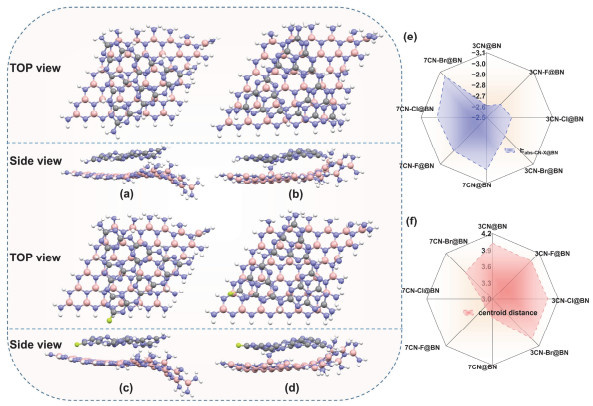
图2
"
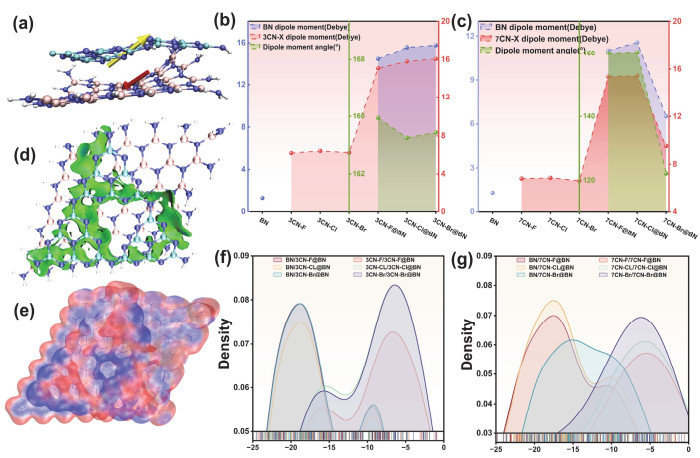
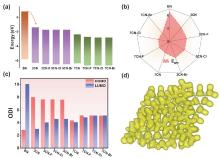
图3
"
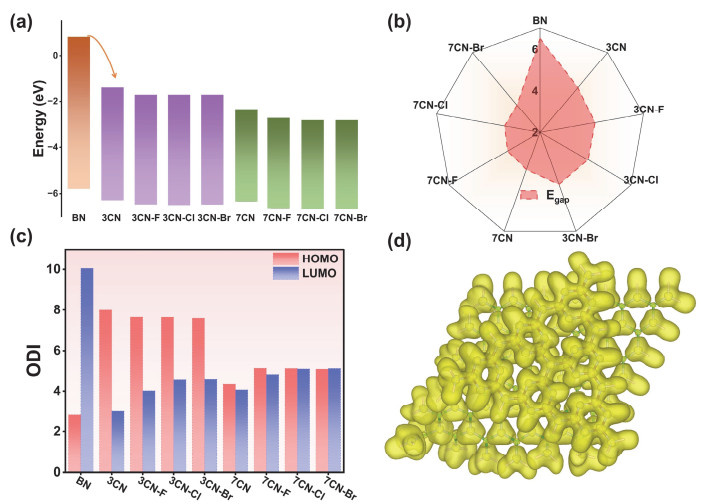
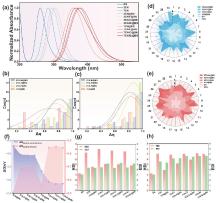
图4
"
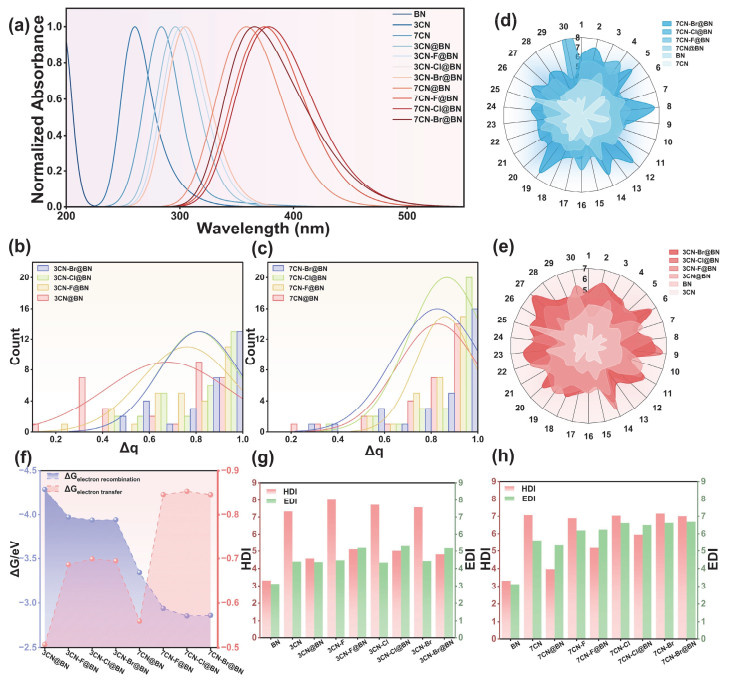
图5
"
图6
"
图7
"
| 1 |
doi: 10.1002/adma.202307490 |
| 2 |
doi: 10.3866/PKU.WHXB202406021 |
| 3 |
doi: 10.1002/adfm.202205119 |
| 4 |
doi: 10.1002/aenm.202301047 |
| 5 |
doi: 10.1016/j.apcatb.2023.123490 |
| 6 |
doi: 10.1016/j.cej.2023.141817 |
| 7 |
doi: 10.1016/j.apcatb.2021.120197 |
| 8 |
doi: 10.1016/j.apsusc.2022.155991 |
| 9 |
doi: 10.1063/5.0196557 |
| 10 |
doi: 10.1002/adma.202206516 |
| 11 |
doi: 10.1002/anie.202405396 |
| 12 |
doi: 10.1016/j.cej.2023.146383 |
| 13 |
doi: 10.1021/acscatal.4c01591 |
| 14 |
doi: 10.1002/anie.202310476 |
| 15 |
doi: 10.1016/j.checat.2023.100861 |
| 16 |
doi: 10.1021/jacs.4c08551 |
| 17 |
doi: 10.1016/j.ccr.2022.214975 |
| 18 |
doi: 10.1021/jacsau.2c00442 |
| 19 |
doi: 10.1021/acs.nanolett.2c00017 |
| 20 |
doi: 10.1021/acs.nanolett.4c02986 |
| 21 |
doi: 10.1016/j.actphy.2025.100065 |
| 22 |
doi: 10.1016/j.jmst.2024.12.094 |
| 23 |
doi: 10.1016/j.seppur.2023.125287 |
| 24 |
doi: 10.1016/S1872-2067(21)64010-X |
| 25 |
doi: 10.1016/j.jmst.2023.11.081 |
| 26 |
doi: 10.3866/PKU.WHXB202405016 |
| 27 |
doi: 10.3866/PKU.WHXB202310013 |
| 28 |
doi: 10.1016/j.cej.2022.136051 |
| 29 |
doi: 10.1002/anie.202004747 |
| 30 |
doi: 10.1073/pnas.2410504121 |
| 31 |
doi: 10.1016/j.actphy.2025.100052 |
| 32 |
doi: 10.3866/PKU.WHXB202407014 |
| 33 |
doi: 10.1016/S1872-2067(23)64496-1 |
| 34 |
doi: 10.1016/j.coche.2024.101040 |
| 35 |
doi: 10.3866/PKU.WHXB202403009 |
| 36 |
doi: 10.3866/PKU.WHXB202406005 |
| 37 |
doi: 10.1016/S1872-2067(24)60114-2 |
| 38 |
doi: 10.1038/s41570-025-00698-3 |
| 39 |
doi: 10.1021/acs.inorgchem.1c00062 |
| 40 |
doi: 10.1016/j.surfin.2023.103152 |
| 41 |
doi: 10.1016/S1872-2067(24)60072-0 |
| 42 |
doi: 10.1016/S1872-2067(23)64607-8 |
| 43 |
doi: 10.1016/j.apcatb.2017.09.059 |
| 44 |
doi: 10.1039/D4TA02059F |
| 45 |
doi: 10.1002/adfm.202315426 |
| 46 |
M.J. Frisch, G.W. Trucks, H.B. Schlegel, G.E. Scuseria, M.A. Robb, J.R. Cheeseman, G. Scalmani, V. Barone, G.A. Petersson, H. Nakatsuji, et al. Gaussian 16 Rev. B. 01[Z]. Wallingford, CT. 2016
|
| 47 |
doi: 10.1016/j.carbon.2021.11.005 |
| 48 |
doi: 10.1002/jcc.22885 |
| 49 |
doi: 10.1002/wcms.81 |
| 50 |
doi: 10.1002/jcc.26812 |
| 51 |
doi: 10.1016/0304-4173(85)90014-X |
| 52 |
doi: 10.1039/c0ee00071j |
| 53 |
doi: 10.1038/s41467-024-47022-z |
| 54 |
doi: 10.1002/anie.202306709 |
| 55 |
doi: 10.1007/s13538-013-0141-2 |
| 56 |
doi: 10.1016/j.carbon.2020.05.023 |
| 57 |
doi: 10.1021/ct400337e |
| 58 |
doi: 10.1038/s41560-023-01211-0 |
| 59 |
doi: 10.1021/acs.chemmater.6b01691 |
| 60 |
doi: 10.1021/acs.jpcc.5b03530 |
| 61 |
doi: 10.1016/j.actphy.2025.100064 |
| 62 |
doi: 10.1016/j.jmst.2023.12.054 |
| [1] | 彭雪峰,雷勇,刘振,吉霞霞,范昌君,杨晓晖. 采用聚合物基质材料的热激活延迟荧光及其敏化器件[J]. 物理化学学报, 2016, 32(9): 2369 -2376 . |
| [2] | 许泽清, 高保娇, 侯晓东. 芳环上硝基取代基对苯甲酸功能化聚苯乙烯-Eu(Ⅲ)配合物光致发光性能的双重影响[J]. 物理化学学报, 2014, 30(4): 745 -752 . |
| [3] | 韩荣成, 喻敏, 沙印林. 溶液环境中CdSeS量子点与金纳米颗粒相互作用[J]. 物理化学学报, 2011, 27(01): 255 -261 . |
| [4] | 李艳虎, 方园, 邹建华, 王彪, 吴宏滨, 彭俊彪. 基于蓝黄磷光二元互补色的高效聚合物白光器件[J]. 物理化学学报, 2010, 26(10): 2752 -2756 . |
| [5] | 唐晓闩;王鸿梅;韩海燕;李建权;金顺平;黄国栋;储焰南;张为俊;周士康. 溴代烷烃与活性氮的反应发光研究[J]. 物理化学学报, 2005, 21(04): 392 -396 . |
| [6] | 刘泽华;赖仁福;郭海清. 发光反应型有机铵分子与CdSe纳米晶的组装[J]. 物理化学学报, 2004, 20(09): 1067 -1070 . |
| [7] | 吕超;林金明. 胶束微观非均相体系与化学发光能量转移[J]. 物理化学学报, 2004, 20(08S): 974 -981 . |
| [8] | 商志才;范成平;郭明;俞庆森. 荧光法研究氧氟沙星与牛乳铁蛋白的相互结合作用[J]. 物理化学学报, 2004, 20(08): 864 -867 . |
| [9] | 宋会花;方震;郭海清. 纳米CdSe与聚4-乙烯基吡啶盐的复合与表征[J]. 物理化学学报, 2003, 19(01): 9 -12 . |
| [10] | 江华;许慧君. 用能量转移探测萘-蒽二元分子体系的构象变化[J]. 物理化学学报, 2001, 17(12): 1092 -1096 . |
| [11] | 吴成印,储焰南,曹德兆. F原子与I2的化学发光反应[J]. 物理化学学报, 1997, 13(10): 885 -889 . |
| [12] | 钟国伦,杨孔章. LB膜中稀土配合物分子间能量转移研究[J]. 物理化学学报, 1997, 13(06): 493 -496 . |
| [13] | 张长拴,江鸿,李洁,李铁津. 蒽醌与稀土离子间的能量转移研究[J]. 物理化学学报, 1997, 13(04): 370 -375 . |
| [14] | 胡义华,王小涓,詹业宏,储焰南,李书涛,曹德兆,郭敬忠,刘传朴,顾月姝. 亚稳态He(23S)、Ar(3P0.2)原子与C2H3分子传能反应[J]. 物理化学学报, 1996, 12(11): 1011 -1014 . |
| [15] | 蔡继业,刘奕,李亚东,成国胜,张伟,张冰,周士康,高军毅,龚知本. 二极管激光探测法研究高振动NO2与NH3振动传能[J]. 物理化学学报, 1996, 12(09): 786 -795 . |
|
||