物理化学学报 >> 2026, Vol. 42 >> Issue (10): 100264.doi: 10.1016/j.actphy.2026.100264
分级ZIF衍生碳/Bi12O17Cl2异质结构协同调控电子动力学与光学性能,提升纯水体系中CO2光还原性能
高韵晗1, 孙星2, 季梦夏1,*( ), 邱杏昌1, 韦天歌1, 徐箐2, 尹盛2, 夏杰祥2,*(), 李华明1,*()
- 1 江苏大学能源研究院, 江苏 镇江 212013
2 江苏大学化学化工学院, 江苏 镇江 212013
-
收稿日期:2025-12-03修回日期:2026-02-16录用日期:2026-02-25发布日期:2026-09-03 -
通讯作者:Email: jmx@ujs.edu.cn (季梦夏)xjx@ujs.edu.cn (夏杰祥)lihm@ujs.edu.cn (李华明)
Hierarchical ZIF-derived carbon/Bi12O17Cl2 heterostructures synergistically enhance electron dynamics and optical properties to boost CO2 photoreduction in pure water
Yunhan Gao1, Xing Sun2, Mengxia Ji1,*(), Xingchang Qiu1, Tiange Wei1, Qing Xu2, Sheng Yin2, Jiexiang Xia2,*(), Huaming Li1,*()
- 1 Institute for Energy Research, Jiangsu University, Zhenjiang 212013, Jiangsu Province, China
2 School of Chemistry and Chemical Engineering, Jiangsu University, Zhenjiang 212013, Jiangsu Province, China
-
Received:2025-12-03Revised:2026-02-16Accepted:2026-02-25Published:2026-09-03 -
Contact:Email: jmx@ujs.edu.cn (Mengxia Ji)xjx@ujs.edu.cn (Jiexiang Xia)lihm@ujs.edu.cn (Huaming Li)

摘要:
传统Bi12O17Cl2光催化剂存在太阳光捕获范围窄、CO2吸附能力弱及电荷利用率低等问题。本研究通过将Bi12O17Cl2超薄纳米管嵌入分级Co-ZIF衍生多孔碳(Co-PC/BOC),构建了紧密的分级异质结结构。Co-PC纳米笼内的多重空腔反射效应与原位生成Co3O4位点的局域表面等离子体共振协同作用,使Co-PC/BOC在全光谱范围内光捕获能力显著增强。在不使用任何光敏剂或牺牲剂的纯水体系中,最优复合材料表现出34.16 μmol g−1 h−1的CO产率(100%选择性),是单体BOC的2.9倍。原位漫反射红外光谱及光电化学测试表明:Co-PC兼具等离子体热电子注入体与电荷分离中心的双重功能,而BOC为*COOH形成与*CO解离提供了丰富的表面活性位点。本工作揭示了金属有机框架及其衍生物在构建高效人工光合体系中的重要潜力。
引用本文
高韵晗, 孙星, 季梦夏, 邱杏昌, 韦天歌, 徐箐, 尹盛, 夏杰祥, 李华明. 分级ZIF衍生碳/Bi12O17Cl2异质结构协同调控电子动力学与光学性能,提升纯水体系中CO2光还原性能[J]. 物理化学学报, 2026, 42(10), 100264. doi: 10.1016/j.actphy.2026.100264
Yunhan Gao, Xing Sun, Mengxia Ji, Xingchang Qiu, Tiange Wei, Qing Xu, Sheng Yin, Jiexiang Xia, Huaming Li. Hierarchical ZIF-derived carbon/Bi12O17Cl2 heterostructures synergistically enhance electron dynamics and optical properties to boost CO2 photoreduction in pure water[J]. Acta Phys. -Chim. Sin. 2026, 42(10), 100264. doi: 10.1016/j.actphy.2026.100264
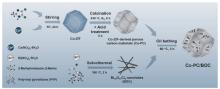
图Scheme 1
"
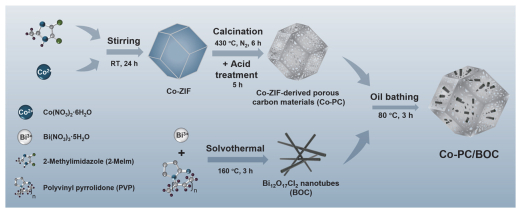
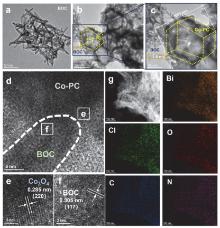
图1
"
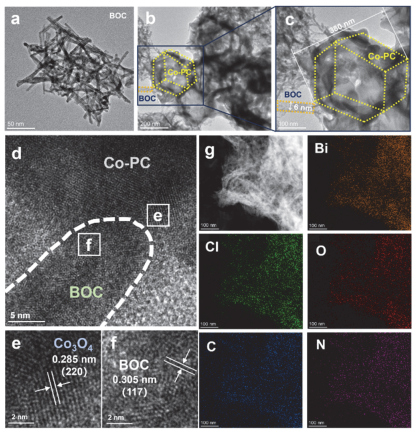
图2
"
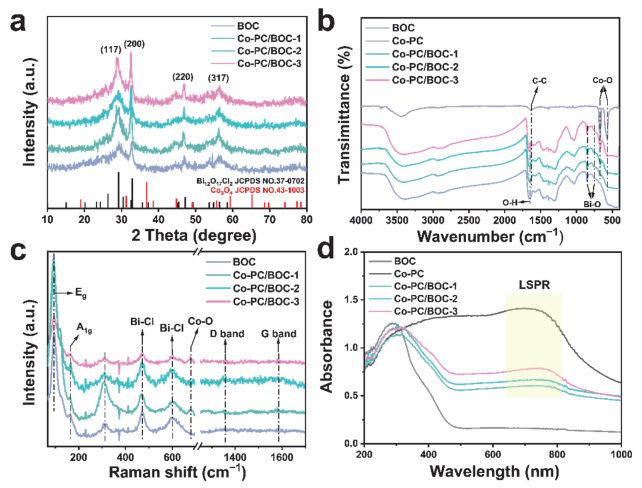
图3
"
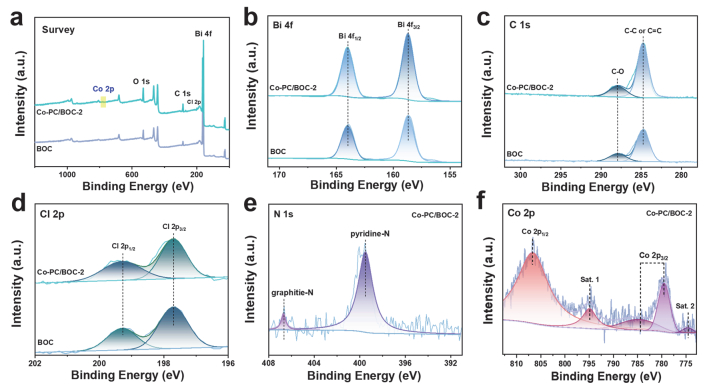
图4
"
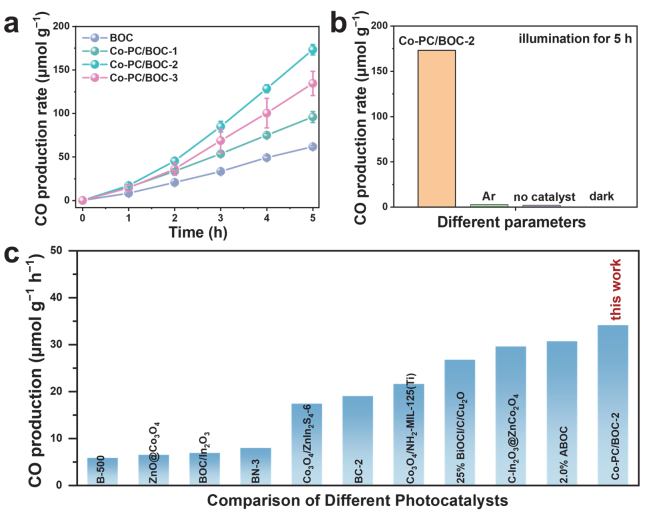
图5
"
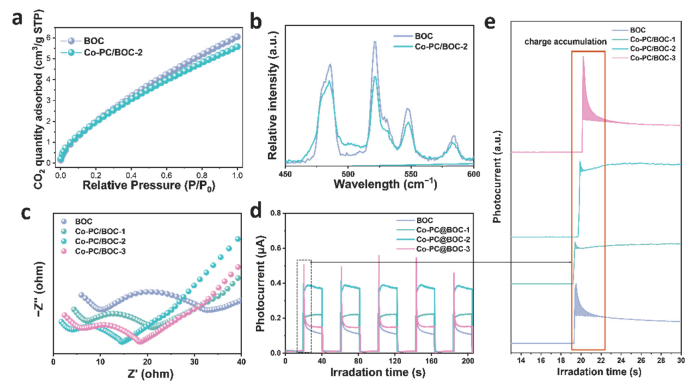
图6
"
| 1 |
A. McLaren, T. Valdes-Solis, G. Li, S. Tsang. J. Am. Chem. Soc. 2009, 131(35), 12540.
doi: 10.1021/ja9052703 |
| 2 |
C. Zhang, M. Akhlaq, H. Yan, Y. Ni, S. Liang, J. Zhou, R. Xue, M. Li, R. Adnan, J. Li. Agric. Water Manag. 2023, 284, 108333.
doi: 10.1016/j.agwat.2023.108333 |
| 3 |
S. Yao, J. He, F. Gao, H. Wang, J. Lin, Y. Bai, J. Fang, F. Zhu, F. Huang, M. Wang. J. Mater. Chem. A 2023, 11, 12539.
doi: 10.1039/D2TA09234D |
| 4 |
L. Hurtado, A. Mohan, U. Ulmer, R. Natividad, A. Tountas, W. Sun, L. Wang, B. Kim, M. Sain, G. Ozin. Chem. Eng. J. 2022, 435, 134864.
doi: 10.1016/j.cej.2022.134864 |
| 5 |
M. Zhao, J. Qin, N. Wang, Y. Zhang, H. Cui. Sep. Purif. Technol. 2024, 329, 125179.
doi: 10.1016/j.seppur.2023.125179 |
| 6 |
S. Cheng, Z. Sun, K. Lim, T. Zhang, E. Hondo, T. Du, L. Liu, M. Judd, N. Cox, Z. Yin, et al.. ACS Appl. Nano Mater. 2023, 6(5), 3608.
doi: 10.1021/acsanm.2c05364 |
| 7 |
S. Ali, S. Sarkar, A. Patra. ACS Appl. Mater. Interfaces 2024, 16(29), 38061.
doi: 10.1021/acsami.4c06647 |
| 8 |
F. Xu, L. Zheng, J. Zhang, Y. He, H. Cao, X. Zheng, H. García, J. Yu. Nat. Catal. 2026, 9(1), 73.
doi: 10.1038/s41929-025-01471-x |
| 9 |
J. Di, C. Zhu, M. Ji, M. Duan, R. Long, C. Yan, K. Gu, J. Xiong, Y. She, J. Xia, et al.. Angew. Chem. Int. Ed. 2018, 57(45), 14847.
doi: 10.1002/anie.201809492 |
| 10 |
J. Li, X. Sun, Y. Duan, J. Ma, C. He, S. Li. Chem. Eng. J. 2023, 473, 145383.
doi: 10.1016/j.cej.2023.145383 |
| 11 |
Q. Li, Y. Li, B. Li, Y. Hao, X. Wang, R. Liu, Y. Ling, X. Liu, F. Li. App. Catal. B: Environ. 2021, 289, 120041.
doi: 10.1016/j.apcatb.2021.120041 |
| 12 |
D. Kato, O. Tomita, R. Nelson, M. Kirsanova, R. Dronskowski, H. Suzuki, C. Zhong, C. Tassel, K. Ishida, Y. Matsuzaki, et al.. Adv. Funct. Mater. 2022, 32(41), 2204112.
doi: 10.1002/adfm.202204112 |
| 13 |
C. Liu, H. Yu, J. Li, X. Yu, Z. Yu, Y. Song, F. Zhang, Q. Zhang, Z. Zou. Acta Phys. -Chim. Sin. 2025, 41(7), 100075.
doi: 10.1016/j.actphy.2025.100075 |
| 14 |
L. Zhou, Q. Huang, Y. Xia. Chem. Rev. 2024, 124(14), 8597.
doi: 10.1021/acs.chemrev.4c00165 |
| 15 |
D. Liu, C. Wang, Y. Yu, B. Zhao, W. Wang, Y. Du, B. Zhang. Chem 2019, 5(2), 376.
doi: 10.1016/j.chempr.2018.11.001 |
| 16 |
Q. Liu, Y. Wu, J. Zhang, K. Chen, C. Huang, H. Chen, X. Qiu. Appl. Surf. Sci. 2019, 490, 395.
doi: 10.1016/j.apsusc.2019.06.099 |
| 17 |
Y. Li, M. Wen, Y. Wang, G. Tian, C. Wang, J. Zhao. Angew. Chem. Int. Ed. 2021, 60(2), 910.
doi: 10.1002/ange.202010156 |
| 18 |
Z. Cai, W. Tao, C. Moore, S. Zhang, C. Wade. Angew. Chem. Int. Ed. 2021, 60(39), 21221.
doi: 10.1002/anie.202108095 |
| 19 |
W. Chen, B. Han, C. Tian, X. Liu, S. Liang, H. Deng, Z. Lin. App. Catal. B: Environ. 2019, 244, 996.
doi: 10.1016/j.apcatb.2018.12.045 |
| 20 |
Y. Wang, K. Liu, Y. Bi, Y. Wei, Y. Li, X. Shi, G. Zhao, A. Huang, Acta Phys. -Chim. Sin. (2026) https://doi.org/10.1016/j.actphy.2026.100238.
|
| 21 |
M. Li, Z. Liu, S. Wu, J. Zhang. ACS EST Engg. 2022, 2(6), 942.
doi: 10.1021/acsestengg.1c00447 |
| 22 |
C. Tang, H. Rao, S. Li, P. She, J. Qin. Small 2024, 20(48), 2405533.
doi: 10.1002/smll.202405533 |
| 23 |
J. Qin, S. Wang, X. Wang. App. Catal. B: Environ. 2017, 209, 476.
doi: 10.1016/j.apcatb.2017.03.018 |
| 24 |
J. Fan, L. Shi, H. Ge, J. Liu, X. Deng, Z. Li, Q. Liang. Adv. Funct. Mater. 2025, 35(1), 2412078.
doi: 10.1002/adfm.202412078 |
| 25 |
E. Musa, A. Yadav, K. Smith, M. Jung, W. Stickle, P. Eschbach, X. Ji, K. Stylianou. Angew. Chem. Int. Ed. 2024, 63(42), e202405681.
doi: 10.1002/ange.202405681 |
| 26 |
D. Ma, F. Liang, Q. Xue, Y. Liu, C. Zhuang, S. Li. Acta Phys. -Chim. Sin. 2025, 41(12), 100190.
doi: 10.1016/j.actphy.2025.100190 |
| 27 |
C. Zhou, C. Lai, P. Xu, G. Zeng, D. Huang, Z. Li, C. Zhang, M. Cheng, L. Hu, J. Wan, et al.. ACS Sustainable Chem. Eng. 2018, 6(5), 6941.
doi: 10.1021/acssuschemeng.8b00782 |
| 28 |
H. Liu, Y. Qiu, W. Gan, G. Zhuang, F. Chen, C. Yang, Y. Yu. Sci. China. Mater. 2024, 67(2), 588.
doi: 10.1007/s40843-023-2707-3 |
| 29 |
S. Hu, Z. Deng, M. Xing, S. Wu, J. Zhang. Res. Chem. Intermed. 2022, 48(8), 3275.
doi: 10.1007/s11164-022-04774-x |
| 30 |
D. Liu, D. Chen, N. Li, Q. Xu, H. Li, J. He, J. Lu. Small 2019, 15(31), 1902291.
doi: 10.1002/smll.201902291 |
| 31 |
B. Li, Y. Cui, Y. Feng, C. Wu, Y. Yan, M. Meng. Appl. Surf. Sci. 2020, 532, 147412.
doi: 10.1016/j.apsusc.2020.147412 |
| 32 |
X. Zhao, X. Yi, W. Pan, Y. Wang, S. Luo, Y. Zhang, R. Xie, D. Leung. J. Mater. Sci. Technol. 2023, 133, 135.
doi: 10.1016/j.jmst.2022.06.022 |
| 33 |
Q. Yang, C. Yang, C. Lin, H. Jiang. J. Colloid Interface Sci. 2019, 58(11), 3511.
doi: 10.1002/ange.201813494 |
| 34 |
M. Du, S. Yang, J. Zhang, D. Syrtsov, J. Ghasemi, M. Fedin, L. Zhang. J. Mater. Sci. Technol. 2026, 243, 245.
doi: 10.1016/j.jmst.2025.05.016 |
| 35 |
L. Luo, X. Liu, S. Ma, L. Li, T. You. Food Chem. 2020, 322, 126778.
doi: 10.1016/j.foodchem.2020.126778 |
| 36 |
T. Shi, Y. Zhong, Y. Feng, D. Chen, H. Ding, K. Chen. J. Mater. Sci. : Mater. Electron. 2022, 33(22), 17522.
doi: 10.1007/s10854-022-08614-x |
| 37 |
Y. Pan, K. Sun, S. Liu, X. Cao, K. Wu, W. Cheong, Z. Chen, Y. Wang, Y. Li, Y. Liu. J. Am. Chem. Soc. 2018, 140(7), 2610.
doi: 10.1021/jacs.7b12420 |
| 38 |
J. Di, J. Xia, M. Ji, B. Wang, S. Yin, Q. Zhang, Z. Chen, H. Li. ACS Appl. Mater. Interfaces 2015, 7(36), 20111.
doi: 10.1021/acsami.5b05268 |
| 39 |
X. Sun, M. Ji, Y. Zhang, Q. Xing, Z. Liu, N. Liu, E. Nkudede, H. Li, S. Yin, J. Xia. J. Mater. Sci. Technol. 2024, 171, 47.
doi: 10.1016/j.jmst.2023.05.075 |
| 40 |
K. Min, M. Hwang, S. Shim, D. Lim, S. Baeck. Chem. Eng. J. 2021, 424, 130400.
doi: 10.1016/j.cej.2021.130400 |
| 41 |
G. Zhu, X. Li, H. Wang, L. Zhang. Catal. Commun. 2017, 88, 5.
doi: 10.1016/j.catcom.2016.09.024 |
| 42 |
L. Zhang, Z. Jin, N. Tsubaki. ACS Appl. Mater. Interfaces 2021, 13(43), 50996.
doi: 10.1021/acsami.1c14987 |
| 43 |
T. Baran, D. Caringella, A. Dibenedetto, M. Aresta. Molecules 2024, 29(19), 4758.
doi: 10.3390/molecules29194758 |
| 44 |
N. Moustakas, M. Klahn, B. Mei, A. Pougin, M. Dilla, T. Peppel, S. Ristig, J. Strunk. HardwareX 2023, 15, e00448.
doi: 10.1016/j.ohx.2023.e00448 |
| 45 |
L. Liu, J. Hu, Y. Sheng, H. Akhoundzadeh, W. Tu, W. Siow, J. Ong, H. Huang, R. Xu. ACS Nano 2024, 18(38), 26271.
doi: 10.1021/acsnano.4c08303 |
| 46 |
Y. Xu, M. Hassan, S. Ali, H. Li, Q. Ouyang, Q. Chen. J. Agric. Food Chem. 2021, 69(5), 1667.
doi: 10.1021/acs.jafc.0c06513 |
| 47 |
J. Li, C. He, J. Wang, X. Gu, Z. Zhang, H. Li, M. Li, L. Wang, S. Wu, J. Zhang. Green Chem. 2023, 25(21), 8826.
doi: 10.1039/d3gc02371k |
| 48 |
Z. Bin, L. Feng, Y. Yan. Food Chem. 2022, 388, 132898.
doi: 10.1016/j.foodchem.2022.132898 |
| 49 |
J. Yang, L. Jing, X. Zhu, W. Zhang, J. Deng, Y. She, K. Nie, Y. Wei, H. Li, H. Xu. App. Catal. B: Environ. 2023, 320, 122005.
doi: 10.1016/j.apcatb.2022.122005 |
| 50 |
X. Yue, L. Cheng, F. Li, J. Fan, Q. Xiang. Angew. Chem. Int. Ed. 2022, 61(40), e202208414.
doi: 10.1002/ange.202208414 |
| 51 |
S. Mazarin, W. Kira, D. da Costa-Filho, C. Zanata, H. Wender, C. Martins. ACS Omega 2025, 10(21), 21529.
doi: 10.1021/acsomega.5c00546 |
| 52 |
J. Wang, D. Liu, M. Li, X. Gu, S. Wu, J. Zhang. Chin. J. Catal. 2024, 63, 202.
doi: 10.1016/S1872-2067(24)60074-4 |
| 53 |
M. Li, C. He, X. Yang, Z. Liu, J. Li, L. Wang, S. Wu, J. Zhang. Chem Catal. 2023, 3(10), 100737.
doi: 10.1016/j.checat.2023.100737 |
| 54 |
M. Ji, J. Di, J. Zhao, C. Chen, Y. Zhang, Z. Liu, H. Li, J. Xia, M. He, H. Li. J. CO2 Util 2022, 59, 101957.
doi: 10.1016/j.jcou.2022.101957 |
| 55 |
Z. Cai, H. Liu, J. Dai, B. Li, L. Yang, J. Wang, H. Zhu. Nat. Commun. 2025, 16(1), 2601.
doi: 10.1038/s41467-025-57742-5 |
| 56 |
Y. Liu, Y. Liu, Z. Yao, Z. Yu, H. Zhu, C. Xing, Y. Wang, X. Tan, Y. Huang, Y. Hou, et al.. Appl. Catal. B Environ. Energy 2025, 371, 125275.
doi: 10.1016/j.apcatb.2025.125275 |
| 57 |
X. Chang, T. Wang, J. Gong. Energy Environ. Sci. 2016, 9(7), 2177.
doi: 10.1039/c6ee00383d |
| 58 |
J. Li, G. Zhan, Y. Yu, L. Zhang. Nat. Commun. 2016, 7(1), 11480.
doi: 10.1038/ncomms11480 |
| 59 |
Y. Dai, W. Peng, Y. Ji, J. Wei, J. Che, Y. Huang, W. Huang, W. Yang, W. Xu. J. Food Sci. 2024, 89(11), 8022.
doi: 10.1111/1750-3841.17398 |
| [1] | 殷鸿飞, 洪梦玲, 张锦阳, 王文涛, 陈伟, 吴国志. 氧空位介导的2D/2D Bi2MoO6/Bi2O2S S型异质结用于高效CO2光还原[J]. 物理化学学报, 2026, 42(9): 100332 - . |
| [2] | 许凯强, 于佳, 夏伟, 张建军, 韩生. 范德华S型异质结赋予快速电荷转移助力光催化活性提升[J]. 物理化学学报, 2026, 42(7): 100211 - . |
| [3] | 邓玉金, 陈怡爽, 张礼杰, 金辉乐, 杨云, 徐全龙, 王舜. 等离子体金纳米双锥强局域电场促进共价有机框架光催化析氢研究[J]. 物理化学学报, 2026, 42(6): 100193 - . |
| [4] | 严鹏程, 王鹏, 黄婧, 莫曌, 徐丽, 陈芸, 张瑜, 齐志冲, 许晖, 李赫楠. 多策略提升卤化氧铋活性材料的光电性能及其在光电化学领域的应用进展[J]. 物理化学学报, 2025, 41(2): 100014 - . |
| [5] | 马浩桐, 衡明宇, 许杨, 毕炜, 缪应纯, 肖舒宁. 微波合成铜负载的碳掺杂氮化硼光催化材料及其大气浓度下CO2还原性能研究[J]. 物理化学学报, 2025, 41(11): 100132 - . |
| [6] | 赵艳艳, 吴珍, 张勇, 朱必成, 张建军. 促进电荷分离和增强O2吸附双重策略提升金修饰含硫空位CdIn2S4的光催化产H2O2性能[J]. 物理化学学报, 2025, 41(11): 100142 - . |
| [7] | 蒋金辉, 孙佳琦, 陈咏一, 张磊, 董鹏玉. W18O49/铝掺杂SrTiO3 S型异质结在LSPR效应辅助下实现全光谱太阳光驱动的光催化产氢[J]. 物理化学学报, 2025, 41(11): 100145 - . |
| [8] | 徐新宇, 陆迦勒, 苏波, 陈佳义, 陈雄, 汪思波. 调控电荷动力学与表面反应性用于Au/Ti-CeO2光催化甲烷选择性氧化制乙烷[J]. 物理化学学报, 2025, 41(11): 100153 - . |
| [9] | 刘高鹏, 李利娜, 王彬, 单宁杰, 董金涛, 季梦夏, 朱文帅, 朱剑豪, 夏杰祥, 李华明. 构筑Bi纳米粒子负载BiOCl纳米片欧姆结用于光催化CO2还原[J]. 物理化学学报, 2024, 40(7): 2306041 - . |
| [10] | 崔元映, 张金锋, 褚海亮, 孙立贤, 代凯. 铋基光催化剂在太阳能转换中的合理设计[J]. 物理化学学报, 2024, 40(12): 2405016 - . |
| [11] | 秦建宇, 安月皎, 张艳峰. 原位合成S型氮缺陷ZnWO4/g-C3N4异质结及CO2光还原性能[J]. 物理化学学报, 2024, 40(12): 2408002 - . |
| [12] | 程敬招, 高诗语, 程蓓, 杨凯, 王往, 曹少文. 4-氨基-1H-咪唑-5-甲腈修饰供体-受体型氮化碳光催化剂的构建及其高效光催化产氢研究[J]. 物理化学学报, 2024, 40(11): 2406026 - . |
| [13] | 徐阳锐, 任叶炜, 刘馨琳, 李宏平, 逯子扬. 具有高传质和亲和表面的NH2-UIO-66基疏水多孔液体用于增强CO2光还原[J]. 物理化学学报, 2024, 40(11): 2403032 - . |
| [14] | 王中辽, 汪静, 张金锋, 代凯. 光激发电荷在光催化氧化还原反应中的全利用[J]. 物理化学学报, 2023, 39(6): 2209037 - . |
| [15] | 胡程, 黄洪伟. 压电极化增强光催化能源转化的研究进展[J]. 物理化学学报, 2023, 39(11): 2212048 - . |
|
||