Acta Phys. -Chim. Sin. ›› 2025, Vol. 41 ›› Issue (5): 100042.doi: 10.1016/j.actphy.2024.100042
• ARTICLE • Previous Articles Next Articles
Highly Efficient, Targeted, and Traceable Perovskite Nanocrystals for Photoelectrocatalytic Oncotherapy
Jian Li1,2,3, Yu Zhang2, Rongrong Yan1,4, Kaiyuan Sun5, Xiaoqing Liu1, Zishang Liang1,4, Yinan Jiao4, Hui Bu2,*( ), Xin Chen1,6,*(), Jinjin Zhao1,*(), Jianlin Shi7
- 1 College of Chemistry and Materials Science, Hebei Technology Innovation Center for Energy Conversion Materials and Devices, Hebei Key Laboratory of Inorganic Nanomaterials, Engineering Research Center of Thin Film Solar Cell Materials and Devices, Hebei Province, Hebei Normal University, Shijiazhuang 050024, China
2 Department of Neurology, The Second Hospital of Hebei Medical University, Key Laboratory of Clinical Neurology (Hebei Medical University), Ministry of Education, Neurological Laboratory of Hebei Province, Shijiazhuang 050051, China
3 General Practice Department, Hengshui People's Hospital, Hengshui 053000, Hebei Province, China
4 School of Materials Science and Engineering, Shijiazhuang Tiedao University, Shijiazhuang 050043, China
5 School of Biological Science and Medical Engineering, Beihang University, Beijing 100191, China
6 Department of Neurology, Xingtai People's Hospital, Xingtai Key Laboratory of Neurology, Xingtai 054001, Hebei Province, China
7 Shanghai Institute of Ceramics, Chinese Academy of Sciences, Shanghai 200050, China
-
Received:2024-10-18Revised:2024-11-29Accepted:2024-11-30Published:2025-04-18 -
Contact:26500825@hebmu.edu.cn (Hui Bu)xinc2019@126.com (Xin Chen) -
Supported by:the National Natural Science Foundation of China(U2130128); the Yanzhao Young Scientist Project from Hebei Natural Science Foundation(B2023205040); the Basic Research Cooperation Special Foundation of Beijing-Tianjin-Hebei Region from Hebei Natural Science Foundation(H2022205047); the Basic Research Cooperation Special Foundation of Beijing-Tianjin-Hebei Region from Hebei Natural Science Foundation(22JCZXJC00060); the Basic Research Cooperation Special Foundation of Beijing-Tianjin-Hebei Region from Hebei Natural Science Foundation(E3B33911DF); the Central Government Guiding Local Science and Technology Development Project(236Z7753G); the Central Government Guiding Local Science and Technology Development Project(246Z7755G); Key Cultivation Special Project for Basic Research from Hebei Education Department(JCZX2025007); Introducing Intelligence and Talent Cultivation Special Fundation from Hebei Provincial Department of Science and Technology; the Innovation Capability Improvement Plan Project of Hebei Province(22567604H); the Ph.D Scientific Research Start-up Fund of Hebei Normal University(L2023B18); the College student's innovation and entrepreneurship training plan program(S202410094046)

Cite this article
Jian Li, Yu Zhang, Rongrong Yan, Kaiyuan Sun, Xiaoqing Liu, Zishang Liang, Yinan Jiao, Hui Bu, Xin Chen, Jinjin Zhao, Jianlin Shi. Highly Efficient, Targeted, and Traceable Perovskite Nanocrystals for Photoelectrocatalytic Oncotherapy[J]. Acta Phys. -Chim. Sin. 2025, 41(5), 100042. doi: 10.1016/j.actphy.2024.100042
share this article
Fig 1
The mechanisms by which CsSn0.5Pb0.5Br3@MTX-CS-FA nanoparticles inhibit tumour cell growth, including photoelectrocatalytic therapy and chemotherapy. Schematic diagram of tumour-targeted CsSn0.5Pb0.5Br3@MTX-CS-FA nanoparticles that produce ROS and release MTX in an alkaline environment to precisely kill tumour cells under visible light irradiation."
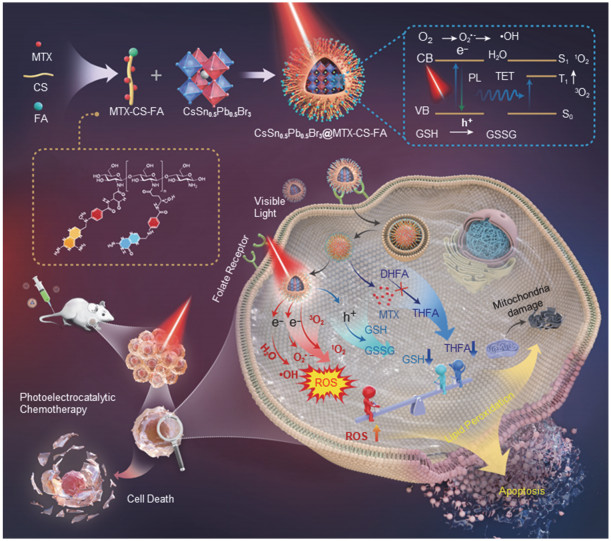
Fig 2
Structural characterization of the nanoparticles. (a) XRD spectra of CsSn0.5Pb0.5Br3@MTX-CS-FA (red) and CsSn0.5Pb0.5Br3 (grey). (b) Fourier transform infrared (FTIR) spectra of CsSn0.5Pb0.5Br3@ MTX-CS-FA (red) and CsSn0.5Pb0.5Br3 (grey). (c) TEM, (d) HRTEM, and fast Fourier transform images (shown in the upper right corner) and (e) selected electron diffraction image of CsSn0.5Pb0.5Br3. (f) TEM, (g) HRTEM, and fast Fourier transform images (shown in the upper right corner) and (h) selected electron diffraction image of CsSn0.5Pb0.5Br3@MTX-CS-FA. (i) N 1s, (j) Pb 4f, and (k) Sn 3d XPS spectra of CsSn0.5Pb0.5Br3@MTX-CS-FA (red), CsSn0.5Pb0.5Br3@MTX-CS-FA in the simulated tumour environment (blue), and CsSn0.5Pb0.5Br3 (grey)."
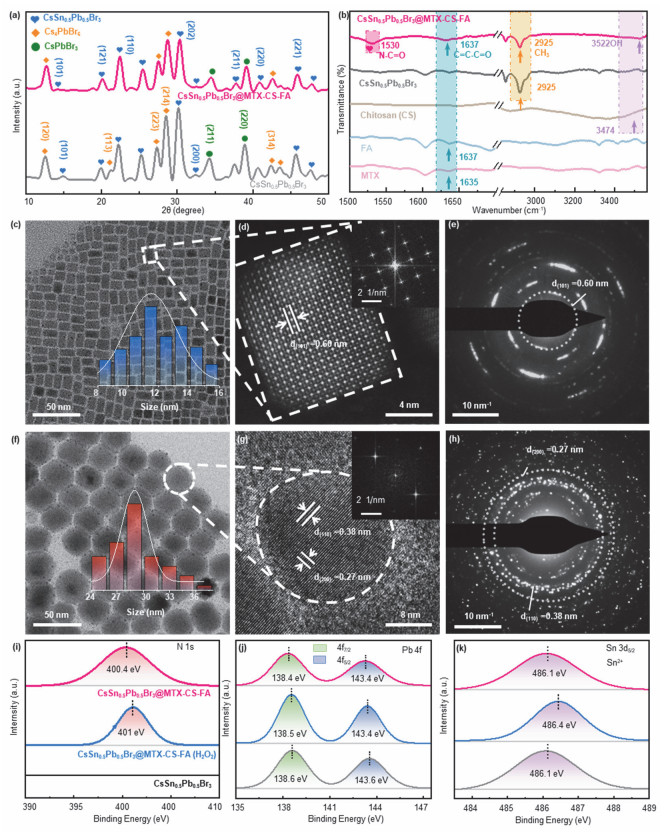
Fig 3
Characterization of the photoelectrical properties of the CsSn0.5Pb0.5Br3@MTX-CS-FA nanoparticles. (a) PL spectrum of CsSn0.5Pb0.5Br3@MTX-CS-FA. (b) IVIS images (upper panel) and images taken under visible light excitation (lower panel) of CsSn0.5Pb0.5Br3@MTX-CS-FA nanoparticle powder dispersed in deionized water from 0 to 228 days. (c) Three-dimensional morphology of CsSn0.5Pb0.5Br3@MTX-CS-FA nanoparticles in the dark. (d) Height distribution of the CsSn0.5Pb0.5Br3@MTX-CS-FA nanoparticles. (e) Three-dimensional morphology overlayed by the contact potential difference (CPD) of CsSn0.5Pb0.5Br3@MTX-CS-FA nanoparticles under illumination (λ = 405 nm, lx = 491 W/m2). (f) Distribution of the contact potential difference (CPD) of CsSn0.5Pb0.5Br3@MTX-CS-FA nanoparticles under dark and illuminated conditions (λ = 405 nm, lx = 491 W/m2)."
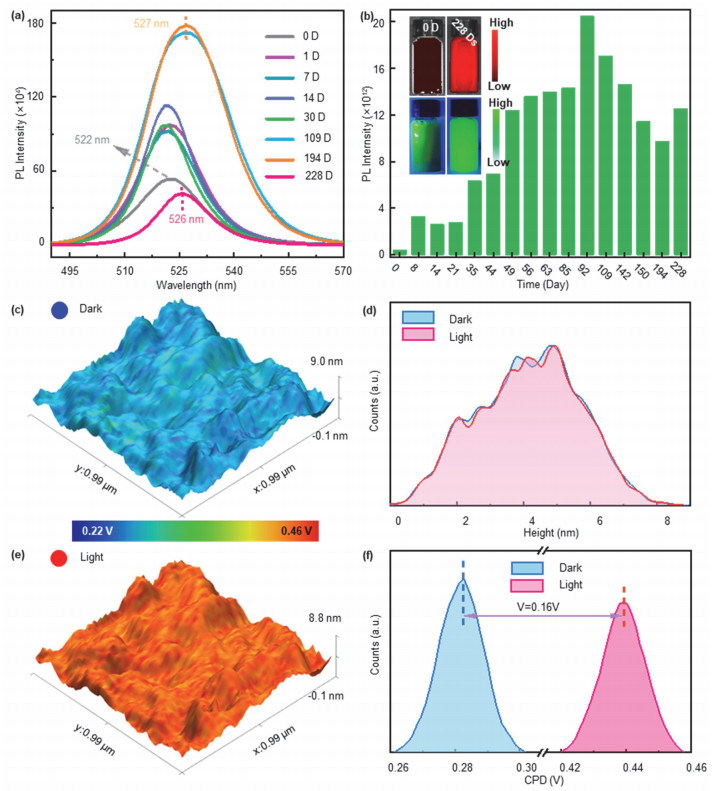
Fig 4
Mechanisms by which CsSn0.5Pb0.5Br3@MTX-CS-FA nanoparticles cause apoptosis in LLC cells. (a) The CsSn0.5Pb0.5Br3@MTX-CS-FA nanoparticles act through three pathways. (b), (c) Detection of GSH concentration in LLC cells using flow cytometry. (d), (e) DHE is used as a ROS probe for ROS detection in LLC cells. (f), (g), (h) Electron spin resonance (ESR) spectroscopic detection of LLC cells using ROS trapping agents (TEMP or DMPPO). (i) An enzyme-linked immunosorbent assay is used to measure the concentration of tetrahydrofolate in LLC cells."
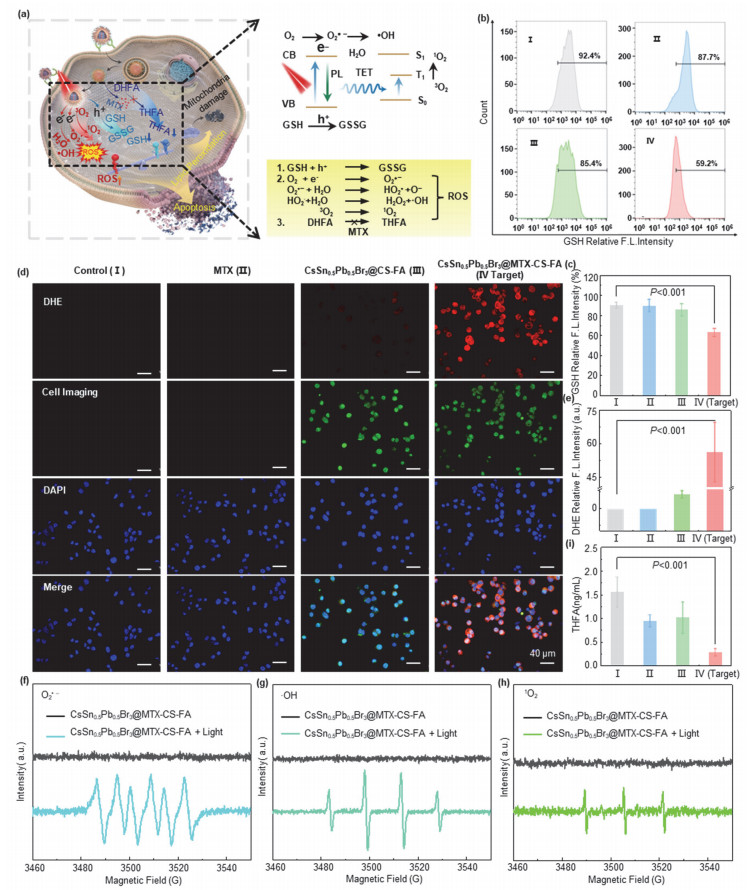
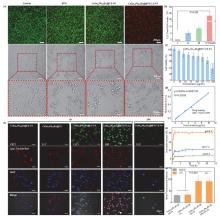
Fig 5
The lethality and targeting of CsSn0.5Pb0.5Br3@MTX-CS-FA nanoparticles in vitro. (a), (b) Images of the live/dead cell double staining experiment results (Cellpose software). (c) Determination of LLC cell viability after treatment with CsSn0.5Pb0.5Br3@MTX-CS-FA nanoparticles. (d), (e) Use release experiments to detect the amount of MTX released under different pH conditions. (f), (g) Confocal microscopy observations of FA targeting in different cell lines (C2C12 and LLC) (statistical analysis is performed by ImageJ)."
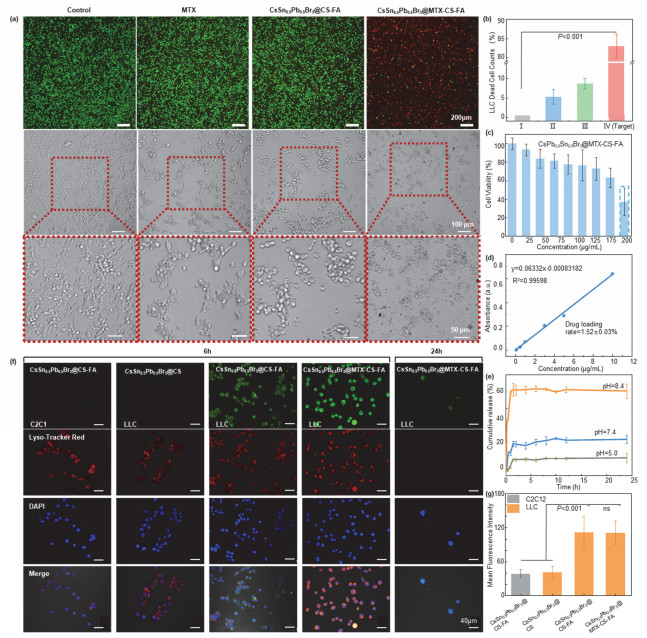
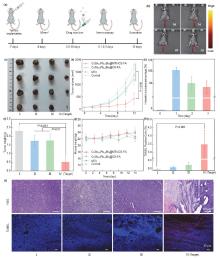
Fig 6
CsSn0.5Pb0.5Br3@MTX-CS-FA nanoparticle-mediated tumour therapy in vivo. (a) Three injections of CsSn0.5Pb0.5Br3@MTX-CS-FA nanoparticles are made into the tail veins of C57BL/6JNifdc tumour-bearing mice for tumour treatment. (b), (c)The targeting of effects of the CsSn0.5Pb0.5Br3@MTX-CS-FA nanoparticles are observed using a small animal in vivo imager. (d)–(g) Curves of mouse LLC tumour volume, final tumour weight and mouse body weight after nanoparticle treatment. (h), (i) H&E and TUNEL staining images of tumour tissue. Data are expressed as the mean ± standard deviation."
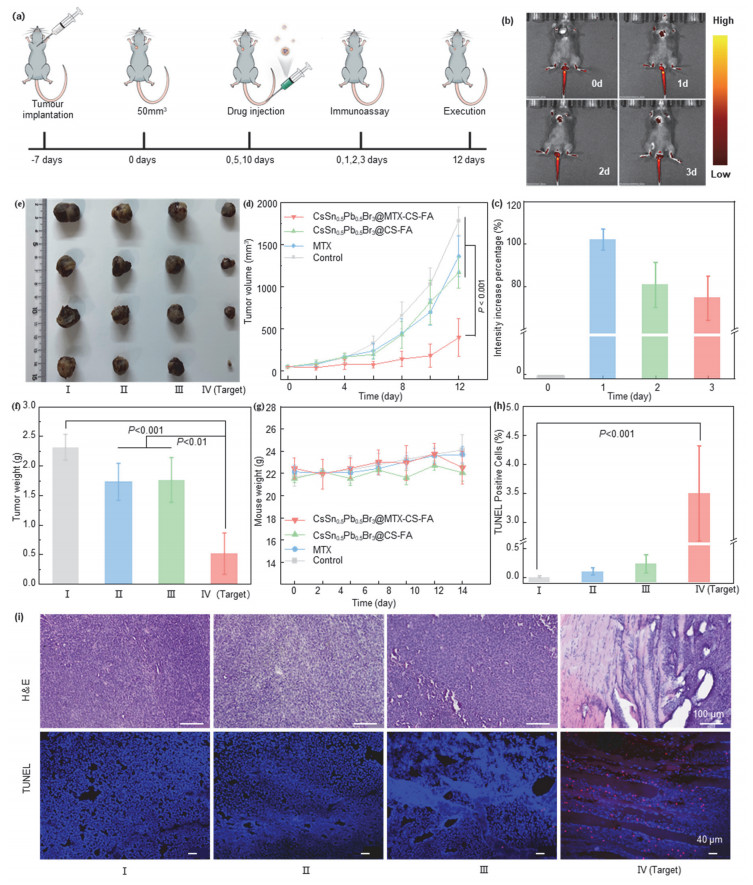
Fig 7
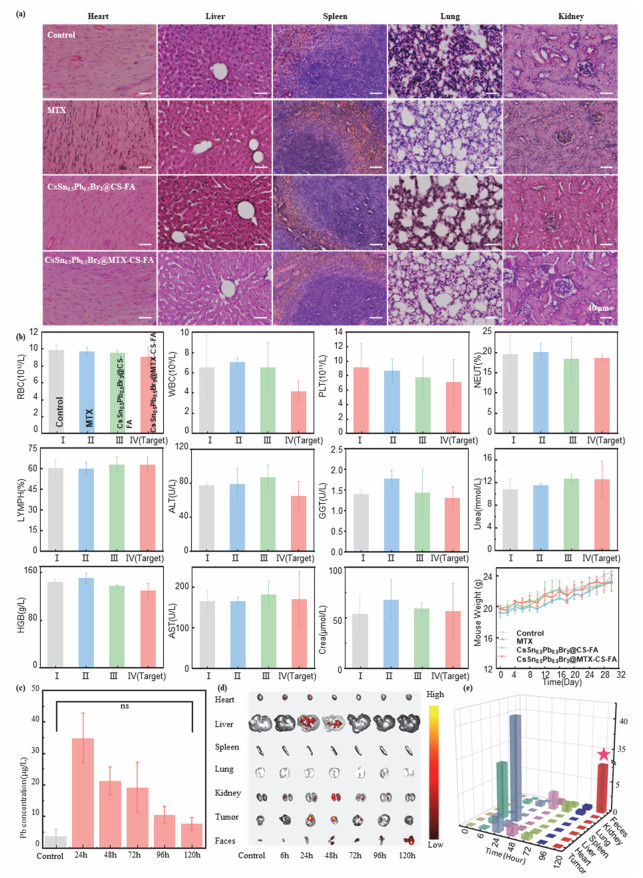
In vivo safety and metabolic distribution of CsSn0.5Pb0.5Br3@MTX-CS-FA nanoparticles. (a) H&E staining images of various organs from healthy C57BL/6JNifdc mice injected with CsSn0.5Pb0.5Br3@MTX-CS-FA nanoparticles via the tail vein. (b) Plots of routine blood parameters, liver and kidney function indicators and body weight of healthy mice injected with CsSn0.5Pb0.5Br3@MTX-CS-FA nanoparticles via the tail vein. (c) Plot of blood lead levels in tumour-bearing mice injected with CsSn0.5Pb0.5Br3@MTX-CS-FA nanoparticles via the tail vein. (d), (e) A small animal in vivo imaging instrument is used to observe the CsSn0.5Pb0.5Br3@MTX-CS-FA nanoparticles in tumour-bearing mice. Data are expressed as the mean ± standard deviation."
| 1 |
doi: 10.1038/35104607 |
| 2 |
doi: 10.1038/nature12340 |
| 3 |
doi: 10.1126/sciadv.ade9044 |
| 4 |
doi: 10.1038/s41586-023-06514-6 |
| 5 |
doi: 10.1038/s41467-021-27640-7 |
| 6 |
doi: 10.1021/jacs.2c12942 |
| 7 |
doi: 10.1002/adma.202208817 |
| 8 |
doi: 10.1038/s41566-021-00931-7 |
| 9 |
doi: 10.1038/s41467-023-35837-1 |
| 10 |
doi: 10.1016/j.nanoen.2022.108074 |
| 11 |
doi: 10.1016/j.scib.2017.08.022 |
| 12 |
doi: 10.1039/c8ta05282d |
| 13 |
doi: 10.1002/adma.202206684 |
| 14 |
doi: 10.1021/ic401215x |
| 15 |
doi: 10.1126/science.aaa5760 |
| 16 |
doi: 10.1002/adma.201806671 |
| 17 |
doi: 10.1126/sciadv.abg8458 |
| 18 |
doi: 10.1038/s41586-022-05486-3 |
| 19 |
doi: 10.1002/smll.202204763 |
| 20 |
doi: 10.1002/smll.202310238 |
| 21 |
doi: 10.1007/s12598-022-02222-8 |
| 22 |
doi: 10.1126/science.adf3349 |
| 23 |
doi: 10.1126/science.adi4107 |
| 24 |
doi: 10.1038/s41586-023-06006-7 |
| 25 |
doi: 10.1038/s41586-023-06396-8 |
| 26 |
doi: 10.1021/acsphotonics.3c00042 |
| 27 |
doi: 10.1002/adfm.202102334 |
| 28 |
doi: 10.1016/j.ccr.2021.214313 |
| 29 |
doi: 10.1186/s40580-023-00366-6 |
| 30 |
doi: 10.1038/s41467-019-13951-3 |
| 31 |
doi: 10.1021/jacs.0c04583 |
| 32 |
doi: 10.1002/anie.202208241 |
| 33 |
doi: 10.1016/j.chempr.2022.03.003 |
| 34 |
doi: 10.1038/ncomms12555 |
| 35 |
doi: 10.1038/s41467-020-15016-2 |
| 36 |
doi: 10.1007/s42765-022-00207-x |
| 37 |
doi: 10.1021/acsanm.3c05605 |
| 38 |
doi: 10.1016/j.nanoen.2019.03.053 |
| 39 |
doi: 10.1002/adfm.202202951 |
| 40 |
doi: 10.1016/j.jpowsour.2016.11.046 |
| 41 |
doi: 10.1002/adma.202203430 |
| 42 |
doi: 10.1002/lpor.202400367 |
| 43 |
doi: 10.1016/j.msec.2020.110807 |
| 44 |
doi: 10.1021/acsami.8b00947 |
| 45 |
doi: 10.1021/acsanm.2c05482 |
| 46 |
doi: 10.1016/j.jcis.2018.06.024 |
| 47 |
doi: 10.1038/s41565-022-01163-8 |
| 48 |
doi: 10.1016/j.cej.2023.143457 |
| 49 |
doi: 10.1002/smll.202300101 |
| 50 |
doi: 10.1002/ange.202006169 |
| 51 |
doi: 10.1002/smll.202307972 |
| 52 |
doi: 10.1002/adma.202005888 |
| 53 |
doi: 10.1038/s41467-022-32050-4 |
| 54 |
doi: 10.1038/s41467-022-33474-8 |
| 55 |
doi: 10.1002/adfm.202213364 |
| 56 |
doi: 10.1002/adfm.202215244 |
| 57 |
doi: 10.1002/anie.202103721 |
| 58 |
doi: 10.1021/jacs.8b04400 |
| 59 |
doi: 10.1002/anie.202007786 |
| 60 |
doi: 10.1016/j.carres.2021.108275 |
| 61 |
doi: 10.1021/mp400269z |
| 62 |
doi: 10.1021/acsnano.2c03752 |
| 63 |
doi: 10.1016/j.jconrel.2023.05.040 |
| 64 |
doi: 10.1016/j.cmet.2020.10.011 |
| 65 |
doi: 10.1021/jacsau.0c00038 |
| 66 |
doi: 10.1038/s41586-022-04961-1 |
| 67 |
doi: 10.1038/s41586-023-05938-4 |
| 68 |
doi: 10.1002/advs.202203749 |
| 69 |
doi: 10.1021/acsenergylett.2c02262 |
| 70 |
doi: 10.1021/jacs.7b08628 |
| 71 |
doi: 10.1021/acsami.0c20285 |
| 72 |
doi: 10.1021/acsmaterialslett.0c00596 |
| 73 |
doi: 10.1021/jacs.5b13470 |
| 74 |
doi: 10.1039/D3TA02909C |
| 75 |
http://www.science-and-fun.de/tools/ (accessed on Oct 3, 2024).
|
| 76 |
doi: 10.3390/ph15020149 |
| 77 |
doi: 10.1016/j.xphs.2021.10.034 |
| 78 |
doi: 10.1039/d0nr08325a |
| 79 |
doi: 10.1016/j.cej.2021.131950 |
| 80 |
doi: 10.1002/adom.202202673 |
| 81 |
doi: 10.1016/j.apcatb.2016.04.016 |
| 82 |
doi: 10.1088/1757-899x/490/2/022067 |
| 83 |
doi: 10.1002/solr.201900457 |
| 84 |
doi: 10.1016/j.surfrep.2010.10.001 |
| 85 |
Chen, X.; Lai, J.; Shen, Y.; Chen, Q.; Chen, L. 2018, 30 (48), 1802490. doi: 10.1002/adma.201802490
|
| 86 |
doi: 10.1039/D2TA08349C |
| 87 |
Yuan, Y.; Li, T.; Wang, Q.; Xing, J.; Gruverman, A.; Huang, J. 2017, 3 (3), e1602164. doi: 10.1126/sciadv.1602164
|
| 88 |
doi: 10.1002/anie.202203088 |
| 89 |
doi: 10.1038/s41467-022-34036-8 |
| 90 |
doi: 10.1038/nm.4232 |
| 91 |
doi: 10.1002/adma.202209589 |
| 92 |
doi: 10.1016/j.biomaterials.2021.121110 |
| 93 |
doi: 10.1002/smll.202303365 |
| 94 |
doi: 10.1038/s41467-022-31799-y |
| 95 |
doi: 10.1016/j.ccell.2018.12.009 |
| 96 |
doi: 10.1039/d0cs00718h |
| 97 |
doi: 10.1093/nsr/nwab139 |
| 98 |
doi: 10.1038/s41568-021-00435-0 |
| 99 |
doi: 10.1021/nn5061404 |
| 100 |
doi: 10.1016/j.biomaterials.2022.121724 |
| 101 |
doi: 10.1021/acsabm.0c00171 |
| 102 |
doi: 10.1002/adma.202200871 |
| 103 |
doi: 10.1016/j.colsurfb.2023.113308 |
| 104 |
doi: 10.1016/j.ijbiomac.2022.07.185 |
| 105 |
doi: 10.1186/s12645-023-00162-1 |
| 106 |
doi: 10.1021/acs.molpharmaceut.2c01035 |
| 107 |
doi: 10.1016/j.apsb.2021.09.024 |
| 108 |
doi: 10.1039/D2BM00883A |
| 109 |
doi: 10.1038/s41467-022-32349-2 |
| 110 |
doi: 10.1016/j.chempr.2020.06.024 |
| 111 |
doi: 10.1002/adma.202008065 |
| 112 |
doi: 10.1016/j.cej.2021.129178 |
| 113 |
doi: 10.1016/j.cej.2022.135373 |
| 114 |
https://stacks.cdc.gov/view/cdc/37586 (accessed on Oct 3, 2024).
|
| 115 |
doi: 10.1016/j.phrs.2022.106632 |
| [1] | Chao HU,Ye MU,Mingyu LI,Jieshan QIU. Recent Advances in the Synthesis and Applications of Carbon Dots [J]. Acta Physico-Chimica Sinica, 2019, 35(6): 572-590. |
| [2] | Fan CHEN,Zhong-Yue WANG,Yan-Yan ZHANG,Ke-Han YU,Li-Xing WENG,Wei WEI. Synthesis of Poly(acrylic acid)-Functionalized La1-xEuxF3 Nanocrystals with High Photoluminescence for Cellular Imaging [J]. Acta Phys. -Chim. Sin., 2017, 33(7): 1446-1452. |
|
||