Acta Phys. -Chim. Sin. ›› 2024, Vol. 40 ›› Issue (11): 2311011.doi: 10.3866/PKU.WHXB202311011
• REVIEW • Previous Articles Next Articles
Emerging Irreversible and Reversible Ion Migrations in Perovskites
Rui Li1,2, Huan Liu1,2, Yinan Jiao2, Shengjian Qin2, Jie Meng1,2, Jiayu Song1,2, Rongrong Yan1,2, Hang Su1,2, Hengbin Chen1,2, Zixuan Shang1, Jinjin Zhao1,*( )
)
- 1 Hebei Technology Innovation Center for Energy Conversion Materials and Devices, Hebei Key Laboratory of Inorganic Nanomaterials, Engineering Research Center of Thin Film Solar Cell Materials and Devices, Hebei Province, College of Chemistry and Materials Science, Hebei Normal University, Shijiazhuang 050024, China
2 School of Materials Science and Engineering, Shijiazhuang Tiedao University, Shijiazhuang 050043, China
-
Received:2023-11-08Revised:2023-12-17Accepted:2024-01-08Published:2024-01-12 -
Contact:Email: jinjinzhao2012@163.com; jinjinzhao2023@hebtu.edu.cn (Jinjin Zhao) -
Supported by:the National Natural Science Foundation of China(U2130128); Yanzhao Young Scientist Project from Natural Science Foundation of Hebei Province(B2023205040); Basic Research Cooperation Special Foundation of Beijing-Tianjin-Hebei Region(H2022205047); Basic Research Cooperation Special Foundation of Beijing-Tianjin-Hebei Region(22JCZXJC00060); Basic Research Cooperation Special Foundation of Beijing-Tianjin-Hebei Region(E3B33911DF); Central Government Guiding Local Science and Technology Development Project(216Z4302G); Hebei Administration for Market Supervision Science and Technology Project List(2023ZC03); Innovation Capability Improvement Plan Project of Hebei Province(22567604H); Ph.D Scientific Research Start-up Fund of Hebei Normal University(L2023B18)

Cite this article
Rui Li, Huan Liu, Yinan Jiao, Shengjian Qin, Jie Meng, Jiayu Song, Rongrong Yan, Hang Su, Hengbin Chen, Zixuan Shang, Jinjin Zhao. Emerging Irreversible and Reversible Ion Migrations in Perovskites[J]. Acta Phys. -Chim. Sin. 2024, 40(11), 2311011. doi: 10.3866/PKU.WHXB202311011
share this article
Fig 1
Schematic illustration of the correlation among the ionic migration, photoelectric conversion, electro-optic conversion, all optical conversion and chemical photoelectric multifield coupling of MHPs."
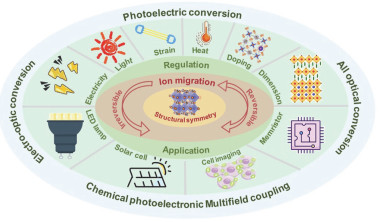
Fig 2
Ion migration pathway and degradation mechanism in perovskites. (a) Transport mechanisms in the MAPbI3 perovskite structure, reproduced from 30; (b) Illustration of the energy barrier for the hopping of the additional energy barriers (yellow color) due to the incorporated Cs+ ions; Illustration of the repelling effect to Ⅰ vacancy induced by incorporated Cs+ ions, which compressed the ion migration channels, reproduced from 72; (c) Photoluminescence quenching mechanisms, when the probability of Iix species encounters is high, boosting I2 molecule formation, reproduced from 54; (d) Schematic illustration of the migration of I− anions and MA+ cations through the film, reproduced from 74; (e) MAPbI3 degradation pathway in presence of water, reproduced from 83; (f) Atomic-scale imaging of the decomposition pathway of MAPbI3, reproduced from 24."
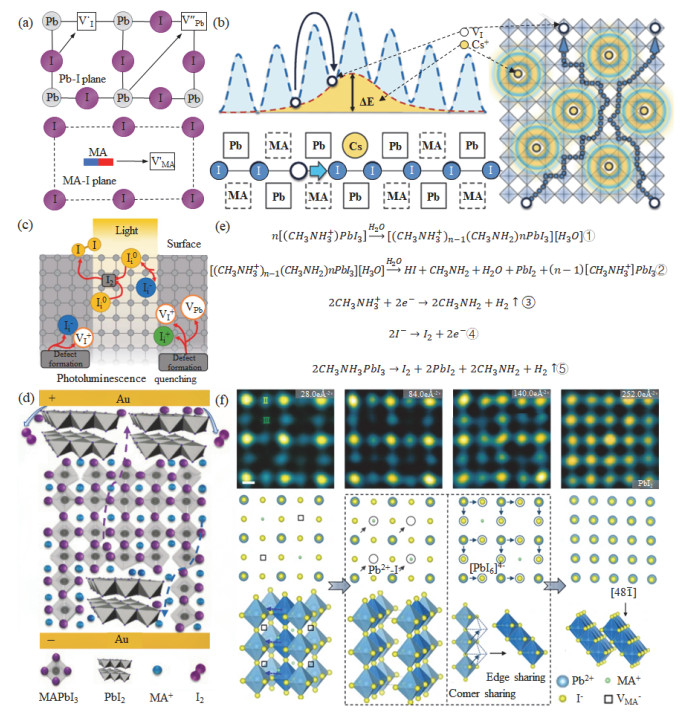
Table 1
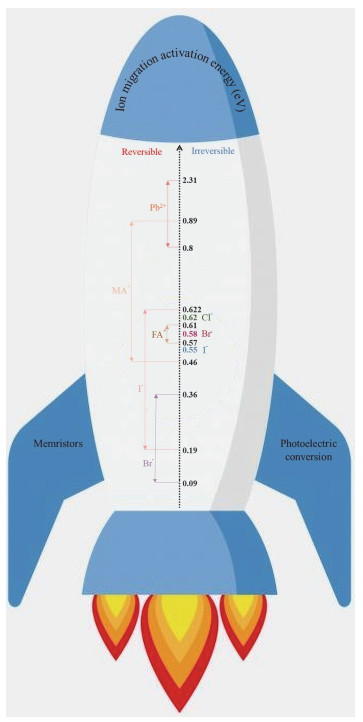
Summary of ion migration activation energies of MAPbI3."
| Materials | Mobile ion | Crystal structure | Activation energy (eV) | Reversibility | Characterization Methods | Ref. | |
| MAPbI3 | MA+ | Tetragonal | 0.46 | Reversible | First-Principles | ||
| Tetragonal | 0.735 | DFT | |||||
| Tetragonal<110> | 0.57 | First-Principles | |||||
| Tetragonal<001> | 0.89 | ||||||
| Tetragonal (a neighboring vacant A-site cage) | 0.84 | ||||||
| Tetragonal | 0.9 ± 0.45 | Arrhenius equation | |||||
| Cubic | 0.39 ± 0.24 | ||||||
| Pb2+ | Tetragonal | 0.8 | First-Principles | ||||
| Tetragonal<110> | 2.31 | ||||||
| I− | Tetragonal | 0.08 | |||||
| Tetragonal | 0.342 | DFT | |||||
| Pseudo-cubic | 0.55 | Irreversible | First-Principles | ||||
| Tetragonal<100> | 0.32 | Reversible | |||||
| Tetragonal<111> | 0.44 | ||||||
| Tetragonal (octahedron edge) | 0.58 | ||||||
| Tetragonal | 0.433 | Nernst-Einstein relation | |||||
| Tetragonal | 0.19 | Dark | Nernst-Einstein relation | ||||
| 0.03 | 25 mW∙cm−2 | ||||||
| Tetragonal | 0.622 | 0.1 mW∙cm−2 | Nernst-Einstein relation (T>250 K) | ||||
| 0.144 | 5 mW∙cm−2 | ||||||
| 0.07 | 25 mW∙cm−2 | ||||||
| Cubic | 0.43 | Arrhenius equation | |||||
| Tetragonal | 0.58 | Arrhenius equation (T<320) | |||||
| Cubic | 0.229 | Arrhenius equation (T>320) | |||||
| Tetragonal | 0.322 | Arrhenius equation | |||||
| 0.416 | Arrhenius equation (PbSO4) | ||||||
| Tetragonal | 0.29±0.06 | Arrhenius equation | |||||
| Tetragonal (1μm grain size) | 0.14 | Nernst-Einstein relation(25mW∙cm−2) | |||||
| Tetragonal (0.3μm grain size) | 0.08 | ||||||
| Tetragonal (Single crystal) | 0.47 | ||||||
| Tetragonal (1μm grain size) | 0.5 | Dark; Nernst-Einstein relation | |||||
| Tetragonal (0.3μm grain size) | 0.27 | ||||||
| Tetragonal (Single crystal) | 1.05 | ||||||
| Tetragonal | 0.37 | Arrhenius equation | |||||
| Cubic | 0.52 | ||||||
| Tetragonal | 0.824 | 0.05 mW∙cm−2 | Nernst-Einstein relation (Illumination; T>250 K) | ||||
| 0.851 | 1 mW∙cm−2 | ||||||
| 0.334 | 5 mW∙cm−2 | ||||||
| 0.144 | 20 mW∙cm−2 | ||||||
Table 2
Summary of ion migration activation energies of other perovskites."
| Materials | Mobile ion | Crystal Structure | Activation energy (eV) | Reversibility | Characterization Methods | Ref. | |
| MAPbBr3 | MA+ | Tetragonal | 0.56 | Reversible | First-Principles | ||
| Br− | Tetragonal | 0.09 | |||||
| Pseudo-cubic | 0.58 | Irreversible | |||||
| Cubic | 0.11 | Reversible | Nernst-Einstein relation (resonance frequency<50Hz) | ||||
| 0.28 | Nernst-Einstein relation (resonance frequency>50Hz) | ||||||
| 0.36 | Nernst-Einstein relation (PbSO4 passivation) | ||||||
| MAPbBrxI3−x | MA+ | Cubic | 0.801 | DFT | |||
| Br− | 0.326 | ||||||
| I1− (Pb-I = 0.319 nm) | 0.456 | ||||||
| I2− (Pb-I = 0.327 nm) | 0.49 | ||||||
| I3− (Pb-I = 0.325 nm) | 0.522 | ||||||
| FAPbI3 | FA | Trigonal<110> | 0.57 | First-Principles | |||
| FA+ | 0.61 | ||||||
| FA | Trigonal<001> | 0.59 | |||||
| FA+ | 0.61 | ||||||
| I | Trigonal<111> | 0.42 | |||||
| I− | 0.48 | ||||||
| I | Trigonal<100> | 0.5 | |||||
| I− | 0.55 | ||||||
| I− | Trigonal | 0.79 | Arrhenius equation | ||||
| 0.218 | |||||||
| AceMAPbI3 | Cubic | 0.542 | Nernst-Einstein relation | ||||
| (GUAMA)PbI3 | 0.36 | Arrhenius equation | |||||
| CsPbI2Br | 0.454 | 0.1 mW∙cm−2 | Nernst-Einstein relation (T> 250 K) | ||||
| 0.456 | 5 mW∙cm−2 | ||||||
| 0.43 | 25 mW∙cm−2 | ||||||
| CsPbBr3 | Cs+ | Orthogonal | 0.7 | First-Principles | |||
| Pb2+ | 0.94 | ||||||
| Br− | 0.27 | ||||||
| 0.19 | Arrhenius equation | ||||||
| 0.25 | |||||||
| CsPbI3 | Cs+ | Tetragonal | 0.61 | DFT | |||
| Pb2+ | 1.4 | ||||||
| I− | 0.21 | ||||||
| MAxFA1−xPbI3 | Trigonal | 0.643 | Arrhenius equation | ||||
| Cs0.05MA0.05FA0.9PbI3 | Cubic | 0.43 | Arrhenius equation | ||||
| Cs0.05MA0.05FA0.9PbI3/BAI | 0.50 | ||||||
| Cs0.05MA0.05FA0.9PbI3/BABr | 0.52 | ||||||
| FAPbI3/GuCl | Cl− | Trigonal | 0.59 | First-Principles | |||
| FAPbI3/GuBr | Br− | 0.62 | |||||
| FAPbI3/GuI | I− | 0.73 | |||||
| MAPbCl3 | Cl− | Pseudo-cubic | 0.62 | Irreversible | |||
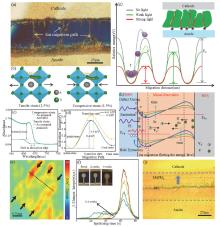
Fig 3
Irreversible unidirectional ion migrations are accelerated by external fields. (a) Local magnified image of filamentary paths on overlaid MAPbI3 films, reproduced from 71; (b) calculation of the activation energy of halide ion migration in perovskite at biaxial 1.5% tensile strain and −1.5% compressive strain, reproduced from 90; (c) compressive strain and tensile strain absorption spectra of perovskite films before and after annealing at 85 ℃ for 60 h, reproduced from 90; (d) The density functional theory (DFT) calculations of strain-related activation energies for vacancy-assisted migration of halide ions in MAPbI3 films, reproduced from 91; (e) Image of MA+ region distribution in presence of stress/strain, reproduced from 93; (f) MAPI3 PSC device aged under N2 atmosphere in dark conditions, reproduced from 94; (g) schematic diagram of light-dependent ion migration in perovskite MAPbI3, reproduced from 74; (h) Slow changes in photogenerated carrier dynamics at the (FAPbI3)0.85(MAPbBr3)0.15 perovskite interface under continuous illumination, reproduced from 96; (i) A laser confocal scanning microscopy image of the MAPbI3 film with PbI2 thread, reproduced from 71."
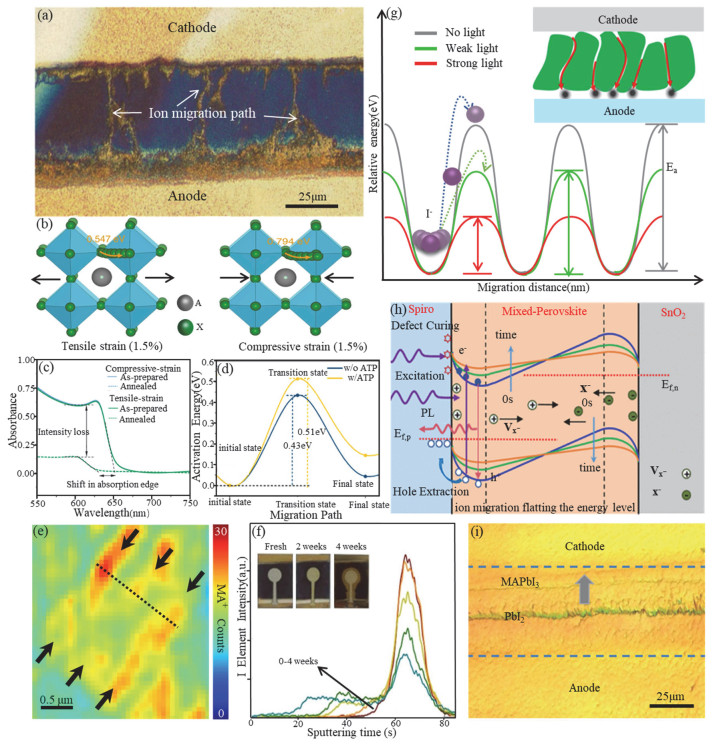
Fig 4
Strategies control ion migration within perovskites. (a) Schematic illustration of mechanisms how 2D perovskite stabilize ion migration at 2D/3D interface, reproduced from 104; (b) XRD patterns of 3D perovskite films before and after aging at ambient air, reproduced from 105; (c) Mapping images of the surface potential measured by KPFM and mapping of the TOF-SIMS signal of I− in HTL. All samples are aged after 200 h of light immersion at 60℃ at AM1.5G solar light, reproduced from 107; (d) Schematic representation of cation-π interactions between erythrite and chalcocite organic cations and DL TS spectra of PSCs without and with erythrite measured between 400 and 100 K, reproduced from 108; (e) Cross-sectional SEM of inorganic CsPbBr3 PSC devices without and with WS2 modification after aging treatment and their corresponding EDS mapping images, reproduced from 109; (f) Simulations of ion transport paths, activation energies and lattice ion displacements in MAPbI3, MA0.75Cs0.25PbI3 and MA0.75GA0.25PbI3. (Local lattice relaxation near the diffusion path is highlighted by the green circle, showing the larger structural distortion in the GA substituted material), reproduced from 102; (g) The iodide ion migration activation energies of MAPbI3 and Ace0.25MA0.75PbI3 are calculated using DFT; (h) Operational stability testing of packaged MAPbI3 and Ace0.03MA0.97PbI3 devices under continuous 1 solar irradiation in open-circuit conditions in ambient air, (g) and (h) are reproduced from 65."
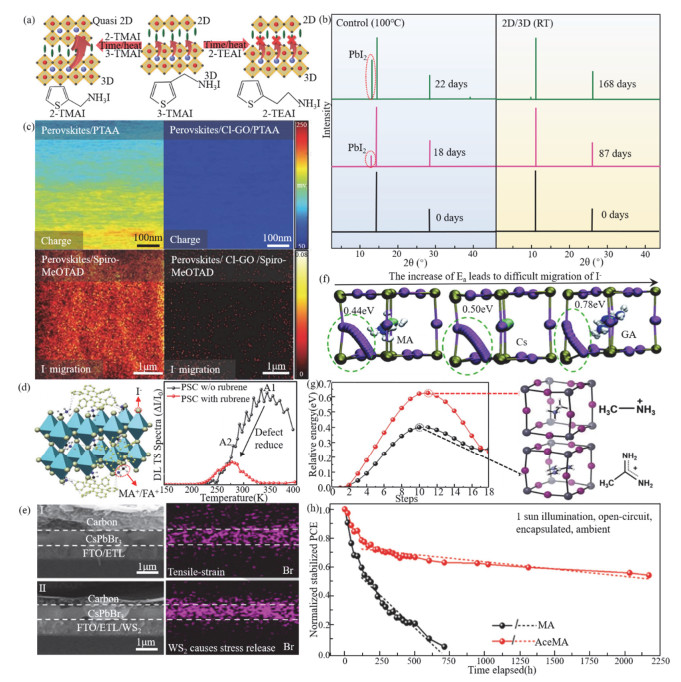
Fig 5
Reversible bidirectional ion migration in MHPs. (a) Diffusion paths for the, $V_{\mathrm{I}}, V_{\mathrm{MA}}^{\prime}, V_{\mathrm{Pb}}^{\prime \prime}$, and $\mathrm{I}_{\mathrm{i}}^{\prime}$ defects. Vacancies are highlighted with dashed circles. Red atoms refer to interstitial defects, reproduced from 53; (b) XRD pattern of an x = 0.6 film before (black) and after (red) white-light soaking for 5 min at ~50 mW∙cm−2, and after 2 h in the dark (blue). The XRD pattern of an x = 0.2 film (green) is offset for comparison. Reproduced from 117; (c) Absorption spectra after 30 min of light soaking show dark recovery, reproduced from 119; (d) Time-resolved surface potential of (BA)2PbI4 plotted versus time. The period where the light is on is, in this case, from 1 to 5 ms, reproduced from 120; (e) PTIR images for the CH3 asymmetric deformation absorption of the MA+ (1468 cm−1) obtained before and after electrical poling with an electric field of 1.6 V/μm for 100 s respectively, reproduced from 121; (f) Real-time observation of MA+ distribution under: light on and 4 V poling, light off and 4 V poling, reproduced from 122; (g) Light-force microscopy (PiFM) images of the CsFAMA film under different amplitude voltage stress and the operation of the perovskite photovoltaic sensor device under positive and negative voltage stress conditions, reproduced from 18."
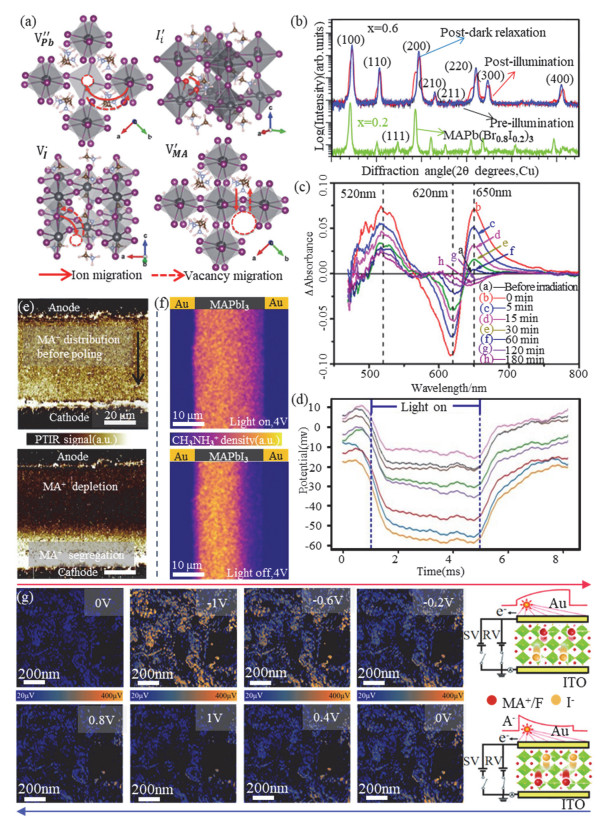
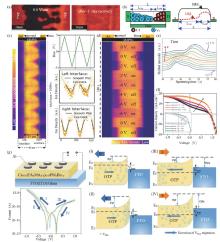
Fig 6
Cyclic evolution of photoelectrical properties of MHPs during reversible bidirectional ion migration. (a) PL(photoluminescence) images of the same MAPbI3 sample at 0.8 V μm−1 bias for 3 min and recovery process, reproduced from 125; (b) Schematic diagram of the net distribution of iodine ions (I−/I) and iodine vacancies (VI) in the MAPbI3 transistor LRS (low resistance state); Graph of profile barrier changes along the channel surface (from S to D) in LRS and HRS (high resistance state), reproduced from 128; (c) tr-ToF-SIMS results for the time distribution of MA+ under bipolar electrical bias, and MA+ intensity evolution near the left and right device interfaces, reproduced from 132; (d) tr-ToF-SIMS results of MA+ migration in MAPbI3, real-time bias and illumination conditions are shown on the right, reproduced from 123; (e) GD-OES profile lines versus sputtering time for iodide ions as a function of the amplitude of the applied bias, reproduced from 133; (f) The I–V curves of MAPbI3 thin-film devices, reproduced from 134; (g) Al/CsFAMAPbIBr/FTO device block diagram, I–V curve, and dynamic ion mobility near CsFAMAPbIBr/FTO interface, Ⅰ–Ⅳ represent the different steps in the scanning process. Only negatively charged defects are marked in the Fig., reproduced from 135."
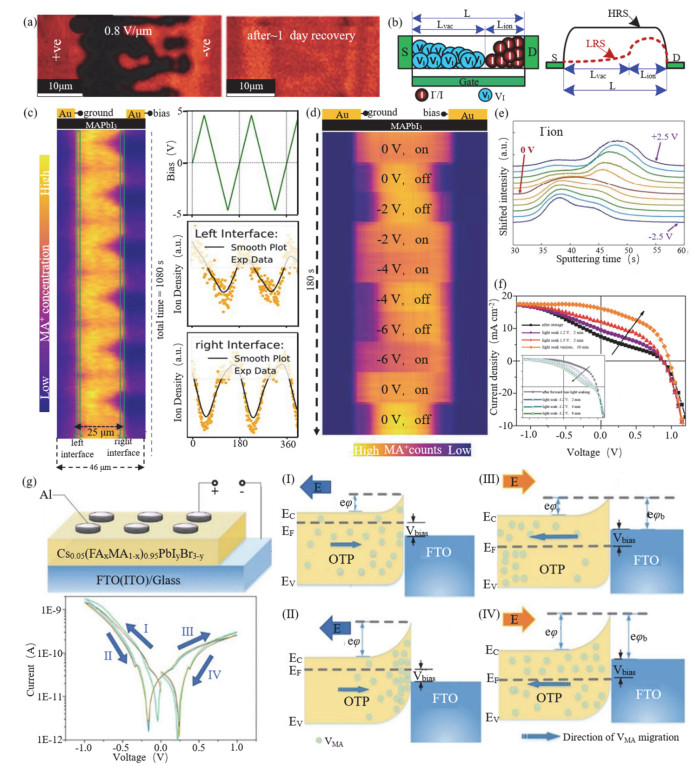
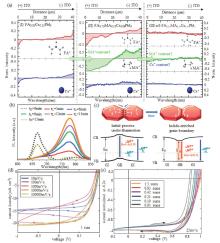
Fig 7
Mediate reversible bidirectional ion migration in MHPs. (a) Averaged ToF-SIMS intensity profiles of (Ⅰ) FA0.85Cs0.15PbI3 (Ⅱ) FA0.76MA0.15Cs0.09PbI3 and (Ⅲ) α/δ-FA0.33MA0.33Cs0.33PbI3 lateral devices before (grey lines) and after applied bias [FA+ (red lines), MA+ (green lines), and Cs+ (blue lines)], reproduced from 136; (b) Time-evolution of photoluminescence (PL) spectra in the dark, upon light illumination and after dark relaxation for Cs0.15FA0.65MA0.20Pb(I0.5Br0.5)3/PTAA/ITO recorded every 3 min under 532 nm illumination at 1000 mW∙cm−2; (c) Influence of photoinduced iodide ion migration on the band bending, (b) and (c) are reproduced from 137; (d) Current–voltage curves of TiO2 based MAPbI3 devices with pronounced hysteresis. (e) J–V data as a function of illumination intensity normalized at −0.2 V. The shape of the hysteresis remains almost the same, (d) and (e) are reproduced from 124."
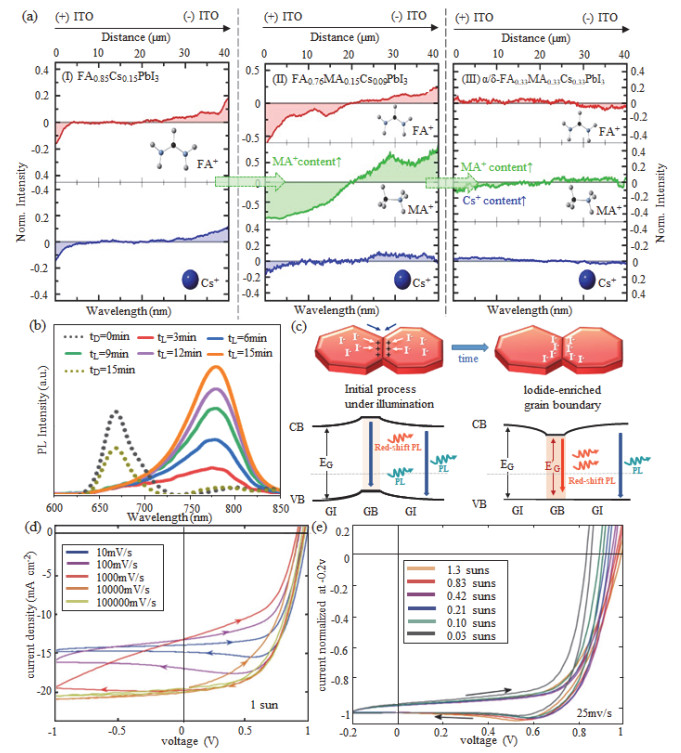
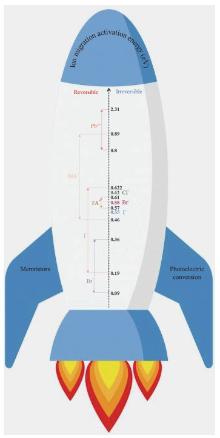
Fig 8
Ion migration activation energy in MHPs and their potential applications."
| 1 |
https://www.nrel.gov/pv/cell-efficiency.html (accessed on Nov 7, 2023).
|
| 2 |
doi: 10.1007/s12598-019-01341-z |
| 3 |
doi: 10.1016/j.scib.2017.08.022 |
| 4 |
doi: 10.1039/C8TA05282D |
| 5 |
doi: 10.1007/s12598-021-01800-6 |
| 6 |
doi: 10.1038/nature12340 |
| 7 |
doi: 10.1038/nenergy.2017.38 |
| 8 |
doi: 10.1038/nphoton.2014.134 |
| 9 |
doi: 10.1126/science.1243982 |
| 10 |
doi: 10.1126/science.aaa5760 |
| 11 |
doi: 10.1126/science.aaa2725 |
| 12 |
doi: 10.1002/adma.201305172 |
| 13 |
doi: 10.1007/s12598-020-01691-z |
| 14 |
doi: 10.1039/D2CS00218C |
| 15 |
doi: 10.15541/jim20190342 |
| 16 |
doi: 10.15541/jim20190394 |
| 17 |
doi: 10.3866/PKU.WHXB202111009 |
|
WagehS.; Al-GhamdiAhmed A.; 赵丽. 物理化学学报, 2022, 38(7), 2111009.
doi: 10.3866/PKU.WHXB202111009 |
|
| 18 |
doi: 10.1002/aisy.202000122 |
| 19 |
doi: 10.1002/adfm.202202951 |
| 20 |
doi: 10.1007/s12598-022-02222-8 |
| 21 |
doi: 10.1002/aelm.202101204 |
| 22 |
doi: 10.1039/C8CS00853A |
| 23 |
doi: 10.1016/j.trechm.2021.04.004 |
| 24 |
doi: 10.1038/s41467-021-25832-9 |
| 25 |
doi: 10.1038/natrevmats.2017.42 |
| 26 |
doi: 10.1126/science.abj1186 |
| 27 |
doi: 10.1016/j.matt.2021.06.028 |
| 28 |
doi: 10.1038/s41563-021-01097-x |
| 29 |
doi: 10.1002/adfm.202100293 |
| 30 |
doi: 10.1038/ncomms8497 |
| 31 |
doi: 10.1021/jacs.5b03615 |
| 32 |
doi: 10.1021/acs.accounts.5b00420 |
| 33 |
doi: 10.1038/s41560-023-01288-7 |
| 34 |
doi: 10.1002/ange.202216634 |
| 35 |
doi: 10.1038/natrevmats.2017.42 |
| 36 |
doi: 10.1002/aenm.202102730 |
| 37 |
doi: 10.1038/nenergy.2015.12 |
| 38 |
doi: 10.1038/ncomms11683 |
| 39 |
doi: 10.1021/acs.jpclett.6b01176 |
| 40 |
doi: 10.1038/s41467-019-09167-0 |
| 41 |
doi: 10.1016/j.joule.2020.09.010 |
| 42 |
doi: 10.1016/j.nanoen.2022.108074 |
| 43 |
doi: 10.3866/PKU.WHXB202211025 |
|
杨帅; 徐瑜歆; 郝子坤; 秦胜建; 张润鹏; 韩钰; 杜利伟; 朱紫洢; 杜安宁; 陈欣; 等. 物理化学学报, 2023, 39(5), 2211025.
doi: 10.3866/PKU.WHXB202211025 |
|
| 44 |
doi: 10.1021/jacs.9b09182 |
| 45 |
doi: 10.1021/acsenergylett.1c00227 |
| 46 |
doi: 10.1021/acsnano.6b02795 |
| 47 |
doi: 10.1021/acs.nanolett.7b01665 |
| 48 |
doi: 10.1038/s41467-019-09047-7 |
| 49 |
doi: 10.1039/C8CS00656C |
| 50 |
doi: 10.1021/jz500370k |
| 51 |
doi: 10.1063/1.4864778 |
| 52 |
doi: 10.1021/jacs.7b10430 |
| 53 |
doi: 10.1039/C5EE01265A |
| 54 |
doi: 10.1038/s41566-019-0435-1 |
| 55 |
doi: 10.1039/C8EE00124C |
| 56 |
doi: 10.1039/C6EE01729K |
| 57 |
doi: 10.1039/C6TA03599J |
| 58 |
doi: 10.1038/s41567-022-01512-3 |
| 59 |
doi: 10.1126/science.aad3000 |
| 60 |
doi: 10.1021/acsenergylett.9b00247 |
| 61 |
doi: 10.1039/C6EE00413J |
| 62 |
doi: 10.1016/j.nanoen.2016.05.052 |
| 63 |
doi: 10.1039/C9MH00445A |
| 64 |
doi: 10.1039/C7TA09112E |
| 65 |
doi: 10.1002/adma.201906995 |
| 66 |
doi: 10.1021/acsenergylett.7b00442 |
| 67 |
doi: 10.1021/acs.jpclett.7b01851 |
| 68 |
doi: 10.1002/ange.201500014 |
| 69 |
doi: 10.1021/jacs.5b08535 |
| 70 |
doi: 10.1016/j.jsamd.2021.07.006 |
| 71 |
doi: 10.1039/C6CP06496E |
| 72 |
doi: 10.1002/aenm.202002552 |
| 73 |
doi: 10.1039/D0CP01119C |
| 74 |
doi: 10.1038/lsa.2016.243 |
| 75 |
doi: 10.1039/D1NR02511B |
| 76 |
doi: 10.1063/1.5120270 |
| 77 |
doi: 10.1016/0167-2738(83)90025-5 |
| 78 |
doi: 10.1016/j.nanoen.2017.06.024 |
| 79 |
doi: 10.1002/adma.202108102 |
| 80 |
|
| 81 |
doi: 10.1063/1.4934633 |
| 82 |
doi: 10.1021/acsenergylett.8b00764 |
| 83 |
doi: 10.1021/nl500390f |
| 84 |
doi: 10.1021/acs.jpclett.9b03161 |
| 85 |
doi: 10.1038/s41467-021-22864-z |
| 86 |
doi: 10.1002/adfm.202304201 |
| 87 |
doi: 10.1038/s41467-018-07177-y |
| 88 |
doi: 10.1002/adma.202001107 |
| 89 |
doi: 10.1021/acsaem.2c02875 |
| 90 |
doi: 10.1038/s41467-020-15338-1 |
| 91 |
doi: 10.1002/adma.202201315 |
| 92 |
doi: 10.1016/j.scriptamat.2018.02.022 |
| 93 |
doi: 10.1038/s41563-018-0152-z |
| 94 |
doi: 10.1002/ejic.202100654 |
| 95 |
doi: 10.3866/PKU.WHXB202007088 |
|
卢岳; 葛杨; 隋曼龄. 物理化学学报, 2022, 38(5), 2007088.
doi: 10.3866/PKU.WHXB202007088 |
|
| 96 |
doi: 10.1021/acsami.8b13932 |
| 97 |
doi: 10.1063/5.0005369 |
| 98 |
doi: 10.1038/s41563-022-01390-3 |
| 99 |
doi: 10.1021/acs.chemmater.1c01175 |
| 100 |
doi: 10.1002/adma.202302071 |
| 101 |
doi: 10.1002/aenm.202201105 |
| 102 |
doi: 10.1039/C9EE00476A |
| 103 |
doi: 10.1021/acsenergylett.8b00047 |
| 104 |
doi: 10.1039/C9TA12489F |
| 105 |
doi: 10.1002/adma.201901242 |
| 106 |
doi: 10.1016/j.nanoen.2021.106521 |
| 107 |
doi: 10.1126/science.aax8018 |
| 108 |
doi: 10.1002/adma.201707583 |
| 109 |
doi: 10.1002/ange.202010252 |
| 110 |
doi: 10.1021/acsenergylett.1c02545 |
| 111 |
doi: 10.1002/anie.201502544 |
| 112 |
doi: 10.1021/acsnano.6b02613 |
| 113 |
doi: 10.1039/C7EE00358G |
| 114 |
doi: 10.1002/aenm.201701981 |
| 115 |
doi: 10.3866/PKU.WHXB202301033 |
|
任书霞; 杨铮; 安帅领; 孟婕; 刘晓敏; 赵晋津. 物理化学学报, 2023, 39(12), 2301033.
doi: 10.3866/PKU.WHXB202301033 |
|
| 116 |
doi: 10.1021/acs.accounts.0c00749 |
| 117 |
doi: 10.1039/C4SC03141E |
| 118 |
doi: 10.1021/acs.jpclett.0c01844 |
| 119 |
doi: 10.1021/acsenergylett.7b00589 |
| 120 |
doi: 10.1021/acsnano.8b08390 |
| 121 |
doi: 10.1002/aenm.201500615 |
| 122 |
doi: 10.1017/S1431927620020267 |
| 123 |
doi: 10.1002/adfm.202008777 |
| 124 |
doi: 10.1039/C4EE03664F |
| 125 |
doi: 10.1039/C6TC03206K |
| 126 |
doi: 10.1002/aenm.201500962 |
| 127 |
doi: 10.1021/acs.jpcc.5b11973 |
| 128 |
doi: 10.35848/1347-4065/aba5e1 |
| 129 |
doi: 10.1002/adma.201700527 |
| 130 |
doi: 10.1002/inf2.12066 |
| 131 |
doi: 10.1021/acsami.1c13561 |
| 132 |
doi: 10.1021/acsnano.1c02097 |
| 133 |
doi: 10.1021/acsenergylett.7b00150 |
| 134 |
doi: 10.1039/C4EE02465F |
| 135 |
doi: 10.1002/aelm.202100014 |
| 136 |
doi: 10.1021/acsenergylett.0c01207 |
| 137 |
doi: 10.1021/acsaem.2c03438 |
| [1] | Zhenhuan Wang, Weifei Wei, Ruijie Ma, Dou Luo, Zhanxiang Chen, Jun Zhang, Liyang Yu, Gang Li, Zhenghui Luo. Core cyanation of benzo[a]phenazine acceptor enables 19.04% binary organic solar cells with green solvent compatibility [J]. Acta Phys. -Chim. Sin., 2026, 42(2): 100182-. |
| [2] | Ying Liang, Yuheng Deng, Shilv Yu, Jiahao Cheng, Jiawei Song, Jun Yao, Yichen Yang, Wanlei Zhang, Wenjing Zhou, Xin Zhang, Wenjian Shen, Guijie Liang, Bin Li, Yong Peng, Run Hu, Wangnan Li. Machine learning-guided antireflection coatings architectures and interface modification for synergistically optimizing efficient and stable perovskite solar cells [J]. Acta Phys. -Chim. Sin., 2025, 41(9): 100098-. |
| [3] | Fengying Zhang, Yanglin Mei, Yuman Jiang, Shenshen Zheng, Kaibo Zheng, Ying Zhou. Research progress of transient absorption spectroscopy in solar energy conversion and utilization [J]. Acta Phys. -Chim. Sin., 2025, 41(9): 100118-. |
| [4] | Mingxuan Qi, Lanyu Jin, Honghe Yao, Zipeng Xu, Teng Cheng, Qi Chen, Cheng Zhu, Yang Bai. Recent progress on electrical failure and stability of perovskite solar cells under reverse bias [J]. Acta Phys. -Chim. Sin., 2025, 41(8): 100088-. |
| [5] | Pengyu Dong, Yue Jiang, Zhengchi Yang, Licheng Liu, Gu Li, Xinyang Wen, Zhen Wang, Xinbo Shi, Guofu Zhou, Jun-Ming Liu, Jinwei Gao. NbSe2 Nanosheets Improved the Buried Interface for Perovskite Solar Cells [J]. Acta Phys. -Chim. Sin., 2025, 41(3): 100029-. |
| [6] | Shanghua Li, Malin Li, Xiwen Chi, Xin Yin, Zhaodi Luo, Jihong Yu. High-Stable Aqueous Zinc Metal Anodes Enabled by an Oriented ZnQ Zeolite Protective Layer with Facile Ion Migration Kinetics [J]. Acta Phys. -Chim. Sin., 2025, 41(1): 100003-. |
| [7] | Yameen Ahmed, Xiangxiang Feng, Yuanji Gao, Yang Ding, Caoyu Long, Mustafa Haider, Hengyue Li, Zhuan Li, Shicheng Huang, Makhsud I. Saidaminov, Junliang Yang. Interface Modification by Ionic Liquid for Efficient and Stable FAPbI3 Perovskite Solar Cells [J]. Acta Phys. -Chim. Sin., 2024, 40(6): 2303057-. |
| [8] | Muhammad Faizan, Guoqi Zhao, Tianxu Zhang, Xiaoyu Wang, Xin He, Lijun Zhang. Elastic and Thermoelectric Properties of Vacancy Ordered Double Perovskites A2BX6: A DFT Study [J]. Acta Phys. -Chim. Sin., 2024, 40(1): 2303004-. |
| [9] | Qiuju Liang, Yinxia Chang, Chaowei Liang, Haolei Zhu, Zibin Guo, Jiangang Liu. Application of Crystallization Kinetics Strategy in Morphology Control of Solar Cells based on Nonfullerene Blends [J]. Acta Phys. -Chim. Sin., 2023, 39(7): 2212006-0. |
| [10] | Shuai Yang, Yuxin Xu, Zikun Hao, Shengjian Qin, Runpeng Zhang, Yu Han, Liwei Du, Ziyi Zhu, Anning Du, Xin Chen, Hao Wu, Bingbing Qiao, Jian Li, Yi Wang, Bingchen Sun, Rongrong Yan, Jinjin Zhao. Recent Advances in High-Efficiency Perovskite for Medical Sensors [J]. Acta Phys. -Chim. Sin., 2023, 39(5): 2211025-0. |
| [11] | Shuxia Ren, Zheng Yang, Shuailling An, Jie Meng, Xiaomin Liu, Jinjin Zhao. High-Efficiency Photoelectric Regulation of Resistive Switching Memory in Perovskite Quantum Dots [J]. Acta Phys. -Chim. Sin., 2023, 39(12): 2301033-. |
| [12] | Tian Wang, Taiyang Zhang, Yuetian Chen, Yixin Zhao. Highly Moisture Resistant 5-Aminovaleric Acid Crosslinked CH3NH3PbBr3 Perovskite Film with ALD-Al2O3 Protection [J]. Acta Phys. -Chim. Sin., 2021, 37(4): 2007021-. |
| [13] | Yawen Li, Guangren Na, Shulin Luo, Xin He, Lijun Zhang. Structural, Thermodynamical and Electronic Properties of All-Inorganic Lead Halide Perovskites [J]. Acta Phys. -Chim. Sin., 2021, 37(4): 2007015-. |
| [14] | Chao Zheng, Aqiang Liu, Chenghao Bi, Jianjun Tian. SCN-doped CsPbI3 for Improving Stability and Photodetection Performance of Colloidal Quantum Dots [J]. Acta Phys. -Chim. Sin., 2021, 37(4): 2007084-. |
| [15] | Jiaxin Wang, Weili Shen, Jinning Hu, Jun Chen, Xiaoming Li, Haibo Zeng. Mechanisms and Applications of Laser Action on Lead Halide Perovskites [J]. Acta Phys. -Chim. Sin., 2021, 37(4): 2008051-. |
|
||