Acta Phys. -Chim. Sin. ›› 2024, Vol. 40 ›› Issue (10): 2312014.doi: 10.3866/PKU.WHXB202312014
Special Issue: Solar Fuel Photocatalyst
• ARTICLE • Previous Articles Next Articles
Bimetallic AuCu Alloy Decorated Covalent Organic Frameworks for Efficient Photocatalytic Hydrogen Production
Wenxiu Yang1, Jinfeng Zhang2, Quanlong Xu1,*( ), Yun Yang1, Lijie Zhang1,*()
- 1 Wenzhou Key Lab of Advanced Energy Storage and Conversion, College of Chemistry and Materials Engineering, Wenzhou University, Wenzhou 325027, Zhejiang Province, China
2 Anhui Province Key Laboratory of Pollutant Sensitive Materials and Environmental Remediation, College of Physics and Electronic Information, Huaibei Normal University, Huaibei 235000, Anhui Province, China
-
Received:2023-12-12Revised:2024-01-12Accepted:2024-01-12Published:2024-03-13 -
Contact:Email: xuql@wzu.edu.cn (Quanlong Xu)ljzhang@wzu.edu.cn. Tel.: +86-18267856003 (Lijie Zhang) -
Supported by:the National Natural Science Foundation of China(52073263); the National Natural Science Foundation of China(52171145); the National Natural Science Foundation of China(21905209)

Cite this article
Wenxiu Yang, Jinfeng Zhang, Quanlong Xu, Yun Yang, Lijie Zhang. Bimetallic AuCu Alloy Decorated Covalent Organic Frameworks for Efficient Photocatalytic Hydrogen Production[J]. Acta Phys. -Chim. Sin. 2024, 40(10), 2312014. doi: 10.3866/PKU.WHXB202312014
share this article
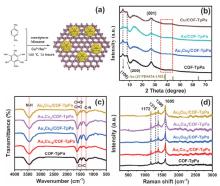
Fig 1
(a) Schematic fabrication of AuCu/COF-TpPa. (b) XRD patterns of COF-TpPa, Cu/COF-TpPa, Au/COF-TpPa, and Au1Cu5/COF-TpPa. (c) FT-IR spectra and (d) Raman spectra of COF-TpPa and AuCu/COF-TpPa."
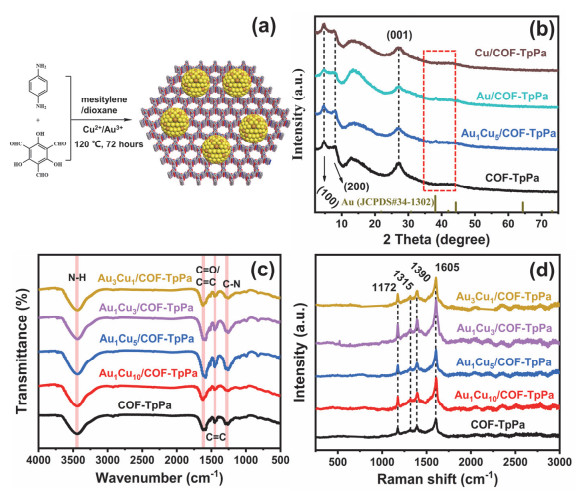
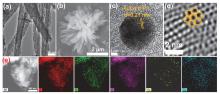
Fig 2
(a) TEM and (b) SEM images of Au1Cu5/COF-TpPa. (c) HR-TEM image and (d) Fourier-filtered image of selected area of Au1Cu5/COF-TpPa. (e) Element mapping of Au1Cu5/COF-TpPa."
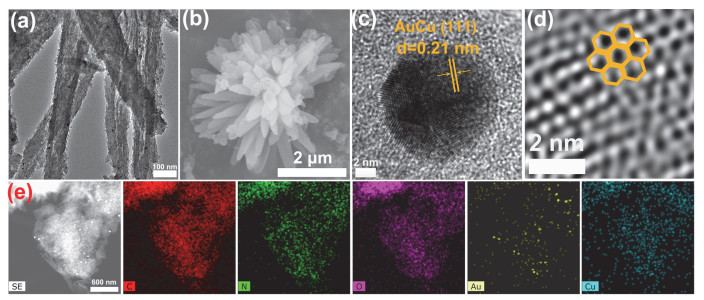
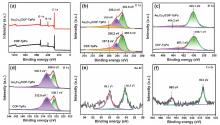
Fig 3
XPS spectra of COF-TpPa and Au1Cu5/COF-TpPa: (a) survey, (b) C 1s; (c) N 1s and (d) O 1s. (e) Au 4f and (f) Cu 2p XPS spectra of Au1Cu5/COF-TpPa."
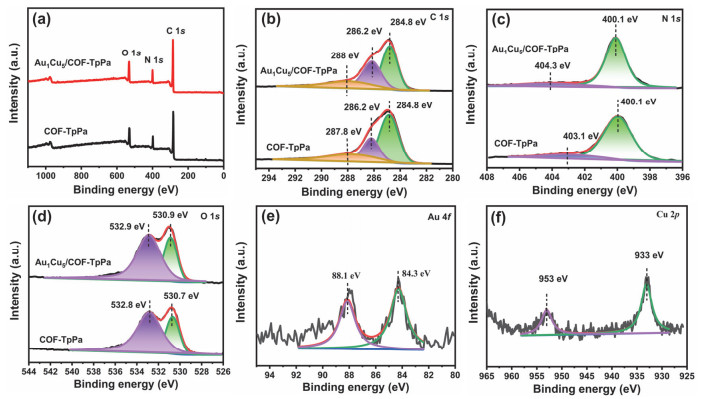
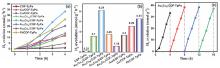
Fig 4
(a) H2 yield and (b) the average H2 evolution rate of as-prepared samples. (c) Long-term stability test of Au1Cu5/COF-TpPa."
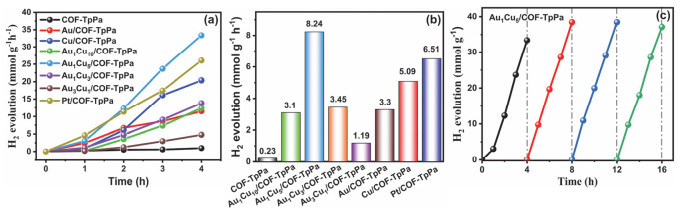
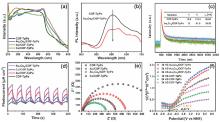
Fig 5
(a) UV-Vis DRS spectra, (b) steady-state PL spectra, and (c) time-resolved PL spectra of COF-TpPa and Au1Cu5/COF-TpPa. (d) Transient photocurrent and (e) EIS of the prepared samples. (f) Mott-Schottky curves of COF-TpPa and Au1Cu5/COF-TpPa."
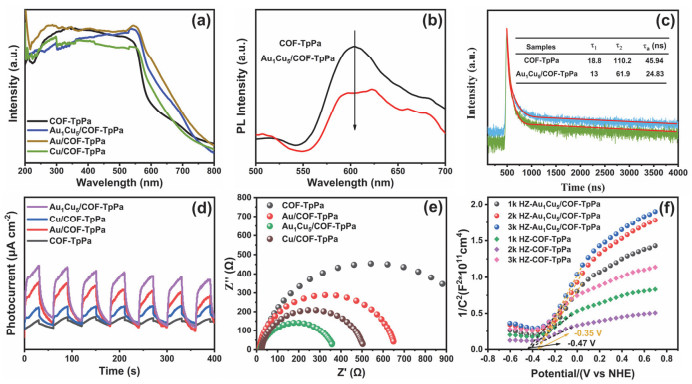
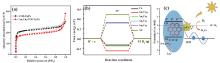
Fig 6
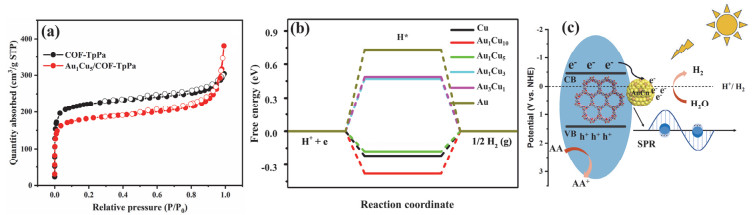
(a) N2 adsorption and desorption isotherms of COF-TpPa and Au1Cu5/COF-TpPa. (b) The adsorption free energy of H* (ΔGH*). (c) Schematic mechanism of Au1Cu5/TpPa under visible light for H2 evolution."
| 1 |
doi: 10.1002/adfm.202300386 |
| 2 |
doi: 10.1002/anie.201712816 |
| 3 |
doi: 10.1039/d0ta04574h |
| 4 |
doi: 10.1002/adma.202004205 |
| 5 |
doi: 10.1002/adfm.202302874 |
| 6 |
doi: 10.1016/j.ccr.2020.213616 |
| 7 |
doi: 10.1016/j.apcatb.2023.122780 |
| 8 |
doi: 10.1002/anie.202204938 |
| 9 |
doi: 10.1039/d0cs00278j |
| 10 |
doi: 10.1039/D3CC02914J |
| 11 |
doi: 10.1021/jacs.3c03198 |
| 12 |
doi: 10.1021/jacs.1c06518 |
| 13 |
doi: 10.1016/S1872-2067(22)64130-5 |
| 14 |
doi: 10.1039/D3TA02189K |
| 15 |
doi: 10.1002/adma.202210952 |
| 16 |
doi: 10.1002/advs.201970011 |
| 17 |
doi: 10.1016/s1872-2067(21)63869-x |
| 18 |
doi: 10.1016/j.jmst.2021.12.065 |
| 19 |
doi: 10.1016/j.jmst.2022.11.001 |
| 20 |
doi: 10.1021/acscatal.2c02081 |
| 21 |
doi: 10.3866/PKU.WHXB202212026 |
|
罗铖; 龙庆; 程蓓; 朱必成; 王临曦. 物理化学学报, 2023, 39, 2212026.
doi: 10.3866/PKU.WHXB202212026 |
|
| 22 |
doi: 10.1016/S1872-2067(22)64108-1 |
| 23 |
doi: 10.1016/j.apcatb.2023.123196 |
| 24 |
doi: 10.3866/PKU.WHXB202212016 |
|
吴新鹤; 陈郭强; 王娟; 李金懋; 王国宏. 物理化学学报, 2023, 39, 2212016.
doi: 10.3866/PKU.WHXB202212016 |
|
| 25 |
doi: 10.3866/PKU.WHXB202108028 |
|
黄悦; 梅飞飞; 张金锋; 代凯; DawsonG.. 物理化学学报, 2022, 38, 2108028.
doi: 10.3866/PKU.WHXB202108028 |
|
| 26 |
doi: 10.1002/adma.202303030 |
| 27 |
doi: 10.1016/j.jmst.2023.06.048 |
| 28 |
doi: 10.1007/s11467-021-1079-4 |
| 29 |
doi: 10.3866/PKU.WHXB202202001Wageh,S.;Al-Ghamdi,A.A.; |
|
WagehS.; Al-GhamdiA. A.; 徐全龙. 物理化学学报, 2022, 38, 2202001.
doi: 10.3866/PKU.WHXB202202001 |
|
| 30 |
doi: 10.1021/acs.chemrev.2c00733 |
| 31 |
doi: 10.1039/C6NR02124G |
| 32 |
doi: 10.1002/cey2.205 |
| 33 |
doi: 10.1021/acs.chemrev.3c00252 |
| 34 |
doi: 10.1002/anie.202304559 |
| 35 |
doi: 10.1002/adfm.202303321 |
| 36 |
doi: 10.1002/smll.202301928 |
| 37 |
doi: 10.1016/S1872-2067(22)64104-4 |
| 38 |
doi: 10.1002/anie.202313172 |
| 39 |
doi: 10.1007/s11467-019-0950-z |
| 40 |
doi: 10.1002/adma.201804883 |
| 41 |
doi: 10.1002/smll.202107840 |
| 42 |
doi: 10.1016/j.snb.2023.133700 |
| 43 |
doi: 10.1016/S1872-2067(22)64118-4 |
| 44 |
doi: 10.1016/j.ccr.2017.07.014 |
| 45 |
doi: 10.1002/solr.202200279 |
| 46 |
doi: 10.1016/j.jmst.2023.04.053 |
| 47 |
doi: 10.1016/j.cej.2023.146818 |
| 48 |
doi: 10.1002/anie.202212045 |
| 49 |
doi: 10.3866/PKU.WHXB202212009 |
|
孙涛; 李晨曦; 鲍钰鹏; 樊君; 刘恩周. 物理化学学报, 2023, 39, 2212009.
doi: 10.3866/PKU.WHXB202212009 |
|
| 50 |
doi: 10.1016/j.apcatb.2022.122301 |
| 51 |
doi: 10.1021/ja308278w |
| 52 |
doi: 10.1016/j.apcatb.2021.120238 |
| 53 |
doi: 10.1021/acscatal.1c03441 |
| 54 |
doi: 10.1038/s41467-022-33501-8 |
| 55 |
doi: 10.1002/anie.201403375 |
| 56 |
doi: 10.1016/j.cej.2019.122635 |
| 57 |
doi: 10.1016/j.ijhydene.2015.11.143 |
| 58 |
doi: 10.1021/jacs.7b01784 |
| 59 |
doi: 10.1016/j.apcatb.2019.04.013 |
| 60 |
doi: 10.1016/j.apcatb.2018.10.020 |
| 61 |
doi: 10.1002/smll.202207467 |
| 62 |
doi: 10.1016/j.nanoen.2022.107031 |
| 63 |
doi: 10.1016/S1872-2067(21)64024-X |
| 64 |
doi: 10.1016/j.jechem.2020.04.040 |
| 65 |
doi: 10.1016/j.jece.2021.106469 |
| 66 |
doi: 10.1021/acscatal.3c00284 |
| [1] | Yu Liu, Pengfei Li, Yize Liu, Zaicheng Sun. Recent advances in carbon dots as a single photocatalyst [J]. Acta Phys. -Chim. Sin., 2026, 42(2): 100167-. |
| [2] | Yuhang Zhang, Yi Li, Yuehan Cao, Yingjie Shuai, Yu Zhou, Ying Zhou. Regulating the formation type by Ir of intermediates to suppress product overoxidation in photocatalytic methane conversion [J]. Acta Phys. -Chim. Sin., 2026, 42(2): 100173-. |
| [3] | Chengxiao Zhao, Zhaolin Li, Dongfang Wu, Xiaofei Yang. SBA-15 templated covalent triazine frameworks for boosted photocatalytic hydrogen production [J]. Acta Phys. -Chim. Sin., 2026, 42(1): 100149-. |
| [4] | Shiyi Chen, Jialong Fu, Jianping Qiu, Guoju Chang, Shiyou Hao. Waste medical mask-derived carbon quantum dots enhance the photocatalytic degradation of polyethylene terephthalate (PET) over BiOBr/g-C3N4 S-scheme heterojunction [J]. Acta Phys. -Chim. Sin., 2026, 42(1): 100135-. |
| [5] | Fengying Zhang, Yanglin Mei, Yuman Jiang, Shenshen Zheng, Kaibo Zheng, Ying Zhou. Research progress of transient absorption spectroscopy in solar energy conversion and utilization [J]. Acta Phys. -Chim. Sin., 2025, 41(9): 100118-. |
| [6] | Menglan Wei, Xiaoxia Ou, Yimeng Wang, Mengyuan Zhang, Fei Teng, Kaixuan Wang. S-scheme heterojunction g-C3N4/Bi2WO6 highly efficient degradation of levofloxacin: performance, mechanism and degradation pathway [J]. Acta Phys. -Chim. Sin., 2025, 41(9): 100105-. |
| [7] | Jingping Li, Suding Yan, Jiaxi Wu, Qiang Cheng, Kai Wang. Improving hydrogen peroxide photosynthesis over inorganic/organic S-scheme photocatalyst with LiFePO4 [J]. Acta Phys. -Chim. Sin., 2025, 41(9): 100104-. |
| [8] | Lewang Yuan, Yaoyao Peng, Zong-Jie Guan, Yu Fang. Insights into the development of 2D covalent organic frameworks as photocatalysts in organic synthesis [J]. Acta Phys. -Chim. Sin., 2025, 41(8): 100086-. |
| [9] | Jiajie Cai, Chang Cheng, Bowen Liu, Jianjun Zhang, Chuanjia Jiang, Bei Cheng. CdS/DBTSO-BDTO S-scheme photocatalyst for H2 production and its charge transfer dynamics [J]. Acta Phys. -Chim. Sin., 2025, 41(8): 100084-. |
| [10] | Yu Wang, Haiyang Shi, Zihan Chen, Feng Chen, Ping Wang, Xuefei Wang. Hollow AgPt@Pt core-shell cocatalyst with electron-rich Ptδ− shell for boosting selectivity of photocatalytic H2O2 production for faceted BiVO4 [J]. Acta Phys. -Chim. Sin., 2025, 41(7): 100081-. |
| [11] | Yadan Luo, Hao Zheng, Xin Li, Fengmin Li, Hua Tang, Xilin She. Modulating reactive oxygen species in O, S co-doped C3N4 to enhance photocatalytic degradation of microplastics [J]. Acta Phys. -Chim. Sin., 2025, 41(6): 100052-. |
| [12] | Yuchen Zhou, Huanmin Liu, Hongxing Li, Xinyu Song, Yonghua Tang, Peng Zhou. Designing thermodynamically stable noble metal single-atom photocatalysts for highly efficient non-oxidative conversion of ethanol into high-purity hydrogen and value-added acetaldehyde [J]. Acta Phys. -Chim. Sin., 2025, 41(6): 100067-. |
| [13] | Hui Wang, Abdelkader Labidi, Menghan Ren, Feroz Shaik, Chuanyi Wang. Recent Progress of Microstructure-Regulated g-C3N4 in Photocatalytic NO Conversion: The Pivotal Roles of Adsorption/Activation Sites [J]. Acta Phys. -Chim. Sin., 2025, 41(5): 100039-. |
| [14] | Qin Li, Huihui Zhang, Huajun Gu, Yuanyuan Cui, Ruihua Gao, Wei-Lin Dai. In situ Growth of Cd0.5Zn0.5S Nanorods on Ti3C2 MXene Nanosheet for Efficient Visible-Light-Driven Photocatalytic Hydrogen Evolution [J]. Acta Phys. -Chim. Sin., 2025, 41(4): 100031-. |
| [15] | Xinwan Zhao, Yue Cao, Minjun Lei, Zhiliang Jin, Tsubaki Noritatsu. Constructing S-scheme heterojunctions by integrating covalent organic frameworks with transition metal sulfides for efficient noble-metal-free photocatalytic hydrogen evolution [J]. Acta Phys. -Chim. Sin., 2025, 41(12): 100152-. |
|
||