Acta Phys. -Chim. Sin. ›› 2024, Vol. 40 ›› Issue (4): 2304024.doi: 10.3866/PKU.WHXB202304024
• ARTICLE • Previous Articles Next Articles
Laser-Induced Carbonization of Hydroxyapatite Sandwich Paper for Inkless Printing
Junjian Wang1,2, Qingquan Yu1, Shunyao Liu1, Yuke Chen1, Xiaoyu Liu1,3, Guodong Li4, Xiaoyan Liu1,*( ), Hong Liu1,3, Weijia Zhou1,*()
- 1 Institute for Advanced Interdisciplinary Research (iAIR), School of Chemistry and Chemical Engineering, University of Jinan, Jinan 250022, China
2 School of Materials Science and Engineering, University of Jinan, Jinan 250022, China
3 State Key Laboratory of Crystal Materials, Shandong University, Jinan 250100, China
4 State Key Laboratory of Biobased Material and Green Papermaking, Qilu University of Technology (Shandong Academy of Sciences), Jinan 250353, China
-
Received:2023-04-13Revised:2023-06-06Accepted:2023-06-08Published:2023-06-16 -
Contact:Email: ifc_liuxy@ujn.edu.cn (Xiaoyan Liu)ifc_zhouwj@ujn.edu.cn (Weijia Zhou) -
Supported by:the National Natural Science Foundation of China(52022037); the National Natural Science Foundation of China(52102171); the Taishan Scholar Project of Shandong Province(tsqn201812083); the Natural Science Foundation of Shandong Province(2021CXGC010603); the Natural Science Foundation of Shandong Province(ZR2021JQ15); the Natural Science Foundation of Shandong Province(ZR2020QE071); the Natural Science Foundation of Shandong Province(ZR2020LLZ006); the Natural Science Foundation of Shandong Province(ZR2021MB035); the Innovative Team Project of Jinan(2021GXRC019)

Cite this article
Junjian Wang, Qingquan Yu, Shunyao Liu, Yuke Chen, Xiaoyu Liu, Guodong Li, Xiaoyan Liu, Hong Liu, Weijia Zhou. Laser-Induced Carbonization of Hydroxyapatite Sandwich Paper for Inkless Printing[J]. Acta Phys. -Chim. Sin. 2024, 40(4), 2304024. doi: 10.3866/PKU.WHXB202304024
share this article
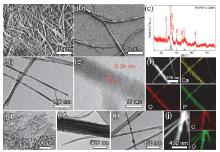
Fig 1
Characterization of HAP and CF. (a, b) SEM images, (c) XRD pattern, (d) TEM image, (e) HRTEM image and (f) EDS elemental mapping of HAP nanowires. (g) SEM image, (h, i) TEM images and (j) EDS elemental mapping of CF."
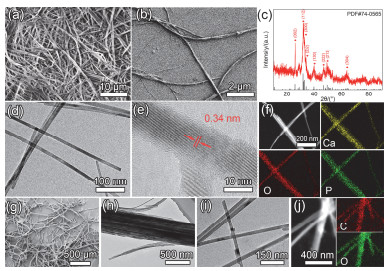
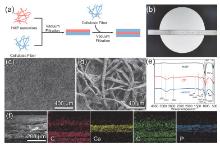
Fig 2
Preparation and characterization of HAP/CF functional paper. (a) The preparation process, (b) digital image of HAP/CF functional paper. (c, d) SEM images of HAP/CF functional paper surface. (e) FTIR of HAP/CF functional paper. (f) SEM image and EDS element mapping images of the cross-section of HAP/CF functional paper."
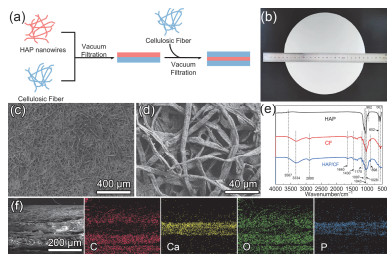
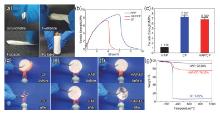
Fig 3
Performance characterization of HAP/CF functional paper. (a) High flexibility of the HAP/CF functional paper under different bending conditions. (b) Tensile strength versus strain curves, (c) Tensile strength numbers, (d–f) Fire resistance tests, (g) TG curves of the CF paper, HAP paper and HAP/CF functional paper."
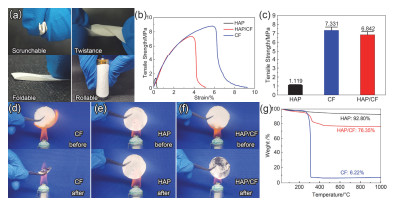
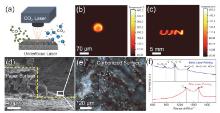
Fig 4
Characterization of HAP/CF functional paper by laser ablation printing. (a) Schematic illustration of laser ablation printing. (b) The laser working point and (c) the working track at the end of laser ablation of the corresponding infrared thermal images. (d) The SEM image of the cross section and (e) polarizing microscope image of the surface after laser ablation printing. (f) Raman spectra of CF/HAP function paper before and after laser ablation printing."
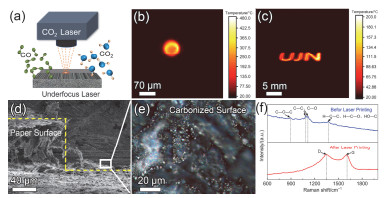
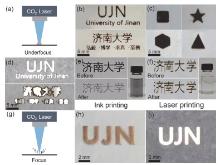
Fig 5
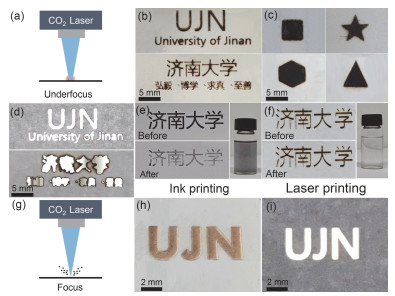
Application of HAP/CF functional paper. (a) The schematic of laser ablation printing in underfocus mode. Photographs of the laser underfocus ablation printing on (b–c) the HAP/CF functional paper and (d) the ordinary A4 paper printing paper. (e–f) Stability test of different printing methods. (g) The schematic of laser ablation printing in underfocus mode. Photographs of the laser focus printing effect of (h) the HAP/CF functional paper and (i) the ordinary A4 paper printing paper."
| 1 |
doi: 10.1038/s41467-023-36275-9 |
| 2 |
doi: 10.1016/j.apr.2019.10.013 |
| 3 |
doi: 10.1007/s11869-022-01174-3 |
| 4 |
doi: 10.1039/D0MH00150C |
| 5 |
doi: 10.1039/c5sc04450b |
| 6 |
doi: 10.1039/c9qi01037h |
| 7 |
doi: 10.1021/acs.cgd.0c01597 |
| 8 |
doi: 10.1021/acs.inorgchem.7b02206 |
| 9 |
doi: 10.1016/j.dyepig.2020.108888 |
| 10 |
doi: 10.1016/j.ijleo.2023.170509 |
| 11 |
doi: 10.1016/j.icheatmasstransfer.2023.106649 |
| 12 |
|
|
杨镇; 刘海; 何远航. 物理化学学报, 2016, 32, 1977.
doi: 10.3866/PKU.WHXB201604293 |
|
| 13 |
doi: 10.1016/j.carbpol.2020.117417 |
| 14 |
|
|
王伟; 王瑶; 占自祥; 谭天; 邓卫平; 张庆红; 王野. 物理化学学报, 2022, 38, 2205032.
doi: 10.3866/PKU.WHXB2022205032 |
|
| 15 |
doi: 10.1016/j.ceramint.2022.06.068 |
| 16 |
doi: 10.1016/j.cej.2022.135489 |
| 17 |
doi: 10.1016/j.jconrel.2021.12.039 |
| 18 |
doi: 10.1021/acsami.6b12838 |
| 19 |
doi: 10.1016/j.cej.2021.132912 |
| 20 |
doi: 10.1002/adma.202005140 |
| 21 |
doi: 10.3390/coatings12040479 |
| 22 |
doi: 10.1016/j.cej.2022.136470 |
| 23 |
doi: 10.1016/j.apcatb.2022.121500 |
| 24 |
doi: 10.1016/j.nanoen.2022.107473 |
| 25 |
doi: 10.1002/adma.201703548 |
| 26 |
doi: 10.1021/acsnano.8b00047 |
| 27 |
doi: 10.1023/A:1018570213546 |
| 28 |
doi: 10.1021/acssuschemeng.9b03793 |
| 29 |
|
|
沈玉华; 杨展澜; 吴瑾光. 物理化学学报, 1999, 15, 9.
doi: 10.3866/PKU.WHXB19991203 |
|
| 30 |
doi: 10.1007/s10570-007-9145-9 |
| 31 |
doi: 10.1016/j.biortech.2021.126033 |
| 32 |
doi: 10.1016/j.carbpol.2018.12.040 |
| 33 |
doi: 10.1007/s40820-020-00577-0 |
| 34 |
doi: 10.1016/j.combustflame.2020.01.016 |
| 35 |
doi: 10.1016/j.fuproc.2020.106456 |
| 36 |
doi: 10.1016/j.carbpol.2012.04.020 |
| 37 |
doi: 10.3390/ijms24032630 |
| 38 |
doi: 10.1021/acssuschemeng.0c01734 |
| 39 |
doi: 10.1002/advs.202105869 |
| [1] | Hailian Tang, Siyuan Chen, Qiaoyun Liu, Guoyi Bai, Botao Qiao, Liu Fei. Stabilized Rh/hydroxyapatite Catalyst for Furfuryl Alcohol Hydrogenation: Application of Oxidative Strong Metal-Support Interactions in Reducing Conditions [J]. Acta Phys. -Chim. Sin., 2025, 41(4): 100036-. |
| [2] | Jiaxin Wang, Weili Shen, Jinning Hu, Jun Chen, Xiaoming Li, Haibo Zeng. Mechanisms and Applications of Laser Action on Lead Halide Perovskites [J]. Acta Phys. -Chim. Sin., 2021, 37(4): 2008051-. |
| [3] | Lei LIU, Yaya HAO, Suhui DENG, Kun WANG, Jiang LI, Lihua WANG, Chunhai FAN, Jiajun LI, Huajie LIU. Multi-Mode Full Spectrum Dark Field Microscope for Single Nanoparticle Localized Surface Plasmon Resonance Dynamics Study [J]. Acta Physico-Chimica Sinica, 2019, 35(4): 371-377. |
| [4] | Kexin WANG,Liurong SHI,Mingzhan WANG,Hao YANG,Zhongfan LIU,Hailin PENG. Biomass Hydroxyapatite-templated Synthesis of 3D Graphene [J]. Acta Physico-Chimica Sinica, 2019, 35(10): 1112-1118. |
| [5] | Hai-Xia LI,Yan-Cheng LIU,Rui-Zhi TANG,Peng ZHANG,Liu-Kui MA,Chi-Yuan WEI,Wen-Feng WANG. Reactions of Triplet-State Difloxacin with Amino Acids and dGMP: A Laser Flash Photolysis Study [J]. Acta Phys. -Chim. Sin., 2017, 33(5): 1051-1056. |
| [6] | Ning-Liang LIU,Huan SHEN. Multiphoton Dissociation and Ionization Dynamics of Allyl Chloride Using Femtosecond Laser Pulses [J]. Acta Phys. -Chim. Sin., 2017, 33(3): 500-505. |
| [7] | Xiao-Ye NIU,Xiao-Qin DU,Qin-Chao WANG,Xiao-Jing WU,Xin ZHANG,Yong-Ning ZHOU. AlN-Fe Nanocomposite Thin Film:A New Anode Material for Lithium-Ion Batteries [J]. Acta Phys. -Chim. Sin., 2017, 33(12): 2517-2522. |
| [8] | Zhen YANG,Hai LIU,Yuan-Hang HE. Molecular Dynamics Simulations of Femtosecond Laser Ablation of Energetic Materials [J]. Acta Phys. -Chim. Sin., 2016, 32(8): 1977-1982. |
| [9] | Juan XIAO,Hao-Li ZHANG. Recent Progress in Organic-Inorganic Hybrid Perovskite Materials for Luminescence Applications [J]. Acta Phys. -Chim. Sin., 2016, 32(8): 1894-1912. |
| [10] | Qing-Long TANG,Hai-Feng LIU,Ming-Kun LI,Ming-Fa YAO. Study on In-Cylinder Charge Stratification of a Dual-Fuel Engine Using Fuel-Tracer Laser-Induced Fluorescence and Chemical Kinetic Simulation [J]. Acta Phys. -Chim. Sin., 2016, 32(12): 2879-2890. |
| [11] | CHEN Zhi-Lei, ZHANG Yong-Bin, HU Yin, LUO Li-Zhu, LIU Ke-Zhao. Influence on Surface Morphology of Uranium by Modification of Pulsed Laser Nitriding [J]. Acta Phys. -Chim. Sin., 2015, 31(Suppl): 111-116. |
| [12] | TANG Qing-Long, ZHANG Peng, LIU Hai-Feng, YAO Ming-Fa. Quantitative Measurements of Soot Volume Fractions in Diesel Engine Using Laser-Induced Incandescence Method [J]. Acta Phys. -Chim. Sin., 2015, 31(5): 980-988. |
| [13] | Qing-Long. TANG,Chao. GENG,Ming-Kun. LI,Hai-Feng. LIU,Ming-Fa. YAO. Laser-Induced Fluorescence Measurements of Formaldehyde and OH Radicals in Dual-Fuel Combustion Process in Engine [J]. Acta Phys. -Chim. Sin., 2015, 31(12): 2269-2277. |
| [14] | ZHANG Peng, LIU Hai-Feng, CHEN Bei-Ling, TANG Qing-Long, YAO Ming-Fa. Fluorescence Spectra of Polycyclic Aromatic Hydrocarbons and Soot Concentration in Partially Premixed Flames of Diesel Surrogate Containing Oxygenated Additives [J]. Acta Phys. -Chim. Sin., 2015, 31(1): 32-40. |
| [15] | WANG Liu-Heng, PENG Rong-Zong, ZHAO Yu-Xia, WU Fei-Peng. Synthesis and Optical Limiting Behaviors of Malononitrile Derivatives [J]. Acta Phys. -Chim. Sin., 2014, 30(5): 980-986. |
|
||