Acta Phys. -Chim. Sin. ›› 2024, Vol. 40 ›› Issue (7): 2307057.doi: 10.3866/PKU.WHXB202307057
• REVIEW • Previous Articles Next Articles
Progress on Entropy Production Engineering for Electrochemical Catalysis
Xinyi Zhang1, Kai Ren1, Yanning Liu1, Zhenyi Gu2, Zhixiong Huang2, Shuohang Zheng2, Xiaotong Wang2, Jinzhi Guo2, Igor V. Zatovsky3, Junming Cao2,*( ), Xinglong Wu1,2,*()
- 1 Faculty of Chemistry, Northeast Normal University, Changchun 130024, China
2 MOE Key Laboratory for UV Light-Emitting Materials and Technology, Northeast Normal University, Changchun 130024, China
3 F.D. Ovcharenko Institute of Biocolloidal Chemistry, NAS Ukraine, Kyiv 03142, Ukraine
-
Received:2023-07-29Revised:2023-08-31Accepted:2023-09-03Published:2023-12-01 -
Contact:Email: jmcao@nenu.edu.cn (Junming Cao)xinglong@nenu.edu.cn (Xinglong Wu) -
Supported by:the National Key R&D Program of China(2023YFE0202000); the National Natural Science Foundation of China(52302222); the Natural Science Foundation of Jilin Province(20230508177RC); the 111 Project(B13013); the China Postdoctoral Science Foundation(2022M720704); the China Postdoctoral Science Foundation(2023T160094); the Fundamental Research Funds for the Central Universities(2412022QD038)

Cite this article
Xinyi Zhang, Kai Ren, Yanning Liu, Zhenyi Gu, Zhixiong Huang, Shuohang Zheng, Xiaotong Wang, Jinzhi Guo, Igor V. Zatovsky, Junming Cao, Xinglong Wu. Progress on Entropy Production Engineering for Electrochemical Catalysis[J]. Acta Phys. -Chim. Sin. 2024, 40(7), 2307057. doi: 10.3866/PKU.WHXB202307057
share this article
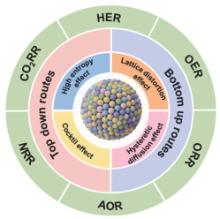
Fig 1
Schematic diagram of entropy effect, synthesis route and electrocatalysis application of HECs."
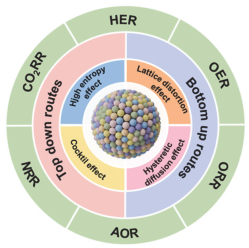
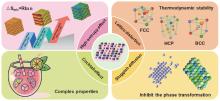
Fig 2
Schematic illustration of the properties and characteristics of HECs."
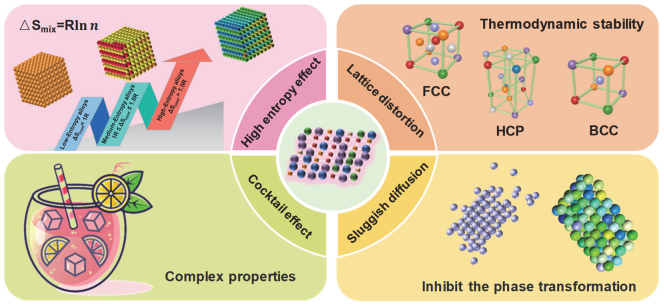
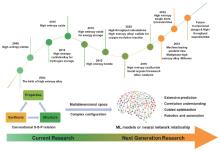
Fig 3
Timeline of the development of HECs and some key applications. In the future, the synthetic-structure-property relationship in traditional materials research will be replaced by data-driven methods."
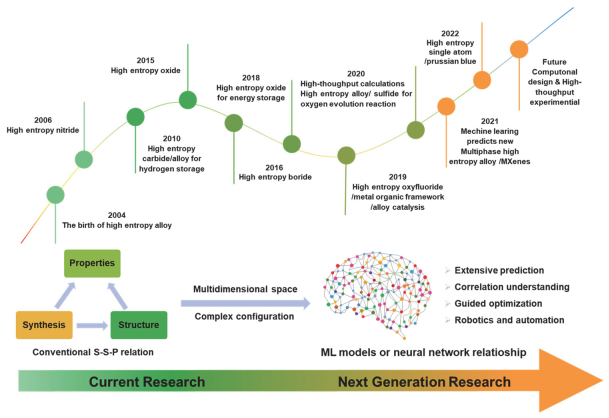
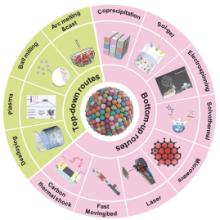
Fig 4
The synthesis of HECs: top-down preparation routes and bottom-up preparation routes."
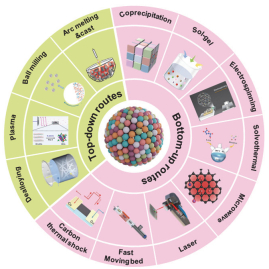
Table 1
Summary of the synthetic method and electrocatalytic application of high-entropy alloy."
| Synthesis routes | Synthesis | Characteristic | Example catalysts | Application | Refs. |
| Top-down routes | Melting and casting techniques | (CrFeCoNi)97O3 | OER | ||
| Plasma | Ultra small particles | FeCrCoNiCu)3O4 | HMF oxidation | ||
| Mechanochemistry | Solution-free, energy-saving, high-productivity, and low-temperature process | (NiMgCuZnCo)O | CO2RR | ||
| HE-ZIF-BM | CO2RR | ||||
| (FeMnNiCoCr)3S2 | Li-ion batteries | ||||
| Dealloying | Low cost, scalable fabrication, controllable structure | AlNiCoRuMoCrFeTi | ORR | ||
| Al-Ni-Co-Ru-X (X = Mo, Cu, V, Fe) | ORR | ||||
| PdPtCuNiP | HER | ||||
| FeCoNiAlTi | |||||
| Bottom-up routes | Carbothermal shock | Ultrafast, single phase, and various compositions | RuIrCeNiWCuCrCo | Li-O2 | |
| PdCuPtNiCo | ORR | ||||
| PdCuPtNiFe | |||||
| PdCuPtNiRh | |||||
| PdCuPtNiIr | |||||
| Laser | Colloids | CoCrFeNiAl | OER | ||
| Fast-moving bed | Ultrafast, single phase, and various compositions | FeCoPdPtIr | HER | ||
| Microwave | Uniform heating, fast heating, and cooling rate | FeCoNi MnVO/Ti3C2Tx−0.5 | OER | ||
| PtPdFeCoNi | |||||
| IrRuCoNiCu | Overall water splitting | ||||
| PtRhCoNiCu | |||||
| Wet chemistry | Small particle size, high dispersion, and single crystal | PtPdIrRuAg | ORR | ||
| IrPdPtRhRu | HER | ||||
| Pd@PdPtRhIrRu | |||||
| FeCoNiCuMn | ORR | ||||
| Electrostatically spun | Simplicity of installation, low cost, various compositions, synthetically controlled | FeCoNiIrRu | OER | ||
| FeCoNiCuMn | Overall water splitting | ||||
| Sol-gel | Low synthesis temperature, high dispersion | PdCuAuAgBiIn | CO2RR | ||
| NiCoFeMnCrP | HER & OER | ||||
| Co-precipitation | Simple process, low cost and synthetically controlled | NiCoCuZnFe-PBA | Li-S |
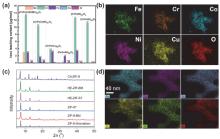
Fig 5
Top-down routes for the synthesis of HECs. (a) The XPS spectra for Cr the in (CrFeCoNi)97O3 and (CrFeCoNiMn)99O1 O-HEAs. (b) EDX mapping of P-HEOs. (c) XRD patterns of ZIF-8-simulation, ZIF-8-BM, ZIF-67, HE-ZIF-ST, HE-ZIF-BM and Cd-ZIF-8. (d) STEM-EDS mapping of the np-AlFeCoNiCr. (a) Adapted from Wiley Publications publisher 48. (b) Adapted from Wiley Publications publisher 49. (c) Adapted from Wiley Publications publisher 50. (d) Adapted from Elsevier Publications publisher 51."
Fig 6
Bottom-up routes for the synthesis of HECs. (a) STEM-EDS elemental mapping of the PdCuPtNiCo HEA NPs. (b) XRD patterns of the HEA-NPs with different composited elements. (c) SEM-EDS mapping of the elemental distribution of HECs containing four to seven elements (scale bar = 1 mm). (d) HAADF-STEM images for the denary (MnCoNiCuRhPdSnIrPtAu) HEA-NPs highly dispersed on GO synthesized by the FMBP strategy. (e) High-angle annular dark-field EDS elemental mapping and HAADF-STEM image for the GaFeMnNiCu HEA. (f) Full-survey of the HEO/Ti3C2Tx-0.5 hybrid sample. (a) Adapted from ACS Publications publisher 55. (b) Adapted from Oxford University Presson behalf of China Science Publications publisher 75. (c) Adapted from ACS Publications publisher 76. (d) Adapted from Wiley Publications publisher 56. (e) Adapted from Wiley Publications publisher 77. (f) Adapted from Wiley Publications publisher 57."
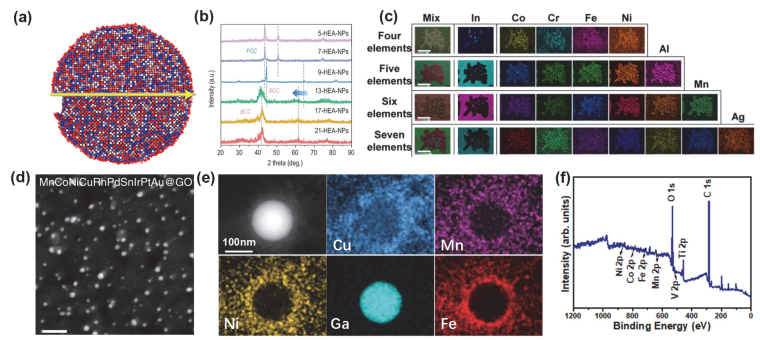
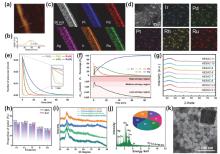
Fig 7
Bottom-up routes for the synthesis of HECs. (a) AFM image (b) and corresponding height profile (c) of oneHEA-PtPdIrRuAg SNR. (d) HAADF-STEM. (e) The numbers of Pd(Ⅱ), Pt(Ⅱ), Rh(Ⅲ), Ir(Ⅳ), and Ru(Ⅲ) ionsremaining in the reaction solution. (f) The instantaneous percentages of Pd, Pt, Rh, Ir, and Ru atoms generated.(g) XRD patterns of the HEA/CNFs patterns of the prepared HESACs. (h) Metal compositions of FeCoNiIrRu/CNFs obtained by ICP and XPS. (i) PXRD patterns of sepetenary PdCuAuAgBiInCo HEAAs, sepetenary PdCuAuAgBiInZn HEAAs, octonary PdCuAuAgBiInCoNi HEAAs, and novenary PdCuAuAgBiInCoNiZn HEAAs.(g) SEM-EDS spectra of PdCuAuAgBiIn HEAAs. (k) SEM and TEM images of CoNiCuMnZnFe-oxide. (a–c) Adapted from ACS Publications publisher 60. (d) Adapted from ACS Publications publisher 61. (e, f) Adapted from ACS Publications publisher 62. (g) Adapted from Wiley Publications publisher 63. (h) Adapted from Elsevier Publications publisher 64. (i, j) Adapted from Wiley Publications publisher 66. (k) Adapted from Wiley Publications publisher 67."

Table 2
Summary of the electrocatalytic performance of high-entropy catalysts."
| Reaction | Composition | Structural feature | Overpotential/mV | Tafel slope/(mV∙dec−1) | Electrolyte | Ref. |
| HER | CuAlNiMoFe | nanoporous | 56 (100 mA∙cm−2) | 60 | 1.0 mol∙L−1 KOH | |
| 23 | 50 | 1.0 mol∙L−1 PBS | ||||
| Co0.6(VMnNiZn)0.4PS3 | nanosheets | 65.9 | 65.5 | 1.0 mol∙L−1 KOH | ||
| PtCoMoPdRh | nanoflowers | 16.5 | 26.8 | 1.0 mol∙L−1 KOH | ||
| PdMoGaInNi | nanosheets | 13 | 93.1 | 0.5 mol∙L−1 H2SO4 | ||
| PtPdRhIrRu | nanocrystals | 36.3 | 33.0 | 1.0 mol∙L−1 KOH | ||
| NiCoFePtRh | nanoparticles | 27 | 30.1 | 0.5 mol∙L−1 H2SO4 | ||
| FeCoNiCuMn | nanoparticles | 281 (100 mA∙cm–2]) | 53 | 1.0 mol∙L−1 KOH | ||
| PtPdRhRuCu | mesoporous nanospheres | 10 | 87 | 1.0 mol∙L−1 KOH | ||
| 13 | 0.5 mol∙L−1 H2SO4 | |||||
| 28 | 1.0 mol∙L−1 PBS | |||||
| Reaction | Composition | Structural feature | Overpotential/mV | Tafel slope/(mV∙dec−1) | Electrolyte | Ref. |
| OER | Ag@CoCuFeAgMoOOH | 281 (100 mA∙cm–2]) | 35.3 | 1.0 mol∙L−1 KOH | ||
| CoCuFeMoOOH@Cu | nanosheets | 199 | 48.8 | 1.0 mol∙L−1 KOH | ||
| FeNiCoCrMnV | nanoparticles | 220 | 45 | 1.0 mol∙L−1 KOH | ||
| FeCoNiCrMo | plate | 281 (100 mA∙cm–2]) | 38.5 | 1.0 mol∙L−1 KOH | ||
| FeNiCoCrMnS2 | spherical | 199 | 39.1 | 1.0 mol∙L−1 KOH | ||
| IrFeCoNiCu | nanoparticles | 302 | 58 | 0.1 mol∙L−1 HClO4 | ||
| FeCoNiIrRu | nanoparticles | 241 | 153 | 0.5 mol∙L−1 H2SO4 | ||
| CoFeNiMoWTe | nanospheres | 373 | 40.6 | 0.5 mol∙L−1 H2SO4 | ||
| K0.8Na0.2(MgMnFeCoNi)F3 | cubic | 314 | 55 | 1.0 mol∙L−1 KOH | ||
| Reaction | Composition | Structural feature | E1/2 (vs RHE)/V | Mass activity | Electrolyte | Ref. |
| ORR | PtFeCoNiCuZn | nanocrystals | 0.898 | 0.48 A mg–1] | 0.1 mol∙L−1 HClO4 | |
| FeCoNiCuPd | nanoparticles | 0.90 | 2.04 A mg–1] | 0.1 mol∙L−1 KOH | ||
| PtPdIrRuAg | ribbons | 0.93 | 3.642.04 A mg–1] | 0.1 mol∙L−1 KOH | ||
| AlNiCoRuMo | 0.875 | 0.81 A mg–1] | 0.1 mol∙L−1 KOH | |||
| AlNiCoRuMoCrFeTi | 0.87 | 0.1 mol∙L−1 KOH | ||||
| Reaction | Composition | Structural feature | Mass activity | Electrolyte | Ref. | |
| AOR | FeCoNiSn@Pd | nanoparticles | 7.34 A∙mg−1 | 1.0 mol∙L−1 KOH + 1.0 mol∙L−1 C2H5OH | ||
| PtPdRuIrOs | nanoparticles | 1.65A∙mg−1 | 0.1 mol∙L−1 HClO4 + 1.0 mol∙L−1 C2H5OH | |||
| np-AlPdNiCuMo | nanoporous | 7.34 A∙mg−1 | 0.5 mol∙L−1 H2SO4 + 0.5 mol∙L−1 C2H5OH | |||
| PtRhBiSnSb | nanoplates | 19.529 A∙mg−1 | 1.0 mol∙L−1 KOH + 1.0 mol∙L−1 CH3OH | |||
| 15.558 A∙mg−1 | 1.0 mol∙L−1 KOH + 1.0 mol∙L−1 C2H5OH | |||||
| 7.535 A∙mg−1 | 1.0 mol∙L−1 KOH + 1.0 mol∙L−1 C3H8O3 | |||||
| PtBiPbNiCo | nanoplates | 7.1 A∙mg−1 | 0.5 mol∙L−1 H2SO4 +0.5 mol∙L−1 CH2O2 | |||
| Reaction | Composition | Structural feature | NH3 yield | Faraday efficiency (FE) | Electrolyte | Ref. |
| NRR | ((NiFeCoMnV)3O4 | nanospheres | 47.58 µg∙h−1∙mg−1 | 10.74% | 1.0 mol∙L−1 KOH | |
| RuFeCoNiCu | nanoparticles | 57.1 µg∙h−1∙mg−1 | 38.5 | 1.0 mol∙L−1 KOH | ||
| 52.6 µg∙h−1∙mg−1 | 27.6% | 0.1 mol∙L−1 Li2SO4 | ||||
| 47.2 µg∙h−1∙mg−1 | 21.2% | 0.1 mol∙L−1 Na2SO4 | ||||
| 37.1 µg∙h−1∙mg−1 | 7.7% | 0.1 mol∙L−1 HCl | ||||
| Reaction | Composition | Structural feature | products | Faraday efficiency (FE) | Electrolyte | Ref. |
| CO2RR | PdCuAuAgBiIn | aerogels | HCOOH | 98.1% | 0.1 mol∙L−1 KHCO3 | |
| (MoWVNbTa)S2 | nanoflowers | CO | 91% | 1 mol∙L−1 KOH+1 mol∙L−1 choline chloride | ||
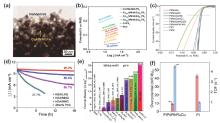
Fig 8
(a) Low-magnification STEM image of nanoporous CuAlNiMoFe with uniform small nanopores.(b) Cox(VMnNiZn)1−xPS3 NSs Tafel diagram. (c) LSV diagram of high entropy alloy and other alloy nanosheets in0.5 mol·L−1 H2SO4. (d) Chronoamperometric (CA) measurements of HEA/LNG, HEA/MNG and HEA/HNG.(e) Mass activity comparisons of us-HEA/C at −0.05 V vs. RHE with state-of-the-art noble metal catalystsreported in the recent literatures. (f) Comparison of overpotentials required to achieve 10 mA·cm−2 andTOF values at an overpotential of 50 mV for PtPdRhRuCu MMNs and Pt MNs. (a) Adapted from Wiley Publications publisher 93. (b) Adapted from ACS Publications publisher 94. (c) Adapted from ACS Publications publisher 94. (d) Adapted from Elsevier Publications publisher 97. (e) Adapted from ACS Publications publisher 98. (f) Adapted from Wiley Publications publisher 99."
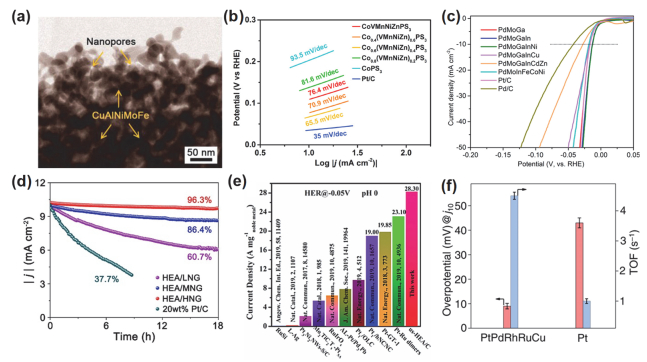
Fig 9
(a) Free energy diagram of Ag@CoCuFeAgMoOOH at 0 V. (b) Tafel plots of the CoCuFeMoOOH@Cu, CoCuMoOOH@Cu, CoFeMoOOH@CCC, Cu foil, and CCC samples. (c) LSV scans recorded at 5 mV·s−1 measured before ADT, after completion of CP50 and CP200, shown in blue, green, and orange, respectively.(d) OER polarization curves in 0.1 mol·L−1 HClO4 electrolyte (scan rate, 5 mV·s−1). (e) Corresponding overpotentials at geometric current density of 20 mA·cm−2 of these prepared electrocatalysts obtained in 0.5 mol·L−1 H2SO4 solution. (f) Long-term stability test at the current density of 10 mA·cm−2 in 0.5 mol·L−1 H2SO4 solution. (a) Adapted from Wiley Publications publisher 100. (b) Adapted from Wiley Publications publisher 101. (c) Adapted from Wiley Publications publisher 102. (d) Adapted from Wiley Publications publisher 105. (e) Adapted from Elsevier Publications publisher 64. (f) Adapted from Wiley Publications publisher 107."
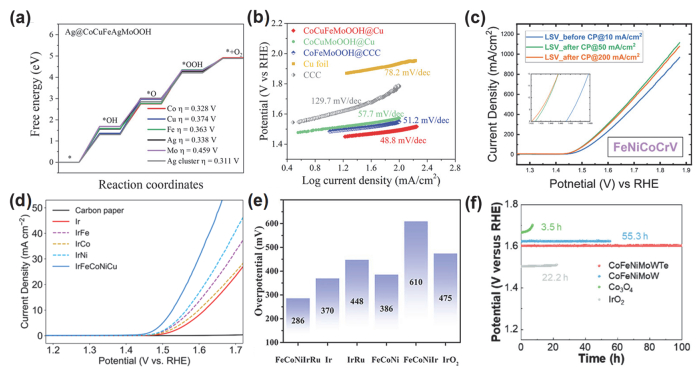
Fig 10
(a) Mass activities and specific of alloy catalysts and commercial Pt/C. (b) ORR polarization curves and mass/specific activity before and after 5000 cycles between 0.6 and 1.1 V. (c) Linear sweep voltammetry (LSV) curves of the OHEA-mNC, OHEA-nNC, DHEA-mNC and Pt/C toward the ORR obtained with a rotation rate of 1600 r·min−1 in 0.1 mol·L–1·KOH electrolyte. (d) Column diagrams of mass activity (normalized with Pt and PGMs, respectively) of different catalysts at 0.9 V (vs. RHE). (e) ORR polarization curves. (f) ORR/OER bifunctional LSV curves. (a, b) Adapted from Wiley Publications publisher 109. (c) Adapted from Wiley Publications publisher 110. (d) Adapted from ACS Publications publisher 60. (e) Adapted from ACS Publications publisher 52. (f) Adapted from Wiley Publications publisher 74."
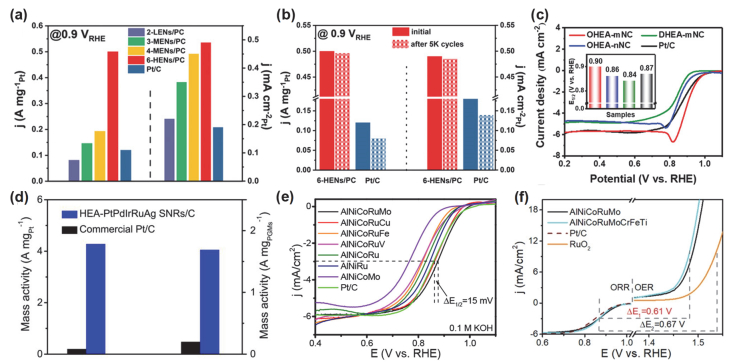
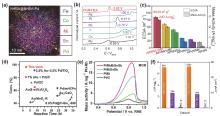
Fig 11
(a) Elemental mapping image of NHEA@NHEA-Pd. (b) MOR positive-going polarization curves of different catalysts recorded at a scan rate of 50 mV·s−1. (c) Comparison chart of Mass activity and electrochemical surface area (ECSA) between PGM-HEA and other metal catalysts. (d) Comparison of the catalytic conversion of holey lamellar HEO catalyst with those reported. (e) CO-stripping curves of PtRhBiSnSb HEI nanoplates, PtBiSnSb nanoplates, and Pt/C catalysts recorded in Ar-saturated 1.0 mol·L−1 KOH at a scan rate of 50 mV·s−1. (f) Mass and specific activities of different catalysts. (a) Adapted from Wiley Publications publisher 111. (b) Adapted from ACS Publications publisher 112. (c) Adapted from Wiley Publications publisher 143. (d) Adapted from Wiley Publications publisher 144. (e) Adapted from Wiley Publications publisher 113. (f) Adapted from Wiley Publications publisher 114."
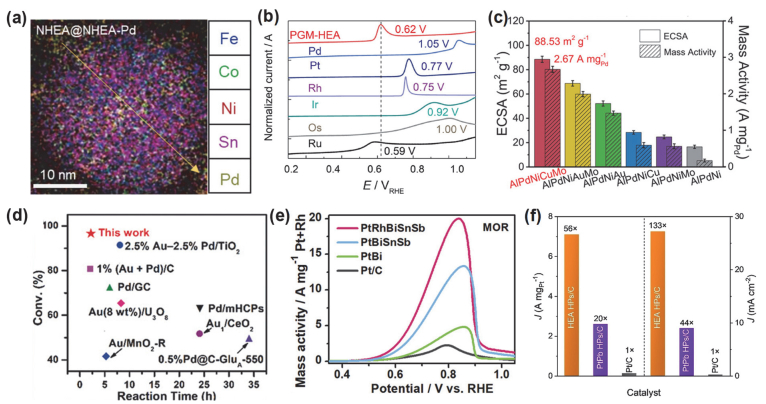
Fig 12
(a) The element mapping of Ni, Co, Fe, Mn, V, and O of HEOs. (b) Cathodic NRR performances of HEOs. (c) NH3 yield rates and Faradaic efficiencies (FEs) tested at different applied potentials (vs. RHE) for 1 h in N2-saturated 1.0 mol·L−1 KOH electrolyte. (d) UV-Vis absorption spectra of the 0.1 mol·L−1 KOH electrolytes stained with indophenol indicator after 1 h electrolysis under N2 at each given potential. (e)NH3 yields and FEs at each given potential in 0.1 mol·L−1 KOH. (f) Schematic illustration of a possible mechanism to explain the enhanced NRR activity of RuFeCoNiCu NPs at low overpotential. (a–c) Adapted from Wiley Publications publisher 115. (d–f) Adapted from Wiley Publications publisher 116."
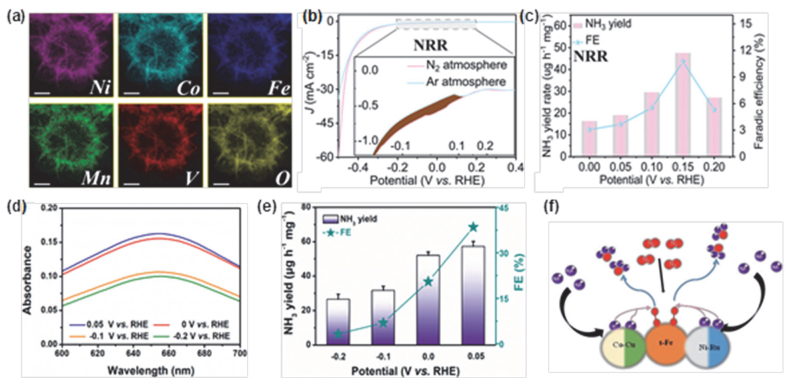
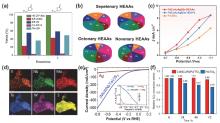
Fig 13
(a) Yields of two cyclic carbonates obtained from the cycloaddition of CO2 with corresponding epoxides catalyzed by HE-ZIF-BM, ZIF-8-BM, ZIF-67, Cd-ZIF-8, and PM-ZIF. (b) Atomic ratio of different elements of sepetenary PdCuAuAgBiInCo HEAAs, sepetenary PdCuAuAgBiInZn HEAAs, octonary PdCuAuAgBiInCoNi HEAAs, and novenary PdCuAuAgBiInCoNiZn HEAAs. (c) Jco of PdCuAuAgBiIn HEAAs, PdCuAuAgBiIn HEAPs and Pd MAs at −0.9 V vs. RHE. (d) EDS chemical maps showing V, Nb, Mo, Ta, W, and S distribution for the flake. (e) The current density of (Mo, W, V, Nb, Ta) and Ag nanoparticles plotted against V vs. RHE using LSV with simultaneous measurements of partial pressure of gaseous products in the inset. (f) Relative activities over time, showing the durability of CoNiCuRuPd/TiO2 and Pd/TiO2 during CO2 hydrogenation. (a) Adapted from Wiley Publications publisher 50. (b, c) Adapted from Wiley Publications publisher 117. (d, e) Adapted from Wiley Publications publisher 66. (f) Adapted from Wiley Publications publisher 163."
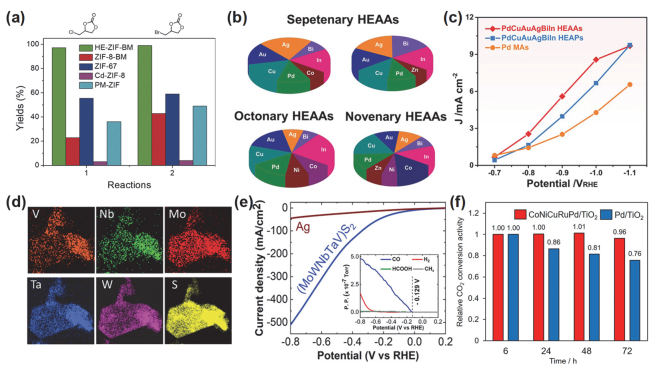
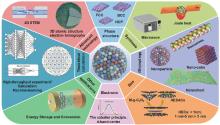
Fig 14
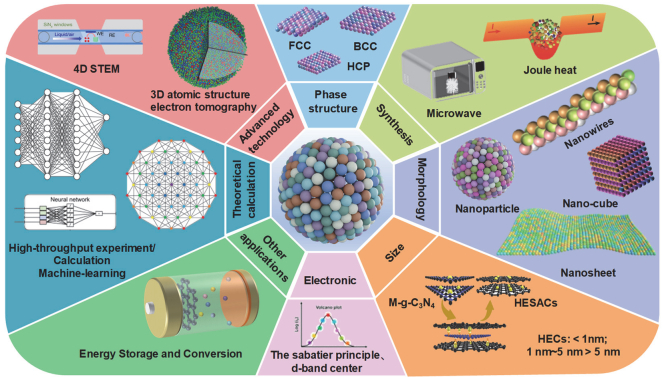
Schematic illustration of the future perspectives of HECs."
| 1 |
doi: 10.1002/idm2.12041 |
| 2 |
doi: 10.1021/acs.accounts.8b00002 |
| 3 |
doi: 10.1002/adma.202205814 |
| 4 |
doi: 10.1039/d2cs00843b |
| 5 |
doi: 10.1039/d1cs00135c |
| 6 |
doi: 10.1002/adma.202108133 |
| 7 |
doi: 10.1016/j.pmatsci.2023.101105 |
| 8 |
doi: 10.1002/adma.202107488 |
| 9 |
doi: 10.1021/jacs.0c02973 |
| 10 |
doi: 10.1039/D0EE01617A |
| 11 |
doi: 10.1016/j.mattod.2023.03.020 |
| 12 |
doi: 10.1021/acs.accounts.0c00655 |
| 13 |
doi: 10.1039/D0EE03915B |
| 14 |
doi: 10.1016/S1872-2067(19)63407-8 |
| 15 |
doi: 10.1039/D1EE00509J |
| 16 |
doi: 10.1016/j.nanoen.2021.106216 |
| 17 |
doi: 10.1007/s12598-022-02168-x |
| 18 |
doi: 10.1038/s41467-019-10303-z |
| 19 |
doi: 10.1038/ncomms10602 |
| 20 |
doi: 10.1016/j.actamat.2017.02.036 |
| 21 |
doi: 10.1016/j.actamat.2014.08.026 |
| 22 |
doi: 10.1038/ncomms10143 |
| 23 |
doi: 10.1038/s41578-019-0121-4 |
| 24 |
doi: 10.1038/ncomms8748 |
| 25 |
doi: 10.1016/j.actamat.2011.06.041 |
| 26 |
doi: 10.1002/adem.200300567 |
| 27 |
doi: 10.1016/j.msea.2003.10.257 |
| 28 |
doi: 10.1080/21663831.2014.912690 |
| 29 |
doi: 10.1016/j.matt.2020.12.021 |
| 30 |
doi: 10.1016/j.actamat.2021.117140 |
| 31 |
doi: 10.1002/anie.202209616 |
| 32 |
doi: 10.1016/j.jechem.2021.12.026 |
| 33 |
doi: 10.1126/sciadv.aaz0510 |
| 34 |
doi: 10.1016/j.matchemphys.2007.01.003 |
| 35 |
doi: 10.1039/D0TA02125C |
| 36 |
doi: 10.1016/j.actamat.2013.04.058 |
| 37 |
doi: 10.1103/PhysRevB.25.5895 |
| 38 |
doi: 10.1007/s40843-017-9195-8 |
| 39 |
doi: 10.1021/acsmaterialslett.9b00064 |
| 40 |
doi: 10.1126/science.aan5412 |
| 41 |
doi: 10.1016/j.actamat.2016.08.081 |
| 42 |
doi: 10.1016/j.scriptamat.2017.05.022 |
| 43 |
doi: 10.1016/j.pmatsci.2013.10.001 |
| 44 |
doi: 10.2475/ajs.s3-16.96.441 |
| 45 |
doi: 10.1007/s12613-020-2000-9 |
| 46 |
doi: 10.1038/nature02146 |
| 47 |
doi: 10.1016/j.matlet.2021.129428 |
| 48 |
doi: 10.1002/adma.202101845 |
| 49 |
doi: 10.1002/anie.202107390 |
| 50 |
doi: 10.1002/anie.201900787 |
| 51 |
doi: 10.1016/j.apcatb.2019.118431 |
| 52 |
doi: 10.1021/acsmaterialslett.0c00434 |
| 53 |
doi: 10.1002/adfm.202101586 |
| 54 |
doi: 10.1021/acs.nanolett.9b01523 |
| 55 |
doi: 10.1021/acsnano.2c07787 |
| 56 |
doi: 10.1038/s41467-020-15934-1 |
| 57 |
doi: 10.1002/smll.202207820 |
| 58 |
doi: 10.1021/acsnano.1c05113 |
| 59 |
doi: 10.14102/j.cnki.0254-5861.2022-0125 |
| 60 |
doi: 10.1021/jacs.2c03544 |
| 61 |
doi: 10.1021/jacs.2c02755 |
| 62 |
doi: 10.1126/sciadv.adf9931 |
| 63 |
doi: 10.1038/s41467-022-32850-8 |
| 64 |
doi: 10.1016/j.cej.2021.133251 |
| 65 |
doi: 10.1039/d2ee03185j |
| 66 |
doi: 10.1002/adma.202209242 |
| 67 |
doi: 10.1002/anie.202209350 |
| 68 |
doi: 10.1016/0040-6031(95)02792-0 |
| 69 |
doi: 10.1002/anie.201005547 |
| 70 |
doi: 10.1039/c2cs15332g |
| 71 |
doi: 10.1039/c1cs15171a |
| 72 |
doi: 10.1039/c7gc00693d |
| 73 |
doi: 10.1002/aenm.202103090 |
| 74 |
doi: 10.1002/smll.202107207 |
| 75 |
doi: 10.1093/nsr/nwac041 |
| 76 |
doi: 10.1021/acsnano.1c04259 |
| 77 |
doi: 10.1007/s12274-021-3804-2 |
| 78 |
doi: 10.1038/s41586-023-06082-9 |
| 79 |
doi: 10.1002/adfm.202010561 |
| 80 |
|
|
马明军; 冯志超; 张小委; 孙超越; 王海青; 周伟家; 刘宏. 物理化学学报,, 2022, 38, 2106003.
doi: 10.3866/PKU.WHXB202106003 |
|
| 81 |
doi: 10.1007/s12598-022-02061-7 |
| 82 |
|
|
崔柏桦; 施毅; 李根; 陈亚楠; 陈伟; 邓意达; 胡文彬. 物理化学学报,, 2022, 38, 2106010.
doi: 10.3866/PKU.WHXB202106010 |
|
| 83 |
doi: 10.1039/D0CS00013B |
| 84 |
doi: 10.1016/j.cclet.2023.108571 |
| 85 |
doi: 10.1016/j.cclet.2022.07.049 |
| 86 |
doi: 10.1002/cnl2.9 |
| 87 |
doi: 10.1016/j.cclet.2022.108046 |
| 88 |
doi: 10.1016/j.scib.2020.06.022 |
| 89 |
doi: 10.1039/d0cs00575d |
| 90 |
doi: 10.1002/admi.202102154 |
| 91 |
doi: 10.1002/cnl2.77 |
| 92 |
doi: 10.1016/j.cej.2022.135375 |
| 93 |
doi: 10.1002/adfm.202009613 |
| 94 |
doi: 10.1021/acsnano.2c01064 |
| 95 |
doi: 10.1016/j.apcatb.2023.122814 |
| 96 |
doi: 10.1021/acscatal.2c02778 |
| 97 |
doi: 10.1016/j.scib.2022.08.022 |
| 98 |
doi: 10.1021/jacs.1c07643 |
| 99 |
doi: 10.1038/s41467-023-39157-2 |
| 100 |
doi: 10.1002/adma.202110511 |
| 101 |
doi: 10.1002/adma.202100745 |
| 102 |
doi: 10.1002/aenm.202200742 |
| 103 |
doi: 10.1016/j.cej.2023.144015 |
| 104 |
doi: 10.1002/adfm.202106229 |
| 105 |
doi: 10.1021/acs.nanolett.3c01831 |
| 106 |
doi: 10.1038/s41467-022-30379-4 |
| 107 |
doi: 10.1002/aenm.202301420 |
| 108 |
doi: 10.1021/jacs.9b12377 |
| 109 |
doi: 10.1002/adfm.202204110 |
| 110 |
doi: 10.1002/adma.202110128 |
| 111 |
doi: 10.1002/adfm.202204643 |
| 112 |
doi: 10.1021/jacs.0c04807 |
| 113 |
doi: 10.1002/adma.202206276 |
| 114 |
doi: 10.1002/anie.202213783 |
| 115 |
doi: 10.1002/smll.202106358 |
| 116 |
doi: 10.1002/adfm.202006939 |
| 117 |
doi: 10.1002/adma.202100347 |
| 118 |
doi: 10.1002/idm2.12059 |
| 119 |
doi: 10.1007/s40843-021-1919-5 |
| 120 |
doi: 10.1002/aenm.202300765 |
| 121 |
doi: 10.1002/aenm.202300239 |
| 122 |
doi: 10.1039/D2EE03930C |
| 123 |
doi: 10.1021/jacs.2c12431 |
| 124 |
doi: 10.1002/aenm.202203913 |
| 125 |
doi: 10.1002/adma.202100347 |
| 126 |
doi: 10.1038/s41467-023-36380-9 |
| 127 |
doi: 10.1039/D3EE00747B |
| 128 |
doi: 10.1039/D2TA09626A |
| 129 |
doi: 10.1002/anie.202218269 |
| 130 |
doi: 10.1038/s41929-020-00546-1 |
| 131 |
doi: 10.1038/s41565-020-00824-w |
| 132 |
doi: 10.1038/s41467-023-37268-4 |
| 133 |
doi: 10.1021/acscatal.2c06118 |
| 134 |
doi: 10.1016/j.jallcom.2021.162508 |
| 135 |
doi: 10.1038/s41467-023-37011-z |
| 136 |
doi: 10.1002/adma.202211099 |
| 137 |
doi: 10.1002/adma.202005767 |
| 138 |
doi: 10.1002/advs.202103722 |
| 139 |
doi: 10.1002/smll.202004500 |
| 140 |
doi: 10.1002/inf2.12306 |
| 141 |
doi: 10.1021/acs.nanolett.0c01908 |
| 142 |
doi: 10.1016/j.nanoen.2018.08.047 |
| 143 |
doi: 10.1002/adfm.202007129 |
| 144 |
doi: 10.1002/anie.202004892 |
| 145 |
doi: 10.1039/c9cs00280d |
| 146 |
doi: 10.1002/adma.201805367 |
| 147 |
doi: 10.1007/s40843-022-2021-y |
| 148 |
doi: 10.1126/science.aar6611 |
| 149 |
doi: 10.1016/j.apcatb.2020.119325 |
| 150 |
doi: 10.1039/c4cs00085d |
| 151 |
doi: 10.1002/adma.201800191 |
| 152 |
doi: 10.1016/j.xcrp.2020.100232 |
| 153 |
doi: 10.1002/aenm.202002131 |
| 154 |
doi: 10.1021/acs.accounts.0c00626 |
| 155 |
doi: 10.1002/inf2.12311 |
| 156 |
doi: 10.1039/D0EE02747B |
| 157 |
doi: 10.1038/s41467-023-37360-9 |
| 158 |
doi: 10.1002/adma.202005821 |
| 159 |
doi: 10.1038/s41560-020-0607-8 |
| 160 |
doi: 10.1038/s41467-023-38524-3 |
| 161 |
doi: 10.1038/s41467-019-13190-6 |
| 162 |
|
|
陈瑶; 陈存; 曹雪松; 王震宇; 张楠; 刘天西. 物理化学学报,, 2023, 39, 2210053.
doi: 10.3866/PKU.WHXB202212053 |
|
| 163 |
doi: 10.1038/s41467-021-24228-z |
| [1] | Chengxiao Zhao, Zhaolin Li, Dongfang Wu, Xiaofei Yang. SBA-15 templated covalent triazine frameworks for boosted photocatalytic hydrogen production [J]. Acta Phys. -Chim. Sin., 2026, 42(1): 100149-. |
| [2] | Ruizhi Duan, Xiaomei Wang, Panwang Zhou, Yang Liu, Can Li. The role of hydroxyl species in the alkaline hydrogen evolution reaction over transition metal surfaces [J]. Acta Phys. -Chim. Sin., 2025, 41(9): 100111-. |
| [3] | Qi Wu, Changhua Wang, Yingying Li, Xintong Zhang. Enhanced photocatalytic synthesis of H2O2 by triplet electron transfer at g-C3N4@BN van der Waals heterojunction interface [J]. Acta Phys. -Chim. Sin., 2025, 41(9): 100107-. |
| [4] | Liangliang Song, Haoyan Liang, Shunqing Li, Bao Qiu, Zhaoping Liu. Challenges and strategies on high-manganese Li-rich layered oxide cathodes for ultrahigh-energy-density batteries [J]. Acta Phys. -Chim. Sin., 2025, 41(8): 100085-. |
| [5] | Xueting Cao, Shuangshuang Cha, Ming Gong. Interfacial Electrical Double Layer in Electrocatalytic Reactions: Fundamentals, Characterizations and Applications [J]. Acta Phys. -Chim. Sin., 2025, 41(5): 100041-. |
| [6] | Runhua Chen, Qiong Wu, Jingchen Luo, Xiaolong Zu, Shan Zhu, Yongfu Sun. Defective Ultrathin Two-Dimensional Materials for Photo-/Electrocatalytic CO2 Reduction: Fundamentals and Perspectives [J]. Acta Phys. -Chim. Sin., 2025, 41(3): 100019-. |
| [7] | Xue Dong, Xiaofu Sun, Shuaiqiang Jia, Shitao Han, Dawei Zhou, Ting Yao, Min Wang, Minghui Fang, Haihong Wu, Buxing Han. Electrochemical CO2 Reduction to C2+ Products with Ampere-Level Current on Carbon-Modified Copper Catalysts [J]. Acta Phys. -Chim. Sin., 2025, 41(3): 100024-. |
| [8] | Xinghai Li, Zhisen Wu, Lijing Zhang, Shengyang Tao. Machine Learning Enables the Prediction of Amide Bond Synthesis Based on Small Datasets [J]. Acta Phys. -Chim. Sin., 2025, 41(2): 100010-. |
| [9] | Haotong Ma, Mingyu Heng, Yang Xu, Wei Bi, Yingchun Miao, Shuning Xiao. Synergistic carbon doping and Cu loading on boron nitride via microwave synthesis for enhanced atmospheric CO2 photoreduction [J]. Acta Phys. -Chim. Sin., 2025, 41(11): 100132-. |
| [10] | Shumin Zhang, Yaqi Wang, Zelin Wang, Libo Wang, Changsheng An, Difa Xu. Ultrafast electron transfer at the ZIS1−x/UCN S-scheme interface enables efficient H2O2 photosynthesis coupled with tetracycline degradation [J]. Acta Phys. -Chim. Sin., 2025, 41(11): 100136-. |
| [11] | Kangjuan Cheng, Chunxiao Liu, Youpeng Wang, Qiu Jiang, Tingting Zheng, Xu Li, Chuan Xia. Design of noble metal catalysts and reactors for the electrosynthesis of hydrogen peroxide [J]. Acta Phys. -Chim. Sin., 2025, 41(10): 100112-. |
| [12] | Xiaorui Chen, Xuan Luo, Tongming Su, Xinling Xie, Liuyun Chen, Yuejing Bin, Zuzeng Qin, Hongbing Ji. Ga-doped Cu/γ-Al2O3 bifunctional interface sites promote the direct hydrogenation of CO2 to DME [J]. Acta Phys. -Chim. Sin., 2025, 41(10): 100126-. |
| [13] | Mingyang Men, Jinghua Wu, Gaozhan Liu, Jing Zhang, Nini Zhang, Xiayin Yao. Sulfide Solid Electrolyte Synthesized by Liquid Phase Approach and Application in All-Solid-State Lithium Batteries [J]. Acta Phys. -Chim. Sin., 2025, 41(1): 100004-. |
| [14] | Yuqiong Li, Bing Lan, Bin Guan, Chunlong Dai, Fan Zhang, Zifeng Lin. Molten Salt Derived Mo2CTx MXene with Excellent Catalytic Performance for Hydrogen Evolution Reaction [J]. Acta Phys. -Chim. Sin., 2024, 40(9): 2306031-. |
| [15] | Qing Li, Guangxun Zhang, Yuxia Xu, Yangyang Sun, Huan Pang. P-Regulated Hierarchical Structure Ni2P Assemblies toward Efficient Electrochemical Urea Oxidation [J]. Acta Phys. -Chim. Sin., 2024, 40(9): 2308045-. |
|
||