Acta Phys. -Chim. Sin. ›› 2025, Vol. 41 ›› Issue (1): 100006.doi: 10.3866/PKU.WHXB202309042
Special Issue: Next-Generation Optoelectronic Functional Materials
• REVIEW • Previous Articles Next Articles
Design Strategy for Thermally Activated Delayed Fluorescence Materials with Multiple Resonance Effect
Zehua Zhang, Haitao Yu*( ), Yanyu Qi*()
- Hebei Key Laboratory of Organic Functional Molecules, College of Chemistry and Materials Science, Hebei Normal University, Shijiazhuang 050024, China
-
Received:2023-09-27Revised:2023-11-07Accepted:2023-11-09Published:2023-12-25 -
Contact:Email: haitaoyu@hebtu.edu.cn (Haitao Yu)hbsdqyy@hebtu.edu.cn (Yanyu Qi) -
Supported by:the National Natural Science Foundation of China(21971054); the National Natural Science Foundation of China(22002092); S&T Program of Hebei(B2022205014); S&T Program of Hebei(22567622H); Science Research Project of Hebei Education Department(BJK2023014); Postdoctoral Research Projects Merit-based Funding Programs of Hebei Province(B2023005008); Shijiazhuang Science and Technology Research and Development Program(241791047A); the Science Foundation of Hebei Normal University(L2022B12); the Science Foundation of Hebei Normal University(L2023T01)

Cite this article
Zehua Zhang, Haitao Yu, Yanyu Qi. Design Strategy for Thermally Activated Delayed Fluorescence Materials with Multiple Resonance Effect[J]. Acta Phys. -Chim. Sin. 2025, 41(1), 100006. doi: 10.3866/PKU.WHXB202309042
share this article
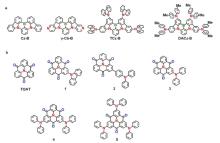
Fig 1
(a) Molecules that regulate luminescence from deep blue to yellow (460–572 nm); (b) A series of molecules obtained by modification of TOTA."
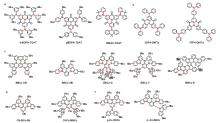
Fig 2
(a) Molecules modified by the parent structure of TOTA; (b) Molecules modified by DiKTa; (c) Molecules modified by BBCz; (d) CN-BCz-BN and its derivative; (e) Molecules obtained by modification of BBCz-SB with 3, 6-di-tert-butylcarbazole."
Fig 3
(a) Molecules obtained by peripheral modification of BNCz with 2-/4-benzonitrile; (b) Molecular structures of R-BN and R-TBN; (c) Molecular structures of 3Cz-DiKTa, 3DMcz-DiKTa and 3DMAC-DiKTa."
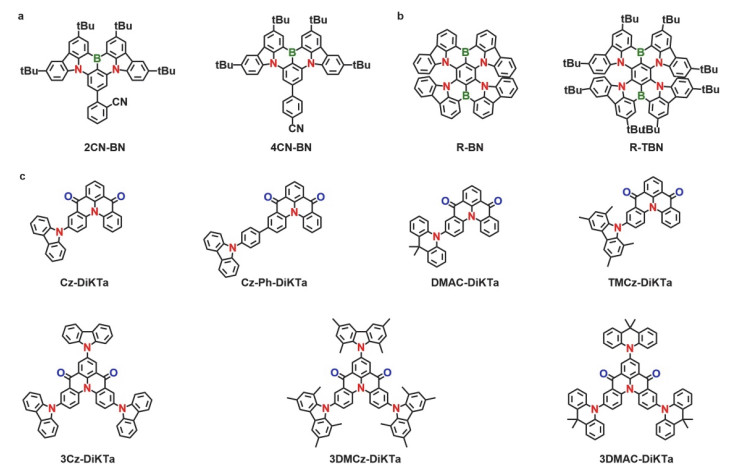
Fig 4
(a) Molecular structures of NBO and NBNP; (b) Molecular structure of BOQAO, tBuQAO and tBuBO; (c) Molecular extension of the BNCz based on the X-π-X principle."
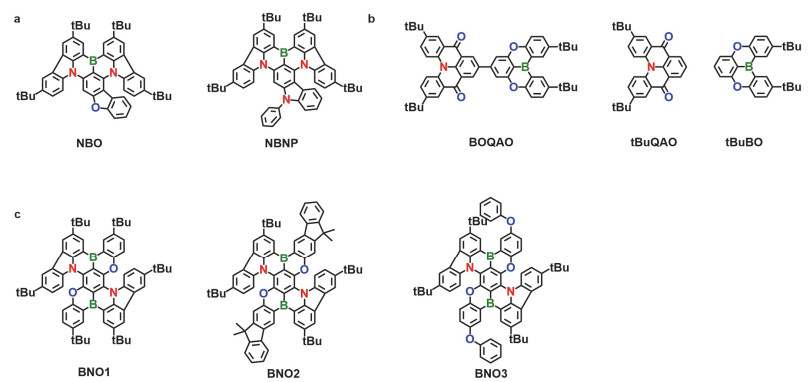
Fig 5
(a) Molecular structure of DPMX-CzDABNA; (b) Molecular structure of mBP-DABNA-Me; (c) Molecules obtained from BNCz modified with o/m/p-fluorophenyl; (d) Molecular structures of BN-Y and BN-R."
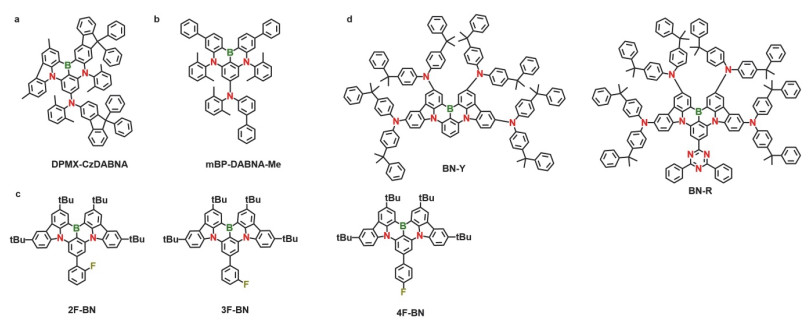
Fig 6
(a) A series of MR molecules substituted by O, S, Se; (b) Other MR molecules substituted by O, S, Se; (c) Molecular structure of TDIDCz; (d) Molecules obtained by modification of BisICz, wherein X = O/S/Se."
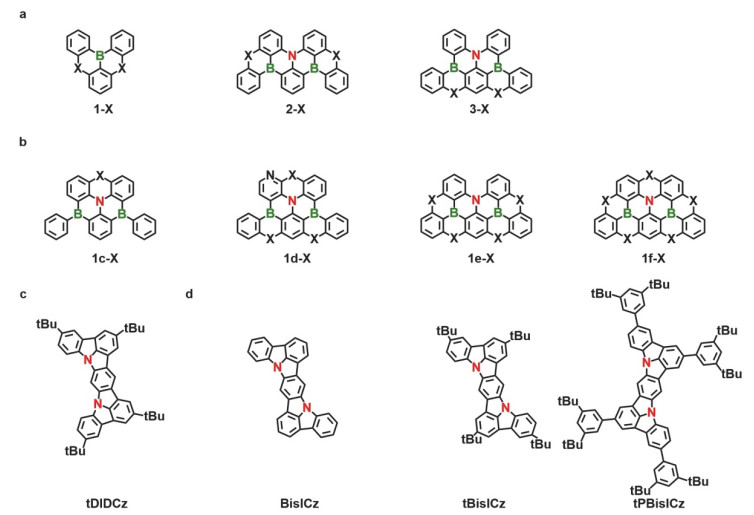
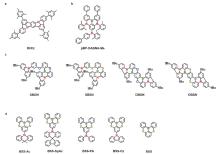
Fig 7
(a) Molecular structure of DilCz; (b) Molecular structure of pBP-DABNA-Me; (c) Narrow green and yellow emitting MR-TADF molecules with high kRISC; (d) Large kRISC MR-TADF molecules with BSS as the mother core."
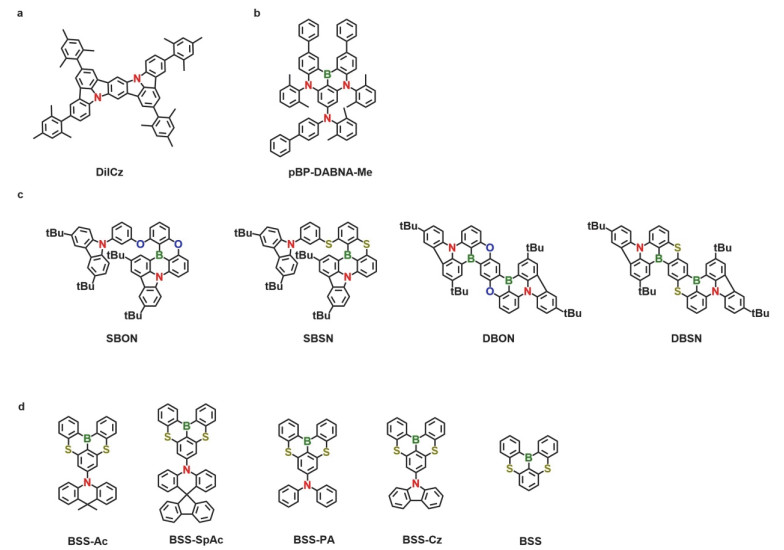
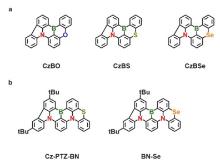
Fig 8
(a) Molecular structures of CzBO, CzBS, and CzBSe; (b) Molecular structures of Cz-PTZ-BN and BN-Se."
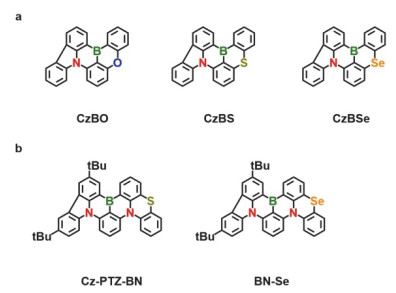
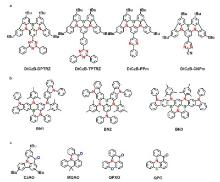
Fig 9
(a) A series of molecules obtained by peripheral modification of the parent nucleus with nitrogen containing six-membered aromatic heterocyclic segments as electron withdrawing groups; (b) MR-TADF molecules BN1, BN2 and BN3 with extremely narrow FWHM; (c) Molecular structures of CzAO, MQAO, QPXO and QPO."
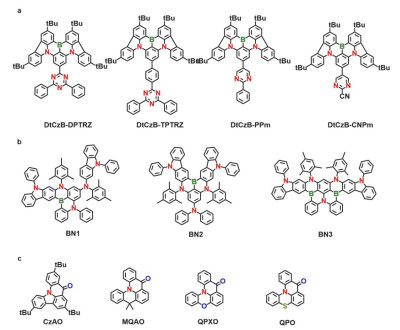
Fig 10
(a) Green emitting MR-TADF molecules obtained by structural expansion of BCz-BN and 2PTZ-BN; (b) Molecular structures of DtBuCzB and DtBuPhCzB; (c) Three MR-TADF molecules emitting dark blue to blue."
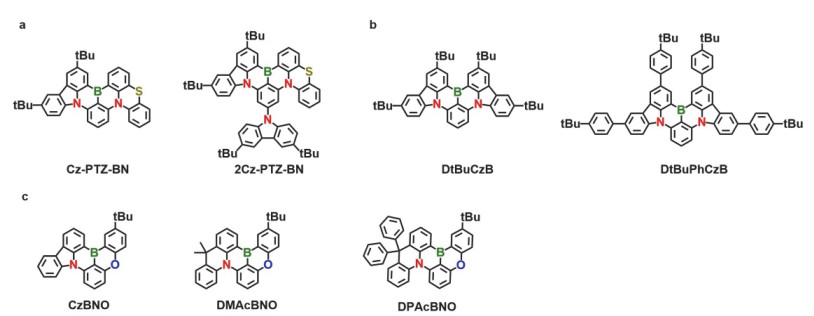
Table 1
Basic photophysical properties of the referenced molecules."
| Molecules | λabs (nm) | λem (nm) | ΔEST (eV) | PLQY (%) | FWHM (nm) | f | Ref. |
| Cz–B | 458 | 477 | 0.14 | 98 | 25 | – | |
| γ-Cb–B | 443 | 460 | 0.14 | 83 | 23 | – | |
| TCz–B | 491 | 512 | 0.13 | 89 | 27 | – | |
| DACz–B | 540 | 572 | 0.13 | 87 | 34 | – | |
| 1 | – | – | 0.21 | – | – | 0.013 | |
| 2 | – | – | 0.15 | – | – | 0.026 | |
| 3 | – | – | 0.29 | – | – | 0.016 | |
| 4 | – | – | 0.34 | – | – | 0.016 | |
| 5 | – | – | 0.34 | – | – | 0.050 | |
| TOAT | 408 | – | 0.34 | – | – | 0.015 | |
| mBDPA-TOAT | 571 | 599 | 0.23 | 73 | 37 | – | |
| pBDPA-TOAT | 563 | 603 | 0.23 | 57 | 48 | – | |
| DMAC-TOAT | 505 | 656 | 0.08 | 15 | 105 | – | |
| 3DPA-DiKTa | 554 | 597 | 0.20 | 59 | 47 | – | |
| 3TPA-DiKTa | 494 | 537 | 0.13 | 44 | 54 | – | |
| BBCz-DB | 453 | 466 | 0.09 | 93 | 16 | – | |
| BBCz-SB | 468 | 489 | 0.13 | 98 | 23 | – | |
| BBCz-G | 487 | 517 | 0.16 | 90 | 34 | – | |
| BBCz-Y | 505 | 549 | 0.17 | 85 | 42 | – | |
| BBCz-R | 597 | 615 | 0.07 | 89 | 21 | – | |
| CN-BCz-BN | – | 496 | – | – | 21 | – | |
| CNCz-BNCz | – | 581 | 0.18 | 90 | 42 | – | |
| m-Cz-BNCz | 489 | 519 | 0.08 | 97 | 38 | – | |
| p-Cz-BNCz | – | 477 | – | – | 22 | 0.3977 | |
| 2CN-BN | – | – | – | – | – | 0.3482 | |
| 4CN-BN | – | – | – | – | – | 0.3273 | |
| R-BN | 629 | 662 | 0.18 | 100 | 38 | 0.2822 | |
| R-TBN | 651 | 692 | 0.16 | 100 | 38 | – | |
| Cz-Ph-DiKTa | – | – | 0.22 | – | 47 | 0.254 | |
| DMAC-DiKTa | – | – | 0.21 | – | 89 | 0.23 | |
| TMCz-DiKTa | – | – | 0.23 | – | 78 | 0.228 | |
| 3Cz-DiKTa | – | – | 0.11 | – | 53 | 0.212 | |
| 3DMCz-DiKTa | – | – | 0.01 | – | 110 | 0.21 | |
| 3DMAC-DiKTa | – | – | 0.01 | – | 116 | 0.02 | |
| Cz-DiKTa | – | – | 0.2 | 90 | 54 | 0.215 | |
| NBNP | 473 | 500 | 0.09 | 93 | 29 | 0.2302 | |
| NBO | 466 | 487 | 0.12 | 92 | 27 | 0.2736 | |
| BOQAO | – | 474 | 0.22 | – | 28 | – | |
| BNO1 | 582 | 605 | 0.25 | 96 | 32 | 0.3133 | |
| BNO2 | 588 | 609 | 0.27 | 95 | 32 | 0.3423 | |
| BNO3 | 595 | 616 | 0.26 | 96 | 33 | 0.3121 | |
| DPMX-CzDABNA | 461 | 471 | 0.11 | – | 22 | 0.3 | |
| mBP-DABNA-Me | 445 | 464 | 0.12 | – | – | – | |
| 2F-BN | – | 494 | 0.16 | 95.4 | 24 | 0.4113 | |
| 3F-BN | – | 499 | 0.08 | 90.2 | 24 | 0.3951 | |
| 4F-BN | – | 496 | 0.11 | 98.7 | 25 | 0.3937 | |
| BN-Y | 534 | 567 | 0.12 | 95 | 34 | 0.382 | |
| BN-R | 581 | 624 | 0.11 | 94 | 46 | 0.233 | |
| 1-X | – | – | – | – | – | – | |
| 2-X | – | – | – | – | – | – | |
| 3-X | – | – | – | – | – | – | |
| 1c-X | – | – | – | – | – | – | |
| 1d-X | – | – | – | – | – | – | |
| 1e-X | – | – | – | – | – | – | |
| 1f–X | – | – | – | – | – | – | |
| tDIDCz | 241 | 393 | 0.44 | 60 | 20 | – | |
| BisICz | – | 432 | 0.31 | 81 | 27 | – | |
| tBisICz | – | 442 | 0.29 | 95 | 21 | – | |
| tPBisICz | – | 448 | 0.27 | 91 | 21 | – | |
| DilCz | 307 | 441 | 0.26 | 70 | 17 | – | |
| pBP–DABNA-Me | – | 462 | 0.176 | 98 | 22 | – | |
| SBON | 442 | 463 | 0.16 | 74 | 24 | – | |
| SBSN | 460 | 489 | 0.10 | 76 | 27 | – | |
| DBON | 491 | 505 | 0.13 | 98 | 20 | – | |
| DBSN | 520 | 553 | 0.13 | 98 | 28 | – | |
| BSS | 431 | 457 | 0.15 | 90 | 27 | – | |
| BSS-Ac | 434 | 456 | 0.04 | 90 | 105 | – | |
| BSS-SpAc | 433 | 456 | 0.07 | 89 | 101 | – | |
| BSS-PA | 432 | 454 | 0.13 | 66 | 35 | – | |
| BSS-Cz | 432 | 455 | 0.14 | 86 | 28 | – | |
| CzBO | – | 445 | 0.15 | 98 | 26 | – | |
| CzBS | – | 471 | 0.11 | 99 | 28 | – | |
| CzBSe | – | 477 | 0.12 | 98 | 33 | – | |
| Cz-PTZ-BN | 475 | 510 | 0.11 | 37 | 91 | 0.4079 | |
| 2Cz-PTZ-BN | 468 | 505 | 0.09 | 38 | 96 | 0.4698 | |
| BN-Se | 467 | 502 | 0.08 | 99 | 42 | 0.2619 | |
| DtCzB-DPTRZ | 507 | 521 | 0.18 | 94 | 24 | 0.2283 | |
| DtCzB-TPTRZ | 477 | 501 | 0.11 | 97 | 27 | 0.2170 | |
| DtCzB-PPm | 474 | 499 | 0.11 | 96 | 25 | 0.3407 | |
| DtCzB-CNPm | 481 | 515 | 0.15 | 93 | 36 | 0.1900 | |
| BN1 | 439 | 454 | 0.12 | – | 18 | – | |
| BN2 | 450 | 464 | 0.09 | – | 15 | – | |
| BN3 | 444 | 456 | 0.03 | – | 17 | – | |
| CzAO | 415 | 431 | 0.40 | 42 | 36 | – | |
| MQAO | 405 | 447 | 0.31 | 72 | 61 | – | |
| QPXO | 413 | 485 | 0.29 | 75 | 76 | – | |
| QPO | 410 | 501 | 0.27 | 33 | 86 | – | |
| DtBuPhCzB | 481 | 496 | 0.09 | 97 | 21 | 0.5693 | |
| DtBuCzB | 467 | 481 | 0.13 | 91 | 22 | 0.4098 | |
| CzBNO | 427 | 443 | 0.21 | 96 | 23 | 0.2611 | |
| DMAcBNO | 434 | 462 | 0.23 | 99 | 34 | 0.2407 | |
| DPAcBNO | 436 | 462 | 0.19 | 98 | 33 | 0.2577 |
| 1 |
doi: 10.1063/1.98799 |
| 2 |
|
|
王玲霞; 梅群波; 颜芳; 田波; 翁洁娜; 张彬; 黄维. 物理化学学报, 2012, 28, 1556.
doi: 10.3866/PKU.WHXB201205043 |
|
| 3 |
|
|
蓝露华; 陶洪; 李美灵; 高栋雨; 邹建华; 徐苗; 王磊; 彭俊彪. 物理化学学报, 2017, 33, 1548.
doi: 10.3866/PKU.WHXB201704283 |
|
| 4 |
doi: 10.1002/adma.201305733 |
| 5 |
doi: 10.1002/adfm.200600167 |
| 6 |
doi: 10.1021/jacs.7b04952 |
| 7 |
doi: 10.1002/anie.201711846 |
| 8 |
doi: 10.1039/c7cc04875k |
| 9 |
doi: 10.1002/adma.201300575 |
| 10 |
doi: 10.1002/anie.201506687 |
| 11 |
doi: 10.1021/jacs.5b10950 |
| 12 |
doi: 10.1002/adma.201902368 |
| 13 |
doi: 10.1021/acsami.9b04664 |
| 14 |
doi: 10.1002/adom.201901627 |
| 15 |
doi: 10.1021/acsami.0c03711 |
| 16 |
doi: 10.1002/anie.202103187 |
| 17 |
doi: 10.1039/d0mh01521k |
| 18 |
doi: 10.1002/anie.202013051 |
| 19 |
|
|
黄斌; 代钰; 班鑫鑫; 蒋伟; 张兆杭; 孙开涌; 林保平; 孙岳明. 物理化学学报, 2015, 31, 1621.
doi: 10.3866/PKU.WHXB201506121 |
|
| 20 |
doi: 10.1063/1.3626856 |
| 21 |
doi: 10.1002/adma.201505491 |
| 22 |
doi: 10.1002/anie.202312666 |
| 23 |
doi: 10.1002/ange.202017328 |
| 24 |
doi: 10.1126/sciadv.adh8296 |
| 25 |
doi: 10.1002/adfm.202102017 |
| 26 |
doi: 10.1002/anie.202109335 |
| 27 |
doi: 10.1002/adom.202002174 |
| 28 |
doi: 10.1002/anie.202310047 |
| 29 |
doi: 10.1021/acsami.0c20619 |
| 30 |
doi: 10.1002/anie.201913393 |
| 31 |
doi: 10.1002/adom.202101789 |
| 32 |
doi: 10.1002/anie.202213697 |
| 33 |
doi: 10.1021/jacs.0c10081 |
| 34 |
doi: 10.1039/d1sc02042k |
| 35 |
doi: 10.1002/anie.202007210 |
| 36 |
doi: 10.1002/adma.202100652 |
| 37 |
doi: 10.1002/anie.202107848 |
| 38 |
doi: 10.1021/acsami.2c02756 |
| 39 |
doi: 10.1002/adom.202102513 |
| 40 |
doi: 10.1039/d1tc05711a |
| 41 |
doi: 10.1002/adma.202201442 |
| 42 |
doi: 10.1021/acsami.1c18704 |
| 43 |
doi: 10.1002/adom.202202267 |
| 44 |
doi: 10.1002/smll.202107574 |
| 45 |
doi: 10.1002/ange.201911266 |
| 46 |
doi: 10.1002/aelm.202001090 |
| 47 |
doi: 10.1002/anie.202216473 |
| 48 |
doi: 10.1021/acsmaterialslett.1c00809 |
| 49 |
doi: 10.1021/acs.orglett.9b03342 |
| 50 |
doi: 10.1021/acs.chemmater.2c01952 |
| 51 |
doi: 10.1002/smll.201907569 |
| 52 |
doi: 10.1002/advs.202101137 |
| 53 |
doi: 10.1039/d1mh01383a |
| 54 |
doi: 10.1002/adma.202207416 |
| 55 |
doi: 10.1002/adom.202200504 |
| 56 |
doi: 10.1007/s11426-020-9944-1 |
| 57 |
doi: 10.1016/j.cej.2022.138545 |
| 58 |
doi: 10.1002/anie.202205684 |
| 59 |
doi: 10.1002/anie.202116927 |
| 60 |
doi: 10.1021/jacs.2c09543 |
| 61 |
doi: 10.31635/ccschem.021.202101033 |
| 62 |
doi: 10.1002/anie.202201588 |
| 63 |
doi: 10.1039/D1TC06165H |
| 64 |
doi: 10.1016/j.cej.2021.131169 |
| 65 |
doi: 10.1002/adom.201902142 |
| 66 |
doi: 10.1002/adom.202102092 |
| [1] | Ye Fan, Chongmei Cao, Yun Fang, Yongmei Xia. Fabrication of Fluorescent Nanodots by Self-Crosslinking Ufasomes of Conjugated Linoleic Acid and Their Unique Fluorescence Properties [J]. Acta Phys. -Chim. Sin., 2022, 38(3): 2002032-. |
| [2] | Mingkai Chang, Na Hu, Yao Li, Dongfan Xian, Wanqiang Zhou, Jingyi Wang, Yanlin Shi, Chunli Liu. Sorption of Eu(Ⅲ) on Montmorillonite and Effects of Carbonate and Phosphate on Its Sorption [J]. Acta Phys. -Chim. Sin., 2022, 38(3): 2003031-. |
| [3] | Jian Yang, Chen Lei, Xiang Liu, Jian Zhang, Yudie Sun, Cheng Zhang, Mingfu Ye, Kui Zhang. Versatile Performance of a Cationic Surfactant Derived from Carbon Quantum Dots [J]. Acta Phys. -Chim. Sin., 2022, 38(12): 2111030-. |
| [4] | Jing Huang, Danyang Wang, Shuhua Li, Hong Fan, Louzhen Fan. Red Fluorescent Carbon Quantum Dots for Diagnosis of Acidic Microenvironment in Tumors [J]. Acta Phys. -Chim. Sin., 2021, 37(10): 1905067-. |
| [5] | Fanghong Qin, Ting Wan, Jiangyuan Qiu, Yihui Wang, Biyuan Xiao, Zaiyin Huang. Temperature Effects on Photocatalytic Heat Changes and Kinetics via In Situ Photocalorimetry-Fluorescence Spectroscopy [J]. Acta Physico-Chimica Sinica, 2020, 36(6): 1905087-. |
| [6] | Taihong Liu, Rong Miao, Haonan Peng, Jing Liu, Liping Ding, Yu Fang. Adlayer Chemistry on Film-based Fluorescent Gas Sensors [J]. Acta Physico-Chimica Sinica, 2020, 36(10): 1908025-. |
| [7] | Kai XUE, Minnan YAN, Fei PAN, Mengying TIAN, Xudong PAN, Hongmei ZHANG. Single-Layer Organic Light-Emitting Devices with C60 and MoO3 Mixed Materials as Hole Injection Layer [J]. Acta Physico-Chimica Sinica, 2019, 35(8): 896-902. |
| [8] | Chao HU,Ye MU,Mingyu LI,Jieshan QIU. Recent Advances in the Synthesis and Applications of Carbon Dots [J]. Acta Physico-Chimica Sinica, 2019, 35(6): 572-590. |
| [9] | Peixuan BU,Chenhui HE,Xinsheng ZHAO. Single-Molecule Study on the Folding of OmpT in Tween-20 Micelles [J]. Acta Phys. -Chim. Sin., 2019, 35(5): 546-554. |
| [10] | Dandan CAO, Rong LÜ, Anchi YU. Preparation and Characterization of Carbon Nitride Film with High Optical Quality [J]. Acta Physico-Chimica Sinica, 2019, 35(4): 442-450. |
| [11] | Huiyun XIA,Tong GENG,Xu ZHAO,Fangfang LI,Fengyan WANG,Lining GAO. Preparation and Sensing Properties of Organic Gel Fluorescence Films Based on ZnS Nanoparticles [J]. Acta Phys. -Chim. Sin., 2019, 35(3): 337-344. |
| [12] | Yanjie HUANG, Chao LIAN, Jinyan ZHOU, Zichen HUANG, Xiaohong KANG, Zhenyu HUANG, Xiaojing LI, Lin CHEN, Yan GUAN. Investigation of Excitation-, pH-, Metal Ion-, Temperature-, and Polarity-Dependent Fluorescence of Carbon Dots Derived from Silkworm Excrement [J]. Acta Physico-Chimica Sinica, 2019, 35(11): 1267-1275. |
| [13] | Xiaohong GUO,Ying ZHOU,Lihong SHI,Yan ZHANG,Caihong ZHANG,Chuan DONG,Guomei ZHANG,Shaomin SHUANG. Luminescence Emission of Copper Nanoclusters by Ethanol-induced Aggregation and Aluminum Ion-induced Aggregation [J]. Acta Phys. -Chim. Sin., 2018, 34(7): 818-824. |
| [14] | Xue HAN,Jin YANG,Yingying LIU,Jianfang MA. Syntheses and Luminescent Properties of Coordination Polymers Based on 1, 2, 4-Triazole-Substituted Resorcin[4]arene [J]. Acta Phys. -Chim. Sin., 2018, 34(5): 476-482. |
| [15] | Jiao LIU,Jicun HUO,Min ZHANG,Xiandui DONG. Ultrafast Photoluminescence Dynamics of Organic Photosensitizers with Conjugated Linkers Containing Different Heteroatoms [J]. Acta Phys. -Chim. Sin., 2018, 34(4): 424-436. |
|
||