Acta Phys. -Chim. Sin. ›› 2025, Vol. 41 ›› Issue (11): 100148.doi: 10.1016/j.actphy.2025.100148
• ARTICLE • Previous Articles Next Articles
Boosting photocatalytic CO2 methanation through TiO2/CdS S-scheme heterojunction and fs-TAS mechanism study
Yiting Huo1,2,3, Xin Zhou2, Feifan Zhao3, Chenbin Ai3, Zhen Wu2, Zhidong Chang1,*( ), Bicheng Zhu3,*()
- 1 School of Chemistry and Biological Engineering, University of Science and Technology Beijing, Beijing, 100083, China
2 School of Chemical Engineering, Ordos Institute of Technology, Ordos, 017000, Inner Mongolia, China
3 Laboratory of Solar Fuel, Faculty of Materials Science and Chemistry, China University of Geosciences, Wuhan 430078, Hubei Province, China
-
Received:2025-07-16Revised:2025-07-30Accepted:2025-08-03Published:2025-09-29 -
Contact:Email: zdchang@ustb.edu.cn (Zhidong Chang)zhubicheng@cug.edu.cn (Bicheng Zhu) -
Supported by:the National Natural Science Foundation of China(52173065); the National Natural Science Foundation of China(22469001); Natural Science Foundation of Inner Mongolia Autonomous Region of China(2025QN05107); Natural Science Foundation of Inner Mongolia Autonomous Region of China(2025ZDLH002)

Cite this article
Yiting Huo, Xin Zhou, Feifan Zhao, Chenbin Ai, Zhen Wu, Zhidong Chang, Bicheng Zhu. Boosting photocatalytic CO2 methanation through TiO2/CdS S-scheme heterojunction and fs-TAS mechanism study[J]. Acta Phys. -Chim. Sin. 2025, 41(11), 100148. doi: 10.1016/j.actphy.2025.100148
share this article
Fig 1
Preparation procedure for TiO2/CdS heterojunctions (a); XRD pattern of TiO2, CdS and 0.4TC (b); Raman spectra of TiO2, CdS, and 0.4TC (c)."
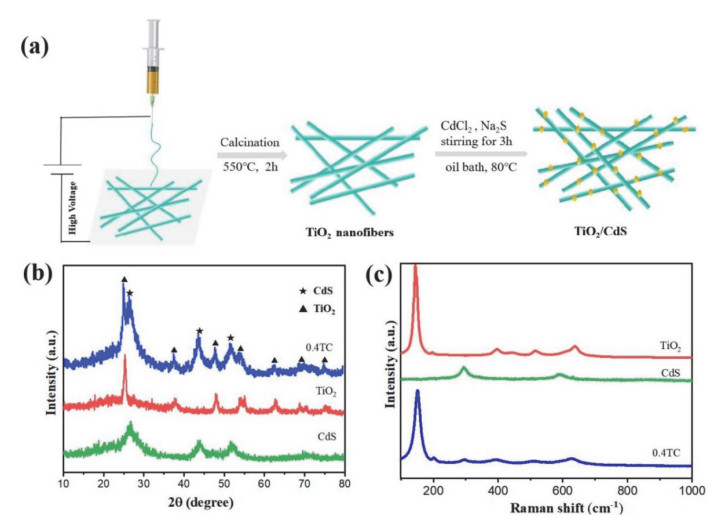
Fig 2
FESEM image of 0.4TC (a); HRTEM image of 0.4TC (b, c); HAADF image and EDS mapping images illustrating the elemental distribution of Ti, O, Cd, and S (d)."
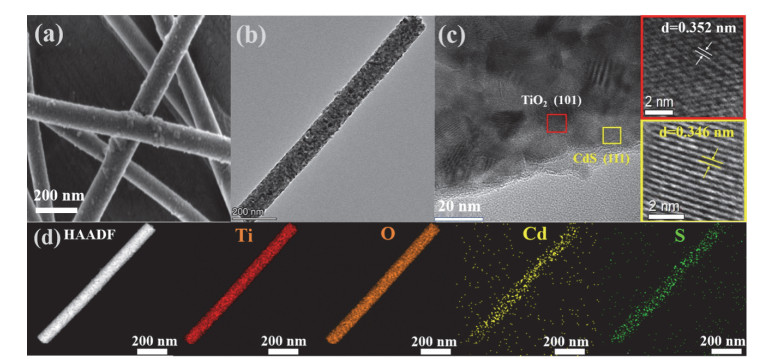
Fig 3
ISI-XPS spectra of Ti 2p (a), O 1s (b), Cd 3d (c), and S 2p (d) of TiO2, CdS, and 0.4TC."
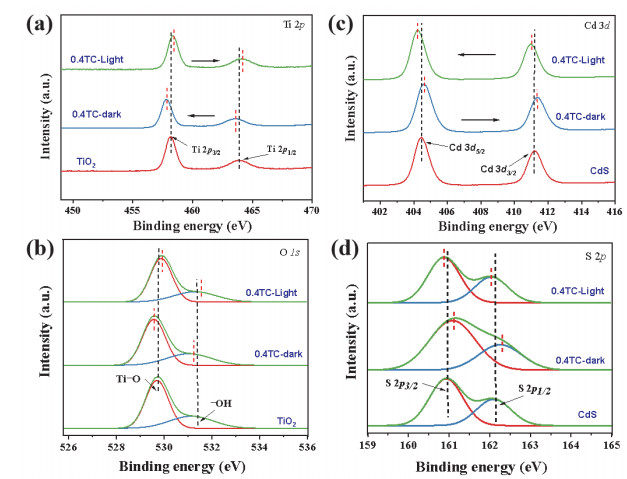
Fig 4
Side-view (a) and top-view (b) representations of the charge density difference distribution in TiO2/CdS, accompanied by the corresponding planar-averaged electron density difference profile Δρ(z) (c)."
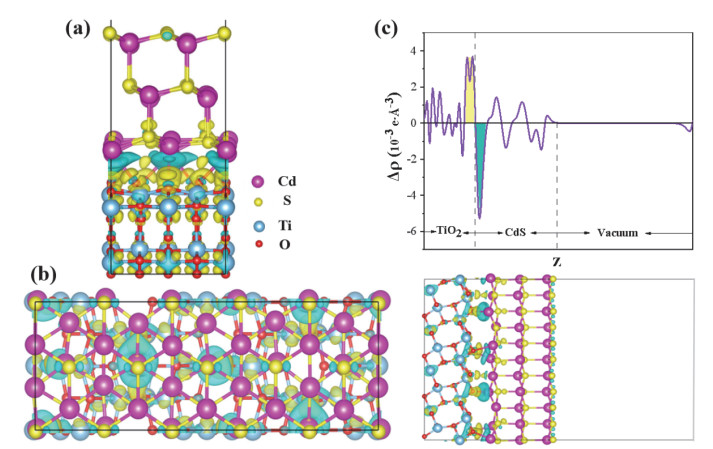
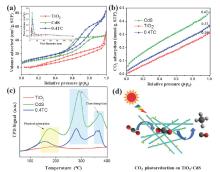
Fig 5
Nitrogen adsorption-desorption isotherm and pore diameter distribution profile (a); CO2 adsorption isotherms (b); CO2-TPD spectra of CdS, TiO2 and 0.4TC (c); Illustration of CO2 adsorption and activation process on the TiO2/CdS (d)."
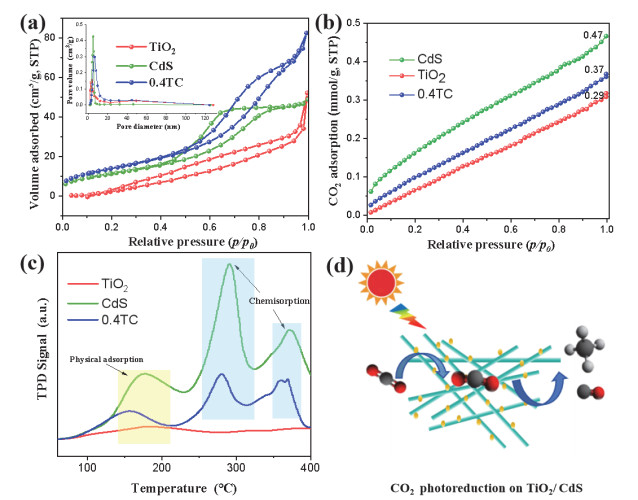
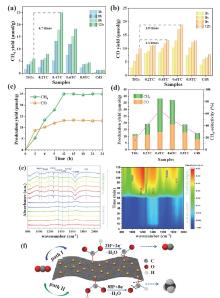
Fig 6
Yields of CH4 (a); Yields of CO (b); Photocatalytic CO2 reduction over 0.4TC (c); Photocatalytic activity of CO and CH4 (d); in-situ DRIFTS spectra for the photocatalytic CO2 reduction over 0.4TC (e); Possible CO2 photoreduction mechanism over 0.4TC (f)."
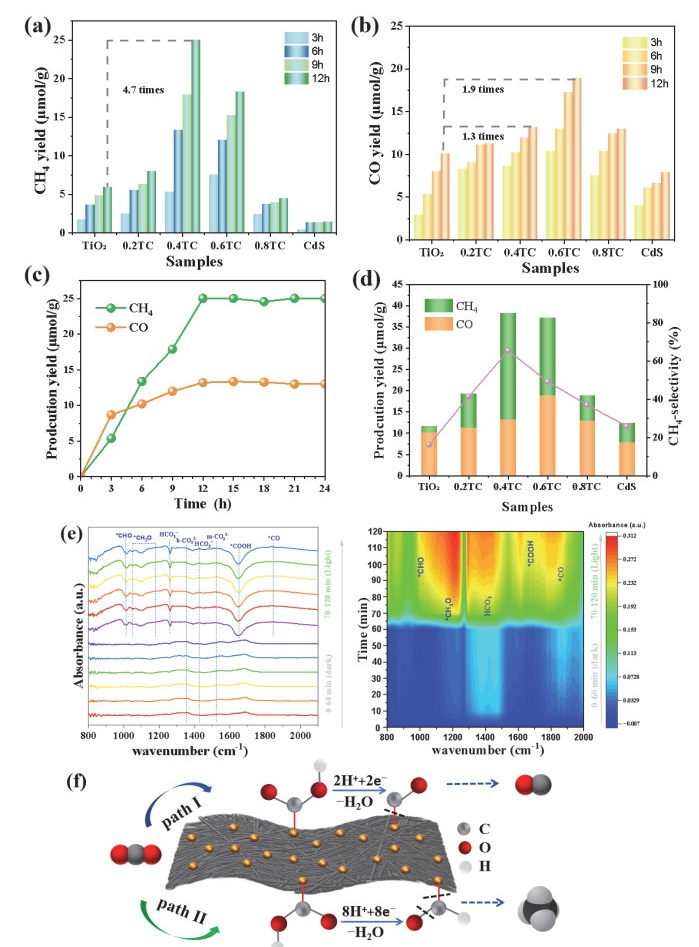
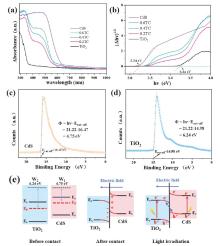
Fig 7
UV-vis DRS (a) and Eg (b) of CdS, TiO2 and TC samples; The UPS spectra of CdS and TiO2 before contact (c, d); The step-scheme electron transfer diagram (e)."
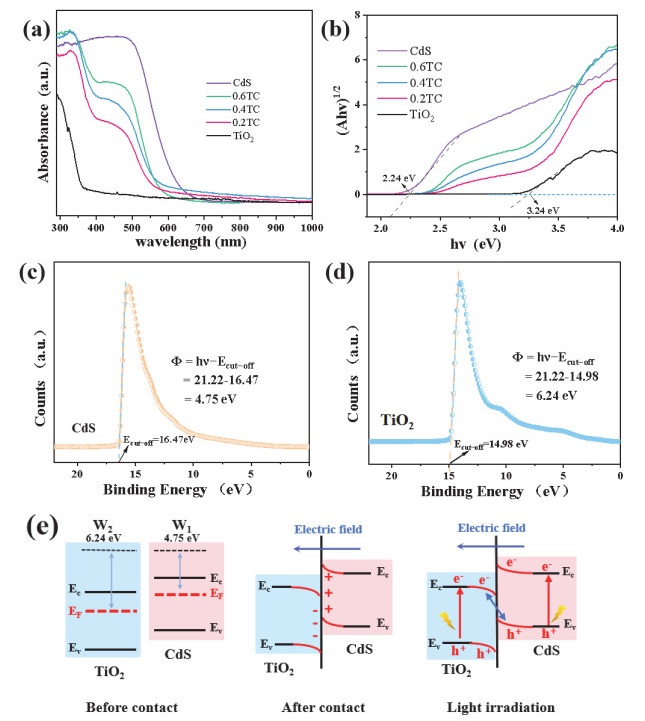
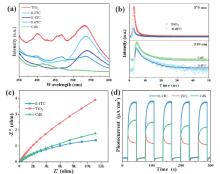
Fig 8
PL spectra (a), TRPL spectra (b), EIS (c), and I–t (d) of TiO2, CdS, and 0.4TC."
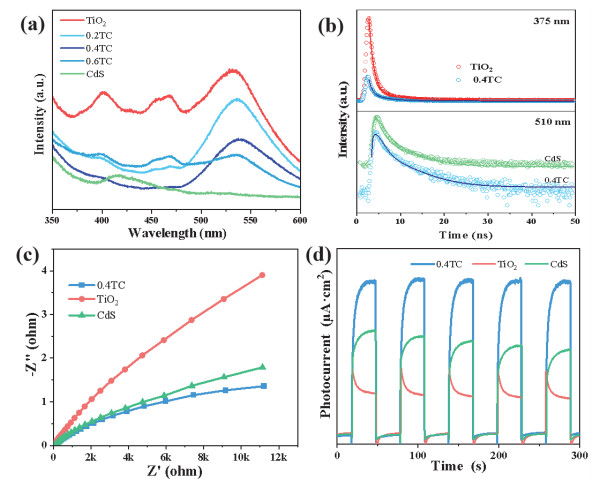
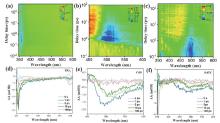
Fig 9
Pseudocolor fs-TAS plots and fs-TA spectra of TiO2 (a, d), CdS (b, e), and 0.4TC (c, f)."
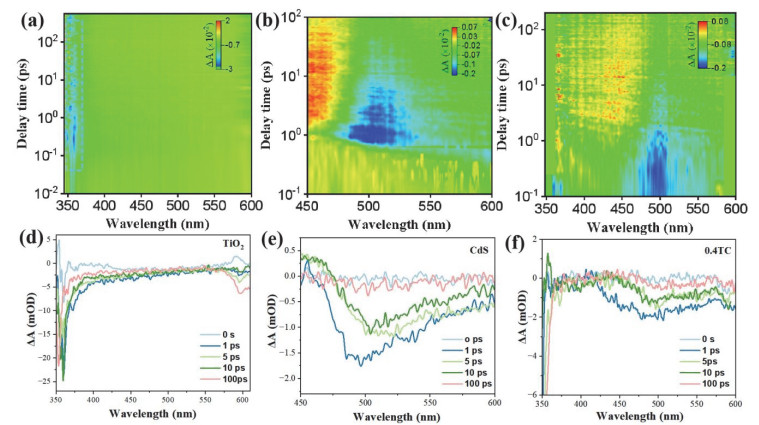
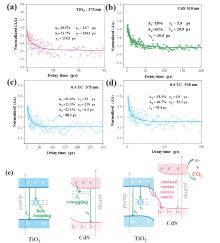
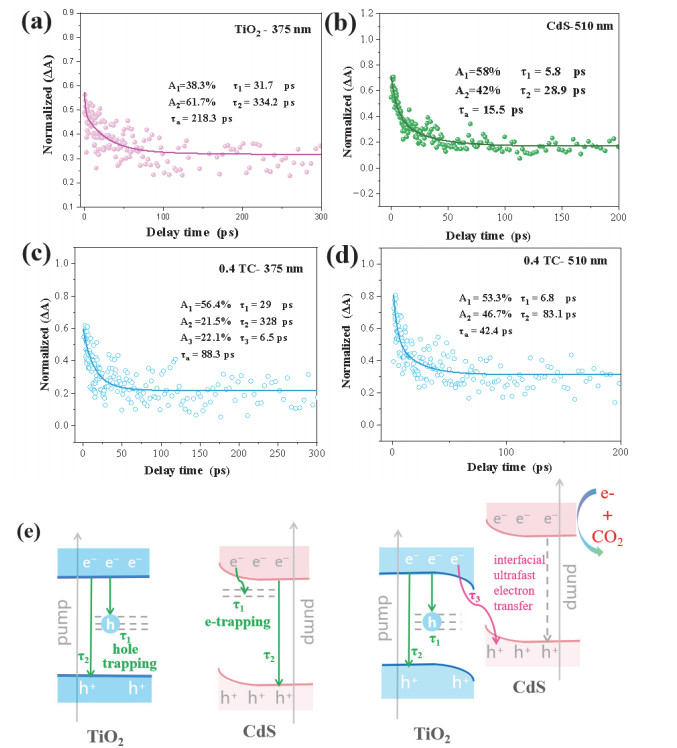
Fig 10
Fs-TAS decay kinetics of TiO2 (a), CdS (b), and 0.4TC (c, d); Schematics for the electron quenching processes of TiO2, CdS, and 0.4TC (e)."
| 1 |
doi: 10.1038/s41467-024-49004-7 |
| 2 |
doi: 10.1038/s41586-023-06917-5 |
| 3 |
doi: 10.1038/s41467-025-58426-w |
| 4 |
doi: 10.3390/molecules30112317 |
| 5 |
doi: 10.1002/anie.202106310 |
| 6 |
doi: 10.1002/adfm.202414931 |
| 7 |
doi: 10.1016/j.cej.2024.150213 |
| 8 |
doi: 10.1016/j.apcatb.2024.124167 |
| 9 |
doi: 10.1021/acscatal.4c00026 |
| 10 |
doi: 10.1016/j.ese.2023.100368 |
| 11 |
doi: 10.1021/acs.energyfuels.4c00203 |
| 12 |
doi: 10.1016/j.jcou.2024.103008 |
| 13 |
doi: 10.1016/j.jmst.2024.12.001 |
| 14 |
doi: 10.1021/acscatal.4c05674 |
| 15 |
doi: 10.1016/j.apsusc.2025.162752 |
| 16 |
|
| 17 |
doi: 10.1038/s41570-025-00698-3 |
| 18 |
doi: 10.1002/adfm.202309603 |
| 19 |
doi: 10.1016/S1872-2067(24)60223-8 |
| 20 |
doi: 10.3866/PKU.WHXB202408002 |
| 21 |
doi: 10.3866/PKU.WHXB202407021 |
| 22 |
doi: 10.1002/anie.202414672 |
| 23 |
doi: 10.1002/adsu.202100264 |
| 24 |
doi: 10.1002/anie.202319432 |
| 25 |
doi: 10.1002/adma.202416210 |
| 26 |
doi: 10.1016/j.apcatb.2024.124560 |
| 27 |
doi: 10.1002/adfm.202422055 |
| 28 |
doi: 10.1016/j.cej.2025.160238 |
| 29 |
doi: 10.1016/j.actphy.2025.100116 |
| 30 |
doi: 10.1016/j.seppur.2024.128473 |
| 31 |
doi: 10.1002/sus2.70011 |
| 32 |
doi: 10.1016/j.jmst.2025.02.040 |
| 33 |
doi: 10.1016/j.jmst.2023.06.052 |
| 34 |
doi: 10.1016/j.ijhydene.2023.09.033 |
| 35 |
doi: 10.1016/j.actphy.2025.100084 |
| 36 |
doi: 10.1039/d5cc00433k |
| 37 |
doi: 10.1016/j.jmst.2025.01.050 |
| 38 |
doi: 10.1016/j.surfin.2025.105807 |
| 39 |
doi: 10.1016/j.apmate.2025.100284 |
| 40 |
doi: 10.1016/j.jcis.2023.10.074 |
| 41 |
doi: 10.1016/j.jmst.2025.03.005 |
| 42 |
doi: 10.1021/la0517890 |
| 43 |
doi: 10.1007/s12649-024-02584-3 |
| 44 |
doi: 10.1002/ange.202218688 |
| 45 |
doi: 10.1002/pssc.200405349 |
| 46 |
doi: 10.1002/smll.202103447 |
| 47 |
doi: 10.1016/j.apcatb.2020.119151 |
| 48 |
doi: 10.3866/PKU.WHXB202212026 |
| 49 |
doi: 10.1016/j.jmst.2023.06.028 |
| 50 |
doi: 10.1016/j.jmat.2021.02.015 |
| 51 |
|
| 52 |
doi: 10.1016/j.jcis.2023.12.173 |
| 53 |
|
| 54 |
doi: 10.1016/j.apcatb.2021.120919 |
| 55 |
doi: 10.1002/anie.202309443 |
| 56 |
doi: 10.1016/S1872-2067(23)64549-8 |
| 57 |
doi: 10.1016/S1872-2067(24)60066-5 |
| 58 |
doi: 10.1016/j.ijhydene.2019.08.049 |
| 59 |
doi: 10.1002/smll.202402867 |
| 60 |
doi: 10.1016/j.jcis.2024.06.176 |
| 61 |
doi: 10.1038/s41467-021-25007-6 |
| 62 |
doi: 10.1016/j.jmst.2023.07.029 |
| 63 |
doi: 10.1016/S1872-2067(23)64566-8 |
| 64 |
doi: 10.3866/PKU.WHXB202402006 |
| 65 |
doi: 10.1016/j.jmst.2025.02.027 |
| 66 |
doi: 10.1016/j.actphy.2025.100064 |
| 67 |
doi: 10.1016/S1872-2067(23)64647-9 |
| 68 |
doi: 10.3866/PKU.WHXB202312024 |
| 69 |
doi: 10.3866/PKU.WHXB202407002 |
| 70 |
doi: 10.1016/S1872-2067(22)64108-1 |
| 71 |
doi: 10.3866/PKU.WHXB202406027 |
| 72 |
doi: 10.1016/S1872-2067(25)60706-1 |
|
||