Acta Phys. -Chim. Sin. ›› 2025, Vol. 41 ›› Issue (9): 100118.doi: 10.1016/j.actphy.2025.100118
• REVIEW • Previous Articles
Research progress of transient absorption spectroscopy in solar energy conversion and utilization
Fengying Zhang1,2, Yanglin Mei1, Yuman Jiang1, Shenshen Zheng1, Kaibo Zheng3,4, Ying Zhou1,2,*( )
)
- 1 Sichuan-Chongqing Joint Key Laboratory of Green Hydrogen Production & Storage and Efficient Utilization, Chengdu 610500, Sichuan Province, China
2 School of New Energy and Materials, Southwest Petroleum University, Chengdu 610500, Sichuan Province, China
3 Department of Chemical Physics and NanoLund Chemical Center, Lund University, Lund 22100, Sweden
4 Department of Chemistry, Technical University of Denmark, Kongens Lyngby DK-2800, Denmark
-
Received:2025-04-24Revised:2025-06-09Accepted:2025-06-10Published:2025-07-04 -
Contact:Email: yzhou@swpu.edu.cn. Tel.: +86-28-83032202 (Ying Zhou) -
Supported by:the National Key R&D Project of China(2020YFA0710000); the National Natural Science Foundation of China(52325401); the National Natural Science Foundation of China(22309152); the National Natural Science Foundation of China(22311530118); the Provincial Key Research and Development Project of Sichuan(2024YFHZ0040); the High-end Foreign Experts Recruitment Program Sichuan(2025HJRC0018); the International Science and Technology Cooperation Project of Chengdu(2021-GH02-00052-HZ)

Cite this article
Fengying Zhang, Yanglin Mei, Yuman Jiang, Shenshen Zheng, Kaibo Zheng, Ying Zhou. Research progress of transient absorption spectroscopy in solar energy conversion and utilization[J]. Acta Phys. -Chim. Sin. 2025, 41(9), 100118. doi: 10.1016/j.actphy.2025.100118
share this article
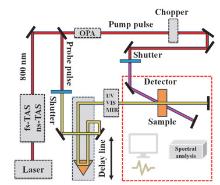
Fig 1
Schematic diagram of typical TAS equipment."
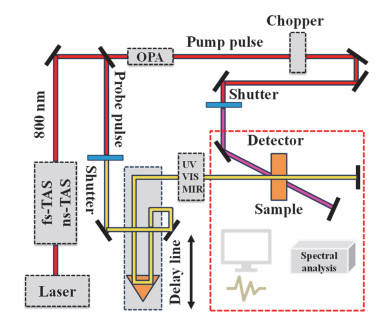
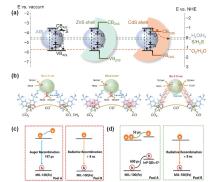
Fig 2
(a) Photoinduced process of AgIn5S8 [60], (b) Photocatalytic CO2 reduction pathways for samples with different sizes [62], (c, d) Recombination pathways for MIL-100(Fe) and InP QDs-S2−/MIL-100(Fe) [64]. (a) Adapted from Elsevier publisher. (b) Adapted from John Wiley and Sons publisher. (c, d) Adapted from John Wiley and Sons publisher."
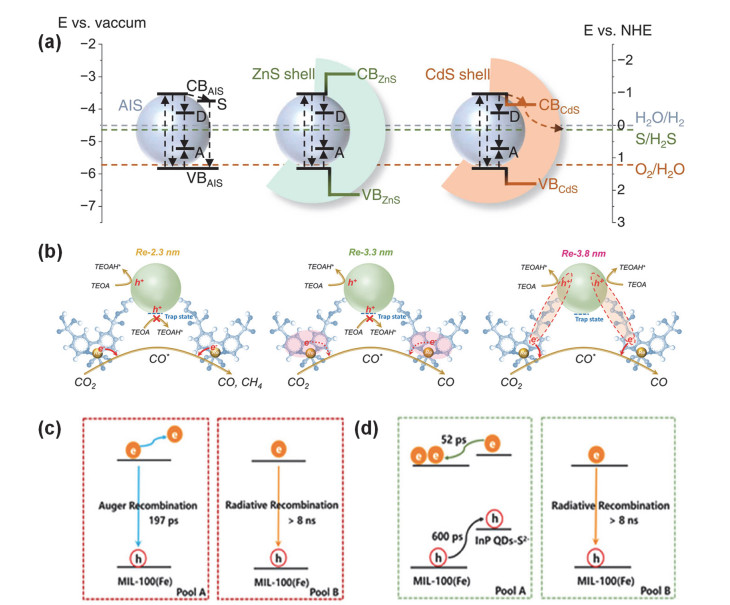
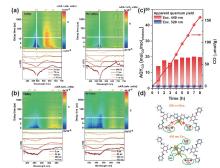
Fig 3
(a) TA spectra of TpBpy and Re-TpBpy under 530 nm excitation and (b) 400 nm excitation, (c) Catalytic performance diagram of Re-TpBpy under different excitation conditions, (d) Mechanism diagram of catalytic performance of Re-TpBpy under different excitation conditions [68]. (a–d) Adapted from Springer Nature publisher."
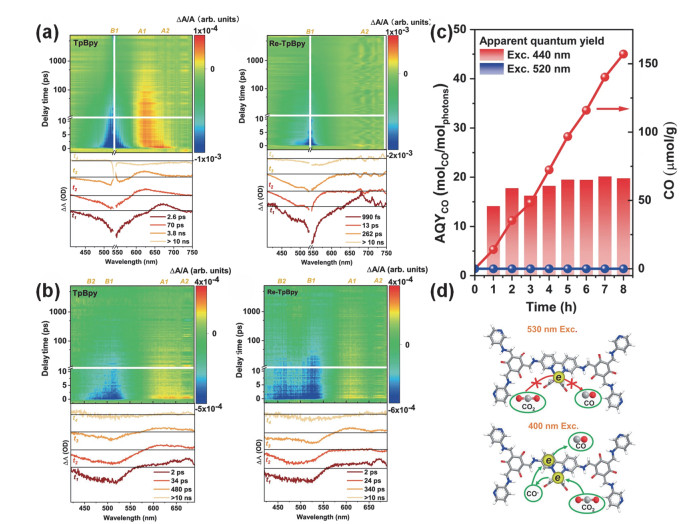
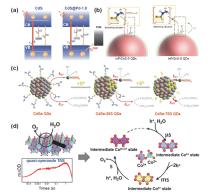
Fig 4
(a) Photodynamic process of CdS and CdS@Pd-1.8 [74], (b) Schematic diagram of hole transfer of InP/ZnS QDs [15], (c) The influence of S2− on MPA capped CdSe QDs [77], (d) Schematic of the proposed valence change kinetics of OER catalytic cycle on Co3O4 [79]. (a) Adapted from American Chemical Society publisher. (b) Adapted from Springer Nature publisher. (c) Adapted from John Wiley and Sons publisher. (d) Adapted from American Chemical Society publisher."
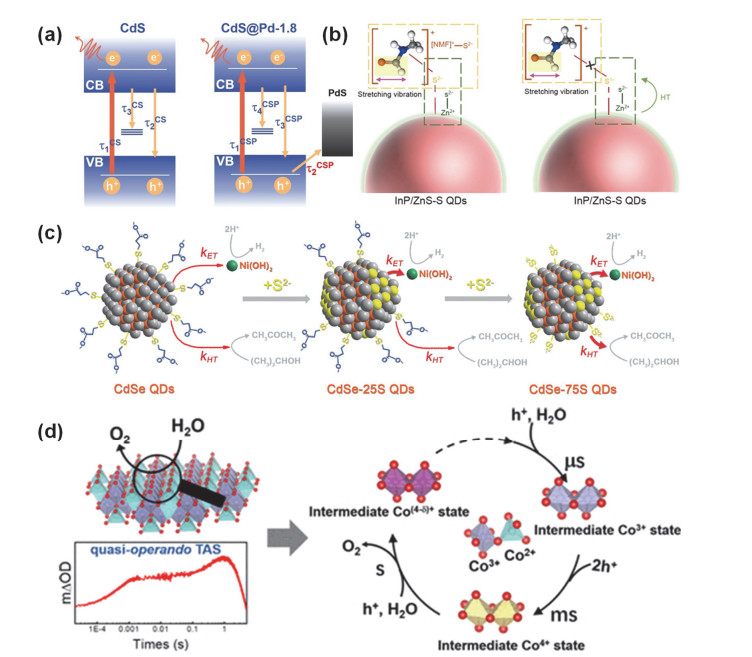
Fig 5
(a) Transient absorption spectra of BiOI and (b) BN/BiOI, (c) The TAS kinetics and photophysical process of neat BiOI and BiOI/BN [84]. (a‒c) Adapted from John Wiley and Sons publisher."
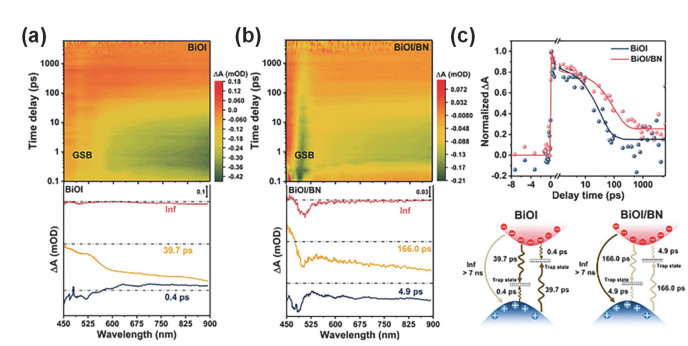
Fig 6
(a) Comparison of TRIR spectra of CdS-T at different attenuation times and long-term in situ FTIR test, (b) TRIR kinetics at 2700 cm−1, (c) Catalytic dynamic mechanism [85]. (a–c) Adapted from John Wiley and Sons publisher."
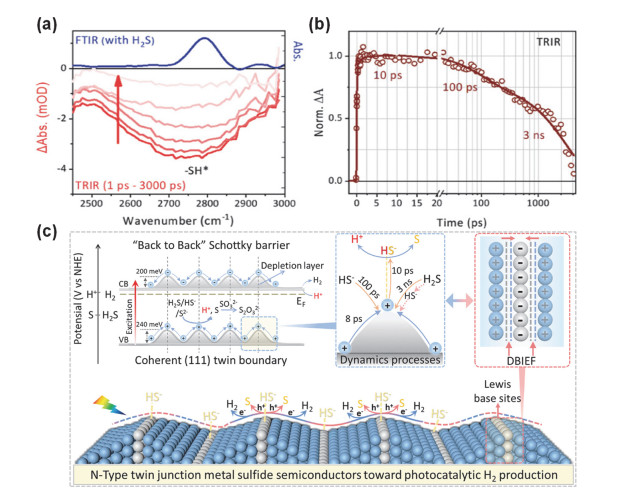
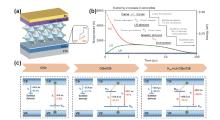
Fig 7
(a) Schematic illustration of the AEP molecule structure and modification in PSC [94], (b) Schematic of the time-dependent temperature of the hot carrier, LO phonons, and LA phonons [96], (c) Charge recombination pathways in CISe (1 : 1), CISe/CIS (1 : 1), and CISe/CIS (4 : 1) quantum dots [98]. (a) Adapted from John Wiley and Sons publisher. (b) Adapted from American Chemical Society. (c) Adapted from Springer Nature publisher."
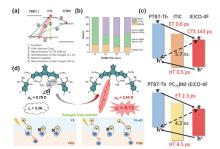
Fig 8
(a) Schematic diagram of charge composite pathway of PC71BM blends with different weight ratios, and (b) Evolution of the amplitudes among three decay components in the blend samples [108], (c) Effect of adding ITIC and PC71BM on charge carrier transfer process of blend films [109], (d) Comparison of blending effects of PM6 [110]. (d) Adapted from John Wiley and Sons publisher. (a, b) Adapted from John Wiley and Sons publisher. (c) Adapted from American Chemical Society."
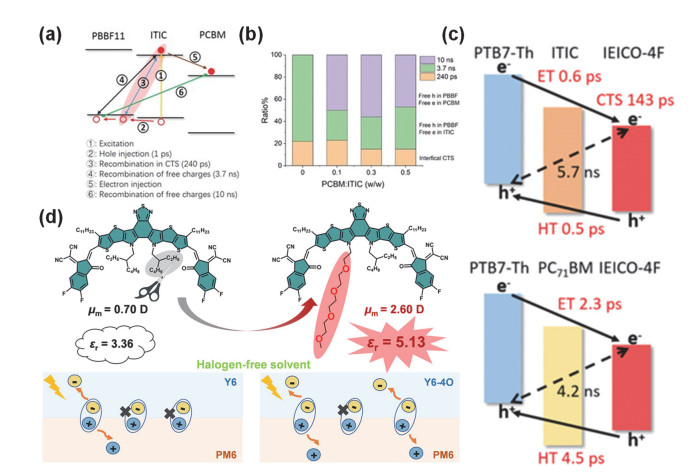
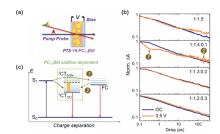
Fig 9
(a) Schematic diagram of in situ TAS device, (b) Measured spectra on ternary P75:Y6:PC71BM device at open-circuit and forward-bias conditions when pumped at 800 nm, and (c) The proposed photophysics with regard to modified CTS by applying a bias in the blend films [118]. (a–c) Adapted from John Wiley and Sons publisher."
| 1 |
doi: 10.1002/aenm.202304362 |
| 2 |
doi: 10.1016/j.chempr.2024.10.018 |
| 3 |
doi: 10.1126/science.abo2757 |
| 4 |
doi: 10.1016/j.cclet.2021.12.060 |
| 5 |
doi: 10.1038/s41566-019-0573-5 |
| 6 |
doi: 10.3866/PKU.WHXB202212006 |
| 7 |
doi: 10.3866/pku.Whxb202209037 |
| 8 |
doi: 10.1002/pip.3839 |
| 9 |
doi: 10.1038/s41586-022-05399-1 |
| 10 |
doi: 10.1002/adma.202404618 |
| 11 |
doi: 10.1038/s41467-025-57742-5 |
| 12 |
doi: 10.1021/jacs.4c10300 |
| 13 |
doi: 10.1039/D4EE01379D |
| 14 |
doi: 10.1038/s41467-020-15262-4 |
| 15 |
doi: 10.1007/s40843-021-1992-3 |
| 16 |
doi: 10.1021/acs.jpcc.4c03688 |
| 17 |
doi: 10.11949/0438-1157.20221120 |
| 18 |
doi: 10.1002/advs.201800221 |
| 19 |
doi: 10.1016/j.fmre.2024.04.003 |
| 20 |
doi: 10.1038/164658a0 |
| 21 |
doi: 10.1021/ed079p548 |
| 22 |
doi: 10.1021/jp001460h |
| 23 |
doi: 10.1021/acs.jpcc.7b10518 |
| 24 |
doi: 10.1002/cphc.201402585 |
| 25 |
doi: 10.1021/acs.chemmater.9b04582 |
| 26 |
doi: 10.1038/s41578-022-00422-3 |
| 27 |
doi: 10.1021/jacs.7b01547 |
| 28 |
doi: 10.1021/jacs.6b11308 |
| 29 |
doi: 10.1364/oe.26.032118 |
| 30 |
doi: 10.1002/solr.202000468 |
| 31 |
doi: 10.1039/d2cc06300j |
| 32 |
doi: 10.1038/s41570-025-00698-3 |
| 33 |
doi: 10.1021/acsnano.3c03989 |
| 34 |
doi: 10.1038/s41578-024-00704-y |
| 35 |
doi: 10.1002/adma.202300064 |
| 36 |
doi: 10.1039/D4CS00985A |
| 37 |
doi: 10.1039/d1cs01164b |
| 38 |
doi: 10.1021/acs.jchemed.0c01056 |
| 39 |
doi: 10.1002/lpor.202200280 |
| 40 |
doi: 10.1126/science.adk9089 |
| 41 |
doi: 10.1021/jacs.2c02341 |
| 42 |
doi: 10.1126/sciadv.adk2778 |
| 43 |
doi: 10.1063/1674-0068/29/cjcp1512246 |
| 44 |
doi: 10.1007/s12598-022-01966-7 |
| 45 |
doi: 10.1002/anie.202416039 |
| 46 |
doi: 10.1016/S1872-2067(24)60152-X |
| 47 |
doi: 10.1039/D1EE02714J |
| 48 |
doi: 10.1016/j.mattod.2024.12.019 |
| 49 |
doi: 10.1007/s12274-021-3725-0 |
| 50 |
doi: 10.1002/cey2.305 |
| 51 |
doi: 10.3866/PKU.WHXB202302051 |
| 52 |
doi: 10.3866/PKU.WHXB202303029 |
| 53 |
doi: 10.1002/advs.202002458 |
| 54 |
doi: 10.1038/s44359-025-00037-1 |
| 55 |
doi: 10.7536/PC220939 |
| 56 |
doi: 10.1021/jacs.4c11123 |
| 57 |
doi: 10.1016/j.apcatb.2024.124207 |
| 58 |
doi: 10.1016/j.apcatb.2023.123393 |
| 59 |
doi: 10.1002/anie.202405756 |
| 60 |
doi: 10.1016/j.apcatb.2023.122747 |
| 61 |
doi: 10.1073/pnas.2315956121 |
| 62 |
doi: 10.1002/adfm.202315734 |
| 63 |
doi: 10.1002/inf2.12535 |
| 64 |
doi: 10.1002/smll.202405512 |
| 65 |
doi: 10.1016/j.jmst.2024.01.021 |
| 66 |
doi: 10.1002/adma.202200563 |
| 67 |
doi: 10.1002/anie.202418496 |
| 68 |
doi: 10.1038/s41467-022-28409-2 |
| 69 |
doi: 10.1002/anie.202302152 |
| 70 |
doi: 10.1038/s41467-024-49373-z |
| 71 |
doi: 10.1002/adma.202412965 |
| 72 |
doi: 10.1002/anie.202305571 |
| 73 |
doi: 10.1038/s44160-025-00782-y |
| 74 |
doi: 10.1021/acscatal.3c01210 |
| 75 |
doi: 10.1039/D4TA02620A |
| 76 |
doi: 10.1038/s41467-018-06294-y |
| 77 |
doi: 10.1002/adma.201804872 |
| 78 |
doi: 10.1038/s41929-021-00605-1 |
| 79 |
doi: 10.1021/jacs.2c11508 |
| 80 |
doi: 10.1021/ja303306u |
| 81 |
doi: 10.1002/anie.202414672 |
| 82 |
doi: 10.1002/adfm.202421847 |
| 83 |
doi: 10.1002/adma.202403215 |
| 84 |
doi: 10.1002/aenm.202404871 |
| 85 |
doi: 10.1002/adma.202415138 |
| 86 |
doi: 10.1002/smll.202412129 |
| 87 |
doi: 10.1021/ja509551m |
| 88 |
doi: 10.1038/natrevmats.2017.26 |
| 89 |
doi: 10.1021/ja076568q |
| 90 |
doi: 10.1103/PhysRevB.85.125206 |
| 91 |
doi: 10.1021/jp309421s |
| 92 |
doi: 10.1039/D4EE02917H |
| 93 |
doi: 10.1038/s41560-024-01564-0 |
| 94 |
doi: 10.1002/adma.202406532 |
| 95 |
doi: 10.1002/aenm.202202813 |
| 96 |
doi: 10.1021/acsenergylett.3c02359 |
| 97 |
doi: 10.1126/sciadv.adp0790 |
| 98 |
doi: 10.1007/s40843-023-2690-3 |
| 99 |
doi: 10.1002/aenm.201502356 |
| 100 |
doi: 10.1016/j.apmate.2025.100275 |
| 101 |
doi: 10.1002/adfm.202315157 |
| 102 |
doi: 10.1002/adfm.202422783 |
| 103 |
doi: 10.1002/anie.202405243 |
| 104 |
doi: 10.1002/advs.202404135 |
| 105 |
doi: 10.1021/jacs.3c05234 |
| 106 |
doi: 10.1002/adom.202500034 |
| 107 |
doi: 10.1002/anie.202416883 |
| 108 |
doi: 10.1002/advs.201802103 |
| 109 |
doi: 10.1002/adfm.202001564 |
| 110 |
doi: 10.1021/jacsau.1c00306 |
| 111 |
doi: 10.1021/jacs.9b12443 |
| 112 |
doi: 10.1515/nanoph-2020-0472 |
| 113 |
doi: 10.1021/jp909993w |
| 114 |
doi: 10.1021/acsaem.0c02478 |
| 115 |
doi: 10.1021/acs.jpcc.1c02729 |
| 116 |
doi: 10.1021/jacs.9b09056 |
| 117 |
doi: 10.1039/C8SC04679D |
| 118 |
doi: 10.1002/solr.202100142 |
| 119 |
doi: 10.1021/acs.jpclett.4c02712 |
| 120 |
doi: 10.1063/1.4921473 |
| [1] | Yu Liu, Pengfei Li, Yize Liu, Zaicheng Sun. Recent advances in carbon dots as a single photocatalyst [J]. Acta Phys. -Chim. Sin., 2026, 42(2): 100167-. |
| [2] | Zhenhuan Wang, Weifei Wei, Ruijie Ma, Dou Luo, Zhanxiang Chen, Jun Zhang, Liyang Yu, Gang Li, Zhenghui Luo. Core cyanation of benzo[a]phenazine acceptor enables 19.04% binary organic solar cells with green solvent compatibility [J]. Acta Phys. -Chim. Sin., 2026, 42(2): 100182-. |
| [3] | Yuhang Zhang, Yi Li, Yuehan Cao, Yingjie Shuai, Yu Zhou, Ying Zhou. Regulating the formation type by Ir of intermediates to suppress product overoxidation in photocatalytic methane conversion [J]. Acta Phys. -Chim. Sin., 2026, 42(2): 100173-. |
| [4] | Chengxiao Zhao, Zhaolin Li, Dongfang Wu, Xiaofei Yang. SBA-15 templated covalent triazine frameworks for boosted photocatalytic hydrogen production [J]. Acta Phys. -Chim. Sin., 2026, 42(1): 100149-. |
| [5] | Shiyi Chen, Jialong Fu, Jianping Qiu, Guoju Chang, Shiyou Hao. Waste medical mask-derived carbon quantum dots enhance the photocatalytic degradation of polyethylene terephthalate (PET) over BiOBr/g-C3N4 S-scheme heterojunction [J]. Acta Phys. -Chim. Sin., 2026, 42(1): 100135-. |
| [6] | Ying Liang, Yuheng Deng, Shilv Yu, Jiahao Cheng, Jiawei Song, Jun Yao, Yichen Yang, Wanlei Zhang, Wenjing Zhou, Xin Zhang, Wenjian Shen, Guijie Liang, Bin Li, Yong Peng, Run Hu, Wangnan Li. Machine learning-guided antireflection coatings architectures and interface modification for synergistically optimizing efficient and stable perovskite solar cells [J]. Acta Phys. -Chim. Sin., 2025, 41(9): 100098-. |
| [7] | Menglan Wei, Xiaoxia Ou, Yimeng Wang, Mengyuan Zhang, Fei Teng, Kaixuan Wang. S-scheme heterojunction g-C3N4/Bi2WO6 highly efficient degradation of levofloxacin: performance, mechanism and degradation pathway [J]. Acta Phys. -Chim. Sin., 2025, 41(9): 100105-. |
| [8] | Jingping Li, Suding Yan, Jiaxi Wu, Qiang Cheng, Kai Wang. Improving hydrogen peroxide photosynthesis over inorganic/organic S-scheme photocatalyst with LiFePO4 [J]. Acta Phys. -Chim. Sin., 2025, 41(9): 100104-. |
| [9] | Jiajie Cai, Chang Cheng, Bowen Liu, Jianjun Zhang, Chuanjia Jiang, Bei Cheng. CdS/DBTSO-BDTO S-scheme photocatalyst for H2 production and its charge transfer dynamics [J]. Acta Phys. -Chim. Sin., 2025, 41(8): 100084-. |
| [10] | Lewang Yuan, Yaoyao Peng, Zong-Jie Guan, Yu Fang. Insights into the development of 2D covalent organic frameworks as photocatalysts in organic synthesis [J]. Acta Phys. -Chim. Sin., 2025, 41(8): 100086-. |
| [11] | Yu Wang, Haiyang Shi, Zihan Chen, Feng Chen, Ping Wang, Xuefei Wang. Hollow AgPt@Pt core-shell cocatalyst with electron-rich Ptδ− shell for boosting selectivity of photocatalytic H2O2 production for faceted BiVO4 [J]. Acta Phys. -Chim. Sin., 2025, 41(7): 100081-. |
| [12] | Yadan Luo, Hao Zheng, Xin Li, Fengmin Li, Hua Tang, Xilin She. Modulating reactive oxygen species in O, S co-doped C3N4 to enhance photocatalytic degradation of microplastics [J]. Acta Phys. -Chim. Sin., 2025, 41(6): 100052-. |
| [13] | Yuchen Zhou, Huanmin Liu, Hongxing Li, Xinyu Song, Yonghua Tang, Peng Zhou. Designing thermodynamically stable noble metal single-atom photocatalysts for highly efficient non-oxidative conversion of ethanol into high-purity hydrogen and value-added acetaldehyde [J]. Acta Phys. -Chim. Sin., 2025, 41(6): 100067-. |
| [14] | Hui Wang, Abdelkader Labidi, Menghan Ren, Feroz Shaik, Chuanyi Wang. Recent Progress of Microstructure-Regulated g-C3N4 in Photocatalytic NO Conversion: The Pivotal Roles of Adsorption/Activation Sites [J]. Acta Phys. -Chim. Sin., 2025, 41(5): 100039-. |
| [15] | Qin Li, Huihui Zhang, Huajun Gu, Yuanyuan Cui, Ruihua Gao, Wei-Lin Dai. In situ Growth of Cd0.5Zn0.5S Nanorods on Ti3C2 MXene Nanosheet for Efficient Visible-Light-Driven Photocatalytic Hydrogen Evolution [J]. Acta Phys. -Chim. Sin., 2025, 41(4): 100031-. |
|
||