Acta Phys. -Chim. Sin. ›› 2024, Vol. 40 ›› Issue (4): 2304003.doi: 10.3866/PKU.WHXB202304003
Special Issue: Multi-Physical Fields Driven Catalysis for Energy Conversion
• REVIEW • Previous Articles Next Articles
Review on Using Molybdenum Carbides for the Thermal Catalysis of CO2 Hydrogenation to Produce High-Value-Added Chemicals and Fuels
Yongqing Xu1, Yuyao Yang1, Mengna Wu1, Xiaoxiao Yang1, Xuan Bie1, Shiyu Zhang1, Qinghai Li1, Yanguo Zhang1, Chenwei Zhang1, Robert E. Przekop2, Bogna Sztorch2, Dariusz Brzakalski2, Hui Zhou1,*( )
)
- 1 Key Laboratory for Thermal Science and Power Engineering of Ministry of Education, Beijing Key Laboratory of CO2 Utilization and Reduction Technology, Department of Energy and Power Engineering, Tsinghua University, Beijing 100084, China
2 Centre for Advanced Technologies, Adam Mickiewicz University in Poznan, Poznan 61-614, Poland
-
Received:2023-04-03Revised:2023-06-12Accepted:2023-06-12Published:2023-06-20 -
Contact:Email: huizhou@tsinghua.edu.cn (Hui Zhou) -
Supported by:the National Natural Science Foundation of China(52276202); the National Natural Science Foundation of China(52206147); International Joint Mission On Climate Change and Carbon Neutrality, Tsinghua-Toyota Joint Research Fund, State Key Laboratory of Chemical Engineering, China(SKL-ChE-22A03); Huaneng Group Science and Technology Research Project, China(KTHT-U22YYJC12); Tsinghua University-Shanxi Clean Energy Research Institute Innovation Project Seed Fund, China

Cite this article
Yongqing Xu, Yuyao Yang, Mengna Wu, Xiaoxiao Yang, Xuan Bie, Shiyu Zhang, Qinghai Li, Yanguo Zhang, Chenwei Zhang, Robert E. Przekop, Bogna Sztorch, Dariusz Brzakalski, Hui Zhou. Review on Using Molybdenum Carbides for the Thermal Catalysis of CO2 Hydrogenation to Produce High-Value-Added Chemicals and Fuels[J]. Acta Phys. -Chim. Sin. 2024, 40(4), 2304003. doi: 10.3866/PKU.WHXB202304003
share this article
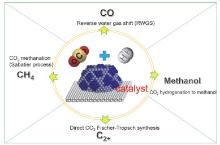
Fig 1
Overview of typical CO2 hydrogenation routes: CO2 methanation (Sabatier process) to produce methane, reverse water-gas shift to make CO (RWGS), methanol synthesis for the methanol economy, and CO2 direct Fischer-Tropsch synthesis to produce olefins (CO2-FT)."
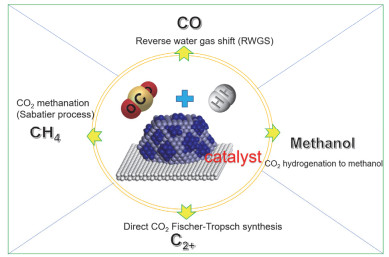
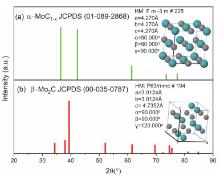
Fig 2
Crystallographic structure spectrum of (a) α-MoC1−x, and (b) β-Mo2C."
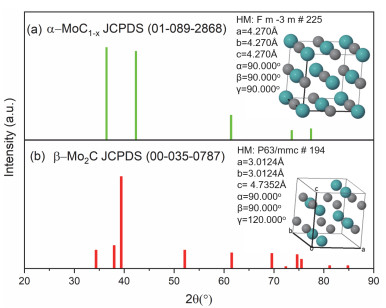
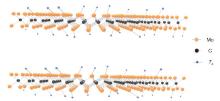
Fig 3
The structure of Mo2CTx (MXenes) with different terminating groups."
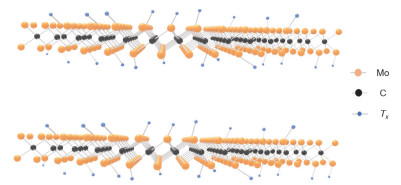
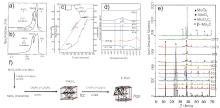
Fig 4
Structure evolution and phase formation mechanism of molybdenum carbides during carburization: (a) TPR traces of coreductionicarburization of MoO3 in flowing 20% CH4/H2 mixture; (b) TPR traces of coreductionicarburization of MoO3 in flowing H2 only; adapted from Journal of Catalysis, Elsevier publisher 39, 40. (c) TGA-DSC profiles monitoring the carburization at a ramp of 1 K∙min−1; (d) TPR-GC-MS data of MoO3 carburization under 10% C2H6/H2; (e) XRD observation of MoO3 carburization at various temperatures (10% (vol.) C2H6/H2); (f) Structure evolution of the molybdenum carbide phases via TPR; adapted from Chemistry of Materials, American Chemical Society publisher 49."
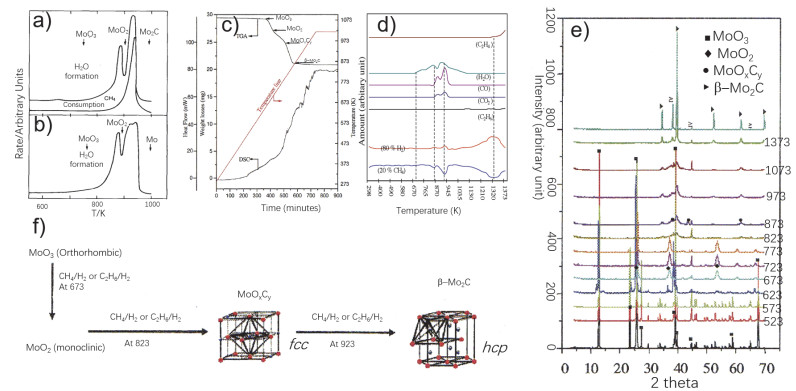
Fig 5
(a) Crystal phase evolution and the generation path of intermediate products over the carburization process of MoO3 with different reductions; adapted from Journal of American Chemical Society, American Chemical Society publisher 71. (b) topotactic and non-topotactic transformations of MoO3 during the synthesizing of molybdenum carbide and metal-supported molybdenum carbides; adapted from Chemistry of Materials, American Chemical Society publisher 72."
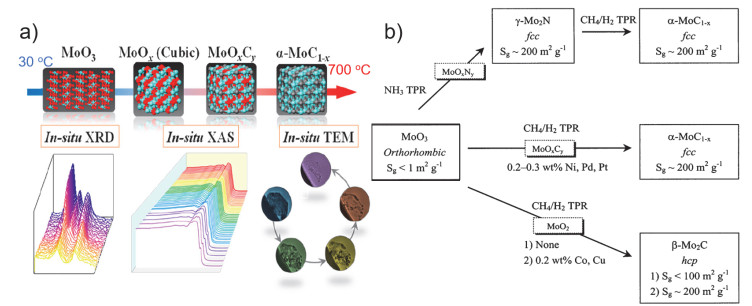
Fig 6
(A) SEM image of the nano-Mo2C wires, and (B–D) TEM images of the nano-Mo2C wires, (E) XRD diffraction pattern and (F) N2 physical adsorption/desorption isotherm curves of the nano-Mo2C wires; reproduced with permission from Royal Society of Chemistry publisher 82."
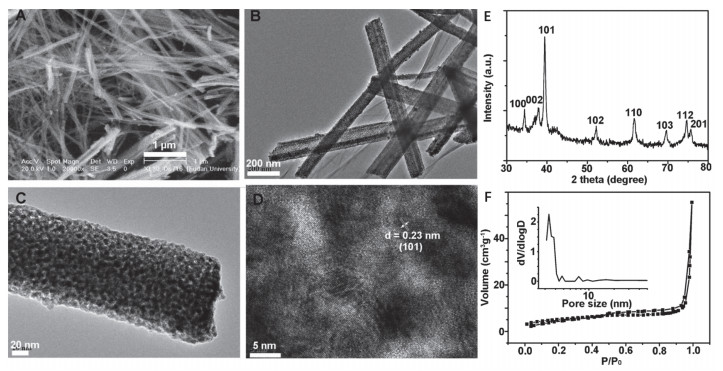
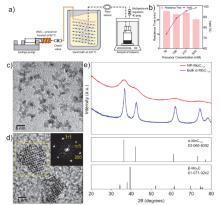
Fig 7
(a) System schematic of the NP-MoC1−x synthesizing millifluidic reactor (uninterrupted); (b) NP-MoC1−x yields related with the [Mo(CO)6] precusor, and reaction residence time; (c) TEM figures of α-MoC1−x NPs that presenting multimodal appearance; (d) A high-resolution TEM image with an FFT pattern of outlined region indexed to the contour area axis of the [011] region; (e) XRD diffraction patterns of the NP-MoC1−x and the bulk α-MoC1−x with the corresponding reference database; adapted from Journal of the American Chemical Society, American Chemical Society publisher 85."
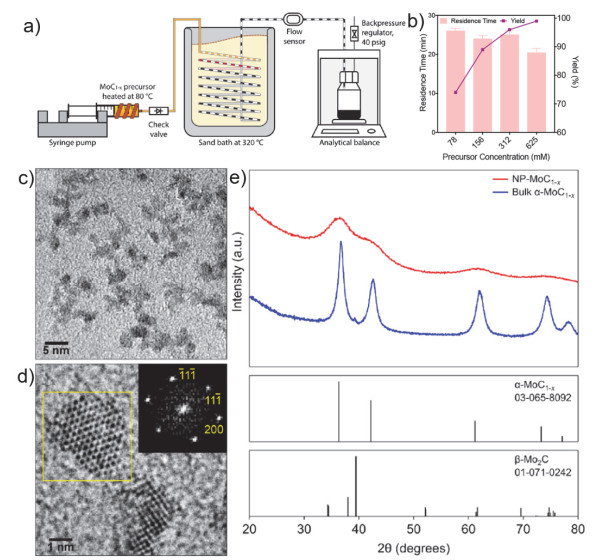
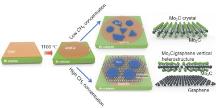
Fig 8
Mo2C crystals growth at low flow rates and high flow rates of CH4 streams; adapted from Advanced Materials, Wiley Online Library publisher 96."
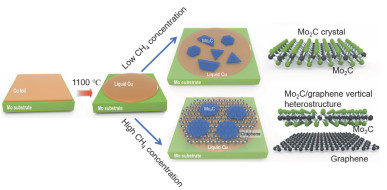
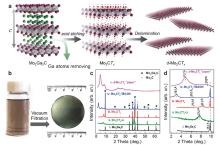
Fig 9
(a) Schematic presentation of the synthesizing and delamination of Mo2CTx. (b) Images of the delaminated solution(diluted) and the free-standing Mo2CTx sheets. (c) XRD diffraction patterns of Mo2Ga2C, multilayered Mo2CTx, Mo2CTx-Li, delaminated Mo2CTx, and free-standing Mo2CTx sheets. (d) Zoom in of XRD patterns focusing on the 2 theta range of 2°–10.5° to show the shift in the 0002 peaks; adapted from Advanced Functional Materials, Wiley Online Library publisher 28."
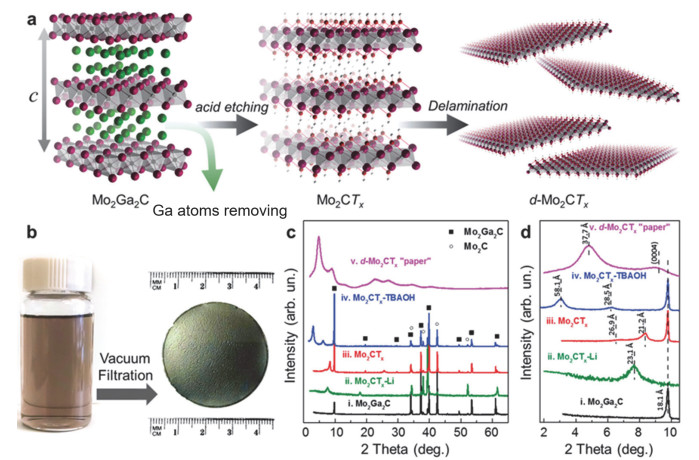
Fig 10
(a) Schematic presentation of two-dimensional (2D) mesoporous Mo2C synthesizing by UV-induced selective corrosion method, (b) SEM images of the Mo2Ga2C precursor and the selected area electron diffraction pattern (SEAD) of Mo2Ga2C crystal (inset). (c) SEM images and (d) TEM images of the Mo2CTx derived from the selective etching of Ga atoms from Mo2Ga2C precursors assisted by UV irradiation; adapted from Sustainable Materials and Technologies, Elsevier publisher 60."
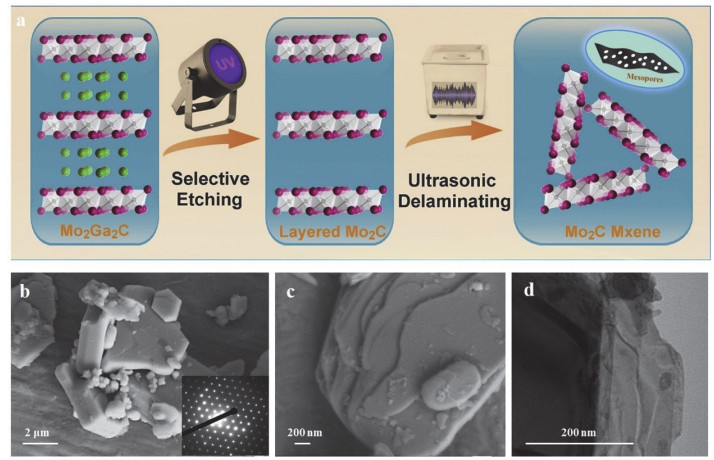
Table 1
Summary of RWGS performance of molybdenum carbide-based materials at various H2 : CO2 ratios and reaction temperatures."
| Catalyst | Reaction condition | CO2 conversion (%) | CO selectivity (%) | Ref. |
| PdNi/CeO2 | 300 ℃; H2 : CO2 = 2 : 1 | 2.5 | 37.5 | |
| β-Mo2C | 300 ℃; H2 : CO2 = 2 : 1 | 8.7 | 93.5 | |
| Co/β-Mo2C | 300 ℃; H2 : CO2 = 2 : 1 | 9.5 | 98.1 | |
| β-Mo2C | 300 ℃; H2 : CO2 = 2 : 1 | – | 100 | |
| β-Mo2C | 400 ℃; H2 : CO2 = 2 : 1 | 1.5 | 100 | |
| β-Mo2C | 500 ℃; H2 : CO2 = 2 : 1 | 6 | 100 | |
| β-Mo2C | 600 ℃; H2 : CO2 = 2 : 1 | 16 | 100 | |
| Cu/β-Mo2C | 300 ℃; H2 : CO2 = 2 : 1 | 5 | 96.5 | |
| Cu/β-Mo2C | 400 ℃; H2 : CO2 = 2 : 1 | 17 | 97.6 | |
| Cu/β-Mo2C | 500 ℃; H2 : CO2 = 2 : 1 | 29 | 99.0 | |
| Cu/β-Mo2C | 600 ℃; H2 : CO2 = 2 : 1 | 40 | 99.2 | |
| 1K-Cu/β-Mo2C | 350 ℃; H2 : CO2 = 2.5 : 1 | 15 | 99.7 | |
| 1K-Cu/β-Mo2C | 400 ℃; H2 : CO2 = 2.5 : 1 | 25 | 99.8 | |
| 1K-Cu/β-Mo2C | 500 ℃; H2 : CO2 = 2.5 : 1 | 43 | 100 | |
| 1K-Cu/β-Mo2C | 600 ℃; H2 : CO2 = 2.5 : 1 | 54 | 100 | |
| K-Mo2C/γ-Al2O3 | 300 ℃; H2 : CO2 = 3 : 1 (pilot scale) | 8.9 | 99.2 | |
| K-Mo2C/γ-Al2O3 | 450 ℃; H2 : CO2 = 3 : 1 (pilot scale) | 43.3 | 95.7 | |
| K-Mo2C/γ-Al2O3 | 600 ℃; H2 : CO2 = 3 : 1 (pilot scale) | 58.5 | 65.8 | |
| 2D-Mo2C | 430 ℃; H2 : CO2 = 1 : 2 | 10 | 99 | |
| 2D-Mo2C | 430 ℃; H2 : CO2 = 1 : 1 | 14 | 97 | |
| 2D-Mo2C | 430 ℃; H2 : CO2 = 3 : 1 | 36 | 90 |
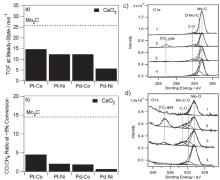
Fig 11
(a) Turnover frequency, and (b) product selectivity on CeO2 (black columns) and Mo2C (dashed line) supported bimetallic-based catalysts at 573 K. (c) AP-XPS of C1s and (d) O 1s of Mo2C after different treatments, briefly, 1) Mo2C (Clean without treatment), 2) 150 mTorr (1 mTorr = 0.133 Pa) CO2 treatment at room temperature, 3) pre-annealed in mixture gases (150 mTorr CO2 blended with 550 mTorr H2) at 523 K, then cooled down to room temperature, 4) pre-annealed in mixture gases (150 mTorr CO2 blended with 550 mTorr H2) at 523 K; adapted from Angewandte Chemie International Edition, Wiley Online Library publisher 109."
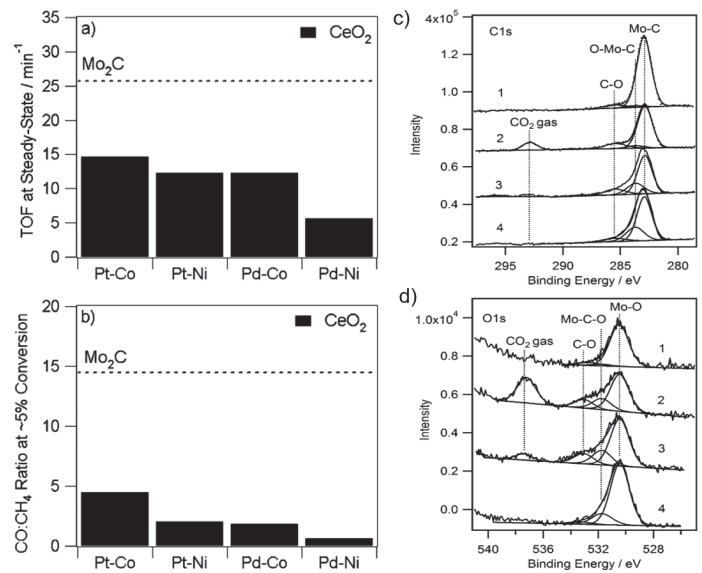
Fig 12
(a) CO2 thermocatalytic conversion rates, and (b) CO product selectivity of the β-Mo2C and the Cu-modified β-Mo2C in the RWGS process. (Pressure: 1 bar, 1 bar = 0.1 MPa; CO2 : H2 = 1 : 2; Temperature: 300–600 ℃; WHSV = 300000 mL∙g−1∙h−1). (c) Stability comparison of 1% (wt.) Cu/β-Mo2C catalyst with the commercial catalyst (36% (wt.) Cu/ZnO/Al2O3) in the RWGS process. (Pressure: 1 bar; CO2 : H2 ratio = 1 : 2; Temperature: 600 ℃; WHSV = 300000 mL∙g−1∙h−1); adapted from ACS Catalysis, American Chemical Society publisher 110; (d) CO2 thermocatalytic conversion rate and (e) CO product selectivity of the K-promoted Cu/β-Mo2C during the RWGS process. (WHSV = 84000 mL∙g−1∙h−1, H2 : CO2 = 2.5); and (f–i) X-ray photoelectron spectroscopy of K-promoted Cu/β-Mo2C. f) Mo 3d; (g) Cu 2p; h) Cu LMM, and i) K 2p; adapted from Molecular Catalysis, Elsevier publisher 111."
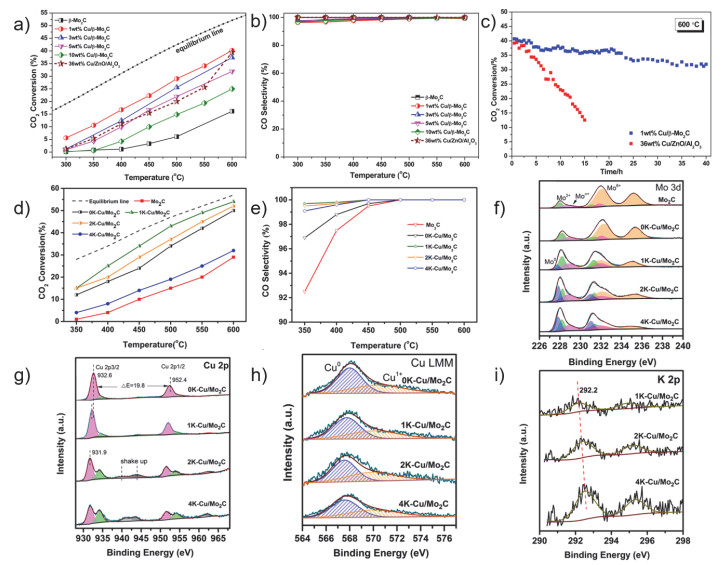
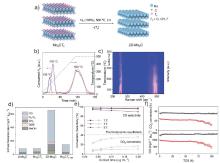
Fig 13
(a) Schematic diagram of the preparation procedure of 2D-Mo2C; (b) temperature-programmed reduction of Mo2CTx; (c) in situ Raman spectroscopy of the Mo2CTx (reduction of the Mo2CTx until 500 ℃); (d) the intrinsic formation rates and CO2 conversion obtained after H2 prereduction of Mo2CTx (Temperature: 230 ℃; Pressure: 25 bar; H2 : CO2 : N2 = 3 : 1 : 1); (e) CO2 hydrogenation with 2D-Mo2C at 430 ℃ and 1 bar; (f) stability assessment of 2D-Mo2C (black lines) and the commercial Cu-ZnO-Al2O3 (red lines); reproduced with permission from Ref. 33."
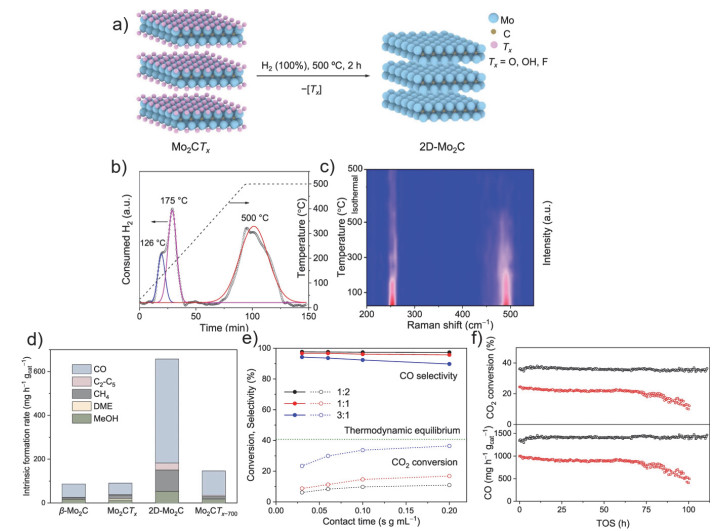
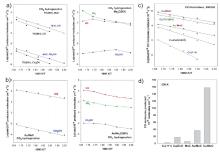
Fig 14
(a) Comparison of the CO2 hydrogenation performance on TiC(001), δ-MoC (polycrystalline), and β-Mo2C(001) (orthorhombic); (b) comparison of the CO2 hydrogenation performance on Au/δ-MoC surfaces and Au/β-Mo2C(001) surfaces; and (c) Arrhenius diagrams for the methanol production by CO2 hydrogenation on a series of Au- and Cu-containing molybdenum carbide materials in 0.049 MPa of CO2 and 0.441 MPa of H2 at temperatures from 500 to 600 K; (d) comparison of the CH3OH production rates at 550 K; adapted from Journal of the American Chemical Society, American Chemical Society publisher 53."
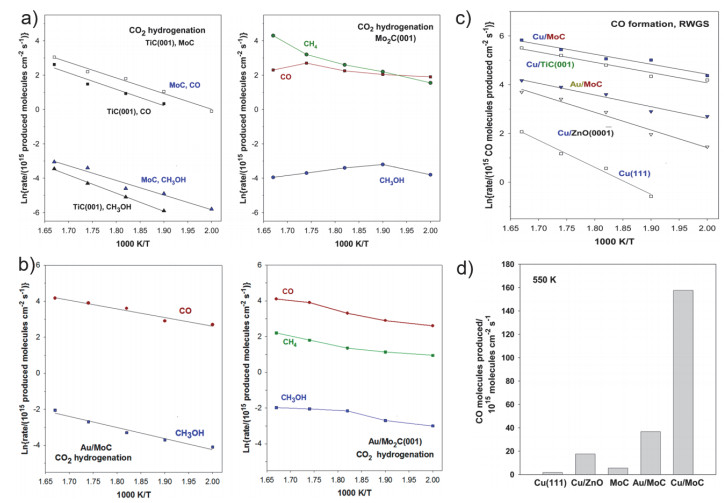
Table 2
Summary of CO2 methanation, hydrogenation to methanol, and direct CO2 Fischer-Tropsch synthesis performance on molybdenum carbide-based materials at various reaction conditions."
| Catalyst | Reaction condition | a. CO2 conversion (%); b. TOF(umol·m−2·s−1) | Product selectivity (%) | Ref. | ||||
| CO | CH4 | C2H6 | CH3OH | C2+ | ||||
| MoC20E-700/TiO2-P | 250 ℃, 30 bar, H2 : CO2 = 3 : 1 | 1.6 a | 71 | 22 | 4 | 3 | – | |
| MoC20E-700/TiO2-D | 250 ℃, 30 bar, H2 : CO2 = 3 : 1 | 2.2 a | 68 | 16 | 5 | 11 | – | |
| MoC20E-700/ZrO2 | 250 ℃, 30 bar, H2 : CO2 = 3 : 1 | 1.7 a | 69 | 24 | 3 | 4 | – | |
| Ir1/2D-Mo2C | DFT calculations | – | – | – | – | – | – | |
| Mo2C | 220 ℃, 60 bar, H2 : CO2 : Ar = 22.7 : 67.2 : 10.1 | 4.6 a | 36.2 | 30.1 | 7.9 | 17.7 | – | |
| Mo2C | 280 ℃, 60 bar, H2 : CO2 : Ar = 22.7 : 67.2 : 10.1 | 16.7 a | 29.4 | 47.5 | 12.7 | 3.3 | – | |
| Cu/Mo2C | 220 ℃, 60 bar, H2 : CO2 : Ar = 22.7 : 67.2 : 10.1 | 4.0 a | 48.5 | 13.5 | 3.0 | 31.5 | – | |
| Cu/Mo2C | 280 ℃, 60 bar, H2 : CO2 : Ar = 22.7 : 67.2 : 10.1 | 13.4 a | 47.8 | 30.8 | 7.4 | 7.6 | – | |
| β-Mo2C | 150 ℃, 20 bar, H2 : CO2 = 3 : 1 | 3.25 a | – | – | – | 60 | – | |
| Cu/β-Mo2C | 150 ℃, 20 bar, H2 : CO2 = 3 : 1 | 5 a | – | – | – | 70 | – | |
| Cs/β-Mo2C | 150 ℃, 20 bar, H2 : CO2 = 3 : 1 | 3 a | – | – | – | 50 | – | |
| Cu/Cs/β-Mo2C | 150 ℃, 20 bar, H2 : CO2 = 3 : 1 | 4 a | – | – | – | 55 | – | |
| N, P, S-dC@Mo2C-973K | 220 ℃, 30 bar, H2 : CO2 = 3 : 1 | 18.9 a | 2.2 | 32.9 | – | 56.4 | – | |
| N, P, S-dC@Mo2C-1073K | 220 ℃, 30 bar, H2 : CO2 = 3 : 1 | 19.4 a | 3.9 | 10.6 | – | 82.4 | – | |
| N, P, S-dC@Mo2C-1173K | 220 ℃, 30 bar, H2 : CO2 = 3 : 1 | 18.2 a | 2.9 | 11.9 | – | 75.9 | – | |
| Cu/Mo2CTx/SiO2-2h | 230 ℃, 25 bar, H2 : CO2 : N2 = 3 : 1 : 1 | 0.3–2.2 a | 46 | 0 | 0 | 42 | – | |
| Cu/Mo2CTx/SiO2-6h | 230 ℃, 25 bar, H2 : CO2 : N2 = 3 : 1 : 1 | 0.7–3.4 a | 48 | 0 | 0 | 52 | – | |
| Cu/Mo2C | 200 ℃, 40 bar, H2 : CO2 = 3 : 1 | 90 b | 8.6 | 9.8 | 3.7 | 63 | – | |
| Pd/Mo2C | 200 ℃, 40 bar, H2 : CO2 = 3 : 1 | 97 b | 9.6 | 7.6 | 2.5 | 68 | – | |
| Co/Mo2C | 200 ℃, 40 bar, H2 : CO2 = 3 : 1 | 86 b | 9.5 | 9.5 | 5.6 | 46 | – | |
| Fe/Mo2C | 200 ℃, 40 bar, H2 : CO2 = 3 : 1 | 99 b | 6.8 | 8.1 | 6.3 | 58 | – | |
| 5%Cu/Mo2C | 300 ℃, 20 bar, H2 : CO2 : Ar = 75 : 15 : 10 | 21 a | 38 | 20 | 3 | 31 | ||
| 9%Cu/Mo2C | 300 ℃, 20 bar, H2 : CO2 : Ar = 75 : 15 : 10 | 19 a | 38 | 25 | 3 | 26 | ||
| 48%Cu/Mo2C | 300℃, 20 bar, H2 : CO2 : Ar = 75 : 15 : 10 | 13 a | 40 | 28 | 4 | 21 | ||
| Fe(0.5)-Mo2C | 400 ℃, 40 bar, H2 : CO2 = 3 : 1 | 9.8 a | 0.5 | 2.1 | 3.5 | 0 | 92 | |
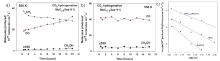
Fig 15
Formation of CH4, CO, and CH3OH during the thermocatalytic hydrogenation of CO2 on an Au(111) surface that covered with 0.3 mL of (a) MoC0.6; and (b) MoC1.1 (Temperature: 550 K; partial pressure (CO2): 0.5 atm, 1 atm = 101325 Pa; and partial pressure (H2): 4.5 atm); (c) Arrhenius profiles for CO2 hydrogenation on the surfaces of Cu(111), bulk δ-MoC, and Au(111) with 0.3 mL of MoC1.1 (Partial pressure (CO2): 0.5 atm; and partial pressure (H2): 4.5 atm); adapted from ACS Catalysis, American Chemical Society publisher 113."
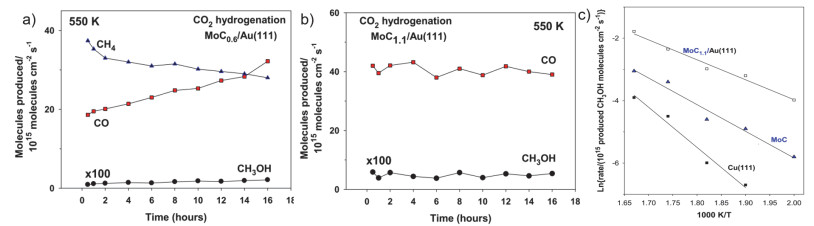
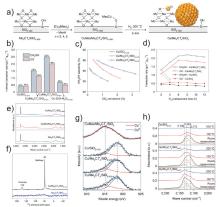
Fig 16
(a) Preparation process of Cu/Mo2CTx/SiO2–500 with high Cu sites dispersity in Mo2CTx nanosheets. (b) Comparison of intrinsic CH3OH and CO formation rates of the catalysts (Temperature: 230 ℃; Pressure: 2.5 MPa, and H2 : CO2 : N2 = 3 : 1 : 1). (c) CH3OH selectivity vs. CO2 conversion by regulating the contact durations. (d) CH3OH and CO formation rates of the Cu/Mo2CTx/SiO2. (e) Infrared spectra of the Mo2CTx/SiO2–500 (black line) and it after grafting of Cu (red line), and after treatment in H2 at 500 ℃ for 2 h (blue line). (f) Solid-state cross-polarization MAS 13C NMR spectra of the Cu/Mo2CTx/SiO2–2 h and the Mo2CTx/SiO2–2 h after anneal in H2/13CO2 (ca. 3) for 12 h at 230 ℃ and 0.5 MPa. (g) Cu L3VV Auger spectra. (h) DRIFTs after CO desorption at various temperatures; reproduced with permission from Ref. 32."
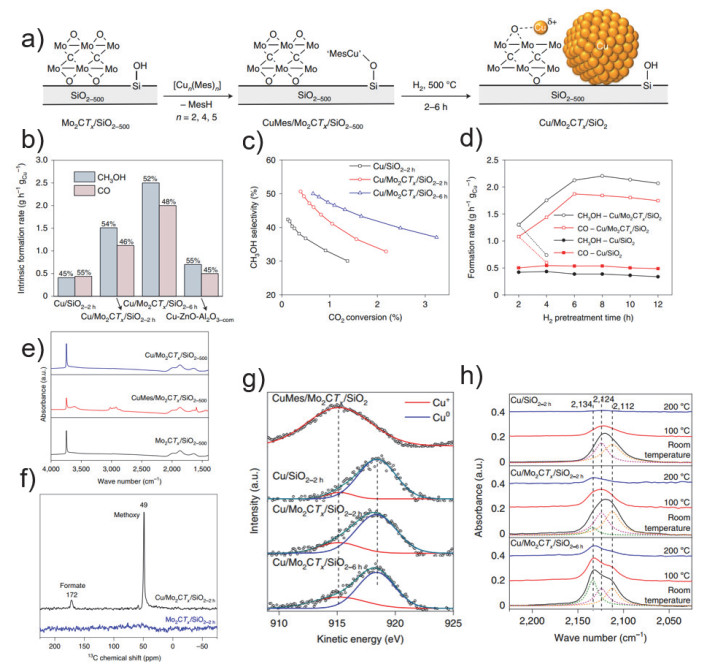
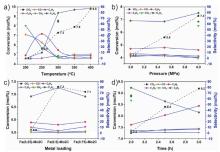
Fig 17
CO2 conversion rates and hydrocarbon product selectivity of the Fe-Mo2C catalyst with (a) different temperatures, (b) different pressures, (c) direct CO2 Fischer-Tropsch synthesis performance of different Fe loaded Mo2C, (d) reaction stability for the Fe(0.5)-Mo2C catalyst; adapted from Journal of CO2 Utilization, Elsevier publisher 137."
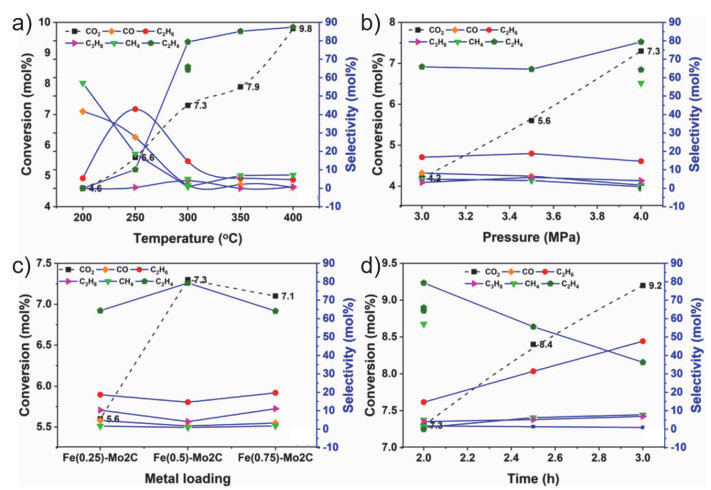
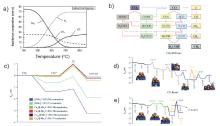
Fig 18
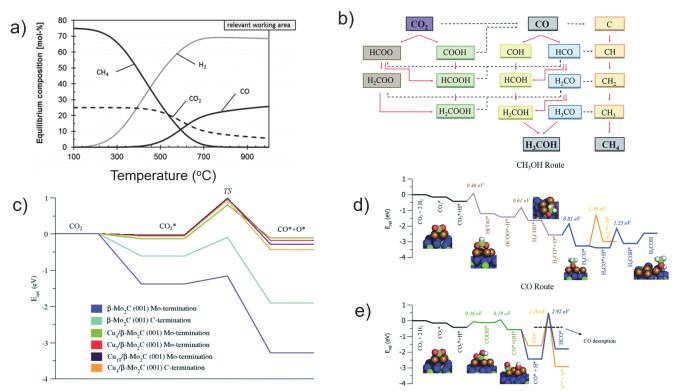
(a) Thermodynamic equilibrium composition of the CO2 hydrogenation at 1 bar, H2 : CO2 = 3 : 1, adapted from Energy & Environmental Science, The Royal Society of Chemistry publisher 14; (b) Flow-process diagram of the heterogeneously thermocatalytic CO2 hydrogenation network. Different colors are highlighted to distinguish the probable reaction intermediates, (acids: green; aldehydes: blue; hydrocarbons: orange; carbonates: brown; and alcohols: yellow) 115; (c) Comparison of energy profile for CO2 dissociation: β-Mo2C(001) with Mo-terminated surface and C-terminated surface and the Cun/β-Mo2C(001) surfaces models 115; (d) Comparison of energy profile for CH3OH production as calculated from a Cu4/β-Mo surface 115; (e) Energy profile of CO production based on predictions from a Cu4/β-Mo surface, adapted from Catalysis Science & Technology, The Royal Society of Chemistry publisher 115."
| 1 |
doi: 10.1073/pnas.2103971118 |
| 2 |
doi: 10.1016/j.joule.2020.07.005 |
| 3 |
doi: 10.1016/j.ccst.2022.100052 |
| 4 |
doi: 10.1016/j.cej.2022.139913 |
| 5 |
doi: 10.1016/j.ccst.2021.100021 |
| 6 |
doi: 10.1016/j.cej.2017.11.160 |
| 7 |
doi: 10.1016/j.jcou.2021.101757 |
| 8 |
doi: 10.1016/j.cej.2022.134852 |
| 9 |
doi: 10.1021/acscatal.7b03063 |
| 10 |
doi: 10.1021/acscatal.9b04555 |
| 11 |
doi: 10.1126/sciadv.aav5077 |
| 12 |
doi: 10.1038/s41467-019-13638-9 |
| 13 |
doi: 10.1126/science.abh4049 |
| 14 |
doi: 10.1039/C5EE02657A |
| 15 |
doi: 10.1038/s41467-019-11349-9 |
| 16 |
doi: 10.1002/cctc.202000195 |
| 17 |
doi: 10.1038/s41467-019-09072-6 |
| 18 |
doi: 10.1016/j.jcat.2022.09.011 |
| 19 |
doi: 10.1021/acs.jpcc.1c08814 |
| 20 |
doi: 10.1039/D0CY01749C |
| 21 |
doi: 10.1038/s41929-018-0067-8 |
| 22 |
doi: 10.1126/science.aah4321 |
| 23 |
doi: 10.1038/s41467-020-18721-0 |
| 24 |
doi: 10.1038/nature21672 |
| 25 |
doi: 10.1021/jacs.0c10776 |
| 26 |
doi: 10.1016/j.jcou.2019.08.024 |
| 27 |
doi: 10.1039/D2TA03481F |
| 28 |
doi: 10.1002/adfm.201505328 |
| 29 |
doi: 10.1126/science.aag2421 |
| 30 |
doi: 10.1016/j.scib.2019.12.025 |
| 31 |
doi: 10.1126/science.abf1581 |
| 32 |
doi: 10.1038/s41929-021-00684-0 |
| 33 |
doi: 10.1038/s41467-021-25784-0 |
| 34 |
doi: 10.1016/j.ijhydene.2022.01.021 |
| 35 |
doi: 10.1021/acs.chemrev.5b00197 |
| 36 |
doi: 10.1016/j.rser.2017.05.204 |
| 37 |
doi: 10.1016/j.pecs.2021.100905 |
| 38 |
doi: 10.3866/PKU.WHXB202210026 |
|
尹倩; 宋慧婷; 徐明; 鄢红; 赵宇飞; 段雪. 物理化学学报, 2023, 39 (3), 2210026.
|
|
| 39 |
doi: 10.1016/0021-9517(87)90218-1 |
| 40 |
doi: 10.1016/0021-9517(88)90119-4 |
| 41 |
doi: 10.1021/acscatal.2c04619 |
| 42 |
doi: 10.1021/acscatal.8b03990 |
| 43 |
doi: 10.1016/j.jechem.2017.08.004 |
| 44 |
doi: 10.1016/j.renene.2021.05.051 |
| 45 |
doi: 10.1002/advs.201500286 |
| 46 |
doi: 10.1021/acs.iecr.9b04910 |
| 47 |
doi: 10.1021/cr950232u |
| 48 |
doi: 10.1006/jcat.2000.2894 |
| 49 |
doi: 10.1021/cm011096e |
| 50 |
doi: 10.1021/jp205950x |
| 51 |
doi: 10.1021/cr0204606 |
| 52 |
doi: 10.1016/j.cis.2020.102144 |
| 53 |
doi: 10.1021/jacs.6b04529 |
| 54 |
doi: 10.1039/C5EE03649F |
| 55 |
doi: 10.1039/C4CP01943A |
| 56 |
doi: 10.1016/j.susc.2016.10.001 |
| 57 |
doi: 10.1039/C9TA02650A |
| 58 |
doi: 10.1016/j.ceramint.2020.05.008 |
| 59 |
doi: 10.1016/j.scriptamat.2015.07.003 |
| 60 |
doi: 10.1016/j.susmat.2020.e00156 |
| 61 |
doi: 10.1038/s41929-021-00686-y |
| 62 |
doi: 10.1021/acssensors.2c00658 |
| 63 |
doi: 10.1039/C6TA01918H |
| 64 |
doi: 10.1039/D2CY00729K |
| 65 |
doi: 10.1021/acs.chemmater.9b01105 |
| 66 |
Rebrov, E. V. Advances in Clean Hydrocarbon Fuel Processing; Elsevier, Belfast, UK, 2011; p. 387. doi: 10.1533/9780857093783.4.387
|
| 67 |
doi: 10.1038/s41586-020-03130-6 |
| 68 |
doi: 10.1007/s10562-014-1278-5 |
| 69 |
doi: 10.1039/C7CY00708F |
| 70 |
doi: 10.1021/acscatal.7b00735 |
| 71 |
doi: 10.1021/jacs.2c08979 |
| 72 |
doi: 10.1021/cm030395w |
| 73 |
doi: 10.1111/j.1151-2916.1991.tb04116.x |
| 74 |
doi: 10.1039/A804645J |
| 75 |
doi: 10.1016/j.jallcom.2006.11.166 |
| 76 |
doi: 10.1016/j.ijrmhm.2013.05.014 |
| 77 |
doi: 10.1149/1945-7111/ac4a52 |
| 78 |
doi: 10.1016/j.electacta.2016.08.104 |
| 79 |
doi: 10.1021/acsomega.8b02856 |
| 80 |
doi: 10.1016/j.jechem.2018.07.006 |
| 81 |
doi: 10.1016/j.ijhydene.2018.08.152 |
| 82 |
doi: 10.1039/C3CP54754J |
| 83 |
doi: 10.1016/j.nanoen.2016.03.024 |
| 84 |
doi: 10.1002/ange.200352386 |
| 85 |
doi: 10.1021/jacs.9b11238 |
| 86 |
doi: 10.3866/PKU.WHXB201810059 |
|
程龙; 刘公平; 金万勤. 物理化学学报, 2019, 35 (10), 1090.
|
|
| 87 |
doi: 10.26599/NRE.2022.9120008 |
| 88 |
doi: 10.3866/PKU.WHXB202108017 |
|
常诚; 陈伟; 陈也; 陈永华; 陈雨; 丁峰; 樊春海; 范红金; 范战西; 龚成; 等. 物理化学学报, 2021, 37 (12), 2108017.
|
|
| 89 |
doi: 10.1038/nenergy.2017.105 |
| 90 |
doi: 10.1002/adma.201506133 |
| 91 |
doi: 10.1021/jacs.9b08897 |
| 92 |
doi: 10.1021/acs.chemmater.0c03549 |
| 93 |
doi: 10.1021/acs.chemrev.7b00536 |
| 94 |
doi: 10.3866/PKU.WHXB201812057 |
|
杜春保; 胡小玲; 张刚; 程渊. 物理化学学报, 2019, 35 (10), 1078.
|
|
| 95 |
doi: 10.1039/C7TA09960F |
| 96 |
|
| 97 |
doi: 10.1063/1.5010101 |
| 98 |
doi: 10.1021/acscatal.0c01127 |
| 99 |
doi: 10.1021/nn204153h |
| 100 |
doi: 10.1002/adma.201102306 |
| 101 |
doi: 10.1038/natrevmats.2016.98 |
| 102 |
doi: 10.1038/s41929-018-0195-1 |
| 103 |
doi: 10.1016/j.ccst.2021.100001 |
| 104 |
doi: 10.1016/j.cej.2021.132110 |
| 105 |
doi: 10.1016/j.fuel.2020.118135 |
| 106 |
doi: 10.1016/j.apcatb.2021.120319 |
| 107 |
doi: 10.1016/j.apcatb.2022.122011 |
| 108 |
doi: 10.1016/j.catcom.2016.06.026 |
| 109 |
doi: 10.1002/anie.201404109 |
| 110 |
doi: 10.1021/acscatal.6b02991 |
| 111 |
doi: 10.1016/j.mcat.2021.111954 |
| 112 |
doi: 10.1039/D0EE01457E |
| 113 |
doi: 10.1021/acscatal.1c01738 |
| 114 |
doi: 10.3389/fchem.2020.00452 |
| 115 |
doi: 10.1039/C5CY02143J |
| 116 |
doi: 10.1021/jp501471u |
| 117 |
doi: 10.1016/j.fuel.2021.122602 |
| 118 |
doi: 10.1039/C5GC00119F |
| 119 |
doi: 10.1002/cssc.201902828 |
| 120 |
doi: 10.1016/j.cej.2020.126903 |
| 121 |
doi: 10.1016/j.jechem.2017.07.002 |
| 122 |
doi: 10.1016/j.jcou.2018.08.012 |
| 123 |
doi: 10.3390/catal7030088 |
| 124 |
doi: 10.1016/j.jcou.2019.03.009 |
| 125 |
doi: 10.1016/j.apcatb.2014.12.025 |
| 126 |
doi: 10.1016/0021-9517(82)90186-5 |
| 127 |
doi: 10.1016/j.ijhydene.2022.10.029 |
| 128 |
doi: 10.1016/j.apcatb.2022.121098 |
| 129 |
doi: 10.1246/cl.1992.5 |
| 130 |
doi: 10.3390/catal10101213 |
| 131 |
doi: 10.3390/nano12071048 |
| 132 |
doi: 10.1039/D1CY00410G |
| 133 |
doi: 10.1016/j.jcou.2017.06.016 |
| 134 |
doi: 10.1016/j.jcat.2016.01.016 |
| 135 |
doi: 10.1016/j.apcata.2017.05.018 |
| 136 |
doi: 10.1039/D1CS01036K |
| 137 |
doi: 10.1016/j.jcou.2021.101607 |
| 138 |
doi: 10.1021/acscatal.2c03404 |
| 139 |
doi: 10.1038/nchem.2794 |
| 140 |
doi: 10.1016/S1872-2067(22)64107-X |
| 141 |
doi: 10.1016/j.jcat.2015.05.020 |
| 142 |
doi: 10.1016/j.jcat.2017.01.020 |
| 143 |
doi: 10.1016/j.jcou.2022.102321 |
| 144 |
doi: 10.1021/acs.iecr.7b01817 |
| 145 |
doi: 10.1016/j.cej.2022.134960 |
| 146 |
doi: 10.1016/j.gce.2021.11.009 |
| 147 |
doi: 10.1038/s41565-021-00951-y |
| 148 |
doi: 10.1073/pnas.1701280114 |
| 149 |
doi: 10.1038/s41929-022-00842-y |
| 150 |
doi: 10.1039/B805427D |
| 151 |
doi: 10.1002/adma.202107554 |
| 152 |
doi: 10.1021/acsanm.0c02473 |
| 153 |
doi: 10.1038/s41929-021-00611-3 |
| 154 |
doi: 10.1016/j.chempr.2022.09.007 |
| 155 |
doi: 10.1021/acs.nanolett.5b00737 |
| 156 |
doi: 10.1016/j.apcatb.2020.118792 |
| [1] | Jianan Hong, Chenyu Xu, Yan Liu, Changqi Li, Menglin Wang, Yanwei Zhang. Decoding the interfacial competition between hydrogen evolution and CO2 reduction via edge-active-site modulation in photothermal catalysis [J]. Acta Phys. -Chim. Sin., 2025, 41(9): 100099-. |
| [2] | Honghong Zhang, Zhen Wei, Derek Hao, Lin Jing, Yuxi Liu, Hongxing Dai, Weiqin Wei, Jiguang Deng. Recent advances in synergistic catalytic valorization of CO2 and hydrocarbons by heterogeneous catalysis [J]. Acta Phys. -Chim. Sin., 2025, 41(7): 100073-. |
| [3] | Liuyun Chen, Wenju Wang, Tairong Lu, Xuan Luo, Xinling Xie, Kelin Huang, Shanli Qin, Tongming Su, Zuzeng Qin, Hongbing Ji. Soft template-induced deep pore structure of Cu/Al2O3 for promoting plasma-catalyzed CO2 hydrogenation to DME [J]. Acta Phys. -Chim. Sin., 2025, 41(6): 100054-. |
| [4] | Qinhui Guan, Yuhao Guo, Na Li, Jing Li, Tingjiang Yan. Molecular sieve-mediated indium oxide catalysts for enhancing photocatalytic CO2 hydrogenation [J]. Acta Phys. -Chim. Sin., 2025, 41(11): 100133-. |
| [5] | Xiaorui Chen, Xuan Luo, Tongming Su, Xinling Xie, Liuyun Chen, Yuejing Bin, Zuzeng Qin, Hongbing Ji. Ga-doped Cu/γ-Al2O3 bifunctional interface sites promote the direct hydrogenation of CO2 to DME [J]. Acta Phys. -Chim. Sin., 2025, 41(10): 100126-. |
| [6] | Yajin Li, Huimin Liu, Lan Ma, Jiaxiong Liu, Dehua He. Photothermal Synthesis of Glycerol Carbonate via Glycerol Carbonylation with CO2 over Au/Co3O4-ZnO Catalyst [J]. Acta Phys. -Chim. Sin., 2024, 40(9): 2308005-. |
| [7] | Yushan Cai, Fang-Xing Xiao. Revisiting MXenes-based Photocatalysis Landscape: Progress, Challenges, and Future Perspectives [J]. Acta Phys. -Chim. Sin., 2024, 40(8): 2306048-. |
| [8] | Feifei Yang, Wei Zhou, Chaoran Yang, Tianyu Zhang, Yanqiang Huang. Enhanced Methanol Selectivity in CO2 Hydrogenation by Decoration of K on MoS2 Catalyst [J]. Acta Phys. -Chim. Sin., 2024, 40(7): 2308017-. |
| [9] | Chengcheng Zhang, Zhiyi Wu, Jiahui Shen, Le He, Wei Sun. Silicon Nanostructure Arrays: An Emerging Platform for Photothermal CO2 Catalysis [J]. Acta Phys. -Chim. Sin., 2024, 40(1): 2304004-. |
| [10] | Yaowu Luo, Dingsheng Wang. Enhancing Heterogeneous Catalysis by Electronic Property Regulation of Single Atom Catalysts [J]. Acta Phys. -Chim. Sin., 2023, 39(9): 2212020-0. |
| [11] | Zhanjun He, Min Huang, Tiejun Lin, Liangshu Zhong. Recent Advances in Dry Reforming of Methane via Photothermocatalysis [J]. Acta Phys. -Chim. Sin., 2023, 39(9): 2212060-0. |
| [12] | Qianwei Song, Guanchao He, Huilong Fei. Photothermal Catalytic Conversion Based on Single Atom Catalysts: Fundamentals and Applications [J]. Acta Phys. -Chim. Sin., 2023, 39(9): 2212038-0. |
| [13] | Huan Liu, Yu Ma, Bin Cao, Qizhen Zhu, Bin Xu. Recent Progress of MXenes in Aqueous Zinc-Ion Batteries [J]. Acta Phys. -Chim. Sin., 2023, 39(5): 2210027-0. |
| [14] | Junwen Lu, Shunan Zhang, Haozhi Zhou, Chaojie Huang, Lin Xia, Xiaofang Liu, Hu Luo, Hui Wang. Ir Single Atoms and Clusters Supported on α-MoC as Catalysts for Efficient Hydrogenation of CO2 to CO [J]. Acta Phys. -Chim. Sin., 2023, 39(11): 2302021-. |
| [15] | Xiaohui Cao, Chengyi Hou, Yaogang Li, Kerui Li, Qinghong Zhang, Hongzhi Wang. MXenes-Based Functional Fibers and Their Applications in the Intelligent Wearable Field [J]. Acta Phys. -Chim. Sin., 2022, 38(9): 2204058-. |
|
||