Acta Phys. -Chim. Sin. ›› 2024, Vol. 40 ›› Issue (6): 2307015.doi: 10.3866/PKU.WHXB202307015
Special Issue: Electrocatalytic Functional Materials
• ARTICLE • Previous Articles Next Articles
Bi-Layer Single Atom Catalysts Boosted Nitrate-to-Ammonia Electroreduction with High Activity and Selectivity
Jingkun Yu1, Xue Yong2,*( ), Ang Cao3, Siyu Lu1,*()
- 1 Green Catalysis Center, and College of Chemistry, Zhengzhou University, Zhengzhou 450001, China
2 Department of Chemistry, University of Sheffield, Sheffield, S37HF, UK
3 Department of Physics, Technical University of Denmark, Kongens Lyngby 2800, Denmark
-
Received:2023-07-06Revised:2023-08-22Accepted:2023-08-23Published:2023-11-29 -
Contact:Email: sylu2013@zzu.edu.cn (Siyu Lu)x.yong@sheffield.ac.uk (Xue Yong) -
Supported by:the National Natural Science Foundation of China(51973200); the National Natural Science Foundation of China(52122308); the National Supercomputing Center in Zhengzhou, China

Cite this article
Jingkun Yu, Xue Yong, Ang Cao, Siyu Lu. Bi-Layer Single Atom Catalysts Boosted Nitrate-to-Ammonia Electroreduction with High Activity and Selectivity[J]. Acta Phys. -Chim. Sin. 2024, 40(6), 2307015. doi: 10.3866/PKU.WHXB202307015
share this article
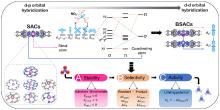
Scheme 1
Schematic diagram of the strategies for ammonia synthesis: three-step screening method (stability, selectivity, and activity) for selecting promising catalysts, rational adjustment from d–p orbital hybridization of SACs to d–d orbital hybridization of BSACs."
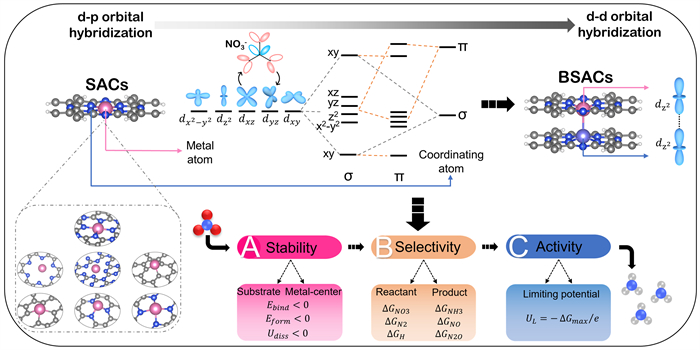
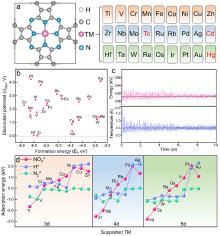
Fig 1
(a) Depicts the atomic structure of TM-Pc as viewed from the top. The TM atoms included in the screening range from Ti to Au. (b) Illustrates the calculated formation energy and dissolution potential of metal atoms in TM-Pc. (c) The energy and temperature evolution over the course of the AIMD simulation for Ti-Pc, which extends over 10 ps at a temperature of 500 K. (d) The adsorption energies for NO3−, N2 molecules, and H protons on TM-Pc."

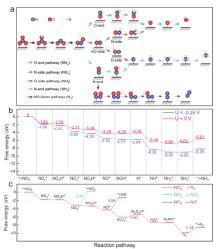
Fig 2
(a) Schematic depiction of NO3RR pathways, including O-end, N-end, and NO-side pathways to the product NH3 and a NO-dimer pathway to the product N2. Gibbs energy changes for NO3RR to (b) NH3 and (c) NO, NO2, and N2 on Ti-Pc."
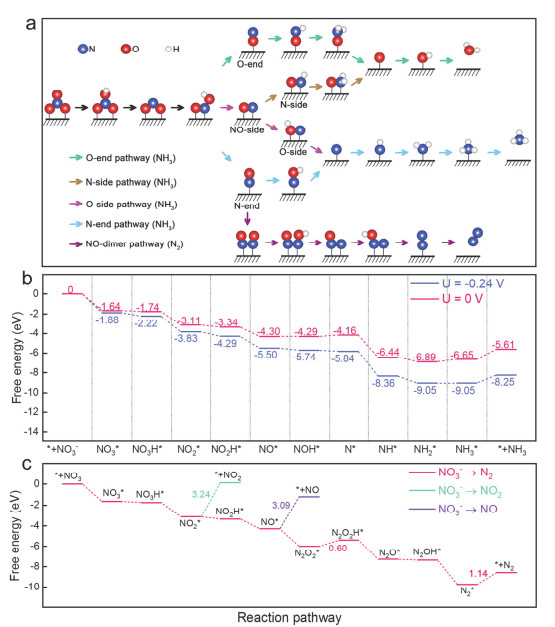
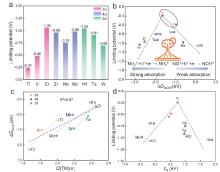
Fig 3
(a) Summary of UL on TM-Pc for NO3RR via the most favorable N-end pathway. (b) NO3RR volcano plot of TM-Pc with a descriptor of ΔGNO3*, where Ti-Pc and V-Pc exactly stand near the top of the volcano plot. (c) The scaling relation between charge transfer of TM atoms and ΔGNO3*. (d) NO3RR volcano plot of TM-Pc with a descriptor of εd."
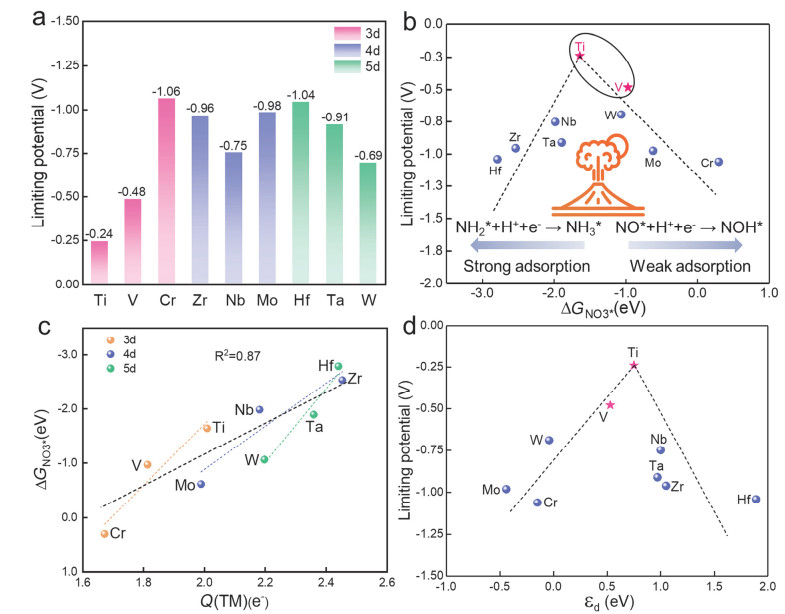
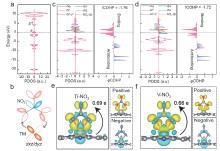
Fig 4
(a) Molecular orbitals of free NO3−. (b) Electron transfer mechanism between nitrate and dxz/dyz orbitals of metal. PDOS and pCOHP of NO3− adsorbed on (c) Ti-Pc and (d) V-Pc, respectively. Charge density differences of NO3− adsorbed on (e) Ti-Pc and (f) V-Pc, respectively."
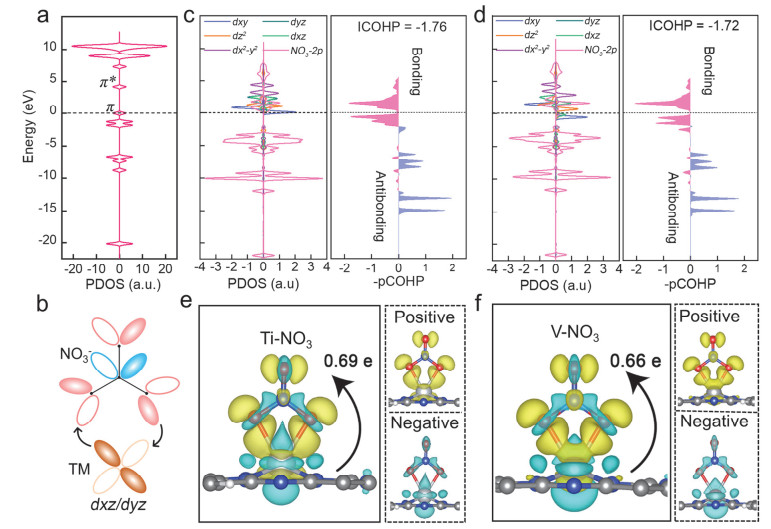
Fig 5
Charge variation during the process of NO3RR on (a) Ti-Pc and (b) V-Pc, respectively."
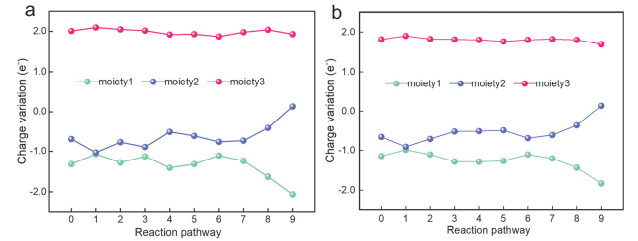
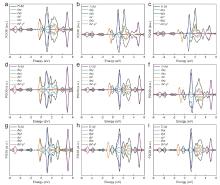
Fig 6
The PDOS for Ti atom of Ti-TM BSACs: (a) Ti2; (b) Ti-V; (c) Ti-Cr; (d) Ti-Zr; (e) Ti-Nb; (f) Ti-Mo; (g) Ti-Hf; (h) Ti-Ta; (i) Ti-W."
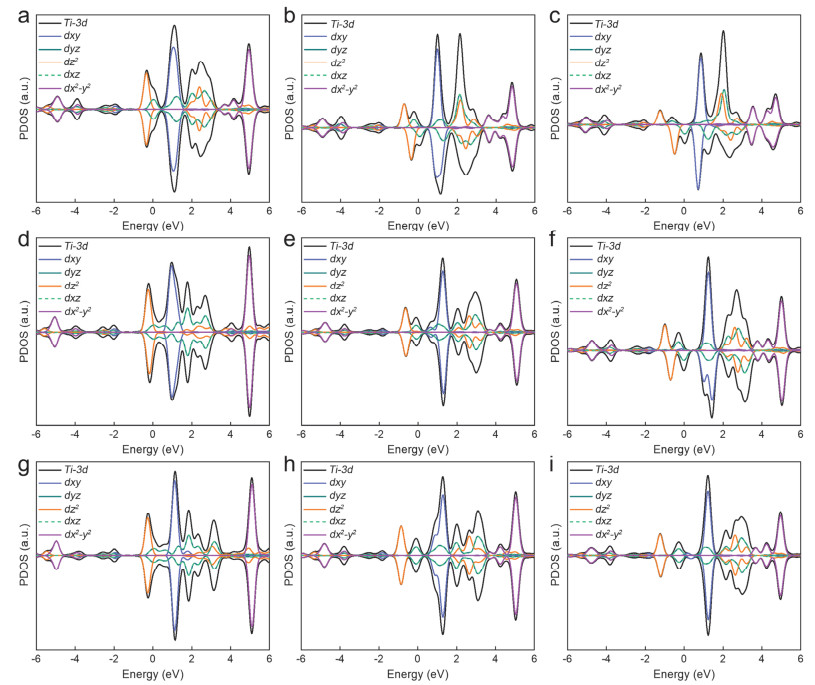
Fig 7
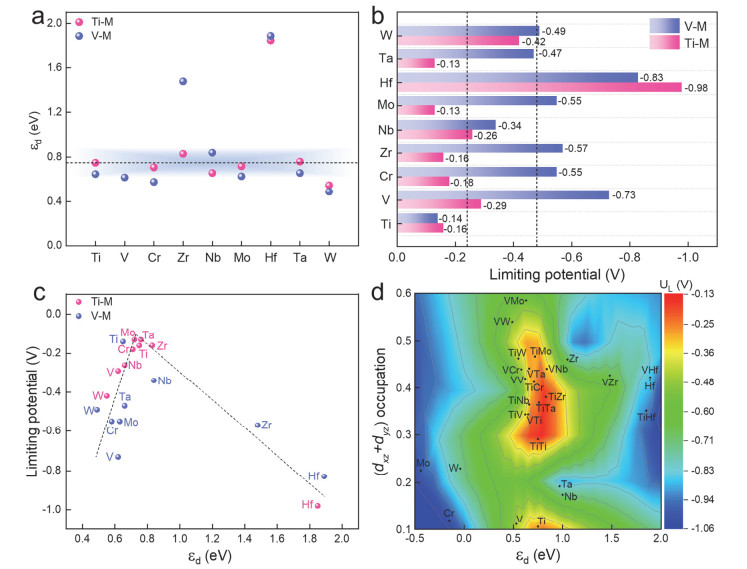
(a) εd of bilayer Ti(M)-Pc and V(M)-Pc systems. (b) The UL of Ti(V)-TM BSACs. (c) NO3RR volcano plot of bilayer Ti(M)-Pc and V(M)-Pc with a descriptor of εd. (d) Contour plot of UL as a function of two descriptors: εd and dxz + dyz occupation."
| 1 |
doi: 10.1002/anie.202204117z |
| 2 |
doi: 10.1038/s41565-022-01121-4 |
| 3 |
doi: 10.26599/NRE.2022.9120010 |
| 4 |
doi: 10.1039/D3QI00554B |
| 5 |
doi: 10.1016/j.mtphys.2022.100619 |
| 6 |
doi: 10.1002/smll.202106961 |
| 7 |
doi: 10.1039/D2SE00830K |
| 8 |
doi: 10.1039/D2QI01791A |
| 9 |
doi: 10.1016/j.xcrp.2022.100961 |
| 10 |
doi: 10.1016/j.apcatb.2023.122473 |
| 11 |
doi: 10.1002/ange.202113135 |
| 12 |
|
|
吴明亮; 章烨晖; 付战照; 吕之阳; 李强; 王金兰. 物理化学学报, 2023, 39, 2207007.
doi: 10.3866/PKU.WHXB202207007 |
|
| 13 |
doi: 10.1016/j.jechem.2021.10.027 |
| 14 |
doi: 10.1016/j.jcat.2019.08.019 |
| 15 |
|
|
罗耀武; 王定胜. 物理化学学报, 2023, 39, 2212020.
doi: 10.3866/PKU.WHXB202212020 |
|
| 16 |
doi: 10.1021/acscatal.2c05992 |
| 17 |
doi: 10.1038/s41467-022-28456-9 |
| 18 |
doi: 10.1021/acs.jpclett.2c01381 |
| 19 |
doi: 10.1002/ange.202215441 |
| 20 |
doi: 10.1038/s41560-021-00925-3 |
| 21 |
doi: 10.1021/jacs.2c13886 |
| 22 |
doi: 10.1039/D0NR05202G |
| 23 |
doi: 10.1039/D1EE03311E |
| 24 |
doi: 10.1002/adfm.202201262 |
| 25 |
doi: 10.1002/adfm.202214062 |
| 26 |
doi: 10.1021/acs.jpcc.2c08319 |
| 27 |
doi: 10.1016/0927-0256(96)00008-0 |
| 28 |
doi: 10.1103/PhysRevB.47.558 |
| 29 |
doi: 10.1103/PhysRevB.59.7413 |
| 30 |
doi: 10.1103/PhysRevB.48.4978.2 |
| 31 |
doi: 10.1103/PhysRevB.50.17953 |
| 32 |
doi: 10.1002/jcc.20495 |
| 33 |
doi: 10.1103/PhysRevB.13.5188 |
| 34 |
doi: 10.1088/0953-8984/21/8/084204 |
| 35 |
doi: 10.1063/1.447334 |
| 36 |
doi: 10.1002/jcc.26353 |
| 37 |
doi: 10.1016/j.cpc.2021.108033 |
| 38 |
doi: 10.1039/D0TA04919K |
| 39 |
doi: 10.1021/jp047349j |
| 40 |
doi: 10.1002/adfm.202008533 |
| 41 |
doi: 10.1016/S0360-0564(02)45013-4 |
| 42 |
doi: 10.1038/s41467-019-11542-w |
| 43 |
doi: 10.1021/acsenergylett.8b00519 |
| 44 |
doi: 10.1002/smtd.201800471 |
| 45 |
doi: 10.1002/cey2.74 |
| 46 |
doi: 10.1021/acs.jpclett.1c03005 |
| 47 |
doi: 10.1016/j.apsusc.2022.153213 |
| 48 |
doi: 10.1021/jacs.9b13347 |
| 49 |
doi: 10.1021/acscatal.1c03666 |
| 50 |
doi: 10.1039/D2TA00470D |
| 51 |
doi: 10.1039/D0TA00794C |
| 52 |
doi: 10.1016/j.apsusc.2022.153829 |
| 53 |
doi: 10.1021/acscatal.9b02179 |
| [1] | Lubing Qin, Fang Sun, Meiyin Li, Hao Fan, Likai Wang, Qing Tang, Chundong Wang, Zhenghua Tang. Atomically Precise (AgPd)27 Nanoclusters for Nitrate Electroreduction to NH3: Modulating the Metal Core by a Ligand Induced Strategy [J]. Acta Phys. -Chim. Sin., 2025, 41(1): 100008-. |
| [2] | Mingliang Wu, Yehui Zhang, Zhanzhao Fu, Zhiyang Lyu, Qiang Li, Jinlan Wang. Structure-Activity Relationship of Atomic-Scale Cobalt-Based N-C Catalysts in the Oxygen Evolution Reaction [J]. Acta Phys. -Chim. Sin., 2023, 39(1): 2207007-0. |
| [3] | Yuxin Chen, Lijun Wang, Zhibo Yao, Leiduan Hao, Xinyi Tan, Justus Masa, Alex W. Robertson, Zhenyu Sun. Tuning the Coordination Structure of Single Atoms and Their Interaction with the Support for Carbon Dioxide Electroreduction [J]. Acta Phys. -Chim. Sin., 2022, 38(11): 2207024-0. |
| [4] | Yawen Li, Guangren Na, Shulin Luo, Xin He, Lijun Zhang. Structural, Thermodynamical and Electronic Properties of All-Inorganic Lead Halide Perovskites [J]. Acta Phys. -Chim. Sin., 2021, 37(4): 2007015-. |
| [5] | Lei FANG,Mingjun SUN,Xinrui CAO,Zexing CAO. Mechanical and Optical Properties of a Novel Diamond-Like Si(C≡C-C6H4-C≡C)4 Single-Crystalline Semiconductor: a First-Principles Study [J]. Acta Phys. -Chim. Sin., 2018, 34(3): 296-302. |
| [6] | Zhi-Gang. WANG,Xiang-Ming. ZENG,Yang. ZHANG,Rao. HUANG,Yu-Hua. WEN. First-Principles Study of Effect of Strain on the Band Structure of ZnO Monolayer [J]. Acta Phys. -Chim. Sin., 2015, 31(9): 1677-1682. |
| [7] | AN Wei, LIU Tian-Hui, WANG Chun-Hai, DIAO Chuan-Ling, LUO Neng-Neng, LIU Yong, QI Ze-Ming, SHAO Tao, WANG Yu-Yin, JIAO Huan, TIAN Guang-Shan, JING Xi-Ping. Assignment for Vibrational Spectra of BaTiO3 Ferroelectric Ceramic Based on the First-Principles Calculation [J]. Acta Phys. -Chim. Sin., 2015, 31(6): 1059-1068. |
| [8] | CUI Jian-Gong, ZHANG Xia, YAN Xin, LI Jun-Shuai, HUANG Yong-Qing, REN Xiao-Min. Electronic Structure Modulation of GaAs Nanowires by Surface Modification [J]. Acta Phys. -Chim. Sin., 2014, 30(10): 1841-1846. |
| [9] | GUO Lei, HU Ge, FENG Wen-Jiang, ZHANG Sheng-Tao. Structural, Elastic, Electronic and Optical Properties of Zinc-Blende MTe (M=Zn/Mg) [J]. Acta Phys. -Chim. Sin., 2013, 29(05): 929-936. |
| [10] | TIAN Xiang-Gui, ZHANG Yue, YANG Tai-Sheng. First-Principles Study of H2 Dissociative Adsorption Reactions on WO3 Surfaces [J]. Acta Phys. -Chim. Sin., 2012, 28(05): 1063-1069. |
| [11] | YUN Jiang-Ni, ZHANG Zhi-Yong. Effect of In and Sc Doping on the Electronic Structure and Optical Properties of SrTiO3 [J]. Acta Phys. -Chim. Sin., 2010, 26(03): 751-757. |
| [12] | CHEN Qi-Li, TANG Chao-Qun. First-Principles Calculations on Electronic Structures of N/F-Doped and N-F-Codoped TiO2 Anatase (101) Surfaces [J]. Acta Phys. -Chim. Sin., 2009, 25(05): 915-920. |
|
||