Acta Phys. -Chim. Sin. ›› 2024, Vol. 40 ›› Issue (6): 2307007.doi: 10.3866/PKU.WHXB202307007
Special Issue: Carbon Dioxide Valorization
• ARTICLE • Previous Articles Next Articles
Hierarchical Palladium-Copper-Silver Porous Nanoflowers as Efficient Electrocatalysts for CO2 Reduction to C2+ Products
Haoyu Sun1, Dun Li2, Yuanyuan Min1, Yingying Wang3,*( ), Yanyun Ma4, Yiqun Zheng1,*(), Hongwen Huang2,*()
- 1 School of Chemistry, Chemical Engineering, and Materials, Jining University, Qufu 273155, Shandong Province, China
2 College of Materials Science and Engineering, Hunan University, Changsha 410082, China
3 Health Management Department, Shandong Vocational College of Light Industry, Zibo 255300, Shandong Province, China
4 Institute of Functional Nano & Soft Materials (FUNSOM), Jiangsu Key Laboratory of Advanced Negative Carbon Technologies, Soochow University, Suzhou 215123, Jiangsu Province, China
-
Received:2023-07-03Revised:2023-08-14Accepted:2023-08-19Published:2023-11-29 -
Contact:Email: huanghw@hnu.edu.cn (Hongwen Huang)yzheng@jnxy.edu.cn (Yiqun Zheng)hxwyy2005@mail.sdu.edu.cn (Yingying Wang) -
Supported by:the Natural Science Foundation of China(21701100); Shandong Provincial Natural Science Foundation, China(2020MB048); Shandong Provincial Natural Science Foundation, China(ZR2022MB120); Young Innovative Talents Introduction & Cultivation Program for Colleges and Universities of Shandong Province, China(储能与环境材料团队); the University Feature Laboratory for Energy Conversion and Nanocatalysis of Shandong Province; Doctoral Startup Research Funding, China(2020BSZX01); Hundred Outstanding Talent Program of Jining University, China(2020ZYRC05); Suzhou Key Laboratory of Functional Nano & Soft Materials; Collaborative Innovation Center of Suzhou Nano Science & Technology; the 111 Project; Joint International Research Laboratory of Carbon-Based Functional Materials and Devices, China

Cite this article
Haoyu Sun, Dun Li, Yuanyuan Min, Yingying Wang, Yanyun Ma, Yiqun Zheng, Hongwen Huang. Hierarchical Palladium-Copper-Silver Porous Nanoflowers as Efficient Electrocatalysts for CO2 Reduction to C2+ Products[J]. Acta Phys. -Chim. Sin. 2024, 40(6), 2307007. doi: 10.3866/PKU.WHXB202307007
share this article
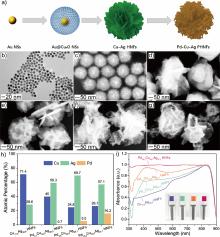
Fig 1
a) Schematic illustration showing the formation process of Pd-Cu-Ag porous hierarchical nanoflowers (PHNFs). b) TEM image of Au nanospheres (NSs). c–g) SEM images of c) Au@CuxO NSs, d) Cu-Ag hierarchical nanoflowers (HNFs), and e–g) as-derived Pd-Cu-Ag PHNFs. h) Elemental compositional histogram and i) UV-Vis extinction spectra of as-obtained CuAg HNFs and Pd-Cu-Ag PHNFs. The inset in i) shows the corresponding aqueous suspensions stored in cuvettes."
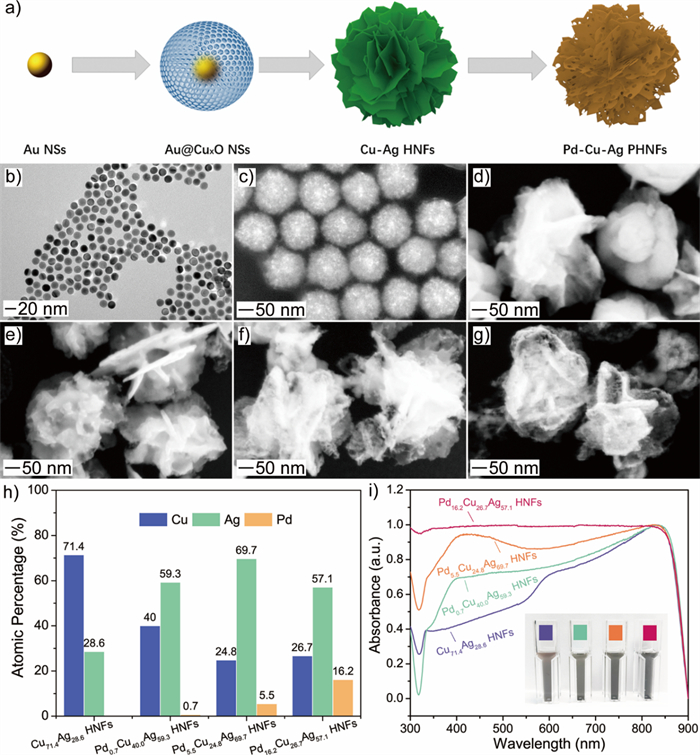
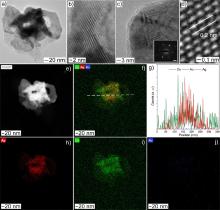
Fig 2
Morphology and structural characterizations of Cu71.4Ag28.6 HNFs: a) TEM; b–d) HRTEM; e) HAADF-STEM; f, h–j) EDX-STEM elemental mapping: f) Cu + Ag + Au, h) Ag, i) Cu, j) Au; g) line-scan profile. The dash line in f) dictated the measured region. The scale bar in the inset of c) is 2 nm−1."
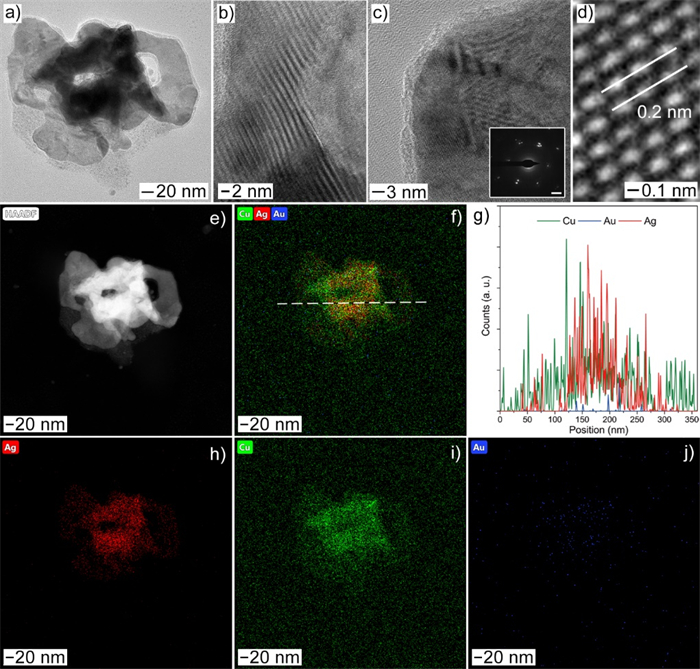
Fig 3
Morphology and structural characterizations of Pd5.5Cu24.8Ag69.7 PHNFs: a) TEM; b, c) HRTEM. Inset: FFT; d) HAADF-STEM; e–h) EDX-STEM elemental mapping: e) Cu + Ag + Pd, f) Pd, g) Ag, h) Cu."
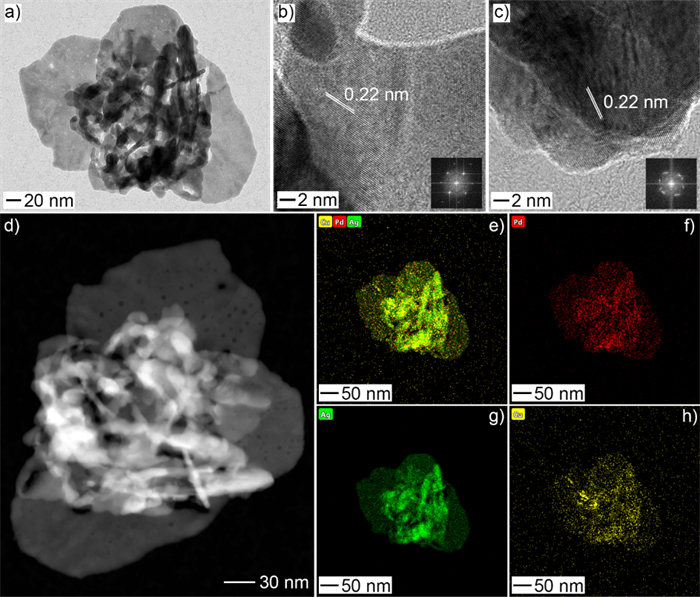
Fig 4
Fes (Faradaic efficiencys) of products for CO2RR in the potential range of −0.5 – −1.1 V vs. RHE over CuAg-based catalysts. Catalysts: a) Cu71.4Ag28.6 HNFs; b) Pd0.7Cu40.0Ag59.3 PHNFs; c) Pd5.5Cu24.8Ag69.7 PHNFs; d) Pd16.2Cu26.7Ag57.1 PHNFs."
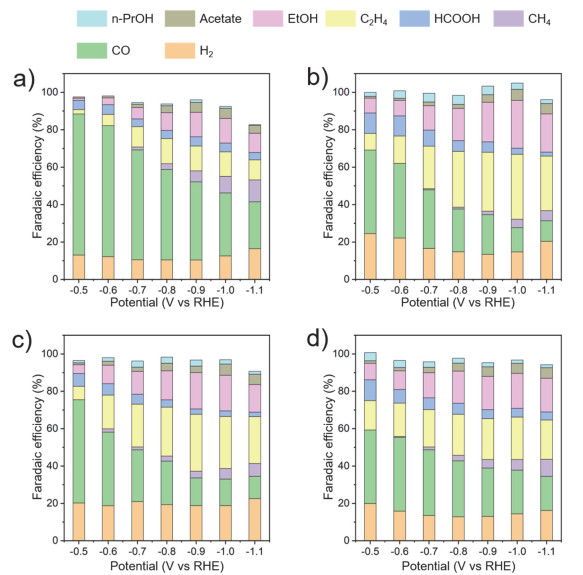
Fig 5
a) Comparison of optimal C2+ FE value obtained by using different catalysts. Catalysts: (A) Cu71.4Ag28.6 HNFs; (B) Pd0.7Cu40.0Ag59.3 PHNFs; (C) Pd5.5Cu24.8Ag69.7 PHNFs; (D) Pd16.2Cu26.7Ag57.1 PHNFs. b) Comparison of FEC2+ and current densities with recent reports. (See details in Table S3)."
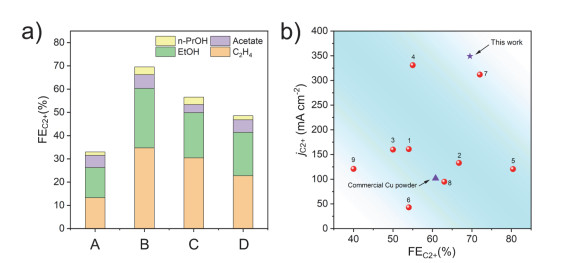
Fig 6
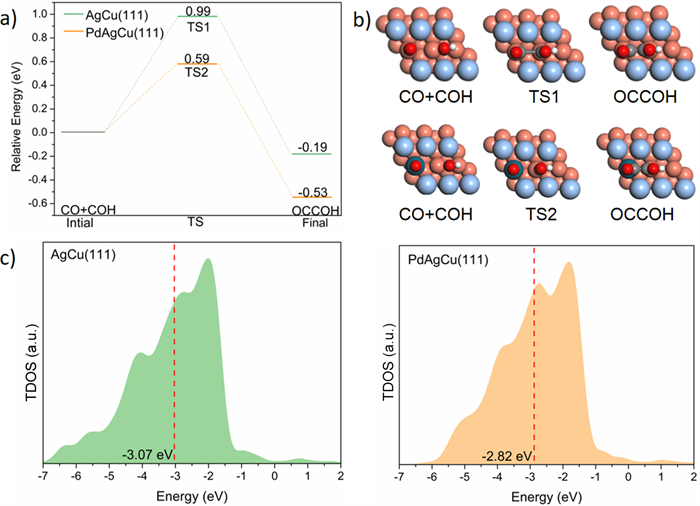
a) The energy profiles of C-C coupling step on AgCu(111) and PdAgCu(111); b) the corresponding structures of intermediates and transition states (TSs), gray for C, red for O, blue for Pd, light blue for Ag and light red for Cu; c) Computed total density of states (TDOS) of AgCu(111) and PdAgCu(111). The d-band center is marked by a red dash line. The Fermi level is set to 0 eV. Color online."
| 1 |
doi: 10.1021/jacs.3c04612 |
| 2 |
doi: 10.1021/jacs.3c05023 |
| 3 |
doi: 10.1002/anie.202307612 |
| 4 |
doi: 10.1002/anie.202308782 |
| 5 |
doi: 10.1021/jacs.3c04769 |
| 6 |
doi: 10.1002/adfm.202101255 |
| 7 |
doi: 10.1002/small.202201695 |
| 8 |
doi: 10.1002/adfm.202101668 |
| 9 |
doi: 10.1002/anie.202217369 |
| 10 |
doi: 10.31635/ccschem.021.202100958 |
| 11 |
doi: 10.1002/anie.202000318 |
| 12 |
doi: 10.1021/acscatal.0c04403 |
| 13 |
doi: 10.1016/S0360-0564(02)45013-4 |
| 14 |
doi: 10.1021/acs.jpcc.8b08170 |
| 15 |
doi: 10.1021/acs.jpclett.0c00082 |
| 16 |
doi: 10.1002/anie.202012631 |
| 17 |
doi: 10.1007/s12274-021-3639-x |
| 18 |
doi: 10.1021/acscatal.9b05319 |
| 19 |
doi: 10.1021/acs.chemrev.3c00033 |
| 20 |
doi: 10.1021/acsenergylett.2c00035 |
| 21 |
doi: 10.1039/d2cc04332g |
| 22 |
doi: 10.1039/c8cs00846a |
| 23 |
doi: 10.1039/d3cc00590a |
| 24 |
doi: 10.3389/fchem.2021.671220 |
| 25 |
doi: 10.1088/0953-8984/14/11/301 |
| 26 |
doi: 10.1103/PhysRevLett.77.3865 |
| 27 |
doi: 10.1038/s41560-020-0607-8 |
| 28 |
doi: 10.1038/s41586-019-1782-2 |
| 29 |
doi: 10.1038/s41929-019-0397-1 |
| 30 |
doi: 10.1016/s0927-0256(03)00111-3 |
| 31 |
doi: 10.1039/D1CE01505B |
| 32 |
doi: 10.1016/j.ceramint.2022.06.310 |
| 33 |
doi: 10.1002/advs.201700194 |
| 34 |
doi: 10.1021/acsomega.1c01062 |
| 35 |
doi: 10.1039/d1cc06735d |
| 36 |
doi: 10.1002/sstr.202200328 |
| 37 |
doi: 10.1016/0039-6028(96)80007-0 |
| [1] | Chengxiao Zhao, Zhaolin Li, Dongfang Wu, Xiaofei Yang. SBA-15 templated covalent triazine frameworks for boosted photocatalytic hydrogen production [J]. Acta Phys. -Chim. Sin., 2026, 42(1): 100149-. |
| [2] | Kangjuan Cheng, Chunxiao Liu, Youpeng Wang, Qiu Jiang, Tingting Zheng, Xu Li, Chuan Xia. Design of noble metal catalysts and reactors for the electrosynthesis of hydrogen peroxide [J]. Acta Phys. -Chim. Sin., 2025, 41(10): 100112-. |
| [3] | Yuting Bai, Cenqi Yan, Zhen Li, Jiaqiang Qin, Pei Cheng. Preparation of High-Strength Polyimide Porous Films with Thermally Closed Pore Property by In Situ Pore Formation Method [J]. Acta Phys. -Chim. Sin., 2024, 40(9): 2306010-. |
| [4] | Qing Li, Guangxun Zhang, Yuxia Xu, Yangyang Sun, Huan Pang. P-Regulated Hierarchical Structure Ni2P Assemblies toward Efficient Electrochemical Urea Oxidation [J]. Acta Phys. -Chim. Sin., 2024, 40(9): 2308045-. |
| [5] | Qiang Zhang, Yuanbiao Huang, Rong Cao. Imidazolium-Based Materials for CO2 Electroreduction [J]. Acta Phys. -Chim. Sin., 2024, 40(4): 2306040-. |
| [6] | Jia Wang, Qing Qin, Zhe Wang, Xuhao Zhao, Yunfei Chen, Liqiang Hou, Shangguo Liu, Xien Liu. P-Doped Carbon-Supported ZnxPyOz for Efficient Ammonia Electrosynthesis under Ambient Conditions [J]. Acta Phys. -Chim. Sin., 2024, 40(3): 2304044-. |
| [7] | Yangrui Xu, Yewei Ren, Xinlin Liu, Hongping Li, Ziyang Lu. NH2-UIO-66 Based Hydrophobic Porous Liquid with High Mass Transfer and Affinity Surface for Enhancing CO2 Photoreduction [J]. Acta Phys. -Chim. Sin., 2024, 40(11): 2403032-. |
| [8] | Youwen Rong, Jiaqi Sang, Li Che, Dunfeng Gao, Guoxiong Wang. Designing Electrolytes for Aqueous Electrocatalytic CO2 Reduction [J]. Acta Phys. -Chim. Sin., 2023, 39(5): 2212027-0. |
| [9] | Shuyi Zheng, Jia Wu, Ke Wang, Mengchen Hu, Huan Wen, Shibin Yin. Electronic Modulation of Ni-Mo-O Porous Nanorods by Co Doping for Selective Oxidation of 5-Hydroxymethylfurfural Coupled with Hydrogen Evolution [J]. Acta Phys. -Chim. Sin., 2023, 39(12): 2301032-. |
| [10] | Yue Huang, Feifei Mei, Jinfeng Zhang, Kai Dai, Graham Dawson. Construction of 1D/2D W18O49/Porous g-C3N4 S-Scheme Heterojunction with Enhanced Photocatalytic H2 Evolution [J]. Acta Phys. -Chim. Sin., 2022, 38(7): 2108028-. |
| [11] | Rongchen Shen, Lei Hao, Qing Chen, Qiaoqing Zheng, Peng Zhang, Xin Li. P-Doped g-C3N4 Nanosheets with Highly Dispersed Co0.2Ni1.6Fe0.2P Cocatalyst for Efficient Photocatalytic Hydrogen Evolution [J]. Acta Phys. -Chim. Sin., 2022, 38(7): 2110014-. |
| [12] | Wei Zhang, Haichen Liang, Kerun Zhu, Yong Tian, Yao Liu, Jiayin Chen, Wei Li. Three-Dimensional Macro-/Mesoporous C-TiC Nanocomposites for Dendrite-Free Lithium Metal Anode [J]. Acta Phys. -Chim. Sin., 2022, 38(6): 2105024-. |
| [13] | Yue Yang, Jiawei Zhu, Pengyan Wang, Haimi Liu, Weihao Zeng, Lei Chen, Zhixiang Chen, Shichun Mu. NH2-MIL-125 (Ti) Derived Flower-Like Fine TiO2 Nanoparticles Implanted in N-doped Porous Carbon as an Anode with High Activity and Long Cycle Life for Lithium-Ion Batteries [J]. Acta Phys. -Chim. Sin., 2022, 38(6): 2106002-. |
| [14] | Lei Wang, Tantan Sun, Nana Yan, Xiaona Liu, Chao Ma, Shutao Xu, Peng Guo, Peng Tian, Zhongmin Liu. Acid Properties of SAPO-34 Molecular Sieves with Different Si Contents Templated by Various Organic Structure-Directing Agents [J]. Acta Phys. -Chim. Sin., 2022, 38(4): 2003046-. |
| [15] | Feiyu Lin, Ying Yang, Congtan Zhu, Tian Chen, Shupeng Ma, Yuan Luo, Liu Zhu, Xueyi Guo. Fabrication of Stable CsPbI2Br Perovskite Solar Cells in the Humid Air [J]. Acta Phys. -Chim. Sin., 2022, 38(4): 2005007-. |
|
||