Acta Phys. -Chim. Sin. ›› 2025, Vol. 41 ›› Issue (3): 100019.doi: 10.3866/PKU.WHXB202308052
Special Issue: Energy Chemistry
• REVIEW • Previous Articles Next Articles
Defective Ultrathin Two-Dimensional Materials for Photo-/Electrocatalytic CO2 Reduction: Fundamentals and Perspectives
Runhua Chen1, Qiong Wu1, Jingchen Luo1, Xiaolong Zu2,*( ), Shan Zhu3, Yongfu Sun1,*()
- 1 Hefei National Research Center for Physical Sciences at Microscale, University of Science and Technology of China, Hefei 230026, China
2 Innovation Laboratory for Sciences and Technologies of Energy Materials of Fujian Province (IKKEM), Xiamen 361005, Fujian Province, China
3 State Grid Anhui Electric Power Research Institute, Hefei 230601, China
-
Received:2023-08-31Revised:2023-10-04Accepted:2023-10-17Published:2023-12-20 -
Contact:Email: xiaolongzu@xmu.edu.cn (Xiaolong Zu)yfsun@ustc.edu.cn (Yongfu Sun) -
Supported by:the National Key Research and Development Program of China(2019YFA0210004); the National Key Research and Development Program of China(2022YFA1502904); the National Key Research and Development Program of China(2021YFA1501502); the National Natural Science Foundation of China(22125503); the National Natural Science Foundation of China(21975242); the National Natural Science Foundation of China(U2032212); the Youth Innovation Promotion Association of CAS(CX2340007003); the Anhui Provincial Natural Science Foundation(2208085QB31)

Cite this article
Runhua Chen, Qiong Wu, Jingchen Luo, Xiaolong Zu, Shan Zhu, Yongfu Sun. Defective Ultrathin Two-Dimensional Materials for Photo-/Electrocatalytic CO2 Reduction: Fundamentals and Perspectives[J]. Acta Phys. -Chim. Sin. 2025, 41(3), 100019. doi: 10.3866/PKU.WHXB202308052
share this article
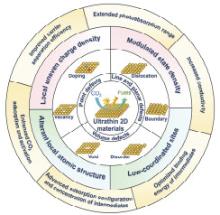
Fig 1
Illustration showing the advantages of defective ultrathin two-dimensional materials for CO2 reduction."
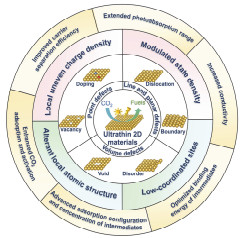
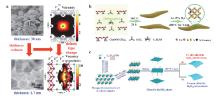
Fig 2
(a) Scheme of the formation of single vacancies and triple vacancy clusters within the BiOCl nanosheets.(b) Schematic representations of the formation of the Vs-CuIn5S8 single-unit-cell layers. (c) Representation of the formation of the O-defective ultrathin In2O3 porous sheets. (a) Adapted from ACS Publications publisher 24. (b) Adapted from Nature Publications publisher 36. (c) Adapted from ACS Publications publisher 37."
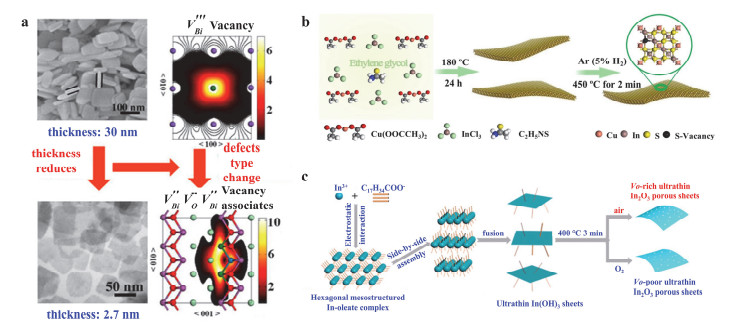
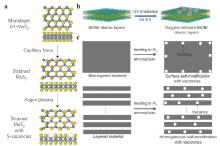
Fig 3
(a) Schematic of the formation of strained MoS2 with S-vacancies. (b) Schematic representations of the formation of oxygen-deficient BiOBr atomic layers. (c) Schematic of surface vacancies in a non-layered material and homogeneous vacancies in a layered material after heating in a H2 atmosphere."
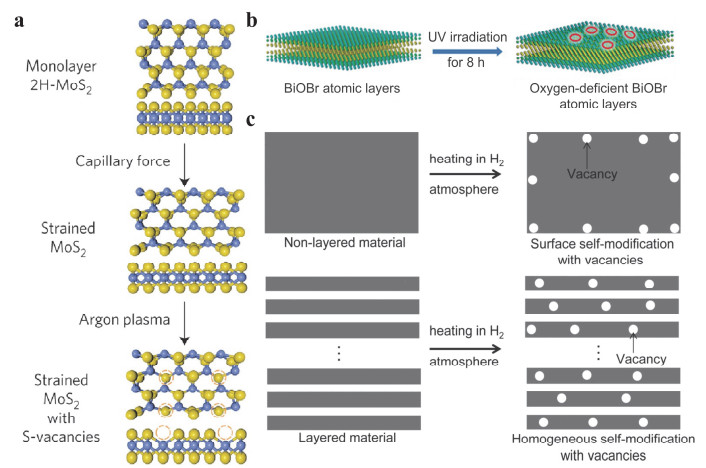
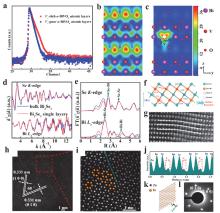
Fig 4
(a) Positron lifetime spectra for the Vv-rich and Vv-poor o-BiVO4 atomic layers. Schematic representation of trapped positrons for (b) the pristine o-BiVO4 slab and (c) the V-defective o-BiVO4 slab. (d) Bi L3-edge and Se K-edge extended XAFS oscillation functions k2χ(k) and (e) the corresponding Fourier transforms for the bulk material (blue) and the Bi2Se3 single layer (red). (f) 2D structural model of a five-atom-thick Bi2Se3 single layer. (g) HAADF-STEM image of the richly lattice-distorted Bi nanosheets. (h–i) HAADF-STEM images, (j) intensity profile corresponding to the dark cyan arrow in (i), (k) the crystal structures, and (l) SAED patterns for VZn-rich one-unit-cell ZnIn2S4 layers. (a–c) Adapted from ACS Publications publisher 43. (d–f) Adapted from Nature Publications publisher 44.(g) Adapted from Springer Link Publications publisher 45. (h–l) Adapted from ACS Publications publisher 26."
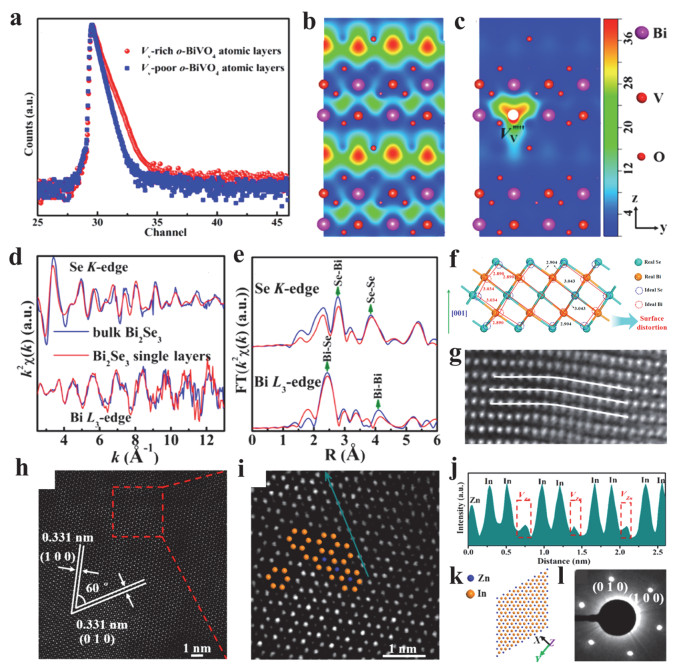
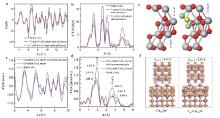
Fig 5
(a) Co K-edge extended XAFS oscillation function k2χ(k) and (b) the corresponding Fourier transforms FT(k2χ(k)) of bulk Co3O4, VO-rich and VO-poor Co3O4 single-unit-cell layers. (c) Ce L3-edge extended XAFS oscillation function k2χ(k) and (d) the corresponding Fourier transforms FT (k2χ(k)) for the ultrathin CeO2 sheets with numerous surface pits, ultrathin CeO2 sheets and bulk CeO2, respectively. (e) The configuration for the VO-TiO2 slab (left) and the configuration for the VO-TiO2 slab with CO2 adsorption (right). C and O atoms of the adsorbed CO2 are shown in yellow and green, respectively. Ti and O atoms of TiO2 are shown in grey and red, respectively.(f) Model diagram of Cu2−xSe and VSe-Cu2−x Se after structural relaxation. (a, b) Adapted from Nature Publications publisher 50. (c, d) Adapted from Nature Publications publisher 39.(e) Adapted from Springer Link Publications publisher 51. (f) Adapted from Wiley Publications publisher 52."
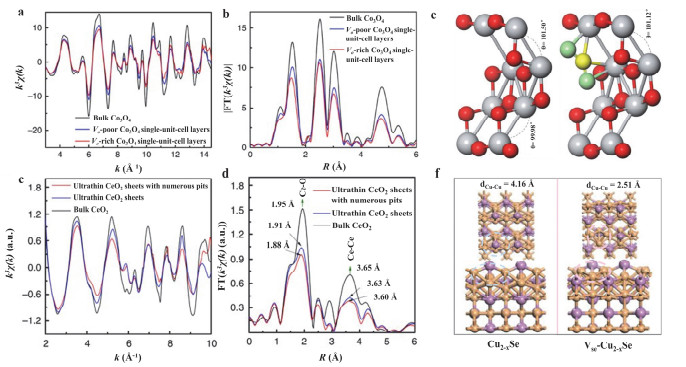
Fig 6
Calculated density of states of (a) o-BiVO4 single-unit-cell layer slab with V vacancy and (b) pristine o-BiVO4 single-unit-cell layer slab along the [001] orientation. Calculated density of states for the (c) VO-Bi2O2CO3 single-unit-cell slab and the (d) perfect Bi2O2CO3 single-unit-cell slab. The top of valence band is taken as the energy zero. Calculated density of states of (e) Ni-doped ZnCo2O4 atomic-layer slab and (f) ZnCo2O4 atomic-layer slab. (a, b) Adapted from ACS Publications publisher 43. (c, d) Adapted from Wiley Publications publisher 55.(e, f) Adapted from Springer Link Publications publisher 56."
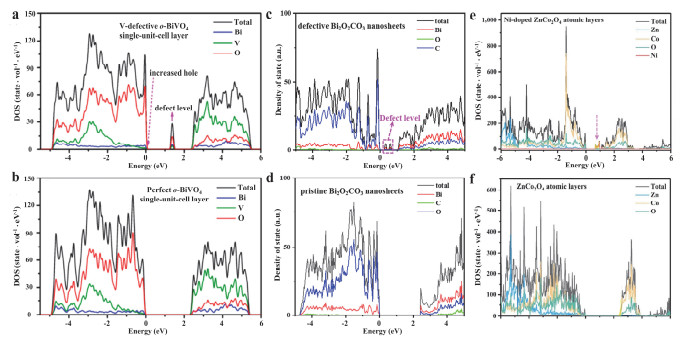
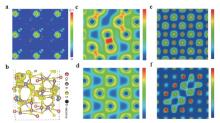
Fig 7
(a) Charge density distribution of the valence band edge along the [001]direction near the S vacancy, plotted from 0 (blue) to 100 e∙nm−3 (red), and (b) crystal structure with charge density contour plots of the VS-CuIn5S8 single-unit-cell layers, where the yellow area represents charge enrichment. The distribution of the charge density of (c) richly latticedistorted Bi nanosheets and (d) poorly lattice-distorted Bi nanosheets. Charge density distribution of the (e) BiOBr atomic layers, and (f) oxygen-deficient BiOBr atomic layers. (a, b) Adapted from Nature Publications publisher 36. (c, d) Adapted from Springer Link Publications publisher 45.(e, f) Adapted from Wiley Publications publisher 31."
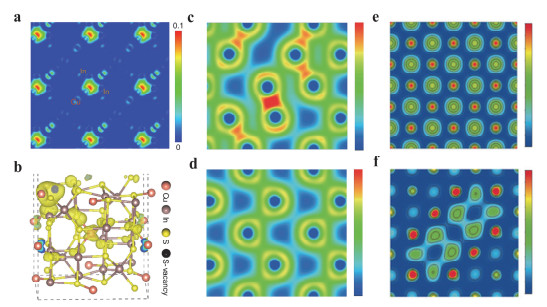
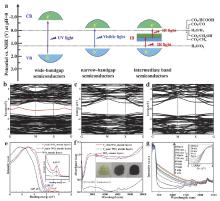
Fig 8
(a) Schematic energy band diagram for CO2 photoreduction into hydrocarbons and O2. Calculated density of states for the WO3 atomic layer slab with (b) three surface oxygen vacancies, (c) two surface oxygen vacancies, and (d) without surface oxygen vacancies. (e) SRPES valence-band spectra and the corresponding enlarged spectra between −1.0 and 2.0 eV and (f) optical absorption spectra for the VO-rich WO3 atomic layers, VO-poor WO3 atomic layers, and WO3 atomic layers. (g) Optical absorption spectra for BiOBr atomic layers after UV irradiation for different time. (a–f) Adapted from Cell Press Publications publisher 62. (g) Adapted from Wiley Publications publisher 31."
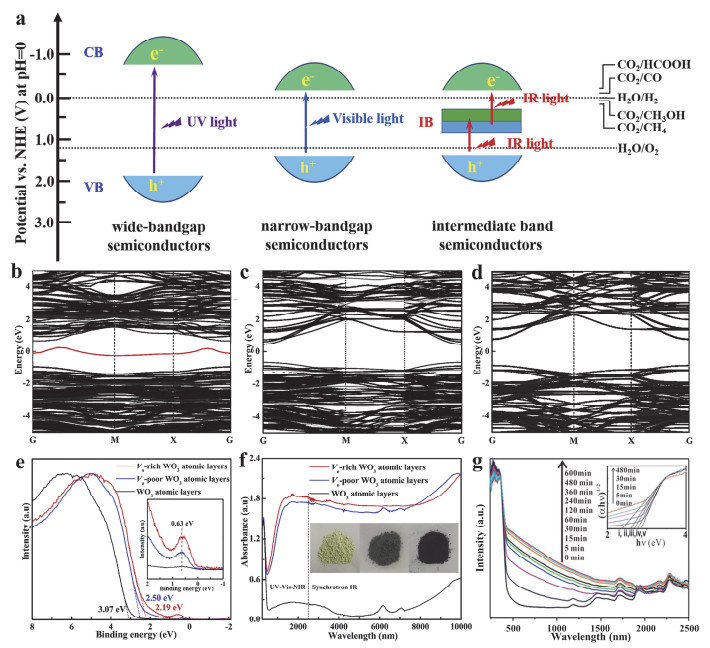
Fig 9
(a) Scheme showing the photo-generated carriers migration paths in the defective K4Nb6O17 bulk and nanosheets. Ultrafast TA spectroscopy of (b) VZn-rich one-unit-cell ZnIn2S4 layers and (c) VZn-poor one-unit-cell ZnIn2S4 layers. (d) Room-temperature PL spectra of the one-unit-cell ZnIn2S4 layers. (e) Surface photovoltage spectra and (inset) corresponding phase spectra and (f) time-resolved fluorescence emission decay spectra for Vv-rich and Vv-poor o-BiVO4 atomic layers. (a) Adapted from Nature Publications publisher 65. (b–d) Adapted from ACS Publications publisher 26. (e–f) Adapted from ACS Publications publisher 43."
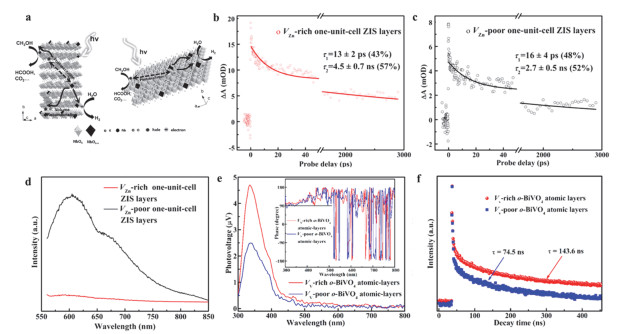
Fig 10
CO2 adsorption isotherms for (a) one-unit-cell ZnIn2S4 layers and (b) CuIn5S8 single-unit-cell layers.(c) The isosurface of the difference between charge densities and the CO2 adsorption energy for the VO-TiO2 slab. Light green and yellow contours represent the electron accumulation and deletion, respectively. Ti and O atoms of TiO2 are shown in grey and red, respectively. (d) Calculated free energy diagrams of CO2 photoreduction over the TiO2 ultrathin layers. (e) The distribution of the charge density of VO-Bi2O2CO3 single-unit-cell slab (up) and the perfect Bi2O2CO3 single-unit-cell slab (down) along the (010) direction, plotted from 0 (blue) to 100 e∙nm−3 (red).(f) Calculated free energy diagrams and scheme of CO2 photoreduction to CO on the Bi2O2CO3 single-unit-cell slab. Calculated free energy diagrams of key steps for CO2 photoreduction to CH4 over (g) the VS-CuIn5S8 single-unit-cell layers and (h) the pristine CuIn5S8 single-unit-cell layers. (i) Products over the VS-CuIn5S8 single-unit-cell layers and the pristine CuIn5S8 single-unit-cell layers. (a) Adapted from ACS Publications publisher 26. (b, g–i) Adapted from Nature Publications publisher 36.(c, d) Adapted from Springer Link Publications publisher 51. (e, f) Adapted from Wiley Publications publisher 55."
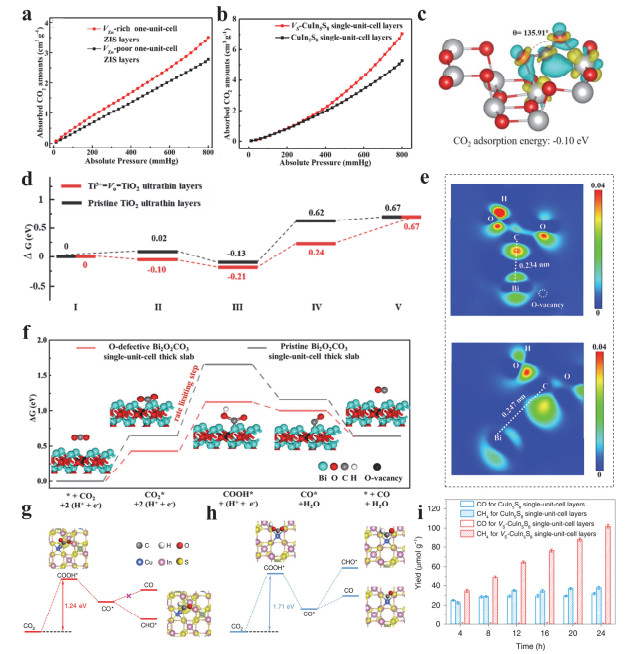
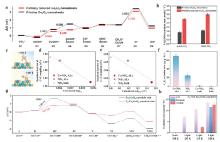
Fig 11
(a) Calculated free energy diagrams of the CO2 reduction to CH3COOH over the partially reduced Co3O4 nanosheets and the perfect Co3O4 nanosheets. (b) CH3COOH formation rates at different CO2 concentrations for the partially reduced Co3O4 nanosheets and the perfect Co3O4 nanosheets. (c) Optimized geometries of the HOOC–COOH* intermediate on the partially reduced Co3O4 nanosheets (up) and pristine Co3O4 nanosheets (down), where the C― C bond distance of the HOOC–COOH* intermediate is in 0.1 nm. (d) The reaction barrier of C― C coupling as a function of the difference in the charge of the two carbon atoms in adsorbed CO intermediates (ΔQCO) and (e) the reaction barrier of C― C coupling as a function of the difference in adsorption energy for the adjacent CO intermediates (ΔECO, eV) for the NiS2 bulk, Co-doped NiS2 atomic layers and NiS2 atomic layers. (f) Products evolution rates of the Co-doped NiS2 atomic layers and the NiS2 atomic layers. (g) Calculated free energy diagrams of CO2 photoreduction to acetate over the VO-Zn2GeO4 nanobelt slab and the Zn2GeO4 nanobelt slab. (h) Products evolution rates over the VO-rich Zn2GeO4 nanobelts in simulated air under different testing conditions. (a–c) Adapted from ACS Publications publisher 58. (d–f) Adapted from Springer Link Publications publisher 68.(g–h) Adapted from ACS Publications publisher 59."
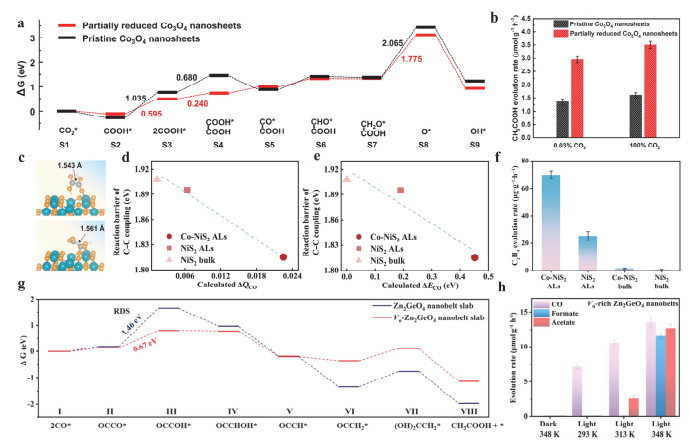
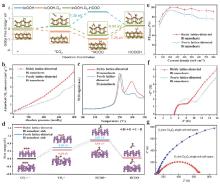
Fig 12
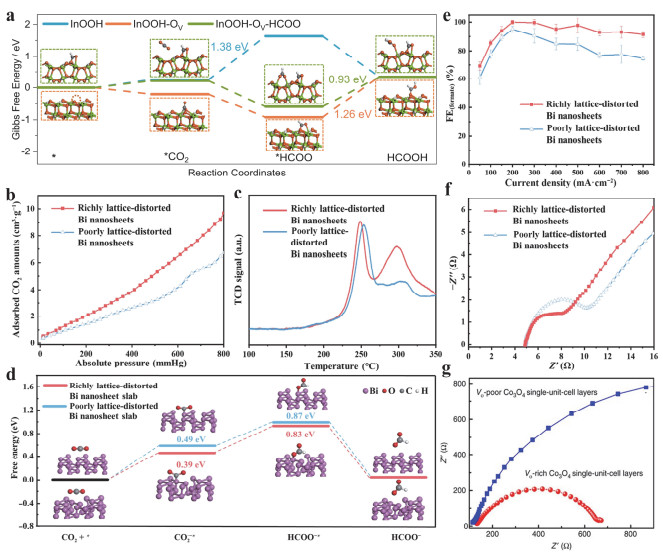
(a) Gibbs free energy diagrams for the CO2 electrochemical reduction on InOOH, InOOH-OV, and InOOH-OV-HCOO with the intermediate adsorption configurations for InOOH-OV and InOOH-OV-HCOO.(b) CO2 adsorption isotherms and (c) CO2 TPD spectra over richly lattice-distorted Bi nanosheets and poorly latticedistorted Bi nanosheets. (d) Gibbs free energy diagrams for the CO2 electrochemical reduction to formate on the richly lattice-distorted Bi nanosheets slab and poorly lattice-distorted Bi nanosheets slab. (e) Faradaic efficiencies of formate with different applied current densities and (f) electrochemical impedance spectra over richly lattice-distorted Bi nanosheets and poorly lattice-distorted Bi nanosheets. (g) Electrochemical impedance spectra over VO-rich Co3O4 single-unit-cell layers and the VO-poor Co3O4 single-unit-cell layers. (a) Adapted from Nature Publications publisher 69. (b–f) Adapted from Springer Link Publications publisher 45.(g) Adapted from Nature Publications publisher 50."
"
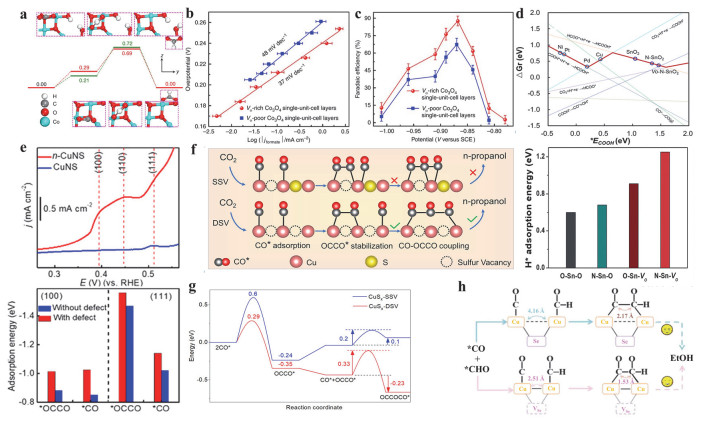

Table 1
Summary of the investigated defective 2D materials for photo-/electrocatalytic CO2 reduction."
| 2D materials | Vacancy types | syntdetic metdod | Characterization metdods | Product | Formation rate/ (μmol·g-1·h-1) or FEP% | Ref. |
| ZnIn2S4 atomic layers | Zn vacancies | hydrotdermal | HAADF-STEM, EPR, PAS | CO | 33.2 | |
| BiOBr atomic layers | Oxygen vacancies | UV irradiation | XPS, EPR, XANES | CO | 87.4 | |
| CuIn2S4 single-unit-cell layers | S vacancies | fast-calciination treatment | XPS, EPR | CH4 | 8.7 | |
| BiVO4 layers | V vacancies | hydrotdermal | PAS | CH3OH | 398.3 | |
| TiO2 ultratdin layers | Oxygen vacancies | annealing treatment | XPS, PAS | CO | 23.1 | |
| Bi2O2CO3 nanosheets | Oxygen vacancies | UV irradiation | XPS, EPR | CO | 275 | |
| ZnCo2O4 atomic layers | Ni-doping | adding reactants | XPS, ICP-AES | CO | 31.4 | |
| WO3 nanosheets | Ti-doping | adding reactants | XPS, XANES | CH3OH | 16.8 | |
| Co3O4 nanosheets | Oxygen vacancies | fast-calciination treatment | XPS, EPR, XANES | CH3COOH | 2.95 | |
| Zn2GeO4 nanobelts | Oxygen vacancies | vacuum aluminotdermic reduction | XPS, EPR | CH3COOH | 12.7 | |
| WO3 layers | Oxygen vacancies | annealing treatment | XPS, EPR | CO | 2.7 | |
| Bi2WO6 atomic layers | Oxygen vacancies | annealing treatment | HRTEM, XPS, Raman, EPR | CH3OH | 157 | |
| NiS2 atomic layers | Co doping | adding reactants | XPS, ICP-AES | C2H4 | 2.5 | |
| Bi nanosheets | lattice-distorted | hydrotdermal | HAADF-STEM, Raman | HCOOH | 100% | |
| Co3O4 atomic layer | Oxygen vacancies | fast-calciination treatment | XAFS, XPS | HCOOH | 85% | |
| Cu2-δSe nanosheets | Se vacancies | hydrotdermal | XPS, EPR, XANES | EtOH | 68.1% | |
| SnO2 nanosheet | oxygen vacancies and N-doping | hydrotdermal | XPS, EPR | HCOOH | 83% | |
| Cu nanosheets | pits | electroreduction | HAADF-STEM | C2H4 | 83.2% |
| 1 |
doi: 10.1021/cr4002758 |
| 2 |
doi: 10.1038/nature16455 |
| 3 |
doi: 10.1039/D2IM00055E |
| 4 |
doi: 10.1016/j.jmst.2021.12.018 |
| 5 |
doi: 10.1007/s11426-022-1595-9 |
| 6 |
|
|
常诚; 陈伟; 陈也; 陈永华; 陈雨; 丁峰; 樊春海; 范红金; 范战西; 龚成; 等. 物理化学学报, 2021, 37, 2108017.
doi: 10.3866/PKU.WHXB202108017 |
|
| 7 |
doi: 10.1016/j.nanoen.2018.08.058 |
| 8 |
doi: 10.1039/C4CS00236A |
| 9 |
doi: 10.1002/adma.202005798 |
| 11 |
doi: 10.1039/C8QI00122G |
|
doi: 10.1007/s12274-022-5112-x |
|
| 12 |
doi: 10.1016/j.carbon.2014.08.059 |
| 13 |
doi: 10.1016/j.carbon.2018.01.008 |
| 14 |
doi: 10.1007/s11426-021-1184-6 |
| 15 |
doi: 10.1021/jacs.0c02973 |
| 16 |
doi: 10.1016/j.jcat.2013.06.008 |
| 17 |
doi: 10.1021/acs.chemrev.8b00705 |
| 18 |
doi: 10.1039/C6EE00383D |
| 19 |
doi: 10.1002/anie.201103600 |
| 20 |
doi: 10.3866/PKU.WHXB202212053 |
|
陈瑶; 陈存; 曹雪松; 王震宇; 张楠; 刘天西. 物理化学学报, 2023, 39, 2212053.
|
|
| 21 |
doi: 10.1016/j.chempr.2017.09.009 |
| 22 |
doi: 10.1002/aenm.202003159 |
| 23 |
doi: 10.1002/adma.201503730 |
| 24 |
doi: 10.1021/ja402956f |
| 25 |
doi: 10.1016/j.nanoen.2019.04.029 |
| 26 |
doi: 10.1021/jacs.7b02290 |
| 27 |
doi: 10.1021/acs.nanolett.8b03655 |
| 28 |
doi: 10.1039/C6CP08409E |
| 29 |
doi: 10.1038/nmat4465 |
| 30 |
doi: 10.1002/anie.201600687 |
| 31 |
doi: 10.1002/anie.201803514 |
| 32 |
doi: 10.1126/science.1200448 |
| 33 |
doi: 10.1007/s12274-015-0917-5 |
| 34 |
doi: 10.1002/chem.201202833 |
| 35 |
doi: 10.1002/adma.201404057 |
| 36 |
doi: 10.1038/s41560-019-0431-1 |
| 37 |
doi: 10.1021/ja501866r |
| 38 |
doi: 10.1039/C4SC00565A |
| 39 |
doi: 10.1038/ncomms3899 |
| 40 |
doi: 10.1021/acs.nanolett.3c00524 |
| 41 |
doi: 10.1021/acsnano.2c11046 |
| 42 |
doi: 10.1016/j.jmst.2017.11.050 |
| 43 |
doi: 10.1021/jacs.6b11263 |
| 44 |
doi: 10.1021/ja3102049 |
| 45 |
doi: 10.1007/s12274-022-4335-1 |
| 46 |
doi: 10.1021/acscatal.2c00157 |
| 47 |
doi: 10.1002/aenm.201600436 |
| 48 |
doi: 10.1016/j.matt.2020.02.006 |
| 49 |
doi: 10.1021/acs.nanolett.2c04335 |
| 50 |
doi: 10.1038/ncomms14503 |
| 51 |
doi: 10.1007/s11426-021-9967-9 |
| 52 |
doi: 10.1002/adfm.202214946 |
| 53 |
doi: 10.1039/D2IM00056C |
| 54 |
doi: 10.1039/D3CC02843G |
| 55 |
doi: 10.1002/anie.202101894 |
| 56 |
doi: 10.1007/s12274-017-1943-2 |
| 57 |
doi: 10.1039/D2NR02364D |
| 58 |
doi: 10.1021/acs.nanolett.1c00383 |
| 59 |
doi: 10.1021/jacs.1c08033 |
| 60 |
doi: 10.1039/D0CS00332H |
| 61 |
doi: 10.1073/pnas.1203122109 |
| 62 |
doi: 10.1016/j.joule.2018.02.019 |
| 63 |
doi: 10.1039/C0EE00309C |
| 64 |
doi: 10.1021/ja207826q |
| 65 |
doi: 10.1002/smll.201303548 |
| 66 |
doi: 10.1016/j.nanoen.2016.12.054 |
| 67 |
doi: 10.1021/acs.jpcc.6b07459 |
| 68 |
doi: 10.1007/s12274-021-3789-x |
| 69 |
doi: 10.1038/s41467-023-37679-3 |
| 70 |
doi: 10.1038/ncomms2066 |
| 71 |
doi: 10.1002/adma.202005113 |
| 72 |
doi: 10.1021/jacs.0c06420 |
| 73 |
doi: 10.1038/s41467-021-21901-1 |
| 74 |
doi: 10.1007/s42823-022-00380-4 |
| 75 |
doi: 10.1039/D2GC03160D |
| 76 |
doi: 10.1007/s42823-022-00401-2 |
| 77 |
doi: 10.1016/j.jmst.2021.10.029 |
| 78 |
doi: 10.1002/adma.202110699 |
| 79 |
doi: 10.1002/adfm.202301984 |
| 80 |
doi: 10.1002/adma.201701774 |
| 81 |
doi: 10.1039/D0TA01154A |
| [1] | Guoqiang Peng, Xiuyan Li, Min Li, Zhibo Su, Falu Hu, Guowei Zhou. Engineering efficient metal-organic frameworks for photocatalytic CO2 reduction [J]. Acta Phys. -Chim. Sin., 2026, 42(2): 100164-. |
| [2] | Jianan Hong, Chenyu Xu, Yan Liu, Changqi Li, Menglin Wang, Yanwei Zhang. Decoding the interfacial competition between hydrogen evolution and CO2 reduction via edge-active-site modulation in photothermal catalysis [J]. Acta Phys. -Chim. Sin., 2025, 41(9): 100099-. |
| [3] | Xianghai Song, Xiaoying Liu, Zhixiang Ren, Xiang Liu, Mei Wang, Yuanfeng Wu, Weiqiang Zhou, Zhi Zhu, Pengwei Huo. Insights into the greatly improved catalytic performance of N-doped BiOBr for CO2 photoreduction [J]. Acta Phys. -Chim. Sin., 2025, 41(6): 100055-. |
| [4] | Xue Dong, Xiaofu Sun, Shuaiqiang Jia, Shitao Han, Dawei Zhou, Ting Yao, Min Wang, Minghui Fang, Haihong Wu, Buxing Han. Electrochemical CO2 Reduction to C2+ Products with Ampere-Level Current on Carbon-Modified Copper Catalysts [J]. Acta Phys. -Chim. Sin., 2025, 41(3): 100024-. |
| [5] | Rohit Kumar, Anita Sudhaik, Aftab Asalam Pawaz Khan, Van Huy Neguyen, Archana Singh, Pardeep Singh, Sourbh Thakur, Pankaj Raizada. Designing tandem S-scheme photo-catalytic systems: Mechanistic insights, characterization techniques, and applications [J]. Acta Phys. -Chim. Sin., 2025, 41(11): 100150-. |
| [6] | Yan Kong, Wei Wei, Lekai Xu, Chen Chen. Electrochemical Synthesis of Organonitrogen Compounds from N-integrated CO2 Reduction Reaction [J]. Acta Phys. -Chim. Sin., 2024, 40(8): 2307049-. |
| [7] | Dong Xiang, Kunzhen Li, Kanghua Miao, Ran Long, Yujie Xiong, Xiongwu Kang. Amine-Functionalized Copper Catalysts: Hydrogen Bonding Mediated Electrochemical CO2 Reduction to C2 Products and Superior Rechargeable Zn-CO2 Battery Performance [J]. Acta Phys. -Chim. Sin., 2024, 40(8): 2308027-. |
| [8] | Xudong Lv, Tao Shao, Junyan Liu, Meng Ye, Shengwei Liu. Paired Electrochemical CO2 Reduction and HCHO Oxidation for the Cost-Effective Production of Value-Added Chemicals [J]. Acta Phys. -Chim. Sin., 2024, 40(5): 2305028-. |
| [9] | Xueting Feng, Ziang Shang, Rong Qin, Yunhu Han. Advances in Single-Atom Catalysts for Electrocatalytic CO2 Reduction [J]. Acta Phys. -Chim. Sin., 2024, 40(4): 2305005-. |
| [10] | Bizhu Shao, Huijun Dong, Yunnan Gong, Jianhua Mei, Fengshi Cai, Jinbiao Liu, Dichang Zhong, Tongbu Lu. Metal-Organic Framework-Derived Nickel Nanoparticles for Efficient CO2 Electroreduction in Wide Potential Windows [J]. Acta Phys. -Chim. Sin., 2024, 40(4): 2305026-. |
| [11] | Zhiquan Zhang, Baker Rhimi, Zheyang Liu, Min Zhou, Guowei Deng, Wei Wei, Liang Mao, Huaming Li, Zhifeng Jiang. Insights into the Development of Copper-Based Photocatalysts for CO2 Conversion [J]. Acta Phys. -Chim. Sin., 2024, 40(12): 2406029-. |
| [12] | Xuejiao Wang, Suiying Dong, Kezhen Qi, Vadim Popkov, Xianglin Xiang. Photocatalytic CO2 Reduction by Modified g-C3N4 [J]. Acta Phys. -Chim. Sin., 2024, 40(12): 2408005-. |
| [13] | You Wu, Chang Cheng, Kezhen Qi, Bei Cheng, Jianjun Zhang, Jiaguo Yu, Liuyang Zhang. Efficient Photocatalytic Production of H2O2 over ZnO/D-A Conjugated Polymer S-scheme Heterojunction and Charge Transfer Dynamics Investigation [J]. Acta Phys. -Chim. Sin., 2024, 40(11): 2406027-. |
| [14] | Hanyu Xu, Xuedan Song, Qing Zhang, Chang Yu, Jieshan Qiu. Mechanistic Insights into Water-Mediated CO2 Electrochemical Reduction Reactions on Cu@C2N Catalysts: A Theoretical Study [J]. Acta Phys. -Chim. Sin., 2024, 40(1): 2303040-. |
| [15] | Yao Chen, Cun Chen, Xuesong Cao, Zhenyu Wang, Nan Zhang, Tianxi Liu. Recent Advances in Defect and Interface Engineering for Electroreduction of CO2 and N2 [J]. Acta Phys. -Chim. Sin., 2023, 39(8): 2212053-0. |
|
||