Acta Phys. -Chim. Sin. ›› 2024, Vol. 40 ›› Issue (11): 2406021.doi: 10.3866/PKU.WHXB202406021
Special Issue: Solar fuel preparation
• ARTICLE • Previous Articles Next Articles
Molten Intermediate Transportation-Oriented Synthesis of Amino-Rich g-C3N4 Nanosheets for Efficient Photocatalytic H2O2 Production
Guoqiang Chen1, Zixuan Zheng1, Wei Zhong2, Guohong Wang1, Xinhe Wu1,*( )
)
- 1 Hubei Key Laboratory of Pollutant Analysis and Reuse Technology, College of Chemistry and Chemical Engineering, Hubei Normal University, Huangshi 435002, Hubei Province, China
2 College of New Materials and New Energies, Shenzhen Technology University, Shenzhen 518118, Guangdong Province, China
-
Received:2024-06-17Revised:2024-07-15Accepted:2024-07-16Published:2024-10-14 -
Contact:Email: wuxinhe@hbnu.edu.cn; Tel.: +86-714-6515602 (Xinhe Wu) -
Supported by:the National Natural Science Foundation of China(22302061); the National Natural Science Foundation of China(22075072); Hubei Provincial Natural Science Foundation of China(2022CFC060); the 2023 National Undergraduate Training Programs for Innovation and Entrepreneurship(202324)

Cite this article
Guoqiang Chen, Zixuan Zheng, Wei Zhong, Guohong Wang, Xinhe Wu. Molten Intermediate Transportation-Oriented Synthesis of Amino-Rich g-C3N4 Nanosheets for Efficient Photocatalytic H2O2 Production[J]. Acta Phys. -Chim. Sin. 2024, 40(11), 2406021. doi: 10.3866/PKU.WHXB202406021
share this article
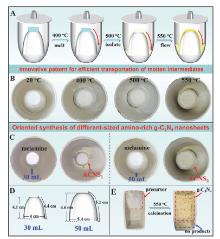
Fig 1
Graphical illustration for the synthesis of amino-rich g-C3N4 nanosheets: (A) theoretical pattern and (B) corresponding products; (C) photos before and after calcination of melamine on different-sized crucibles; (D) graphical illustration of 30 and 50 mL crucible sizes; (E) photos of precursors before and after calcination."
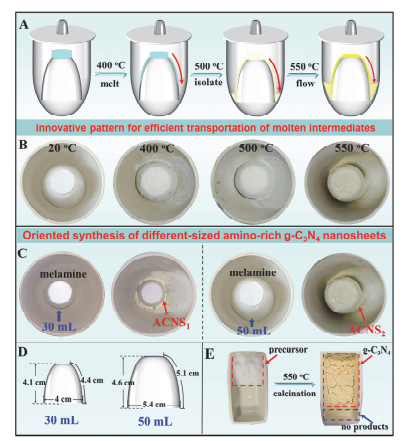
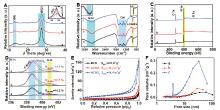
Fig 2
(A) XRD patterns, (B) FT-IR spectra, (C) XPS survey spectra, (D) N 1s high-resolution XPS spectra, (E) nitrogen adsorption-desorption isotherms, and (F) pore size distribution curves of (a) BCN, (b) ACNS1, and (c) ACNS2."
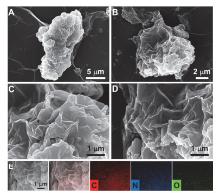
Fig 3
SEM images of (A) BCN and (B–D) ACNS2 samples, (E) EDS elemental mapping images of ACNS2 sample."

Fig 4
TEM images of (A) BCN and (B–F) ACNS2 samples."
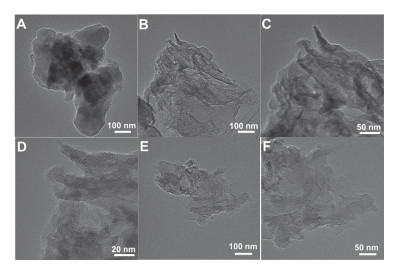
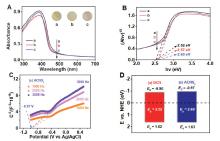
Fig 5
(A) UV-Vis diffused reflectance spectra and corresponding photographs (inset), (B) Tauc plots, (C) Mottschottky plots with the flat band potential and (D) Band alignments of various samples. (a) BCN (b) ACNS1 and (c) ACNS2."
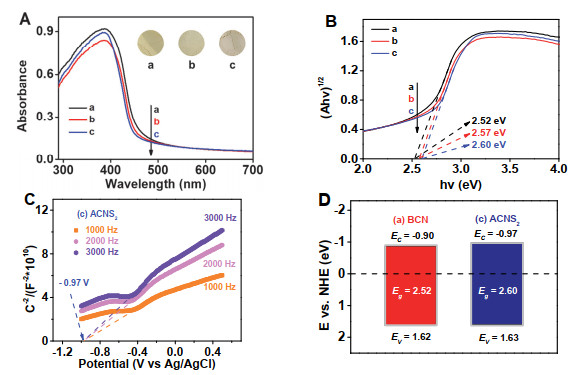
Fig 6
Photocatalytic activities of (A, B) H2O2 production and (C) H2O2 decomposition for (a) BCN (b) ACNS1 and (c) ACNS2, (D) photocatalytic cyclic test of ACNS2 sample."
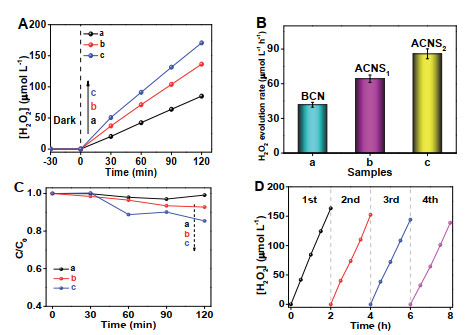
Fig 7
(A) Optimal models for O2 adsorption on g-C3N4 and amino-rich g-C3N4 and (B) their corresponding adsorption energy and schematic illustrations; the optimized models for *OOH adsorption on (C) g-C3N4 and (D) amino-rich g-C3N4, and their corresponding computational results of (E) bond length and (F) Gibbs free energy of *OOH radical; (G) proposed H2O2-production mechanism."
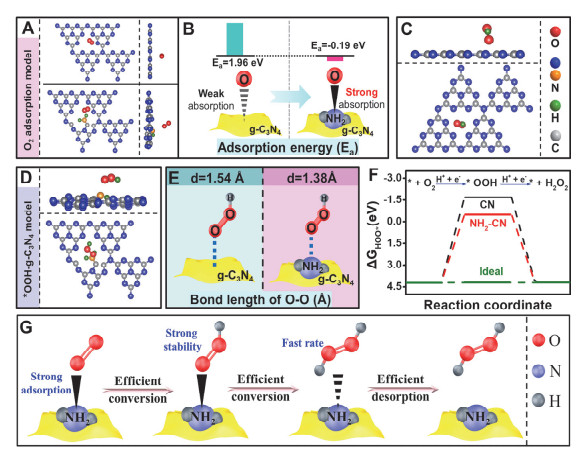
Fig 8
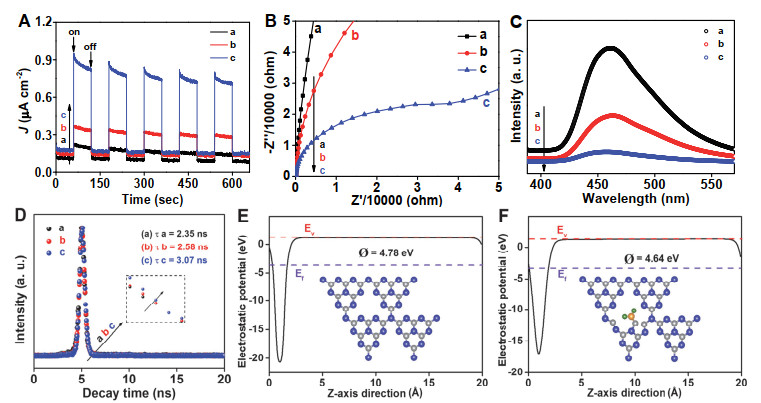
(A) Transient photocurrent responses, (B) electrochemical impedance spectra, PL spectra of (C) steady-state and (D) time-resolved for (a) BCN (b) ACNS1 and (c) ACNS2; Work function calculation results and models of (E) g-C3N4 and (F) amino-rich g-C3N4."
| 1 |
doi: 10.1038/s41467-024-45604-5 |
| 2 |
doi: 10.1016/s1872-2067(22)64205-0 |
| 3 |
doi: 10.1016/j.apcatb.2024.124215 |
| 4 |
doi: 10.1021/acs.jpclett.3c00811 |
| 5 |
doi: 10.1002/adma.202203225 |
| 6 |
doi: 10.1002/anie.202316410 |
| 7 |
doi: 10.1007/s40843-023-2717-0 |
| 8 |
doi: 10.3866/PKU.WHXB202212016 |
| 9 |
doi: 10.1016/j.apcatb.2022.122301 |
| 10 |
doi: 10.1002/advs.202302503 |
| 11 |
doi: 10.1016/s1872-2067(22)64159-7 |
| 12 |
doi: 10.1002/adma.202310600 |
| 13 |
doi: 10.1007/s40843-023-2755-2 |
| 14 |
doi: 10.1016/s1872-2067(22)64201-3 |
| 15 |
doi: 10.1016/j.apcatb.2020.118899 |
| 16 |
doi: 10.3866/PKU.WHXB202209016 |
| 17 |
doi: 10.1002/advs.202302503 |
| 18 |
doi: 10.1016/j.ijhydene.2021.03.174 |
| 19 |
doi: 10.1016/j.jallcom.2020.158448 |
| 20 |
doi: 10.1021/ja402521s |
| 21 |
doi: 10.1002/adfm.202102540 |
| 22 |
doi: 10.1038/s41467-022-33654-6 |
| 23 |
doi: 10.1021/acsami.8b04783 |
| 24 |
doi: 10.1021/jacs.8b12428 |
| 25 |
doi: 10.1039/c4ta04487h |
| 26 |
doi: 10.1016/j.jallcom.2021.163310 |
| 27 |
doi: 10.1016/j.chempr.2018.12.009 |
| 28 |
doi: 10.1021/ja308249k |
| 29 |
doi: 10.1021/acsenergylett.7b01328 |
| 30 |
doi: 10.3866/PKU.WHXB202403009 |
| 31 |
doi: 10.1016/s1872-2067(23)64448-1 |
| 32 |
doi: 10.1016/j.cej.2023.147711 |
| 33 |
doi: 10.1016/j.jcis.2020.10.141 |
| 34 |
doi: 10.1016/s1872-2067(23)64523-1 |
| 35 |
doi: 10.1016/j.jcis.2022.11.143 |
| 36 |
doi: 10.1002/smll.202300109 |
| 37 |
doi: 10.1016/s1872-2067(23)64417-1 |
| 38 |
doi: 10.1016/j.carbon.2019.07.083 |
| 39 |
doi: 10.1038/s41467-023-42853-8 |
| 40 |
doi: 10.1016/j.apcatb.2019.01.088 |
| 41 |
doi: 10.1016/s1872-2067(23)64491-2 |
| 42 |
doi: 10.3866/PKU.WHXB202212026 |
| 43 |
doi: 10.1016/j.jcis.2023.10.043 |
| 44 |
doi: 10.1016/j.apcatb.2021.120414 |
| 45 |
doi: 10.1038/s41467-024-47624-7 |
| 46 |
doi: 10.1002/adsu.202200144 |
| 47 |
doi: 10.3866/PKU.WHXB202212010 |
| 48 |
doi: 10.1016/j.cclet.2023.108157 |
| 49 |
doi: 10.1002/anie.202313172 |
| 50 |
doi: 10.1002/adfm.202302325 |
| 51 |
doi: 10.1002/anie.202218688 |
| 52 |
doi: 10.3866/PKU.WHXB202307022 |
| 53 |
doi: 10.1016/j.jmst.2023.05.046 |
| 54 |
doi: 10.1002/anie.202304559 |
| 55 |
doi: 10.1016/j.cej.2023.143528 |
| 56 |
doi: 10.3866/PKU.WHXB202312007 |
| 57 |
doi: 10.1002/anie.202212045 |
| 58 |
doi: 10.1021/acscatal.2c05001 |
| 59 |
doi: 10.1016/j.surfin.2024.104684 |
|
||