Acta Phys. -Chim. Sin. ›› 2024, Vol. 40 ›› Issue (11): 2407014.doi: 10.3866/PKU.WHXB202407014
• ARTICLE • Previous Articles
Improved Photo-Carrier Transfer by an Internal Electric Field in BiOBr/N-rich C3N5 3D/2D S-Scheme Heterojunction for Efficiently Photocatalytic Micropollutant Removal
Changjun You1, Chunchun Wang1, Mingjie Cai2, Yanping Liu1,*( ), Baikang Zhu1,*(), Shijie Li1,*()
- 1 Zhejiang Key Laboratory of Petrochemical Environmental Pollution Control, National Engineering Research Center for Marine Aquaculture, Key Laboratory of Health Risk Factors for Seafood of Zhejiang Province, Zhejiang Ocean University, Zhoushan 316022, Zhejiang Province, China
2 College of Environmental Science and Engineering, State Key Laboratory of Pollution Control and Resource Reuse, Tongji University, Shanghai 200092, China
-
Received:2024-07-14Revised:2024-08-12Accepted:2024-08-13Published:2024-10-14 -
Contact:Email: liuyp@zjou.edu.cn (Yanping Liu)zszbk@126.com (Baikang Zhu)lishijie@zjou.edu.cn (Shijie Li) -
Supported by:National Natural Science Foundation of China(U1809214); the Natural Science Foundation of Zhejiang Province of China(LY20E080014); the Natural Science Foundation of Zhejiang Province of China(LTGN23E080001); the Open Research Subject of Zhejiang Key Laboratory of Petrochemical Environmental Pollution Control(2021Y02); the Science and Technology Project of Zhoushan(2022C41011)

Cite this article
Changjun You, Chunchun Wang, Mingjie Cai, Yanping Liu, Baikang Zhu, Shijie Li. Improved Photo-Carrier Transfer by an Internal Electric Field in BiOBr/N-rich C3N5 3D/2D S-Scheme Heterojunction for Efficiently Photocatalytic Micropollutant Removal[J]. Acta Phys. -Chim. Sin. 2024, 40(11), 2407014. doi: 10.3866/PKU.WHXB202407014
share this article
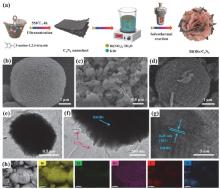
Fig 1
(a) Construction process of BBN heterojunctions; SEM images of (b) BiOBr, (c) C3N5, and (d) BBN-2; (e–f) TEM and (g) HRTEM image of BBN-2; (h) EDX mapping images of C, N, O, Bi, and Br distribution."
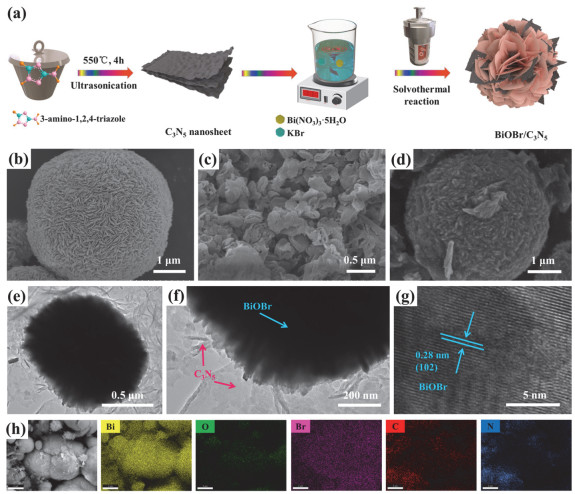
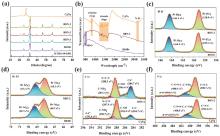
Fig 2
(a) XRD patterns, (b) FTIR spectra, XPS spectra of (c) Bi 4f, (d) Br 3d, (e) C 1s, and (f) N 1s of C3N5, BiOBr, and BBN-2."
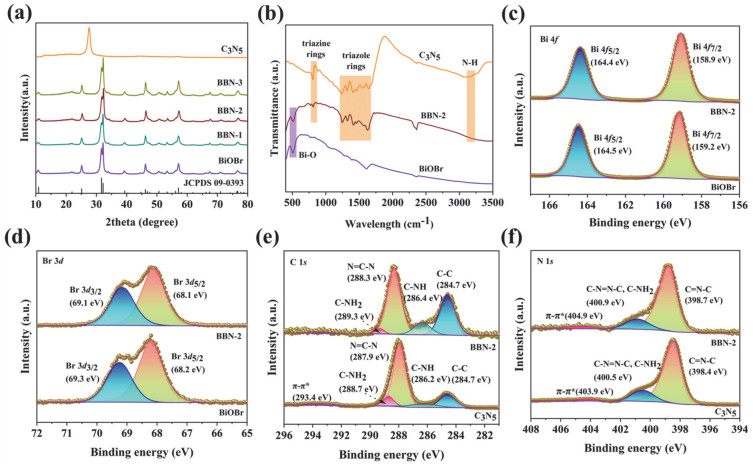
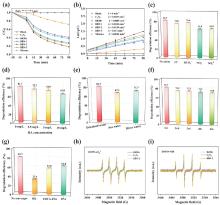
Fig 3
(a) Photocatalytic TC decontamination performance of different samples and (b) their photo-oxidation kinetics; (c–e) TC eradication performance of BBN-2 under various environmental conditions; (f) Cycling tests for TC destruction over BBN-2; (g) The elimination efficiency of TC in the BBN-2 system with various scavengers; EPR data of (h) DMPO-•O2− and (i) DMPO-•OH over BiOBr, C3N5 and BBN-2."
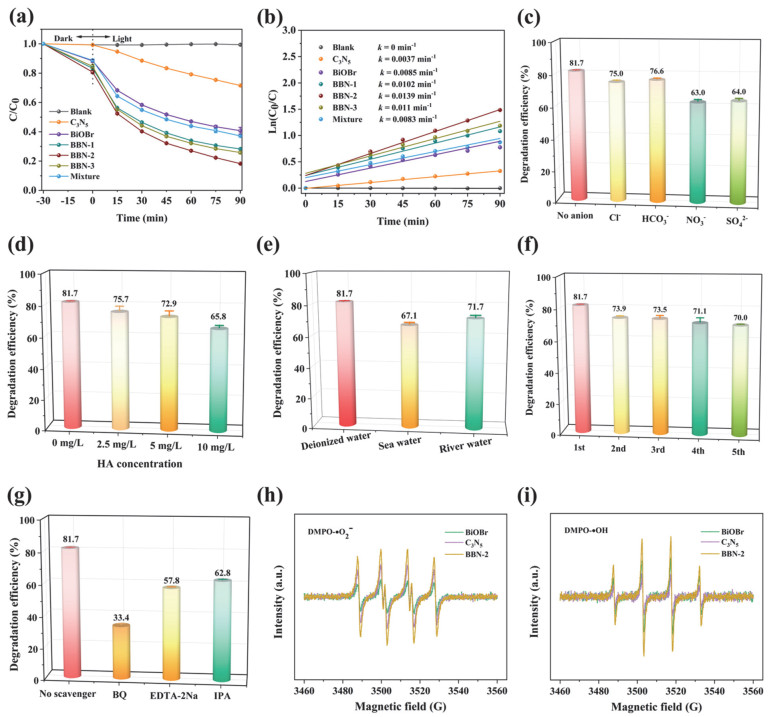
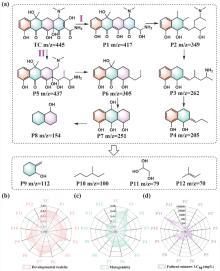
Fig 4
(a) TC destruction process over BBN-2; (b–d) Toxicity analysis."
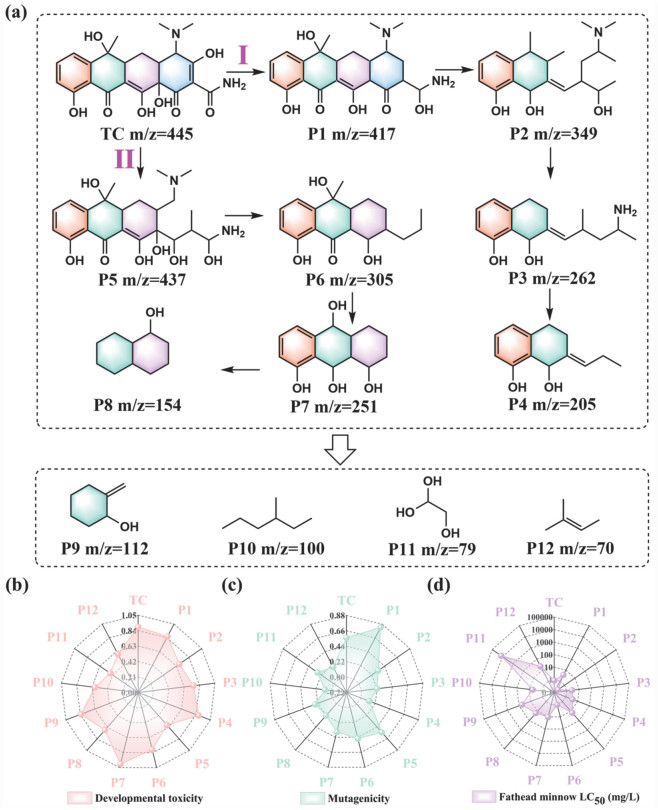
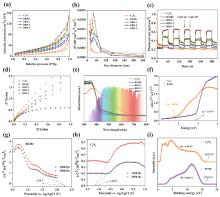
Fig 5
(a) N2 adsorption-desorption analyses and (b) the relevant pore-size distributions of BiOBr, C3N5 and BBN samples; (c) Transient photocurrent densities, (d) EIS Nyquist profiles, and (e) DRS spectrum of BiOBr, C3N5 and BBN heterojunctions; (f) Band gap energies of BiOBr and C3N5; Mott-Schottky data of (g) BiOBr and (h) C3N5; (i) UPS spectra of C3N5 and BiOBr."
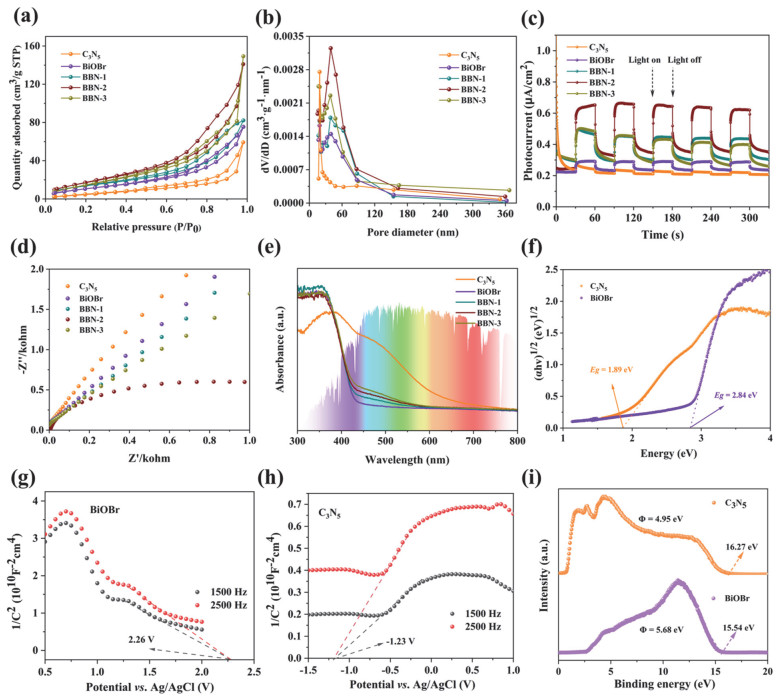
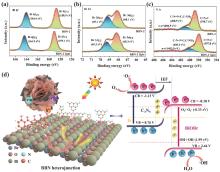
Fig 6
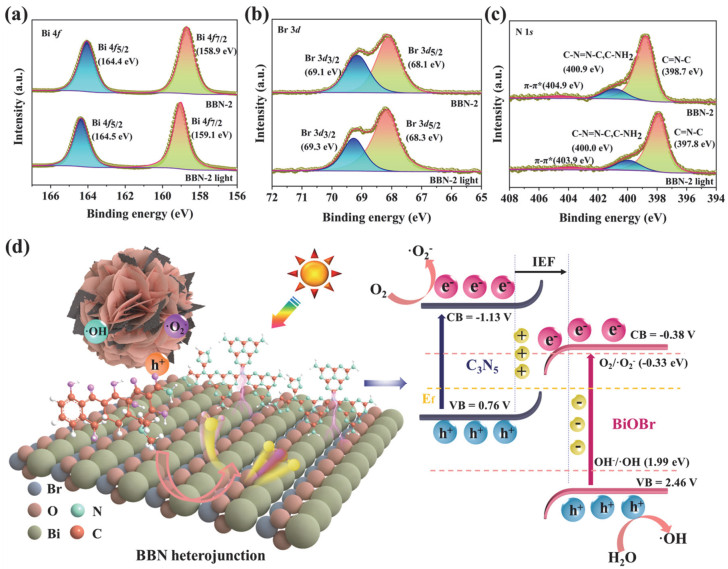
(a–c) In situ XPS spectra of BBN-2 under light illumination; (d) Photocatalytic decontamination mechanism of BBN-2 under visible light."
| 1 |
doi: 10.1016/j.eehl.2022.04.003 |
| 2 |
doi: 10.1016/j.eehl.2022.10.001 |
| 3 |
doi: 10.1360/nso/20220029 |
| 4 |
doi: 10.1016/j.jhazmat.2021.127946 |
| 5 |
doi: 10.1021/acs.est.2c09854 |
| 6 |
doi: 10.1016/j.watres.2020.116693 |
| 7 |
doi: 10.1038/s41565-018-0238-4 |
| 8 |
doi: 10.1038/s41565-018-0234-8 |
| 9 |
doi: 10.1038/s41565-018-0216-x |
| 10 |
doi: 10.19728/j.issn1672-6634.2023030005 |
| 11 |
doi: 10.1007/s41061-022-00409-2 |
| 12 |
doi: 10.1016/j.cjsc.2023.100066 |
| 13 |
doi: 10.1016/j.apmate.2023.100150 |
| 14 |
doi: 10.1016/j.chempr.2023.05.040 |
| 15 |
doi: 10.1126/sciadv.ade9044 |
| 16 |
doi: 10.1038/s41557-022-01093-x |
| 17 |
doi: 10.1039/d2cs00183g |
| 18 |
doi: 10.1039/d0cs00357c |
| 19 |
doi: 10.1021/acsnano.0c10945 |
| 20 |
doi: 10.1038/s41563-020-00868-2 |
| 21 |
doi: 10.1016/j.joule.2017.12.009 |
| 22 |
doi: 10.1038/s41563-019-0591-1 |
| 23 |
doi: 10.19728/j.issn1672-6634.2023040004 |
| 24 |
doi: 10.1016/S1872-2067(22)64193-7 |
| 25 |
doi: 10.1016/j.jmst.2023.07.064 |
| 26 |
doi: 10.19728/j.issn1672-6634.2023050002 |
| 27 |
doi: 10.34133/research.0073 |
| 28 |
doi: 10.1016/j.nanoms.2022.05.001 |
| 29 |
doi: 10.1002/sus2.76 |
| 30 |
doi: 10.1016/j.esci.2023.100136 |
| 31 |
doi: 10.3866/PKU.WHXB202211010 |
| 32 |
doi: 10.1007/s42765-023-00276-6 |
| 33 |
doi: 10.1007/s42765-022-00220-0 |
| 34 |
doi: 10.1021/acsami.3c04959 |
| 35 |
doi: 10.1016/j.cej.2021.130173 |
| 36 |
doi: 10.1021/acsaem.2c00296 |
| 37 |
doi: 10.1016/j.rser.2023.113948 |
| 38 |
doi: 10.3866/PKU.WHXB202212026 |
| 39 |
doi: 10.1002/anie.202101894 |
| 40 |
doi: 10.1038/s41560-023-01262-3 |
| 41 |
doi: 10.1039/D1TA10323G |
| 42 |
doi: 10.1016/j.jclepro.2021.126617 |
| 43 |
doi: 10.1016/j.ccr.2017.08.010 |
| 44 |
doi: 10.1021/acs.est.2c03769 |
| 45 |
doi: 10.1002/ange.201803514 |
| 46 |
doi: 10.1016/j.apcatb.2011.10.016 |
| 47 |
doi: 10.1016/j.jece.2021.105404 |
| 48 |
doi: 10.1007/s40843-023-2764-8 |
| 49 |
doi: 10.1016/S1872-2067(19)63496-0 |
| 50 |
doi: 10.1016/j.jcis.2024.01.213 |
| 51 |
doi: 10.1016/j.jmst.2023.03.024 |
| 52 |
doi: 10.1002/adma.202310600 |
| 53 |
doi: 10.19728/j.issn1672-6634.2023090011 |
| 54 |
doi: 10.1016/j.trechm.2022.08.008 |
| 55 |
doi: 10.3866/PKU.WHXB202310013 |
| 56 |
doi: 10.1111/jace.17696 |
| 57 |
doi: 10.1016/j.fuel.2022.126267 |
| 58 |
doi: 10.1021/acsami.2c21049 |
| 59 |
doi: 10.3866/PKU.WHXB202307022 |
| 60 |
doi: 10.1038/s41467-024-49004-7 |
| 61 |
doi: 10.1002/ange.201811061 |
| 62 |
doi: 10.1021/jacs.9b00144 |
| 63 |
doi: 10.1016/j.jenvman.2023.117570 |
| 64 |
doi: 10.1021/acsami.2c04729 |
| 65 |
doi: 10.1016/S1872-2067(23)64417-1 |
| 66 |
doi: 10.1002/ange.202203261 |
| 67 |
doi: 10.1002/adfm.201401636 |
| 68 |
doi: 10.1039/C8TA04165B |
| 69 |
doi: 10.1002/adfm.201303214 |
| 70 |
doi: 10.1002/adfm.202009807 |
| 71 |
doi: 10.1002/anie.202313325 |
| 72 |
doi: 10.1016/j.jmst.2023.03.037 |
| 73 |
doi: 10.1016/j.jhazmat.2021.126613 |
| 74 |
doi: 10.3866/PKU.WHXB202302051 |
| 75 |
doi: 10.1016/j.apmate.2022.100094 |
| 76 |
doi: 10.1021/acsnano.4c00217 |
| 77 |
doi: 10.1016/j.ccr.2022.214541 |
| 78 |
doi: 10.19728/j.issn1672-6634.2022090001 |
| 79 |
doi: 10.1021/acs.langmuir.3c00519 |
| 80 |
doi: 10.1002/adma.202001763 |
| 81 |
doi: 10.1016/j.cej.2022.136609 |
| 82 |
doi: 10.3866/PKU.WHXB202212009 |
| [1] | Fan Fan, Hao Xiu, Yuting Wang, Yongpeng Cui, Yajun Wang. Construction of NH2-MIL-125/Na-doped g-C3N4 composite S-scheme heterojunction and its performance in photocatalytic hydrogen peroxide production [J]. Acta Phys. -Chim. Sin., 2026, 42(2): 100143-. |
| [2] | Yu Liu, Pengfei Li, Yize Liu, Zaicheng Sun. Recent advances in carbon dots as a single photocatalyst [J]. Acta Phys. -Chim. Sin., 2026, 42(2): 100167-. |
| [3] | Yuhang Zhang, Yi Li, Yuehan Cao, Yingjie Shuai, Yu Zhou, Ying Zhou. Regulating the formation type by Ir of intermediates to suppress product overoxidation in photocatalytic methane conversion [J]. Acta Phys. -Chim. Sin., 2026, 42(2): 100173-. |
| [4] | Chengxiao Zhao, Zhaolin Li, Dongfang Wu, Xiaofei Yang. SBA-15 templated covalent triazine frameworks for boosted photocatalytic hydrogen production [J]. Acta Phys. -Chim. Sin., 2026, 42(1): 100149-. |
| [5] | Chengyan Ge, Jiawei Hu, Xingyu Liu, Yuxi Song, Chao Liu, Zhigang Zou. Self-integrated black NiO clusters with ZnIn2S4 microspheres for photothermal-assisted hydrogen evolution by S-scheme electron transfer mechanism [J]. Acta Phys. -Chim. Sin., 2026, 42(1): 100154-. |
| [6] | Shiyi Chen, Jialong Fu, Jianping Qiu, Guoju Chang, Shiyou Hao. Waste medical mask-derived carbon quantum dots enhance the photocatalytic degradation of polyethylene terephthalate (PET) over BiOBr/g-C3N4 S-scheme heterojunction [J]. Acta Phys. -Chim. Sin., 2026, 42(1): 100135-. |
| [7] | Menglan Wei, Xiaoxia Ou, Yimeng Wang, Mengyuan Zhang, Fei Teng, Kaixuan Wang. S-scheme heterojunction g-C3N4/Bi2WO6 highly efficient degradation of levofloxacin: performance, mechanism and degradation pathway [J]. Acta Phys. -Chim. Sin., 2025, 41(9): 100105-. |
| [8] | Jingping Li, Suding Yan, Jiaxi Wu, Qiang Cheng, Kai Wang. Improving hydrogen peroxide photosynthesis over inorganic/organic S-scheme photocatalyst with LiFePO4 [J]. Acta Phys. -Chim. Sin., 2025, 41(9): 100104-. |
| [9] | Fengying Zhang, Yanglin Mei, Yuman Jiang, Shenshen Zheng, Kaibo Zheng, Ying Zhou. Research progress of transient absorption spectroscopy in solar energy conversion and utilization [J]. Acta Phys. -Chim. Sin., 2025, 41(9): 100118-. |
| [10] | Wenlong Wang, Wentao Hao, Lang He, Jia Qiao, Ning Li, Chaoqiu Chen, Yong Qin. Bandgap and adsorption engineering of carbon dots/TiO2 S-scheme heterojunctions for enhanced photocatalytic CO2 methanation [J]. Acta Phys. -Chim. Sin., 2025, 41(9): 100116-. |
| [11] | Jiajie Cai, Chang Cheng, Bowen Liu, Jianjun Zhang, Chuanjia Jiang, Bei Cheng. CdS/DBTSO-BDTO S-scheme photocatalyst for H2 production and its charge transfer dynamics [J]. Acta Phys. -Chim. Sin., 2025, 41(8): 100084-. |
| [12] | Lewang Yuan, Yaoyao Peng, Zong-Jie Guan, Yu Fang. Insights into the development of 2D covalent organic frameworks as photocatalysts in organic synthesis [J]. Acta Phys. -Chim. Sin., 2025, 41(8): 100086-. |
| [13] | Fanpeng Meng, Fei Zhao, Jingkai Lin, Jinsheng Zhao, Huayang Zhang, Shaobin Wang. Optimizing interfacial electric fields in carbon nitride nanosheet/spherical conjugated polymer S-scheme heterojunction for hydrogen evolution [J]. Acta Phys. -Chim. Sin., 2025, 41(8): 100095-. |
| [14] | Weikang Wang, Yadong Wu, Jianjun Zhang, Kai Meng, Jinhe Li, Lele Wang, Qinqin Liu. Green H2O2 synthesis via melamine-foam supported S-scheme Cd0.5Zn0.5In2S4/S-doped carbon nitride heterojunction: synergistic interfacial charge transfer and local photothermal effect [J]. Acta Phys. -Chim. Sin., 2025, 41(8): 100093-. |
| [15] | Yu Wang, Haiyang Shi, Zihan Chen, Feng Chen, Ping Wang, Xuefei Wang. Hollow AgPt@Pt core-shell cocatalyst with electron-rich Ptδ− shell for boosting selectivity of photocatalytic H2O2 production for faceted BiVO4 [J]. Acta Phys. -Chim. Sin., 2025, 41(7): 100081-. |
|
||