Acta Phys. -Chim. Sin. ›› 2024, Vol. 40 ›› Issue (11): 2407013.doi: 10.3866/PKU.WHXB202407013
Special Issue: Solar fuel preparation
• ARTICLE • Previous Articles Next Articles
d-Band Center Regulated O2 Adsorption on Transition Metal Single Atoms Loaded COF: A DFT Study
Fei Xie1, Chengcheng Yuan1, Haiyan Tan2, Alireza Z. Moshfegh3, Bicheng Zhu1,*( ), Jiaguo Yu1,*()
- 1 Laboratory of Solar Fuel, Faculty of Materials Science and Chemistry, China University of Geosciences, Wuhan 430078, China
2 School of Chemistry and Environmental Engineering, Hubei University for Nationalities, Enshi 445000, Hubei Province, China
3 Institute for Nanoscience and Nanotechnology, Department of Physics, Sharif University of Technology, Tehran 11365-8639, Iran
-
Received:2024-07-10Revised:2024-07-28Accepted:2024-07-30Published:2024-10-14 -
Contact:Email: zhubicheng@cug.edu.cn; Tel.: +86-13296512925 (Bicheng Zhu)yujiaguo93@cug.edu.cn; Tel.: +86-15927228289 (Jiaguo Yu) -
Supported by:the National Key Research and Development Program of China(2022YFE0115900); the National Natural Science Foundation of China(52372294); the National Natural Science Foundation of China(22262012); the National Natural Science Foundation of China(22238009); the National Natural Science Foundation of China(52173065); the National Natural Science Foundation of China(22361142704); the Natural Science Foundation of Hubei Province of China(2022CFA001); the Fundamental Research Funds for the Central Universities; China University of Geosciences (Wuhan)(CUG22061)

Cite this article
Fei Xie, Chengcheng Yuan, Haiyan Tan, Alireza Z. Moshfegh, Bicheng Zhu, Jiaguo Yu. d-Band Center Regulated O2 Adsorption on Transition Metal Single Atoms Loaded COF: A DFT Study[J]. Acta Phys. -Chim. Sin. 2024, 40(11), 2407013. doi: 10.3866/PKU.WHXB202407013
share this article
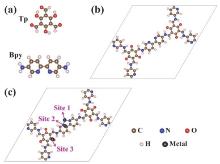
Fig 1
(a) Molecular structures of Tp and Bpy. Top views of (b) optimized COF and (c) constructed M-COF with three loading sites."
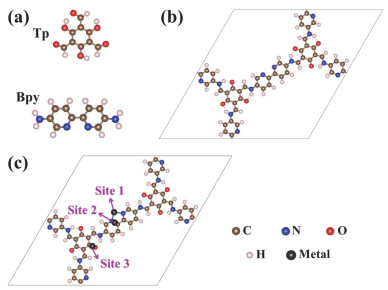

Table 1
Formation energy (eV) of M-COF at different loading sites."
| Site | Fe-COF | Co-COF | Ni-COF | Cu-COF |
| 1 | –2.10 | –2.77 | –3.14 | –1.80 |
| 2 | –1.63 | –1.75 | –2.00 | Move to site 1 |
| 3 | –1.53 | –1.20 | –1.84 | –0.74 |
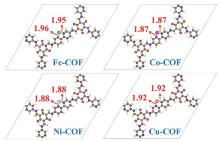
Fig 2
Top views of optimized metal-loaded COF. The red numbers represent the length (Å) of the M―N bonds."
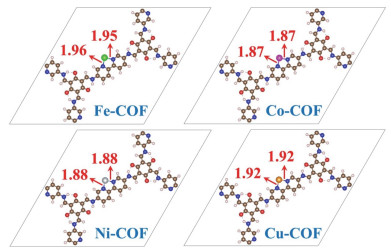
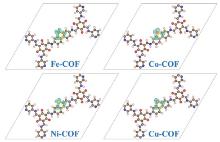
Fig 3
Charge density difference of metal-loaded COF. The isosurface value is 0.003 e·Å−3."
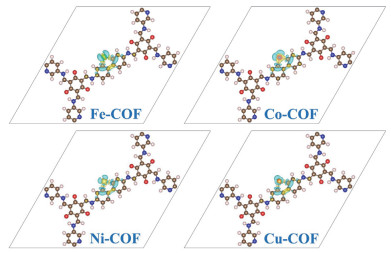
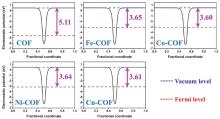
Fig 4
Electrostatic potential of COF and metal-loaded COF along c direction. The purple numbers represent work function."
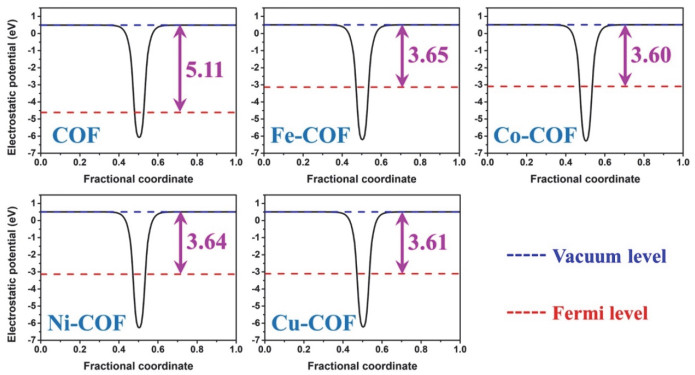
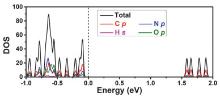
Fig 5
DOS of COF. The dash line represents the Fermi energy."
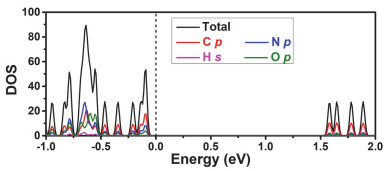
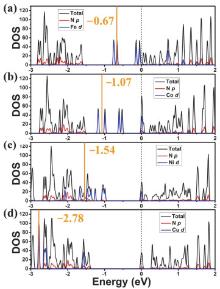
Fig 6
DOS of (a) Fe-COF, (b) Co-COF, (c) Ni-COF, and (d) Cu-COF. The orange lines and numbers represent the d-band centers of metal atoms."
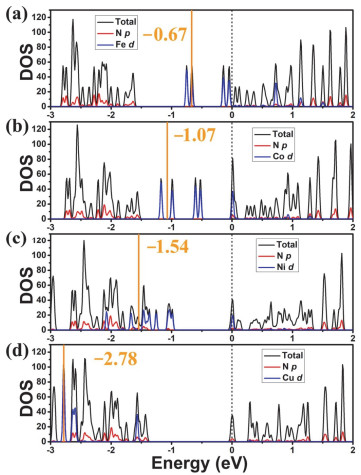
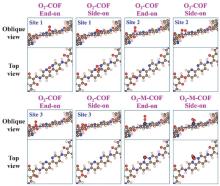
Fig 7
Oblique view and top view of constructed O2-COF and O2-M-COF adsorption models."
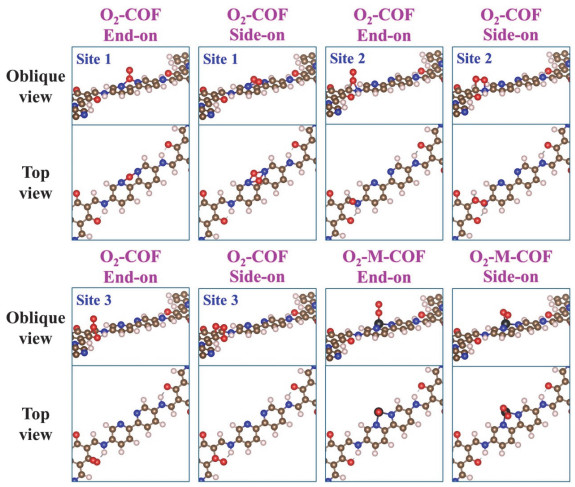
Table 2
Adsorption energy (eV) of O2-COF at different adsorption sites."
| Mode | Site 1 | Site 2 | Site 3 |
| End-on | 1.03 | –0.05 | –0.04 |
| Side-on | 0.33 | –0.07 | 2.62 |
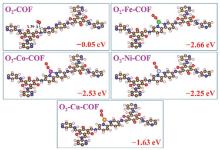
Fig 8
Optimized O2-COF and O2-M-COF adsorption models in end-on mode. The red numbers represent adsorption energy. The black number represents the distance between the O atom in O2 and the N atom in COF."
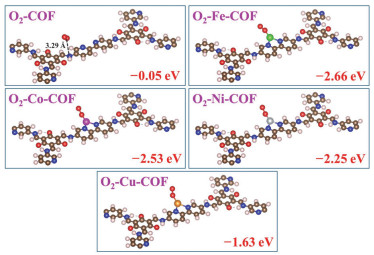
Table 3
Geometric parameters and Bader charge of O2-COF and O2-M-COF adsorption systems in end-on mode."
| Adsorption system | M―Oads bond length | O=O bond length | Bader charge of O2 |
| O2-COF | – | 1.23 Å | 0.10 |
| O2-Fe-COF | 1.69 Å | 1.30 Å | 0.65 |
| O2-Co-COF | 1.64 Å | 1.29 Å | 0.58 |
| O2-Ni-COF | 1.67 Å | 1.29 Å | 0.57 |
| O2-Cu-COF | 1.83 Å | 1.31 Å | 0.60 |
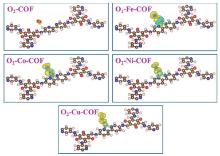
Fig 9
Charge density difference of O2-COF and O2-M-COF adsorption systems in end-on mode. The isosurface value is 0.002 e·Å−3."
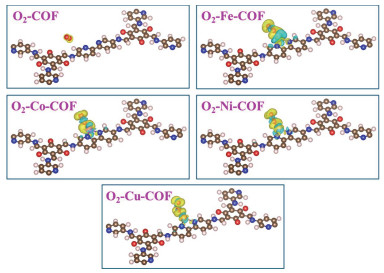
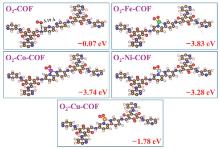
Fig 10
Optimized O2-COF and O2-M-COF adsorption models in side-on mode. The red numbers represent adsorption energy. The black number represents the distance between the O atom in O2 and the N atom in COF."
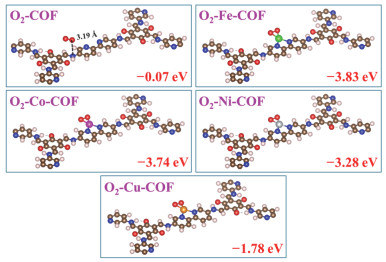
Table 4
Geometric parameters and Bader charge of O2-COF and O2-M-COF adsorption systems in side-on mode."
| Adsorption system | M―Oads1 bond length | M―Oads2 bond length | O=O bond length | Bader charge of O2 |
| O2-COF | – | – | 1.24 Å | 0.13 |
| O2-Fe-COF | 1.80 Å | 1.80 Å | 1.44 Å | 0.75 |
| O2-Co-COF | 1.79 Å | 1.79 Å | 1.40 Å | 0.73 |
| O2-Ni-COF | 1.79 Å | 1.82 Å | 1.40 Å | 0.79 |
| O2-Cu-COF | 1.87 Å | 1.90 Å | 1.40 Å | 0.79 |
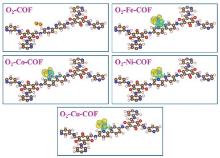
Fig 11
Charge density difference of O2-COF and O2-M-COF adsorption systems in side-on mode. The isosurface value is 0.002 e·Å–3."
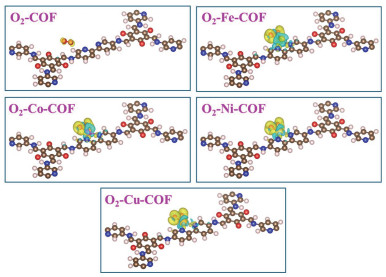
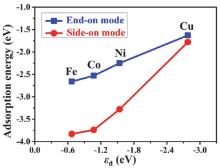
Fig 12
Relationship between the d-band centers of the metal atoms in M-COF and the adsorption energy of O2-M-COF."
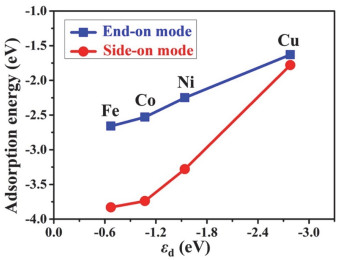
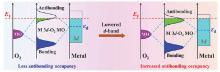
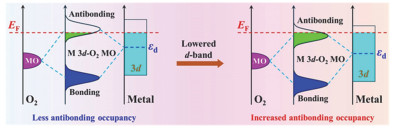
Fig 13
Schematic illustration of increased occupancy of antibonding states caused by the lowered d-band of the metal atoms in M-COF."
| 1 |
doi: 10.1002/adma.202310600 |
| 2 |
doi: 10.3866/PKU.WHXB202212057 |
| 3 |
doi: 10.1021/acs.inorgchem.0c00422 |
| 4 |
doi: 10.1016/j.cej.2022.136584 |
| 5 |
doi: 10.1016/S1872-2067(22)64205-0 |
| 6 |
doi: 10.1016/j.jmst.2023.05.030 |
| 7 |
doi: 10.1002/adma.202400288 |
| 8 |
doi: 10.1016/S1872-2067(22)64143-3 |
| 9 |
doi: 10.1021/acscatal.4c00026 |
| 10 |
doi: 10.3866/PKU.WHXB202303032 |
| 11 |
doi: 10.1016/S1872-2067(21)63869-X |
| 12 |
doi: 10.1016/j.jmst.2021.12.065 |
| 13 |
doi: 10.1016/j.apcatb.2023.122780 |
| 14 |
doi: 10.1016/S1872-2067(22)64127-5 |
| 15 |
doi: 10.1016/j.cej.2023.146818 |
| 16 |
doi: 10.3866/PKU.WHXB202212020 |
| 17 |
doi: 10.1002/smll.202301928 |
| 18 |
doi: 10.1016/j.jmst.2021.11.035 |
| 19 |
doi: 10.1002/aenm.202302797 |
| 20 |
doi: 10.1007/s40843-021-1662-8 |
| 21 |
doi: 10.1039/D4CP01257G |
| 22 |
doi: 10.1016/j.commatsci.2017.05.017 |
| 23 |
doi: 10.1016/j.jmst.2023.06.028 |
| 24 |
doi: 10.1016/j.ijhydene.2023.07.062 |
| 25 |
doi: 10.1039/D2TA07167C |
| 26 |
doi: 10.1002/adfm.202107651 |
| 27 |
doi: 10.3866/PKU.WHXB202207024 |
| 28 |
doi: 10.1016/S1381-1169(96)00348-2 |
| 29 |
doi: 10.1103/PhysRevB.89.115114 |
| 30 |
doi: 10.1007/s12598-022-02210-y |
| 31 |
doi: 10.1038/s41467-024-47624-7 |
| 32 |
doi: 10.1016/S1872-2067(23)64484-5 |
| 33 |
doi: 10.1016/j.jmst.2021.08.007 |
| 34 |
doi: 10.1007/s12598-023-02448-0 |
| 35 |
doi: 10.1016/j.jcis.2024.06.176 |
| 36 |
doi: 10.1021/acs.inorgchem.3c04158 |
| 37 |
doi: 10.1039/D3TA00079F |
| 38 |
doi: 10.1039/D1SE00358E |
| 39 |
doi: 10.1016/j.apsusc.2022.153621 |
| 40 |
doi: 10.1038/s41467-023-36338-x |
| 41 |
doi: 10.1002/smll.202401168 |
| 42 |
doi: 10.1021/jacs.2c01814 |
| 43 |
doi: 10.1016/j.jcis.2021.08.118 |
| 44 |
doi: 10.1021/jacs.2c06920 |
| 45 |
doi: 10.1021/acsmaterialslett.3c01141 |
| 46 |
doi: 10.1016/j.cej.2024.151479 |
| 47 |
doi: 10.1016/j.cej.2020.126383 |
| 48 |
doi: 10.1021/jacs.9b02997 |
| 49 |
doi: 10.1126/sciadv.adi9442 |
| 50 |
doi: 10.1016/j.cej.2020.126149 |
| 51 |
doi: 10.1021/jacs.3c11169 |
| 52 |
doi: 10.1002/advs.202206933 |
| 53 |
doi: 10.1021/acs.chemmater.6b01370 |
| 54 |
doi: 10.1002/adma.202008599 |
| 55 |
doi: 10.1016/j.jcis.2024.03.102 |
| 56 |
doi: 10.1039/D1CP05699A |
| 57 |
doi: 10.3866/PKU.WHXB202212026 |
| 58 |
doi: 10.1021/acsami.3c07036 |
| 59 |
doi: 10.1016/j.jcis.2023.06.062 |
| 60 |
doi: 10.1038/s41467-024-45604-5 |
| 61 |
doi: 10.1002/adma.202406460 |
| 62 |
doi: 10.1142/S1088424624500214 |
| 63 |
doi: 10.1002/adma.202303030 |
| 64 |
doi: 10.1016/j.jmst.2023.05.028 |
| 65 |
doi: 10.1016/S1872-2067(23)64645-5 |
| 66 |
doi: 10.1007/s12598-023-02428-4 |
| 67 |
doi: 10.1016/j.jcis.2024.06.023 |
| [1] | Yu Liu, Pengfei Li, Yize Liu, Zaicheng Sun. Recent advances in carbon dots as a single photocatalyst [J]. Acta Phys. -Chim. Sin., 2026, 42(2): 100167-. |
| [2] | Yuhang Zhang, Yi Li, Yuehan Cao, Yingjie Shuai, Yu Zhou, Ying Zhou. Regulating the formation type by Ir of intermediates to suppress product overoxidation in photocatalytic methane conversion [J]. Acta Phys. -Chim. Sin., 2026, 42(2): 100173-. |
| [3] | Chengxiao Zhao, Zhaolin Li, Dongfang Wu, Xiaofei Yang. SBA-15 templated covalent triazine frameworks for boosted photocatalytic hydrogen production [J]. Acta Phys. -Chim. Sin., 2026, 42(1): 100149-. |
| [4] | Shiyi Chen, Jialong Fu, Jianping Qiu, Guoju Chang, Shiyou Hao. Waste medical mask-derived carbon quantum dots enhance the photocatalytic degradation of polyethylene terephthalate (PET) over BiOBr/g-C3N4 S-scheme heterojunction [J]. Acta Phys. -Chim. Sin., 2026, 42(1): 100135-. |
| [5] | Menglan Wei, Xiaoxia Ou, Yimeng Wang, Mengyuan Zhang, Fei Teng, Kaixuan Wang. S-scheme heterojunction g-C3N4/Bi2WO6 highly efficient degradation of levofloxacin: performance, mechanism and degradation pathway [J]. Acta Phys. -Chim. Sin., 2025, 41(9): 100105-. |
| [6] | Jingping Li, Suding Yan, Jiaxi Wu, Qiang Cheng, Kai Wang. Improving hydrogen peroxide photosynthesis over inorganic/organic S-scheme photocatalyst with LiFePO4 [J]. Acta Phys. -Chim. Sin., 2025, 41(9): 100104-. |
| [7] | Fengying Zhang, Yanglin Mei, Yuman Jiang, Shenshen Zheng, Kaibo Zheng, Ying Zhou. Research progress of transient absorption spectroscopy in solar energy conversion and utilization [J]. Acta Phys. -Chim. Sin., 2025, 41(9): 100118-. |
| [8] | Jiajie Cai, Chang Cheng, Bowen Liu, Jianjun Zhang, Chuanjia Jiang, Bei Cheng. CdS/DBTSO-BDTO S-scheme photocatalyst for H2 production and its charge transfer dynamics [J]. Acta Phys. -Chim. Sin., 2025, 41(8): 100084-. |
| [9] | Lewang Yuan, Yaoyao Peng, Zong-Jie Guan, Yu Fang. Insights into the development of 2D covalent organic frameworks as photocatalysts in organic synthesis [J]. Acta Phys. -Chim. Sin., 2025, 41(8): 100086-. |
| [10] | Yu Wang, Haiyang Shi, Zihan Chen, Feng Chen, Ping Wang, Xuefei Wang. Hollow AgPt@Pt core-shell cocatalyst with electron-rich Ptδ− shell for boosting selectivity of photocatalytic H2O2 production for faceted BiVO4 [J]. Acta Phys. -Chim. Sin., 2025, 41(7): 100081-. |
| [11] | Xueqi Yang, Juntao Zhao, Jiawei Ye, Desen Zhou, Tingmin Di, Jun Zhang. Modulating the d-band center of NNU-55(Fe) for enhanced CO2 adsorption and photocatalytic activity [J]. Acta Phys. -Chim. Sin., 2025, 41(7): 100074-. |
| [12] | Yadan Luo, Hao Zheng, Xin Li, Fengmin Li, Hua Tang, Xilin She. Modulating reactive oxygen species in O, S co-doped C3N4 to enhance photocatalytic degradation of microplastics [J]. Acta Phys. -Chim. Sin., 2025, 41(6): 100052-. |
| [13] | Xianghai Song, Xiaoying Liu, Zhixiang Ren, Xiang Liu, Mei Wang, Yuanfeng Wu, Weiqiang Zhou, Zhi Zhu, Pengwei Huo. Insights into the greatly improved catalytic performance of N-doped BiOBr for CO2 photoreduction [J]. Acta Phys. -Chim. Sin., 2025, 41(6): 100055-. |
| [14] | Yuchen Zhou, Huanmin Liu, Hongxing Li, Xinyu Song, Yonghua Tang, Peng Zhou. Designing thermodynamically stable noble metal single-atom photocatalysts for highly efficient non-oxidative conversion of ethanol into high-purity hydrogen and value-added acetaldehyde [J]. Acta Phys. -Chim. Sin., 2025, 41(6): 100067-. |
| [15] | Hui Wang, Abdelkader Labidi, Menghan Ren, Feroz Shaik, Chuanyi Wang. Recent Progress of Microstructure-Regulated g-C3N4 in Photocatalytic NO Conversion: The Pivotal Roles of Adsorption/Activation Sites [J]. Acta Phys. -Chim. Sin., 2025, 41(5): 100039-. |
|
||