物理化学学报 >> 2026, Vol. 42 >> Issue (10): 100293.doi: 10.1016/j.actphy.2026.100293
碳纳米管桥接垂直氧化锌阵列的致密导电网络增强碳纤维/聚合物复合材料的电磁干扰屏蔽、力学及热学性能
黄心萌1, 张浩然1,*( ), 刘梦欣1, 缪莹1, 余珍稀1, 吴奇2, 潘蕾1,*()
- 1 南京航空航天大学材料科学与技术学院, 江苏 南京 210016
2 南京航空航天大学航天学院, 江苏 南京 210016
-
收稿日期:2026-02-13修回日期:2026-03-30录用日期:2026-03-30发布日期:2026-09-03 -
通讯作者:bettypan@nuaa.edu.cn (潘蕾)Email: haoranzhang@nuaa.edu.cn (张浩然)
A densified conductive network of carbon nanotube-bridged vertical ZnO arrays for enhanced electromagnetic interference shielding, mechanical, and thermal properties of carbon fiber/polymer composites
Xinmeng Huang1, Haoran Zhang1,*(), Mengxin Liu1, Ying Miao1, Zhenxi Yu1, Qi Wu2, Lei Pan1,*()
- 1 College of Materials Science and Technology, Nanjing University of Aeronautics and Astronautics, Nanjing 210016, Jiangsu Province, China
2 College of Aerospace Engineering, Nanjing University of Aeronautics and Astronautics, Nanjing 210016, Jiangsu Province, China
-
Received:2026-02-13Revised:2026-03-30Accepted:2026-03-30Published:2026-09-03 -
Contact:bettypan@nuaa.edu.cn (Lei Pan)Email: haoranzhang@nuaa.edu.cn (Haoran Zhang)

摘要:
为满足先进电子器件对电磁干扰屏蔽与高效热管理集成化日益增长的需求,本研究通过仿生层级界面设计,开发了一种多功能碳纤维增强聚合物基复合材料(CFRP)。采用多级界面工程策略:首先,通过聚多巴胺活化改善界面粘附;其次,原位生长垂直排列的氧化锌纳米棒阵列,提供机械互锁、介电损耗及径向热传导路径;最后,通过片状碳纳米管网络桥接相邻纤维,形成致密、连续的导电框架。这种有机-无机“线-面”耦合结构实现了显著的多功能增强效果:复合材料在X波段的电磁干扰屏蔽效能达到30.8 dB,面外导热系数达0.71 W m−1 K−1,力学性能亦有显著提升——层间剪切强度与弯曲强度分别提高了57.4%和84.3%。此外,复合材料还展现出高效焦耳热效应与光热响应特性。本工作提出了一种可扩展的多级界面策略,实现了结构、热学与电磁功能的协同集成,为电磁干扰敏感领域中下一代结构材料的设计提供了可行的技术路径。
引用本文
黄心萌, 张浩然, 刘梦欣, 缪莹, 余珍稀, 吴奇, 潘蕾. 碳纳米管桥接垂直氧化锌阵列的致密导电网络增强碳纤维/聚合物复合材料的电磁干扰屏蔽、力学及热学性能[J]. 物理化学学报, 2026, 42(10), 100293. doi: 10.1016/j.actphy.2026.100293
Xinmeng Huang, Haoran Zhang, Mengxin Liu, Ying Miao, Zhenxi Yu, Qi Wu, Lei Pan. A densified conductive network of carbon nanotube-bridged vertical ZnO arrays for enhanced electromagnetic interference shielding, mechanical, and thermal properties of carbon fiber/polymer composites[J]. Acta Phys. -Chim. Sin. 2026, 42(10), 100293. doi: 10.1016/j.actphy.2026.100293
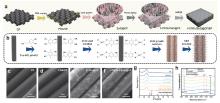
图1
"
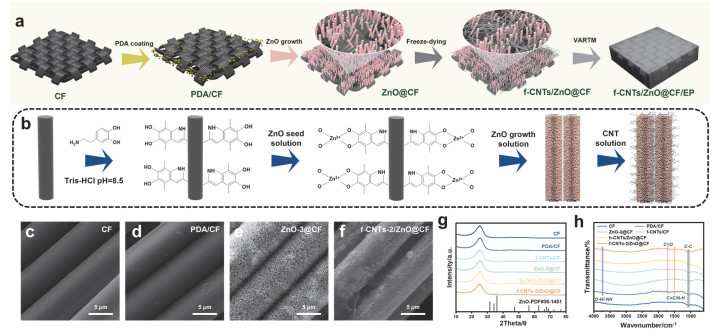
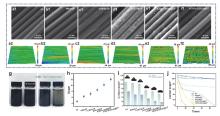
图2
"
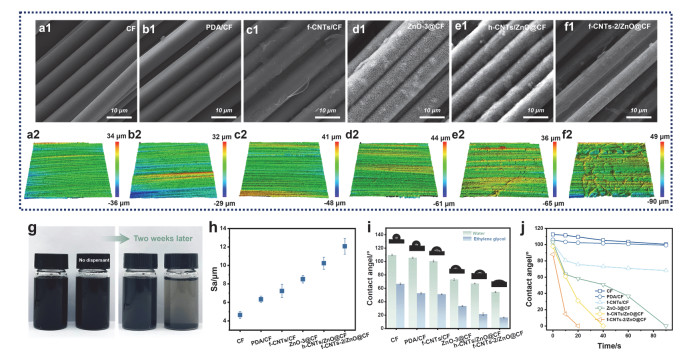
图3
"
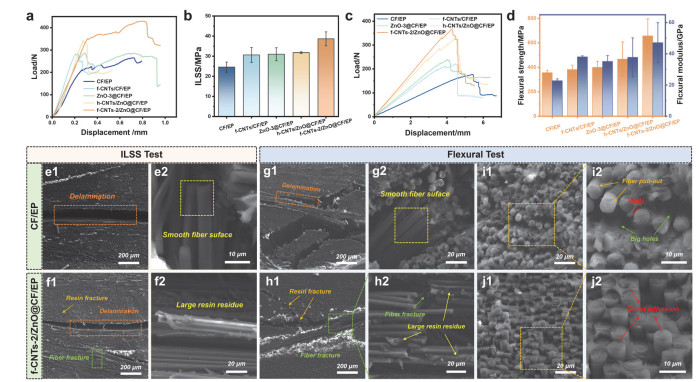
图4
"
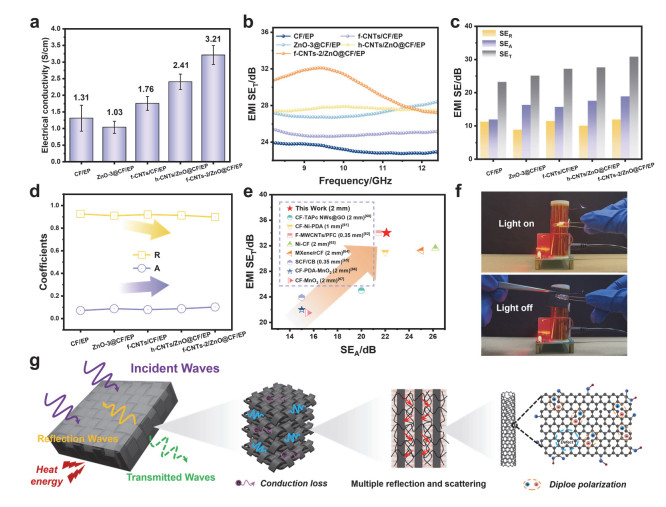
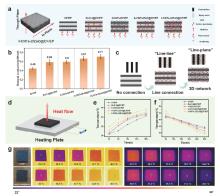
图5
"
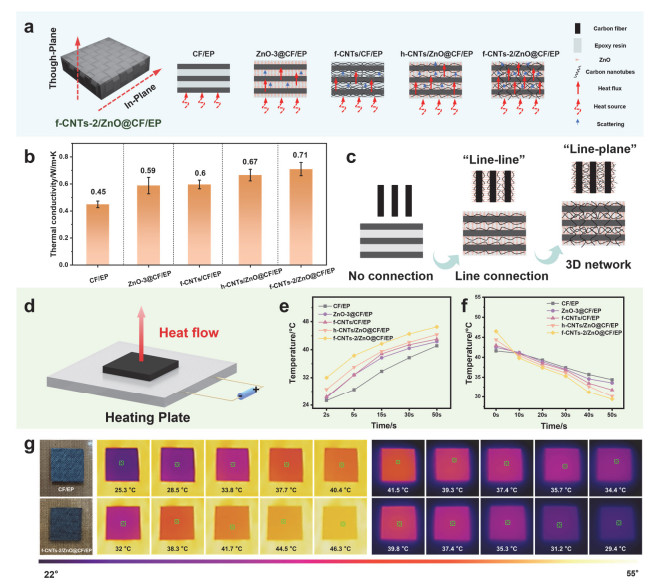
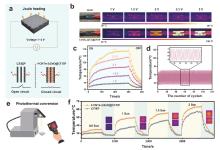
图6
"
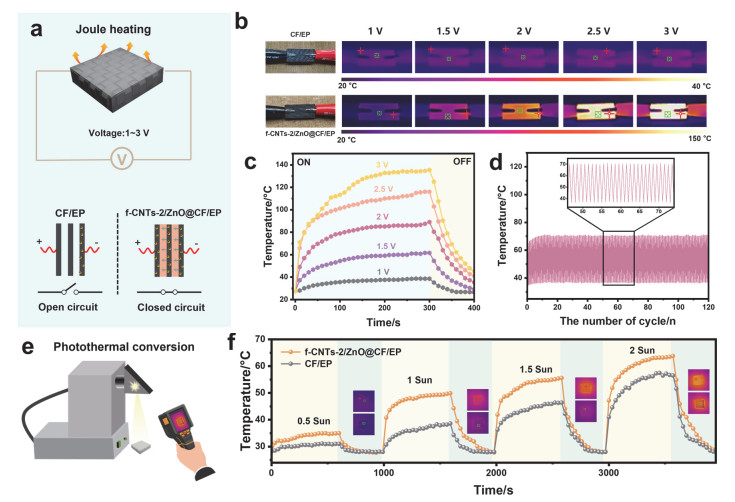
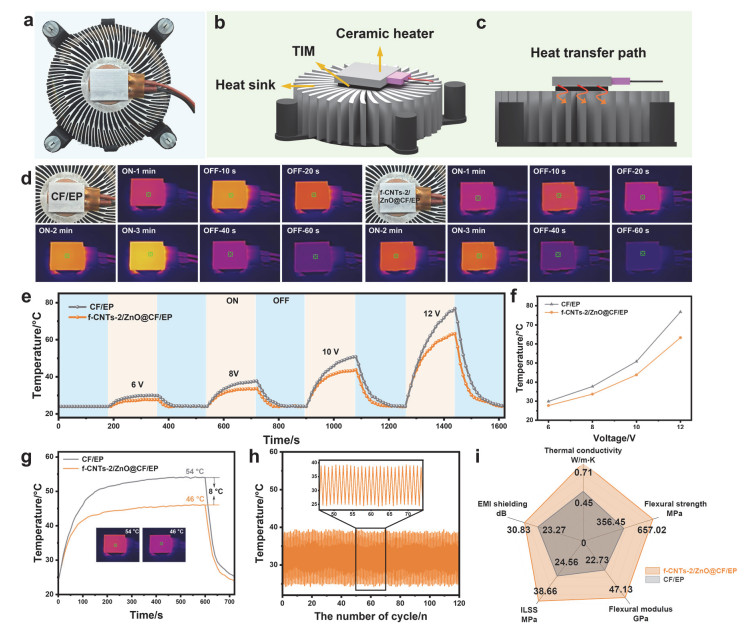
图7
"
| 1 |
F. Yan, L. Liu, K. Li, L. Jin, M. Zhang, Y. Liu, L. Xiao, Y. Ao. Compos. Sci. Technol. 2021, 201, 108489.
doi: 10.1016/j.compscitech.2020.108489 |
| 2 |
X. Chen, S. Cheng, K. Wen, C. Wang, J. Zhang, H. Zhang, H. Ma, L. Wu, T. Li, B. Li, J. Shao. Compos. Pt. B-Eng. 2023, 248, 110368.
doi: 10.1016/j.compositesb.2022.110368 |
| 3 |
H. Zheng, G. Song, J. Zhu, C. Wang, W. Zhang, B. Li, G. Wu, X. Yang, X. Sun, Y. Huang, L. Ma. Compos. Pt. B-Eng. 2023, 263, 110883.
doi: 10.1016/j.compositesb.2023.110883 |
| 4 |
Q. Li, Z. Gao, W. Zhou, S. Yang, Z. Jia, G. Wu. Nano Res. 2026, 19, 94908525.
doi: 10.26599/NR.2026.94908525 |
| 5 |
Y. Pan, K. Yu, D. Lan, Z. Zhang, Z. Chen. Carbon 2025, 245, 120824.
doi: 10.1016/j.carbon.2025.120824 |
| 6 |
M. Shi, Z. Jia, S. Xu, Z. Gao, G. Wu. Adv. Funct. Mater. 2026, 36, e74648.
doi: 10.1002/adfm.74648 |
| 7 |
D. Wu, Z. Yao, X. Sun, X. Liu, L. Liu, R. Zhang, C. Wang. Chem. Eng. J. 2022, 429, 132449.
doi: 10.1016/j.cej.2021.132449 |
| 8 |
N. Xu, S. Chen, Y. Li, N. Jiang, T. Zheng, N. Goossens, J. Vleugels, D. Zhang, D. Seveno. Compos. Pt. B-Eng. 2022, 246, 110278.
doi: 10.1016/j.compositesb.2022.110278 |
| 9 |
Y. Li, B. Jiang, Y. Huang. Compos. Sci. Technol. 2022, 227, 109564.
doi: 10.1016/j.compscitech.2022.109564 |
| 10 |
X. Li, J. Liu, Z. Jia, D. Lan, D. Ai, Z. Gao, F. Bai, G. Wu. J. Mater. Sci. Technol. 2026, 268, 41.
doi: 10.1016/j.jmst.2025.12.046 |
| 11 |
C. Zhang, S. Xiao, Z. Shen, R. Li, J. Liu, S. Guo, L. Xu. New J. Chem. 2020, 44(19), 7876.
doi: 10.1039/d0nj00442a |
| 12 |
H. Tian, Y. Yao, D. Liu, Y. Li, R. Jv, G. Xiang, A. Xiang. Polym. Compos. 2019, 40, E654.
doi: 10.1002/pc.24938 |
| 13 |
B. Wang, Q. Fu, L. Sun, Y. Lu, Y. Liu. Mater. Lett. 2022, 306, 130953.
doi: 10.1016/j.matlet.2021.130953 |
| 14 |
Y. Liu, L. Li, J. Wang, Y. Fei, N. Liu, G. Wu. New Carbon Mater. 2021, 36(3), 639.
doi: 10.1016/s1872-5805(21)60035-5 |
| 15 |
F. Yan, L. Liu, M. Li, M. Zhang, L. Shang, L. Xiao, Y. Ao. Compos. Pt. A-Appl. Sci. Manuf. 2019, 125, 105530.
doi: 10.1016/j.compositesa.2019.105530 |
| 16 |
Z. Yao, C. Wang, Y. Wang. IOP Conf. Ser. Earth Environ. Sci. 2019, 354, 012075.
doi: 10.1088/1755-1315/354/1/012075 |
| 17 |
S. Cui, Z. Yang, Z. Lu. Compos. Sci. Technol. 2020, 193, 108131.
doi: 10.1016/j.compscitech.2020.108131 |
| 18 |
D. Lan, J. Wang, Y. Wang, X. Guo, D. Du, C. Zhang, G. Wu. Carbon 2026, 253, 121416.
doi: 10.1016/j.carbon.2026.121416 |
| 19 |
M. Ma, D. Lan, L. Zhang, Y. Wang, Z. Jia, Z. Gao, H. Qiu, G. Wu. J. Mater. Sci. Technol. 2026, 273, 69.
doi: 10.1016/j.jmst.2026.03.014 |
| 20 |
K. Chen, B. Shi, Y. Yue, J. Qi, L. Guo. ACS Nano 2015, 9(8), 8165.
doi: 10.1021/acsnano.5b02333 |
| 21 |
H. Yu, Y. Zhu, Z. Xiong, B. Lu. Chem. Eng. J. 2020, 399, 125666.
doi: 10.1016/j.cej.2020.125666 |
| 22 |
V. Rodríguez-García, R. Villoria. Compos. Pt. B-Eng. 2021, 215, 108795.
doi: 10.1016/j.compositesb.2021.108795 |
| 23 |
H. Quan, W. Yang, M. Lapeyriere, E. Schaible, R. Ritchie, M. Meyers. Matter 2020, 3(3), 842.
doi: 10.1016/j.matt.2020.05.011 |
| 24 |
S. Zhang, R. Niu, X. Guo, Z. Jia, D. Lan, G. Wu. Carbon 2026, 252, 121371.
doi: 10.1016/j.carbon.2026.121371 |
| 25 |
Y. Zhang, H. Lu, M. Zhan, Z. Hou, S. Li, H. Wang, X. Wu, Y. Zhang. ACS nano 2023, 17(6), 5905.
doi: 10.1021/acsnano.2c12855 |
| 26 |
B. Qiu, B. Qiu, T. Sun, Q. Zou, M. Yuan, S. Zhou, Y. Chen, S. Xia, Z. Heng, H. Zou, M. Liang. Compos. Sci. Technol. 2022, 229, 109672.
doi: 10.1016/j.compscitech.2022.109672 |
| 27 |
C. Song, X. Yin, M. Han, X. Li, Z. Hou, L. Zhang, L. Cheng. Carbon 2017, 116, 50.
doi: 10.1016/j.carbon.2017.01.077 |
| 28 |
T. Zhao, X. Guo, Z. Gao, Z. Jia, D. Lan, G. Wu. Carbon 2026, 254, 121509.
doi: 10.1016/j.carbon.2026.121509 |
| 29 |
Y. Xu, Y. Yang, D. Yan, H. Duan, G. Zhao, Y. Liu. Chem. Eng. J. 2019, 360, 1427.
doi: 10.1016/j.cej.2018.10.235 |
| 30 |
P. Yin, D. Lan, Z. Yuan, R. Wang, Y. Zhang, X. Sun. J. Alloys Compd. 2025, 1037, 182260.
doi: 10.1016/j.jallcom.2025.182260 |
| 31 |
S. Mao, R. Miao, D. Lan, S. Zhang, J. Zhou, X. Liu, S. Du, Z. Zhao, G. Wu. Acta Phys.-Chim. Sin. 2026, 42, 100279.
doi: 10.1016/j.actphy.2026.100279 |
| 32 |
X. Luo, T. Liu, C. Wei, D. Lan, X. Li, Y. Ma, H. Xie, F. Yu, G. Wu. Sustain. Mater. Technol. 2024, 42, e01127.
doi: 10.1016/j.susmat.2024.e01127 |
| 33 |
J. Chen, B. Yuan, D. Yang, Z. Wu, H. Xu, M. Huang, C. Liu, C. Shen. Compos. Sci. Technol. 2023, 240, 110081.
doi: 10.1016/j.compscitech.2023.110081 |
| 34 |
J. Zhou, X. Huang, D. Lan, Z. Jia, G. Wu. Carbon 2025, 248, 121143.
doi: 10.1016/j.carbon.2025.121143 |
| 35 |
X. Luo, H. Xie, Y. Ma, D. Lan, G. Wu, Z. Jia. Int. J. Miner. Metall. Mater. 2026, 33(3), 768.
doi: 10.1007/s12613-025-3252-1 |
| 36 |
H. Liu, R. Fu, X. Su, B. Wu, H. Wang, Y. Xu, X. Liu. Compos. Commun. 2021, 23, 100593.
doi: 10.1016/j.coco.2020.100593 |
| 37 |
X. Ren, D. Lan, Z. Gao, S. Zhang, Y. Zhan, M. He, Z. Jia, G. Wu. J. Mater. Sci. Technol. 2025, 255, 236.
doi: 10.1016/j.jmst.2025.09.001 |
| 38 |
X. Zhou, X. Wang, X. Chen, D. Lan, Y. Gao, X. Wang, D. Li, S. Zhang, L. Zhang, G. Wu. Acta Phys.-Chim. Sin. 2026, 42, 100287.
doi: 10.1016/j.actphy.2026.100287 |
| 39 |
Y. Liu, X. Su, D. Lan, J. Liu, W. Ma, Y. Liu. Acta Phys.-Chim. Sin. 2026, 42, 100276.
doi: 10.1016/j.actphy.2026.100276 |
| 40 |
T. Hu, D. Lan, J. Wang, X. Zhong, G. Bu, P. Yin. Carbon 2025, 232, 119798.
doi: 10.1016/j.carbon.2024.119798 |
| 41 |
H. Lee, S. Dellatore, W. Miller, P. Messersmith. Science 5849, 318(2007), 426.
doi: 10.1126/science.1147241 |
| 42 |
A. Postma, Y. Yan, Y. Wang, A. Zelikin, E. Tjipto, F. Caruso. Chem. Mater. 2009, 21(14), 3042.
doi: 10.1021/cm901293e |
| 43 |
Z. Jia, Z. Guo, H. Ma, D. Lan, G. Wu. Carbon 2026, 251, 121357.
doi: 10.1016/j.carbon.2026.121357 |
| 44 |
J. Elias, R. Tena-Zaera, G. Wang, C. Lévy-Clément. Chem. Mater. 2008, 20(21), 6633.
doi: 10.1021/cm801131t |
| 45 |
J. Fei, D. Luo, J. Huang, C. Zhang, X. Duan, L. Zhang. Surf. Coat. Technol. 2018, 344, 433.
doi: 10.1016/j.surfcoat.2018.03.056 |
| 46 |
N. Zheng, Y. Huang, W. Sun, X. Du, H. Liu, S. Moody, J. Gao, Y. Mai. Carbon 2016, 110, 69.
doi: 10.1016/j.carbon.2016.09.002 |
| 47 |
J. Zheng, L. Cheng, S. Zhang, D. Lan, X. Zhao, X. Liu, J. Zhou, S. Cai, L. Niu, G. Wu, X. Li. J. Mater. Sci. Technol. 2026, 264, 163.
doi: 10.1016/j.jmst.2025.11.031 |
| 48 |
Z. Jia, J. Li, D. Lan, S. Zhang, Z. Gao, X. Shi, G. Wu. J. Mater. Sci. Technol. 2025, 256, 246.
doi: 10.1016/j.jmst.2025.08.044 |
| 49 |
C. Li, Y. Dong, X. Yuan, Z. Qiu, Y. Zhang, S. Yan, X. Gao, B. Zhu. Carbon 2023, 212, 118131.
doi: 10.1016/j.carbon.2023.118131 |
| 50 |
D. Yuan, Y. Li, R. Ma, W. Zhou, J. Li, L. Gao. Compos. Pt. A-Appl. Sci. Manuf. 2026, 201, 109412.
doi: 10.1016/j.compositesa.2025.109412 |
| 51 |
G. Quan, Y. Wu, Y. Zhang, L. Xiao, Y. Liu. Polym. Compos. 2024, 45(3), 2202.
doi: 10.1002/pc.27913 |
| 52 |
R. Niu, Z. Jia, D. Lan, S. Zhang, Z. Gao, Z. Weng, F. Bai, G. Wu. Nano Res. 2026, 19, 94908411.
doi: 10.26599/NR.2026.94908411 |
| 53 |
C. Zhang, F. Zhou, Y. Zhao, S. Wang, S. Huang, Q. Zhao, D. Lan, X. Guo, Y. Ren, B. Liang. New J. Chem. 2026, 50(7), 3256.
doi: 10.1039/D5NJ04791A |
| 54 |
T. Hou, Y. Zhang, Z. Jia, D. Lan, G. Wu. Carbon 2026, 251, 121348.
doi: 10.1016/j.carbon.2026.121348 |
| 55 |
J. Zhou, D. Shi, Y. Wang, W. Dong, M. Chen. Compos. Commun. 2023, 37, 101432.
doi: 10.1016/j.coco.2022.101432 |
| 56 |
D. Liu, D. Lan, Y. Yin, J. Kong, Y. Meng, Y. Liu, Y. Qiu, G. Xia, D. Liu. Acta Phys.-Chim. Sin. 2026, 42, 100275.
doi: 10.1016/j.actphy.2026.100275 |
| 57 |
Z. Jiao, W. Huyan, J. Yao, Z. Yao, J. Zhou, P. Liu. J. Mater. Sci. Technol. 2022, 113, 166.
doi: 10.1016/j.jmst.2021.09.024 |
| 58 |
X. Luo, H. Xie, F. Yu, J. Zhang, X. Li, X. Wei, X. Lai, S. Wang. Mater. Res. Bull. 2024, 175, 112759.
doi: 10.1016/j.materresbull.2024.112759 |
| 59 |
B. Liang, Y. Zhao, S. Wang, S. Huang, F. Zhou, C. Zhang, Y. Wang, X. Guo. Acta Phys.-Chim. Sin. 2026, 42, 100285.
doi: 10.1016/j.actphy.2026.100285 |
| 60 |
M. He, P. Xu, Y. Zhang, K. Liu, X. Yang. Chem. Eng. J. 2020, 388, 124255.
doi: 10.1016/j.cej.2020.124255 |
| 61 |
S. Zhu, R. Shi, M. Qu, J. Zhou, C. Ye, L. Zhang, H. Cao, D. Ge, Q. Chen. Compos. Sci. Technol. 2021, 207, 108696.
doi: 10.1016/j.compscitech.2021.108696 |
| 62 |
M. Qu, X. Yang, L. Peng, L. Liu, C. Yang, Z. Zhao, X. Liu, T. Zhang, J. He. Carbon 2021, 174, 110.
doi: 10.1016/j.carbon.2020.12.015 |
| 63 |
W. Wang, Z. Zhai, J. Liu, Y. Wang, Z. Yang. Polym. Compos. 2023, 44(12), 8838.
doi: 10.1002/pc.27741 |
| 64 |
Y. Hu, J. Gu, Y. Zhang, G. Liu, X. Yi, X. Liu. Compos. Commun. 2024, 48, 101953.
doi: 10.1016/j.coco.2024.101953 |
| 65 |
D. Kong, J. Li, A. Guo, X. Xiao. Chem. Eng. J. 2021, 408, 127365.
doi: 10.1016/j.cej.2020.127365 |
| 66 |
N. Sun, Q. Cui, K. Qiao, Y. Zhang, J. Zhou, S. Yan, L. Liu, B. Zhu, B. Yu. Compos. Pt. A-Appl. Sci. Manuf. 2024, 184, 108260.
doi: 10.1016/j.compositesa.2024.108260 |
| 67 |
N. Sun, Q. Cui, L. Liu, B. Zhu, B. Yu. Chem. Eng. J. 2025, 513, 162826.
doi: 10.1016/j.cej.2025.162826 |
| 68 |
L. Qiu, P. Guo, Q. Kong, C. W. Tan, K. Liang, J. Wei, J. N. Tey, Y. Feng, X. Zhang, B. K. Tay. Carbon 2019, 145, 725.
doi: 10.1016/j.carbon.2019.01.085 |
| 69 |
P. Qiao, J. Dai, Z. Niu, Y. Li, D. Lan, Y. Yi, Y. Cao, Y. Wang, L. Chen. J. Polym. Res. 2026, 33(2), 49.
doi: 10.1007/s10965-026-04773-1 |
| 70 |
X. Cheng, C. Wang, D. Lan, Z. Tang, S. Chen, W. Zhang, X. Zhou, L. Zhang, G. Wu. Nano Res. 2026,
doi: 10.26599/nr.2026.94908433 |
| [1] | 方春月, 谭晓璇, 王春红, 何洋, 裴晓园, 张钰, Sarani binti Zakaria, 伏广伟, 王建刚, 陈利, 刘坤, 徐婷, 司传领. 聚多巴胺封装液态金属的Janus液态金属@MXene/Fe3O4纳米纤维膜:用于电磁干扰屏蔽与红外调控[J]. 物理化学学报, 2026, 42(10): 100281 - . |
| [2] | 刘晓南, 雷智, 卢茂霞, 马冬威, 王川, 吴泽宏, 张道海. 构建基于Fe3O4@ZIF-67的柔性多功能水凝胶及其电磁干扰屏蔽与应变传感性能[J]. 物理化学学报, 2026, 42(10): 100354 - . |
| [3] | 黄鋆, 聂鹏飞, 鲁勇朝, 李佳洋, 王怡文, 刘建允. 丝光沸石负载自支撑氮掺杂多孔碳纳米纤维电容器及高效选择性去除硬度离子[J]. 物理化学学报, 2025, 41(7): 100066 - . |
| [4] | 李莹, 赵钰燊, 陈凯, 刘旭, 伊廷锋, 陈立锋. 高性能锂离子电池用N掺杂C-Sn交联纳米纤维自支撑电极的理性设计[J]. 物理化学学报, 2024, 40(3): 2305007 - . |
| [5] | 贺文娅, 程虎虎, 曲良体. 烯碳纤维基能源器件的研究进展[J]. 物理化学学报, 2022, 38(9): 2203004 - . |
| [6] | 王骞, 吴恺, 王航超, 刘文, 周恒辉. 亲锂的三维二硫化锡@碳纤维布用于稳定的锂金属负极[J]. 物理化学学报, 2021, 37(1): 2007092 - . |
| [7] | 王玖,吴南石,刘涛,曹少文,余家国. 用于超级电容器的锰钴氧化物/碳纤维材料[J]. 物理化学学报, 2020, 36(7): 1907072 - . |
| [8] | 宁红岩,杨其磊,杨晓,李鹰霞,宋兆钰,鲁逸人,张立红,刘源. 碳纤维负载Rh-Mn紧密接触的催化剂及其合成气制乙醇催化性能[J]. 物理化学学报, 2017, 33(9): 1865 -1874 . |
| [9] | 李婷,向双飞,东为富,马丕明,施冬健,陈明清. 纳米钠基蒙脱土复合超强机械性能双网络抗菌水凝胶[J]. 物理化学学报, 2016, 32(11): 2761 -2768 . |
| [10] | 梁祎, 卢赟, 姚维尚, 张学同. 化学改性氧化石墨烯交联的聚酰亚胺气凝胶[J]. 物理化学学报, 2015, 31(6): 1179 -1185 . |
| [11] | 马娟,宋凤丹,周泽齐,齐随涛,伊春海,杨伯伦. 一维有序ZnO纳米棒阵列的制备和优化[J]. 物理化学学报, 2015, 31(11): 2213 -2219 . |
| [12] | 卢建建,应宗荣,刘信东,赵双生. 静电纺丝法制备交联多孔纳米碳纤维膜及其电化学电容性能[J]. 物理化学学报, 2015, 31(11): 2099 -2108 . |
| [13] | 柴晓燕, 朱才镇, 何传新, 张广照, 刘剑洪. 液态丙烯腈低聚物修复聚丙烯腈基碳纤维微孔缺陷[J]. 物理化学学报, 2014, 30(4): 753 -760 . |
| [14] | 于惠梅, 潘秀红, 张明辉, 刘岩, 余建定. Nd3+/Yb3+离子共掺的氧化钛基上转换发光玻璃的热学和力学性能[J]. 物理化学学报, 2014, 30(2): 227 -231 . |
| [15] | 孙宝, 郝彦忠, 郭奋, 李英品, 罗冲, 裴娟, 申世刚. P3HT修饰一维有序壳核式CdS/ZnO纳米棒阵列复合膜的光电化学性能[J]. 物理化学学报, 2012, 28(12): 2861 -2866 . |
|
||