物理化学学报 >> 2024, Vol. 40 >> Issue (11): 2406020.doi: 10.3866/PKU.WHXB202406020
所属专题: 太阳燃料制备
用于高效制氢的双S型ZnS/ZnO/CdS异质结构光催化剂
RazaAsif Hassan, FarhanShumail, 余志贤, 吴艳*( )
)
- 中国地质大学(武汉)材料科学与化学学院, 武汉 430078
-
收稿日期:2024-06-17修回日期:2024-07-24录用日期:2024-07-29发布日期:2024-10-14 -
通讯作者:Email: wuyan@cug.edu.cn; Tel: +86-13517286716 (吴艳) -
基金资助:国家自然科学基金(22378372); 中国政府奖学金支持
Double S-Scheme ZnS/ZnO/CdS Heterostructure Photocatalyst for Efficient Hydrogen Production
Asif Hassan Raza, Shumail Farhan, Zhixian Yu, Yan Wu*()
- Faculty of Materials Science and Chemistry, China University of Geosciences, Wuhan 430078, China
-
Received:2024-06-17Revised:2024-07-24Accepted:2024-07-29Published:2024-10-14 -
Contact:Email: wuyan@cug.edu.cn; Tel: +86-13517286716 (Yan Wu) -
Supported by:the National Natural Science Foundation of China(22378372); Chinese Government Scholarship

摘要:
这项工作展示了一种新型具有高效光催化活性的双S型ZnS/ZnO/CdS三元异质结光催化剂。具有最佳CdS组成的ZnS/ZnO/CdS三元催化剂,ZnS/ZnO/CdS-14%显示最大H2析出速率为4.1 mmol·g‒1·h‒1。最大光催化性能分别约是相应的ZnS/CdS和ZnO/ZnS的2倍和13倍。在420 nm下,获得了19.8%的量子效率。此外,连续6次测试后,催化剂的结构和产氢活性只有微小的变化,表明了光催化剂的稳定性。根据理论计算和实验结果,三元光催化活性的显著提高归因于快速的电子转移和分离,以及相互作用的双S型半导体界面之间的紧密接触。这项工作强调了一种构建双S型光催化系统的新方法,该分解水产氢系统对光生载流子具有高效分离和快速迁移能力。
引用本文
RazaAsif Hassan, FarhanShumail, 余志贤, 吴艳. 用于高效制氢的双S型ZnS/ZnO/CdS异质结构光催化剂[J]. 物理化学学报, 2024, 40(11), 2406020. doi: 10.3866/PKU.WHXB202406020
Asif Hassan Raza, Shumail Farhan, Zhixian Yu, Yan Wu. Double S-Scheme ZnS/ZnO/CdS Heterostructure Photocatalyst for Efficient Hydrogen Production[J]. Acta Phys. -Chim. Sin. 2024, 40(11), 2406020. doi: 10.3866/PKU.WHXB202406020
图1
"
图2
"
图3
"
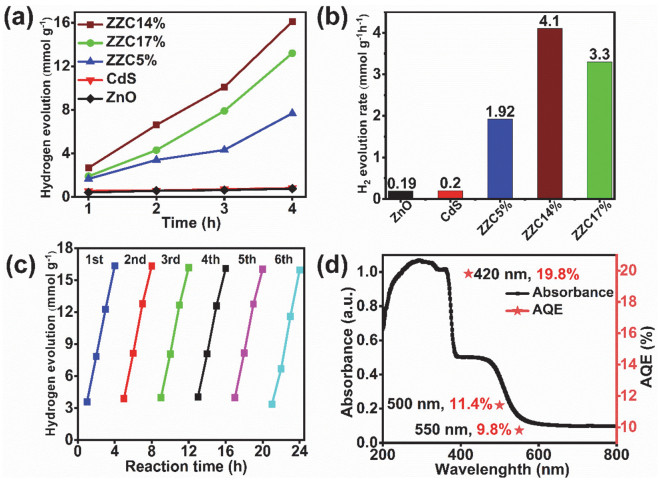
图4
"
图5
"
图6
"
图7
"
图8
"
图9
"
| 1 |
doi: 10.1016/j.chempr.2022.04.013 |
| 2 |
doi: 10.3866/PKU.WHXB202212009 |
| 3 |
doi: 10.1038/238037a0 |
| 4 |
doi: 10.1039/DIRA04823F |
| 5 |
doi: 10.1016/j.nanoen.2023.109164 |
| 6 |
doi: 10.1016/S1872-2067(21)63889 |
| 7 |
doi: 10.1021/acsami.3c8575 |
| 8 |
doi: 10.1002/anie.202303054 |
| 9 |
doi: 10.3866/PKU.WHXB202004046 |
| 10 |
doi: 10.1016/j.apcatb.2023.123196 |
| 11 |
doi: 10.1016/j.jmst.2023.06.052 |
| 12 |
doi: 10.1016/j.mtchem.2024.102000 |
| 13 |
doi: 10.1016/j.apcatb.2023.123325 |
| 14 |
doi: 10.1016/j.mtadv.2024.100469 |
| 15 |
doi: 10.1016/j.mtcomm.2023.107999 |
| 16 |
doi: 10.1016/j.jcis.2024.04.010 |
| 17 |
doi: 10.1016/j.inoche.2021.109056 |
| 18 |
doi: 10.1016/j.cej.2023.148296 |
| 19 |
doi: 10.1016/j.mtsust.2023.100337 |
| 20 |
doi: 10.1021/acssuschemeng.2c07255 |
| 21 |
doi: 10.1016/j.cej.2021.130368 |
| 22 |
doi: 10.1001/adma.202202929 |
| 23 |
doi: 10.1021/acsaem.2c00301 |
| 24 |
doi: 10.1021/acsami.3c15957 |
| 25 |
doi: 10.1021/acsnano.3c12773 |
| 26 |
doi: 10.1002/adma.202311937 |
| 27 |
doi: 10.1016/j.jece.2023.109760 |
| 28 |
doi: 10.1016/j.apsusc.2022.155631 |
| 29 |
Li, Q.; Yang, S.; Huang, Y.; Liang, Y.; Hu, C.; Wang, M.; Liu, Z.; Tai, Y.; Liu, J.; Li, Y. J. Mater. Sci. Technol. 2024, in press. doi: 10.1016/j.jmst.2024.01.104
|
| 30 |
doi: 10.3866/PKU.WHXB202312024 |
| 31 |
doi: 10.1038/s41467-024-49004-7 |
| 32 |
doi: 10.1038/s41467-020-18350-7 |
| 33 |
doi: 10.1016/j.apcatb.2018.11.011 |
| 34 |
doi: 10.1002/adma.202310600 |
| 35 |
doi: 10.3866/PKU.WHXB202307022 |
| 36 |
doi: 10.3866/PKU.WHXB202208030 |
| 37 |
doi: 10.1016/S1872-2067(23)64438-9 |
| 38 |
doi: 10.1016/j.jmst.2023.04.049 |
| 39 |
doi: 10.3866/PKU.WHXB202212016 |
| 40 |
doi: 10.1016/j.jmst.2023.03.002 |
| 41 |
doi: 10.1016/j.jcis.2022.11.058 |
| 42 |
doi: 10.1016/j.jmst.2023.07.029 |
| 43 |
doi: 10.3866/PKU.WHXB202308036 |
| 44 |
doi: 10.1016/j.ijhydene.2024.01.087 |
| 45 |
doi: 10.1016/j.mineng.2023.108236 |
| 46 |
doi: 10.1002/small.202309439 |
| 47 |
doi: 10.1016/S1872-2067(23)64502-4 |
| 48 |
doi: 10.1016/S1872-2067(23)64466-3 |
| 49 |
doi: 10.1016/j.cej.2022.140258 |
| 50 |
doi: 10.1007/s10853-022-07980-5 |
| 51 |
doi: 10.1021/acsanm.3c05962 |
| 52 |
doi: 10.1016/j.cej.2023.144217 |
| 53 |
doi: 10.1002/anie.202218688 |
| 54 |
doi: 10.1016/j.apcatb.2021.120184 |
| 55 |
doi: 10.1016/j.mtchem.2023.101875 |
| 56 |
doi: 10.1016/j.apsusc.2024.159795 |
| 57 |
doi: 10.1039/D1CY00951F |
| 58 |
doi: 10.1038/s41467-024-47022-z |
| 59 |
doi: 10.1016/j.jcis.2024.04.189 |
| 60 |
doi: 10.1016/j.cej.2024.151408 |
| 61 |
doi: 10.1021/acsnano.0c00767 |
| 62 |
doi: 10.1016/j.nanoen.2022.107411 |
| 63 |
doi: 10.1016/j.jmst.2023.07.019 |
| 64 |
doi: 10.1016/j.jmst.2024.02.055 |
| 65 |
doi: 10.1016/j.apcatb.2022.122300 |
| 66 |
doi: 10.1016/j.nanoen.2022.108024 |
| 67 |
doi: 10.1016/j.nanoen.2021.106646 |
| 68 |
doi: 10.1016/j.jcis.2023.06.080 |
| 69 |
doi: 10.1016/j.apmt.2021.101344 |
| 70 |
doi: 10.1002/admi.202002124 |
| 71 |
doi: 10.1016/j.apcatb.2022.121839 |
| 72 |
doi: 10.1002/adma.202309199 |
| 73 |
doi: 10.1002/adma.202209141 |
| [1] | 黄火帅, 韦之栋, 严嘉玮, 池家晟, 苏千翔, 陈铭夏, 江治, 孙洋洲, 上官文峰. 揭示ZnxCd1−xS固溶体光催化析氢中的直接-间接带隙跃迁机制[J]. 物理化学学报, 2026, 42(1): 100141 - . |
| [2] | 赵呈孝, 李昭霖, 吴东方, 杨小飞. SBA-15模板化共价三嗪框架增强光催化产氢[J]. 物理化学学报, 2026, 42(1): 100149 - . |
| [3] | 洪佳楠, 许辰宇, 刘烟, 黎昌棋, 王梦琳, 张彦威. 通过边缘活性位点调控解析光热催化中析氢与二氧化碳还原的界面竞争[J]. 物理化学学报, 2025, 41(9): 100099 - . |
| [4] | 李钦, 张慧慧, 顾华军, 崔园园, 高瑞华, 戴维林. Ti3C2 MXene纳米片上原位生长的Cd0.5Zn0.5S纳米棒实现高效可见光催化析氢[J]. 物理化学学报, 2025, 41(4): 100031 - . |
| [5] | 赵鑫婉, 曹越, 雷敏军, 靳治良, TsubakiNoritatsu. 构建S型异质结:通过将共价有机框架与过渡金属硫化物结合实现高效无贵金属光催化制氢[J]. 物理化学学报, 2025, 41(12): 100152 - . |
| [6] | 柳如艳, 倪振瑞, RuzimuradovOlim, TurayevKhayit, 刘涛, 余罗, 邝攀勇. Ni诱导的Pt 5d-H 1s反键轨道调控以增强析氢和尿素氧化[J]. 物理化学学报, 2025, 41(12): 100159 - . |
| [7] | 秦春玲, 陈爽, GomaaHassanien, ShenashenMohamed A., El-SaftySherif A., 刘倩, 安翠华, 刘熙俊, 邓齐波, 胡宁. 外加物理场调控二维材料的HER和OER性能[J]. 物理化学学报, 2024, 40(9): 2307059 - . |
| [8] | 孙巍, 王永靖, 项坤, 白赛帅, 王海涛, 邹菁, Arramel, 江吉周. CoP修饰Ti3C2Tx MXene纳米复合材料作为高效析氢反应电催化剂[J]. 物理化学学报, 2024, 40(8): 2308015 - . |
| [9] | 肖林锋, 任婉璐, 沈诗诗, 陈梦姗, 廖润华, 周英棠, 李喜宝. 调控ZnIn2S4/Bi2O3 S型异质结的电子结构和润湿性增强光催化析氢[J]. 物理化学学报, 2024, 40(8): 2308036 - . |
| [10] | 卢华森, 宋世旭, 贾萁森, 刘光波, 姜鲁华. 用于光电催化水分解的氧化亚铜基光电阴极研究进展[J]. 物理化学学报, 2024, 40(2): 2304035 - . |
| [11] | 黄凯辉, 陈德俊, 张欣, 沈荣晨, 张鹏, 许第发, 李鑫. 构建共价三嗪框架/氮掺杂碳包覆氧化亚铜S型异质结促进光催化析氢[J]. 物理化学学报, 2024, 40(12): 2407020 - . |
| [12] | 周正宇, 姚惠琴, 吴有林, 李腾, 椿范立, 靳治良. Cu-石墨炔/双金属钨酸盐S型异质结协同增强光催化析氢[J]. 物理化学学报, 2024, 40(10): 2312010 - . |
| [13] | 杨文秀, 张金锋, 徐全龙, 杨云, 张礼杰. AuCu双金属合金修饰共价有机框架用于高效光催化析氢[J]. 物理化学学报, 2024, 40(10): 2312014 - . |
| [14] | 赖可溱, 李丰彦, 李宁, 高旸钦, 戈磊. 金属-有机骨架衍生的Ni-CNT/ZnIn2S4异质结用于光催化产氢及其电荷转移途径的确定[J]. 物理化学学报, 2024, 40(1): 2304018 - . |
| [15] | 李真, 刘雯, 陈春旭, 马婷婷, 张金锋, 王正华. 将In2O3/CdSe-DETA纳米复合材料中的电荷转移从Type-I转变为S-Scheme以提高光催化制氢的活性和稳定性[J]. 物理化学学报, 2023, 39(6): 2208030 - . |
|
||