

物理化学学报 >> 2024, Vol. 40 >> Issue (6): 2306039.doi: 10.3866/PKU.WHXB202306039
刘建东1, 李鑫1, 吴达雄1, 王华平1, 黄俊达1, 马建民1,2,*( )
)
收稿日期:2023-06-26
修回日期:2023-08-01
录用日期:2023-08-16
发布日期:2023-11-29
通讯作者:
Email: nanoelechem@hnu.edu.cn (马建民)
基金资助:
Jiandong Liu1, Xin Li1, Daxiong Wu1, Huaping Wang1, Junda Huang1, Jianmin Ma1,2,*()
Received:2023-06-26
Revised:2023-08-01
Accepted:2023-08-16
Published:2023-11-29
Contact:
Email: nanoelechem@hnu.edu.cn (Jianmin Ma)
Supported by:摘要:
锂金属电池的循环稳定性和倍率能力受制于多个因素,如阳极/阴极电解液界面的品质和电解液溶剂化特性。在该工作中,我们提出了阴离子受体电解液添加剂策略,通过六氟苯添加剂对Li+溶剂化结构进行调控,实现了PF6−的稳定性并提高了电解液的导电性,优化了阳极/阴极电解液界面中间相的组分/结构特征,有效抑制了锂枝晶的生长和提升了阴极表面的Li+传输,Li||Li对称电池在1 mA∙cm−2的电流密度下实现超过400 h的稳定循环,并且Li||NCM811电池在200 mA∙g−1的电流密度下经过100次循环后的容量保持率达到75%。
刘建东, 李鑫, 吴达雄, 王华平, 黄俊达, 马建民. 优化Li||NCM811电池电解液溶剂化和电极电解液界面的阴离子受体添加剂策略[J]. 物理化学学报, 2024, 40(6), 2306039. doi: 10.3866/PKU.WHXB202306039
Jiandong Liu, Xin Li, Daxiong Wu, Huaping Wang, Junda Huang, Jianmin Ma. Anion-Acceptor Electrolyte Additive Strategy for Optimizing Electrolyte Solvation Characteristics and Electrode Electrolyte Interphases for Li||NCM811 Battery[J]. Acta Phys. -Chim. Sin. 2024, 40(6), 2306039. doi: 10.3866/PKU.WHXB202306039
图1
"
图2
"
图3
"
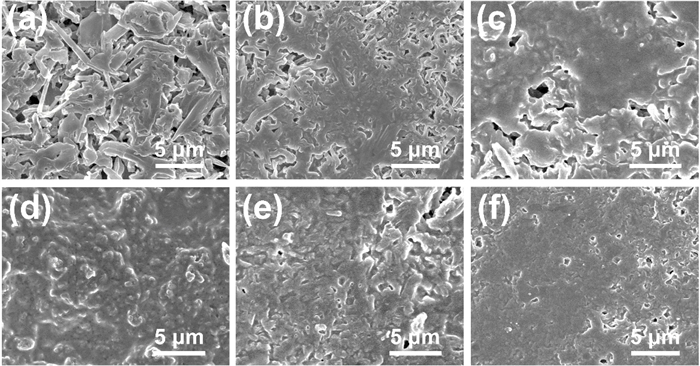
图4
"
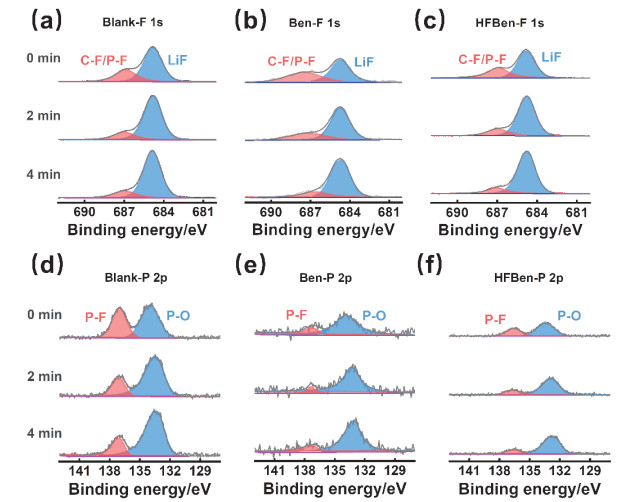
图5
"
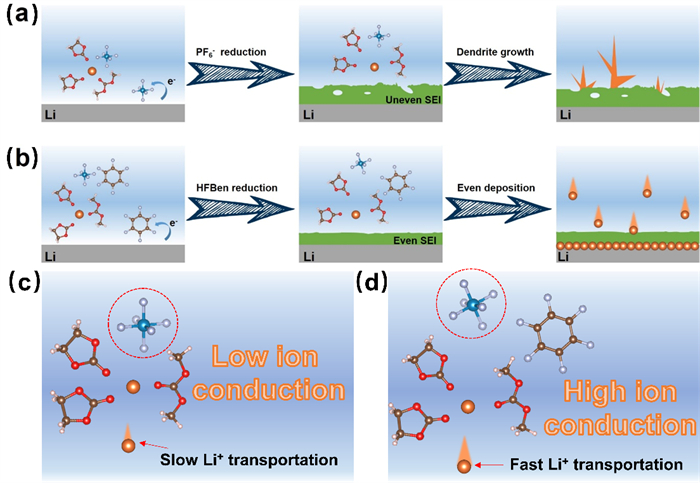
图6
"
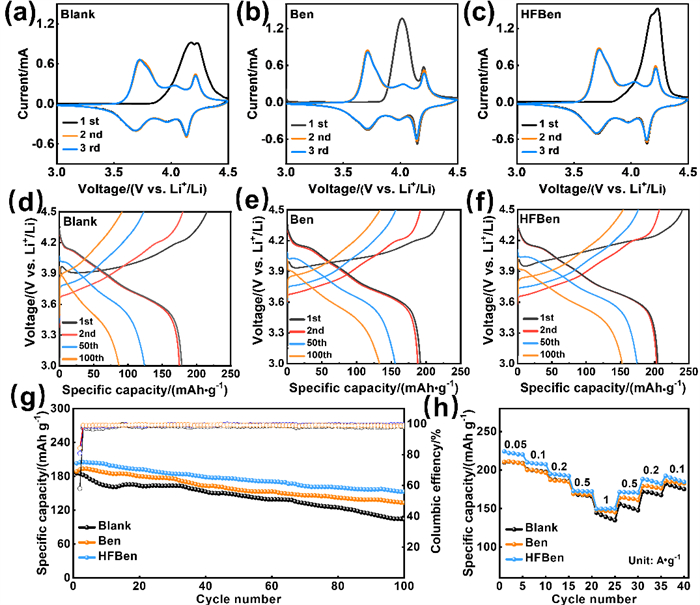
图7
"
| 1 |
|
|
黄俊达; 朱宇辉; 冯煜; 韩叶虎; 谷振一; 刘日鑫; 杨冬月; 陈凯; 张相禹; 孙威; 等. 物理化学学报, 2022, 38, 2208008.
doi: 10.3866/PKU.WHXB202208008 |
|
| 2 |
doi: 10.1016/j.jechem.2021.04.045 |
| 3 |
doi: 10.1002/adfm.202104395 |
| 4 |
doi: 10.1016/j.cclet.2021.07.021 |
| 5 |
doi: 10.1007/s12598-021-01944-5 |
| 6 |
doi: 10.1002/aenm.202100046 |
| 7 |
doi: 10.1016/j.ensm.2018.02.017 |
| 8 |
doi: 10.1073/pnas.2012071118 |
| 9 |
doi: 10.1002/advs.201500213 |
| 10 |
doi: 10.1016/j.jechem.2022.10.026 |
| 11 |
doi: 10.1016/j.jpowsour.2019.227366 |
| 12 |
doi: 10.1016/j.jechem.2019.05.017 |
| 13 |
doi: 10.1021/acsami.6b13105 |
| 14 |
doi: 10.1002/adma.201804822 |
| 15 |
doi: 10.1149/2.0481813jes |
| 16 |
doi: 10.1002/advs.202201297 |
| 17 |
doi: 10.1016/j.jechem.2022.06.046 |
| 18 |
doi: 10.1021/acs.nanolett.6b01581 |
| 19 |
doi: 10.1002/adma.201901645 |
| 20 |
doi: 10.1016/j.electacta.2017.08.179 |
| 21 |
doi: 10.1002/adma.201504117 |
| 22 |
doi: 10.1002/adma.201800884 |
| 23 |
doi: 10.1016/j.jechem.2019.09.031 |
| 24 |
doi: 10.1002/anie.201813905 |
| 25 |
doi: 10.1002/anie.202009575 |
| 26 |
doi: 10.1002/aenm.202300084 |
| 27 |
doi: 10.1021/acsaem.2c03934 |
| 28 |
doi: 10.1002/aenm.202200337 |
| 29 |
doi: 10.1002/anie.202013993 |
| 30 |
doi: 10.1002/anie.202107957 |
| 31 |
doi: 10.1126/science.abn1818 |
| 32 |
doi: 10.1149/2.0011507jes |
| 33 |
doi: 10.1038/nmat4041 |
| 34 |
doi: 10.1002/anie.201916301 |
| 35 |
doi: 10.1016/j.ensm.2021.09.007 |
| 36 |
doi: 10.1021/jp501670g |
| 37 |
doi: 10.1063/1.5144280 |
| 38 |
doi: 10.1002/adma.202301171 |
| 39 |
doi: 10.1002/adfm.202214195 |
| 40 |
doi: 10.1039/B823110A |
| 41 |
doi: 10.1016/j.nanoen.2019.103881 |
| 42 |
doi: 10.1016/j.cpc.2004.12.014 |
| 43 |
doi: 10.1002/wcms.1159 |
| 44 |
doi: 10.1002/adma.202206009 |
| 45 |
doi: 10.1007/s40820-022-00896-4 |
| 46 |
doi: 10.1016/j.electacta.2018.03.089 |
| 47 |
doi: 10.1006/jcph.1995.1039 |
| 48 |
doi: 10.1021/jacs.2c02260 |
| 49 |
doi: 10.1016/j.jpowsour.2013.08.041 |
| 50 |
doi: 10.1038/s41467-018-02888-8 |
| 51 |
doi: 10.1016/j.joule.2020.06.016 |
| 52 |
doi: 10.1002/aenm.202102148 |
| 53 |
doi: 10.1038/s41467-019-13993-7 |
| 54 |
doi: 10.1021/jacs.0c02302 |
| [1] | 彭羽, 陈嘉威, 殷悦, 曹永杰, 廖莫愁, 王丛笑, 董晓丽, 夏永姚. 无碳酸乙烯酯电解液定向构筑正极电解质界面相实现高电压钴酸锂的宽温域稳定运行[J]. 物理化学学报, 2025, 41(8): 100087 - . |
| [2] | 曹雪婷, 察爽爽, 龚鸣. 电催化反应中的界面双电层:理论、表征与应用[J]. 物理化学学报, 2025, 41(5): 100041 - . |
| [3] | 杨睿, 李惠, 孟庆飞, 李文杰, 吴际良, 方永进, 黄驰, 曹余良. PC基电解液对Li/CrOx一次电池高倍率性能的影响[J]. 物理化学学报, 2024, 40(9): 2308053 - . |
| [4] | 韩卓, 张丹丰, 王海先, 郑国瑞, 柳明, 贺艳兵. 长寿命高镍锂电池界面重构电解液添加剂研究进展[J]. 物理化学学报, 2024, 40(9): 2307034 - . |
| [5] | 陈浩, 杨冬月, 黄岗, 张新波. 锂氧电池有机电解液的研究进展[J]. 物理化学学报, 2024, 40(7): 2305059 - . |
| [6] | 刘泽宇, 黄文泽, 肖阳, 张俊东, 孔伟进, 武鹏, 赵辰孜, 陈爱兵, 张强. 全固态无负极锂金属电池纳米化复合集流体构筑[J]. 物理化学学报, 2024, 40(3): 2305040 - . |
| [7] | 李亚捷, 陈斌, 王依平, 邢辉, 赵伟, 张更, 施思齐. 定制电解液或隔膜实现锂离子各向异性输运从而抑制枝晶生长:相场模拟研究[J]. 物理化学学报, 2024, 40(3): 2305053 - . |
| [8] | 薛晴, 李圣驿, 赵亚楠, 盛鹏, 徐丽, 李正曦, 张波, 李慧, 王博, 杨立滨, 曹余良, 陈重学. 基于活性炭||Na0.44MnO2的低成本、高倍率和长寿命碱性钠离子电池电容器[J]. 物理化学学报, 2024, 40(2): 2303041 - . |
| [9] | 夏求应, 蔡雨, 刘威, 王金石, 吴川智, 昝峰, 徐璟, 夏晖. 锂负极失效的全固态薄膜锂电池的直接回收再利用[J]. 物理化学学报, 2023, 39(8): 2212051 -0 . |
| [10] | 屈卓研, 张笑银, 肖茹, 孙振华, 李峰. 有机硫化合物在锂硫电池中的应用[J]. 物理化学学报, 2023, 39(8): 2301019 -0 . |
| [11] | 薛国勇, 李静, 陈俊超, 陈代前, 胡晨吉, 唐凌飞, 陈博文, 易若玮, 沈炎宾, 陈立桅. 单离子聚合物快离子导体[J]. 物理化学学报, 2023, 39(8): 2205012 -0 . |
| [12] | 刘欢, 马宇, 曹斌, 朱奇珍, 徐斌. MXenes在水系锌离子电池中的应用研究进展[J]. 物理化学学报, 2023, 39(5): 2210027 -0 . |
| [13] | 陈晨阳, 赵永智, 李园园, 刘金平. 高电压/宽温域水系碱金属离子电池的研究进展[J]. 物理化学学报, 2023, 39(5): 2211005 -0 . |
| [14] | 汪茹, 刘志康, 严超, 伽龙, 黄云辉. 高安全锂离子电池复合集流体的界面强化[J]. 物理化学学报, 2023, 39(2): 2203043 -0 . |
| [15] | 齐亚娥, 夏永姚. 电解液调控策略提升水系锌离子电池正极材料电化学性能[J]. 物理化学学报, 2023, 39(2): 2205045 -0 . |
|
||
