物理化学学报 >> 2023, Vol. 39 >> Issue (11): 2212062.doi: 10.3866/PKU.WHXB202212062
所属专题: 多物理场能源催化转化
亚甲基蓝嵌入的供体受体型g-C3N4纳米片光催化剂用于产H2
殷方鑫1, 秦品权2,*( ), 许景三3, 曹少文1,*()
- 1 武汉理工大学, 材料复合新技术国家重点实验室, 武汉 430070
2 武汉理工大学, 理学院, 武汉 430070
3 昆士兰科技大学, 化学和物理学院, 澳大利亚 布里斯班 QLD 4000
-
收稿日期:2022-12-31录用日期:2023-02-27发布日期:2023-03-09 -
通讯作者:秦品权,曹少文E-mail:qinpqcu@whut.edu.cn;swcao@whut.edu.cn -
基金资助:国家重点研发计划(2022YFE0114800);国家自然科学基金(51922081)
Methylene Blue Incorporated Donor-Acceptor g-C3N4 Nanosheet Photocatalyst for H2 Production
Fangxin Yin1, Pinquan Qin2,*(), Jingsan Xu3, Shaowen Cao1,*()
- 1 State Key Laboratory of Advanced Technology for Materials Synthesis and Processing, Wuhan University of Technology, Wuhan 430070, China
2 School of Science, Wuhan University of Technology, Wuhan 430070, China
3 School of Chemistry and Physics, Queensland University of Technology, Brisbane, QLD 4000, Australia
-
Received:2022-12-31Accepted:2023-02-27Published:2023-03-09 -
Contact:Pinquan Qin, Shaowen Cao E-mail:qinpqcu@whut.edu.cn;swcao@whut.edu.cn -
Supported by:the National Key R & D Program of China(2022YFE0114800);the National Natural Science Foundation of China(51922081)

摘要:
石墨相氮化碳(g-C3N4)是一种优异的产H2光催化剂,但是其存在载流子分离效率低、光吸收能力较差和比表面积小的问题。本研究通过对二氰二胺和亚甲基蓝(MB)进行热共聚合,结合后续热剥离策略,成功合成了一种新型分子内供体-受体(D-A)结构g-C3N4纳米片光催化剂。实验结果和密度泛函理论(DFT)计算表明,将亚甲基蓝掺入g-C3N4框架中扩大了光吸收范围,促进了载流子的分离。此外,热剥离增加了催化剂的比表面积且进一步促进了载流子的分离。因此,D-A结构g-C3N4纳米片显示出大幅提升的光催化产氢活性(2275.6 μmol·h−1·g−1),分别是块状g-C3N4、D-A结构g-C3N4、g-C3N4纳米片的5.30,2.60和1.30倍。这项工作为设计用于太阳能转换的D-A改性光催化材料提供了一个有价值的思路。
支持信息
引用本文
殷方鑫, 秦品权, 许景三, 曹少文. 亚甲基蓝嵌入的供体受体型g-C3N4纳米片光催化剂用于产H2[J]. 物理化学学报, 2023, 39(11), 2212062. doi: 10.3866/PKU.WHXB202212062
Fangxin Yin, Pinquan Qin, Jingsan Xu, Shaowen Cao. Methylene Blue Incorporated Donor-Acceptor g-C3N4 Nanosheet Photocatalyst for H2 Production[J]. Acta Phys. -Chim. Sin. 2023, 39(11), 2212062. doi: 10.3866/PKU.WHXB202212062
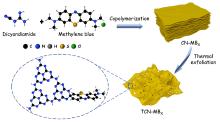
Scheme 1
Schematic illustration of the fabrication of porous TCN-MBx D-A conjugated polymers."
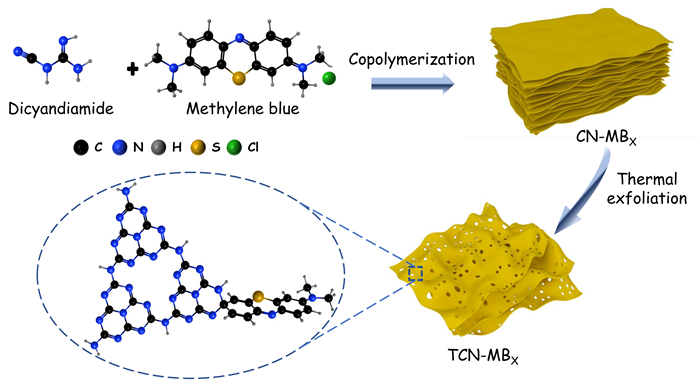
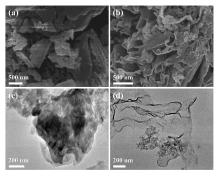
Fig 1
FESEM images of (a) CN and (b) TCN-MB10. TEM images of (c) CN-MB10 and (d) TCN-MB10."
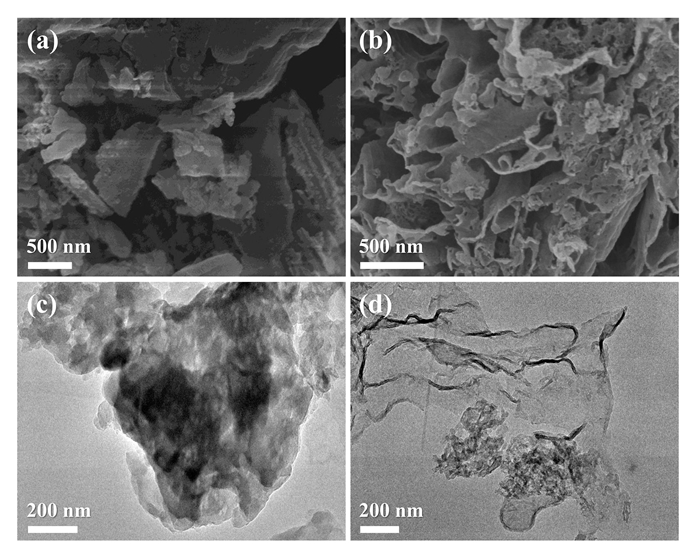
Fig 2
(a) XRD patterns and (b, c) FTIR spectra of CN, CN-MB10, TCN, and TCN-MB10; (d) 13C NMR spectra of CN and CN-MB10."
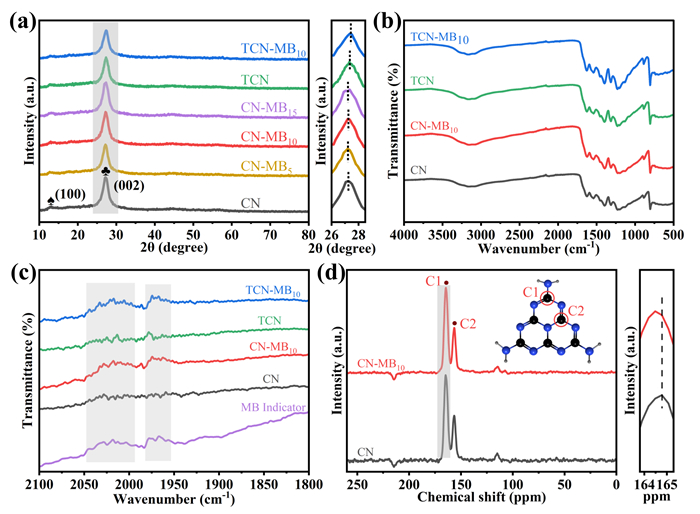
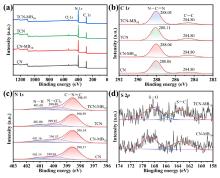
Fig 3
(a) XPS survey spectra, (b) C 1s, and (c) N 1s of CN, CN-MB10, TCN, and TCN-MB10; (d) S 2p of CN-MB10 and TCN-MB10."

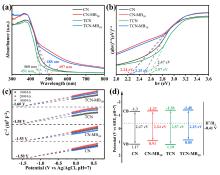
Fig 4
(a) UV-Vis DRS, (b) plots of (αhv)1/2 vs. (hv), (c) Mott-Schottky plots, and (d) band alignments of CN, CN-MB10, TCN, and TCN-MB10."
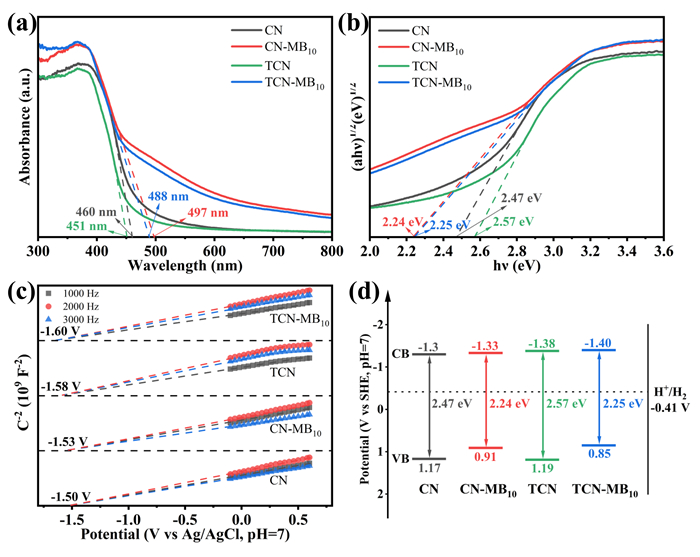
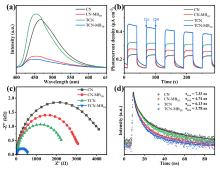
Fig 5
(a) PL spectra, (b) PCR, (c) EIS, and (d) TRPL decay spectra of CN, CN-MB10, TCN, and TCN-MB10."

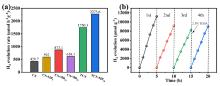
Fig 6
(a) Hydrogen evolution rates of CN, CN-MB, TCN, and TCN-MB10. (b) Stability test of TCN-MB10 photocatalyst."
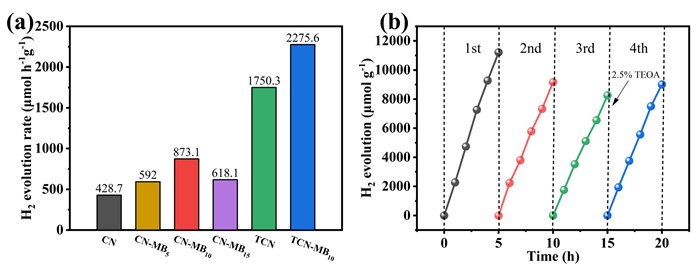
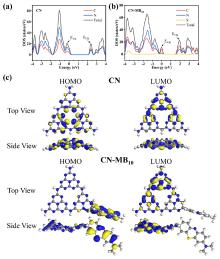
Fig 7
(a, b) PDOS and TDOS profiles of CN and CN-MB10. (c) The spatial distribution of charge density over the HOMO and LUMO of CN and CN-MB10."

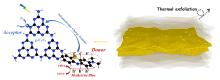
Fig 8
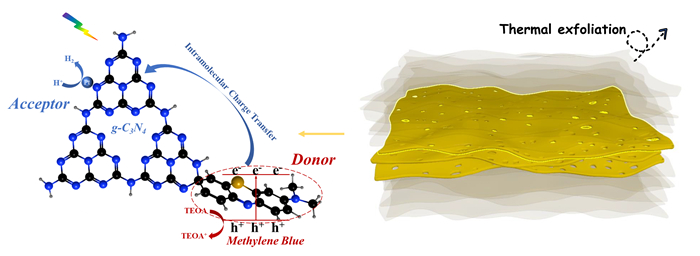
Schematic illustration of the proposed possible mechanism of the improved photocatalytic activity."
| 1 |
XuQ.;ZhangL.;ChengB.;FanJ.;YuJ.Chem2020,6,1543.
doi: 10.1016/j.chempr.2020.06.010 |
| 2 |
ChenX.;WangJ.;ChaiY.;ZhangZ.;ZhuY.Adv. Mater.2021,33,2007479.
doi: 10.1002/adma.202007479 |
| 3 |
CaoS.;LowJ.;YuJ.;JaroniecM.Adv. Mater.2015,27,2150.
doi: 10.1002/adma.201500033 |
| 4 | WuX.;ChenG.;WangJ.;LiJ.;WangG.Acta Phys. -Chim. Sin.2023,39,2212016. |
|
吴新鹤;陈郭强;王娟;李金懋;王国宏;物理化学学报,2023,39,2212016.
doi: 10.3866/PKU.WHXB202212016 |
|
| 5 |
RuanD.;KimS.;FujitsukaM.;MajimaT.Appl. Catal. B-Environ.2018,238,638.
doi: 10.1016/j.apcatb.2018.07.028 |
| 6 |
FujishimaA.;HondaK.Nature1972,238,37.
doi: 10.1038/238037a0 |
| 7 |
MengA.;ZhangL.;ChengB.;YuJ.Adv. Mater.2019,31,1807660.
doi: 10.1002/adma.201807660 |
| 8 |
ShkirM.;PalanivelB.;KhanA.;KumarM.;ChangJ.;ManiA.;AlfaifyS.Chemosphere2022,291,132687.
doi: 10.1016/j.chemosphere.2021.132687 |
| 9 |
ShenR.;RenD.;DingY.;GuanY.;NgY. H.;ZhangP.;LiX.Sci. China-Mater.2020,63,2153.
doi: 10.1007/s40843-020-1456-x |
| 10 |
XiaP.;AntoniettiM.;ZhuB.;HeilT.;YuJ.;CaoS.Adv. Funct. Mater.2019,29,1900093.
doi: 10.1002/adfm.201900093 |
| 11 |
IsmailA. A.;FaisalM.;Al-HaddadA.J. Environ. Sci.2018,66,328.
doi: 10.1016/j.jes.2017.05.001 |
| 12 |
CaoS.;YuJ.J. Phys. Chem. Lett.2014,5,2101.
doi: 10.1021/jz500546b |
| 13 |
WuM.;ZhangJ.;HeB.;WangH.;WangR.;GongY.Appl. Catal. B-Environ.2019,241,159.
doi: 10.1016/j.apcatb.2018.09.037 |
| 14 |
ZhaoS.;ZhangY.;ZhouY.;WangY.;QiuK.;ZhangC.;FangJ.;ShengX.Carbon2018,126,247.
doi: 10.1016/j.carbon.2017.10.033 |
| 15 |
ZhuY.;RenT.;YuanZ.ACS Appl. Mater. Interfaces2015,7,16850.
doi: 10.1021/acsami.5b04947 |
| 16 |
GuoF.;ShiW.;LiM.;ShiY.;WenH.Sep. Purif. Technol.2019,210,608.
doi: 10.1016/j.seppur.2018.08.055 |
| 17 |
WanS.;XuJ.;CaoS.;YuJ.Interdiscip. Mater.2022,1,294.
doi: 10.1002/idm2.12024 |
| 18 |
SunZ.;TanY.;WanJ.;HuangL.Chin. J. Chem.2021,39,2044.
doi: 10.1002/cjoc.202000743 |
| 19 |
PoonC.;WuD.;YamV. W.Angew. Chem.-Int. Ed.2016,55,3647.
doi: 10.1002/anie.201510946 |
| 20 |
CastetF.;AurelP.;FritschA.;DucasseL.;LiotardD.;LinaresM.;CornilJ.;BeljonneD.Phys. Rev. B2008,77,115210.
doi: 10.1103/PhysRevB.77.115210 |
| 21 |
KocherginY. S.;SchwarzD.;AcharjyaA.;IchangiA.;KulkarniR.;EliasovaP.;VacekJ.;SchmidtJ.;ThomasA.;BojdysM. J.Angew. Chem.-Int. Ed.2018,57,14188.
doi: 10.1002/anie.201809702 |
| 22 |
CheH.;LiuC.;CheG.;LiaoG.;DongH.;LiC.;SongN.;LiC.Nano Energy2020,67,104273.
doi: 10.1016/j.nanoen.2019.104273 |
| 23 |
FanX.;ZhangL.;ChengR.;WangM.;LiM.;ZhouY.;ShiJ.ACS Catal.2015,5,5008.
doi: 10.1021/acscatal.5b01155 |
| 24 |
ShiY.;LiL.;SunH.;XuZ.;CaiY.;ShiW.;GuoF.;DuX.Sep. Purif. Technol.2022,292,121038.
doi: 10.1016/j.seppur.2022.121038 |
| 25 |
LiuY.;TianJ.;WangQ.;WeiL.;WangC.;YangC.Opt. Mater.2020,99,109594.
doi: 10.1016/j.optmat.2020.110128 |
| 26 |
ZhuK.;LvY.;LiuJ.;WangW.;WangC.;WangP.;MengA.;LiZ.;LiQ.Ceram. Int.2019,45,3643.
doi: 10.1016/j.ceramint.2018.11.025 |
| 27 |
YangL.;LiuX.;LiuZ.;WangC.;LiuG.;LiQ.;FengX.Ceram. Int.2018,44,20613.
doi: 10.1016/j.ceramint.2018.06.105 |
| 28 |
ChenY.;YangB.;XieW.;ZhaoX.;WangZ.;SuX.;YangC.J. Mater. Res. Technol-JMRT2021,13,301.
doi: 10.1016/j.jmrt.2021.04.056 |
| 29 |
ZhaoH.;YuH.;QuanX.;ChenS.;ZhangY.;ZhaoH.;WangH.Appl. Catal. B-Environ.2014,152,46.
doi: 10.1016/j.apcatb.2014.01.023 |
| 30 |
SheX.;XuH.;XuY.;YanJ.;XiaJ.;XuL.;SongY.;JiangY.;ZhangQ.;LiH.J. Mater. Chem. A2014,2,2563.
doi: 10.1039/c3ta13768f |
| 31 |
XiaP.;ZhuB.;YuJ.;CaoS.;JaroniecM.J. Mater. Chem. A2017,5,3230.
doi: 10.1039/c6ta08310b |
| 32 |
SheX.;WuJ.;ZhongJ.;XuH.;YangY.;VajtaiR.;LouJ.;LiuY.;DuD.;LiH.;et alNano Energy2016,27,138.
doi: 10.1016/j.nanoen.2016.06.042 |
| 33 |
YanJ.;HanX.;QianJ.;LiuJ.;DongX.;XiF.J. Mater. Sci.2017,52,13091.
doi: 10.1007/s10853-017-1419-5 |
| 34 |
DongF.;LiY.;WangZ.;HoW.Appl. Surf. Sci.2015,358,393.
doi: 10.1016/j.apsusc.2015.04.034 |
| 35 | LiH.;LiF.;YuJ.;CaoS.Acta Phys. -Chim. Sin.2021,37,2010073. |
|
李瀚;李芳;余家国;曹少文;物理化学学报,2021,37,2010073.
doi: 10.3866/PKU.WHXB202010073 |
|
| 36 |
NiuP.;ZhangL.;LiuG.;ChengH.Adv. Funct. Mater.2012,22,4763.
doi: 10.1002/adfm.201200922 |
| 37 |
LiK.;SunM.;ZhangW.Carbon2018,134,134.
doi: 10.1016/j.carbon.2018.03.089 |
| 38 |
ChenX.;ShiR.;ChenQ.;ZhangZ.;JiangW.;ZhuY.;ZhangT.Nano Energy2019,59,644.
doi: 10.1016/j.nanoen.2019.03.010 |
| 39 |
WangY.;ZhangY.;ZhaoS.;HuangZ.;ChenW.;ZhouY.;LvX.;YuanS.Appl. Catal. B-Environ.2019,248,44.
doi: 10.1016/j.apcatb.2019.02.007 |
| 40 |
SongX.;WuY.;ZhangX.;LiX.;ZhuZ.;MaC.;YanY.;HuoP.;YangG.Chem. Eng. J.2021,408,127292.
doi: 10.1016/j.cej.2020.127292 |
| 41 |
ZhangG.;ZhangM.;YeX.;QiuX.;LinS.;WangX.Adv. Mater.2014,26,805.
doi: 10.1002/adma.201303611 |
| 42 |
ZhangY.;WuL.;ZhaoX.;ZhaoY.;TanH.;ZhaoX.;MaY.;ZhaoZ.;SongS.;WangY.;et alAdv. Energy Mater.2018,8,1801139.
doi: 10.1002/aenm.201801139 |
| 43 |
QinJ.;WangS.;RenH.;HouY.;WangX.Appl. Catal. B-Environ.2015,179,1.
doi: 10.1016/j.apcatb.2015.05.005 |
| 44 |
YuF.;WangZ.;ZhangS.;YeH.;KongK.;GongX.;HuaJ.;TianH.Adv. Funct. Mater.2018,28,1804512.
doi: 10.1002/adfm.201804512 |
| 45 |
LiH.;LeeH.;ParkG.;LeeB.;ParkJ.;ShinC.;HouW.;YuJ.Carbon2018,129,637.
doi: 10.1016/j.carbon.2017.12.048 |
| 46 |
SongX.;LiX.;ZhangX.;WuY.;MaC.;HuoP.;YanY.Appl. Catal. B-Environ.2020,268,118736.
doi: 10.1016/j.apcatb.2020.118736 |
| 47 |
YangY.;ChenJ.;MaoZ.;AnN.;WangD.;FahlmanB. D.RSC Adv.2017,7,2333.
doi: 10.1039/c6ra26172h |
| 48 |
SunZ.;JiangY.;ZengL.;HuangL.ChemSusChem2019,12,1325.
doi: 10.1002/cssc.201802890 |
| 49 |
YangJ.;WuX.;MeiZ.;ZhouS.;SuY.;WangG.Adv. Sustain. Syst.2022,6,2200056.
doi: 10.1002/adsu.202200056 |
| 50 |
SunH.;GuoF.;PanJ.;HuangW.;WangK.;ShiW.Chem. Eng. J.2021,406,126844.
doi: 10.1016/j.cej.2020.126844 |
| 51 |
ZhengY.;LinL.;YeX.;GuoF.;WangX.Angew. Chem. Int. Ed.2014,53,11926.
doi: 10.1002/anie.201407319 |
| 52 |
LiY.;JinR.;XingY.;LiJ.;SongS.;LiuX.;LiM.;JinR.Adv. Energy Mater.2016,6,1601273.
doi: 10.1002/aenm.201601273 |
| 53 |
WuX.;MaH.;WangK.;WangJ.;WangG.;YuH.J. Colloid Interface Sci.2023,633,817.
doi: 10.1016/j.jcis.2022.11.143 |
| [1] | 魏勉, 程畅, 何博文, 程蓓, 戚克振, 别传彪. 无机-有机CdS/YBTPy S型光催化剂高效产氢及其机理[J]. 物理化学学报, 2025, 41(12): 100158 - . |
| [2] | 刘瑞云, 王苹, 王雪飞, 陈峰, 余火根. 功函数工程调控Mo2C MXene的Mo 4d电子结构以提升光催化产氢效率[J]. 物理化学学报, 2025, 41(11): 100137 - . |
| [3] | 蒋金辉, 孙佳琦, 陈咏一, 张磊, 董鹏玉. W18O49/铝掺杂SrTiO3 S型异质结在LSPR效应辅助下实现全光谱太阳光驱动的光催化产氢[J]. 物理化学学报, 2025, 41(11): 100145 - . |
| [4] | 杨佳琦, 郝旭强, 景杰杰, 郝宇强, 靳治良. 3D/2D ReSe2/ZnCdS S型光催化剂高效界面电荷分离增强光催化析氢[J]. 物理化学学报, 2025, 41(10): 100131 - . |
| [5] | 陈恒, 聂龙辉, 徐凯, 杨毅琼, 方彩红. 两步焙烧法制备大比表面积和结晶性增强超薄g-C3N4纳米片及其高效光催化产H2O2[J]. 物理化学学报, 2024, 40(11): 2406019 - . |
| [6] | 程敬招, 高诗语, 程蓓, 杨凯, 王往, 曹少文. 4-氨基-1H-咪唑-5-甲腈修饰供体-受体型氮化碳光催化剂的构建及其高效光催化产氢研究[J]. 物理化学学报, 2024, 40(11): 2406026 - . |
| [7] | 吕娜, 荆雪东, 许瑶, 鲁巍, 刘奎朝, 张振翼. 多组分纳米纤维体系中载流子动力学的有效级联调制及其高效光催化产氢性能研究[J]. 物理化学学报, 2023, 39(4): 2207045 -0 . |
| [8] | 刘珊池, 王凯, 杨梦雪, 靳治良. Mn0.2Cd0.8S@CoAl LDH S-型异质结构建及其光催化析氢性能研究[J]. 物理化学学报, 2022, 38(7): 2109023 - . |
| [9] | 沈荣晨, 郝磊, 陈晴, 郑巧清, 张鹏, 李鑫. 高分散Co0.2Ni1.6Fe0.2P助催化剂改性P掺杂g-C3N4纳米片高效光催化析氢的研究[J]. 物理化学学报, 2022, 38(7): 2110014 - . |
| [10] | 张鹏, 王继全, 李源, 姜丽莎, 王壮壮, 张高科. 非贵金属助剂Ni2P修饰类石墨碳氮化物光催化剂增强可见光光催化产氢性能[J]. 物理化学学报, 2021, 37(8): 2009102 - . |
| [11] | 姜志民, 陈晴, 郑巧清, 沈荣晨, 张鹏, 李鑫. 1D Mn0.2Cd0.8S纳米棒/2D Ti3C2纳米片肖特基异质结的构建及光催化产氢性能研究[J]. 物理化学学报, 2021, 37(6): 2010059 - . |
| [12] | 刘阳, 郝旭强, 胡海强, 靳治良. 构建NiS2/MoSe2 S型异质结高效光催化产氢[J]. 物理化学学报, 2021, 37(6): 2008030 - . |
| [13] | 周雪梅. 二氧化钛负载单原子催化剂用于光催化反应的研究[J]. 物理化学学报, 2021, 37(6): 2008064 - . |
| [14] | 王苹, 李海涛, 曹艳洁, 余火根. 羧基功能化石墨烯增强TiO2光催化产氢性能[J]. 物理化学学报, 2021, 37(6): 2008047 - . |
| [15] | 杜新华,李阳,殷辉,向全军. Au/TiO2/MoS2等离子体复合光催化剂的制备及其增强光催化产氢活性[J]. 物理化学学报, 2018, 34(4): 414 -423 . |
|
||