物理化学学报 >> 2024, Vol. 40 >> Issue (8): 2308020.doi: 10.3866/PKU.WHXB202308020
所属专题: 电化学分离与资源化
V2CFx MXene衍生2D V2O3@介孔碳纳米片的制备及其电容脱盐特性
张泽豪1,2, 王政1,*( ), 李海波2,*()
- 1 宁夏大学化学化工学院, 煤炭高效利用与绿色化工国家重点实验室, 银川 750021
2 宁夏大学材料与新能源学院, 宁夏光伏材料重点实验室, 银川 750021
-
收稿日期:2023-08-15修回日期:2023-09-10录用日期:2023-09-12发布日期:2023-09-18 -
通讯作者:Email: wzheng@nxu.edu.cn. Tel.: +86-951-2062414 (王政)lihaibo@nxu.edu.cn (李海波) -
基金资助:国家自然科学基金(22272085); 国家自然科学基金(22169015)
Preparation of 2D V2O3@Pourous Carbon Nanosheets Derived from V2CFx MXene for Capacitive Desalination
Zehao Zhang1,2, Zheng Wang1,*(), Haibo Li2,*()
- 1 State Key Laboratory of High-efficiency Utilization of Coal and Green Chemical Engineering, College of Chemistry and Chemical Engineering, Ningxia University, Yinchuan 750021, China
2 Ningxia Key Laboratory of Photovoltaic Materials, School of Materials and New Energy, Ningxia University, Yinchuan 750021, China
-
Received:2023-08-15Revised:2023-09-10Accepted:2023-09-12Published:2023-09-18 -
Contact:Email: wzheng@nxu.edu.cn. Tel.: +86-951-2062414 (Zheng Wang)lihaibo@nxu.edu.cn (Haibo Li) -
Supported by:the National Natural Science Foundation of China(22272085); the National Natural Science Foundation of China(22169015)

摘要:
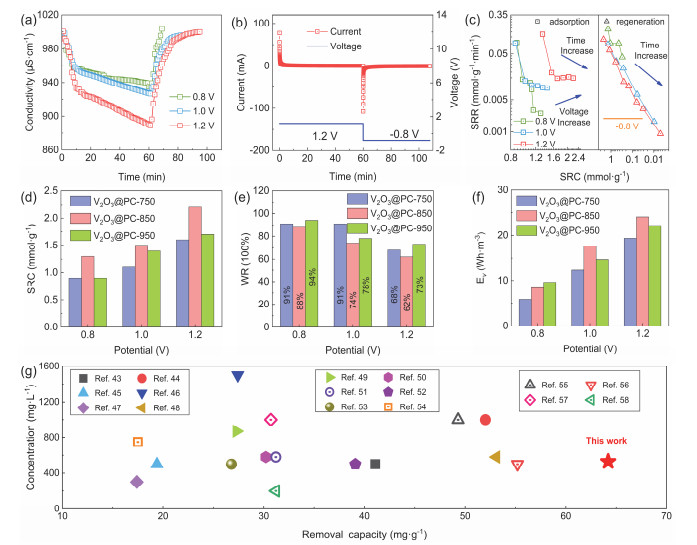
采用同源金属V2CFx MXene作为前驱体制备了三氧化二钒@多孔碳(V2O3@porous carbon,V2O3@PC)纳米片作为电容去离子(CDI)阳极,研究其脱盐特性。实验探究了在不同在碳化温度下V2O3@PC的结构、结晶度、润湿性、石墨化程度和电化学特性。研究表明,所制备的V2O3@PC呈现出典型的2D纳米片结构,高结晶度的V2O3纳米颗粒被高石墨化度的PC牢牢束缚。这种结构具有良好的界面润湿性和高导电性,因而可以促进电解质的渗透,加速界面电荷的转移以并促进盐离子的传输和扩散。此外,PC也能较好的抑制V2O3在多次循环后的体积膨胀。电化学结果表明,V的可逆电化学转化在一定程度上提高了Na+的储存。当电压为1.2 V时,NaCl电导率为1000 μS·cm−1时,优化后的V2O3@PC电极具有高达2.20 mmol∙g−1的脱盐容量,0.13 mmol∙g−1∙min−1的脱盐速率,62%的水回收率以及24.0 Wh∙m−3的低能耗。
引用本文
张泽豪, 王政, 李海波. V2CFx MXene衍生2D V2O3@介孔碳纳米片的制备及其电容脱盐特性[J]. 物理化学学报, 2024, 40(8), 2308020. doi: 10.3866/PKU.WHXB202308020
Zehao Zhang, Zheng Wang, Haibo Li. Preparation of 2D V2O3@Pourous Carbon Nanosheets Derived from V2CFx MXene for Capacitive Desalination[J]. Acta Phys. -Chim. Sin. 2024, 40(8), 2308020. doi: 10.3866/PKU.WHXB202308020
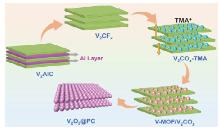
图1
V2O3@PC的合成示意图"
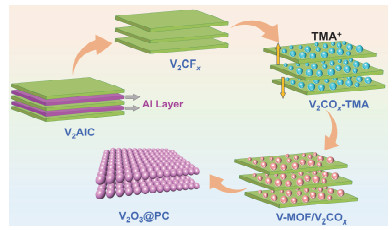
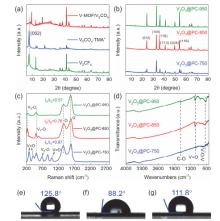
图2
(a) V2CFx、V2COx-TMA+及V-MOF/V2COx的XRD图像,V2O3@PC-750、V2O3@PC-850和V2O3@PC-950的(b) XRD、(c) Raman图像、(d) FTIR图像,(e) V2O3@PC-750、(f) V2O3@PC-850和(g) V2O3@PC-950水接触角图像"
图3
(a–c) V2CFx、V2COx-TMA+及V-MOF/V2COx的SEM图像,(d–f) V2O3@PC-750、V2O3@PC-850和V2O3@PC-950的SEM图像,(g) V2O3@PC-850的元素映射图像"
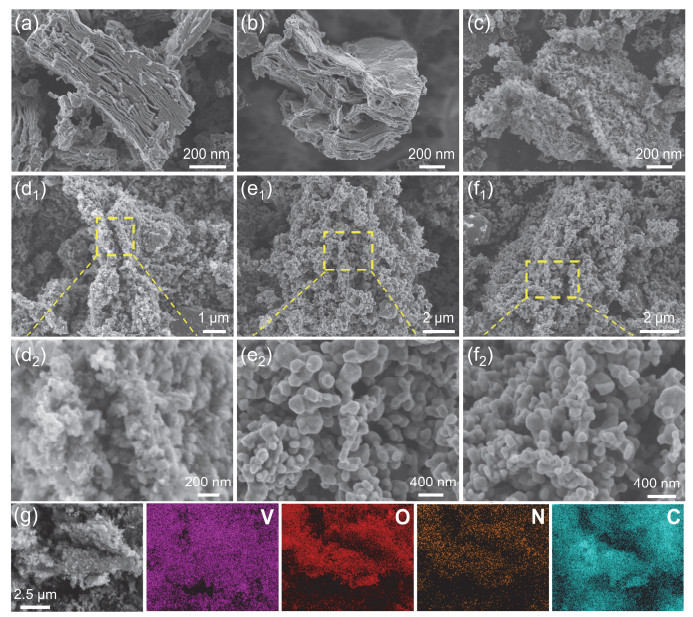
图4
(a,d)、(b,e)、(c,f)分别为V2O3@PC-750、V2O3@PC-850和V2O3@PC-950的HRTEM图像,(g,h,i)分别为V2O3@PC-750、V2O3@PC-850和V2O3@PC-950的SAED模式"
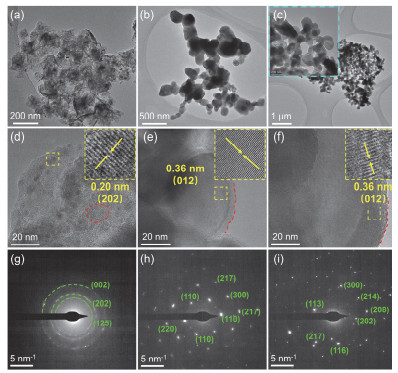
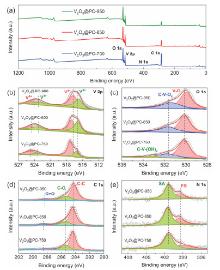
图5
V2O3@PC-750、V2O3@PC-850和V2O3@PC-950的(a) XPS全谱图,(b) V 2p、(c) O 1s、(d) C 1s、(e) N 1s的高分辨XPS谱图"
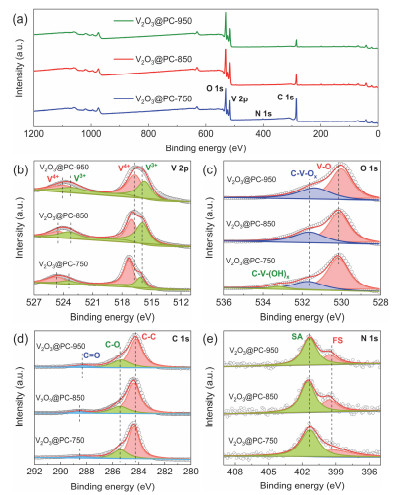
表1
V2O3@PC-750, V2O3@PC-850和V2O3@PC-950的元素分数(at%)"
| Element | Element fraction (at%) | ||
| V2O3@PC-750 | V2O3@PC-850 | V2O3@PC-950 | |
| V | 16.5 | 26.6 | 29.5 |
| O | 26.2 | 41.4 | 43.2 |
| C | 55.9 | 30.9 | 25.9 |
| N | 1.4 | 1.1 | 1.4 |
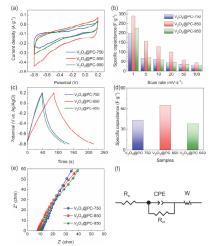
图6
V2O3@PC-750、V2O3@PC-850和V2O3@PC-950的(a) CV曲线,(b)不同扫描速率(mV∙s−1)对应的比电容(F·g−1),(c) 0.5 A·g−1下1.0 mol·L−1 NaCl溶液中的GCD曲线,(d) 0.5 A·g−1电流密度下的比电容,(e) EIS谱和(f)等效电路"
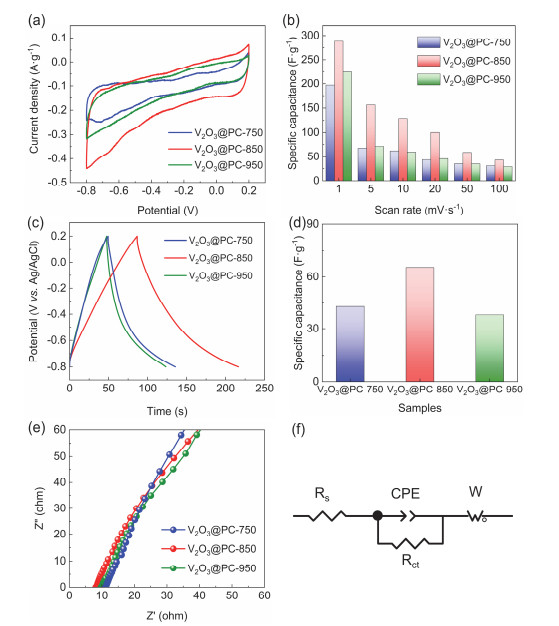
表2
由等效电路拟合的Rs和Rct值"
| Sample | V2O3@PC-750 | V2O3@PC-850 | V2O3@PC-950 |
| Rs (Ω) | 11.2 | 8.2 | 9.8 |
| Rct (Ω) | 0.8 | 0.3 | 0.5 |
图7
(a) V2O3@PC-850//AC CDI系统的电导率和(b)电流瞬态变化,(c)电压对CDI影响的Ragone Kim-Yoon-Plot图,(d)相对于电压(V)下的脱盐容量(mmol·g−1),(e)水回收率,(f)体积能耗和(g)不同CDI电极的脱盐能力比较"
| 1 |
doi: 10.1016/j.carbon.2022.11.035 |
| 2 |
doi: 10.1021/acsami.2c15997 |
| 3 |
doi: 10.1021/acsnano.9b04612 |
| 4 |
doi: 10.1016/j.cej.2022.135381 |
| 5 |
doi: 10.1016/j.cej.2023.142394 |
| 6 |
doi: 10.1016/j.jcis.2023.04.007 |
| 7 |
|
|
熊岳城; 于飞; 马杰. 物理化学学报, 2022, 38, 2006037.
doi: 10.3866/PKU.WHXB202006037 |
|
| 8 |
doi: 10.1016/j.desal.2022.116274 |
| 9 |
doi: 10.1016/j.desal.2023.116652 |
| 10 |
doi: 10.1016/j.diamond.2020.107758 |
| 11 |
doi: 10.1039/C9TA14112J |
| 12 |
doi: 10.1002/anie.202111823 |
| 13 |
doi: 10.1021/acs.est.0c01518 |
| 14 |
doi: 10.1016/j.jcis.2022.05.131 |
| 15 |
doi: 10.2166/wst.2022.383 |
| 16 |
doi: 10.1021/acs.estlett.6b00124 |
| 17 |
doi: 10.1039/D0EE02997A |
| 18 |
doi: 10.1038/s41563-021-00989-2 |
| 19 |
doi: 10.1021/acs.nanolett.1c01276 |
| 20 |
doi: 10.1016/j.matt.2020.02.002 |
| 21 |
doi: 10.1016/j.nanoen.2020.104727 |
| 22 |
doi: 10.1021/acsami.9b13729 |
| 23 |
doi: 10.1038/s41467-021-27203-w |
| 24 |
doi: 10.1016/j.electacta.2019.06.138 |
| 25 |
doi: 10.1039/D1TA01043C |
| 26 |
doi: 10.1002/anie.201709738 |
| 27 |
doi: 10.1002/adma.202110109 |
| 28 |
|
|
邵碧珠; 董慧君; 龚云南; 梅剑华; 蔡锋石; 刘金彪; 钟地长; 鲁统部. 物理化学学报, 2024, 40, 2305026.
doi: 10.3866/PKU.WHXB202305026 |
|
| 29 |
|
|
李玉琼; 兰冰; 管斌; 代春龙; 张帆; 林紫锋. 物理化学学报, 2024, 40, 2306031.
doi: 10.3866/PKU.WHXB202306031 |
|
| 30 |
doi: 10.1002/aenm.202202860 |
| 31 |
doi: 10.1016/j.mattod.2022.06.006 |
| 32 |
doi: 10.19728/j.issn1672-6634.2023010004 |
| 33 |
doi: 10.15541/jim20200243 |
| 34 |
doi: 10.1021/acsnano.9b06866 |
| 35 |
doi: 10.1002/adma.202300771 |
| 36 |
doi: 10.1002/aenm.202001791 |
| 37 |
doi: 10.1016/j.nanoen.2018.05.056 |
| 38 |
doi: 10.1016/j.electacta.2021.138685 |
| 39 |
doi: 10.1016/j.cej.2022.137438 |
| 40 |
doi: 10.1016/j.apsusc.2020.145920 |
| 41 |
doi: 10.1038/s41467-020-17934-7 |
| 42 |
doi: 10.1002/adfm.202000852 |
| 43 |
doi: 10.1016/j.desal.2023.116733 |
| 44 |
doi: 10.1016/j.desal.2021.115376 |
| 45 |
doi: 10.1021/acs.est.9b04274 |
| 46 |
doi: 10.1016/j.desal.2020.114665 |
| 47 |
doi: 10.1016/j.desal.2015.01.033 |
| 48 |
doi: 10.1002/gch2.202100095 |
| 49 |
doi: 10.1039/C7NR03579A |
| 50 |
doi: 10.1016/j.electacta.2016.04.056 |
| 51 |
doi: 10.1039/C4EE02378A |
| 52 |
doi: 10.1039/C9EN01238A |
| 53 |
doi: 10.1039/C8EN00652K |
| 54 |
doi: 10.1016/j.envres.2022.113331 |
| 55 |
doi: 10.1039/D1EN00514F |
| 56 |
doi: 10.1016/j.desal.2020.114897 |
| 57 |
doi: 10.1007/s11771-022-4893-0 |
| 58 |
doi: 10.1016/j.seppur.2021.119828 |
| [1] | 张慧, 赵子健, 王雅静, 倪凯, 王彦飞, 朱亮, 刘建允, 赵晓昱. 通过热压法构建具有高效离子传输路径的无溶剂LiFePO4卤水提锂电极[J]. 物理化学学报, 2026, 42(2): 100130 - . |
| [2] | 陈芸, 邓代洁, 徐丽, 朱兴旺, 李赫楠, 孙成明. 共价键调控电荷转移以实现自供能电化学传感平台对重金属离子的灵敏分析[J]. 物理化学学报, 2026, 42(1): 100144 - . |
| [3] | 王雷, 张盼盼, 郭志远, 汪婧, 马杰, 纪志永. 电化学提锂中的法拉第材料:进展、挑战与性能强化方法[J]. 物理化学学报, 2026, 42(1): 100127 - . |
| [4] | 项书宏, 杨旅, 徐应生, 曹国新, 周宏建. 利用碳纳米管分散的亚铁氰化锌钾电极选择性电吸附高盐放射性废水中的铯(Ⅰ)[J]. 物理化学学报, 2025, 41(9): 100097 - . |
| [5] | 孙明磊, 袁忠勇. 电化学降解污水中含氮废弃物的升值策略[J]. 物理化学学报, 2025, 41(9): 100108 - . |
| [6] | 陈泽秋, 蔡黎淼, 关杰, 李瞻洋, 王昊, 郭耀广, 徐兴涛, 潘丽坤. 电容去离子提锂技术中电极材料的研究进展[J]. 物理化学学报, 2025, 41(8): 100089 - . |
| [7] | 黄鋆, 聂鹏飞, 鲁勇朝, 李佳洋, 王怡文, 刘建允. 丝光沸石负载自支撑氮掺杂多孔碳纳米纤维电容器及高效选择性去除硬度离子[J]. 物理化学学报, 2025, 41(7): 100066 - . |
| [8] | 杨雪琦, 赵俊涛, 叶家伟, 周德森, 狄廷敏, 张军. 调节NNU-55(Fe)的d带中心以增强CO2吸附和光催化活性[J]. 物理化学学报, 2025, 41(7): 100074 - . |
| [9] | 邱领邦, 蒋江民, 王李波, 白浪, 周飞, 周羔宇, 庄全超, 崔艳华. 原位电化学阻抗谱监测长寿命热电池Nb12WO33正极材料的高温双放电机制[J]. 物理化学学报, 2025, 41(5): 100040 - . |
| [10] | 严国泽, 左彬, 刘少卿, 王桃, 王若愚, 包锦洋, 赵忠舟, 储菲菲, 李政通, YusukeYamauchi, SaadMelhi, 徐兴涛. 电容去离子海水提铀的机遇与挑战[J]. 物理化学学报, 2025, 41(4): 100032 - . |
| [11] | 王禹尧, 曹志涛, 杜泽宇, 曹鑫鑫, 梁叔全. 钠离子电池铁基聚阴离子正极材料研究进展[J]. 物理化学学报, 2025, 41(4): 100035 - . |
| [12] | 王卓, 白雪, 张可新, 王鸿志, 董家宝, 高源, 赵斌. MOF模板法合成氮掺杂碳材料用于增强电化学钠离子储存和去除[J]. 物理化学学报, 2025, 41(3): 100026 - . |
| [13] | 叶萍, 覃玲霜, 贺萌瑶, 巫方方, 陈增烨, 梁明星, 邓立波. 荷叶衍生多孔碳的零电荷电位调节实现废水中电化学捕集镉离子[J]. 物理化学学报, 2025, 41(3): 100023 - . |
| [14] | 杨美清, 王路, 卢浩滋, 杨耀成, 刘松. 用于丝网印刷光电化学生物传感器的功能纳米材料的最新进展[J]. 物理化学学报, 2025, 41(2): 100018 - . |
| [15] | 严鹏程, 王鹏, 黄婧, 莫曌, 徐丽, 陈芸, 张瑜, 齐志冲, 许晖, 李赫楠. 多策略提升卤化氧铋活性材料的光电性能及其在光电化学领域的应用进展[J]. 物理化学学报, 2025, 41(2): 100014 - . |
|
||