物理化学学报 >> 2025, Vol. 41 >> Issue (4): 100032.doi: 10.3866/PKU.WHXB202404006
所属专题: 电化学分离与资源化
电容去离子海水提铀的机遇与挑战
严国泽1, 左彬1,*, 刘少卿1, 王桃1, 王若愚1, 包锦洋1, 赵忠舟1, 储菲菲1, 李政通2, YusukeYamauchi3,4,5, SaadMelhi6, 徐兴涛1,*( )
)
- 1 浙江海洋大学海洋科学与技术学院, 浙江 舟山 316022
2 河海大学水文水资源与水利工程科学国家重点实验室, 南京 210098
3 名古屋大学工程研究生院材料工艺工程系, 名古屋 464-8601, 日本
4 澳大利亚昆士兰大学生物工程与纳米技术研究所, 昆士兰州布里斯班 4072, 澳大利亚
5 延世大学化学与生物分子工程系, 首尔 03722, 韩国
6 沙特阿拉伯比沙大学理学院化学系, 比沙 61922, 沙特阿拉伯
-
收稿日期:2024-04-02修回日期:2024-04-30录用日期:2024-05-07发布日期:2024-12-28 -
通讯作者:Email: zuobin@zjou.edu.cn (左彬)xingtao.xu@zjou.edu.cn (徐兴涛) -
基金资助:浙江海洋大学人才引进研究基金(JX6311101423); 浙江海洋大学人才引进研究基金(JX6311103723); 浙江省教育厅一般项目(Y202353930); 浙江省高校基本科研业务费(2024J006); 国家级大学生创新训练项目(202310340024)
Opportunities and Challenges of Capacitive Deionization for Uranium Extraction from Seawater
Guoze Yan1, Bin Zuo1,*, Shaoqing Liu1, Tao Wang1, Ruoyu Wang1, Jinyang Bao1, Zhongzhou Zhao1, Feifei Chu1, Zhengtong Li2, Yamauchi Yusuke3,4,5, Melhi Saad6, Xingtao Xu1,*()
- 1 Marine Science and Technology College, Zhejiang Ocean University, Zhoushan 316022, Zhejiang Province, China
2 State Key Laboratory of Hydrology-Water Resources and Hydraulic Engineering, Hohai, University, Nanjing 210098, China
3 Department of Materials Process Engineering, Graduate School of Engineering, Nagoya University, Nagoya University, Nagoya 464-8601, Japan
4 Australian Institute for Bioengineering and Nanotechnology (AIBN), The University of Queensland, Brisbane, QLD 4072, Australia
5 Department of Chemical and Biomolecular Engineering, Yonsei University, 50 Yonsei-ro, Seodaemun-gu, Seoul 03722, South Korea
6 Department of Chemistry, College of Science, University of Bisha, Bisha, 61922, Saudi Arabia
-
Received:2024-04-02Revised:2024-04-30Accepted:2024-05-07Published:2024-12-28 -
Contact:Email: zuobin@zjou.edu.cn (Bin Zuo)xingtao.xu@zjou.edu.cn (Xingtao Xu) -
Supported by:the Zhejiang Ocean University Talent Introduction Research Fund(JX6311101423); the Zhejiang Ocean University Talent Introduction Research Fund(JX6311103723); the General Project of the Zhejiang Provincial Department of Education(Y202353930); the Fundamental Research Funds for Zhejiang Provincial Universities and Research Institutes(2024J006); the National Undergraduate Innovation Training Program(202310340024)

摘要:
铀是核工业不可或缺的资源,而陆基铀矿资源含量有限且分布不均。因此,海水提铀(UES)对可持续能源生产具有巨大潜力。电容去离子(CDI)技术以其低能耗、工艺简单、对环境友好和高吸附效率而闻名,对UES具有重要潜力。本文回顾了CDI技术的发展历史、原理、分类和应用。在发展历史部分,我们简要介绍了CDI技术的早期发展,并强调了其在UES中的关键里程碑以及近期优化工作。在原理和分类部分,我们将CDI技术置于UES应用的背景下,进行了全面介绍。另外,在应用部分,我们重点介绍了CDI技术在UES中的当前应用。此外,本文详细阐述了CDI技术在UES中的当前研究现状及其在吸附性、选择性和经济效益方面的优势。在吸附性方面,CDI技术通过精心优化电极结构和材料选择,展现了其吸附铀离子的效率。在选择性方面,CDI技术通过灵活调控电极材料和操作参数,有选择性地提取铀,同时减轻了来自竞争离子的干扰,从而提高了提取效率。在经济性方面,CDI技术因其低能耗和经济性脱颖而出,促进了高效的铀提取,且在UES领域具有与替代方法相比的实质经济优势。最后,我们讨论了该技术在铀提取过程中的挑战因素(竞争离子、盐度、pH值和生物污损),旨在探讨使用CDI技术进行UES的可行性和经济效益,并为进一步优化和推广CDI技术在UES中的应用提供理论支持。此外,我们还致力于通过引入材料信息学来解决CDI在提铀过程中存在的一些当前挑战,并展望该问题的未来发展。本文为CDI技术在UES中的发展和工业进展提供了实用的见解,旨在为后续CDI海水提铀研究提供宝贵的参考,以促进海水资源的可持续利用。
引用本文
严国泽, 左彬, 刘少卿, 王桃, 王若愚, 包锦洋, 赵忠舟, 储菲菲, 李政通, YusukeYamauchi, SaadMelhi, 徐兴涛. 电容去离子海水提铀的机遇与挑战[J]. 物理化学学报, 2025, 41(4), 100032. doi: 10.3866/PKU.WHXB202404006
Guoze Yan, Bin Zuo, Shaoqing Liu, Tao Wang, Ruoyu Wang, Jinyang Bao, Zhongzhou Zhao, Feifei Chu, Zhengtong Li, Yamauchi Yusuke, Melhi Saad, Xingtao Xu. Opportunities and Challenges of Capacitive Deionization for Uranium Extraction from Seawater[J]. Acta Phys. -Chim. Sin. 2025, 41(4), 100032. doi: 10.3866/PKU.WHXB202404006
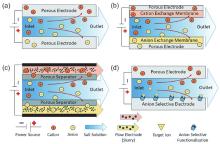
图1
"
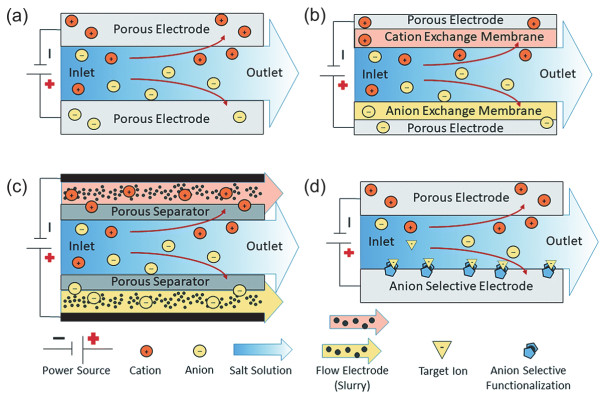
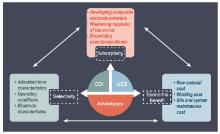
图2
"
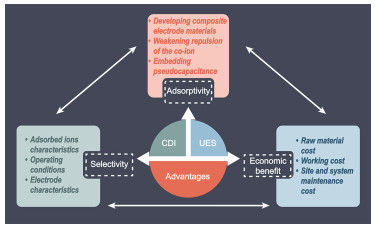
表1
"
| Electrode material/Type | Electrosorption mechanism | Adsorption performance | Ref. | |
| Uptake capacity | Removal ratio | |||
| 3DG | EDL formation | 113.80 mg∙g−1 (at 1.8 Ⅴ) | N/A | |
| CS/GO | EDL formation and complexation | 271.2 mg∙g−1 (at 0.9 Ⅴ) | N/A | |
| CS/BC | EDL formation, ion exchange and complexation | 207.6 mg∙g−1 (at 0.9 Ⅴ and pH 4.0) | N/A | |
| PVA/GO | EDL formation and complexation | 333.0 mg∙g−1 (at 0.9 Ⅴ) | N/A | |
| RGH | EDL, extra micro electric field and complexation | N/A | 97.9% (at 1.2 Ⅴ and 4 h) | |
| HGNbP | Electro-adsorption, electro-reduction and coordination | 1340 mg∙g−1 (in 1000 mg∙L−1 U(Ⅵ) solution) | 99.9% (within 30 min in 50 mg∙L−1 U(Ⅵ) solution) | |
| WO3/C | Synergistic effect of EDLs and pseudocapacitive from WO3/C | 449.9 mg∙g−1 (at 1.2 Ⅴ) | N/A | |
| CMPC | EDLs and pseudocapacitive | 410.33 mg∙g−1 (at 1.2 Ⅴ). | 95.2% | |
| CC/PANI | Hybrid capacitive adsorption and coordination | 282.2 mg∙g−1 (at 0.9 Ⅴ and pH 4.0) | N/A | |
| GO/PPy | EDL and pseudocapacitive adsorption and complexation | 246.5 mg∙g−1 (at pH 4.0 and 0.9 Ⅴ) | N/A | |
| FCDI | Electrosorption and electroreduction | The volume of uranium-containing water was reduced from 2400 mL to 40 mL | 99% | |
| MCDI | Electrosorption | N/A | 98.9% (a groundwater source containing 50 μg∙L−1 uranium) | |
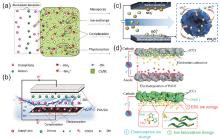
图3
"
表2
"
| Electrode material | Electrosorption mechanism | Performance | Ref. | |
| Uptake capacity | Comparation | |||
| NHPC | UO22+ and NHPC produce synergistic effects through coulomb interaction and reduction reaction | 152.43 mg∙g−1 | Kd = 1620.84 mL∙g−1 | |
| CMM | MXene provides a pseudocapacitance/intercalation effect and the conductive base | 582.46 mg∙g−1 (at 1.2 Ⅴ) | 92.3% multi-ionic solution | |
| Amorphous BP nanosheets | The strong coordination between P and U | In aqueous solutions ranging from 0.05 to 130 mg∙L−1, the maximum adsorption capacity is 2584 mg∙g−1. | When nine kinds of ions coexist and the concentration is 100 times, the material maintains good selectivity for uranyl ions. | |
| CSKN-15 | The redox fixation of U(Ⅵ) | 78.34 mg∙g−1 in seawater | SU/M is higher than 120. | |
| HGP hydrogel | The physi-, chemi-, and electro-sorption simultaneously took effect | 545.7 mg∙g−1 (at 1.2 Ⅴ and pH 5.0) | SU/M values for each cation are far above 1. | |
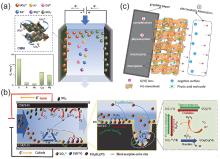
图4
"
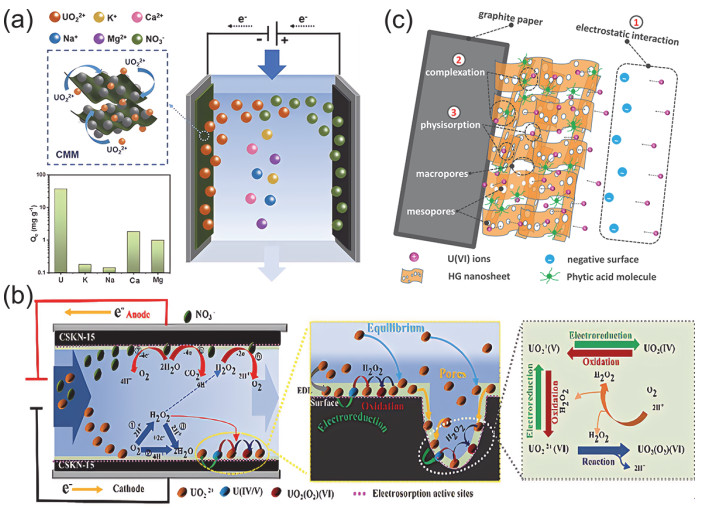
表3
"
| Technologies | Raw material cost | Working cost | Site and system maintenance cost | Total cost |
| Chemical reduction | $20 to $41 | $20 to $100 | $40 to $120 | $80 to $261 |
| Microbial reduction | $20 to $41 | $50 to $130 | $30 to $56 | $100 to $227 |
| Photocatalytic reduction | $20 to $41 | $23 to $30 | $$30 to $60 | $73 to $131 |
| CDI | $40 to $80 | $0.74 to $1.75 | $10 to $80 | $50.74 to $161.75 |
图5
"
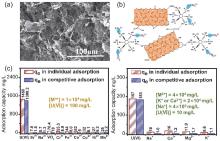
图6
"
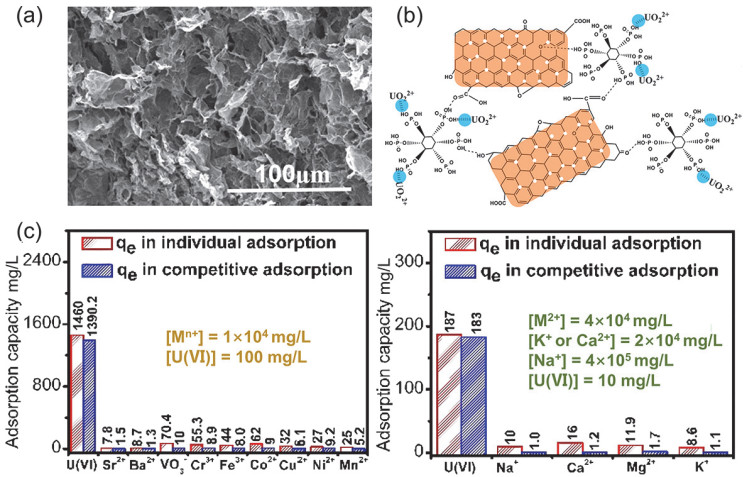
图7
"
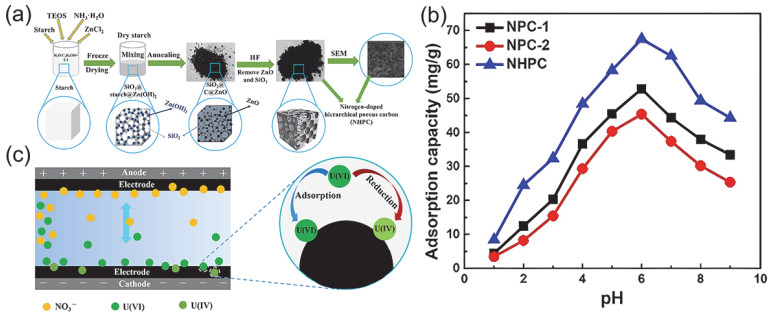
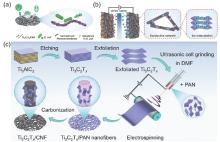
图8
"
| 1 |
doi: 10.1016/j.desal.2023.116773 |
| 2 |
doi: 10.3390/en15124310 |
| 3 |
doi: 10.1002/anie.202007895 |
| 4 |
doi: 10.1016/j.ccr.2023.215097 |
| 5 |
doi: 10.1002/anie.201906191 |
| 6 |
doi: 10.1016/j.ccr.2023.215234 |
| 7 |
doi: 10.1021/acs.est.0c08743 |
| 8 |
doi: 10.1016/j.seppur.2023.124204 |
| 9 |
doi: 10.1016/j.desal.2022.116153 |
| 10 |
doi: 10.1016/j.cej.2021.133578 |
| 11 |
doi: 10.1021/acsami.1c09107 |
| 12 |
doi: 10.1039/d0qm00946f |
| 13 |
doi: 10.1016/j.cej.2020.128129 |
| 14 |
doi: 10.1016/j.asej.2022.102030 |
| 15 |
doi: 10.1016/j.chemosphere.2019.125003 |
| 16 |
doi: 10.1039/c9en00730j |
| 17 |
doi: 10.1016/j.jece.2022.109028 |
| 18 |
doi: 10.1016/j.chemosphere.2018.11.071 |
| 19 |
doi: 10.1021/acs.est.8b02807 |
| 20 |
doi: 10.1080/19443994.2016.1152638 |
| 21 |
doi: 10.1016/j.seppur.2022.122169 |
| 22 |
doi: 10.1016/j.cej.2023.142012 |
| 23 |
doi: 10.1039/d3ta04476a |
| 24 |
|
|
卢淼; 刘建允; 程健; 王世平; 杨健茂. 物理化学学报, 2014, 30, 2263.
doi: 10.3866/PKU.WHXB201410141 |
|
| 25 |
|
|
王雷; 于飞; 马杰. 物理化学学报, 2017, 33, 1338.
doi: 10.3866/PKU.WHXB201704113 |
|
| 26 |
|
|
熊岳城; 于飞; 马杰. 物理化学学报, 2022, 38, 2006037.
doi: 10.3866/PKU.WHXB202006037 |
|
| 27 |
doi: 10.1016/j.seppur.2021.120172 |
| 28 |
doi: 10.1021/acs.chemrev.1c00396 |
| 29 |
doi: 10.1016/j.desal.2022.116219 |
| 30 |
doi: 10.1016/j.pmatsci.2013.03.005 |
| 31 |
doi: 10.1021/j100819a038 |
| 32 |
doi: 10.1149/1.2408094 |
| 33 |
doi: 10.1149/1.1836402 |
| 34 |
doi: 10.1016/j.cplett.2012.06.016 |
| 35 |
doi: 10.1149/1.2213354 |
| 36 |
doi: 10.1016/j.jelechem.2011.01.012 |
| 37 |
doi: 10.1016/j.carbon.2008.11.012 |
| 38 |
doi: 10.1039/c9en00017h |
| 39 |
doi: 10.1016/s0378-3820(00)00114-4 |
| 40 |
doi: 10.1016/j.desal.2006.01.011 |
| 41 |
doi: 10.1039/c3ee24443a |
| 42 |
doi: 10.1039/c4ee02378a |
| 43 |
doi: 10.1016/j.desal.2018.10.013 |
| 44 |
doi: 10.1016/j.watres.2017.10.024 |
| 45 |
doi: 10.1039/c9ew00945k |
| 46 |
doi: 10.3390/membranes12050459 |
| 47 |
doi: 10.1016/j.watres.2015.08.012 |
| 48 |
doi: 10.1038/s41578-020-0193-1 |
| 49 |
doi: 10.1016/j.cocis.2022.101602 |
| 50 |
doi: 10.1002/adfm.202213578 |
| 51 |
doi: 10.21743/pjaec/2021.12.02 |
| 52 |
doi: 10.1016/j.jelechem.2020.114416 |
| 53 |
doi: 10.1016/j.memsci.2009.09.043 |
| 54 |
|
| 55 |
doi: 10.1016/j.desal.2018.01.026 |
| 56 |
doi: 10.1016/j.desal.2019.01.031 |
| 57 |
doi: 10.1021/acs.est.7b05874 |
| 58 |
doi: 10.1016/j.watres.2012.08.031 |
| 59 |
doi: 10.1016/j.desal.2013.04.013 |
| 60 |
doi: 10.1016/j.coelec.2022.101084 |
| 61 |
doi: 10.1016/j.cej.2022.137415 |
| 62 |
doi: 10.1016/j.desal.2023.117096 |
| 63 |
doi: 10.1016/j.memsci.2017.10.026 |
| 64 |
doi: 10.1016/j.seppur.2020.116626 |
| 65 |
doi: 10.1016/j.electacta.2016.09.026 |
| 66 |
doi: 10.1016/j.desal.2022.115569 |
| 67 |
doi: 10.1016/j.desal.2018.10.009 |
| 68 |
doi: 10.1021/acssuschemeng.0c04101 |
| 69 |
doi: 10.1016/j.desal.2019.114078 |
| 70 |
doi: 10.1016/j.seppur.2023.124577 |
| 71 |
doi: 10.1016/S1872-5805(23)60736-X |
| 72 |
doi: 10.1021/acsami.1c09107 |
| 73 |
doi: 10.1016/j.cej.2021.133161 |
| 74 |
doi: 10.3390/en16031136 |
| 75 |
doi: 10.1039/d1mh01882e |
| 76 |
doi: 10.1016/j.cej.2020.124493 |
| 77 |
doi: 10.1016/j.cej.2019.01.098 |
| 78 |
doi: 10.1016/j.seppur.2023.124519 |
| 79 |
doi: 10.1016/j.desal.2023.116619 |
| 80 |
doi: 10.3390/pr10061075 |
| 81 |
doi: 10.1016/j.carbon.2015.12.095 |
| 82 |
doi: 10.1016/j.cej.2023.141621 |
| 83 |
doi: 10.1038/s41545-021-00109-2 |
| 84 |
doi: 10.1016/j.jclepro.2021.128251 |
| 85 |
doi: 10.1021/acs.est.8b04858 |
| 86 |
doi: 10.1002/wer.10696 |
| 87 |
doi: 10.1080/10643389.2021.1902698 |
| 88 |
doi: 10.1016/j.watres.2020.116059 |
| 89 |
doi: 10.1016/j.cej.2017.01.082 |
| 90 |
doi: 10.1016/j.desal.2023.117146 |
| 91 |
Xu, P.; Elson, B.; E Drewes, J. Electrosorption of Heavy Metals with Capacitive Deionization: Water Reuse, Desalination and Resources Recovery. In Desalination; 2019; pp 497–523.
|
| 92 |
doi: 10.1021/acs.est.8b07157 |
| 93 |
doi: 10.1016/j.cej.2023.142012 |
| 94 |
doi: 10.1016/j.seppur.2023.125494 |
| 95 |
doi: 10.1016/j.seppur.2020.117175 |
| 96 |
doi: 10.1016/j.cej.2017.07.067 |
| 97 |
doi: 10.1016/j.colsurfa.2022.129367 |
| 98 |
doi: 10.1016/j.seppur.2023.125292 |
| 99 |
doi: 10.1016/j.jwpe.2022.102930 |
| 100 |
doi: 10.1016/j.seppur.2022.122169 |
| 101 |
doi: 10.1016/j.seppur.2020.117753 |
| 102 |
doi: 10.1016/j.techfore.2013.04.019 |
| 103 |
doi: 10.1016/j.apsusc.2016.11.230 |
| 104 |
doi: 10.1021/ie970518k |
| 105 |
doi: 10.1021/cr5001546 |
| 106 |
doi: 10.1016/j.watres.2014.07.013 |
| 107 |
doi: 10.1039/c7ta03515b |
| 108 |
doi: 10.1039/c7en00019g |
| 109 |
doi: 10.1016/j.electacta.2010.02.012 |
| 110 |
doi: 10.1007/s12039-010-0071-2 |
| 111 |
doi: 10.1016/j.chemosphere.2015.12.012 |
| 112 |
doi: 10.1039/d0ee00341g |
| 113 |
doi: 10.1007/s13762-016-1061-9 |
| 114 |
doi: 10.1007/s10967-019-06650-2 |
| 115 |
doi: 10.1016/j.seppur.2022.120827 |
| 116 |
doi: 10.1016/j.seppur.2021.119005 |
| 117 |
doi: 10.1016/j.seppur.2021.119604 |
| 118 |
doi: 10.1039/c4ee03172e |
| 119 |
doi: 10.1016/j.cej.2021.130351 |
| 120 |
doi: 10.1016/j.jhazmat.2022.130054 |
| 121 |
doi: 10.1016/j.cej.2020.128200 |
| 122 |
doi: 10.1016/j.jcis.2018.07.129 |
| 123 |
doi: 10.1016/j.desal.2014.03.041 |
| 124 |
doi: 10.1016/j.cej.2020.125460 |
| 125 |
doi: 10.1016/j.desal.2023.116773 |
| 126 |
doi: 10.1016/j.jece.2023.111498 |
| 127 |
doi: 10.1016/j.watres.2018.11.064 |
| 128 |
doi: 10.1021/es5055989 |
| 129 |
doi: 10.1016/j.seppur.2021.120172 |
| 130 |
doi: 10.1021/acs.est.3c03477 |
| 131 |
doi: 10.1039/d0ee03145c |
| 132 |
doi: 10.1021/ie050321p |
| 133 |
doi: 10.1016/j.desal.2012.12.029 |
| 134 |
doi: 10.1021/jp711706z |
| 135 |
doi: 10.1016/j.jhazmat.2015.09.064 |
| 136 |
doi: 10.1002/anie.202302180 |
| 137 |
doi: 10.1016/j.cej.2018.11.236 |
| 138 |
doi: 10.1016/j.seppur.2022.122866 |
| 139 |
doi: 10.1016/j.cej.2021.132702 |
| 140 |
doi: 10.1016/j.cej.2023.142413 |
| 141 |
doi: 10.1016/j.jhazmat.2022.128591 |
| 142 |
doi: 10.1038/nenergy.2017.7 |
| 143 |
doi: 10.1016/j.apsusc.2019.04.103 |
| 144 |
doi: 10.1038/s41893-021-00709-3 |
| 145 |
doi: 10.1002/er.5845 |
| 146 |
doi: 10.1002/advs.201900085 |
| 147 |
doi: 10.1016/j.eneco.2015.01.016 |
| 148 |
doi: 10.3390/nano13132005 |
| 149 |
doi: 10.1016/j.cej.2021.128810 |
| 150 |
doi: 10.1002/anie.202101015 |
| 151 |
doi: 10.1016/j.desal.2022.116154 |
| 152 |
doi: 10.1016/j.micromeso.2021.111231 |
| 153 |
doi: 10.1039/d0dt00618a |
| 154 |
doi: 10.1016/j.ccr.2022.214615 |
| 155 |
doi: 10.1002/advs.202201735 |
| 156 |
doi: 10.1016/j.ijbiomac.2022.03.019 |
| 157 |
doi: 10.1021/acsestwater.0c00262 |
| 158 |
doi: 10.1002/adsu.202300393 |
| 159 |
doi: 10.1016/j.inoche.2023.111284 |
| 160 |
doi: 10.1016/j.molliq.2022.120514 |
| 161 |
doi: 10.1016/j.desal.2023.116893 |
| 162 |
doi: 10.1016/j.cej.2021.133121 |
| 163 |
doi: 10.1016/j.seppur.2023.126170 |
| 164 |
doi: 10.1016/j.tree.2022.02.009 |
| 165 |
doi: 10.1016/j.desal.2022.115721 |
| 166 |
doi: 10.1016/j.jhazmat.2022.128983 |
| 167 |
doi: 10.1021/acsami.1c02882 |
| 168 |
doi: 10.1021/acs.est.7b06382 |
| 169 |
doi: 10.1016/j.reactfunctpolym.2021.105068 |
| 170 |
doi: 10.1039/d2sc06946f |
| 171 |
doi: 10.1016/j.seppur.2023.125186 |
| 172 |
doi: 10.1016/j.seppur.2022.120571 |
| 173 |
doi: 10.1016/j.jhazmat.2021.126872 |
| 174 |
doi: 10.1016/j.memsci.2019.117564 |
| 175 |
doi: 10.3390/ma16196451 |
| 176 |
doi: 10.1021/acs.est.6b06339 |
| 177 |
doi: 10.3390/ijerph191710599 |
| 178 |
doi: 10.3390/su142114429 |
| 179 |
doi: 10.2174/1573413716666210101120710 |
| 180 |
doi: 10.3390/app13095635 |
| 181 |
doi: 10.1016/j.cej.2022.134959 |
| 182 |
doi: 10.1016/j.joule.2017.12.010 |
| 183 |
doi: 10.1039/c5ee00519a |
| 184 |
doi: 10.1039/d0ee02838j |
| 185 |
doi: 10.1007/s10845-018-1392-0 |
| 186 |
doi: 10.1002/adma.202107212 |
| [1] | 项书宏, 杨旅, 徐应生, 曹国新, 周宏建. 利用碳纳米管分散的亚铁氰化锌钾电极选择性电吸附高盐放射性废水中的铯(Ⅰ)[J]. 物理化学学报, 2025, 41(9): 100097 - . |
| [2] | 陈泽秋, 蔡黎淼, 关杰, 李瞻洋, 王昊, 郭耀广, 徐兴涛, 潘丽坤. 电容去离子提锂技术中电极材料的研究进展[J]. 物理化学学报, 2025, 41(8): 100089 - . |
| [3] | 黄鋆, 聂鹏飞, 鲁勇朝, 李佳洋, 王怡文, 刘建允. 丝光沸石负载自支撑氮掺杂多孔碳纳米纤维电容器及高效选择性去除硬度离子[J]. 物理化学学报, 2025, 41(7): 100066 - . |
| [4] | 叶萍, 覃玲霜, 贺萌瑶, 巫方方, 陈增烨, 梁明星, 邓立波. 荷叶衍生多孔碳的零电荷电位调节实现废水中电化学捕集镉离子[J]. 物理化学学报, 2025, 41(3): 100023 - . |
| [5] | 王卓, 白雪, 张可新, 王鸿志, 董家宝, 高源, 赵斌. MOF模板法合成氮掺杂碳材料用于增强电化学钠离子储存和去除[J]. 物理化学学报, 2025, 41(3): 100026 - . |
| [6] | 张泽豪, 王政, 李海波. V2CFx MXene衍生2D V2O3@介孔碳纳米片的制备及其电容脱盐特性[J]. 物理化学学报, 2024, 40(8): 2308020 - . |
| [7] | 张笑晨, 于飞, 马杰. 多角度数理模拟在电容去离子中的前沿应用[J]. 物理化学学报, 2024, 40(11): 2311026 - . |
| [8] | 熊岳城, 于飞, 马杰. 电容去离子除氯电极的构建及其脱盐性能研究进展[J]. 物理化学学报, 2022, 38(5): 2006037 - . |
| [9] | 王雷,于飞,马杰. 石墨烯基电极材料的设计和构建及其在电容去离子中的应用[J]. 物理化学学报, 2017, 33(7): 1338 -1353 . |
|
||