物理化学学报 >> 2024, Vol. 40 >> Issue (11): 2311026.doi: 10.3866/PKU.WHXB202311026
所属专题: 电化学分离与资源化
多角度数理模拟在电容去离子中的前沿应用
张笑晨1,2, 于飞3, 马杰1,2,*( )
)
- 1 同济大学环境科学与工程学院, 环境功能材料研究中心, 上海 200092
2 喀什大学土木工程学院, 新疆 喀什 844000
3 上海海洋大学海洋生态与环境学院, 上海 201306
-
收稿日期:2023-11-21修回日期:2023-12-25录用日期:2023-12-26发布日期:2024-02-26 -
通讯作者:Email: jma@tongji.edu.cn (马杰) -
基金资助:国家自然科学基金(22276137); 国家自然科学基金(52170087)
Cutting-Edge Applications of Multi-Angle Numerical Simulations for Capacitive Deionization
Xiaochen Zhang1,2, Fei Yu3, Jie Ma1,2,*()
- 1 Research Center for Environmentally Functional Materials, College of Environmental Science and Engineering, Tongji University, Shanghai 200092, China
2 School of Civil Engineering, Kashi University, Kashi 844000, the Xinjiang Uygur Autonomous Region, China
3 College of Oceanography and Ecological Science, Shanghai Ocean University, Shanghai 201306, China
-
Received:2023-11-21Revised:2023-12-25Accepted:2023-12-26Published:2024-02-26 -
Contact:Email: jma@tongji.edu.cn (Jie Ma) -
Supported by:the National Natural Science Foundation of China(22276137); the National Natural Science Foundation of China(52170087)

摘要:
随着基础理论与计算机领域的发展,诸多相对于实验方法具有明显优势的数理模拟被应用于电容去离子(Capacitive deionization,CDI)技术研究。多角度数理模拟在CDI电极离子动力学、结构-性能构效关系、工艺参数优化及经济技术性分析发挥着重要作用,有力推动了CDI电极材料开发及装置构型设计的发展。目前关于CDI领域的综述集中在CDI电极材料开发和装置构型设计,缺乏关于CDI领域的前沿模拟研究现状及进展的全面综述。本文从最早用于描述CDI动力学过程的连续尺度模型出发,系统地归纳与梳理了CDI中多角度数理模拟的分类,总结了不同数理模拟方法(连续/孔隙尺度模型、分子动力学与密度泛函理论、仿真与机器学习、技术经济性分析)的优势与缺点,并对未来发展方向进行了展望。本文是首篇关于CDI领域多角度数理模拟的前沿进展综述和展望,可为CDI研究新范式提供理论基础和研究思路。
引用本文
张笑晨, 于飞, 马杰. 多角度数理模拟在电容去离子中的前沿应用[J]. 物理化学学报, 2024, 40(11), 2311026. doi: 10.3866/PKU.WHXB202311026
Xiaochen Zhang, Fei Yu, Jie Ma. Cutting-Edge Applications of Multi-Angle Numerical Simulations for Capacitive Deionization[J]. Acta Phys. -Chim. Sin. 2024, 40(11), 2311026. doi: 10.3866/PKU.WHXB202311026
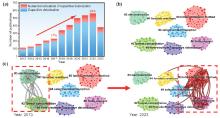
图1
(a) 2013–2023年电容去离子领域的发文数量及其中涉及数理模拟研究的文章比例;(b) 2013–2023年电容去离子领域文献关键词共现聚类分析及高被引论文;(c) 2013年和2023年电容去离子领域文献共现聚类分析(红色虚线框内)。(以上数据来源:Web of Science数据库,可视化软件:CiteSpace)"
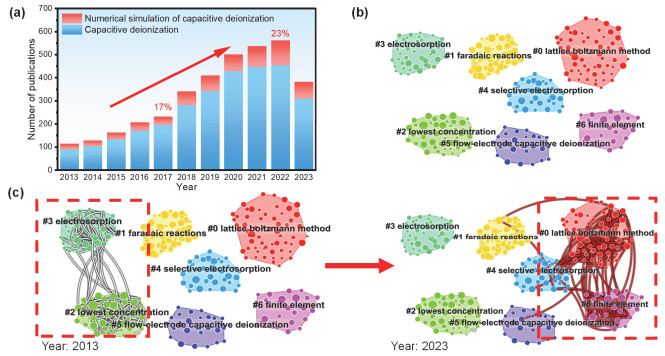
表1
不同数理模拟方法在CDI研究中的优缺点"
| Numerical simulation method | Advantage | Disadvantage |
| Continuous-scale model | Allows effective characterization of the ionodynamic processes of CDI and identification of the conditions that limit its rate and course. | The material microstructure is drastically simplified, requiring the use of semi-empirical formulas to describe reaction kinetics. |
| Pore-scale model | The microscopic porous structure of the porous medium is clearly resolved, eliminating the need for empirical formulas to preset transport parameters. | The number of working groups conducting related research is still small, and the applicability of different electrode materials remains to be examined. |
| Molecular dynamics | Can be used to explain the coupling between ion dynamics, charge compensation mechanisms and CDI performance and ion selectivity. | Empirical parameters are needed to calculate pairing potentials and forces that do not explicitly capture electron degrees of freedom. |
| Density functional theory | It can be used to explain the CDI mechanism of various electrode materials, and at the same time can provide information reference for material design. | Are computationally intensive tasks that take up a lot of computational resources. |
| Finite element analysis | A powerful tool for revealing the relationship between structural properties of electrode materials during ion removal and optimizing CDI process parameters. | Models are approximations of real objects, so accuracy is limited. |
| Computational fluid dynamics | A spatio-temporal quantitative portrayal of the three-dimensional flow field using a combination of computerized numerical calculations and graphical presentations. | Mathematical models are often complex nonlinear partial differential equations that require higher performance computer processors with limited modeling accuracy. |
| Machine learning | Data-driven machine learning has particular strengths in handling nonlinear data and revealing complex mechanisms of water treatment processes. | “Catastrophic forgetting” effect could crash machine learning models. |
| Techno-economic analysis | It is possible to derive the optimal combination of technical and economic aspects of CDI to achieve the best technical and economic results. | Relevant research is still quite scarce and there is a lack of a harmonized and standardized institutional framework. |
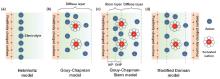
图2
描述双电层结构的四种模型:(a) Helmholtz模型,(b) Gou-Chapman模型,(c) Gouy-Chapman-Stern模型,(d)改进Donna模型"
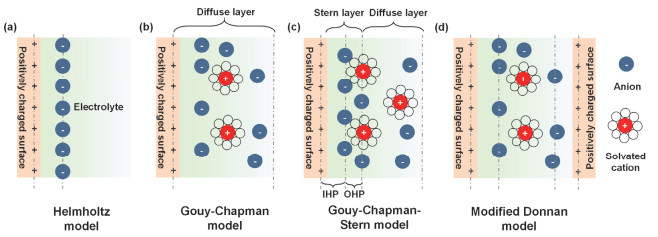
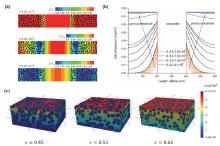
图3
(a) 溶液浓度在多孔电极中的动态分布121;(b) CDI的脱盐容量随时间的变化(箭头表示时间的方向) 121;(c)不同孔隙度(ε)的电极内部离子浓度分布124"
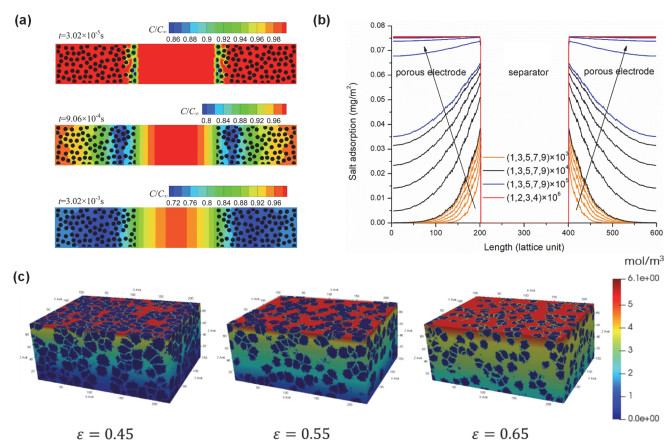
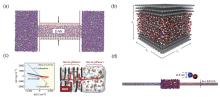
图4
(a) 碳纳米管的分子动力学模拟系统135;(b)充满水以及钠离子和氯离子的狭缝孔隙的模拟系统136;(c)石墨烯(RGO) 薄膜的电化学石英晶体微天平测试结果与分子动力学模拟离子扩散137;(d)超级电容器与离子液体的分子动力学模型138"
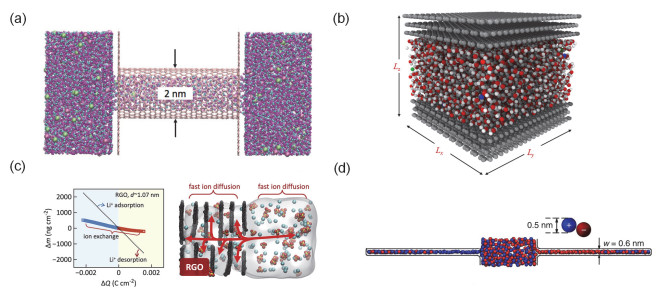
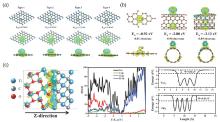
图5
(a) 在具有不同缺陷的碳材料上Na的吸附能140;(b)不同形态碳材料对Na的吸附能及差分电荷密度141;(c) TiO2/Ti3C2异质结的差分电荷密度、分波态密度及功函数计算143"
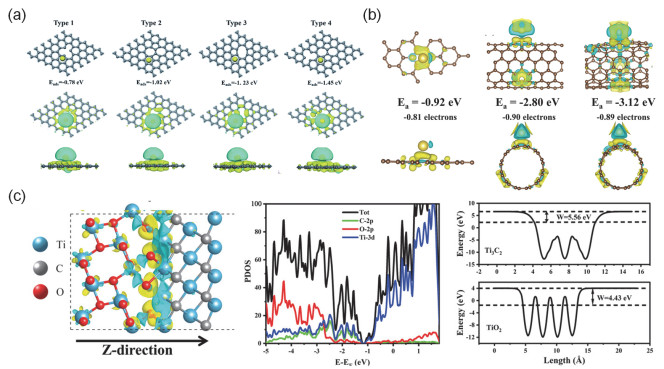
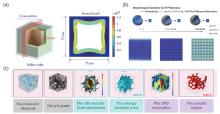
图6
(a) 空心结构与实心结构的应力和变形位移分布的有限元模拟结果152;(b)不同纳米结构离子扩散分布有限元模拟153;(c)三维泡沫集流器的三维电场和计算流体力学模拟163"
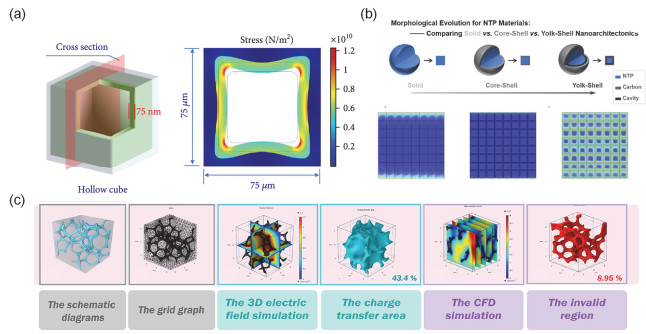
图7
已建立的(a)人工神经网络模型167和(b)随机森林模型的简化拓扑结构167;(c)深度强化学习与膜电容去离子系统结合应用176"
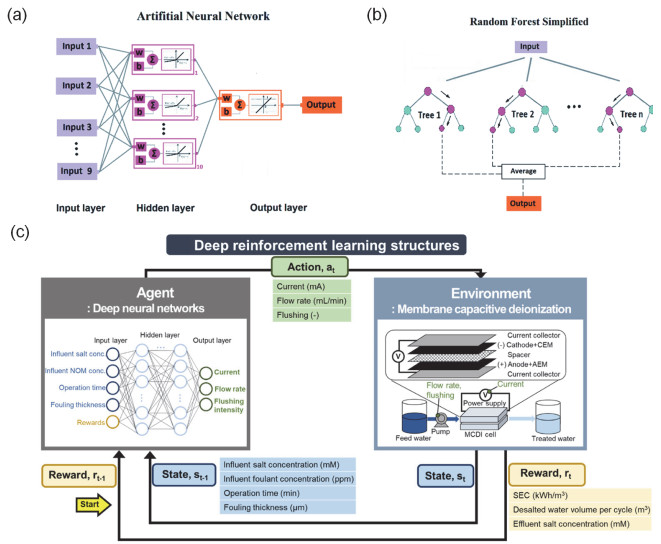
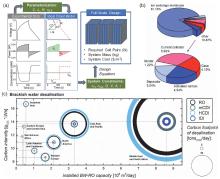
图8
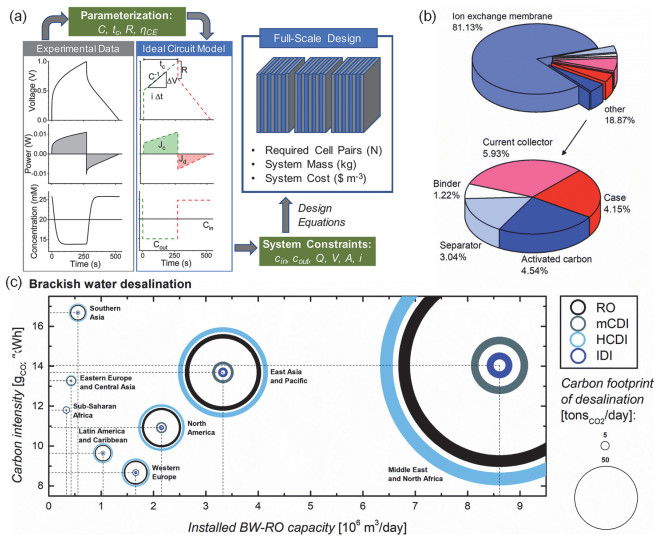
(a) 电容去离子技术经济性分析示意图182;(b)膜电容去离子模块组件成本占比72;(c)反渗透技术与电容去离子技术在不同条件下碳足迹对比72"
| 1 |
doi: 10.1038/s41586-018-0123-1 |
| 2 |
doi: 10.1016/j.desal.2014.02.031 |
| 3 |
doi: 10.1038/nature06599 |
| 4 |
doi: 10.1126/science.1200488 |
| 5 |
doi: 10.3866/PKU.WHXB202009022 |
|
李艳; 胡星盛; 黄静伟; 王磊; 佘厚德; 王其召. 物理化学学报, 2021, 37(8), 2009022.
doi: 10.3866/PKU.WHXB202009022 |
|
| 6 |
doi: 10.3866/PKU.WHXB202201008 |
|
王文亮; 张灏纯; 陈义钢; 史海峰. 物理化学学报, 2022, 38(7), 2201008.
doi: 10.3866/PKU.WHXB202201008 |
|
| 7 |
doi: 10.3866/PKU.WHXB202112027 |
|
周亮; 李云锋; 张永康; 秋列维; 邢艳. 物理化学学报, 2022, 38(7), 2112027.
doi: 10.3866/PKU.WHXB202112027 |
|
| 8 |
doi: 10.3866/PKU.WHXB202101020 |
|
陈清; 赵健; 程虎虎; 曲良体. 物理化学学报, 2022, 38(1), 2101020.
doi: 10.3866/PKU.WHXB202101020 |
|
| 9 |
doi: 10.3866/PKU.WHXB202003031 |
|
常明凯; 胡娜; 李遥; 鲜东帆; 周万强; 王静一; 时燕琳; 刘春立. 物理化学学报, 2022, 38(3), 2003031.
doi: 10.3866/PKU.WHXB202003031 |
|
| 10 |
doi: 10.3866/PKU.WHXB202211019 |
|
刘振中; 万思文; 吴阳; 王波延; 季宏亮. 物理化学学报, 2023, 39(5), 2211019.
|
|
| 11 |
doi: 10.1039/C5EE00519A |
| 12 |
doi: 10.1039/C7EE00855D |
| 13 |
doi: 10.1002/anie.202302180 |
| 14 |
doi: 10.1016/j.watres.2022.118290 |
| 15 |
doi: 10.1039/C3EE24443A |
| 16 |
doi: 10.1016/j.watres.2023.120436 |
| 17 |
doi: 10.1016/j.watres.2023.119831 |
| 18 |
doi: 10.3866/PKU.WHXB201410141 |
|
卢淼; 刘建允; 程健; 王世平; 杨健茂. 物理化学学报, 2014, 30(12), 2263.
doi: 10.3866/PKU.WHXB201410141 |
|
| 19 |
doi: 10.3866/PKU.WHXB201704113 |
|
王雷; 于飞; 马杰. 物理化学学报, 2017, 33(7), 1338.
doi: 10.3866/PKU.WHXB201704113 |
|
| 20 |
doi: 10.3866/PKU.WHXB20111116 |
|
王喜文; 姜芳婷; 索全伶; 方玉珠; 路勇. 物理化学学报, 2011, 27(11), 2605.
doi: 10.3866/PKU.WHXB20111116 |
|
| 21 |
doi: 10.1021/acs.est.9b00655 |
| 22 |
doi: 10.1016/j.watres.2009.10.020 |
| 23 |
doi: 10.1016/j.watres.2021.117959 |
| 24 |
doi: 10.1016/j.desal.2016.03.019 |
| 25 |
doi: 10.1016/j.desal.2023.116798 |
| 26 |
doi: 10.1002/smll.202205619 |
| 27 |
doi: 10.1016/j.watres.2022.119441 |
| 28 |
doi: 10.1021/acs.est.1c03228 |
| 29 |
doi: 10.1016/j.desal.2023.116409 |
| 30 |
doi: 10.1039/D0EN00826E |
| 31 |
doi: 10.1016/j.cej.2022.135381 |
| 32 |
doi: 10.1016/j.cej.2021.133578 |
| 33 |
doi: 10.1039/D1EN00350J |
| 34 |
doi: 10.3866/PKU.WHXB202006037 |
|
熊岳城; 于飞; 马杰. 物理化学学报, 2022, 38(5), 2006037.
doi: 10.3866/PKU.WHXB202006037 |
|
| 35 |
doi: 10.1016/j.jhazmat.2021.127084 |
| 36 |
doi: 10.1016/j.jhazmat.2016.03.055 |
| 37 |
doi: 10.1039/C9EN00730J |
| 38 |
doi: 10.1039/C7TA03515B |
| 39 |
doi: 10.1016/j.scitotenv.2019.07.069 |
| 40 |
doi: 10.1016/j.cej.2017.12.120 |
| 41 |
doi: 10.1016/j.jhazmat.2020.123568 |
| 42 |
doi: 10.1016/j.jhazmat.2023.131785 |
| 43 |
doi: 10.1002/advs.202203189 |
| 44 |
doi: 10.1016/j.watres.2023.119645 |
| 45 |
doi: 10.1016/j.watres.2021.117423 |
| 46 |
doi: 10.1021/acs.est.0c01836 |
| 47 |
doi: 10.1021/acs.est.3c03922 |
| 48 |
doi: 10.1016/j.watres.2022.118351 |
| 49 |
doi: 10.1016/j.jhazmat.2022.128591 |
| 50 |
doi: 10.1021/acs.est.2c00982 |
| 51 |
doi: 10.1016/j.cej.2022.134967 |
| 52 |
doi: 10.1021/acsnano.5b03763 |
| 53 |
doi: 10.1016/j.pmatsci.2013.03.005 |
| 54 |
doi: 10.1149/1.3193709 |
| 55 |
doi: 10.1016/j.electacta.2016.12.060 |
| 56 |
doi: 10.1016/j.desal.2006.01.011 |
| 57 |
doi: 10.1016/j.watres.2021.117222 |
| 58 |
doi: 10.1016/j.watres.2018.11.064 |
| 59 |
doi: 10.1039/C6CS00776G |
| 60 |
doi: 10.1021/cr500232y |
| 61 |
doi: 10.1021/nl203889e |
| 62 |
doi: 10.1016/j.nanoen.2017.12.015 |
| 63 |
doi: 10.1002/advs.201400018 |
| 64 |
doi: 10.1038/ncomms7544 |
| 65 |
doi: 10.1016/j.joule.2018.02.018 |
| 66 |
doi: 10.1039/C4EE01034E |
| 67 |
doi: 10.1021/jacs.7b01119 |
| 68 |
doi: 10.1016/j.desal.2019.114098 |
| 69 |
doi: 10.1002/aenm.201700278 |
| 70 |
doi: 10.1038/s41467-018-07159-0 |
| 71 |
doi: 10.1002/advs.202002213 |
| 72 |
doi: 10.1039/D0EE00725K |
| 73 |
doi: 10.1016/j.coelec.2020.05.003 |
| 74 |
doi: 10.1002/adfm.202213578 |
| 75 |
doi: 10.1002/adfm.202304790 |
| 76 |
doi: 10.1038/s41578-023-00564-y |
| 77 |
doi: 10.1002/smll.202300253 |
| 78 |
doi: 10.1016/0013-4686(67)80079-3 |
| 79 |
doi: 10.1149/1.2408094 |
| 80 |
doi: 10.1016/0013-4686(63)80042-0 |
| 81 |
doi: 10.1002/andp.18792430702 |
| 82 |
doi: 10.1051/jphystap:019100090045700.Ajp |
| 83 |
doi: 10.1080/14786440408634187 |
| 84 |
doi: 10.1039/C2EE21737F |
| 85 |
doi: 10.1016/j.jcis.2011.04.049 |
| 86 |
doi: 10.1021/es403682n |
| 87 |
doi: 10.1016/j.watres.2015.08.012 |
| 88 |
doi: 10.1016/j.watres.2016.01.048 |
| 89 |
doi: 10.1016/j.colcom.2015.12.001 |
| 90 |
doi: 10.1021/acs.est.8b06954 |
| 91 |
doi: 10.1016/j.watres.2017.05.036 |
| 92 |
doi: 10.1021/acs.est.9b04749 |
| 93 |
doi: 10.1016/j.watres.2022.119517 |
| 94 |
doi: 10.1039/C3EE42209G |
| 95 |
doi: 10.1021/acs.est.9b07482 |
| 96 |
doi: 10.1021/acs.jpca.9b05503 |
| 97 |
doi: 10.1021/acs.langmuir.9b03571 |
| 98 |
doi: 10.1021/acs.langmuir.1c02806 |
| 99 |
doi: 10.1149/2.0761603jes |
| 100 |
doi: 10.1016/j.electacta.2017.02.006 |
| 101 |
doi: 10.1016/j.electacta.2018.03.065 |
| 102 |
doi: 10.1016/j.watres.2019.114995 |
| 103 |
doi: 10.1103/PhysRevApplied.9.064036 |
| 104 |
doi: 10.1016/j.watres.2017.12.073 |
| 105 |
doi: 10.1149/1945-7111/abfefd |
| 106 |
doi: 10.1016/j.jcis.2014.05.015 |
| 107 |
doi: 10.1016/j.cej.2018.11.236 |
| 108 |
doi: 10.1016/j.watres.2007.12.022 |
| 109 |
doi: 10.1021/es201551e |
| 110 |
doi: 10.1016/j.carbon.2008.11.012 |
| 111 |
doi: 10.1039/C0JM01911A |
| 112 |
doi: 10.1021/am201683j |
| 113 |
doi: 10.1016/j.est.2022.104744 |
| 114 |
doi: 10.1016/j.cej.2019.122099 |
| 115 |
doi: 10.1016/j.cherd.2022.10.046 |
| 116 |
doi: 10.1016/j.cnsns.2014.03.005 |
| 117 |
doi: 10.1002/2014JB011812 |
| 118 |
doi: 10.1016/j.cemconcomp.2017.09.014 |
| 119 |
doi: 10.1016/j.jcis.2017.12.047 |
| 120 |
doi: 10.1016/j.ijheatmasstransfer.2019.01.149 |
| 121 |
doi: 10.1016/j.molliq.2021.115863 |
| 122 |
doi: 10.1016/j.desal.2022.115718 |
| 123 |
doi: 10.1016/j.desal.2021.115520 |
| 124 |
doi: 10.1016/j.seppur.2022.121626 |
| 125 |
doi: 10.1021/acs.chemrev.1c00904 |
| 126 |
doi: 10.1021/acs.est.9b01374 |
| 127 |
doi: 10.1016/j.joule.2020.06.020 |
| 128 |
doi: 10.1021/acsami.0c11233 |
| 129 |
doi: 10.1016/j.desal.2015.02.040 |
| 130 |
doi: 10.1016/j.desal.2021.115325 |
| 131 |
doi: 10.1039/D2TA06006J |
| 132 |
doi: 10.1021/jp811283b |
| 133 |
doi: 10.1021/jp310090u |
| 134 |
doi: 10.1021/acsami.0c07903 |
| 135 |
doi: 10.1016/j.cej.2021.128920 |
| 136 |
doi: 10.1016/j.cej.2022.134750 |
| 137 |
doi: 10.1016/j.ensm.2020.06.001 |
| 138 |
doi: 10.1038/s41467-020-19903-6 |
| 139 |
doi: 10.1016/j.watres.2022.118927 |
| 140 |
doi: 10.1039/D0TA07014A |
| 141 |
doi: 10.1002/adfm.202209741 |
| 142 |
doi: 10.1016/j.cej.2022.137438 |
| 143 |
doi: 10.1002/advs.202204041 |
| 144 |
doi: 10.1002/adfm.202105203 |
| 145 |
doi: 10.1002/eem2.12255 |
| 146 |
doi: 10.1021/acsnano.2c11430 |
| 147 |
doi: 10.1039/C9TA08663C |
| 148 |
doi: 10.1016/j.elecom.2013.12.020 |
| 149 |
doi: 10.1021/acsami.9b12744 |
| 150 |
doi: 10.1021/acsami.8b08232 |
| 151 |
doi: 10.1039/D2TA00611A |
| 152 |
doi: 10.34133/2021/9754145 |
| 153 |
doi: 10.1021/jacs.3c01755 |
| 154 |
doi: 10.1016/j.desal.2021.115493 |
| 155 |
doi: 10.1016/j.softx.2022.101234 |
| 156 |
doi: 10.1016/j.desal.2023.116899 |
| 157 |
doi: 10.1016/j.desal.2023.116865 |
| 158 |
doi: 10.1016/j.desal.2018.10.021 |
| 159 |
doi: 10.1016/j.chemosphere.2020.126781 |
| 160 |
doi: 10.1021/acsestwater.3c00242 |
| 161 |
doi: 10.1016/j.watres.2021.117498 |
| 162 |
doi: 10.1016/j.desal.2020.114912 |
| 163 |
doi: 10.1016/j.watres.2022.118642 |
| 164 |
doi: 10.1016/j.desal.2023.116676 |
| 165 |
doi: 10.1016/j.watres.2019.03.030 |
| 166 |
doi: 10.1126/science.aaa8415 |
| 167 |
doi: 10.1039/D0TA09531A |
| 168 |
doi: 10.1016/j.desal.2021.115197 |
| 169 |
doi: 10.1016/j.watres.2017.04.039 |
| 170 |
doi: 10.1016/j.desal.2021.115233 |
| 171 |
doi: 10.1016/j.desal.2022.115826 |
| 172 |
doi: 10.1016/j.scitotenv.2022.159158 |
| 173 |
doi: 10.1016/j.desal.2022.115992 |
| 174 |
doi: 10.1016/j.neunet.2014.09.003 |
| 175 |
doi: 10.1016/j.conengprac.2020.104331 |
| 176 |
doi: 10.1016/j.watres.2022.119337 |
| 177 |
doi: 10.1016/j.desal.2023.116614 |
| 178 |
doi: 10.1016/j.watres.2022.119349 |
| 179 |
doi: 10.1016/j.jii.2022.100383 |
| 180 |
doi: 10.1016/j.desal.2021.115482 |
| 181 |
doi: 10.1039/C9EW00797K |
| 182 |
doi: 10.1021/acs.est.9b04347 |
| 183 |
doi: 10.1016/j.watres.2020.116034 |
| 184 |
doi: 10.1016/j.desal.2022.116350 |
| 185 |
doi: 10.1038/s41524-023-01049-w |
| 186 |
doi: 10.1038/s41524-018-0070-2 |
| 187 |
doi: 10.1016/j.neunet.2023.01.014 |
| [1] | 梁英, 邓羽恒, 余士律, 程家豪, 宋嘉伟, 姚俊, 杨亦辰, 张万雷, 周文靖, 张欣, 沈文剑, 梁桂杰, 李彬, 彭勇, 胡润, 李望南. 机器学习辅助减反膜结构设计与界面修饰协同优化的高效稳定钙钛矿太阳能电池[J]. 物理化学学报, 2025, 41(9): 100098 - . |
| [2] | 项书宏, 杨旅, 徐应生, 曹国新, 周宏建. 利用碳纳米管分散的亚铁氰化锌钾电极选择性电吸附高盐放射性废水中的铯(Ⅰ)[J]. 物理化学学报, 2025, 41(9): 100097 - . |
| [3] | 陈泽秋, 蔡黎淼, 关杰, 李瞻洋, 王昊, 郭耀广, 徐兴涛, 潘丽坤. 电容去离子提锂技术中电极材料的研究进展[J]. 物理化学学报, 2025, 41(8): 100089 - . |
| [4] | 黄鋆, 聂鹏飞, 鲁勇朝, 李佳洋, 王怡文, 刘建允. 丝光沸石负载自支撑氮掺杂多孔碳纳米纤维电容器及高效选择性去除硬度离子[J]. 物理化学学报, 2025, 41(7): 100066 - . |
| [5] | 严国泽, 左彬, 刘少卿, 王桃, 王若愚, 包锦洋, 赵忠舟, 储菲菲, 李政通, YusukeYamauchi, SaadMelhi, 徐兴涛. 电容去离子海水提铀的机遇与挑战[J]. 物理化学学报, 2025, 41(4): 100032 - . |
| [6] | 王卓, 白雪, 张可新, 王鸿志, 董家宝, 高源, 赵斌. MOF模板法合成氮掺杂碳材料用于增强电化学钠离子储存和去除[J]. 物理化学学报, 2025, 41(3): 100026 - . |
| [7] | 叶萍, 覃玲霜, 贺萌瑶, 巫方方, 陈增烨, 梁明星, 邓立波. 荷叶衍生多孔碳的零电荷电位调节实现废水中电化学捕集镉离子[J]. 物理化学学报, 2025, 41(3): 100023 - . |
| [8] | 姜羊林, 陈明卿, 梁民, 尧奕歌, 张燕, 王鹏, 张建平. 4′-N,N-二乙氨基-3-羟基苯并黄酮激发态分子内质子转移机制的溶剂极性效应——实验和理论研究[J]. 物理化学学报, 2025, 41(2): 100012 - . |
| [9] | 李兴海, 吴志森, 张利静, 陶胜洋. 基于小数据集的机器学习预测酰胺键合成转化率[J]. 物理化学学报, 2025, 41(2): 100010 - . |
| [10] | 赵鑫婉, 曹越, 雷敏军, 靳治良, TsubakiNoritatsu. 构建S型异质结:通过将共价有机框架与过渡金属硫化物结合实现高效无贵金属光催化制氢[J]. 物理化学学报, 2025, 41(12): 100152 - . |
| [11] | 张泽豪, 王政, 李海波. V2CFx MXene衍生2D V2O3@介孔碳纳米片的制备及其电容脱盐特性[J]. 物理化学学报, 2024, 40(8): 2308020 - . |
| [12] | 孙巍, 王永靖, 项坤, 白赛帅, 王海涛, 邹菁, Arramel, 江吉周. CoP修饰Ti3C2Tx MXene纳米复合材料作为高效析氢反应电催化剂[J]. 物理化学学报, 2024, 40(8): 2308015 - . |
| [13] | 孔维恺忻, 廉靖靖, 彭超, 朱杰, 郑钰琳, 黄巍然, 张博文, 段桂芳, 马琳, 彭晓东, 马维宁, 朱素杰, 黄卓. 联用多步骤虚拟筛选方法发现具有新母核的GABAA受体正性变构调节剂[J]. 物理化学学报, 2024, 40(1): 2302044 - . |
| [14] | 徐涵煜, 宋雪旦, 张青, 于畅, 邱介山. 理论研究Cu@C2N催化剂表面上水分子对电催化CO2还原反应机理的影响[J]. 物理化学学报, 2024, 40(1): 2303040 - . |
| [15] | 王鹤然, 陈凯, 伏硕, 王晧暄, 袁加轩, 胡星奕, 许文娟, 密保秀. 三种同分异构的双苯并吩噻嗪材料的合成、理论计算及光物理性质[J]. 物理化学学报, 2024, 40(1): 2303047 - . |
|
||